
November 2, 1948: The most famous newspaper headline of all time? It might be the New York Daily News of October 30, 1975: "FORD TO CITY: DROP DEAD." Or it might be the one the Chicago Tribune (a proud Republican paper at the time) put up the morning after today's Presidential election.
The problem is, Harry was smarter than most of them. Which is why he's enjoying himself so much in the photo above: He fooled 'em all.
But Dewey was dumb to have blown what should have been a sure win. How dumb was he? Well, maybe not that dumb:

Dewey remains the only major-party Presidential nominee
with facial hair since the Republicans nominated
Charles Evans Hughes in 1916.
The Republican Party didn't give him the support he needed, because they presumed he wouldn't need it. The polls all indicated a Dewey romp.
Why? Because the Democratic Party had been splintered, from both wings. From the left: Henry A. Wallace, who had been Secretary of Agriculture in President Franklin D. Roosevelt's 1st 2 terms, Vice President in the 3rd, and Secretary of Commerce in FDR's 4th term before he died and it became Truman's 1st.
He was the darling of what's now called the progressive movement, but, then, it was an actual group named the Progressive Party. Aside from the name, it had no connection to the previous parties of that name, nominating Theodore Roosevelt in 1912 and Robert La Follette in 1924.

It was feared that Wallace would take the black vote. He did, but not as much as was feared. It was feared that he would take organized labor with him. He did, but with this, too, not as much as was feared. It was feared that his campaign would swing New York to Dewey. It did. It was feared that his campaign would swing California to Dewey. It didn't. And it was feared that losing New York and California, with a combined 72 Electoral Votes, would cost Truman the election. Even if Truman had lost California's 25 EVs, he still would have won.
From the right: Strom Thurmond, Governor of South Carolina, who welcomed the Southern Delegates who walked out of the Democratic Convention in Philadelphia (both parties held their Conventions at the Philadelphia Civic Center that year), following a pro-civil rights speech by the Mayor of Minneapolis, who was running for the U.S. Senate, and won: Hubert Humphrey.
Thurmond was happy to accept the Presidential nomination of the States' Rights Party, a.k.a. the Dixiecrats. A precursor to the 1968 independent candidacy of George Wallace (no relation to Henry), he managed to win his home State of South Carolina, plus Alabama, Mississippi, Louisiana, and 1 Electoral Vote in Tennessee.

Later famously the oldest U.S. Senator ever,
Thurmond was just 45 years old at this point.
I don't think a picture of him looking young exists.
And Dewey himself seemed to be a great candidate. A crusading District Attorney in Manhattan, he had put some of the nation's nastiest organized crime bosses in prison, including the creator of the governing body of the American Mafia, "the Commission," Charles "Lucky" Luciano.
He was in his 2nd term as a successful, popular Governor. He had been the Republican nominee for President in 1944, running against wartime Commander-in-Chief Roosevelt, and had done well enough to earn himself a shot at a vulnerable peacetime President in Truman. And he was a young, good-looking guy: Just 46, and there was the thought that he could redeem the idea of mustaches after the bad reputation they had recently gotten from Adolf Hitler.
Surely, with Dewey popular, Thurmond splitting the formerly "Solid South," and Wallace moving New York and California from the Truman column to the Dewey column, Dewey would win. Interviewed in 1995, even Thurmond -- who wasn't even on the ballot in all 48 States, and knew he had no chance, but was very much willing to spoil things for Truman -- admitted, "I thought Dewey would win."
On the day before the election, the nation's foremost political columnist, Drew Pearson of The Washington Post -- no relation to the later black football star of the same name -- wrote that any chance of a Truman victory was "impossible," and his column printed the day after the election stated that Pearson had "surveyed the closely-knit group around Tom Dewey who will take over the White House 86 days from now." Another national columnist, Walter Winchell, reported that gambling odds were 15 to 1 against Truman.
More than 500 newspapers, accounting for over 78 percent of the nation's total circulation, endorsed Dewey. Truman picked up 182 endorsements, accounting for just 10 percent of America's newspaper readership, being surpassed by Thurmond, who got the remaining 12 percent from many Southern papers.
Alistair Cooke, writing in England for the Manchester Guardian, published an article on the day of the election entitled "Harry S. Truman: A Study of a Failure." For its 1st-ever television coverage of a Presidential election, NBC News had constructed a large cardboard model of the White House containing two elephants that would pop out when NBC announced Dewey's victory. Since Truman's defeat was considered certain, no donkeys were placed in the White House model.
As Truman made his way to his hometown of Independence, Missouri, 10 miles east of downtown Kansas City, to await the election returns, some among his inner circle had already accepted other jobs, and not a single reporter traveling on his campaign train thought that he would win. Some prominent Republicans, anticipating serving in a Dewey Presidency, had already bought homes in Washington.
More than 500 newspapers, accounting for over 78 percent of the nation's total circulation, endorsed Dewey. Truman picked up 182 endorsements, accounting for just 10 percent of America's newspaper readership, being surpassed by Thurmond, who got the remaining 12 percent from many Southern papers.
Alistair Cooke, writing in England for the Manchester Guardian, published an article on the day of the election entitled "Harry S. Truman: A Study of a Failure." For its 1st-ever television coverage of a Presidential election, NBC News had constructed a large cardboard model of the White House containing two elephants that would pop out when NBC announced Dewey's victory. Since Truman's defeat was considered certain, no donkeys were placed in the White House model.
As Truman made his way to his hometown of Independence, Missouri, 10 miles east of downtown Kansas City, to await the election returns, some among his inner circle had already accepted other jobs, and not a single reporter traveling on his campaign train thought that he would win. Some prominent Republicans, anticipating serving in a Dewey Presidency, had already bought homes in Washington.
But the Republicans got too complacent. Truman did win California after all, by a razor-thin margin of 18,000 votes. And there was no State that Thurmond threw from Truman to Dewey -- although Maryland was close enough, and its largest city Baltimore black enough, that Wallace, who got 10,000 votes there, might have thrown it to Dewey.
The Cold War was supposed to be Dewey's winning issue. Instead, it was Truman's, with the Truman Doctrine protecting Greece and Turkey from Communist takeover, the Marshall Plan aiding Western Europe before the Soviet Union could, and the Berlin Airlift preventing the Soviets from starving West Berlin into capitulation.
Also, after 16 years, voters still didn't trust the Republicans with the economy. Truman never mentioned Herbert Hoover, the last Republican President and the man who presided over the start of the Great Depression, by name, because they were on good terms. (Whereas Hoover was definitely not on good terms with FDR -- or with his own Republican predecessor, Calvin Coolidge.) So he blamed the Republicans in general for the Depression of the 1930s, and it worked.
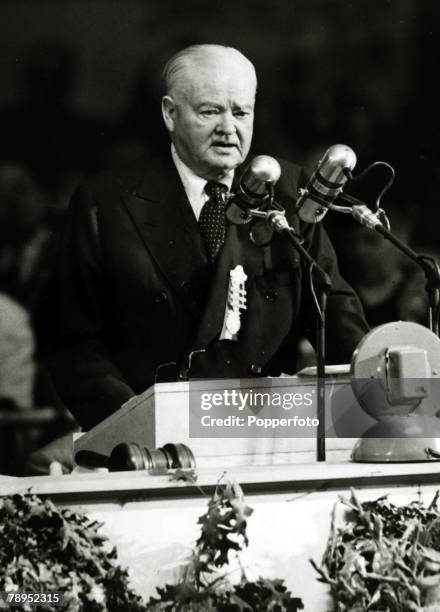
Hoover at the 1948 Republican Convention in Philadelphia.
They continued to invite him to every Convention,
and he kept coming until 1960.
From their days as fellow members of the U.S. Senate, Truman was good friends with Alben Barkley, the Kentuckian who was the Democrats' Senate Leader, and had no problem accepting him as the nominee for Vice President. But he hitched his wagon to the legacy of Franklin Delano Roosevelt, effectively making the New Deal his platform (his 1949 State of the Union Address would update it for the times as "the Fair Deal"), and FDR's ghost his running mate.


Truman and Roosevelt, at FDR's Hyde Park estate,
after the 1944 Democratic Convention
Truman knew he could win, and he knew how he could do it: By going to the people themselves, in what the GOP derisively called "a whistle-stop campaign," a phrase Truman ran with, and explaining the truth to people where they were, and in terms they could understand -- without talking down to them, as Donald Trump does today. He connected with people the same way FDR did, even though they were very different men.
The crowds Truman got at the "whistle stops" were huge. Writers for conservative papers tried to say that it was just people coming out to the political equivalent of a vaudeville show. Walter Lippman, often called "the Father of American Journalism," pointed out that it took Truman away from Washington for 16 days, and inadvertently proved how little he mattered.
But Lippman had never left Washington. Nor had most of the tour's critics seen it. As would be said today, they remained inside their bubble. Or, as Bob Dylan would sing in 1965, "Something is happening here, but you don't know what it is, do you, Mr. Jones?"
On Election Night, NBC announcer H.V. Kaltenborn announced, "Well, the President is leading by over a million votes in the popular vote, but we believe that when the country vote comes in, he will be defeated by an overwhelming majority." Indeed, at one point, he saw something that suggested that the election had swung to Dewey, and proclaimed him the winner.
On his way back from Kansas City to Washington, Truman stopped at Union Station in St. Louis, and was presented with a copy of that morning's Chicago Daily Tribune. The publication calling itself "The World's Greatest Newspaper" (hence the call letters of the radio station they founded, WGN) was published by "Colonel" Robert McCormick, the Rupert Murdoch of his era: A man who would tell any lie and spread any rumor, so long as it fulfilled his principle of electing more Republicans, so he could make more money.
But the Trib had violated what would later be called the Felix Unger Rule: "You should never assume, because, when you ASSUME, you make an ASS of U and ME." The result was the most famous headline in newspaper history, and Truman was delighted to see his old enemy the Colonel make an ass of himself. After all, it wasn't enough for the Colonel to have his paper say, in a huge headline, "DEWEY WINS" or "DEWEY ELECTED." He wanted to rub it in, telling the President he hated so much that he had lost: "DEWEY DEFEATS TRUMAN." Oops.
At a celebratory dinner in Washington a few days later, Truman threw the guests into laughter, imitating Kaltenborn's clipped delivery. He also thanked those who had stood by him, and those who should have: "The September Democrats and the October Democrats... and the Monday Democrats, and the Tuesday Democrats, and the Wednesday Democrats!"
Ever since, Ol' Harry S has been the patron saint of political underdogs, of the people who are told they can't possibly win.
(There's no period on his middle initial, since it legally didn't stand for anything, as his parents couldn't agree on whether to name him after one of his grandfathers, Anderson Shippe Truman or Solomon Young. So his entire middle name was the letter S, with no period. His mother's brother was Harry Young, and the name was "Harry," not "Henry" or "Harrison." His legal name was "Harry S Truman.")
Even Republicans cite him as an inspiration. As Truman himself would have said, "Well, that's just political conversation." Or, as his only child, Margaret, who became a noted writer of mystery novels after a failed singing career, put it while editing one of her father's books, and seeing the words "political conversation" written down, "My father originally used a shorter word here, but decided to change it." Clearly, Margaret was too much of a lady, even then, to say what the word was. Just as clearly, the word was "bullshit."
(There's no period on his middle initial, since it legally didn't stand for anything, as his parents couldn't agree on whether to name him after one of his grandfathers, Anderson Shippe Truman or Solomon Young. So his entire middle name was the letter S, with no period. His mother's brother was Harry Young, and the name was "Harry," not "Henry" or "Harrison." His legal name was "Harry S Truman.")
Even Republicans cite him as an inspiration. As Truman himself would have said, "Well, that's just political conversation." Or, as his only child, Margaret, who became a noted writer of mystery novels after a failed singing career, put it while editing one of her father's books, and seeing the words "political conversation" written down, "My father originally used a shorter word here, but decided to change it." Clearly, Margaret was too much of a lady, even then, to say what the word was. Just as clearly, the word was "bullshit."
Truman did love him some of what I like to call "George Carlin words." Legend has it that Harry and his wife Bess (formerly Elizabeth Wallace) toured a greenhouse, and Harry, a former farmer himself, told the owner, a woman, that she "must have used some good manure." The owner pulled Bess aside and said, "Can't you get the President to say, 'Fertilizer'?" And Bess said, "It's taken me this long just to get him to say, 'manure'!"
Truman won 24.1 million votes, Dewey 22.0 million, Thurmond 1,175,930, Wallace 1,157,328. Popular vote share: Truman 49.5 percent, Dewey 45.1, Thurmond 2.41, Wallace 2.37. States: Truman 28, Dewey 16, Thurmond 4, Wallace none. Electoral Votes, with 266 being a majority: Truman 303, Dewey 189, Thurmond 39, Wallace none. Wallace got 8.2 percent of the popular vote in New York, 4.7 percent in California, and in no other State did he get more than 4 percent.
After the election, a study by the University of Michigan revealed that "14 percent of Truman's voters, or 3,374,800, had decided to vote for him in the last fortnight of the campaign." In the last 2 weeks.
Gallup and Roper also did an analysis of the votes: They "learned that one voter in every seven (6,927,000), made up his mind in the last two weeks before the election. Of these, 75 percent picked Truman."
The Democrats also swept back into power in Congress, taking 75 seats in the House of Representatives and 9 in the Senate. Notable newly-elected Senators included Democrats Humphrey, Estes Kefauver of Tennessee, Paul Douglas of Illinois, and Bob Kerr of Oklahoma. Only 2 new Republicans were elected: Margaret Chase Smith of Maine (making her the 1st woman to serve in both houses of Congress) and Robert Hendrickson of New Jersey. Indeed, of the 91 Republicans newly elected to the House in 1946, more than half of them went down to defeat.
Charles Bennett of Florida was the last Congressman elected in 1948 still continuously serving, retiring before the 1992 election. However, Sidney Yates of Illinois, elected in 1948, left the House in 1962 to run for the Senate. He lost, but regained his House seat in 1964, and remained until retiring before 1998.
The truth was, it wasn't that close. People who voted for Dewey were basically voting for him simply because he was the Republican nominee. Outside New York State, he was not especially popular. Even people who met him didn't find him personally likable. In 2 elections as the Republican nominee for President, he only won a total of 288 Electoral Votes, barely enough to win 1. This time, the non-Republican vote was 54.3 percent. Truman had made the election a referendum on the Republicans, and it worked in his favor.
The polls had gotten it all wrong. Radio comedian Fred Allen used a horse racing metaphor: He said that Truman had become the 1st man to lose in a Gallup and win in a walk.
If Dewey hadn't been so complacent, he would have realized that Truman was reaching the hearts and minds of the people. And he might have gone out to answer Truman's charges against him and "that do-nothing Republican 80th Congress." Maybe the Republicans, as a party, blew it for Dewey. But he also blew it for himself.
No friend of Truman's, or any Democrat's, Time magazine boss Henry Luce named Truman his magazine's Man of the Year for 1948, as he had for 1945. I suspect it was more for the Marshall Plan and the Berlin Airlift than it was for the election.
Truman could have run for what would have amounted to a 3rd term in 1952, but didn't. He went back to Independence, where he built, opened, operated, and lectured at his Presidential Library, until a broken hip in 1965 put an end to his public life. He died in 1972.
Vice President Barkley ran a half-hearted campaign to succeed Truman in 1952, but, already 74 years old and a Southerner, he knew he had little chance. He died in 1956.
Dewey was elected to a 3rd term as Governor of New York in 1950, and left office after that 3rd term. The New York State Thruway is also known as the Governor Thomas E. Dewey Thruway. Despite being 17 years younger, he died in 1971, a year before Truman.
Wallace drifted into obscurity, and wrote books about farming, his specialty. He died in 1965, of Lou Gehrig's disease. Thurmond returned to the Democratic fold, was elected to the Senate in 1956, became a segregationist leader, switched to the Republican Party after the signing of the Civil Rights Act of 1964, and kept getting re-elected to the Senate until 2002, when, approaching his 100th birthday, even he had to admit that he wouldn't survive another term. He died the next year.
Truman's Presidential Library opened in Independence, 10 miles east of downtown Kansas City, on July 6, 1957. The USS Harry S Truman is a nuclear-powered aircraft carrier, CVN-75, a.k.a. The HST, in service since 1996. There are high schools named for Truman in Independence (naturally), New York City (as part of the Co-Op City complex in The Bronx), the suburbs of Philadelphia (Levittown, Pennsylvania), Detroit (Taylor, Michigan) and Seattle (Federal Way, Washington). And there is a Truman College in Chicago.

Statue, U.S. Capitol Building
Truman remains the only President born in Missouri, or representing it in politics. Aside from Ulysses S. Grant, he remains the only one to have lived there for a significant amount of time; and, unlike Grant, it was for his entire life.
He has been played by Robert Vaughn in The Man from Independence in 1974, James Whitmore in Give 'em Hell, Harry! in 1975, E.G. Marshall in Collision Course: Truman vs. MacArthur in 1976, Ed Flanders in MacArthur in 1977, Harry Morgan in Backstairs at the White House in 1979, Walker Edmiston in J. Edgar Hoover in 1987, Richard Dysart in Day One in 1989, Gary Sinise in Truman in 1995, David Patrick Kelly in Flags of Our Fathers in 2006, and Bob Gunton in Project Blue Book in 2019. (UPDATE: He was played by Gary Oldman in Oppenheimer in 2023.)
Charles F. Brannan was the last surviving member of the Truman Cabinet, serving as Secretary of Agriculture in the 2nd term. He lived until 1992.
As for Dewey, in 1964, the New York State Thruway, which he got built as Governor, was officially renamed the Governor Thomas E. Dewey Thruway, although most people in the State call it just "The Thruway."
Robert McCormick died in 1955. The Tribune dropped "Daily" from its name in 1963, and began its shift away from doctrinaire conservatism in 1969. Still, it didn't endorse a Democrat for President until 2008, with home-State Senator Barack Obama.
*
November 2, 1948, like all modern Election Days in America, was a Tuesday. The baseball season was over. There were no football games played. The NBA season had started the day before, but there were no games on this day. And the NHL also had no games scheduled. So there were no scores on this historic day.


