Showing posts with label new mexico. Show all posts

Friday, September 30, 2022

September 30, 1958: "The Rifleman" Premieres

September 30, 1958: The Rifleman premieres on ABC. It is a Western, the most popular form of TV programming at the time.

Chuck Connors played Lucas McCain, a Lieutenant in the Union Army during the American Civil War. Having lost his wife Margaret to illness, in 1881, he buys a ranch about 3 miles outside the fictional town of North Folk, in the New Mexico Territory, where he raises his son, Mark, played by Johnny Crawford. (New Mexico gained Statehood in 1912.)

The opening theme at the beginning of each episode depicted McCain walking down the street of a town, while rapid-firing his Winchester 44-40 1892 model rifle that had been modified at the trigger and lever. (This makes the rifle an anachronism.) The rifle's modification allowed McCain to fire the rifle only by hand pumping the lever, which had a setscrew imbedded in it to trip the weapon's trigger.

McCain fires 12 shots from his rifle during the opening credits: 7 shots in the 1st close-up, and 5 more as the camera switches to another view. The blank cartridges are shorter than standard cartridges, so the magazine can hold more of the blanks. The soundtrack contained a dubbed 13th shot, to allow the firing to end with a section of the theme music.

The series ran for 5 seasons, had second chances as a common theme. Micah Torrance, the town Marshal, played by Paul Fix, was a recovering alcoholic. Some episodes saw the repairing of friendships broken by the Civil War.  

Like James Arness, the star of Gunsmoke, Connors was an imposing Western figure due to his height, in his case 6-foot-5. He played basketball at New Jersey's Seton Hall University, and 53 games for the Boston Celtics in 1946 and '47. He went on to play 1 baseball game for his hometown Brooklyn Dodgers in 1949, coming to bat once as a pinch-hitter, never playing the field for them. He then got traded to the Chicago Cubs, and played 66 games at 1st base for them in the 1951 season.

The Cubs' top farm team at the time was the Los Angeles Angels of the Pacific Coast League. While playing in L.A., this athlete found off-season work as a stuntman, and, like John Wayne, moved from stunts to acting, mostly in Westerns. After The Rifleman, he played Jason McCord, the lead in Branded. He died in 1992, at age 71. Johnny Crawford, who had been a Mouseketeer on The Mickey Mouse Club, became a singer and the leader of a retro swing band, and lived until 2021.

*

September 30, 1958 was a Tuesday. Baseball was between the end of its regular season and the start of the World Series. Football was in midweek. And the NBA and NHL seasons hadn't started yet. So there were no scores on this historic day.

Saturday, July 16, 2022

July 16, 1945: The Trinity Test

July 16, 1945: The Trinity test takes place. It is successful.

In June 1942, the U.S. Army Corps of Engineers started the Manhattan Project. This walled-off, super-secure facility in Los Alamos, New Mexico was kept as secret as they could, in order to keep Nazi Germany from knowing what they were doing. As it turned out, the real worry was with the Soviet Union, and their spies.

Due to the Allied bombings of German facilities, the Nazis never came close to developing an atomic bomb. They surrendered on May 8, 1945. But the new President, Harry Truman, wanted to avoid a full-scale invasion of the remaining enemy, Japan, if at all possible. The atomic bomb was the solution.

The Project's director was J. Robert Oppenheimer. He had a concern that the bomb might ignite the atmosphere and eliminate all life on Earth. But he said the chance of that happening was "near zero."
The first bomb was completed, and its test, codenamed "Trinity," was set for July 16, 1945, at what is now White Sands Missile Range, in a sparsely populated area outside Bingham, New Mexico. The detonation was at 5:29 AM Mountain Time, 7:29 U.S. Eastern Time. The test was successful. But every witness knew that this was both good news in the short term and, potentially, very bad news in the long run. They knew that America wouldn't have a monopoly on the bomb forever. Oppenheimer later said:

We knew the world would not be the same. A few people laughed, a few people cried. Most people were silent. I remembered the line from the Hindu scripture, the Bhagavad Gita. Vishnu is trying to persuade the Prince that he should do his duty, and, to impress him, takes on his multi-armed form, and says, "Now, I am become Death, the destroyer of worlds." I suppose we all thought that, one way or another.

On August 6, Truman ordered the dropping of the 1st available atomic bomb on Hiroshima, Japan. On August 9, he ordered another, dropped on Nagasaki. On August 14, Japan surrendered.

In 1949, the Soviets announced that they had successfully tested an atomic bomb.

A 2019 episode of the YouTube series Epic Rap Battles of History featured "Nice" Peter Shukoff playing Oppenheimer, and "Epic" Lloyd Ahlquist playing Marvel Comics villain Thanos.

*

July 16, 1945 was a Monday. These baseball games were played:

* The New York Yankees lost to the Detroit Tigers, 9-4 at Yankee Stadium.

* The New York Giants lost to the Chicago Cubs, 4-3 at the Polo Grounds.

* The Brooklyn Dodgers beat the Pittsburgh Pirates, 8-4 at Forbes Field in Pittsburgh.

* The Cleveland Indians beat the Boston Red Sox, 3-2 at Fenway Park in Boston.

* A doubleheader was split at Shibe Park in Philadelphia. The Chicago White Sox won the opener, 6-2. The Philadelphia Athletics won the nightcap, 7-1.

* The St. Louis Browns swept a doubleheader from the Washington Senators, 7-3 and 5-1 at Griffith Stadium in Washington.

* The St. Louis Cardinals beat the Boston Braves, 2-0 at Sportsman's Park in St. Louis. Harry Brecheen pitched a 7-hit shutout.

* And the Cincinnati Reds and the Philadelphia Phillies were not scheduled.

Wednesday, July 13, 2022

July 14, 1881: The Death of Billy the Kid

July 14, 1881: Billy Bonney dies. Billy the Kid, however, lives on. And no one seems to get his story right.

On the 1973 album that launched him to stardom, Piano Man, Billy Joel included a song titled "The Ballad of Billy the Kid." He made the mistake of writing the lyrics first and doing the research second. He continued to play the song live through his tour for his album 52nd Street in 1978-79, saying, "Every word in this song is a lie," and has occasionally played it since.

BJ got the details really wrong. He said the Kid was from Wheeling, West Virginia. No source about him had said that before. He said the Kid started his criminal career by robbing a bank in Colorado, and eventually "robbed his way from Utah to Oklahoma." There is no evidence that he ever robbed a bank, or committed any crime in any of those 3 States. (BJ may have been confused by the fact that Butch Cassidy and the Sundance Kid operated out of Utah. But the Indian Territory wasn't even opened to white settlement, as the Oklahoma Territory, until 1889, 8 years after the Kid died.)

BJ said the Kid "soon put many older guns to shame." There is no evidence that he ever engaged in a classic Wild West gunfight. He said the Kid was hanged in front of a large crowd. He was caught, and he was sentenced to be hanged... but he escaped.

BJ also said, "He never had a sweetheart." Far from the truth: He thought his girlfriend was in the room with him when he was killed.

One thing BJ got absolutely right: "The cowboy and the rancher knew his name."

*

Or, at least, his nickname. He was born on September 17, 1859 in... New York. The same city as Billy Joel, a Bronx native. Apparently, the Kid was born in Manhattan, although Brooklyn was also claimed. At birth, his name was Henry McCarty, so it wasn't William. Or Bill, or Billy, or Mac, or Buddy. (Sorry for drifting into a Sheryl Crow song there.)

After his father died, his mother Catherine moved the family to Indianapolis, where she met William Antrim. They moved to Wichita, Kansas, where Catherine married William. But when she died, William left Henry and his brother Joseph. Desperate, Henry started robbing -- not banks, but groceries, clothing, and, finally, guns. He moved to Arizona and stole horses, and was first mentioned in a newspaper, listed as "Kid Antrim." Because of his stepfather, he began to be listed as "William Antrim." Soon, these were combined into "Billy the Kid."

He reached the New Mexico Territory (it became a State in 1912), and began using the name William H. Bonney. He began working for ranchers, including stealing horses. Those ranch owners were rich, the men working for them were not. The owners were like Mob bosses, and, in what became known as the Lincoln County War, they hired what would now be called hitmen. And Billy the Kid was one of them.

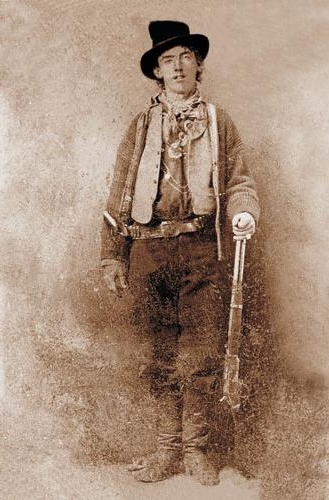
The photograph shown above is the only one of him known to exist. (There is one other alleged to show him and another man, but it hasn't been authenticated.) Usually, this photo shows him holding the rifle with his right hand, and a Colt revolver on his left hip. (The brand of firearm he used was pretty much the only detail the Billy Joel song got right.) This gave rise to the belief that he was lefthanded. In 1958, Paul Newman starred in a movie about him, titled The Left Handed Gun. Except the photo process meant that the image was reversed. The image shown above is how he would have appeared to the photographer. The Kid was righthanded, as were most of the men now remembered as Wild West gunfighters. (In the 1974 movie Blazing Saddles, Gene Wilder played Jim, "The Waco Kid," and he was a lefty.)

But myths about Billy abounded. He was already the subject of "dime novels," telling stories involving him that simply weren't true, or were exaggerations of what he actually did. People who knew him later told interviewers that he didn't like that, but he never killed anybody over it.

He was captured by Sheriff Pat Garrett in 1880, and was sentenced to be hanged. According to records, Judge Warren Bristol said, "You are going to hang until you are dead, dead, dead." Billy responded by saying, "You can go to Hell, Hell, Hell."

His execution was set for May 13, 1881, in Lincoln. But on April 28, he escaped. He is only known, for sure, to have killed 4 men in his life, and 2 of them were in his escape. And that was while his legs were still shackled, before he found an axe and cut the shackles. Whatever else he may have been in real life, Billy the Kid was no dummy, and he was no coward.

The Governor of the Territory was Lew Wallace, who had just published the novel Ben-Hur. He placed a $500 bounty on the Kid's head. Garrett, embarrassed by the Kid having escaped his custody, was determined to get him, as a matter of pride as much as money. He had heard that the Kid was in Fort Sumner, and took 2 deputies with him.

On July 14, 1881, Garrett found Pete Maxwell, son of a land baron and known to be a friend of the Kid. They talked for hours, until midnight. Then Billy walked in. This was less than 2 years after Thomas Edison made the first practical electric light bulb, so the light was poor, and Billy couldn't recognize Garrett. He had a Mexican girlfriend, and thought she might be there, so he asked, in Spanish, "¿Quién es? ¿Quién es?" ("Who is it?")

Garrett couldn't see Billy's face, but he recognized Billy's voice. Garrett fired 2 shots. The 2nd missed. The 1st hit Billy right in the chest, above the heart. He was dead, at age 21.

It took a year for the Territory to grant Garrett the $500 bounty. In the meantime, people glad to be rid of the Kid had contributed over $7,000 to Garrett. In 1882, he published The Authentic Life of Billy, the Kid, and that's where we learned most of what we thought we knew about him. A lot of it was lies, designed to make Billy look more evil and dangerous than he was (including the claim that he'd killed 21 men, one for every year of his life), thus making Garrett look more heroic for taking him down than he really was.

What happened to Garrett? He chose not to run for another term as Sheriff of Lincoln County, and returned to Texas, where he ran for the State legislature, and lost. He went into several businesses, all of which failed. In 1901, President Theodore Roosevelt appointed him Collector of Customs for the border city of El Paso, Texas. He was so bad at that office that people kept writing to TR, telling him to fire Garrett. In 1906, even the Rough Rider had had enough of him, and fired him.

On February 29, 1908, Garrett was shot and killed in Las Cruces, New Mexico, in a dispute over ownership of livestock. He was 57. While not the killer and thief that Billy the Kid was, he was no hero, either.

As is so often the case with teenagers and young adults, TV and movie portrayals of him tend to use actors much too old to play him. Newman was 33, as was Michael J. Pollard in the 1972 film Dirty Little Billy. Jack Beutel was 27 in the 1943 film The Outlaw. Emilio Estevez was 25 in the 1988 film Young Guns. And Kris Kristofferson was 36 in the 1973 film Pat Garrett and Billy the Kid.

And, as with Jesse James and Butch Cassidy, well into the 20th Century, and the rise of Westerns in films and even on TV, there were old men claiming to be Billy the Kid. One, Ollie P. Roberts, even asked Thomas J. Mabry, Governor of New Mexico in 1948, to fulfill his predecessor Lew Wallace's promise of a pardon if he'd turned himself in. Since the promise was only rumored, never confirmed, Mabry turned him down.

*

July 14, 1881 was a Thursday. There was one game played in the National League that day: The Boston Red Stockings beat the Detroit Wolverines, 3-2 at Recreation Park in Detroit.

The Red Stockings became the Boston Beaneaters in 1883, and went through other names before adopting Braves in 1912, moving to Milwaukee in 1953 and Atlanta in 1966. The Wolverines won the Pennant in 1887, but, with team owner Frederick Stearns unable to meet the new salary demands of championship-winning players, went out of business only a year later.

Friday, July 8, 2022

July 8, 1947: What Happened In Roswell?

July 8, 1947: Something happened in Roswell, New Mexico, and it is still debated today.

Officially, personnel at Roswell Army Air Field -- it would be September 18 of that year before the U.S. Air Force was officially separated from the U.S. Army -- recovered metallic and rubber debris from a military balloon. They issued a press release announcing possession of a "flying disc."

This took place during the "flying disc craze," sparked by widespread media coverage of pilot Kenneth Arnold's alleged sighting, leading to hundreds of reports of "unidentified flying objects." That got abbreviated to "UFO." Unfortunately, "UFO" has come to mean "spacecraft from another planet," instead of its literal meaning: A flying object that has not been identified.

In the wake of media inquiries about the situation, the Army quickly retracted its earlier statement, stating that the crashed object was a conventional weather balloon.

In the years to come, conspiracy theories claimed that debris from an alien spaceship had been covered up by the American federal government. Finally, in 1994, the Air Force told the truth: They released a report saying that the crashed object was a top secret nuclear test surveillance balloon, and they didn't want the Soviet Union to know about it. By 1994, there was no more Soviet Union.

Still, many people want to believe in "flying saucers" and extraterrestrial life. In the 1970s, no less than former Beatle John Lennon was one of several people who called in a sighting of a UFO in New York. And eventual President Jimmy Carter, then Governor of Georgia, claimed to have seen a UFO, admitting that he couldn't prove it was an alien spacecraft, but that it looked like what the reports of them did.

The legislation creating the National Security Act, including the CIA was already going through Congress when the Roswell incident happened. So, even though it was signed into law on July 26, it had nothing to do with this.

*

July 8, 1947 was a Tuesday. There was only one score on this historic day: It was in baseball's All-Star Game, played at Wrigley Field in Chicago. The American League beat the National League, 2-1. The starting pitchers were Hal Newhouser of the Detroit Tigers and Ewell Blackwell of the Cincinnati Reds.

Johnny Mize of the New York Giants hit a home run in the bottom of the 4th inning, for the NL's only run. In the top of the 6th, Joe DiMaggio of the New York Yankees grounded into a double play, but it got Luke Appling of the Chicago White Sox home with the tying run. The winning run came in the top of the 7th, when Stan Spence of the Washington Senators singled home Bobby Doerr of the Boston Red Sox. Frank "Spec" Shea of the Yankees was the winning pitcher, and Johnny Sain of the Boston Braves was the losing pitcher.

Tuesday, June 14, 2022

June 14, 1949: The 1st Mammal In Space

June 14, 1949: Albert II, a rhesus monkey, becomes the first primate to enter space, on U.S. Hermes project V-2 rocket Blossom IVB, launched from Holloman Air Force Base outside Almagordo, New Mexico.

He reached an altitude of 83 miles -- or 134 kilometers. The Kármán line, the demarcation line then used for "in space" or not, is 100 kilometers, or 62.15 miles. Unfortunately, he died upon reentry, after a parachute failure caused his capsule to strike the ground at high speed.

Before Albert II, the only previous known living beings in space were fruit flies, launched by the U.S. in a V-2 rocket suborbital flight on February 20, 1947. The flies were recovered alive.

If you're wondering, "What about Laika, the dog the Russians sent up?" She was the 1st animal to be put into Earth orbit. Albert was the 1st animal in space, but he never reached orbit.

The U.S. continued to launch "space monkeys." On September 16, 1949, Albert III died in an explosion of his V-2, below the Kármán line. On December 8, 1949, Albert IV crossed the Kármán line, but died on impact after another parachute failure.

The pre-NASA U.S. space program switched to Aerobee rockets. On April 18, 1951, Albert V died due to parachute failure. On September 20, 1951, a monkey named Yorick and 11 mice failed to cross the Kármán line. They survived the landing, but York and 2 of the mice died shortly thereafter, from the stress of the overheated capsule. On May 21, 1952, Patricia and Mike survived, but only went up 16 miles.

There was no further attempt with a monkey until December 13, 1958: Gordo, aboard a Jupiter AM-13, reached a record height of 310 miles, and splashed down in the South Atlantic Ocean, but his parachute failed, he hit the water too hard, and he died.

On May 28, 1959, aboard a Jupiter AM-18, Miss Able and Miss Baker made it. Miss Able died 4 days later, but Miss Baker lived all the way to 1984. On December 4, 1959, Sam flew on Little Joe 2, 53 miles, not "into space," but survived. On January 21, 1960, Miss Sam flew on Little Joe 1B, but only went up 8 miles: This was simply a test of emergency procedures, which she survived.

Then the switch was made to the closest animal to humans: Chimpanzees. (All monkeys are apes, but not all apes are monkeys. "Monkeys" are distinguished by having tails. Apes, including chimpanzees and orangutans, do not.) On January 31, 1961, Ham flew on Mercury-Redstone 2, paving the way for human astronauts. He lived until 1983, and was immortalized as the "space monkey" in Billy Joel's 1989 song "We Didn't Start the Fire."

*

June 14, 1949 was a Tuesday. These baseball games were played:

* The New York Yankees beat the Chicago White Sox, 15-3 at Yankee Stadium. Vic Raschi, "The Springfield Rifle," went the distance for the win. Tommy Henrich went 2-for-4 with a home run and 5 RBIs. Joe DiMaggio was injured, and had yet to make his season's debut.

* The New York Giants beat the Cincinnati Reds, 2-0 at Crosley Field in Cincinnati. Larry Jansen went the distance for the win, and went 2-for-3 in his own cause. Bobby Thomson went 3-for-4.

* The Brooklyn Dodgers beat the St. Louis Cardinals, 7-2 at Sportsman's Park in St. Louis. Gene Hermanski hit a home run. Jackie Robinson went 2-for-5 with 2 RBIs. Preacher Roe went the distance for the win. For the Cards, Stan Musial went 1-for-3 with a walk.

* The Cleveland Indians beat the Boston Red Sox, 10-5 at Fenway Park in Boston. The Tribe piled 6 runs on Joe Dobson before the Sox even came to bat, including a home run by former Yankee star Joe Gordon. Bob Feller went the distance for the win. Ted Williams went 2-for-4 with a walk and 3 RBIs.

* The Detroit Tigers beat the Philadelphia Athletics, 4-0 at Shibe Park in Philadelphia. Virgil Trucks allowed only 2 baserunners: A walk to Elmer Valo in the 2nd inning, and a single to Hank Majeski in the 5th. In 1952, Trucks pitched 2 no-hitters -- and otherwise went 3-19 that season.

* The St. Louis Browns beat the Washington Senators, 7-2 at Griffith Stadium in Washington.

* The Pittsburgh Pirates beat the Boston Braves, 4-3 at Forbes Field in Pittsburgh. Wally Westlake went 4-for-5 with a home run and 3 RBIs. Ralph Kiner went 1-for-4.

* And the Philadelphia Phillies beat the Chicago Cubs, 9-2 at Wrigley Field in Chicago.

Monday, April 4, 2022

April 4, 1983: The N.C. State Miracle

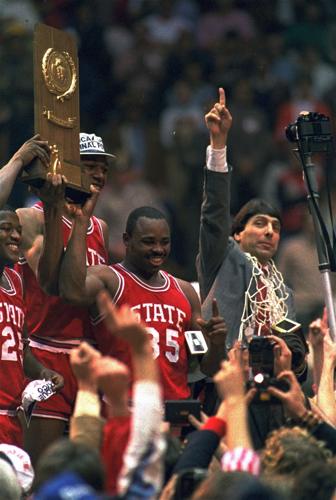
April 4, 1983: The NCAA Basketball Tournament Final is held at the University Arena, a.k.a. "The Pit," on the campus of the University of New Mexico in Albuquerque. It caps one of the great underdog stories in the Tournament's history.

Coached by Long Island native and former Rutgers player Jim Valvano, North Carolina State University was not expected to have a great season in 1982-83. They finished the regular season 17-10. They had beaten teams then ranked Number 20, West Virginia in a holiday tournament at the Meadowlands; Number 19 Georgia Tech at home, the Reynolds Coliseum in Raleigh; and Number 3 North Carolina at home. But they had also lost away to Number 14 Louisville, Number 15 Missouri away; Number 2 Virginia at home; Number 3 North Carolina away; Wake Forest in Greensboro; Number 6 Memphis State at home; Maryland away; Notre Dame at home; Number 3 Virginia away; and Maryland at home.

But the Wolfpack won the Atlantic Coast Conference Tournament at The Omni in Atlanta. They beat Wake Forest, then Number 5 North Carolina in overtime, and then Number 2 Virginia in the Final. They went into the NCAA Tournament, and beat Pepperdine in double overtime, 69-67. They upset Number 6 Nevada-Las Vegas (UNLV), 71-70. They beat Utah, 75-56, and played Virginia one more time, beating the Number 4 Cavaliers, 63-62.

The Final Four was held at the University of New Mexico's University Arena in Albuquerque. The court is actually below ground level, giving the place the nickname "The Pit." N.C. State beat Number 18 Georgia, 67-60. That set up a Final with the University of Houston. They won their Semifinal, 94-81 over the University of Louisville.

Coached by Guy Lewis, who had taken UH to the Final Four (not that the name was in use yet) in 1967 and 1968, they featured center Akeem "the Dream" Olajuwon (who would later start calling himself "Hakeem") and guard Clyde "the Glide" Drexler. Their high-flying, slam-dunking style led Houston Post sportswriter Thomas Bonk to think of college fraternities, and he nicknamed them "Phi Slama Jama."

The Cougars went into the Final 31-2 and ranked Number 1, having lost only away to Syracuse and to then-Number 1 Virginia in a tournament in Tokyo.

N.C. State went in 25-10. The starting lineup was guards Sidney Lowe and Dereck Whittenburg, forwards Lorenzo Charles and Thurl Bailey, and center Cozell McQueen. Their close games got them nicknamed the "Cardiac Pack." But Houston were favored by 7 1/2 points, and their experience of having gotten to the Final Four the season before made them look like they should win.

Uncharacteristically, Drexler was called for 4 fouls in the 1st half, with a 5th foul meaning dismissal from the game. N.C. State led at halftime, 33-25. Whatever Lewis told his Cougars in the locker room, it worked, as they went on a 17-2 run to take the lead. But with the arena's odd combination of being nearly a mile above sea level and having its court underground, Olajuwon left the game multiple times to receive oxygen. That forced the Cougars to slow the pace of the game in order to protect their lead.

Tied 52-52 with 44 seconds remaining, and with no shot clock in college basketball (it would be adopted for the 1985-86 season), the Wolfpack held the ball for a final shot attempt. Houston's Benny Anders narrowly missed stealing the ball as the clock ticked down. Whittenburg got the deflected ball about 30 feet from the basket, and launched a shot. It didn't quite go in, but Charles got it as it started to go down, and dunked it just before the clock ran out.

Final score: North Carolina State 54, Houston 52. It was N.C. State's 2nd National Championship, after coach Norm Sloan led them to the 1974 title.

It was one of the most stunning upsets in the history of college basketball. Valvano ran onto the court, looking as if he wasn't sure where he was going. He later said he was "looking for somebody to hug." It was reminiscent of another team in red and white, English soccer team Sunderland A.F.C., whose manager Bob Stokoe ran around the touchline to celebrate their big upset win over Leeds United in the 1973 FA Cup Final.

Thurl Bailey went on to play 11 seasons in the NBA, with the Utah Jazz and the Minnesota Timberwolves, before playing in Greece and Italy, and returning for 1 more season with the Jazz. Sidney Lowe played 4 seasons, for the Indiana Pacers, the Detroit Pistons and the Atlanta Hawks, and was an original Charlotte Hornet in 1988-89 and an original Minnesota Timberwolf in 1989-90. He then went into coaching, including as head coach of the Timberwolves, and 5 seasons at N.C. State, including 2 20-win seasons, although he was unable to get them into the NCAA Tournament.

Lorenzo Charles played the 1985-86 season with the Hawks, before playing in Italy, Spain, Turkey, Sweden and Uruguay. Cozell McQueen played 3 games for the Pistons in 1987, and also played in France, Italy and Spain. Dereck Whittenburg went right into coaching, including the head jobs at New York City schools Wagner (getting them into the 2003 NCAA Tournament) and Fordham, and 3 stints as an assistant at his Alma Mater, before returning to N.C. State as an assistant athletic director. Sophomore guard Terry Gannon went on to become a renowned sportscaster. And freshman guard Ernie Meyers became a broadcaster for N.C. State.

Valvano had previously coached Iona College into the NCAA Tournament in 1979 and 1980. He went on to get N.C. State back into the Elite Eight in 1985 and 1986. In 1990, an NCAA investigation cleared him of wrongdoing, but some of his players had broken rules, and it reflected badly on him. He was forced to resign, and titled his memoir Valvano: They Gave Me a Lifetime Contract, and Then They Declared Me Dead.

Nevertheless, Dave Didion, the NCAA investigator handling Valvano's case, wrote a personal letter to Valvano, saying, among other things, "If I had a son, I would feel comfortable with you as his coach and encourage him to learn from you."

Valvano was hired as a college basketball analyst by ESPN, but developed cancer, and died in 1993. The V Foundation for Cancer Research was founded in his name, and he was posthumously elected to the Basketball Hall of Fame. Lorenzo Charles died in 2011. As of April 4, 2022, the rest of the '83 Wolfpack are still alive.

Over the 1981-82, 1982-83 and 1983-84 seasons, the University of Houston went 88-16, including 71-12 in the regular season. The Cougars won the Southwest Conference title in 1983 and 1984. They made the NCAA Tournament Final Four all 3 seasons, and the Final in the last 2. With their "Phi Slamma Jamma" style, they did something even the Houston teams of Elvin Hayes in 1967 and '68 couldn't do: They made basketball cool to the football-crazy State of Texas.

But they couldn't take the final step. In 1982, they lost the Semifinal to North Carolina. In 1983, they lost this epic final to N.C. State. And in 1984, they lost the Final to Georgetown. It would take another 37 years before they reached the Final Four again. In between, the Houston Rockets made 3 NBA Finals, winning 2; the Dallas Mavericks made 2, winning 1; the San Antonio Spurs made 6, winning 5; and the University of Texas, Texas Tech and Baylor University each made a Final Four, with Tech reaching the 2019 Final and Baylor beating Houston in the 2021 Semifinal before beating Gonzaga to become the 1st Texas-based team to win a National Championship since Texas-El Paso (UTEP, then known as Texas Western) did so in 1966.

UPDATE: Houston reached the Final in 2025, losing to Florida. 

*

April 4, 1983 was a Monday. Ben Gordon, who helped the University of Connecticut win the 2004 National Championship, was born that day. So was actress Amanda Righetti.

As NCAA Tournament Finals tended to be in that era, it was also Opening Day for Major League Baseball, and there were 4 games that day:

* The Kansas City Royals beat the Baltimore Orioles, 7-2 at Memorial Stadium in Baltimore. Larry Gura outpitched Dennis Martinez. George Brett went 2-for-4 with a home run, a walk, and 2 RBIs. Willie Aikens and Jerry Martin also hit home runs for the Royals. For the O's, Eddie Murray and Cal Ripken Jr. each went 1-for-3 with a walk and an RBI. Despite this defeat, the Orioles went on to win the World Series.

* The Cincinnati Reds beat the Atlanta Braves, 5-4 at Riverfront Stadium in Cincinnati. Dave Concepción singled Eddie Milner home with the winning run in the bottom of the 8th, off Steve Bedrosian, who had relieved Phil Niekro. This made Mario Soto the winning pitcher. Johnny Bench, in what turned out to be his last season as a player, went 2-for-4 with an RBI. Ron Oester and Gary Redus hit home runs for the Reds, Chris Chambliss for the Braves.

* The Texas Rangers beat the Chicago White Sox, 5-3 at Arlington Stadium in the Dallas suburb of Arlington, Texas. Mike Richardt and Larry Parrish hit home runs. Mike Smithson started for the Rangers, but John Butcher was the winning pitcher, in relief, defeating LaMarr Hoyt. Despite this, Hoyt went on to win the American League Cy Young Award, and the White Sox won the AL Western Division title, before losing the AL Championship Series to the Orioles, who then beat the Philadelphia Phillies in the World Series.

* And the Cleveland Indians beat the Oakland Athletics, 8-5 at the Oakland Coliseum. Rick Sutcliffe outpitched Rick Langford. Andre Thornton hit a home run for the Tribe, while Toby Harrah went 4-for-6, but with no RBIs. Kelvin Moore homered for the A's. Rickey Henderson went 1-for-4 with a walk and a stolen base.

The NHL was between the end of its regular season and the start of the Stanley Cup Playoffs. There was 1 game in the NBA that night: The Seattle SuperSonics beat the Los Angeles Lakers, 121-111 at the Seattle Center Coliseum. David Thompson, the hero of N.C. State's 1974 National Championship, led all scorers with 31 points.

And there was 1 game in the USFL, the United States Football League: The Denver Gold beat the Michigan Panthers, 29-21 at the Silverdome in the Detroit suburb of Pontiac, Michigan.

Monday, March 7, 2022

March 8, 1916: Pancho Villa's Raid on Columbus, New Mexico

March 8, 1916: Pancho Villa crosses from Mexico into New Mexico, and attacks the town of Columbus, 3 miles north of the border. It remains the last land invasion of the United States of America.

Mexico had been in a state of revolution since 1910. In 1914, 9 U.S. sailors came ashore at the Mexican port city of Veracruz to secure supplies, and were detained by Mexican forces. The Mexican government refused to release them, and, despite the country being in a state of revolution and civil war, all the factions united against the U.S.

President Woodrow Wilson sent troops to Veracruz, under the command of Admiral Henry T. Mayo, and taking the city turned out to be easy. The occupation lasted 6 months, and led to the fall of President Victoriano Huerta. But this led to a renewal of the hatred of Americans by Mexicans, originally stoked by the Mexican-American War of 1846 and 1847.

José Doroteo Arango Arámbula was born on June 5, 1878 in San Juan del Río, in the State of Durango. He began calling himself Francisco Villa, taking his grandfather's surname, although it's not clear where the nickname "Pancho" came from. His friends called him "La Cucaracha" (The Cockroach), but he would he would eventually be called the Lion of the North, the Centaur of the North, and the Mexican Napoleon.

He became a key figure in the movement that forced out President Porfirio Diaz. But when the next President, Francisco Madero, was ousted by General Victoriano Huerta in 1913, Villa led the Constitutionalist Army against him.

But, as so often happens, after the revolution, the victors split, between the forces of Villa and Venustiano Carranza. The U.S. government aided the Carranza government against Villa in the Second Battle of Agua Prieta in November 1915. Villa lost, and most of his army left him.

Angry over this, on March 8, 1916, he took what he had left, crossed the border into Columbus, New Mexico -- New Mexico had only gained Statehood 4 years earlier -- and raided an American military outpost manned by the 13th U.S. Cavalry, because he needed weapons. In so doing, 8 American soldiers and 10 civilians were killed. But 67 of Villa's men were killed, and 7 were captured. He got the weapons he needed, but, in terms of manpower, he was considerably worse off.

But, like George Washington, he knew he wasn't the best of generals, but was a savvy politician. He gave interviews to foreign journalists, including John Reed, whose fame now rests on his reporting on the Bolshevik Revolution. He had film cameras follow him, and allowing the films to be sent to Hollywood and released, with the label "And starring Pancho Villa as himself." In 2003, that became the title of a film about Villa, starring Spanish actor Antonio Banderas.

The raid led to another American invasion of Mexico, which became known as the Punitive Expedition. While failing to capture Villa, it sent him into hiding, leading to his downfall. It was also a convenient warmup for the U.S. Army for fighting in World War I, especially since its commander was General John J. Pershing. "Black Jack" would go on to command U.S. troops in Europe in World War I. General George S. Patton, then a Lieutenant, credited much of his later career to having served on this Expedition.
Cartoon by Clifford Berryman for The Washington Star

In 1920, Carranza was ousted from power, and the new President, Adolfo de la Huerta, offered Villa a deal: Amnesty and a landed estate, if he would retire from politics. He took it. But on July 20, 1923, while visiting Parral, in the State of Chihuahua, he was assassinated in his car, a 1919 Dodge, probably on the orders of the next President, Álvaro Obregón, who still saw him as a threat. Supposedly, Villa's last words were, "Don't let it end like this. Tell them I said something."

After his death he was excluded from the pantheon of revolutionary heroes until the Sonoran generals Obregón and Calles, whom he battled during the Revolution, were gone from the political stage. Villa's exclusion from the official narrative of the Revolution might have contributed to his continued posthumous popular acclaim. He was celebrated during the Revolution and long afterward by corridosfilms about his life, and novels by prominent writers. In 1976, his remains were reburied in the Monument to the Revolution in Mexico City in a huge public ceremony.

*

March 8, 1916 was a Wednesday. Baseball was in Spring Training. Football was in the off-season. Professional basketball didn't really exist.

This was before the National Hockey League, but there was a National Hockey Association, from which only the Montreal Canadiens survive today, although a new Ottawa Senators team took up the name of an NHA/NHL franchise that went out of business in 1934; and a Pacific Coast Hockey Association, from which no teams survive.

The PCHA wrapped up its season on February 25. Two games were played in the NHA on this day. The Toronto Blueshirts beat the Montreal Wanderers, 3-2 at the Montreal Arena. And the Ottawa Senators beat the Quebec Bulldogs, 8-5 at the Ottawa Arena.

Thursday, January 20, 2022

January 20, 2008: "Breaking Bad" Premieres

January 20, 2008: Breaking Bad premieres on cable network AMC. The letters formerly stood for American Movie Classics, but now, they officially don't stand for anything.

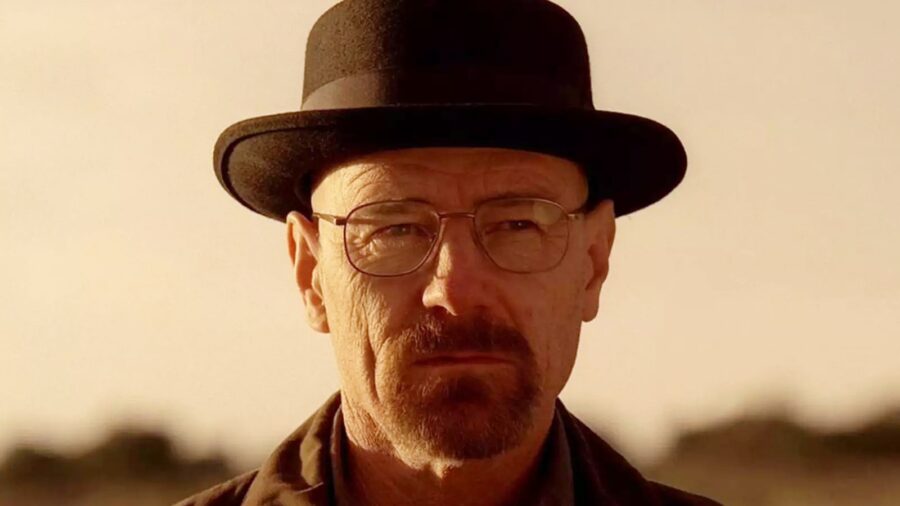
Described as a "neo-Western," the series, created by Vince Gilligan, stars Bryan Cranston as Walter White, a high school science teacher in Albuquerque, New Mexico, who learns he has cancer. His teacher's salary has left him with nothing to leave his family after he dies, especially when his own health care costs are soon to skyrocket. So he puts his chemistry know-how to desperate use, and becomes a producer and seller of the illegal drug methamphetamine.

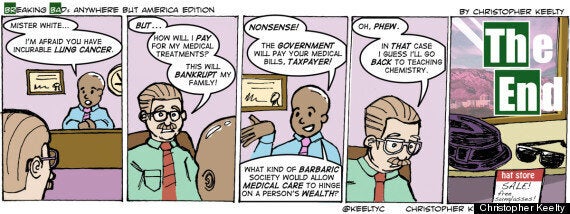
The joke is that, in any country but America, the one industrialized nation without a national health care service, Breaking Bad would have been a one-minute story:
Walt's efforts, assisted by his former student Jesse Pinkman (Aaron Paul), cause him to run afoul of local drug gangs, but, being smarter than they are, he manages to beat them at their own game, becoming more and more evil -- "breaking bad" -- until he's just as cold-blooded a killer as the nastiest drug lord. "God bless America."

Thanks to his lawyer, Saul Goodman (Bob Odenkirk), he not only avoids legal trouble for most of the series' run, but, for a while, manages to hide this activity from his wife, Skyler (Anna Gunn); his son, Walter Jr. (RJ Mitte -- like CC Sabathia, he doesn't use periods on his initials); and Skyler's brother-in-law, Hank Schrader (Dean Norris), who just so happens to be an agent of the Drug Enforcement Administration (DEA).

The show was popular immediately. Walt's adoption of the code name Heisenberg (after Werner Heisenberg, a prominent 20th Century German scientist), his hat, his sunglasses, his one-time appearance in a dress shirt and underwear but no pants, and his throwing of a pizza, box and all, onto the roof of his house, all became Internet memes. It got to the point that the owner of the private home in Albuquerque that stood in for the White residence had to publicly ask fans of the show to stop throwing pizzas onto his roof.

Walt's quotes also became iconic. When Skyler first began to suspect that he was in trouble, and was worried that, one day, there would be a knock on the door -- from the police or criminals -- he told her, "I am the danger! I am the one who knocks!" On another occasion, after conning one of his rivals into killing another, Skyler sees a report of the murder on the news, and asks Walt what happened. He says, "I won." On another occasion, when making a deal, he demanded that a customer say his name:

"You're Heisenberg."
"You're goddamn right."

The show lasted 5 years, and won 16 Emmy Awards, despite its "hero" being a villain. Its fans were obsessed with the hope that the show would have a good ending, citing Seinfeld, The Sopranos and Dexter as shows they did not want it to emulate. Spoiler Alert: They got their wish, as Walt died having assured his victory over his competition, and also having assured that Jesse would get away clean.

Odenkirk has since starred in a prequel show, Better Call Saul, taking place before Saul met Walter. And Paul has starred in a sequel film, El Camino: A Breaking Bad Story.

In a 2014 episode of the YouTube series Epic Rap Battles of History"Epic" Lloyd Ahlquist who played Walter, against "Nice" Peter Shukoff, who played Rick Grimes of The Walking Dead.

*

January 20, 2008 was a Sunday. Baseball was out of season. The NFL had its Conference Championships. In the AFC, the New England Patriots beat the San Diego Chargers, 21-12 at Gillette Stadium in the Boston suburb of Foxboro, Massachusetts. That made the Pats 18-0 on the season.

In the NFC, despite having to play the Green Bay Packers in the cold and the snow of Lambeau Field, the New York Giants won, 23-20, as Lawrence Tynes kicked a field goal in overtime. This set up Super Bowl XLII, and one of the greatest moments in NFL history.

I watched the end of this game, not at home, not in a bar, and not in Lambeau itself, but on the scoreboard at the Prudential Center in Newark, then in its 1st season hosting New Jersey Devils hockey. The Devils had beaten the Toronto Maple Leafs, 3-2, thanks to 2 goals by John Madden (no relation to the football guru of the same name) and 1 by Travis Zajac.

Afterward, knowing that the majority of Devils fans were also Giants fans, they let anyone who wanted to watch the game on the scoreboard stay, and even had the concession stands keep serving food. Of the 15,291 of us who paid to see the game, I'd say about 2,000 stuck around. It was a nice gesture by team management.

There were 5 other games played in the NHL that day:

* In an "Original Six" matchup, the New York Rangers lost to the Boston Bruins, 3-1 at Madison Square Garden. (The New York Islanders were not scheduled.)

* The Philadelphia Flyers beat the Ottawa Senators, 6-1 at the Wachovia Center (now the Xfinity Mobile Arena) in Philadelphia.

* The Edmonton Oilers beat the Atlanta Thrashers, 4-2 at the Philips Arena (now the State Farm Arena) in Atlanta.

* The Dallas Stars beat the Anaheim Ducks, 5-2 at the American Airlines Center in Dallas.

* And the Colorado Avalanche beat the Columbus Blue Jackets, 3-1 at the Pepsi Center (now the Ball Arena) in Denver.

There was only 1 game played in the NBA that day: The New Jersey Nets lost to the Phoenix Suns, 116-92 at the US Airways Center (now the Mortgage Matchup Center) in Phoenix.

Wednesday, January 5, 2022

January 6, 1912: New Mexico Is Admitted As the 47th State

January 6, 1912: New Mexico is admitted to the Union as the 47th State.

New Mexico was in the Southwest. It had been acquired as part of the Mexican Cessation of 1848, after the Mexican-American War. It has become known for its Native American and Wild West heritages, and its distinctive State Flag, a depiction of the Sun by the Zia tribe.

New Mexico's politics tend to be split down the middle, with equal numbers of Democrats and Republicans. Its highest-ranking politician has been Deb Haaland, Secretary of the Interior under President Joe Biden, and a former member of the U.S. House of Representatives.

The State Capitol is Santa Fe, and the largest city is Albuquerque. It's large enough to be the seat of the University of New Mexico, which hosted the 1979 NCAA Tournament Final Four. But it's not large enough to host a major league team, although the Class AAA Pacific Coast League has had a team in the city for many years. New Mexico State University is in Las Cruces.

*

January 6, 1912 was a Tuesday. Comic actor Danny Thomas was born.

The only professional sports league in operation at the time was Canada's National Hockey Association. It had 2 games scheduled that night. The Montreal Canadiens beat the Quebec Bulldogs, 5-4 at the Quebec Skating Rink. And the Montreal Wanderers beat the Ottawa Silver Seven, forerunners of the original Ottawa Senators, 9-5 at the Montreal Arena. 

December 31, 1999 & January 1, 2000: The Millennium

December 31, 1999:  The Millennium arrives. The people of planet Earth survived. At a terrible cost. But we hadn't destroyed ourselves. ...