Showing posts with label erwin rommel. Show all posts

Thursday, November 3, 2022

November 3, 1942: The Battle of El Alamein

An unidentified soldier (left) and General Montgomery
in a tank at El Alamein

November 3, 1942: Field Marshal Erwin Rommel begins Nazi Germany's retreat from the Second Battle of El Alamein, on the Mediterranean coast of Egypt, 160 miles west of the national capital of Cairo. This was the beginning of the end for his Afrika Corps, and for the Nazis' control of anything in Africa.

There had been a First Battle of El Alamein, from July 1 to 27, 1942, but it was regarded as a stalemate. This Second Battle began on October 23. It ended the Axis threat to Egypt, the Suez Canal, and the Middle Eastern and Persian oil fields.

The battle was a big morale-booster for the Allies, who hadn't had a major victory since the sinking of the Nazi battleship Bismarck, a year and a half earlier. It remains the most significant victory led by the British Army since Waterloo in 1815. (I say "led by" because the U.S. led the D-Day invasion of 1944.) Aside from air support, the United States of America had nothing to do with this win. It was British Empire troops, including from India, Australia, New Zealand and South Africa; with aid from Free France and Greece.

These troops were under the command of Lieutenant-General Bernard Law Montgomery, who thus became Britain's most important military commander since Arthur Wellesley, the Duke of Wellington, at Waterloo. He was promoted to Field Marshal, and was named 1st Viscount Montgomery of Alamein after the war. He lived until 1976.

Five days after the British victory at El Alamein, the Allies launched Operation Torch, invading North Africa through Morocco. That meant that, like Europe, North Africa was now a war on two fronts. Rommel's reputation as the brilliant "Desert Fox" would not be damaged, but he would not be on the winning side of this war. He wouldn't even live to see the end of it.

*

November 3, 1942 was a Tuesday. Baseball season was over. Football season was over. The NBA hadn't been founded yet. And the NHL season hadn't started yet. So there were no scores on this historic day.

Friday, October 14, 2022

October 14, 1944: The Death of Field Marshal Erwin Rommel

October 14, 1944: Field Marshal Erwin Rommel, implicated in the 20th of July Plot that tried and failed to assassinate Chancellor Adolf Hitler of Germany, is given a choice: A long and public trial, which would result in his disgrace and execution; or committing suicide, with the promise that his death would be told to the Reich as one from battle, and his reputation and his family would be left alone.
He chooses to say goodbye to his family at their home in Herrlingen, in Baden-Württemberg, Southern Germany, and takes a cyanide pill. He was 52 years old.
Johannes Erwin Eugen Rommel, born on November 15, 1891 in Heidenheim an der Brenz, also in Baden-Württemberg, was a hero of World War I. Initially, he supported Hitler's rise to power, and was vital in Nazi victories in France and North Africa, where, commanding the tank-based unit known as the Afrika Corps, he became known as "The Desert Fox."
He was hailed for his unwillingness to fight dirty, appears not to have shared the anti-Semitic views of the Nazi high command, and did associate with the leaders of the 20th of July Plot. For thess reasons, he was one of the few Germans whose reputation improved after World War II.
But he made a key tactical mistake: In 1937, then-Lieutenant Colonel Rommel published a book, whose English title was Infantry Attacks. Surely, he must have known that Hitler was preparing for another war, at least on a continental scale, and that he would be a commander in it (he was only 46 at the time of the book's publication), and that his tactics might be read and anticipated.
One man who did just that was another man who was then a Lieutenant Colonel, the U.S. Army's George S. Patton Jr., a West Point graduate who never missed a trick. Whether Patton, eventually a full General (4 stars), actually said, as George C. Scott did in playing him in the 1970 film Patton, "Rommel, you magnificent bastard, I read your book!" only he knew for sure.
*
October 14, 1944 was a Saturday. Also dying in Nazi custody on this day was Tadeusz Gebethner, a Polish former soccer star who had been arrested for protecting Jews. I have a separate entry for that event.
Baseball season was over, ending 5 days earlier with the all-St. Louis World Series, with the Cardinals beating the Browns in 6 games. The NBA hadn't been founded yet. The NHL season didn't start for another 2 weeks.
There were college football games that day, including the following:
* Number 1 Notre Dame beat Dartmouth, 64-0 at Fenway Park in Boston, making it, technically, a "home game" for the Hanover, New Hampshire-based Dartmouth.
* Number 3 Army beat the University of Pittsburgh, 69-7 at Michie Stadium in West Point, New York. Army later beat Notre Dame and, unsurprisingly, would win the National Championship.
* Number 4 Randolph Field beat Southern Methodist (SMU), 41-0 at Alamo Stadium in San Antonio. Randolph Field was a base of the U.S. Army Air Forces, predecessor to the U.S. Air Force that was separated from the Army in 1947. Their team included University of Virginia star "Bullet Bill" Dudley, who had already played a pro season with the Pittsburgh Steelers. He was eligible to play against collegiate opposition for Randolph Field because Randolph Field was not a college team.
They finished 12-0 and ranked Number 3, but didn't face ranked opposition until their last 2 games: A 20-7 win over Number 14 March Field (Air Force, Riverside, California) at the Los Angeles Coliseum on December 10, and a 13-6 win over Number 20 Second Air Force (Colorado Springs, later the site of the Air Force Academy) at the Polo Grounds on December 16. They were good, but almost certainly not good enough to beat Number 1 Army or Number 2 Navy.
* Number 5 Great Lakes Naval Training Station beat Western Michigan, 38-0 at Ross Field in Chicago. Great Lakes, whose baseball team included Bob Feller and Phil Rizzuto, and was good enough to be called "the 17th Major League Team," went 9-2, losing only to Ohio State, ranked Number 4 at the time; and Notre Dame, Number 9.
* Number 6 Navy beat Duke, 7-0 at Thompson Stadium in Annapolis, Maryland. Navy would beat Notre Dame, but, ranked Number 2 at the time, would lose to Army at Municipal Stadium in Baltimore.
* Number 7 Purdue lost to Number 11 Iowa Pre-Flight, 13-6 at Ross-Ade Stadium in West Lafayette, Indiana. Iowa Pre-Flight was the Navy flying school set up at the University of Iowa, even though that school kept its team for the duration of The War. On that day, they lost to Number 14 Illinois, 40-6 at Memorial Stadium in Champaign, Illinois. On the Saturday after Thanksgiving, Iowa Pre-Flight beat Iowa, 30-6 at Iowa Stadium, which would later be renamed Kinnick Stadium, after Nile Kinnick, the 1939 Heisman Trophy winner, who was killed in a Navy training flight in 1943.
* Number 8 Ohio State beat Number 19 Wisconsin, 20-7 at Camp Randall Stadium in Madison, Wisconsin.
* Number 9 Pennsylvania beat William & Mary, 46-0 at Franklin Field in Philadelphia. To someone whose memory of college football only goes back to the 1978 split of NCAA Division I into Division I-A and I-AA (now FBS and FCS, respectively), it seems strange to see an Ivy League team ranked at all, let alone in the Top 10.
* Among teams in the New York Tri-State Area: Columbia lost to Yale, 27-10 at the Yale Bowl in New Haven, Connecticut; New York University lost to Temple, 25-0 at Ohio Field in The Bronx; City College of New York played the day before, and lost to Boston College, 33-0 at Braves Field in Boston; Rutgers did not start its season until October 28, playing only 5 games, 2 against Lafayette, 2 against Lehigh, and 1 against their own ASTP (Army Specialized Training Program) team; Princeton, until November 11, playing only 3 games; and Fordham had suspended its program entirely.

Wednesday, July 20, 2022

July 20, 1944: The Plot to Kill Hitler

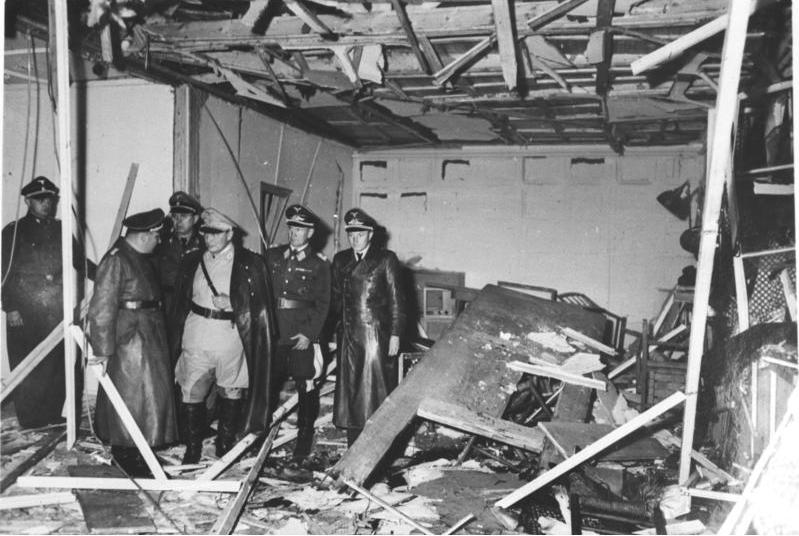
July 20, 1944: Operation Valkyrie is carried out. The intention is to kill Chancellor Adolf Hitler of Nazi Germany. It is not successful.

A previous attempt to kill him was made on November 8, 1939, in Munich, as Hitler was celebrating the anniversary of the Beer Hall Putsch, the Nazi Party's failed attempt to take over the government of the German state of Bavaria in 1923. Hitler left earlier than expected, so he was not among the 8 people killed by a bomb planted by Georg Elser.

Elser was quickly found and imprisoned. With some irony, not only was he not executed immediately, but he outlived many of the 1944 plotters -- and almost outlived Hitler anyway, only being executed at the Dachau concentration camp on April 9, 1945.

By July 1944, on the Western Front, the Allies had made their D-Day invasion, and were rolling through France. On the Eastern Front, the Soviets had pushed Nazi troops out of their country. For the first time, it was clear that Germany was losing the war.

Generals begged Hitler for trains, to move troops and equipment to the fronts. Hitler said, "No, I need the trains to kill the Jews." In other words, to transport them to the concentration camps. So the generals knew that the thing that would most help them in the war was not coming.

So a plot was hatched to remove Hitler from power. And since he had been granted absolute power by the Reichstag years earlier, the only way to do that was to kill him. The hope was that the successor government would then be able to make peace with the Allies, and that Germany would be able to keep what it still had by that point.

The plotters had an inside man. Colonel Claus von Stauffenberg was an aide to the senior staff of the Germany Army, the Wehrmacht. Hitler had scheduled a meeting of the senior staff for his retreat, the Wolfsschanze (Wolf's Lair) in Rastenburg, East Prussia, for July 20.

Stauffenberg walked into the briefing room carrying a briefcase containing two small bombs. But he only had time to arm one of the bombs. He left the briefcase under the conference table, as close to Hitler as he could get it. Then, as part of the plan, someone walked in and told Stauffenberg that there was a phone call for him. He excused himself, and left the room.

At 12:42 PM, Stauffenberg looked back, and saw the explosion and the smoke. He presumed that Hitler was dead. He got into a staff car, driven by his aide Werner von Haeften, and left the Wolfsschanze complex for the nearby airfield. By 1:00, he was airborne, with a plane whose flight was arranged by another conspirator.

At 4:00, Stauffenberg's plane landed at Berlin's Templehof airport, and he called the Bendlerblock, the Nazis' version of the Pentagon, telling them that Hitler was dead. This was his biggest mistake: It immediately made him something he had not been before the call: A suspect.

Had he waited for confirmation -- or, as it turned out, for denial -- he might not have become a suspect. Becoming one was bad for him, because Hitler was alive. When Stauffenberg left the briefing room, Colonel Heinz Brandt moved the briefcase. As a result, while the explosion did kill 4 people and injure almost everyone else in the room, Hitler was shielded by a leg of the solid oak conference table. Shrapnel ripped through his pants, giving him minor wounds to his legs. And, like almost everyone else in the room, Hitler suffered a perforated eardrum. But that was the extent of his injuries.

The Gestapo ended up arresting more than 7,000 people, executing 5,000 of them, including Stauffenberg, shot by a firing squad the next day. Field Marshal Erwin Rommel was a part of the plot, but, as Germany's greatest living military hero, he was given the option of suicide, and the use of a cover story that he had died in battle, which would protect his name and his family from dishonor.

The Allies continued closing in, and Hitler lasted another 9 months before taking the easy way out. The Soviets attempted to destroy the Wolfsschanze, but it was so solidly reinforced that conventional explosives couldn't do the job. The remains are now a historic site, and the redrawing of national borders after the war means that they're now located in Kętrzyn, Poland.

*

July 20, 1944 was a Thursday. Basketball star Mel Daniels was born on this day.

These baseball games were played:

* The New York Yankees lost to the St. Louis Browns, 7-3 at Sportsman's Park in St. Louis. Home runs in the bottom of the 7th inning by Mike Chartak and George McQuinn turned the game around. McQuinn would make it up to the Yankees, though, as their 1st baseman during their 1947 World Championship season.

* The New York Giants were swept in a doubleheader by the St. Louis Cardinals, 10-2 and 6-2 at the Polo Grounds. The Giants' bullpen melted down in the top of the 11th inning of the 2nd game.

* The Brooklyn Dodgers lost to the Cincinnati Reds, 6-0 at Ebbets Field. Harry Gumbert allowed 8 hits, but kept the shutout.

* The Boston Braves swept a doubleheader from the Chicago Cubs, with both games at Braves Field ending 5-4. In the opener, Chuck Workman singled home the winning run in the bottom of the 14th inning.

* A doubleheader was split at Shibe Park in Philadelphia. The Pittsburgh Pirates won the opener, 4-1. The Philadelphia Phillies won the nightcap, 3-2, with Ford Mullen singling home the winning run in the bottom of the 11th.

* The Cleveland Indians beat the Philadelphia Athletics, 2-1 at League Park in Cleveland.

* The Detroit Tigers beat the Washington Senators, 7-6 at Brigg Stadium in Detroit. (It was renamed Tiger Stadium in 1961.)

* The Boston Red Sox beat the Chicago White Sox, 11-7 at Comiskey Park in Chicago.

December 31, 1999 & January 1, 2000: The Millennium

December 31, 1999:  The Millennium arrives. The people of planet Earth survived. At a terrible cost. But we hadn't destroyed ourselves. ...