Showing posts with label baseball hall of fame. Show all posts

Saturday, December 31, 2022

December 31, 1972: Roberto Clemente Is Killed

December 31, 1972: Roberto Clemente is killed in a plane crash, trying to get relief supplies from his native Puerto Rico to earthquake-ravaged Nicaragua.

Eight days earlier -- the same day as the football play known as the "Immaculate Reception" -- an earthquake measuring 6.3 on the Richter scale struck the Nicaraguan capital of Managua.

As with the San Francisco earthquake of 1906, there were fires started, and the city's firefighting equipment was damaged by the earthquake. Between the initial quake and the fires, the Managua disaster killed about 11,000 people, and left about 300,000 of the city's 1 million or so people homeless. The city's top 4 hospitals were destroyed, and there were food shortages.

The world responded with relief, but the country's right-wing dictator, Anastasio Somoza Debayle -- my autocorrect poignantly tried to turn that into "Debacle" -- had it distributed according to his own purposes, much like an old-style American city "machine politician."

Enter Roberto Clemente. The right fielder for the Pittsburgh Pirates had just completed his 18th major league season. At age 38, he showed no signs of slowing down. That season, he batted .312, helped the Pirates win their 3rd straight National League Eastern Division title, was named to his 15th All-Star game, was awarded his 12th Gold Glove, and collected his 3,000th career hit. He collected 1,877 hits in the 1960s, more than any other player.

He had won 4 NL batting titles, was named the NL's Most Valuable Player in 1966, and had helped the Pirates win the World Series in 1960 and 1971, being named the Series MVP in the ladder. 

He was not the first black Hispanic player in the major leagues, but, at this point, he was easily the greatest. Indeed, like actor-comedian Jackie Gleason was, and hockey star Wayne Gretzky later would be, he was nicknamed "The Great One." He was a point of pride for baseball fans all over Latin America, not just in his native Puerto Rico.

Already heavily involved in charities all over Latin America, Clemente had visited Managua only a few weeks before the earthquake. He organized three planeloads of relief supplies, but heard they had all been diverted by the Somoza government. He decided to accompany the fourth flight himself, to make sure that it didn't happen again.

The plane was a propeller-driven cargo plane, a DC-7. This particular plane, one of 338 that McDonnell-Douglas built between 1953 and 1958, was a bad choice, as it had a history of mechanical problems. On December 31, 1972, New Year's Eve, it was loaded up at Isla Verde International Airport outside the Puerto Rican capital of San Juan.
A DC-7, similar to the Clemente relief plane

Between cargo, and regular supplies like fuel, the plane ended up 4,200 pounds over its recommended limit. The plane took off at 9:20 PM (8:20 PM, U.S. East Coast time), for a 4-hour flight from San Juan to Managua -- meaning the New Year of 1973 would have begun for them in midflight.

But within 3 minutes, the pilot, Jerry Hill, realized he couldn't get the plane high enough due to the weight, and told the San Juan control tower that he had begun to turn around. Just afterward, one of the plane's four engines exploded, and it crashed into the Atlantic Ocean. 

Although most pieces of the plane were found, Hill was the only one of the five people on board whose body was found. There is no grand memorial for Roberto Clemente at any cemetery: He still lies somewhere off the coast of his homeland. He left behind a wife and three sons.
For baseball fans, January 1, 1973 did not present a "Happy New Year." The Pirates retired Clemente's Number 21, and wore that number in a patch on their sleeves all season long. It would be the only season from 1970 to 1975 that they didn't win the NL East title. On March 20, a special election was held for the Baseball Hall of Fame, and the five-year waiting period after a player's last game was waived, making Clemente eligible. He was elected with nearly 93 percent of the vote.
Manager Bill Virdon with the patch

The Pirates dedicated a statue of him outside Three Rivers Stadium. When they moved to the adjacent PNC Park in 2001, the statue went with them, and the neighboring 6th Street Bridge connecting the North Side with downtown Pittsburgh was renamed the Roberto Clemente Bridge.

An arena that was nearly ready to open in San Juan at the time of his death was named the Roberto Clemente Coliseum. New York City named a park across from the Bronx apartment building where Hank Greenberg grew up after a member of the Hall of Fame -- not Greenberg, but, reflecting that this neighborhood is now mostly Puerto Rican, Clemente.

On December 31, 1985, 13 years later, another New Year's Eve would be struck by air travel tragedy, as the crash outside Dallas of another McDonnell-Douglas plane with a troubled history, this one an old DC-3, killed seven people including early rock and roll star Ricky Nelson.

Earlier in 1985, Isla Verde International Airport in San Juan was renamed Luis Muñoz Marín International Airport, after the 1st elected Governor of the island, who had presided over the airport's opening in 1955.

*

December 31, 1972 was a Sunday. The end of the year marked the 1st year that Americans bought more color television sets than black-and-white sets, and the 1st year that a majority of American homes had color TV sets. I have a separate entry for that event.

It was the off-season for baseball. The NFL played its Conference Championship Games:

* Although the Miami Dolphins had an undefeated regular season, the Pittsburgh Steelers hosted the AFC Championship Game at Three Rivers Stadium, because the NFL was still using a rotating system for hosting the title game, not home field advantage.

Eight days after the franchise's 1st-ever Playoff win, on the Franco Harris "Immaculate Reception," the Steelers led 10-7 in the 3rd quarter. But the Dolphins came from behind to win, 21-17.

* The Washington Redskins dominated the defending NFL Champions, the Dallas Cowboys, 26-3 at Robert F. Kennedy Stadium. Head coach George Allen led his veteran "Over-the-Hill Gang" to the team's 1st Playoff win in 30 years. 

But the Dolphins would complete the perfect season by beating the Redskins in Super Bowl VII, 2 weeks later at the Los Angeles Memorial Coliseum.

There were no games played in the NBA or the ABA on New Year's Eve 1972. There were 3 NHL games played that day:

* The New York Rangers beat the St. Louis Blues, 6-1 at Madison Square Garden. 

* The Detroit Red Wings and the Minnesota North Stars played to a tie, 4-4 at the Olympia Stadium in Detroit. 

* And the Chicago Black Hawks beat the Buffalo Sabres, 4-2 at Chicago Stadium. 

And there were 3 games played in the World Hockey Association, which was in its 1st season:

* The New England Whalers beat the New York Raiders, 3-0 in the other game played on Madison Square Garden ice that day.

* The Quebec Nordiques beat the Ottawa Nationals, 8-4 at Le Colisée de Québec. Rene Levesque must have loved that.

* And the Philadelphia Blazers beat the Los Angeles Sharks, 3-1 at the Los Angeles Memorial Sports Arena. 

Wednesday, November 2, 2022

November 2, 1995: The Yankees Hire "Clueless" Joe Torre

November 2, 1995: The New York Yankees name Joe Torre as their new manager‚ replacing Buck Showalter.
Torre had been a good catcher with the Milwaukee and Atlanta Braves in the 1960s, a decent 1st baseman for the St. Louis Cardinals in the early 1970s, and a very good hitter throughout his playing career.
His managing was another matter. He managed the New York Mets in the late 1970s, and he didn't have much to work with. He managed the Braves in the early 1980s, and got them to a Division title in 1982 and almost to another in 1983, but that was it. He managed the Cardinals in the 1990s, and didn't get too far.
The Cardinals fired him in 1995, and he thought he'd never manage again. "I'd run out of teams," he said, noting that he'd played for 3 teams, and managed all of them. He'd been a broadcaster between his Braves and Cardinals jobs, and figured he'd go back into the broadcast booth, and that's how he'd finish out his days in baseball.
Then George Steinbrenner called to offer him the Yankee managing job. Joe had never played in the American League, let alone managed in it. But George thought he was the guy.
The New York Daily News didn't think so: Citing his lackluster managerial record up until then, and also the circus that tended to surround Steinbrenner, especially where managers were concerned, they printed the headline "CLUELESS JOE," a play on early baseball star "Shoeless" Joe Jackson. As a Yankee Fan, I will admit: I was very skeptical about this hire.
The results: World Champions in his 1st season, 1996. Wild Card in 1997. World Champions in 1998, winning more games than any team ever had in a regular season and postseason combined, 125, including a 4-game sweep in the World Series. World Champions in 1999, including the best postseason record of the 1995-present Division Series era, 11-1. World Champions in 2000, beating the Mets in the World Series. American League Champions in 2001, missing another title by 1 run. Division Champions in 2002. AL Champions in 2003, with the dramatic AL Championship Series win over the Boston Red Sox.
Then, of course, the downturn, the kind of things that the Daily News probably expected when it printed the headline. A shocking ALCS loss in 2004. Pathetic performances in the AL Division Series in 2005, 2006 and 2007.
Joe got lowballed by George's heirs, of both the family and the business variety: His sons Hank and Hal, Yankee brass Randy Levine and Lonn Trost, and general manager Brian Cashman. He walked out, and managed the Los Angeles Dodgers to a pair of Division titles, before taking a job in Major League Baseball's office.
Joe and the House of Steinbrenner made up. He's been elected to the Baseball Hall of Fame, and is honored in Monument Park at the new Yankee Stadium.
The Daily News called him "CLUELESS JOE." They get reminded of that more than they do of "FORD TO CITY: DROP DEAD."
*
November 2, 1995 was a Thursday. Baseball season had ended 5 days earlier, when the Atlanta Braves beat the Cleveland Indians in the World Series. There was a college football game, a big one, which decided the Atlantic Coast Conference title: Number 2 Florida State were upset by Number 24 Virginia, 33-28 at Scott Stadium in Charlottesville, Virginia.
The NBA season started the next day. There were 5 games played in the NHL:
* The New York Rangers lost to the Los Angeles Kings, 5-3 at The Forum outside Los Angeles in Inglewood, California.
* The New Jersey Devils and the San Jose Sharks played to a tie, 3-3 at the San Jose Arena (now the SAP Center).
* The Ottawa Senators beat the Hartford Whalers, 5-0 at the Hartford Civic Center (now the PeoplesBank Arena).
* In an "Original Six" matchup, the Detroit Red Wings beat the Boston Bruins, 6-5 at the brand-new FleetCenter (now the TD Garden) in Boston. Steve Yzerman scored with 3:50 left in overtime.
* And the Florida Panthers beat the Philadelphia Flyers, 2-1 at The Spectrum in Philadelphia.

Wednesday, August 24, 2022

August 24, 1989: Pete Rose Is Banned From Baseball

August 24, 1989: Pete Rose is banned from baseball.

It didn't seem possible. For my generation, if there was a "face of baseball," Rose was it:

* 1963: National League Rookie of the Year with the Cincinnati Reds, his hometown team.

* 1965: Led the NL in hits.

* 1966: Hit 16 home runs, which turned out to be his career high.

* 1968: Led the NL in batting average, on-base percentage, and hits. Finished 2nd in the voting for NL Most Valuable Player.

* 1969: Led the NL in batting average and runs scored. His batting average of .348, his on-base percentage of .428, his slugging percentage of .512, and his total of 82 RBIs would remain career highs, while his 16 home runs matched his career high. Won a Gold Glove as a right fielder, after being a 2nd baseman until 1967, but would switch to left field by 1972, 3rd base in 1975, and 1st base in 1979.

* 1970: Led the NL in hits. Won another Gold Glove. Scored the winning run in the All-Star Game by crashing into American League catcher Ray Fosse. Led the Reds to the NL Pennant, but lost the World Series.

* 1972: Led the NL in hits. Led the Reds to another Pennant, but lost the World Series.

* 1973: Led the NL in batting average and hits. Won the NL MVP. Led the Reds to the NL Western Division title. Picked a fight with the much-smaller New York Mets shortstop Bud Harrelson in Game 3 of the NL Championship Series. Won Game 4 of the NLCS with an extra-inning home run. Lost Game 5.

* 1974: Led the NL in doubles and runs.

* 1975: Led the NL in doubles and runs. Won his 1st World Series, and was named its MVP.

* 1976: Led the NL in hits, doubles and runs. Won his 2nd World Series.

* 1978: Tied the NL record with a 44-game hitting streak. Led the NL in doubles. Collected his 3,000th career hit.

New York's WOR-Channel 9 broke away from their broadcast of the New York Mets' game to show Rose's at-bats in Game 44 and Game 45. That's how big Rose was. But, as he found out, he wasn't bigger than the game.

* 1979: Signed as a free agent with the Philadelphia Phillies. Led the NL in on-base percentage.

* 1980: Led the NL in doubles. Led the Phillies to their 1st World Series win, his 3rd.

* 1981: Led the NL in hits. Collected his 3,631st career hit, to become the NL's all-time leader.

* 1982: Played in all 162 games. He was 41 years old. And it was the NL, so he couldn't "take it easy" as a designated hitter, either.

* 1983: Led the Phillies to another Pennant, but lost the World Series. Overall, he was in 6 World Series, winning 3 of them.

* 1984: Signed with the Montreal Expos. Collected his 4,000th career hit. Was traded back to the Reds, and named their manager as well.

* 1985: Collected his 4,192nd career hit, to become Major League Baseball's all-time leader. (He actually did it with his 4,190th, but at the time, most people still considered 4,191 the record that Ty Cobb held, so the record was celebrated with Number 4,192.) Played in his last All-Star Game, his 17th. Managed the Reds to a 2nd place finish in the NL West.

* 1986: Played his last game, although never really retired as a player. Retired as MLB's all-time leader in games played (3,562), plate appearances (15,890), at-bats (14,053), hits (4,256) and times reached base (5,929). Managed the Reds to another 2nd place finish.

* 1987: Managed the Reds to another 2nd place finish.

* 1988: Managed the Reds to another 2nd place finish, their 4th in a row. He had yet to get them into the postseason, though. No Wild Card berths in those days.

His hits included 3,215 singles (a record), 746 doubles (2nd all-time to Tris Speaker), 135 triples and 160 home runs. In spite of this, his career "slash line" is not especially notable: Batting average .303, on-base percentage .375, slugging percentage .409.

His OPS+ is 118, meaning he was 18 percent better at producing runs than the average player during his career. To put that in perspective, compare it to those of his teammates who have been elected to the Baseball Hall of Fame: Frank Robinson, 154; Mike Schmidt, 148; Joe Morgan, 132; Johnny Bench, 126; Tim Raines, 123; Tony Perez, 122; Andre Dawson, 119; Gary Carter, 116.

(Admit it: You forgot that Rose played the first part of the 1984 season with the Montreal Expos. And you were also as surprised as I was that Morgan had a higher OPS+ than Bench, and that Raines had a higher one than Dawson and Carter.)

But he didn't have great power stats. As I said, he hit 160 home runs in 24 seasons, and had 1,134 RBIs. Over a full season, that's an average of about 7 home runs and 53 RBIs. Granted, he was usually a leadoff hitter, spending his entire career in the National League, when the batter in front of him would nearly always have been the pitcher or a weak pinch-hitter for the pitcher, thus reducing his chances of having a man on base. But he should have had more RBIs than that.

It was never just about the stats with Peter Edward Rose. He was nicknamed "Charlie Hustle," because he was always hustling. When he drew a base on balls, a.k.a. a walk, he wouldn't walk to 1st base. He would run. He only stole 198 bases in 24 years, topping out at 20 in 1979, and was caught stealing 149 times. But it's hard to tell how many extra bases he earned just by running harder.

He played the game with a boyish enthusiasm, but always reminded you that he was The Man. Lots of fans loved him. The ones who hated him still admitted that they loved the way he played the game.

For my generation of baseball fans, if any one person "was baseball," it was Pete Rose.

Thomas Boswell, the great baseball columnist of The Washington Post, spoke for me, and for millions of other baseball fans, when, interviewed by Ken Burns for his documentary Baseball, he said of Rose, "Fooled me completely."

*

Pete Rose was more than a compulsive compiler of baseball statistics and other achievements. He was also a compulsive attention-seeker. He was also a compulsive liar. He was also a compulsive womanizer. And, most damaging of all, he was also a compulsive gambler.

From the beginning of Major League Baseball, gambling has been what the sport has been most afraid of: The idea that a game was not honest, that a player would rather make money by losing a game on purpose, a.k.a. throwing the game, than play honestly and win. (Of course, if team owners weren't cheap, they could have avoided this by paying the players more than the gamblers would have.) There was a gambling scandal in 1877, and it resulted in the first time that players were permanently banned from baseball.

There was the Black Sox Scandal that resulted from 7 players from the Chicago White Sox being permanently banned for throwing the 1919 World Series -- to the Reds, eventually to be Rose's hometown team as well as the team for whom he played they most, so he should have known all about it. (An additional player was banned despite refusing to take part in the fix, because he knew about it but didn't report it.) Those players were permanently banned from working in baseball in any capacity, playing or otherwise. That has, to this day, over 100 years later, kept the White Sox' biggest star at the time, Joe Jackson, from being elected to the Hall of Fame.

Every MLB clubhouse has a sign giving the rule, known as Rule 21(d). Here is the text of the rule:

(1) Any player, umpire, or Club or League official or employee, who shall bet any sum whatsoever upon any baseball game in connection with which the bettor has no duty to perform, shall be declared ineligible for one year.

(2) Any player, umpire, or Club or League official or employee, who shall bet any sum whatsoever upon any baseball game in connection with which the bettor has a duty to perform, shall be declared permanently ineligible.

(3) Any player, umpire, or Club or League official or employee who places bets with illegal book makers, or agents for illegal book makers, shall be subject to such penalty as the Commissioner deems appropriate in light of the facts and circumstances of the conduct. Any player, umpire, or Club or League official or employee who operates or works for an illegal bookmaking business shall be subject to a minimum of a one-year suspension by the Commissioner. For purposes of this provision, an illegal book maker is an individual who accepts, places or handles wagers on sporting events from members of the public as part of a gaming operation that is unlawful in the jurisdiction in which the bets are accepted. 

In layman's terms:

(1) If you bet on a game in which you're not involved, you're suspended for one year -- 365 days -- from the date of the application of the suspension. In other words: This article was posted on August 24, 2022. If, on that date, you were employed by the New York Yankees, and you bet on that night's game between the Boston Red Sox and the Toronto Blue Jays (which the Jays ended up winning, 3-2 in 10 innings at Fenway Park), and the Commissioner of Baseball, Rob Manfred, found out about it, ran his investigation, and suspended you on September 1, then, you would be eligible to return to working in baseball on September 1, 2023.  

(2) If you bet on a game in which you are involved, you're gone, forever. Not for life: Forever.

(3) If you place a bet with a bookie, or someone working for a bookie, the Commissioner will decide what punishment would be appropriate, and then give it to you.

Again: The penalty for a baseball player or manager betting on any baseball game he's involved in is a permanent ban. Not for the rest of your life: Once you die, you're still banned. It's permanent. Forever. And everybody knows it.

Rose knew it. He knew what would happen if he broke the rule and got caught. He did it anyway. He thought he could get away with it. He thought he was bigger than the game. The only players who have ever been bigger than the game have been Jackie Robinson and maybe Babe Ruth. Not Pete Rose.

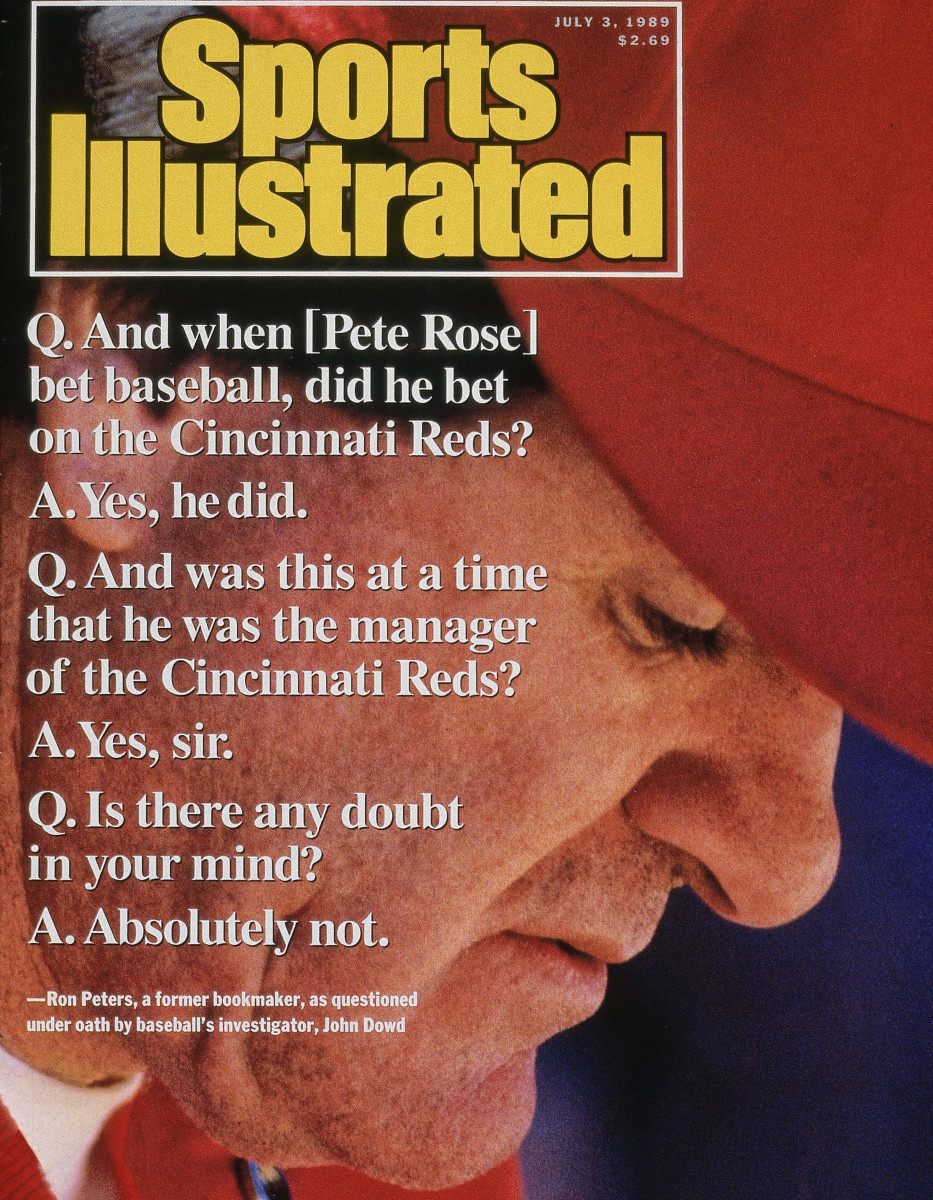
Commissioner Bart Giamatti found out that Rose had bet on Major League Baseball games. His investigator, former U.S. Justice Department official John Dowd, found the proof that Rose had bet on baseball games in which he had played, managed, and done both. When asked if he bet on baseball, Rose denied it.

But when confronted with the proof, he cut a deal: A permanent ban, and the loss of his job managing his hometown team, in exchange for the chance to apply for reinstatement.

On August 24, 1989, Commissioner Giamatti announced that the scandal, which had hung over the sport all season long, had come to a conclusion with Rose's banishment.

On September 1, 1989, 7 days later, Giamatti died of a heart attack. He was only 51 years old. He was replaced as Commissioner by Francis T. "Fay" Vincent. He would never reinstate Rose: As Rose pointed out, Vincent was Giamatti's best friend.

Vincent was fired by the team owners in 1992, and Milwaukee Brewers owner Allan "Bud" Selig became Commissioner. Being a team owner, Selig was never going to cave in to a player without the law stepping in, as was the case with the end of the Strike of 1994-95. In 2015, Selig was succeeded by Rob Manfred. Still in office as of August 24, 2022, he has never reinstated Rose, either.

Rose continued to lie about it until 2004. Even now, he insists that he never bet on his own team to lose. Whether he realizes it or not, this is a half-truth: Any game that he did not bet on the Reds to win was a signal to the gamblers that he didn't think the team would win that game, so they bet against his team.

In 1991, the Baseball Hall of Fame passed a rule stating that any player on Major League Baseball's list of permanently ineligible individuals could not appear on a ballot in any Hall of Fame election. Therefore, Rose is not eligible for election.

Some fans say that the Hall of Fame is not legitimate without the sport's all-time hit leader. Others say that keeping him out is a proper punishment; and, besides, there are plenty of artifacts from Rose's career on display at the Hall: Pieces of his uniforms, bats and gloves he used, balls he hit. After all, it isn't just the Baseball Hall of Fame: It is the National Baseball Hall of Fame and Museum.

Rose is still on the outside looking in. And he has apologized for the lie, but not for the actions that led to the lie. He has never apologized for betting on baseball. 

It's also worth noting that the Hall of Fame is run by a private corporation. It works with Major League Baseball, but MLB does not have any power over the Hall of Fame. It works both ways: The Hall could make Rose eligible, and he could be elected, but he would still be banned by MLB; and MLB could lift its ban, and the Hall could then make Rose eligible, and he still might not be elected, due to lingering anger over what he did.

So don't blame MLB, or the Hall of Fame, or anybody connected with the operation of either. The only person to blame for Pete Rose not being a member of the Baseball Hall of Fame is Pete Rose.

Rose also went to federal prison, on income tax evasion charges. Rose has also admitted to having an affair with a woman who was 14 years old when it began. Fourteen. Matching his uniform number.

Postscript: The Reds hired Lou Piniella to replace Rose as manager. He had starred as an outfielder for the Yankees' American League Pennant teams of 1976, 1977, 1978 and 1981; and had managed them to a 2nd-place finish in 1986. Out of respect to Rose, who wore Number 14, which Piniella also wore, Piniella reversed his uniform number to 41. The following season, 1990, he managed the Reds to win the World Series.

Giamatti's son Paul Giamatti became an award-winning actor. Pete Rose Jr. was less successful: In 1997, he was called up to the Reds, making 11 appearances, getting 2 hits, with 1 RBI. In other words, between them, the Pete Roses have 4,258 career hits.

"P.J." Rose continued to play in various independent and foreign professional leagues until 2009. In 2006, he served 1 month in prison for distributing a drug to help his teammates. So, while the father's offenses never included cheating -- at least, not within baseball -- the son did. But, unlike the father, the son came clean and cooperated with the corresponding authorities, and was allowed to return to professional baseball. From 2011 to 2016, he managed in the White Sox' organization.

As someone of my generation pointed out, the future didn't turn out like we expected: Pete Rose was banned from baseball and went to prison, O.J. Simpson murdered 2 people and went to prison (but for a separate crime), Bill Cosby went to prison, Bruce Jenner is a woman, pretty much every professional wrestling villain turned out to be a good guy in real life, while Hulk Hogan turned out to be a massive jerk, and Donald Trump became the President.

As the (practically self-appointed) symbol of baseball, Pete Rose didn't just break THE Rule, he betrayed everybody who loved the game. He betrayed us all. That's why what he did hurt so much. And that's why he should never be forgiven, regardless of his playing accomplishments.

UPDATE: Pete Rose died on September 30, 2024. He had not yet been reinstated. Lots of baseball fans insisted that he had "served his time" and should now be elected to the Hall of Fame. On May 13, 2025, Manfred announced that the permanent bans on Rose, Shoeless Joe Jackson, and 7 other deceased players were lifted, making them eligible for the Hall of Fame. He also announced that anyone later placed on the permanently ineligible list would have their bans lifted after death. Clearly, he either does not understand, or does not respect, the meaning of the word "permanent."

*

August 24, 1989 was a Thursday. The NFL season was about to begin. It was the off-season for the NBA and the NHL. Here are the MLB results from that day:

* The New York Yankees split a doubleheader with the Baltimore Orioles at Yankee Stadium. The Yankees won the 1st game 5-1. Chuck Cary went 8 innings for the win, and got 2 hits each from Steve Sax and Roberto Kelly, and Don Mattingly went 1-for-3 with a double and 2 RBIs. The Orioles won the 2nd game 9-2. Eric Plunk did not pitch well, giving up a home run to Larry Sheets.

* The St. Louis Cardinals beat the Atlanta Braves, 4-1 at Atlanta-Fulton County Stadium.

* The Toronto Blue Jays beat the Detroit Tigers, 11-3 at the SkyDome in Toronto.

* The Pittsburgh Pirates beat the Houston Astros, 3-2 at Three Rivers Stadium. Jose Lind won it with a sacrifice fly in the 14th inning.

* The Cleveland Indians beat the Seattle Mariners, 5-2 at Cleveland Municipal Stadium.

* The Minnesota Twins beat the Chicago White Sox, 6-4 at the Metrodome in Minneapolis.

* The California Angels beat the Kansas City Royals, 5-0 at Royals Stadium in Kansas City. (It was renamed Kauffman Stadium in 1993.) Bert Blyleven, age 38, pitched a 4-hit shutout.

* The Texas Rangers beat the Oakland Athletics, 6-2 at Arlington Stadium in the Dallas suburb of Arlington, Texas.

* In the American League, the Boston Red Sox and the Milwaukee Brewers were not scheduled.

* And in the National League, these teams were not scheduled: The Chicago Cubs, the Los Angeles Dodgers, the Montreal Expos, the New York Mets, the Philadelphia Phillies, the San Diego Padres, the San Francisco Giants, and, most notably, the Cincinnati Reds.

Monday, August 22, 2022

August 22, 1949: The Yankees Purchase Johnny Mize

Mize with the ball from his 2,000th career hit,
June 28, 1953

August 22, 1949: The New York Yankees purchase the contract of slugging 1st baseman Johnny Mize from the New York Giants, for $40,000.

Mize was 36 years old, and in his 11th season in the major leagues, having lost 3 seasons due to serving in the U.S. Navy in World War II. "The Big Cat" had won the National League batting title in 1939, with a .349 average, while with the St. Louis Cardinals; led the NL in home runs 4 times, including the last 2; and had topped 100 RBIs in 7 seasons.

He was losing playing time, and the Yankees couldn't promise him more. But he played 5 more seasons, and helped the Yankees win the World Series all 5 times. He had never played on a Pennant winner before: He arrived with the Cardinals in 1936, 2 years after their "Gashouse Gang" Pennant, and was traded before the 1942 season, missing their 1942-46 stretch of 4 in 5 seasons.

But the faith of Yankee manager Casey Stengel, the knowledge that Stengel's platooning him at 1st base with Joe Collins meant that he didn't have to play every day at his age, and the short right-field porch at Yankee Stadium revitalized him. He hit 25 home runs with 72 RBIs in essentially half a season in 1950, and became the best pinch-hitter in the game. He hit 3 home runs in the 1952 World Series. He closed his career in 1953, with a .312 batting average, 358 home runs, and an OPS+ of 158. He appeared in 10 All-Star Games.

He was elected to the Baseball Hall of Fame in 1981, and died in 1993. In 1995, Ted Williams ranked him 15th on his list of the Top 20 Hitters of All Time.

So, was this a bad deal for the Giants? Not really: With Whitey Lockman becoming their new 1st baseman, they won the NL Pennant in 1951, and the World Series in 1954. So it was a wash for the Giants, but a great deal for the Yankees.

*

August 22, 1949 was a Monday. Long-distance swimmer Diana Nyad, who swam from Havana to Key West in 53 hours when she was 64 years old, was born on this day.

Only 1 baseball game was played that day: The Boston Braves beat the Brooklyn Dodgers, 7-6 at Braves Field in Boston. This was a wild one. The Dodgers took a 6-5 lead in the top of the 9th. But former Dodger Eddie Stanky led off the bottom of the 9th with a home run off Ralph Branca. Branca then walked Eddie Fletcher, with Sibby Sisti coming in as a pinch-runner. Dodger manager Burt Shotton brought Erv Palica in to pitch, and after getting 2 outs, he allowed a game-winning double by Jeff Heath.

Another former Dodger, Pete Reiser, went 2-for-5 with 3 RBIs for the Braves. For the Dodgers, Jackie Robinson went 0-for-4, but drew a walk and had an RBI on a sacrifice fly. Roy Campanella hit a home run.

Saturday, July 2, 2022

July 2, 1903: The Strange Death of Ed Delahanty

July 2, 1903: One of baseball's greatest and strangest players comes to one of baseball's saddest and strangest ends.

Edward James Delahanty was born on October 30, 1867, in Cleveland. He was 1 of a record 5 brothers to play Major League Baseball. Tom got 16 career hits. Joe had 222. Frank had 223. Jim had 1,159. Between them, they had 1,620. But Big Ed had 2,596 all by himself.

A left fielder for most of his career, which started in 1888, Ed batted .346 lifetime, peaking at .410 in 1899, and put together an astonishing 152 OPS+. He had 7 100+ RBI seasons, which was stunning for the time. On July 3, 1896, he hit 4 home runs in a game, making him only the 2nd player to do it, after Bobby Lowe of the Boston Beaneaters (forerunners of the Atlanta Braves) in 1894.

Ed played most of his career with the Philadelphia Phillies. In 1902, he jumped to the American League, playing for the Washington Senators. That season, by hitting .376, he won the batting title, to go with the one he won in the National League in 1899. He remains the only player to win them in both Leagues.

He died while still an active player, on July 2, 1903, only 35 years old. The incident is shrouded in mystery: He jumped the Senators while they were in Detroit to play the Tigers, and boarded a train for New York, a train that cut across Canada, through its Province of Ontario, before crossing back into the U.S. at Buffalo. He got drunk on the train, was accused of threatening passengers with a straight razor, and the conductor kicked him off.

He tried to walk across the International Railway Bridge between Fort Erie, Ontario and Buffalo, got into a fight with the bridge's night watchman, and went over the bridge into the Niagara River. His body was found at the bottom of Niagara Falls a month later.
The International Railway Bridge

Did he jump? Did he fall? Was he pushed? We will never know. The watchman was not charged.

Delahanty was elected to the Baseball Hall of Fame in 1945, his career legendary, but incomplete due to his own misbehavior -- and, perhaps, someone else's. He was also elected to the Philadelphia Baseball Wall of Fame.

As for his brothers, Joe died in 1936, Tom in 1951, Jim in 1953, and Frank was the last survivor, living until 1966.

The Bridge is still in use, but for freight traffic only.

*

July 2, 1903 was a Thursday. King Olav V of Norway was born on this day, and reigned from 1957 until his death in 1991.

These baseball games were played that day:

* The New York Highlanders beat the St. Louis Browns, 3-2 at Sportsman's Park in St. Louis. This stadium would be replaced by another on the same site with the same name in 1909, be renamed Busch Stadium in 1953, and last until 1966. Willie Keeler went 2-for-4 with an RBI for the Highlanders, who in 1913 officially took up the name that people had been calling them by for a while: The Yankees.

* The Brooklyn Superbas lost to the Pittsburgh Pirates, 8-4 at Washington Park in Brooklyn. Honus Wagner went 2-for-4 with 2 RBIs. The Superbas became the Dodgers in 1911.

* The Cincinnati Reds beat the Boston Beaneaters, 2-0 at the South End Grounds in Boston. Frank "Noodles" Hahn pitched a 7-hit shutout. The Boston team of the National League went through several name changes before settling on "Braves" in 1912.

* The Philadelphia Phillies beat the Chicago Cubs, 7-2 at Baker Bowl in Philadelphia.

* The Cleveland Naps beat the Philadelphia Athletics, 11-6 at League Park in Cleveland. This stadium would be replaced with one on the same site with the same name in 1910, and last until 1946. The Cleveland team was named for its manager and 2nd baseman, Napoleon "Nap" Lajoie. They became the Cleveland Indians in 1915, and the Cleveland Guardians in 2022.

* The Detroit Tigers beat the Washington Senators, 1-0 at Bennett Park in Detroit. This stadium would be replaced with one on the same site in 1912, named Navin Field, renamed Briggs Stadium in 1938, and renamed Tiger Stadium in 1961. George Mullin pitched a 3-hit shutout. This game was played hours before Delahanty's death. No games were canceled: The Senators were not scheduled to play the next day, anyway, as they were traveling from Detroit to Cleveland.

* The Chicago White Sox beat the Boston Americans, 6-2 at South Side Park in Chicago. The Americans became the Red Sox in 1908.

* And the New York Giants were supposed to play the St. Louis Cardinals, at the 1890-1911 version of the Polo Grounds, but got rained out. It was rescheduled as part of a doubleheader on August 13, and the Giants swept, 6-2 and 9-7. Christy Mathewson was the winning pitcher in the 1st game. The losing pitcher was a rookie named Mordecai Brown, a.k.a. "Three-Finger" Brown, due to a childhood disfigurement that gave him a great curveball. He later became the ace of the Cubs, often starting against Mathewson, ace vs. ace, future Hall-of-Famer vs. future Hall-of-Famer.

Sunday, June 12, 2022

June 12, 1939: The Baseball Hall of Fame Opens

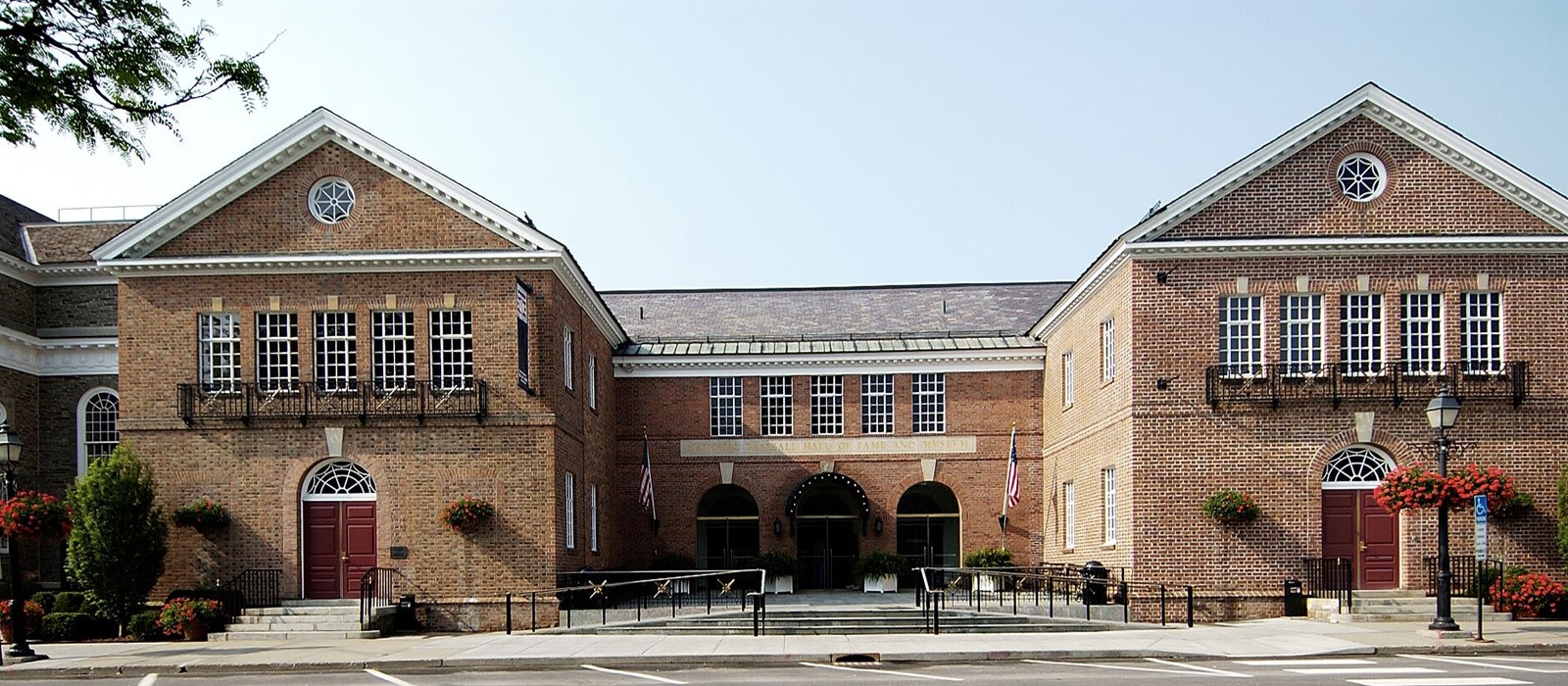
June 12, 1939: The National Baseball Hall of Fame and Museum opens, at 25 Main Street in Cooperstown, Otsego County, in Central New York. It was the official 100th Anniversary of baseball being invented in that town by Abner Doubleday.

Of course, just as most people already knew the world was round long before Christopher Columbus was born, most people already knew that Doubleday, a hero of the American Civil War, who did come from Cooperstown, didn't have a damn thing to do with baseball. The real reason the Hall, and its accompanying museum, were established there is that the Clark family, the unofficial powers-that-be (and still do) in Cooperstown, wanted a tourist attraction during, and that would outlast, the Great Depression. Mission accomplished.

The opening ceremony is presided over by the Commissioner of Baseball, Kenesaw Mountain Landis. It is broadcast nationwide on NBC radio.

In each of the past 4 years, there had been elections for the Hall of Fame. These were the inductees thus far:

* 1936: Ty Cobb, Babe Ruth, Honus Wagner, Christy Mathewson and Walter Johnson. "The First Five," or "The First Class," whose plaques are located in an X pattern, with leading vote-getting Cobb's in the middle, at the center of the back wall of the Hall's Gallery.
Top left: Christy Mathewson. Top right: Honus Wagner.
Center: Ty Cobb.
Bottom left: Babe Ruth. Bottom right: Walter Johnson.

* 1937: Players George Wright, Cy Young, Nap Lajoie and Tris Speaker; managers Connie Mack and John McGraw; and the 1st President of each major league, the National League's Morgan Bulkeley and the American League's Ban Johnson.

* 1938: One player, Grover Cleveland Alexander; and pioneers Alexander Cartwright and Henry Chadwick.

* 1939: Players Candy Cummings, Al Spalding, Cap Anson, Buck Ewing, Charles "Old Hoss" Radbourn, Willie Keeler, Eddie Collins and George Sisler; and executive Charles Comiskey. (Due to the unusual circumstances of his retirement, Lou Gehrig would be elected later in the year, after the Hall's opening.)

So there were 5 inaugural electees, and 25 inaugural inductees. Of these, 11 were still alive: Mack was 76 years old, Young 72, Wagner 65, Lajoie 64, Alexander and Collins 52, Johnson and Speaker 51, Sisler 46, and Ruth 44.

And of those 11 men, 10 posed for a commemorative photograph. Legend has it that Cobb arrived late, in order to spite someone, probably Landis. He was late, arriving a few minutes after the photo was taken, but it was due to circumstances beyond his control: He lived in California, and, transportation links being what they were at the time, he just plain didn't make it.
Top row, left to right: Honus Wagner, Grover Cleveland Alexander,
Tris Speaker, Nap Lajoie, George Sisler and Walter Johnson.
Bottom row, left to right: Eddie Collins, Babe Ruth, Connie Mack and Cy Young.
No, I don't know why the Babe has no tie and has his
collar sticking out over his lapels, like he's in the 1970s.

Sisler is probably the least well-remembered player of these 10, partly because he fell just short of 3,000 hits for his career; and partly because he played most of his career for a team that no longer exists in that form: The St. Louis Browns became the Baltimore Orioles in 1954.

Uniform numbers have only been worn since 1929, so most of the original 25 honorees are not honored with the retirement of their uniform number, because the number, let alone the honor, wasn't available. Wagner wore one as a coach, and was so honored; Johnson wore one as a manager, and Speaker and Collins wore them as coaches, but were not so honored.

Cobb, Johnson, Mack and Sisler are honored with statues at the current ballparks in their cities. Ruth is honored with one at the ballpark in his hometown. Young is honored with one at the site of one of his home ballparks. And Mathewson is honored with the renaming of his school's football stadium for him. (In college, he excelled at that sport as well.) Comiskey was once, but is no longer, honored with the naming of the ballpark he built for him.

In 1949, Ogden Nash, my grandmother's favorite poet, wrote "Line-Up for Yesterday" for Sport magazine, an alphabetical list of star players. For the letter Z, instead of citing a single player, since none with a last name starting with Z has been elected to the Hall of Fame, he wrote:

Z is for Zenith
The summit of fame.
These men are up there.
These men are the game.

For the letter I, he cheated a little:

I is for Me,
Not a hard-hitting man,
But an outstanding all-time
Incurable fan.

*

June 12, 1939 was a Monday. There were no scores on that historic day: MLB got the day off so the ceremony could be the focus, it was the off-season for the NFL and the NHL, and the NBA hadn't been founded yet.

Saturday, April 2, 2022

April 2, 1908: The Doubleday Legend

Abner Doubleday

April 2, 1908: The Mills Commission, convened to determine the origins of the sport of baseball, releases its finding. They get it very wrong.

Albert Goodwill Spalding, former star pitcher of the Boston Red Stockings (the team that became the Atlanta Braves), and owner of the Chicago White Stockings (the team that became the Cubs), demanded a definitive origin story for the sport, to stop people like the English-born journalist Henry Chadwick from claiming that baseball evolved from the English games of cricket and rounders.

The members:

* Abraham G. Mills (1844-1929), owner of the Washington Olympics, a team at the dawn of the professional era; and the President of the National League in the 1883 and 1884 seasons.

* Morgan G. Bulkeley (1837-1922), Mayor of Hartford, 1880-88; Governor of Connecticut, 1889-93; U.S. Senator, 1905-11; pertinent to baseball, owner of the Hartford Blues, a team at the dawn of the professional era; and the 1st President of the National League, serving only in the 1st season, 1876.

* Arthur P. Gorman (1839-1906), Maryland House of Delegates, 1869-75, including Speaker, 1872-74; State Senator, 1875-81; U.S. Senator, 1881-99 and 1903-06; described in 1952 by The Baltimore Sun as "the most powerful political figure the State has ever known"; pertinent to baseball, a founding member of the Washington Nationals, a team at the dawn of the professional era, and the first team to be known as the Washington Senators -- and, thus, all later teams with the name -- was named in his honor.

* Nicholas E. Young (1840-1916), another early figure in Washington baseball, later a respected umpire, the 1st secretary and the 1st treasurer of the NL, president of the NL from 1885 to 1902. He oversaw the merger with the American Association after the 1891 season, but his recalcitrance in the face of the founding of the American League led to his downfall.

* Alfred J. Reach (1840-1928), one of the best players in baseball as the amateur era gave way to professionalism. A right fielder for the Brooklyn Eckfords and the original Philadelphia Athletics, he led the Athletics to the 1st Pennant of the National Association in 1871. In 1883, he founded the team now known as the Philadelphia Phillies, and owned them until 1903. He founded a sporting goods company that competed with that of Al Spalding, before selling out to him in 1889. In return, when the AL was founded, Spalding put the Reach name on the AL's game balls, and his own on the NL's balls. This held until 1976; since then, all have borne the Spalding name.

* George Wright (1847-1937), the shortstop on the 1st openly professional baseball team, the 1869 and 1870 Cincinnati Red Stockings. That team sort-of evolved into the Boston Red Stockings, and Wright (along with Spalding, pitching) was their best player, leading them to the NA Pennant in 1872, 1873, 1874 and 1875; and the NL Pennant in 1877 and 1878. In 1879, he was the player-manager of the NL Pennant-winning Providence Grays.

* James E. Sullivan (1862-1914), President of the Amateur Athletic Union, which would later name its annual award for America's best amateur athlete for him.

For nearly 3 years, the Mills Commission got nowhere. Finally, in late 1907, they found the story they needed, and they released it on April 2, 1908: Baseball was invented on June 12, 1839 in Cooperstown, New York, laid out in a cow pasture owned by the Phinney family, related to the Coopers by marriage, by Abner Doubleday.

This claim was given to the Commission by a 71-year-old mining engineer from Denver named Abner Graves (yes, also named Abner), who said that he witnessed Doubleday playing the then-popular game of "town ball," being played by students of 2 local schools on what came to be known as "Farmer Phinney's Lot," and watched Doubleday make the changes necessary to create a better version, and watched him give it the name "base ball."

Graves backed his story up by sending the Commission a diagram that, he said, Doubleday gave him. In 1934, someone visiting the Graves family in Cooperstown found a tattered ball, which was put on display in the Village Hall and later in the Hall of Fame itself (where it is still on display), and called "The Doubleday Ball," alleged to be the ball in the first game. The First Baseball.

Abner Doubleday was a real person. And if you were going to make something up, he was a great choice. He was a graduate of the U.S. Military Academy at West Point, New York -- 146 miles southeast of Cooperstown. He served in the Mexican-American War. He was second-in-command at Fort Sumter, South Carolina, when it was attacked on April 12, 1861, and he ordered the 1st Union shot in retaliation. Thus, he was there for the beginning of an epic story that would later chronicled by documentarian Ken Burns... The Civil War.

He was one of the heroes of the Battle of Gettysburg on July 3, 1863. He rose to the rank of Major General -- 2 stars. His multi-volume journal has been a godsend for people studying American military life in the mid-19th Century, including the Civil War and the Indian Wars. He commanded an all-black regiment, with no racist incidents. He was a financial backer of Thomas Edison's inventions. He even founded San Francisco's famous cable car company.

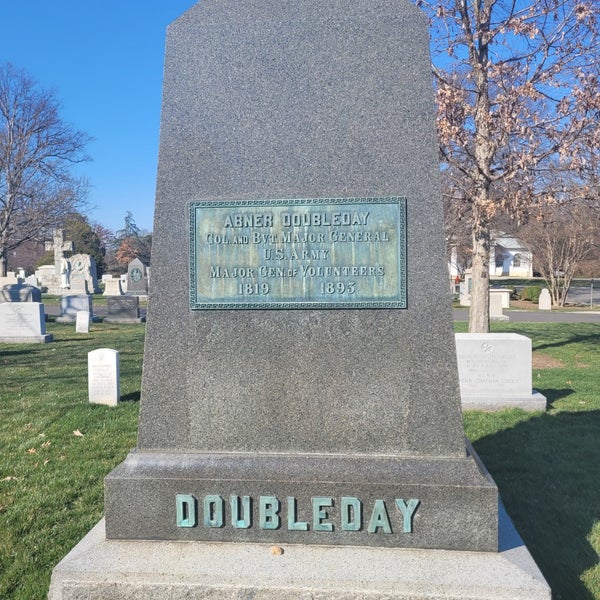
On multiple levels, Abner Doubleday was a genuine American hero. He was, as the saying goes, a Renaissance Man. And he was a New Jerseyan the last few years of his life, living in Mendham, Morris County -- also the hometown of former Governor Chris Christie and Game of Thrones actor Peter Dinklage -- although he is rightly buried at Arlington National Cemetery, not far from an actual sports legend, Joe Louis.
Note that the plaque on his tombstone
does not mention baseball.

It was also helpful that Mills, Bulkeley, Gorman, Young, and -- this cannot be minimized -- Spalding, the de facto Commissioner at the time, had also been friends of Doubleday's. It was also helpful that Doubleday had died in 1893, and was, rather conveniently, no longer around to say, "Come on, guys. You know that story isn't true."

The truth? Mills knew Doubleday rather well, and admitted that he'd never heard him claim to be the inventor of baseball. Doubleday's extensive journals mention baseball only once: In his duty as a quartermaster, he had requisitioned balls and bats for his soldiers, as there was a lot of down time between battles and they needed a diversion, and baseball had grown tremendously popular in the 1850s. His obituary in The New York Times didn't mention baseball at all. Based on the evidence we have, we don't know if Abner Doubleday liked baseball -- or if he ever even actually saw a game. 

As for Abner Graves, he was old, and he was nuts. He apparently (accidentally?) burned down his own house, killing his wife. He spent a good chunk of his later years institutionalized. What's more, he would have been just 5 years old at what he claimed was the time of the game's invention. (I was 5 years old in 1975, when Carlton Fisk hit a certain home run, and I have absolutely no memory of having seen it then, not even on the news the next day.)

But here's the clincher, the part that makes the Doubleday story absolutely impossible: At the time, cadets at West Point were not permitted to leave the Academy grounds for any reason. If Doubleday had been in Cooperstown at any time in 1839, he would have been AWOL: Absent without leave. And there's no way he could have snuck off the grounds, gone almost 150 miles with no mode of transportation faster than a horse (there was no rail connection), gotten to Cooperstown, been involved with any sort of town event, gotten back, and snuck onto the grounds, without anybody noticing he was gone. It would have been days. He would have been expelled.

(A similar story had already been written for the invention of rugby. William Webb Ellis, the man credited with inventing it as, as we would say, a high school student at the Rugby School in the West Midlands of England, went on to become a well-known and highly respected man in his country, in his case a clergyman, and died without ever having made a claim to being the inventor of a sport, making him unable to deny the credit he later got.)

No, Doubleday did not invent baseball. Nor can it be called wholly the invention of Alexander Cartwright, who has been credited with writing the original rules for the game in New York in 1845 (and the evidence we have now suggests that other men wrote some of them). It is worth nothing that Cartwright, Spalding, Bulkeley and Wright were among the early inductees into the Baseball Hall of Fame. Doubleday has never been elected.

Baseball wasn't invented so much as it evolved, and to name any one person its creator is, however well-intentioned, misleading.

*

April 2, 1908 was a Thursday. Actor Buddy Ebsen was born. Baseball was in Spring Training at the time, so there were no scores on this historic day. The Stanley Cup had been decided for the year on March 14, when the Montreal Wanderers beat the Toronto Hockey Club.

Wednesday, February 2, 2022

February 2, 1936: The 1st Baseball Hall of Fame Election

Top left: Christy Mathewson. Top right: Honus Wagner.
Center: Ty Cobb.
Bottom left: Babe Ruth. Bottom right: Walter Johnson.

February 2, 1936: The Baseball Hall of Fame holds its 1st election for players.

Members of the Baseball Writers' Association of America (BBWAA) were given authority to select individuals from the 20th Century; while a special Veterans Committee, made up of individuals with greater familiarity with the 19th Century game, was polled to select deserving individuals from that era. The intent was for 15 honorees to be selected before the ceremony that would open the Hall's Museum in 1939: 10 from the 20th Century and 5 from the 19th; and that additional players from both eras would be selected in later years.

The Voters were given free rein to decide for themselves in which group a candidate belonged, with neither group knowing the outcome of the other election; some candidates had their vote split between the elections as a result: Cy Young, the pitcher with most wins in Major League history, finished 8th in the BBWAA vote, and 4th in the Veterans vote.

In addition, there was no prohibition on voting for active players, a number of whom received votes. Individuals who had been banned from baseball, such as "Shoeless" Joe Jackson and Hal Chase, were also not formally excluded, though few voters chose to include them on ballots.

In the BBWAA election, voters were instructed to cast votes for 10 candidates, the same number of desired selections. In the Veterans' election, voters were also instructed to vote for 10, although the desire for only 5 initial selections led to revisions in the way the votes were counted.  Any candidate receiving votes on at least 75 percent of the ballots in either election would be honored with induction to the Hall upon its opening in the sport's supposed centennial year of 1939.

A total of 226 ballots were cast, with 2,231 individual votes for 47 specific candidates, an average of 9.87 per ballot. 170 votes were required for election.
PlayerVotesPercent
Ty Cobb22298.2
Babe Ruth21595.1
Honus Wagner21595.1
Christy Mathewson20590.7
Walter Johnson18983.6
Nap Lajoie14664.6
Tris Speaker13358.8
Cy Young11149.1
Rogers Hornsby10546.4
Mickey Cochrane8035.3
George Sisler7734.0
Eddie Collins6026.5
Jimmy Collins5825.6
Grover Cleveland Alexander5524.3
Lou Gehrig5122.5
Roger Bresnahan4720.7
Willie Keeler4017.6
Rube Waddell3314.6
Jimmie Foxx219.2
Ed Walsh208.8
Ed Delahanty177.5
Pie Traynor167.1
Frankie Frisch146.1
Lefty Grove125.3
Hal Chase114.8
Ross Youngs104.4
Bill Terry93.9
Johnny Kling83.5
Lou Criger73.1
Mordecai Brown62.6
Johnny Evers62.6
Frank Chance52.2
John McGraw41.7
Ray Schalk41.7
Al Simmons41.7
Chief Bender20.8
Joe Jackson20.8
Edd Roush20.8
Frank Baker10.4
Bill Bradley10.4
Fred Clarke10.4
Sam Crawford10.4
Kid Elberfeld10.4
Connie Mack10.4
Rube Marquard10.4
Nap Rucker10.4
Dazzy Vance10.4
Charlie Gehringer00
Gabby Hartnett00
Billy Sullivan00
Note: All players whose names are in italics here have since been elected. Eddie Collins and Jimmy Collins were not related, but they were teammates, on the 1907 and 1908 Philadelphia Athletics, at the end of Jimmy's playing career and near the beginning of Eddie's.

Still active at the time of the vote: Hornsby, Cochrane, Gehrig, Foxx, Traynor, Frisch, Grove, Simmons, Gehringer and Hartnett. Ruth had played his last game only 8 months earlier.

The Hall would eventually ban from its balloting all players declared ineligible by Major League Baseball, so, as of February 2, 2022, Chase and Jackson have never been elected. Nor have, from this list, Kling, Criger, Bradley, Elberfeld and Rucker. None of those have many advocates at this point.

Cobb finished 1st in the voting. This made him, unofficially, not just in baseball, but the 1st member of any major sport's Hall of Fame. As time passed, however, despite neither man playing a game in the interim -- Ruth was the most recently-retired of the 5, having played his last game on May 30, 1935 -- Ruth came to surpass Cobb in fans' minds as the greatest player in the history of the sport.

Brief profiles:

* Tyrus Raymond Cobb, born on December 18, 1886 in Narrows, Georgia, and grew up in Royston, Georgia. Nicknamed "The Georgia Peach."

Center field, Detroit Tigers, 1905-26; Philadelphia Athletics, 1927-28. .366 lifetime batting average, still an all-time record. 4,189 hits, formerly a record, still 2nd all-time. 892 stolen bases, formerly a record. 168 OPS+. (His hit total had long been listed as 4,191, and thus his batting average at .367, but a later check of records showed that 1 game, and thus 2 of his hits, had mistakenly been counted twice.)
This photo is colorized, but real.

* George Herman Ruth Jr., born on February 6, 1895 in Baltimore, Maryland, and grew up there. Nicknamed "Babe" because his teammates, referring to the scout who signed him, called him "Jack Dunn's Baby." Also known as "The Great Bambino," "The Sultan of Swat," and a lot of similar hard-hitting royal nicknames.

Boston Red Sox, 1914-19; New York Yankees, 1920-34; Boston Braves, 1935. As a pitcher, most of it from 1914 to 1918: 94-46 record, 2.28 ERA, 122 ERA+, 1.159 WHIP, so he was on his way to a Hall of Fame level at that before his hitting meant that he had to be was switched to an everyday player. As an offensive player, mostly from 1918 onward: .342 batting average. 714 home runs, formerly a record. 2,214 RBIs, formerly a record. .474 on-base percentage, 2nd all-time. .690 slugging percentage, still a record. 206 OPS+, still a record. 
The Yankees did not put the interlocking N-Y logo
on their jerseys permanently until 1936,
so Ruth never wore such a jersey.

* John Peter Wagner, born February 24, 1874 in Carnegie, Pennsylvania, outside Pittsburgh. Being of German descent, he was called the German variation of John, "Hans," which became "Honus." Known for his speed as "The Flying Dutchman," keeping in mind that "Dutch" was a name given to people of German descent, as well as to people descended from the Netherlands.

Shortstop, Louisville Colonels, 1897-99; Pittsburgh Pirates, 1900-17. .328 batting average. 3,420 hits, the record until surpassed by Cobb. 723 stolen bases. Considered the best defensive player of his era. 151 OPS+.
* Christopher Mathewson, born August 12, 1880 in Factoryville, in the Lehigh Valley of Pennsylvania. Nicknamed "Christy," "Matty" and "Big Six," because he was 6 feet tall, at a time when that was considered big. Pitcher, New York Giants, 1900-16, concluding that last year with the Cincinnati Reds. 373-188, 2.13 ERA, 136 ERA+, 1.058 WHIP.
Colorized, but definitely a photo, not a painting.

* Walter Perry Johnson, born November 6, 1887 in Humboldt, Kansas, and grew up in Fullerton, California, outside Los Angeles. Nicknamed "The Big Train" early in his career, and "Old Barney" in his later years. Pitcher, Washington Senators, 1907-27. 417-279, 2.17 ERA, 147 ERA+ 1.061 WHIP.
These men became known as "The First Five," or "The First Class." Their plaques are located in an X pattern, with leading vote-getter Cobb's in the middle, at the center of the back wall of the Hall's Gallery.

Cobb was infamous for being difficult to get along with, including with Ruth, but the men eventually put aside their personal and, in terms of baseball playing, stylistic rivalry, and formed a friendship. Cobb had no problem getting along with the others, nor did any of them with each other.
Cobb visiting with Mathewson, 1911 World Series

In 1999, The Sporting News named its 100 Greatest Baseball Players. Ruth had last played 64 years earlier; Cobb, 71; Johnson, 72; Wagner, 82; Mathewson, 83. The number of people who could accurately remember watching them play was already pretty small. The rankings: Ruth came in 1st, Cobb 3rd, Johnson 4th, Mathewson 7th, Wagner 13th. (In between: Willie Mays was 2nd, Hank Aaron 5th, Lou Gehrig 6th, Ted Williams 8th, Hornsby 9th, Stan Musial 10th, Joe DiMaggio 11th, and Alexander 12th.)

In 2022, ESPN listed their Top 100. Ruth's last game was now further back that Mathewson's was in the earlier vote. Ruth came in 1st again, with David Schoenfeld writing for their article, "The baseball we watch today is Babe Ruth's game. Many players make an impact, a few become folk heroes, but nobody changed a sport like Ruth did when he joined the Yankees and transformed baseball into a game of power."

Cobb came in 4th, Johnson 9th, Wagner 12th, Mathewson 25th. (In between: Mays 2nd, Aaron 3rd, Williams 5th, Gehrig 6th, Mickey Mantle 7th, Barry Bonds a steroid-aided 8th, Musial 10th, Pedro Martinez a stupid 11th, Ken Griffey Jr. 13th, Greg Maddux 14th, Mike Trout a laughable 15th, DiMaggio 16th, Roger Clemens 17th, Mike Schmidt 18th, Frank Robinson 19th, Hornsby 20th, Young 21st, Tom Seaver 22nd, Rickey Henderson 23rd, and Randy Johnson -- no relation to Walter, although nearly as fast -- 24th.)

Lajoie, Speaker and Young were elected to the Hall of Fame in its 2nd election, in 1937; Alexander in 1938; Anson, Eddie Collins, Ewing, Keeler, Radbourn, Sisler and, in a special election due to his fatal illness, Gehrig, in 1939.

In addition, elected as managers were Connie Mack and John McGraw in 1937; elected as executives or "pioneers" were Morgan Bulkeley, Ban Johnson and George Wright in 1937; Alexander Cartwright and Henry Chadwick in 1938; and Charles Comiskey, Candy Cummings and Al Spalding in 1939.

So there were 25 inductees when the Hall had its opening ceremony in Cooperstown, New York, already known not to really be the sport's birthplace, on June 12, 1939. There were 11 still alive: Cobb, Ruth, Wagner, Johnson, Lajoie, Speaker, Young, Alexander, Eddie Collins, Sisler and Mack. Transportation links being what they were at the time, Cobb had difficulty getting there, and arrived just too late to appear in the photograph taken of the other 10.

Cobb did turn out to be the last survivor of the First Five, living until 1961. Mathewson had died in 1925, well before the vote; Johnson in 1946, and Ruth in 1948; both too young and from cancer; and Wagner in 1955. Sisler was the last of the Initial Inductees, living until 1973.

*

February 2, 1936 was a Sunday. Baseball and football were out of season. The NBA hadn't been founded yet. There were 2 games in the NHL. The New York Americans lost to the Boston Bruins, 2-1 at the Boston Garden. And the Chicago Black Hawks beat the Toronto Maple Leafs, 2-0 at the Chicago Stadium.

December 31, 1999 & January 1, 2000: The Millennium

December 31, 1999:  The Millennium arrives. The people of planet Earth survived. At a terrible cost. But we hadn't destroyed ourselves. ...