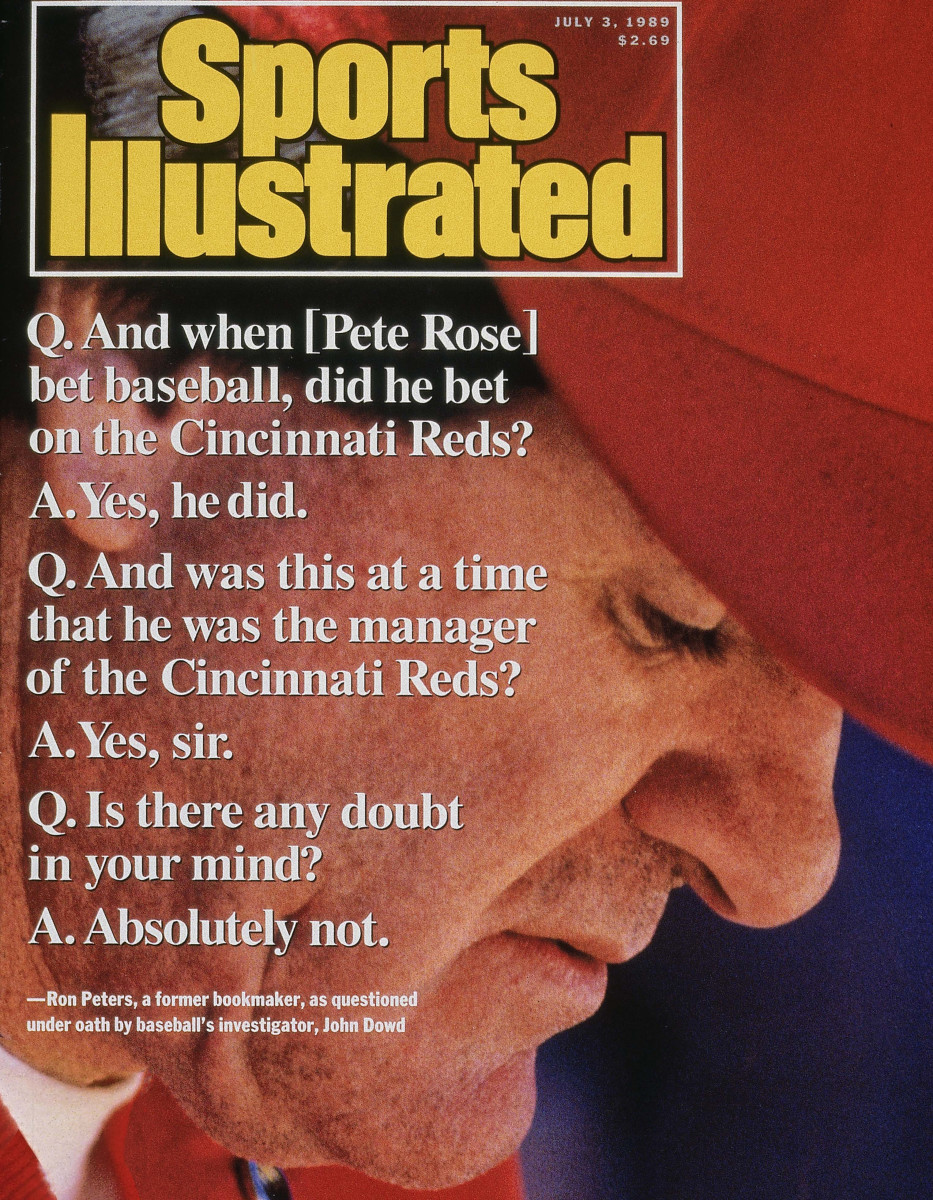
August 24, 1989: Pete Rose is banned from baseball.
It didn't seem possible. For my generation, if there was a "face of baseball," Rose was it:
* 1963: National League Rookie of the Year with the Cincinnati Reds, his hometown team.
* 1965: Led the NL in hits.
* 1966: Hit 16 home runs, which turned out to be his career high.
* 1968: Led the NL in batting average, on-base percentage, and hits. Finished 2nd in the voting for NL Most Valuable Player.
* 1969: Led the NL in batting average and runs scored. His batting average of .348, his on-base percentage of .428, his slugging percentage of .512, and his total of 82 RBIs would remain career highs, while his 16 home runs matched his career high. Won a Gold Glove as a right fielder, after being a 2nd baseman until 1967, but would switch to left field by 1972, 3rd base in 1975, and 1st base in 1979.
* 1970: Led the NL in hits. Won another Gold Glove. Scored the winning run in the All-Star Game by crashing into American League catcher Ray Fosse. Led the Reds to the NL Pennant, but lost the World Series.
* 1972: Led the NL in hits. Led the Reds to another Pennant, but lost the World Series.
* 1973: Led the NL in batting average and hits. Won the NL MVP. Led the Reds to the NL Western Division title. Picked a fight with the much-smaller New York Mets shortstop Bud Harrelson in Game 3 of the NL Championship Series. Won Game 4 of the NLCS with an extra-inning home run. Lost Game 5.
* 1974: Led the NL in doubles and runs.
* 1975: Led the NL in doubles and runs. Won his 1st World Series, and was named its MVP.
* 1976: Led the NL in hits, doubles and runs. Won his 2nd World Series.
* 1978: Tied the NL record with a 44-game hitting streak. Led the NL in doubles. Collected his 3,000th career hit.
New York's WOR-Channel 9 broke away from their broadcast of the New York Mets' game to show Rose's at-bats in Game 44 and Game 45. That's how big Rose was. But, as he found out, he wasn't bigger than the game.
* 1979: Signed as a free agent with the Philadelphia Phillies. Led the NL in on-base percentage.
* 1980: Led the NL in doubles. Led the Phillies to their 1st World Series win, his 3rd.
* 1981: Led the NL in hits. Collected his 3,631st career hit, to become the NL's all-time leader.
* 1982: Played in all 162 games. He was 41 years old. And it was the NL, so he couldn't "take it easy" as a designated hitter, either.
* 1983: Led the Phillies to another Pennant, but lost the World Series. Overall, he was in 6 World Series, winning 3 of them.
* 1984: Signed with the Montreal Expos. Collected his 4,000th career hit. Was traded back to the Reds, and named their manager as well.
* 1985: Collected his 4,192nd career hit, to become Major League Baseball's all-time leader. (He actually did it with his 4,190th, but at the time, most people still considered 4,191 the record that Ty Cobb held, so the record was celebrated with Number 4,192.) Played in his last All-Star Game, his 17th. Managed the Reds to a 2nd place finish in the NL West.
* 1986: Played his last game, although never really retired as a player. Retired as MLB's all-time leader in games played (3,562), plate appearances (15,890), at-bats (14,053), hits (4,256) and times reached base (5,929). Managed the Reds to another 2nd place finish.
* 1987: Managed the Reds to another 2nd place finish.
* 1988: Managed the Reds to another 2nd place finish, their 4th in a row. He had yet to get them into the postseason, though. No Wild Card berths in those days.
His hits included 3,215 singles (a record), 746 doubles (2nd all-time to Tris Speaker), 135 triples and 160 home runs. In spite of this, his career "slash line" is not especially notable: Batting average .303, on-base percentage .375, slugging percentage .409.
His OPS+ is 118, meaning he was 18 percent better at producing runs than the average player during his career. To put that in perspective, compare it to those of his teammates who have been elected to the Baseball Hall of Fame: Frank Robinson, 154; Mike Schmidt, 148; Joe Morgan, 132; Johnny Bench, 126; Tim Raines, 123; Tony Perez, 122; Andre Dawson, 119; Gary Carter, 116.
(Admit it: You forgot that Rose played the first part of the 1984 season with the Montreal Expos. And you were also as surprised as I was that Morgan had a higher OPS+ than Bench, and that Raines had a higher one than Dawson and Carter.)
But he didn't have great power stats. As I said, he hit 160 home runs in 24 seasons, and had 1,134 RBIs. Over a full season, that's an average of about 7 home runs and 53 RBIs. Granted, he was usually a leadoff hitter, spending his entire career in the National League, when the batter in front of him would nearly always have been the pitcher or a weak pinch-hitter for the pitcher, thus reducing his chances of having a man on base. But he should have had more RBIs than that.
It was never just about the stats with Peter Edward Rose. He was nicknamed "Charlie Hustle," because he was always hustling. When he drew a base on balls, a.k.a. a walk, he wouldn't walk to 1st base. He would run. He only stole 198 bases in 24 years, topping out at 20 in 1979, and was caught stealing 149 times. But it's hard to tell how many extra bases he earned just by running harder.
He played the game with a boyish enthusiasm, but always reminded you that he was The Man. Lots of fans loved him. The ones who hated him still admitted that they loved the way he played the game.
For my generation of baseball fans, if any one person "was baseball," it was Pete Rose.
Thomas Boswell, the great baseball columnist of The Washington Post, spoke for me, and for millions of other baseball fans, when, interviewed by Ken Burns for his documentary Baseball, he said of Rose, "Fooled me completely."
*
Pete Rose was more than a compulsive compiler of baseball statistics and other achievements. He was also a compulsive attention-seeker. He was also a compulsive liar. He was also a compulsive womanizer. And, most damaging of all, he was also a compulsive gambler.
From the beginning of Major League Baseball, gambling has been what the sport has been most afraid of: The idea that a game was not honest, that a player would rather make money by losing a game on purpose, a.k.a. throwing the game, than play honestly and win. (Of course, if team owners weren't cheap, they could have avoided this by paying the players more than the gamblers would have.) There was a gambling scandal in 1877, and it resulted in the first time that players were permanently banned from baseball.
There was the Black Sox Scandal that resulted from 7 players from the Chicago White Sox being permanently banned for throwing the 1919 World Series -- to the Reds, eventually to be Rose's hometown team as well as the team for whom he played they most, so he should have known all about it. (An additional player was banned despite refusing to take part in the fix, because he knew about it but didn't report it.) Those players were permanently banned from working in baseball in any capacity, playing or otherwise. That has, to this day, over 100 years later, kept the White Sox' biggest star at the time, Joe Jackson, from being elected to the Hall of Fame.
Every MLB clubhouse has a sign giving the rule, known as Rule 21(d). Here is the text of the rule:
(1) Any player, umpire, or Club or League official or employee, who shall bet any sum whatsoever upon
any baseball game in connection with which the bettor has no duty to perform, shall be declared
ineligible for one year.
(2) Any player, umpire, or Club or League official or employee, who shall bet any sum whatsoever upon
any baseball game in connection with which the bettor has a duty to perform, shall be declared
permanently ineligible.
(3) Any player, umpire, or Club or League official or employee who places bets with illegal book makers,
or agents for illegal book makers, shall be subject to such penalty as the Commissioner deems
appropriate in light of the facts and circumstances of the conduct. Any player, umpire, or Club or League
official or employee who operates or works for an illegal bookmaking business shall be subject to a
minimum of a one-year suspension by the Commissioner. For purposes of this provision, an illegal
book maker is an individual who accepts, places or handles wagers on sporting events from members of
the public as part of a gaming operation that is unlawful in the jurisdiction in which the bets are
accepted.
In layman's terms:
(1) If you bet on a game in which you're not involved, you're suspended for one year -- 365 days -- from the date of the application of the suspension. In other words: This article was posted on August 24, 2022. If, on that date, you were employed by the New York Yankees, and you bet on that night's game between the Boston Red Sox and the Toronto Blue Jays (which the Jays ended up winning, 3-2 in 10 innings at Fenway Park), and the Commissioner of Baseball, Rob Manfred, found out about it, ran his investigation, and suspended you on September 1, then, you would be eligible to return to working in baseball on September 1, 2023.
(2) If you bet on a game in which you are involved, you're gone, forever. Not for life: Forever.
(3) If you place a bet with a bookie, or someone working for a bookie, the Commissioner will decide what punishment would be appropriate, and then give it to you.
Again: The penalty for a baseball player or manager betting on any baseball game he's involved in is a permanent ban. Not for the rest of your life: Once you die, you're still banned. It's permanent. Forever. And everybody knows it.
Rose knew it. He knew what would happen if he broke the rule and got caught. He did it anyway. He thought he could get away with it. He thought he was bigger than the game. The only players who have ever been bigger than the game have been Jackie Robinson and maybe Babe Ruth. Not Pete Rose.
Commissioner Bart Giamatti found out that Rose had bet on Major League Baseball games. His investigator, former U.S. Justice Department official John Dowd, found the proof that Rose had bet on baseball games in which he had played, managed, and done both. When asked if he bet on baseball, Rose denied it.
But when confronted with the proof, he cut a deal: A permanent ban, and the loss of his job managing his hometown team, in exchange for the chance to apply for reinstatement.
On August 24, 1989, Commissioner Giamatti announced that the scandal, which had hung over the sport all season long, had come to a conclusion with Rose's banishment.
On September 1, 1989, 7 days later, Giamatti died of a heart attack. He was only 51 years old. He was replaced as Commissioner by Francis T. "Fay" Vincent. He would never reinstate Rose: As Rose pointed out, Vincent was Giamatti's best friend.
Vincent was fired by the team owners in 1992, and Milwaukee Brewers owner Allan "Bud" Selig became Commissioner. Being a team owner, Selig was never going to cave in to a player without the law stepping in, as was the case with the end of the Strike of 1994-95. In 2015, Selig was succeeded by Rob Manfred. Still in office as of August 24, 2022, he has never reinstated Rose, either.
Rose continued to lie about it until 2004. Even now, he insists that he never bet on his own team to lose. Whether he realizes it or not, this is a half-truth: Any game that he did not bet on the Reds to win was a signal to the gamblers that he didn't think the team would win that game, so they bet against his team.
In 1991, the Baseball Hall of Fame passed a rule stating that any player on Major League Baseball's list of permanently ineligible individuals could not appear on a ballot in any Hall of Fame election. Therefore, Rose is not eligible for election.
Some fans say that the Hall of Fame is not legitimate without the sport's all-time hit leader. Others say that keeping him out is a proper punishment; and, besides, there are plenty of artifacts from Rose's career on display at the Hall: Pieces of his uniforms, bats and gloves he used, balls he hit. After all, it isn't just the Baseball Hall of Fame: It is the National Baseball Hall of Fame and Museum.
Rose is still on the outside looking in. And he has apologized for the lie, but not for the actions that led to the lie. He has never apologized for betting on baseball.
It's also worth noting that the Hall of Fame is run by a private corporation. It works with Major League Baseball, but MLB does not have any power over the Hall of Fame. It works both ways: The Hall could make Rose eligible, and he could be elected, but he would still be banned by MLB; and MLB could lift its ban, and the Hall could then make Rose eligible, and he still might not be elected, due to lingering anger over what he did.
So don't blame MLB, or the Hall of Fame, or anybody connected with the operation of either. The only person to blame for Pete Rose not being a member of the Baseball Hall of Fame is Pete Rose.
Rose also went to federal prison, on income tax evasion charges. Rose has also admitted to having an affair with a woman who was 14 years old when it began. Fourteen. Matching his uniform number.
Postscript: The Reds hired Lou Piniella to replace Rose as manager. He had starred as an outfielder for the Yankees' American League Pennant teams of 1976, 1977, 1978 and 1981; and had managed them to a 2nd-place finish in 1986. Out of respect to Rose, who wore Number 14, which Piniella also wore, Piniella reversed his uniform number to 41. The following season, 1990, he managed the Reds to win the World Series.
Giamatti's son Paul Giamatti became an award-winning actor. Pete Rose Jr. was less successful: In 1997, he was called up to the Reds, making 11 appearances, getting 2 hits, with 1 RBI. In other words, between them, the Pete Roses have 4,258 career hits.
"P.J." Rose continued to play in various independent and foreign professional leagues until 2009. In 2006, he served 1 month in prison for distributing a drug to help his teammates. So, while the father's offenses never included cheating -- at least, not within baseball -- the son did. But, unlike the father, the son came clean and cooperated with the corresponding authorities, and was allowed to return to professional baseball. From 2011 to 2016, he managed in the White Sox' organization.
As someone of my generation pointed out, the future didn't turn out like we expected: Pete Rose was banned from baseball and went to prison, O.J. Simpson murdered 2 people and went to prison (but for a separate crime), Bill Cosby went to prison, Bruce Jenner is a woman, pretty much every professional wrestling villain turned out to be a good guy in real life, while Hulk Hogan turned out to be a massive jerk, and Donald Trump became the President.
As the (practically self-appointed) symbol of baseball, Pete Rose didn't just break THE Rule, he betrayed everybody who loved the game. He betrayed us all. That's why what he did hurt so much. And that's why he should never be forgiven, regardless of his playing accomplishments.
UPDATE: Pete Rose died on September 30, 2024. He had not yet been reinstated. Lots of baseball fans insisted that he had "served his time" and should now be elected to the Hall of Fame. On May 13, 2025, Manfred announced that the permanent bans on Rose, Shoeless Joe Jackson, and 7 other deceased players were lifted, making them eligible for the Hall of Fame. He also announced that anyone later placed on the permanently ineligible list would have their bans lifted after death. Clearly, he either does not understand, or does not respect, the meaning of the word "permanent."
*
August 24, 1989 was a Thursday. The NFL season was about to begin. It was the off-season for the NBA and the NHL. Here are the MLB results from that day:
* The New York Yankees split a doubleheader with the Baltimore Orioles at Yankee Stadium. The Yankees won the 1st game 5-1. Chuck Cary went 8 innings for the win, and got 2 hits each from Steve Sax and Roberto Kelly, and Don Mattingly went 1-for-3 with a double and 2 RBIs. The Orioles won the 2nd game 9-2. Eric Plunk did not pitch well, giving up a home run to Larry Sheets.
* The St. Louis Cardinals beat the Atlanta Braves, 4-1 at Atlanta-Fulton County Stadium.
* The Toronto Blue Jays beat the Detroit Tigers, 11-3 at the SkyDome in Toronto.
* The Pittsburgh Pirates beat the Houston Astros, 3-2 at Three Rivers Stadium. Jose Lind won it with a sacrifice fly in the 14th inning.
* The Cleveland Indians beat the Seattle Mariners, 5-2 at Cleveland Municipal Stadium.
* The Minnesota Twins beat the Chicago White Sox, 6-4 at the Metrodome in Minneapolis.
* The California Angels beat the Kansas City Royals, 5-0 at Royals Stadium in Kansas City. (It was renamed Kauffman Stadium in 1993.) Bert Blyleven, age 38, pitched a 4-hit shutout.
* The Texas Rangers beat the Oakland Athletics, 6-2 at Arlington Stadium in the Dallas suburb of Arlington, Texas.
* In the American League, the Boston Red Sox and the Milwaukee Brewers were not scheduled.
* And in the National League, these teams were not scheduled: The Chicago Cubs, the Los Angeles Dodgers, the Montreal Expos, the New York Mets, the Philadelphia Phillies, the San Diego Padres, the San Francisco Giants, and, most notably, the Cincinnati Reds.


No comments:
Post a Comment