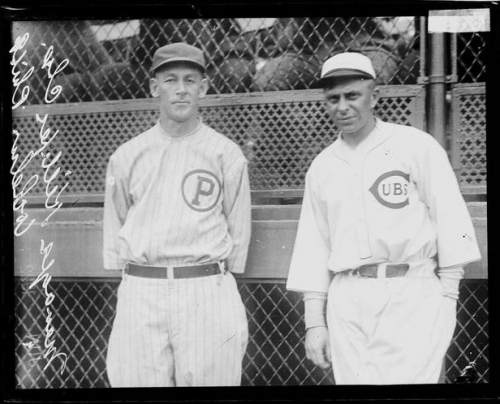
Left: Phillies manager Irvin "Kaiser" Wilhelm.
Right: Cubs manager Bill Killefer, himself a former Phillie.
August 25, 1922: The highest-scoring game in the history of Major League Baseball is played.
The Chicago Cubs hosted the Philadelphia Phillies, at Cubs Park on the North Side of Chicago. It would be renamed Wrigley Field in 1926. The ballpark has a reputation as one of the best for hitters, but that's only when its famous wind is blowing out. Statistics show that, when the wind blows in, it's considerably more favorable to pitchers. But Cub management traditionally builds the team around power hitting instead of pitching, and that was a major reason why the Cubs didn't win a National League Pennant from 1945 to 2016.
While the account of the game on Baseball-Reference.com makes no mention of the weather, clearly, the wind was blowing out that day.
Tony Kaufman was the starting pitcher for the Cubs, and lasted 4 innings. Jimmy Ring, a World Series winner with the 1919 Cincinnati Reds, started for the Phillies, and didn't finish the 4th inning, allowing 16 runs -- but only 6 of them earned.
Things started innocently enough, as the Cubs led 1-0 after the 1st inning. In the top of the 2nd, the Phillies scored 3 runs, thanks to 3 singles and back-to-back errors. But in the bottom of the 2nd, the Cubs got 10 hits, including home runs by Laurence "Hack" Miller (no connection to later Cub Hall-of-Famer Lewis "Hack" Wilson) and Bob O'Farrell (later the catcher on the 1926 World Champion St. Louis Cardinals), and also got the benefit of 3 walks and 2 errors. It was 11-3 Chicago.
The Phillies picked up 2 runs in the 3rd, and another in the 4th, to make it 11-6. But in the bottom of the 4th, the Cubs put the game out of reach -- or so it appeared. They scored 14 runs on 11 hits, including another homer by Miller, plus 3 walks, a sacrifice bunt, a hit batsman, and 2 errors. 25-6.
The Phillies scored 3 runs in the top of the 5th, but it seemed like mere consolation at the time. The Cubs added a run in the top of the 6th, to make it 26-9. Surely, that would be enough.
The Phils attacked in the top of the 8th as if they thought they still had a chance: Walk, error, RBI single, walk, RBI sacrifice fly, RBI single, sacrifice bunt, walk, error allowing 2 runs, single, 2-RBI double, strikeout. It was now Cubs 26, Phillies 17. Still no chance for the Keystone City club, right? After all, this was not 1969 or later: The Cubs did not yet have their reputation for "choking."
Top of the 9th: The Phillies went all-in. Single. Walk. Single. 26-18. Double. 26-19. Strikeout. Single. 26-21. Single. Strikeout. Walk. Single. 26-22. Botched pickoff play. 26-23. Walk. Only 1 more out was needed, but the bases were loaded. Finally, Earnest "Tiny" Osborne, responsible for the last 2 runs, struck DeWitt Wiley "Bevo" LeBourveau out to end the game.
For the Chicago Cubs: 26 runs, on 25 hits, they made 5 errors, and left 9 men on base. Cliff Heathcote got 5 hits, and 4 RBIs. Miller and Marty Krug each got 4 hits, 2 of Miller's being home runs. Miller and Charlie Hollocher each had 6 RBIs. Although he only went the 1st 4 innings, and wouldn't be granted this distinction under today's rules, Kaufman was credited as the winning pitcher. Under today's rules, Osborne was credited with a save -- in a game his team once led by 19 runs, and by 8 when he came in, although he only "earned" 2 of them. Kaufman was the only player in the Cubs' starting lineup who didn't get at least 2 hits. Charles "Gabby" Hartnett, the only Hall-of-Famer in this game for either team, came in as a defensive replacement at catcher, and walked in his only plate appearance.
For the Philadelphia Phillies: 23 runs, on 26 hits, they made 4 errors, and left 16 men on base, including the men who, at the end, could have tied the game had they all scored. Russ Wrightstone and Curt Walker each had 4 hits. Wrightstone had 4 RBIs. Ring was the losing pitcher.
The attendance at the game? There was only an estimate: 7,000. And the time of the game? Despite an MLB record that still stands with 49 runs, just 3 hours and 1 minute. It helped that, for all that the Cubs dished out, the Phillies only used 2 pitchers: Ring and Philip "Lefty" Weinert.
Zeb Terry was the last survivor of this game for the Cubs, living until 1988, outliving Bob O'Farrell by 23 days. No Phillies player lived that long.
On May 17, 1979, 57 years later, the same 2 teams would play at Wrigley, and the Phils would gain something of a revenge for the 1922 contest, winning 23-22. It became known as "The Wild Day at Wrigley," and TV footage survives. The 1922 game, of course, didn't even have a radio broadcast, so all we have are the written accounts.
*
August 25, 1922 was a Friday. These other games were played in the major leagues:
* A doubleheader was split at the Polo Grounds. The St. Louis Browns won the opener, 3-1. The New York Yankees won the nightcap, 6-5. Babe Ruth went 2-for-8 with 2 RBIs on the day. George Sisler went 3-for-8 with 2 RBIs.
* The New York Giants beat the St. Louis Cardinals, 4-3 at Sportsman's Park in St. Louis. Ross Youngs went 3-for-4 with an RBI, and Casey Stengel went 1-for-4 with an RBI. Rogers Hornsby went 3-for-4 with a solo home run.
* The Brooklyn Dodgers, or the Robins as they were known under Wilbert Robinson as manager from 1914 to 1931, swept a doubleheader from the Pittsburgh Pirates at Forbes Field, 8-7 and 8-6. Over the 2 games, Zack Wheat went 3-for-8 with 2 walks and an RBI.
* The Boston Red Sox beat the Cleveland Indians, 9-0 at Fenway Park in Boston. Jack Quinn pitched a 2-hit shutout. Indians player-manager Tris Speaker did not put himself into this game.
* The Detroit Tigers beat the Washington Senators, 3-2 at Griffith Stadium in Washington. Tigers player-manager Ty Cobb did put himself into the game, and went 2-for-5.
* And the Boston Braves and the Cincinnati Reds got rained out at Redland Field in Cincinnati. The game was made up as part of a doubleheader the next day. The Reds swept, 5-3 and 2-1. The ballpark was renamed Crosley Field in 1934.


No comments:
Post a Comment