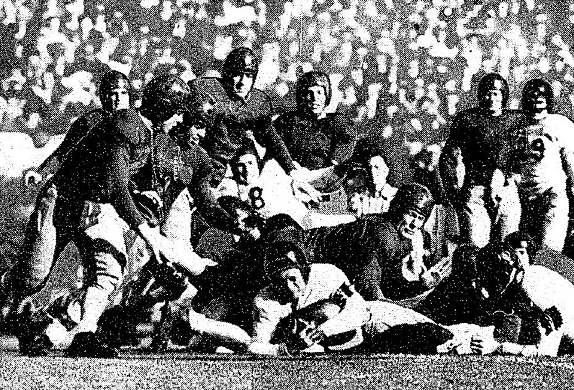
Showing posts with label big 8. Show all posts

Friday, November 25, 2022

November 25, 1971: Nebraska vs. Oklahoma, "The Game of the Century"

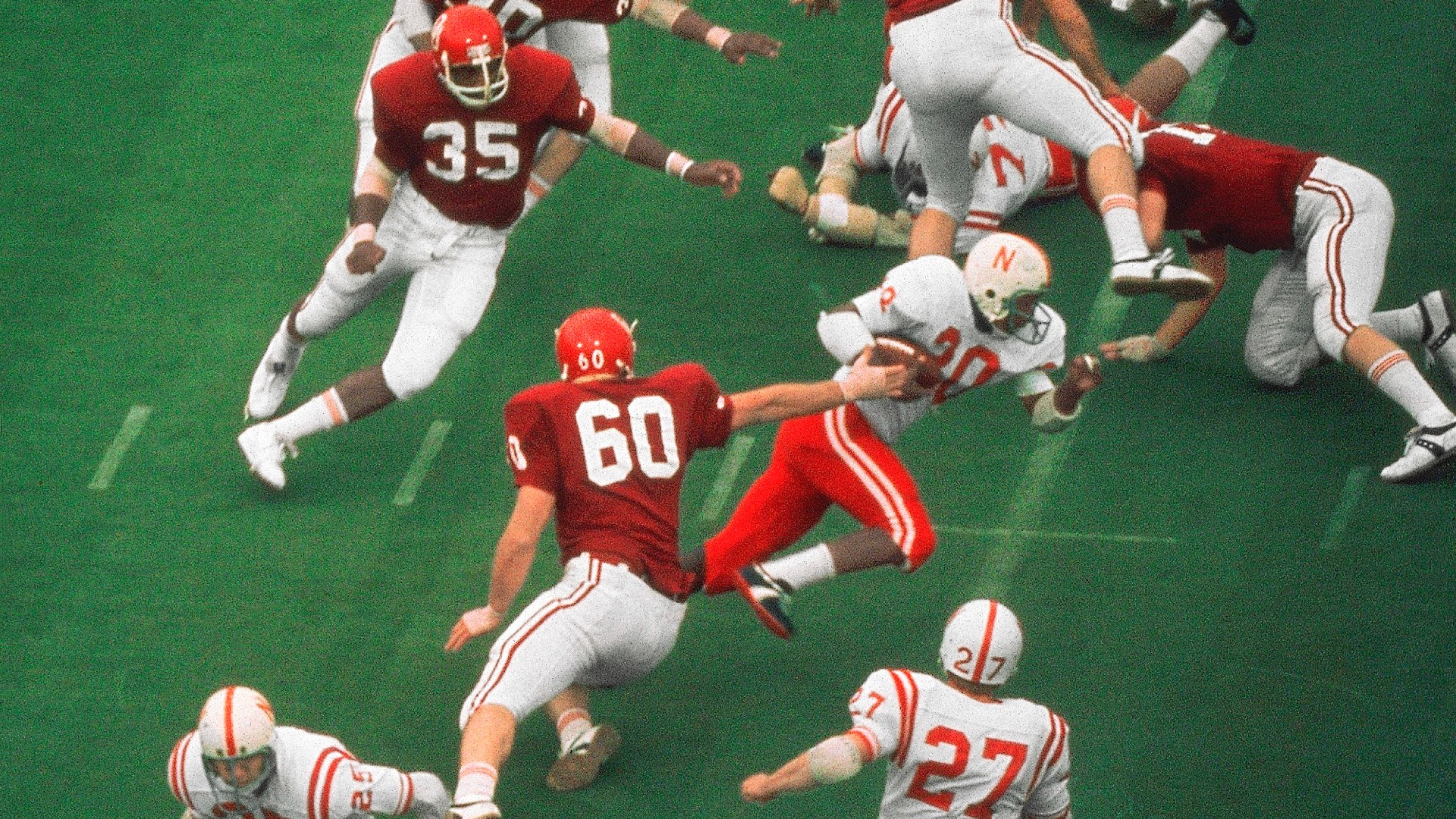
Number 20: Johnny Rodgers

November 25, 1971: One of college football's occasional "Games of the Century" is played.

They seemed to be coming every year. 1966 saw Michigan State vs. Notre Dame, in the Big Ten region if not a Big Ten game in its own right. 1967 saw USC vs. UCLA, in the league now known as the Pac-12. 1969 saw Texas vs. Arkansas, in the now-defunct Southwest Conference. In 1971, it was the turn of the league then known as the Big 8, now the Big 12.

For many years, the University of Nebraska's big rival was the University of Oklahoma. The rivalry was usually played on Thanksgiving weekend. In 1959, Nebraska beat Oklahoma, ending the Sooners' 74-game conference winning streak. In 1963, Nebraska won a game that the Big 8 refused to postpone, despite President Kennedy's assassination the day before.

On November 25, 1971, the Nebraska Cornhuskers and the Oklahoma Sooners met at Oklahoma Memorial Stadium, a.k.a. Owen Field, in Norman. The 'Huskers had won the National Championship the season before, were riding a 28-game unbeaten streak (27-0-1, without losing since October 11, 1969), and were ranked Number 1 in the country. The Sooners ranked Number 2. The entire country was watching that Thanksgiving Day.

Each team had a superstar running back. Nebraska, coached by Bob Devaney, had Johnny Rodgers, also a great receiver, from Omaha, running as the last back in the "I formation." He was known as "Johnny the Jet" and "Johnny R Superstar." The nickname clearly came from the theme song to the Broadway musical Jesus Christ Superstar, although it's not known if Nebraska fans made up a song for it, the way fans of London soccer team Arsenal made one up for "Charlie George, superstar."

Oklahoma had Greg Pruitt, a Houston native, running out of the wishbone offense, installed by coach Chuck Fairbanks, after he was impressed at how the Sooners' other big rivals, the University of Texas, ran it under coach Darrell Royal. (Ironically, Royal had played quarterback at Oklahoma.)

Chris Schenkel and Bud Wilkinson, who had established the Oklahoma dynasty before retiring (there were 2 other head coaches between him and Fairbanks), called the game for ABC, and the largest college football audience ever to that point, 55 million people, watched. It kicked off at 2:00 PM Central Time (3:00 Eastern, the ABC broadcast beginning 10 minutes before).
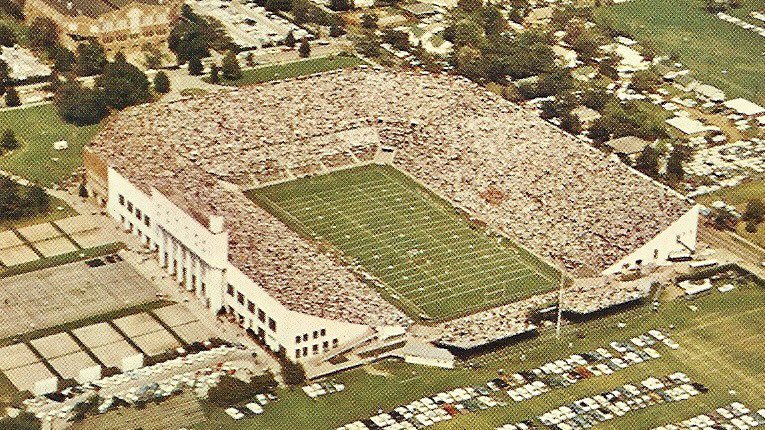
Nebraska stopped Oklahoma's 1st possession, and the Sooners had to punt. Rodgers returned the punt 72 yards for a touchdown. Twice in the 1st half, the Sooners fumbled the ball away. Rich Glover, the 'Huskers' middle guard, toyed with the Oklahoma offensive line.

The Sooners kicked a field goal, then teach team scored a touchdown in the 2nd quarter. But quarterback Jack Mildren led the Sooner offense on a long drive at the end of the 1st half, and Oklahoma had a 17-14 lead. It was the 1st time Nebraska had been behind all season long.

But a 3rd Sooner fumble led to the 'Huskers retaking the lead, and they expanded it to 28-17 late in the 3rd quarter, on Jeff Kinney's 3rd touchdown of the day. But near the end of the 3rd quarter, Mildren led the Sooners on another drive, and it was 28-24 'Huskers. He did it again, and with 7:10 left in regulation, Oklahoma led, 31-28.

The 'Huskers made the most of the time they had left. They got to the Sooner 48, and Husker quarterback Jerry Tagge through to Rodgers, who made a 2nd "signature play" in 1 game, breaking tackles and getting to the 15. Kinney scored his 4th touchdown of the game with 1:38 left. Oklahoma got the ball back, but the 'Huskers sacked Mildren on 3rd and 4th down to put it away. Final score: Nebraska 35, Oklahoma 31.

Nebraska thus clinched the Big 8 title, kept the Number 1 ranking, and set themselves up for the National Championship. They did have 1 more regular-season game, traveling to Hawaii, and they won, 45-3. They closed with another Number 1 vs. Number 2 matchup, beating Alabama in the Orange Bowl in Miami, 38-6.

Oklahoma only dropped to Number 3, and also had 1 more regular-season game, against in-State rival Oklahoma State. They traveled to Stillwater, and beat the Cowboys, 58-14. The aforementioned Alabama beat their big rivals, Auburn, in "the Iron Bowl" in Birmingham, 2 days after Thanksgiving, and Auburn, holding their Number 5 ranking, played Oklahoma in the Sugar Bowl in New Orleans. Oklahoma won, 40-22. Nevertheless, they finished the season with only the Sugar Bowl trophy, while Nebraska were the National Champions and the Big Eight Conference Champions.

Nebraska's 31-game unbeaten streak (30-0-1) ended with the opening game of the 1972 season, 20-17 against UCLA at the Los Angeles Coliseum. Then they went 9-0-1, with only a tie against Iowa State further marring their record. They had gone 40-1-2 over 3 years, a staggering total, for a .942 winning percentage. Then they hosted Oklahoma at Memorial Stadium in Lincoln on Thanksgiving, and the Sooners got some revenge, 17-14. 

After beating Notre Dame in the 1973 Orange Bowl, Devaney retired as Nebraska head coach, becoming athletic director, and elevating his offensive coordinator Tom Osborne to the head job. Osborne had a great deal of success, winning 13 Conference Championships, and 12 bowl games including 9 of those traditionally contested on New Year's Day; but also some staggering near-misses for the National Championship, before winning it in the 1994, 1995 and (in a split poll) 1997 seasons.

Nebraska's Johnny Rodgers was awarded the Heisman Trophy for the 1972 season. The San Diego Chargers took him with their 1st round pick in the 1973 NFL Draft. Instead, he signed with the Montreal Alouettes of the Canadian Football League. He won a Rookie of the Year award, 2 Most Valuable Player awards, and the 1974 Grey Cup (CFL Championship.)

In 1977, with the Chargers still holding his NFL rights, he signed with them. But he was plagued with injuries, and retired after the 1978 season, having played only 17 NFL games.

Oklahoma's Greg Pruitt had a much better pro career. He made 5 Pro Bowls, 4 with the Cleveland Browns and 1 with the Los Angeles Raiders, and was a member of the Raiders' Super Bowl XVIII winners in 1984. Both Rodgers and Pruitt were elected to the College Football Hall of Fame, but neither made it to the Pro Football Hall of Fame.

In 1978, Nebraska won the regular-season game, as Number 4 beating Number 1 Oklahoma, but a rematch was set up in the Orange Bowl (which then took the Big 8 winner), and Oklahoma won it. In 1987, Oklahoma were Number 2 when they beat Number 1 Nebraska.

The Big 8's 1996 conversion into the Big 12 put the teams in separate divisions, as Oklahoma and Oklahoma State were put in with the 4 teams brought in from Texas to form the South Division, to balance the divisions out, ending Huskers-Sooners as an annual rivalry.

Nebraska's 2011 move to the Big Ten made the matchup even rarer: They stopped playing each other after Oklahoma beat them in the 2010 Big 12 Championship Game. They finally met again on September 18, 2021, in Norman, to celebrate the 50th Anniversary of that Game of the Century. Oklahoma won, 23-16.

Overall, Oklahoma leads the rivalry 46-38-3, but it's 43-23 Oklahoma since 1943, 11-8 Nebraska since 1988, and 7-2 Oklahoma since 2000.

*

November 25, 1971 was Thanksgiving Day, so it was a Thursday. 'Huskers-Sooners was 1 of 4 college football games played that day. Number 7 Georgia beat Georgia Tech, 28-24 at Grant Field in Atlanta. Number 12 Texas beat Texas A&M, 34-14 at Kyle Field in College Station, Texas. And Number 18 Mississippi, a.k.a. Ole Miss, beat Mississippi State, 48-0 at Hemingway Stadium in Oxford, Mississippi. (It's now named Vaught-Hemingway Stadium.)

In the NFL doubleheader, NBC telecast the opener, and the Detroit Lions beat the Kansas City Chiefs, 32-21 at Tiger Stadium in Detroit. (Remember: This was 50 years ago.) CBS aired the nightcap, and the Dallas Cowboys beat the Los Angeles Rams, 28-21 at Texas Stadium in the Dallas suburb of Irving Texas.

There were 3 games played in the NBA. The Phoenix Suns beat the Detroit Pistons, 122-103 at the Arizona Veterans Memorial Coliseum in Phoenix. The Philadelphia 76ers beat the Golden State Warriors, 112-111 at the Oakland Coliseum Arena. And the Los Angeles Lakers beat the Seattle SuperSonics, 139-115 at the Seattle Center Coliseum.

There were 2 games played in the American Basketball Association. The New York Nets lost to the Kentucky Colonels, 133-117 at Freedom Hall in Louisville. And the Virginia Squires beat the Pittsburgh Condors, 131-118 at the Civic Arena in Pittsburgh.

And 1 game was played in the NHL: The Boston Bruins beat the Philadelphia Flyers, 4-2 at the Boston Garden.

Also, actress Christina Applegate was born.

Thursday, October 13, 2022

October 13, 1923: Nebraska's Memorial Stadium Opens

October 13, 1923: Memorial Stadium opens on the campus of the University of Nebraska in Lincoln. The Cornhuskers are not yet arch-rivals with the University of Oklahoma, but that's who they play in the 1st game, and they beat the Sooners 24-0. A week later, Oklahoma opened its own Memorial Stadium.
From 1909 to 1922, the 'Huskers had played at Nebraska Field. Their new stadium originally seated 31,080. In 1962, with Bob Devaney in his 1st season as head coach, they got good, and began a streak of selling out that lasted through the 2019 season. The COVID restrictions of 2020 meant that the 4 Nebraska home games that season were played behind closed doors, so the NCAA recognizes the streak as still being intact as of October 13, 2022.
Because of the team's success, the stadium was expanded to 64,000 in 1967, 73,000 in 1972, 74,000 in 1999, 81,000 in 2006, and 87,000 in 2013. Subsequently, wider seats were installed, and by 2017, capacity was reduced to 85,458. Every seat is still filled, known as "The Sea of Red." The field was concerted to artificial turf in 1970, was renamed for coach Tom Osborne in 1998, and since 1999 has been FieldTurf.
Since moving in, Nebraska have won 30 Conference Championships: 1923 in the Missouri Valley Intercollegiate Athletic Association; in the league alternately known as the Big Six, the Big Seven and the Big Eight, in 1928, '29, '31, '32, '33, '35, '36, '37 and '40, '63, '64, '65, '66, '69, '70, '71, '72, '75, '78, '81, '82, '83, '84, '88, '91, '92, '93, '94, '95; and in 1997 and '99 in the Big Twelve. They joined the Big Ten in 2011, and have won their Division in 2013, but not the Conference. They were awarded National Championships under Devaney in 1970 and 1971; and under Osborne in 1994, 1995 and 1997.
UPDATE: On August 30, 2023, Nebraska's renowned women's volleyball team, in a sport normally played indoors, played at Memorial Stadium, defeating the University of Nebraska at Omaha in 3 straight games. The attendance was 92,003, a record for the stadium, and a record for any women's sporting event, at any level, anywhere in the world. The football attendance record is 91,585, for the Cornhuskers' 41-31 win over the University of Miami on September 20, 2014.
*
October 13, 1923 was a Saturday. Among the other notable college football games played that day were these:
* Notre Dame beat Army, 13-0 at Ebbets Field.
* Navy beat West Virginia Wesleyan, 26-7 at Worden Field in Annapolis, Maryland.
* Columbia beat Wesleyan University, 12-6 at Baker Field (now Wien Stadium) in Upper Manhattan.
* Rutgers beat Lehigh, 10-0 at Neilson Field in New Brunswick, New Jersey
* Princeton beat Georgetown, 17-0 at Palmer Stadium in Princeton, New Jersey.
* Harvard were held to a 6-6 tie by Middlebury College at Harvard Stadium in Boston.
* In a rivalry that would one day be known as the "Backyard Brawl," West Virginia beat the University of Pittsburgh, 13-7 at Forbes Field in Pittsburgh.
* Ohio State were held to a 23-23 tie by Colgate at Ohio Stadium in Columbus.
* Unusually, there were 3 North vs. South matchups on this day, all held in the North. Yale beat Georgia, 40-0 at the Yale Bowl in New Haven, Connecticut. Syracuse beat Alabama, 23-0 at Archbold Stadium in Syracuse, New York.
And Michigan beat Vanderbilt, 3-0 at Ferry Field in Ann Arbor, Michigan. Given that each was a major power in its own region, this was a major measuring stick for Southern college football, and the fact that Vandy only lost by 3 points on the road was taken as a good sign.
Game 4 of the World Series was played that day. A 6-run 2nd inning leads the New York Yankees to an 8-4 win over the New York Giants at the Polo Grounds, and ties up the Series. Bob Shawkey was the winning pitcher, and Babe Ruth went 1-for-3 with 2 walks.
Also, Dutch soccer legend Servaas "Faas" Wilkes was born on this day.

Thursday, October 6, 2022

October 6, 1990: Colorado's Fifth Down

October 6, 1990: The University of Colorado win a football game that they shouldn't have, because they received a 5th down, and nobody noticed it at the time.

For those of you not familiar with American football: A team is allowed 4 downs, or plays, to move the ball 10 yards (about 9.14 meters) toward the goal line. If the offense moves the ball 10 yards in 4 attempts or fewer, it gains another 1st down, which restarts the process. If, after four attempts, the offense has neither scored nor gained 10 yards, the other team is given possession of the ball. This is called "turning the ball over on downs."

The goalposts are on the end line, ten yards behind the goal line. A field goal is worth three points, and attempting one requires the ball to be snapped seven yards behind the line of scrimmage. Therefore, a 50-yard field goal, pretty much the difference between an NFL-quality placekicker and less than that, would have to be kicked from the defensive team's 33-yard line.

If a team is within that, or closer, and is on 4th down, it usually tries the field goal. If the ball is between there and midfield, the 50-yard line, and 4 yards or less from the point where a 1st down would be gained, the team usually tries another play from scrimmage, a run or a pass. This is usually called "going for it." But if it's more than 4 yards, or if the offensive team is still in their half of the field, 99 percent of the time, their coach will punt the ball back to the other team, and trust their defense to hold the other team's offense.

Under normal circumstances -- for example, excluding penalties that can involve replaying a down -- no team is supposed to be allowed 5 attempts. But there have been times when a 5th down changed the outcome of a game. On November 16, 1940, Cornell University went into Dartmouth's College's Memorial Field in Hanover, New Hampshire with an 18-game winning streak. Cornell scored a late touchdown to win the game, 7-3. But after reviewing the game film, Cornell head coach Carl Snavely discovered that the officials had mistakenly given his team an extra down. He informed the NCAA, and forfeited the game, and Dartmouth were declared 3-0 winners.

On December 8, 1966, the Los Angeles Rams were penalized for holding as they attempted a winning drive against the Chicago Bears at the Los Angeles Coliseum. Holding is one of the penalties that results in a down being replayed, not lost. But the officials mistakenly changed the down marker from 1st to 2nd. Nobody noticed, the Rams went on to turn the ball over on downs, and lost, 17-16. The loss didn't change the NFL's Playoff race, so nothing was ever done about it.

In 1972, the University of Miami played Tulane at the Orange Bowl, and the officials mistakenly called Miami's offense back on the field after it had turned over on downs. Miami scored a touchdown on the next play, and won, 24-21. They did not forfeit.

So: On October 6, 1990, a Big Eight Conference game was played in front of 46,856 -- about 16,000 short of a sellout, due to rainy weather -- at Faurot Field in Columbia, Missouri, between the University of Missouri and the University of Colorado. Colorado came into the game ranked Number 12 in the country, with a record of 3-1-1, having lost to Illinois and tied Tennessee. Missouri were unranked, 2-2, and heavy underdogs.
Colorado's starting quarterback, Darian Hagan, was injured, so backup quarterback Charles Johnson started. The game went back and forth, until, with 3 minutes left, trailing 31-27, Colorado got the ball back. With 40 seconds left, they got a 1st down, just short of Missouri's goal line.

In college football, with less than 2 minutes remaining in each half, the clock is stopped when a 1st down is gained, long enough for the referees to move the markers showing the line of scrimmage and the spot where a 1st down can be gained, markers joined by a chain. This action, and also the gaining of a 1st down, are called "moving the chains." Once the markers are in place, the referee restarts the clock.

On 1st down and goal to go, Johnson spiked the ball to stop the clock. This was part of the problem: The rule allowing a quarterback to do this was brand-new, and this may have confused an official. Still, the down marker was correctly changed to read 2nd down.

Running back Eric Bieniemy ran up the middle, and was stopped just short of the goal line. It was now 3rd down, and Colorado called time out. But the officials did not change the down marker. At the time, officials were not required to carry handheld down markers.

It's also been alleged that the official in charge of the down marker was distracted by EMTs tending to a Missouri fan in the stands who had suffered a heart attack. (Unfortunately, he died. I don't have his name.)

So on what should have been 3rd down, every on-field indication was of 2nd down. The scoreboard operator saw this, and put a "2" up on the board. Again, Bienemy was stopped short. On the 3rd down that should have been 4th, Johnson spiked the ball again. If the correct down had always been listed, the 2nd spike would have been made instead of the 2nd Bienemy run.

So now when it should have been Missouri's ball, Colorado had a 4th down. Johnson took the ball on a quarterback keeper, and scored. Colorado led, 33-31.

It was only then that the officials realized their mistake. The broadcasters also noticed it. But the officials chose to let the touchdown count, and Colorado took a knee instead of trying an extra point, for fear of Missouri blocking it and returning it for 2 points. Colorado were allowed to win.

Amid calls to forfeit, head coach Bill McCartney, one of those evangelicals who was very selective about Christianity, refused, citing Missouri's failure to take care of their artificial turf in lousy weather. (He refused even after instant replays showed that Johnson had been stopped short of the goal line, and hadn't actually scored. To make matters worse, McCartney was a Missouri graduate.) Missouri appealed to the Big Eight Conference, but were denied. All the league did was suspend the officiating crew.

Colorado won the Big Eight title, rose to Number 1 in the rankings, and beat Notre Dame in the Orange Bowl. The Associated Press' (AP) poll, of sportswriters, named them the National Champions, despite the fact that they had a tie, a legitimate loss, and a win that should have been a legitimate loss.

The poll conducted by United Press International (UPI) was of the coaches, and their choice for the final Number 1 was Georgia Tech, 11-0-1, the only blemish on their record a tie against North Carolina. Perhaps it was because they were Champions of the Atlantic Coast Conference, not one of the biggest leagues, that led the AP writers to choose Colorado over them.

And without a playoff, or even the Bowl Championship Series, teams that won their leagues were locked into certain bowls: The Big Ten and Pacific-Ten into the Rose, the Big Eight into the Orange, the Southeastern Conference into the Sugar, the Southwest Conference into the Cotton, and the aforementioned ACC into the Citrus. So unless the Rose had Number 1 vs. Number 2, or 1 of the top 2 was the titlist in the Big Eight, the SEC or the SWC, and the other was an independent like Notre Dame and Miami then were, we weren't going to get a definitive National Champion, even if both polls agreed.

And they frequently didn't. Here are the times when that happened, with the AP choice (which began in 1936) listed 1st, the UPI choice (which began in 1950) 2nd:

* 1954: Ohio State and UCLA.
* 1957: Auburn and Ohio State.
* 1965: Alabama and Michigan State.
* 1970: Nebraska and Texas.
* 1973: Notre Dame and Alabama, even though Notre Dame beat Alabama in the Sugar Bowl.
* 1974: Oklahoma and Southern California (USC). UPI excluded teams on probation from its poll, thus disqualifying Oklahoma.
* 1978: Alabama and Southern California, even though USC beat Alabama in the regular season.
* 1990: Colorado and Georgia Tech.
* 1991: Miami and Washington.
* 1997: Michigan and Nebraska.

So this game, leading to a split final poll, and the following year's split final poll, may have changed the history of the sport. In 1992, the Bowl Coalition was created, and this was the first step toward the Playoff system we have now.

Charles Johnson, who scored the winning touchdown, became a receiver when he signed with the Pittsburgh Steelers. So did his successor as Colorado quarterback Kordell Stewart, who, because he was a "quarterback/runner/receiver," was nicknamed Slash. Johnson played for them from 1994 to 1998, the Philadelphia Eagles in 1999 and 2000, the New England Patriots in 2001 (where he won a Super Bowl), and the Buffalo Bills in 2002). He then became a high school administrator and coach, before dying on July 17, 2022, only 50 years old. No cause of death was determined

*

October 6, 1990 was a Saturday. Among the other major college football games that day were these:

* Number 1 Notre Dame were upset by Stanford, 36-31 at Notre Dame Stadium in South Bend, Indiana. The Fighting Irish later lost to Penn State, but were still Number 5 when they played Colorado in the Orange Bowl. Had they won that game, they wouldn't have been awarded the National Championship -- then again, it's Notre Dame, so you never know -- but Colorado certainly wouldn't have, being 8-2-1.

* Number 2 Florida State were upset by Number 9 Miami, 31-22 at the Orange Bowl. Two weeks later, the Hurricanes lost to Notre Dame, blowing their chance. The same day, the Seminoles lost to Auburn, finishing theirs off.

* Number 3 Michigan beat Wisconsin, 41-3 at Camp Randall Stadium in Madison, Wisconsin. The Wolverines then lost their next 2 games, to Michigan State and Iowa, blowing their chance.

* Number 4 Tennessee had the week off. They later blew their chance by losing to Alabama and Notre Dame.

* Number 5 Auburn beat Louisiana Tech, 16-14 at Jordan-Hare Stadium in Auburn, Alabama. But the Tigers blew their chance by losing 3 games the rest of the way.

* Number 7 Oklahoma beat in-State rival Oklahoma State, 31-17 at Lewis Field (now Boone Pickens Stadium) in Stillwater, Oklahoma. But the Sooners lost their next 3 games.

* Number 8 Nebraska beat Kansas State, 45-8 at KSU Stadium (now Bill Snyder Family Stadium) in Manhattan, Kansas. The next month, Colorado beat them to knock them out of the Big 8, and national, title picture.

* Number 10 Florida beat Louisiana State, 34-8 at Ben Hill Griffin Stadium in Gainesville, Florida. The next week, the Gators lost to Tennessee.

* Texas, then unranked, beat Rice, 26-10 at Rice Stadium in Houston. They got up to Number 3 before losing to then-Number 4 Miami in the Cotton Bowl. And they'd already lost to Colorado on September 22. So even if they'd won the Cotton Bowl, they probably wouldn't have been ranked any higher than 3rd in the last poll.

Baseball's Playoffs were in progress. The National League Championship Series was on a travel day,  with the Pittsburgh Pirates and the Cincinnati Reds tied 1-1. The Reds went on to win the series in 6 games.

Game 1 of the American League Championship Series was played at Fenway Park in Boston. The Boston Red Sox led 1-0 after 6 innings, but the Oakland Athletics scored a run in the 7th, another in the 8th, and 7 in the 9th, to win, 9-1. They swept the series. They were heavily favored to win the World Series, but the Reds swept them in 4 straight.

The NBA season didn't start until November 2. But there were 10 NHL games that day:

* The New York Rangers lost to the Hartford Whalers, 5-4 at the Hartford Civic Center (now the XL Center).

* The New York Islanders lost to the Minnesota North Stars, 4-2 at the Metropolitan Sports Center in the Minneapolis suburb of Bloomington, Minnesota.

* The New Jersey Devils beat the Philadelphia Flyers, 3-1 at the Brendan Byrne Arena at the Meadowlands.

* The Montreal Canadiens beat the Buffalo Sabres, 6-5 at the Montreaa Forum.

* The Boston Bruins beat the Quebec Nordiques, 7-1 at the Boston Garden.

* The Washington Capitals beat the Detroit Red Wings, 6-4 at the Capital Centre in the Washington suburb of Landover, Maryland.

* The Chicago Blackhawks beat the St. Louis Blues, 5-2 at the St. Louis Arena.

* On CBC's Hockey Night In Canada, The Calgary Flames beat the Toronto Maple Leafs, 4-1 at the Saddledome in Calgary.

* The Winnipeg Jets and the Edmonton Oilers played to a 3-3 tie at the Northlands Coliseum in Edmonton.

* And the Vancouver Canucks beat the Los Angeles Kings, 6-3 at The Forum outside Los Angeles in Inglewood, Califorrnia.

Also, in English soccer, Arsenal beat Norwich City, 2-0 at Arsenal Stadium, a.k.a. Highbury, in North London.

Wednesday, January 12, 2022

January 12, 1907: The Big Eight Conference Is Founded

January 12, 1907: The Missouri Valley Intercollegiate Athletic Association is founded in Kansas City, Missouri. It eventually became known as the Big Eight Conference, or the Big 8.

The 5 original members were the University of Kansas, the University of Missouri, the University of Nebraska, Washington University of St. Louis, and the University of Iowa. Iowa only competed in the MVIAA for football and track, remaining in the league that would become the Big Ten Conference, and left the MVIAA entirely in 1911, leading to a split between Iowa and Iowa State that lasts to this day, and one between Iowa and neighboring Nebraska that lasted until 2011.

Iowa State University and Drake University of Des Moines, Iowa joined in 1908. Kansas State University joined in 1913. Grinnell College of Grinnell, Iowa was admitted in 1919, the University of Oklahoma in 1920, and Oklahoma State University (known as Oklahoma A&M until 1958) in 1925.

In 1928, Iowa State, Kansas, Kansas State, Missouri, Nebraska and Oklahoma left to form a new league. The remainders -- Drake, Grinnell, Oklahoma A&M and Washington University formed the Missouri Valley Conference. The 6 schools that left took on the MVIAA name, but began to informally call themselves the Big Six Conference. Both leagues traced their founding to the original MVIAA of 1907.

The University of Colorado was added in 1928, making the MVIAA a Big Seven. In 1957, Oklahoma State left the MVC and joined the MVIAA, making it the Big Eight. In 1964, the Big Eight name was made official.

From 1954 to 1995, the Orange Bowl in Miami usually invited the Big 8 football champion to participate. Of those 42 appearances: Oklahoma and Nebraska, the league's biggest football rivals, each made 15. In 1978, Nebraska beat Oklahoma in the regular season, then lost their last regular-season game, setting up a rematch in the Orange Bowl, which Oklahoma won.

Colorado appeared 5 times, Missouri 2, Kansas 1. Iowa State, Kansas State and Oklahoma State never made it. No Big 8 school appeared in the Orange Bowls of 1965, 1967, 1974 and 1975.

Kansas and Missouri, and to a lesser extent Kansas and Kansas State, would be heated rivals in basketball first, football second. Oklahoma and Oklahoma State would be college wrestling's greatest rivalry, but their "Bedlam" rivalry in football became heavily favored in OU's favor, and OU considers both Nebraska and Texas to be bigger rivals than OSU.

Iowa State also developed a great wrestling program, though not as great as Iowa, their Big 10 rivals. Kansas became, far and away, the league's greatest basketball program, and, to a lesser extent, in soccer; Oklahoma, its best in track & field; Oklahoma State, its best in baseball.

In the 1995-96 schoolyear, 4 schools from the Southwest Conference applied for, and received, membership to the Big 8: The University of Texas, Texas A&M, Texas Tech, and Baylor University of Waco, Texas. The 4 remaining SWC schools -- Texas Christian, Southern Methodist, Houston and its crosstown rival Rice -- joined other leagues.

Thus did 2 of the great college sports leagues, the Big 8 and the SWC, come to an end, but a better league, the Big Twelve Conference, was formed. The 4 Texas schools and the 2 Oklahoma schools formed the South Division, the other teams the North Division.

But that league did not hold: Nebraska went to the Big Ten, Colorado went to the Pac-10, and Texas, Texas A&M and Oklahoma all left for the Southeastern Conference. The Big 12 resembled the old Big 8, but little remains of that Great Plains collegiate sports tradition.

*

January 12, 1907 was a Saturday. Baseball and football were out of season. Professional basketball barely existed. There were no hockey games on this day, but, a few days later, the Kenora Thistles would beat the Montreal Wanderers for the Stanley Cup.

English soccer played the 1st Round Proper of its Football Association (FA) Cup. Teams winning that day were Aston Villa, Bolton Wanderers, Bradford City, Brentford, Bristol City, Burslem Port Vale, Bury, Crystal Palace (beating eventual League Champions Newcastle United in a big upset), Everton, Liverpool, Middlesbrough, Millwall, Norwich City, Notts County, Oldham Athletic, Sheffield Wednesday, Southampton Sunderland and West Ham United.

Playing to draws, and requiring a replay: Woolwich Arsenal, 1-1 away to Grimsby Town at Blundell Park, winning the replay 3-0; Accrington Stanley over Crewe Alexandra; Barnsley over Nottingham Forest; Blackburn Rovers over Manchester City; Bristol Rovers over Queens Park Rangers, Derby County needing a 2nd replay to defeat Chesterfield; Fulham over Stockport County, Lincoln City over Chelsea; Luton Town over Gainsborough Trinity; New Brompton needing a 2nd replay to defeat Burton United; Portsmouth over Manchester United, Tottenham Hotspur needing a 2nd replay to defeat Hull City; and West Bromwich Albion over Stoke City.

Sheffield Wednesday would go on to win the Final over Everton.

Saturday, January 1, 2022

January 1, 1935: The 1st Orange Bowl

January 1, 1935: The 1st Orange Bowl is played, at Miami Field in Miami. Unlike in a few later appearances, having the home-field advantage did not help the University of Miami, as they lost to Bucknell University, 26-0.

The Bison defense held the Hurricanes to just 4 1st downs and 28 yards total offense en route to the victory. The Bucknell offense gained 278 yards, and earned its 6th shutout of the season.

The Orange Bowl was pattered after the Rose Bowl in Pasadena, California, with its pregame Tournament of Roses Parade. The Fiesta of the American Tropics parade was held in 1926, but there was no game. Then came the Florida land bust that year, and then the Great Depression in 1929, killing Florida tourism.

In 1932, trying to revive Florida tourism, Miami was ready to try again. A parade was held on January 1, 1933, and a Festival of Palms Bowl was played at Moore Park on January 2, with the University of Miami beating Manhattan College, 7-0. In 1934, again at Moore Park, Miami lost to Duquesne University of Pittsburgh. For the following season, the organizing committee received official sanction from the NCAA, and, for that reason, the 1935 edition was not only the 1st to carry the Orange Bowl name, but is recognized as the 1st Orange Bowl, rather than the 3 earlier Festival of Palms Bowls.
Miami Field

And so, every year, from 1936-37 to 2001-02, the King Orange Jamboree Parade would be held in downtown Miami on New Year's Eve, and the Orange Bowl on New Year's Day, except when January 1 fell on a Sunday, moving the game back to January 2. Traditionally, NBC televised both. The Parade's attendance dropped, and it was canceled in 2002.

Bucknell, in Lewisburg, Pennsylvania, downgraded its football program in 1948. In 1973, with the NCAA reclassifying, they were put in Division II. In 1978, they were promoted to Division I-AA, which was renamed the Football Championship Subdivision (FCS) in 2006. They have played at the same stadium since 1924. In 1989, it was renamed Christy Mathewson-Memorial Stadium, in honor of the school's most famous graduate, the New York Giants pitcher who was 1 of the 1st 5 players elected to the Baseball Hall of Fame.

Clarke Hinkle, star running back for the Green Bay Packers in the 1930s, before this Orange Bowl, remains Bucknell's greatest football player. They have never again appeared in a bowl game, and have never won a conference championship.

Miami, on the other hand, would have a decent football history until the 1980s, when they became a bit indecent, but also one of the best programs in the game. In 1937, they moved into Burdine Stadium, built on the site of Miami Field, named for the late Roddy Burdine, department store owner and major booster of the City of Miami. The stadium was renamed the Miami Orange Bowl in 1959, and would host 5 Super Bowls, including the New York Jets' famed upset of the Baltimore Colts in Super Bowl III.
The Miami Dolphins played at the Orange Bowl from 1966 to 1986, then moved into Joe Robbie Stadium in suburban Miami Gardens in 1987. The Orange Bowl game was first played there in 1997 and 1998, moved back to its namesake stadium in 1999, and has been played at the Miami Gardens facility, now named Hard Rock Stadium, from 2000 onward. The University of Miami last played at the Orange Bowl in 2007, and moved to Miami Gardens. The stadium was demolished in 2008, and the new home of the Miami Marlins, now named LoanDepot Park, opened on the site in 2012.
From 1968 to 1996, the Champion of the Big Eight Conference was officially awarded a berth in the Orange Bowl, something that had unofficially been done since 1954. It was accepted all but twice, by Nebraska in 1974 and 1975, in favor of a better shot at the National Championship. They paid dearly for this, losing both times. Since the 2014 season, the Champion of the Atlantic Coast Conference has been guaranteed a berth in the Orange Bowl, unless it qualifies for the National Championship Playoff.

The Orange Bowl has featured 16 teams that won the National Championship for the preceding calendar year: Miami in 1988 and 1992; Oklahoma in 1954, 1987 and 2001; Nebraska in 19871, 1972, 1995 and 1997; Georgia Tech in 1952; Alabama in 1965; Clemson in 1982;  Notre Dame in 1990; Colorado in 1991; and Florida State in 1994.

*

January 1, 1935 was a Tuesday. This was also the day the 1st Sugar Bowl was played, at Tulane Stadium in New Orleans. Tulane University beat Temple University, 20-14. I have a separate entry for that event.

Also on this day, the Rose Bowl was played at the stadium of the same name, outside Los Angeles in Pasadena, California. Alabama completed an undefeated season, ruining Stanford's, 29-13.

And the entire National Hockey League was in action:

* The New York Rangers lost to the Boston Bruins, 5-2 at the Boston Garden.

* The New York Americans beat the Montreal Canadiens, 5-3 at Madison Square Garden.

* The Detroit Red Wings beat the Toronto Maple Leafs, 1-0 at Maple Leaf Gardens in Toronto.

* And the Montreal Maroons beat the Chicago Black Hawks, 2-1 at the Chicago Stadium.

December 31, 1999 & January 1, 2000: The Millennium

December 31, 1999:  The Millennium arrives. The people of planet Earth survived. At a terrible cost. But we hadn't destroyed ourselves. ...