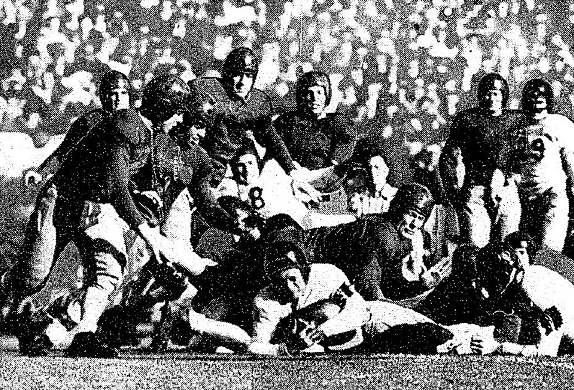
January 1, 1935: The 1st Orange Bowl is played, at Miami Field in Miami. Unlike in a few later appearances, having the home-field advantage did not help the University of Miami, as they lost to Bucknell University, 26-0.
The Bison defense held the Hurricanes to just 4 1st downs and 28 yards total offense en route to the victory. The Bucknell offense gained 278 yards, and earned its 6th shutout of the season.
The Orange Bowl was pattered after the Rose Bowl in Pasadena, California, with its pregame Tournament of Roses Parade. The Fiesta of the American Tropics parade was held in 1926, but there was no game. Then came the Florida land bust that year, and then the Great Depression in 1929, killing Florida tourism.
In 1932, trying to revive Florida tourism, Miami was ready to try again. A parade was held on January 1, 1933, and a Festival of Palms Bowl was played at Moore Park on January 2, with the University of Miami beating Manhattan College, 7-0. In 1934, again at Moore Park, Miami lost to Duquesne University of Pittsburgh. For the following season, the organizing committee received official sanction from the NCAA, and, for that reason, the 1935 edition was not only the 1st to carry the Orange Bowl name, but is recognized as the 1st Orange Bowl, rather than the 3 earlier Festival of Palms Bowls.
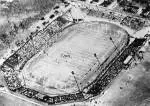
Miami Field
And so, every year, from 1936-37 to 2001-02, the King Orange Jamboree Parade would be held in downtown Miami on New Year's Eve, and the Orange Bowl on New Year's Day, except when January 1 fell on a Sunday, moving the game back to January 2. Traditionally, NBC televised both. The Parade's attendance dropped, and it was canceled in 2002.
Bucknell, in Lewisburg, Pennsylvania, downgraded its football program in 1948. In 1973, with the NCAA reclassifying, they were put in Division II. In 1978, they were promoted to Division I-AA, which was renamed the Football Championship Subdivision (FCS) in 2006. They have played at the same stadium since 1924. In 1989, it was renamed Christy Mathewson-Memorial Stadium, in honor of the school's most famous graduate, the New York Giants pitcher who was 1 of the 1st 5 players elected to the Baseball Hall of Fame.
Clarke Hinkle, star running back for the Green Bay Packers in the 1930s, before this Orange Bowl, remains Bucknell's greatest football player. They have never again appeared in a bowl game, and have never won a conference championship.
Miami, on the other hand, would have a decent football history until the 1980s, when they became a bit indecent, but also one of the best programs in the game. In 1937, they moved into Burdine Stadium, built on the site of Miami Field, named for the late Roddy Burdine, department store owner and major booster of the City of Miami. The stadium was renamed the Miami Orange Bowl in 1959, and would host 5 Super Bowls, including the New York Jets' famed upset of the Baltimore Colts in Super Bowl III.

The Miami Dolphins played at the Orange Bowl from 1966 to 1986, then moved into Joe Robbie Stadium in suburban Miami Gardens in 1987. The Orange Bowl game was first played there in 1997 and 1998, moved back to its namesake stadium in 1999, and has been played at the Miami Gardens facility, now named Hard Rock Stadium, from 2000 onward. The University of Miami last played at the Orange Bowl in 2007, and moved to Miami Gardens. The stadium was demolished in 2008, and the new home of the Miami Marlins, now named LoanDepot Park, opened on the site in 2012.

From 1968 to 1996, the Champion of the Big Eight Conference was officially awarded a berth in the Orange Bowl, something that had unofficially been done since 1954. It was accepted all but twice, by Nebraska in 1974 and 1975, in favor of a better shot at the National Championship. They paid dearly for this, losing both times. Since the 2014 season, the Champion of the Atlantic Coast Conference has been guaranteed a berth in the Orange Bowl, unless it qualifies for the National Championship Playoff.
The Orange Bowl has featured 16 teams that won the National Championship for the preceding calendar year: Miami in 1988 and 1992; Oklahoma in 1954, 1987 and 2001; Nebraska in 19871, 1972, 1995 and 1997; Georgia Tech in 1952; Alabama in 1965; Clemson in 1982; Notre Dame in 1990; Colorado in 1991; and Florida State in 1994.
*
January 1, 1935 was a Tuesday. This was also the day the 1st Sugar Bowl was played, at Tulane Stadium in New Orleans. Tulane University beat Temple University, 20-14. I have a separate entry for that event.
Also on this day, the Rose Bowl was played at the stadium of the same name, outside Los Angeles in Pasadena, California. Alabama completed an undefeated season, ruining Stanford's, 29-13.
And the entire National Hockey League was in action:
* The New York Rangers lost to the Boston Bruins, 5-2 at the Boston Garden.
* The New York Americans beat the Montreal Canadiens, 5-3 at Madison Square Garden.
* The Detroit Red Wings beat the Toronto Maple Leafs, 1-0 at Maple Leaf Gardens in Toronto.
* And the Montreal Maroons beat the Chicago Black Hawks, 2-1 at the Chicago Stadium.


No comments:
Post a Comment