Showing posts with label ireland. Show all posts

Sunday, November 27, 2022

November 27, 1975: The Assassination of Ross McWhirter

The McWhirter Twins, 1974: Norris (left) & Ross

November 27, 1975: Ross McWhirter, with his twin brother Norris a sportswriter, co-founder of The Guinness Book of World Records, and a Conservative Party activist, is assassinated outside his home in Enfield, North London. He was 50 years old.

The twin brothers were born on August 12, 1925 in North London, and both served in the Royal Navy in World War II, on a minesweeper. They became sports journalists. In 1951, they published Get to Your Marks, and earlier that year they had founded an agency to provide facts and figures to Fleet Street, the catch-all name for British newspapers, even if they were no longer based on the London street of that name.

In 1954, Norris served as the public address announcer for the track meet at Oxford University in which Roger Bannister became the 1st man to run a mile race in under 4 minutes. Also competing that day was Christopher Chataway, who worked for the Guinness brewery, and introduced them to his boss, Sir Hugh Beaver.

The following year, the 1st Guinness Book of World Records was published, billed as the ultimate settler of bar bets. It quickly became the biggest-selling book in Britain, setting a world record itself, and eventually became more famous than the stout itself. In 1965, the twins were guests on the American panel game show I've Got a Secretwhere they exhibited their memorization of their book.

Both brothers became Conservative Party activists. Both ran for seats in Parliament in the 1964 general election, but were unsuccessful. Norris tried again in 1966, and lost again. In 1972, Prime Minister Edward Heath, Leader of the Conservative Party, brought Britain into the European Common Market. Norris called it "treason." In a 2017 article in The Guardian, Stuart Jeffries called him "the original Brexiter":

Imagine, if you dare, that Katie Hopkins is also the status guru on Test Match Special. Or that Nigel Farage is renowned not just as the beef-faced broker who got us out of the EU but for his astute postgame analysis on Match of the Day.

Neither of these comparisons really does justice to Norris McWhirter. He was something else. He was alt-right before the term was invented. 

(For readers not familiar with British politics: Hopkins is a newspaper columnist, known for her anti-immigrant views; Farage was the longtime leader of the far-right UK Independence Party, and claims to be the person most responsible for Britain finally leaving the European Union, the process known as "Brexit"; Test Match Special is a TV show about cricket; Match of the Day, about soccer. And, yes, there is another show on British TV, called Soccer Saturday, so they don't always call that sport "football.")

Ross advocated and lobbied for various restrictions on the freedom of the Irish community in Britain, such as compulsory registration with the local police, and a requirement for signed photographs when renting flats or booking hotel rooms. If that sounds like something that Donald Trump would like, that's not my fault.

In 1975, Ross McWhirter offered a £50,000 reward -- in 2022 money, about £342,000; with the current exchange rate, about $415,000 -- for information leading to a conviction for several recent high-profile bombings in England that were publicly claimed by the Provisional Irish Republican Army (IRA).

On November 27, at 6:45 PM, he was shot by 2 members of the Balcombe Street Gang. The killers were Harry Duggan and Hugh Doherty. Duggan said later, "McWhirter thought he lived in Texas. He put a bounty on our heads. He asked to be killed."

No, he didn't. Being a right-wing jerk is not an invitation to murder. And killing him didn't accomplish anything.

Duggan and Doherty were captured 9 days later, and charged with his murder and 10 others. They were sentenced to life imprisonment, but freed in 1999 under the terms of the Good Friday Agreement. As of November 27, 2022, both men are still alive.

Norris McWhirter lived on, without his brother, as a union-bashing libertarian. With the election of the Conservatives, and of the twins' longtime friend Margaret Thatcher as Prime Minister, in 1979, his beliefs became, for the most part, official government policy.

He had medals cast and given to athletes boycotting the Olympics in Moscow in 1980, and publicly defended athletes who dared to resist the ban on playing sporting events in then-apartheid South Africa. Defenders of that state, in both Britain and America, defended by saying they weren't personally racist, themselves, but supported a regime that was openly anti-Communist. Of course, the implication was that the country's black activists were Communists.

Norris sold his interest in the Guinness Book in 1996, and died on April 19, 2004, at the age of 78.

*

November 27, 1975 was a Thursday. In America, it was Thanksgiving Day. Since 1934, that had meant that the Detroit Lions played at home. This would be their 1st T-Day game in the suburbs, and they lost, 20-0 to the Los Angeles Rams, at the Silverdome in Pontiac, Michigan.

Since 1966, Thanksgiving had meant that the Dallas Cowboys played at home. But this year, and again in 1977 (but not in 1976), the NFL deviated from Dallas, giving the home game to the football version of the St. Louis Cardinals. The Cards lost to the Buffalo Bills, 32-14 at Busch Memorial Stadium. The NFL might have been motivated to give St. Louis the game not because of the Cardinals, but because of their opponents: The Bills featured the most popular player in the League, running back O.J. Simpson.

One game was played in college football, the rivalry known as "Clean Old-Fashioned Hate": Georgia, then ranked Number 15, beat Georgia Tech, 42-26 at Grant Field in Atlanta.

Baseball was out of season. There were 3 games played in the NBA:

* The New York Knicks beat the Washington Bullets, 96-90 at the Capital Centre in the Washington suburb of Landover, Maryland.

* The Kansas City Kings beat the Cleveland Cavaliers, 95-91 at The Coliseum in the Cleveland suburb of Richfield, Ohio.

* And the Golden State Warriors beat the Milwaukee Bucks, 106-105 at the Milwaukee Exposition & Convention Center Arena, a.k.a. The MECCA. (It's now the UW-Milwaukee Panther Arena.)

And there was 1 game in the American Basketball Association: The Utah Stars beat the Kentucky Colonels, 128-126 in overtime at the Salt Palace in Salt Lake City, Utah. Despite the defeat, William "Bird" Averitt of the Colonels led all scorers on the night with 43 points. Ron Boone led the Stars with 34.

There were 2 games in the NHL. The Montreal Canadiens beat the New York Islanders, 2-1 at the Nassau Coliseum. And the League's Missouri teams played each other: The Kansas City Scouts beat the St. Louis Blues, 3-2 at the Kemper Arena (now the Hy-Vee Arena) in Kansas City. This may have been the Scouts' high point: A year later, they moved to Denver, becoming the Colorado Rockies. In 1982, they moved again, becoming the New Jersey Devils.

And there were 4 games in the World Hockey Association:

* The Indianapolis Racers beat the Winnipeg Jets, 3-1 at the Market Square Arena in Indianapolis.

* The Minnesota Fighting Saints beat the Cincinnati Stingers, 5-3 at the St. Paul Civic Center in St. Paul, Minnesota.

* The Calgary Cowboys beat the Phoenix Roadrunners, 5-1 at the Arizona Veterans Memorial Coliseum in Phoenix.

* And the San Diego Mariners beat the Quebec Nordiques, 5-1 at the San Diego Sports Arena (now the Pechanga Arena).

Monday, November 21, 2022

November 21, 1920: Croke Park's Bloody Sunday

November 21, 1920: Ireland has had a few tragic days in its history that have become known as "Bloody Sunday." This is one of them.

Michael Hogan, 24, was a player in Gaelic football, Ireland's take on the sport. He played right full back, and was Captain of the Tipperary County team. He was also an officer in the Irish Volunteers, a paramilitary organization whose declared primary aim was "to secure and maintain the rights and liberties common to the whole people of Ireland."

On November 21, 1920, with the Irish War of Independence ongoing, for Tipperary in a challenge match against Dublin County, at Croke Park in Dublin. During the game, officers of the Royal Ulster Constabulary, Protestants in the British Army, entered the stadium. In retaliation for General Michael Collins' "Squad" having killed 15 members of the Cairo Gang, a group of British Intelligence officers, earlier in the day, these "Black and Tans," already known and hated for their extrajudicial killings, and opened fire.

Hogan was 1 of 14 people killed. He died in the arms of his teammate, Tommy Ryan, who heard his last words: "Jesus, Mary and Joseph, I'm done for." Another teammate, Jim Egan, was wounded, but survived.

This was the middle portion of an all-day assault by the RUC. In the morning, they opened fire at the Gresham Hotel. At night, they shot people at Dublin Castle. At least 30 people died on the day.
A modernized Croke Park

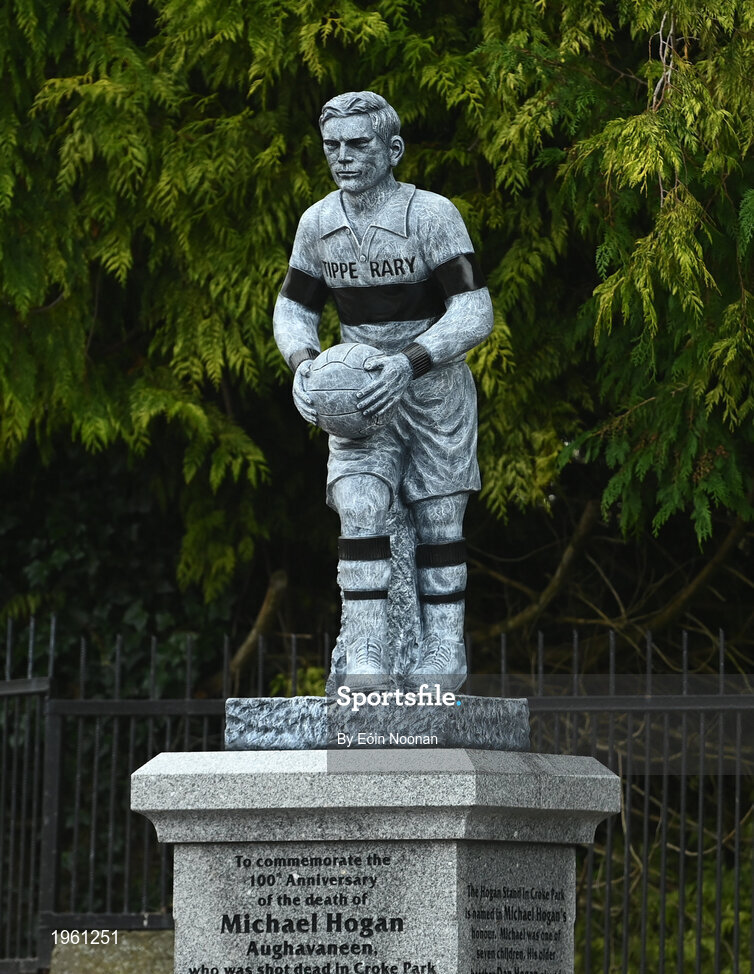
In 1924, a new stand was built at Croke Park. It was named the Hogan Stand in his memory. In 1999, as part of the stadium's redevelopment, a new Hogan Stand was built. A plaque at the now 82,300-seat stadium commemorates Bloody Sunday, including Hogan's death. A statue of Hogan has been dedicated in Tipperary.

Other "Bloody Sundays" in Ireland include August 31, 1913, when the Dublin Metropolitan Police killed 1 demonstrator and injured 400; July 10, 1921, when the IRA and the police fought in Belfast, with 20 dead, over 100 wounded, and over 200 houses destroyed; and January 30, 1972, "The Battle of the Bogside," when an intended peace demonstration in Derry was fired upon, killing 14 people.

*

November 21, 1920 was a Sunday. Baseball was out of season. The NBA hadn't been founded yet. And the NHL season was a month away from starting. The NFL was in its 1st season, then named the American Professional Football Association. There were 7 games played, and 6 of them ended in shutouts. This was not unusual for that era:

* The Rochester Jeffersons beat a cross-town team that wasn't in the NFL, the Rochester Scalpers, 16-0 at the Rochester Baseball Park in Rochester, New York.

* The Canton Bulldogs beat the Buffalo All-Americans, 3-0 at Canisius Field in Buffalo.

* The Cleveland Tigers beat the Toledo Maroons, 14-0 at League Park in Cleveland.

* The Akron Pros beat the Dayton Triangles, 13-0 at League Park in Akron, Ohio.

* The Columbus Panhandles and a non-NFL team, Zanesville Mark Gray, played to a 0-0 tie at Neil Park in Columbus, Ohio.

* The Chicago Cardinals beat a non-NFL team, Lansing Oldsmobile, 14-0 at Normal Park on the South Side of Chicago.

* And the Decatur Staleys, the team that would become the Chicago Bears, beat the Hammond Pros, 28-7 at Staley Field in Decatur, Illinois.

Tuesday, November 1, 2022

November 1, 1920: William Butler Yeats Publishes "The Second Coming"

November 1, 1920: American literary magazine The Dial publishes "The Second Coming," a poem by William Butler Yeats.

Born on June 13, 1865 on the Southside of Dublin, Ireland, Yeats (pronounced like "yates") was a Protestant who became fascinated by poetry and by early Irish legends. He was first published in 1889, but by 1900, his poetry grew more physical and politicized.

With Ireland still in the British Empire, and its men forced to fight for an occupying force in World War I, leading to the Easter Rising of 1916 and the Irish struggle for independence, Yeats wrote "An Irish Airman Foresees His Death," published in 1919 after the war's end:

I know that I shall meet my fate
Somewhere among the clouds above;
Those that I fight I do not hate
Those that I guard I do not love.

World War I scarred so many, in so many ways. And, though they began during the war, neither the Irish struggle for independence nor the Spanish Flu epidemic ended with it. Indeed, Yeats' wife, Georgia Hyde-Lees, caught the flu, while pregnant, and she and the baby barely survived.

Things really did seem to be falling apart, and Yeats' poem "The Second Coming," rather than suggest the Second Coming of the Messiah, seemed to suggest the end of the world:

Turning and turning in the widening gyre
The falcon cannot hear the falconer;
Things fall apart; the centre cannot hold;
Mere anarchy is loosed upon the world,
The blood-dimmed tide is loosed, and everywhere
The ceremony of innocence is drowned;
The best lack all conviction, while the worst
Are full of passionate intensity.

Surely some revelation is at hand;
Surely the Second Coming is at hand.
The Second Coming! Hardly are those words out
When a vast image out of Spiritus Mundi
Troubles my sight: somewhere in sands of the desert
A shape with lion body and the head of a man,
A gaze blank and pitiless as the sun,
Is moving its slow thighs, while all about it
Reel shadows of the indignant desert birds.
The darkness drops again; but now I know
That twenty centuries of stony sleep
Were vexed to nightmare by a rocking cradle,
And what rough beast, its hour come round at last,
Slouches towards Bethlehem to be born?

In 1923, Yeats was awarded the Nobel Prize for Literature. He died on January 28, 1939, at the age of 73, having survived the post-World War I "mere anarchy," and the Great Depression, but knowing that World War II was on the horizon. Shortly before his death, he published "The Municipal Gallery Revisited," in which he wrote, "Think where man's glory most begins and ends, and say my glory was I had such friends."

Georgie lived on until 1968. Daughter Anne, born during the Spanish Flu epidemic, became a costume and stage designer, and then an esteemed painter, and lived until 2001. Son Michael became a lawyer, and was elected to the Irish Senate, the Seanad Éireann. He lived until 2007, and the poet's genetic line continues through Michael's children and grandchildren.

*

November 1, 1920 was a Monday. There were 2 other reasons that this was a big day in the history of writing. Eugene O'Neill's play The Emperor Jones premiered on Broadway. I have a separate entry for that event. And conservative newspaper columnist James J. Kilpatrick was born.

Baseball was out of season. Football was in midweek. Professional basketball barely existed. And the NHL season didn't start until December 22. So there were no scores on this historic day.

Monday, October 31, 2022

November 1, 1884: The Gaelic Athletic Association Is Founded

November 1, 1884: The Gaelic Athletic Association is founded at Hayes's Hotel in Thurles, County Tipperary, in what's now the Republic of Ireland. The GAA governs the traditional Irish sports such as hurling and Gaelic football -- but not Irish soccer, which is governed by the Football Association of Ireland (FAI). The Northern Ireland equivalent is the Irish Football Association (IFA).
For decades, Irish athletes resisted the sports that England were first to organize: Association football (soccer), rugby, and cricket. So they developed their own version of football, and rounders (a baseball-like game then less popular in England than cricket), and hurling. For girls, the game of canogie was invented, sort of a cross between field hockey and lacrosse.
By the 1960s, the growth of television allowed Irish people to see English sports more easily, and they decided to try to, literally, beat the English at their own games. An Ireland rugby team, made up of both Republic of Ireland players and Norther Ireland players, has been very successful. In soccer, though the Republic team (run by the Football Association of Ireland, or FAI) and the Northern Ireland team (run by the Irish Football Association, or IFA) remain separate, and tend not to do well.
The GAA also promotes Irish music and dance, as well as the Irish language, and it also promotes environmental stewardship through its Green Clubs initiative. Today, it is headquartered at Croke Park, the 82,300-seat national stadium, in Dublin. A GAA museum is at the stadium.
*
November 1, 1884 was a Saturday. In America, baseball was the most popular sport, especially among its many Irish immigrants, but the season was over. But some Irish turned to American-style football, due to its closer to resemblance to the Gaelic version and rugby than to English soccer. These were still the early days of college football, and only 4 games were played that day:
* Wesleyan University, of Middletown, Connecticut, beat Harvard, 16-0 at the Hartford Ball Club Grounds in Hartford, Connecticut.
* Rutgers beat Lehigh, 61-0 at College Field in New Brunswick, New Jersey.
* The College of New Jersey, renamed Princeton University in 1896, beat Stevens Institute of Technology, of Hoboken, New Jersey, at University Field in Princeton, New Jersey.
* And the University of Pennsylvania beat Lafayette, 21-0 at the University Athletic Grounds in Philadelphia.

Monday, October 3, 2022

October 3, 1992: Sinéad O'Connor Rips the Pope

October 3, 1992: Sinéad O'Connor is the musical guest on Saturday Night Live. She sings Bob Marley's "War" a cappella, then shows a picture of Pope John Paul II, tears it in half, and yells, "Fight the real enemy!"

At the time, it was unclear what point she meant to make by this action and these words, which seemed to condemn the Catholic Church, and the then-current Pope in particular. The American media condemned her to the point that whatever her message was became completely ignored.

She was trying to make a point about how the Church had abused children, boys and girls alike, in many ways, in her native Ireland and elsewhere. Neither her career nor her life has ever recovered. She threw her career away for the truth, but blaming the most popular Pope of all time did no one any favors.

Born as Sinéad Marie Bernadette O'Connor on December 8, 1966 in Dublin, she had been launched to stardom with her 1987 album The Lion and the Cobra, and had hit Number 1 with a cover of Prince's "Nothing Compares 2 U" in 1990. But the SNL incident ended her run as a star.

Just a few days later, she was one of the performers at the Bob Dylan tribute concert at Madison Square Garden in New York, and was booed off the stage. Master of ceremonies Kris Kristofferson, who had cited her courage in introducing her, hugged her, and said, "Don't let the bastards get you down."

But they did. She never had another hit. She explored other avenues of religion, becoming a priest in a radical offshoot of the Catholic Church; then later converting to Islam, taking the name Shuhada' Sadaqat. But she didn't seem to find peace in either of her new attempts at religion. A few times in the 2010s and early 2020s, she had threatened suicide, and even disappeared for a few days.

She married 4 times, and had 4 children. But on January 7, 2022, her son Shane, only 17, committed suicide. She canceled her planned tour, and an album she was set to release was postponed indefinitely.

John Paul must have learned something from the experience, because he made more of an outreach to more people than any other Pope. Time magazine named him their Man of the Year for 1994.

UPDATE: Sinéad O'Connor died on July 26, 2023, at the age of 56. An autopsy listed the cause of death as Chronic obstructive pulmonary disease (COPD).

*

October 3, 1992 was a Saturday. These Major League Baseball games were played that day:

* The New York Yankees lost to the Boston Red Sox, 7-5 at Fenway Park in Boston. Don Mattingly went 1-for-4 with an RBI, and Wade Boggs went 1-for-2 before being removed for a pinch-hitter. Wade Boggs, removed for a pinch-hitter? It worked: Phil Plantier hit a home run.

* The New York Mets beat the Pittsburgh Pirates, 2-1 at Shea Stadium. Dwight Gooden went the distance for the win, and Dave Gallagher went 3-for-4. Eddie Murray went 0-for-3 for the Mets. Barry Bonds went 0-for-3.

* The Atlanta Braves beat the San Diego Padres, 1-0 at Atlanta-Fulton County Stadium, in a game shortened to 6 innings due to rain. Tony Gwynn did not play.

* The Toronto Blue Jays beat the Detroit Tigers, 3-1 at the SkyDome (now the Rogers Centre) in Toronto.

* The Baltimore Orioles beat the Cleveland Indians, 7-1 at Cleveland Municipal Stadium. Cal Ripken went 3-for-5 with a home run and 3 RBIs.

* The Cincinnati Reds beat the San Francisco Giants, 6-1 at Riverfront Stadium in Cincinnati.

* The Montreal Expos beat the Chicago Cubs, 3-1 at Wrigley Field in Chicago.

* The Kansas City Royals beat the Minnesota Twins, 7-6 at Royals Stadium in Kansas City. (It was renamed Kauffman Stadium the next season.) George Brett went 2-for-4 with 2 RBIs. Kevin Koslosfki singled home the winning run in the bottom of the 11th inning.

* The Philadelphia Phillies beat the St. Louis Cardinals, 3-2 at Busch Memorial Stadium in St. Louis.

* The Houston Astros beat the Los Angeles Dodgers, 3-2 at the Astrodome in Houston. Mike Simms singled home Craig Biggio in the bottom of the 13th inning. Before the game, the Houston Astros retired the Number 25 of former outfielder Jose Cruz Sr. and the Number 33 of former pitcher Mike Scott.

* The California Angels beat the Texas Rangers, 4-2 at Anaheim Stadium (now Angel Stadium of Anaheim). 

* The Oakland Athletics beat the Milwaukee Brewers, 10-3 at the Oakland Coliseum. The A's got home runs from Mark McGwire, Harold Baines, Scott Brosius and Mike Bordick. Rickey Henderson went 0-for-2 with 3 walks. Robin Yount went 0-for-3 with an RBI on a sacrifice fly. Paul Molitor went 1-for-2 with 2 walks.

* The Seattle Mariners beat the Chicago White Sox, 7-2 at the Kingdome in Seattle. Ken Griffey Jr. went 1-for-3 with a walk and 2 RBIs.

There was also college football that day, including these games:

* Number 1 and defending Co-National Champion University of Washington beat Number 20 Southern California, 17-10 at Husky Stadium in Seattle. Washington won the Pacific-10 Conference title.

* Number 2 Miami beat Number 3 Florida State, 19-16 at the Orange Bowl in Miami. For the 2nd season in a row, Florida State lost to Miami when a last-second field goal was missed. In 1991, it was "Wide Right I." In 1992, it was "Wide Right II."

Defending Co-National Champion Miami continued its undefeated streak through the regular season. Florida State won the Atlantic Coast Conference title, and beat Nebraska in the Orange Bowl. Nebraska won the Big Eight Conference title. This week, they were ranked Number 15, and were idle.

* Number 4 Michigan beat Iowa, 52-28 at Michigan Stadium in Ann Arbor. Michigan won the Big Ten Conference title, and beat Washington in the Rose Bowl.

* Number 5 Texas A&M beat Texas Tech, 19-17 at Kyle Field in College Station, Texas. A&M won the Southwest Conference title.

* Number 6 Notre Dame were upset by Number 18 Stanford, 33-16 at Notre Dame Stadium in South Bend, Indiana. Notre Dame still managed to reach the Cotton Bowl, where they beat Texas A&M.

* Number 7 Tennessee beat Louisiana State, 20-0 at Tiger Stadium in Baton Rouge, Louisiana.

* Number 8 Penn State beat Rutgers, 38-24 at Giants Stadium at the Meadowlands in East Rutherford, New Jersey. The attendance was 72,203, the largest crowd that Rutgers has ever had for what has been designated as a "home game" for them. The game is played there, instead of on campus at Rutgers Stadium in Piscataway, 36 miles away, because arch-rival Penn State bring so many fans, and attract so many fans from New Jersey and New York City, that it feels more like a home game for them.

* Number 9 Alabama beat South Carolina, 48-7 at Bryant-Denny Stadium in Tuscaloosa, Alabama. 'Bama went on to win the Southeastern Conference title, and beat Miami in the Sugar Bowl to end their streak and replace them as National Champions.

* Number 11 UCLA were upset by Arizona, 23-3 at Arizona Stadium in Tucson.

* Number 12 Ohio State were upset by Wisconsin, 20-16 at Camp Randall Stadium in Madison, Wisconsin.

* Number 23 Georgia Tech beat Number 21 North Carolina State, 16-13 at Grant Field in Atlanta.

* Navy lost to North Carolina, 28-14 at Kenan Memorial Stadium in Chapel Hill, North Carolina. Army were idle this week.

* And Princeton beat Lehigh, 38-29 at Goodman Stadium in Bethlehem, Pennsylvania.

And in English soccer, Arsenal beat West London team Chelsea, 2-1 at the Arsenal Stadium, a.k.a. Highbury, in North London.

Wednesday, September 21, 2022

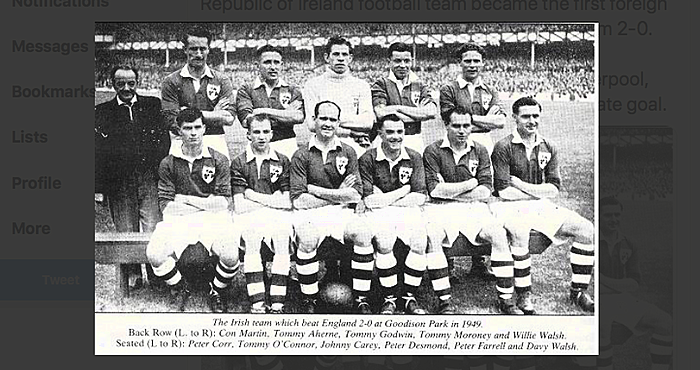
September 21, 1949: England 0-2 Ireland

September 21, 1949: The Republic of Ireland soccer team defeats England 2-0 at Goodison Park in Liverpool, the home ground of Everton Football Club. As a result, Ireland become the 1st non-United Kingdom team to defeat England on English soil.

Cornelius "Con" Martin of Birmingham team Aston Villa, and Peter Farrell of Everton (thus playing on his home pitch), scored the goals. Davy Walsh, a forward whose best years were with Belfast team Linfield, Birmingham-area team West Bromwich Albion, and Aston Villa (where he was a teammate of Martin), was the last survivor from this team, living until 2016.

Things would get worse for England over the next few years: In 1950, they participated in the World Cup for the 1st time, and were humiliated by the U.S. team; followed by shreddings at the hands of the "Magnificent Magyars" of Hungary in 1953 and 1954, and poor performances in the 1954, 1958 and 1962 World Cups. It would take until 1966 for them to redeem themselves.

Ireland, however, were unable to follow up on this triumph. They didn’t make the World Cup until 1990 (reaching the Quarterfinals), doing so again in 1994 and 2002, but not since.

*

September 21, 1949 was a Wednesday. Basketball Hall-of-Famer Artis Gilmore was born.

And these baseball games were played that day:

* The New York Yankees lost to the Chicago White Sox, 10-9 at Yankee Stadium. The White Sox scored 3 runs in the 8th inning and 3 more in the 9th, to come from behind to win. Rocky Krsnich and Gus Zernial hit home runs for the Pale Hose. Joe DiMaggio did not play.

* A doubleheader was split at Crosley Field in Cincinnati. The New York Giants lost the opener to the Cincinnati Reds, 5-4. Sheldon "Available" Jones should not have been so available, as he walked Danny Litwhiler with the bases loaded in the bottom of the 10th inning. The Giants won the nightcap, 5-2. The game was called due to rain after 7 innings.

* A doubleheader was split at Sportsman's Park in St. Louis. The St. Louis Cardinals won the opener, 1-0. Max Lanier pitched a 5-hit shutout, outpitching Don Newcombe. The Brooklyn Dodgers won the nightcap, 5-0. Elwin "Preacher" Roe pitched a 2-hit shutout, while Harry Brecheen didn't get out of the 4th inning. Duke Snider hit a home run. Over the 2 games, Jackie Robinson went 0-for-6 with 2 walks, while tan Musial went 1-for-7.

* The Boston Red Sox beat the Cleveland Indians, 9-6 at Fenway Park in Boston. Ted Williams and Al Zarilla hit home runs for the Red Sox. Ellis Kinder won his 22nd game of the season.

* The Detroit Tigers beat the Philadelphia Athletics, 4-1 at Shibe Park in Philadelphia.

* The Washington Senators beat the St. Louis Browns, 7-0 at Griffith Stadium in Washington. Dick Welk pitched a 3-hit shutout.

* The Boston Braves beat the Pittsburgh Pirates, 9-7 at Forbes Field in Pittsburgh. Ralph Kiner hit 2 home runs for the Bucs, but it wasn't enough.

* And a doubleheader was split at Wrigley Field in Chicago. The Philadelphia Phillies won the 1st game, 3-1. The Chicago Cubs won the 2nd game, 9-6.

Sunday, August 21, 2022

August 22, 1922: The Assassination of Michael Collins

August 22, 1922: Michael Collins is assassinated in Béal na Bláth, County Cork, Ireland. He was only 31 years old.

"The Big Fellow" was born 19 miles away, also in County Cork, in Woodfield. Here, sports led to larger history. At the time, the entirety of Ireland was still part of the British Empire. Collins' father, and most of the male role models he sought out after he was 6, when his father died, had been involved in Ireland's occasional rebellions.

Nevertheless, at age 15, he took a civil service exam, passed it, and was rewarded with a job in London, the Empire's capital. While living there, he was a member of the London County Board of the Gaelic Athletic Association, the governing body for traditional Irish sports such as "Gaelic football" and hurling. So sports had an effect on history in this case: This association brought him into contact with rebels trying to establish Irish independence. In 1915, he moved to New York to work in a bank, a job that lasted one year.

Thus, the executions of the Easter Rising of 1916 did not include him. Indeed, the removal of several of the cause's leaders meant that others had to step in, and this aided his rise through the ranks. His background, working in banks in the Irish communities of London and New York, led to his appointment as the Minister for Finance in the early Republic of Ireland. He became Adjutant General for the Irish Volunteers, and became renowned for his guerrilla warfare strategy.

Sent to London to negotiate peace terms, he was offered a treaty that would establish the Irish Free State -- with an Oath of Allegiance to the Crown. The British Crown, held by King George V. In other words, this "Free State" would have another nation's head of state as its own -- just like Canada, Australia, and a few other "independent nations." Collins accepted this compromise, calling it "the freedom to achieve freedom." Some in the Provisional Government did not, and the end of the Irish War of Independence led to the beginning of the Irish Civil War.

Collins was named Chairman of the Provisional Government and commander-in-chief of the National Army. On August 22, 1922, returning from a visit to Cork City, a rebel stronghold, his convoy stopped at around 7:15 PM, at a bar called Long's Pub. It is now named the Diamond Bar. They were ambushed.
A recent photo of the Diamond Bar

Collins' aide, Emmet Dalton (as far as I know, no relation to the outlaw of the same name in 19th Century America's Wild West), ordered the driver of Collins' armored car to "Drive like hell!" But Collins said, "No, stop, and we'll fight 'em!" A great example of "famous last words." Collins jumped out of the vehicle with his Lee Enfield rifle. He and his men fired from behind the car, which had a Vickers machine gun. But the Vickers jammed, and was of no use.
Collins' car, restored

Collins moved back, his men presuming that it was to get a better view. He got off a couple of shots, and was reloading when he was hit in the head from a shot by former British Army sniper Denis "Sonny" O'Neill, a native of West Cork who had met Collins on a few occasions, before the split in the Irish nationalist ranks. Collins was the only man to die in the firefight.

O'Neill was granted a pension by the post-civil war government, and worked for a board of elections before dying peacefully in 1950.

Collins was played by Brendan Gleeson in the 1991 made-for-TV film The Treaty, by Liam Neeson in the 1996 film Michael Collins, and by Gavin Drea in the 2019 film Resistance.

*

August 22, 1922 was a Tuesday. These Major League Baseball games were played that day:

* The New York Yankees lost to the Cleveland Indians, 6-2 at the Polo Grounds. Bullet Joe Bush was outpitched by George "the Mule" Uhle. Babe Ruth went 0-for-4, but he did drive in a run with a groundout. Tris Speaker not only managed the Indians to victory, but hit a home run.

* The New York Giants beat the Cincinnati Reds, 7-3 at Redland Field in Cincinnati. It was renamed Crosley Field in 1934.

* The Brooklyn Robins beat the Chicago Cubs, 5-4 at Cubs Park in Chicago. From 1914 to 1931, while Wilbert Robinson was their manager, the Dodgers were officially named the Robins. Cubs Park was renamed Wrigley Field in 1926.

* The St. Louis Browns beat the Boston Red Sox, 9-4 at Fenway Park in Boston. Urban Shocker, a once-and-future Yankee, outpitched Herb Pennock, a future Yankee.

* The Detroit Tigers swept a doubleheader from the Philadelphia Athletics at Shibe Park in Philadelphia. The Tigers won the opener, 6-4; and the nightcap, 17-3. Over the course of the 2 games, Ty Cobb went 4-for-10. Bobby Veach homered for the Tigers in both games.

* A doubleheader was split at Griffith Stadium in Washington. The Washington Senators won the 1st game, 4-2. The Chicago White Sox won the 2nd game, 3-0. Frank Mack pitched a 5-hit shutout, and got 2 hits to support his own cause.

* The Pittsburgh Pirates beat the Philadelphia Phillies, 4-3 at Forbes Field in Pittsburgh.

* The Boston Braves and the St. Louis Cardinals appear not to have been scheduled to play. 

Sunday, August 14, 2022

August 15, 1892: William E. Gladstone Forms His Last Government

August 15, 1892: Having led his Liberal Party to the lead, but not a majority, in the recent general election, William Ewart Gladstone brings the Members of the House of Commons who belong to the Irish Nationalist Party into his coalition, forming a majority. He goes to Queen Victoria, and tells her, "I can form a government." Not really having the power to stop him, she lets him.

The Queen was 73 years old. The Prime Minister was 82, the oldest man ever to hold that office. (For comparison's sake, Joe Biden was elected President in 2020, just short of turning 78.) It is the 4th separate time that Gladstone had held the office.

Gladstone (the E was silent) was born on December 29, 1829 in Liverpool, the son of John Gladstone, a Scot who served in Parliament in the 1810s and 1820s. William was first elected to the House of Commons in 1832, to Robert Peel's faction of the Conservative Party. In 1846, Peel's faction broke away, and formed the Liberal Party.

He served in the Cabinets of 3 Liberal Prime Ministers: George Hamilton-Gordon, 4th Earl of Aberdeen; Henry John Temple, 3rd Viscount Palmerston; and John Russell, 1st Earl Russell. Under each of them, it included tenure as Lord of the Exchequer, Britain's equivalent to the Secretary of the Treasury.

His policies emphasized equality of opportunity and opposition to trade protectionism, which would eventually, as he became Prime Minister, became known as Gladstonian Liberalism, and earned him the nickname "The People's William." It also earned him initial nicknames, long before America ever had FDR or JFK: He was known by his actual initials as "WEG," and, eventually, as "the GOM," short for "the Grand Old Man."

When the Liberal Party gained a majority in the 1868 general election, Gladstone was named Prime Minister, taking office for the 1st time on December 3, succeeding the Conservative Leader, Benjamin Disraeli. The rivalry between the 2 men defined an era in British politics, and on February 17, 1874, having lost an election, Gladstone had to give way to Disraeli.

He regained the office on April 23, 1880, his election victory putting an end to Disraeli's career, and starting those of his sons Henry and Herbert Gladstone, who were also elected to Parliament. As in his first term, he pushed for easing of poverty, university reform, fairness toward Ireland, and a conciliatory foreign policy.

This time, what became known as "the Scramble for Africa" was on, and he opposed it. The victory in the Anglo-Egyptian War of 1882 was the highlight of his tenure, but the fall of Khartoum in the Sudan, including the death of the popular British commander George Gordon, led to the worst press treatment of his career. Critics inverted his nickname "GOM" into "MOG," for "Murderer of Gordon." Queen Victoria herself wrote him a telegram rebuking him, but offered him an earldom if he would resign. He resigned on June 9, 1885, but refused the earldom, which won him back some admirers.

But the new Conservative government of Robert Arthur Talbot Gascoyne-Cecil, 3rd Marquess of Salisbury, fell apart quickly over the issue of Irish Home Rule, in part due to a press release by Herbert Gladstone. (And you had a problem with Hunter Biden?) On February 1, 1886, Charles Stewart Parnell, known as "the Uncrowned King of Ireland," took his Irish Parliamentary Party out of Lord Salisbury's government, and allied with the elder Gladstone, who became Prime Minister for the 3rd time.

But rural voters in what had been Gladstone constituencies were not ready to support anything other than London domination of Ireland, and several Liberal Party members left, forming the Liberal Unionist Party. On July 21, 1886, not even 6 months after taking charge again, Gladstone was out for the 3rd time, and Salisbury was in for the 2nd.

But the Grand Old Man was not done. In 1889, he supported the London dockers' strike, regaining much of his former working-class support. An election in 1892 resulted in a minority government, and Gladstone once again cut a deal with Irish Members of Parliament to become Prime Minister for the 4th time on August 15. He got a Home Rule bill through the Commons on September 1, 1893, but the House of Lords overwhelmingly rejected it on September 8. He wanted to call a general election, on the sole subject of that bill, immediately, but was talked out of it.

Gladstone was the first Prime Minister to make it a condition of ministers to resign directorships of public companies in 1892. This was abandoned by Salisbury in 1895, but was restored by Liberal Henry Campbell-Bannerman in 1905, and has been observed ever since.

Gladstone decided to resign the Premiership, ostensibly on health grounds, on March 2, 1894. At 84, he remains the oldest person ever to hold the office. He had held the post for roughly 12 of the preceding 24 years. He resigned from Parliament the next year, after 63 years.

In his last years, he warned against "militarism" and "jingoism," apparently foreseeing the crisis that would result in World War I. He did not, however, foresee the Liberal Party's collapse, and its effective replacement by the Labour Party, in the decade after that. He died on May 19, 1898, at the age of 88, and was laid to rest in Westminster Abbey.

*

August 15, 1892 was a Monday. These games were played in baseball's National League:

* The New York Giants beat the Cincinnati Reds, 9-2 at League Park in Cincinnati.

* The Brooklyn Bridegrooms lost to the St. Louis Browns, 3-2 at an early version of Sportsman's Park in St. Louis. In the 1887-88 off-season, 6 players from the team formerly known as the Brooklyn Grays got married, so people began calling the team the Bridegrooms. In 1911, they took the name Dodgers. In 1900, the Browns became the Cardinals.

* The Washington Senators beat the Pittsburgh Pirates, 4-2 at Exposition Park in Allegheny, across the River of the same name from Pittsburgh proper. In 1907, Allegheny was annexed into Pittsburgh.

* The Boston Beaneaters beat the Cleveland Spiders, 5-0 at the 1890-1909 version of League Park in Cleveland. The Beaneaters went threw a few name changes before settling on "Braves" in 1912.

* The Philadelphia Phillies beat the Louisville Colonels, 2-1 at Eclipse Park in Louisville, Kentucky.

* And the Baltimore Orioles beat the Chicago Colts, 9-2 at South Side Park in Chicago. The Orioles, the Senators, the Spiders and the Colonels were all consolidated out of business by the NL after the 1899 season. In 1903, the Chicago franchise became the Cubs.

Saturday, August 13, 2022

August 13, 1914: "It's a Long Way To Tipperary" Becomes Britain's Song of World War I

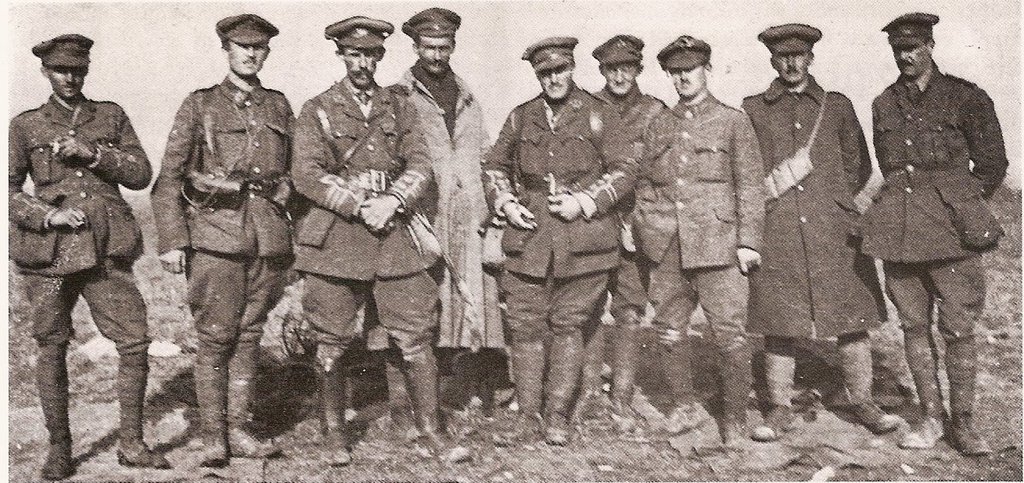
Soldiers in the Connaught Rangers

August 13, 1914: "It's a Long Way To Tipperary" is sung by the Connaught Rangers, an Irish unit in the British Army, as they marched through Boulogne, on the English Channel coast of France.

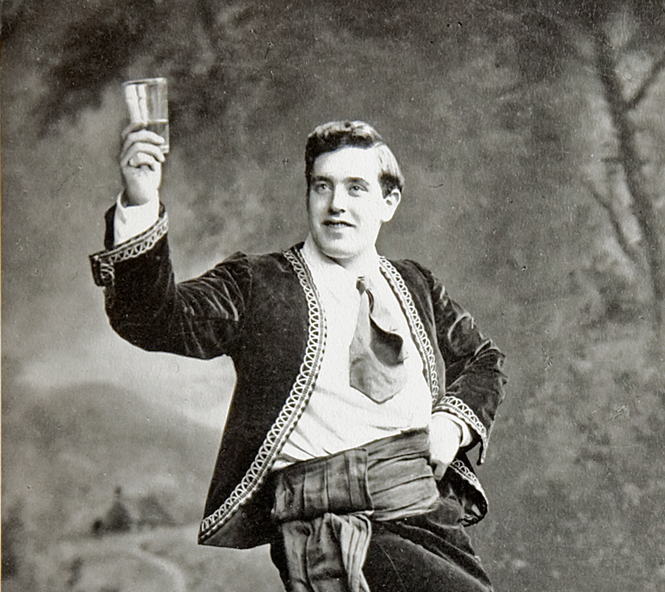
The song, written by composer Jack Judge (1872-1938) for a London music hall 2 years earlier, thus becomes identified with British soldiers, and is popularized further when popular tenor John McCormack (1884-1945) records it in November of that year.
John McCormack

Judge’s grandparents were from Tipperary, which is in County Tipperary, in the Province of Munster, in the south of what became, after 1922, the Republic of Ireland. For the record, Tipperary is 483 miles from London, 615 miles from Boulogne, and about 650 miles from World War I's Western Front – a long way by almost any measure, unless you're an astronaut.

It would take America until 1917 to enter "The Great War," and its song would be George M. Cohan's "Over There."

The song was revived in Charles Schulz' comic strip Peanuts, as Snoopy pretended to be a World War I flying ace; and was sung as a farewell by the main cast in the final episode of The Mary Tyler Moore Show. It was also adapted into a fight song for the University of Missouri.

Today, there are welcoming signs in central Tipperary, saying, "You've come a long way." According to Ireland's 2016 Census, it is home to just 4,979 people.

*

August 13, 1914 was a Thursday. That year, and the next, there were 3 major leagues in baseball.

In the American League: 

* The New York Yankees beat the Boston Red Sox, 1-0 at Fenway Park in Boston. Ray Fisher allowed 8 hits, but pitched a shutout, to defeat Hubert "Dutch" Leonard. Leonard's earned-run average rose to 0.94. He would finish at 1.01, the lowest in major league history. (Bob Gibson's 1.12 in 1968 is the lowest in the post-1920 Lively Ball Era.)

The only run came in the top of the 3rd inning, when Luke Boone -- no relation to later major leaguer Ray Boone, his son Bob Boone, or Bob's sons Bret Boone and Aaron Boone -- doubled Fritz Maisel home. Tris Speaker went 1-for-3. Babe Ruth had debuted for the Red Sox on July 11, but, still being only a pitcher, did not appear in this game.

* The Philadelphia Athletics beat the Washington Senators, 7-0 at Shibe Park in Philadelphia. Future Yankee ace Bob Shawkey pitched a 3-hit shutout.

* The Cleveland Naps beat the Detroit Tigers, 6-3 at League Park in Cleveland. Napoleon "Nap" Lajoie, the Cleveland team's manager, 2nd baseman, best hitter and namesake, went 1-for-2 with a walk and an RBI. "Shoeless" Joe Jackson went 2-for-3 with 3 RBIs. Ty Cobb went 1-for-3 with a walk. After this season, Lajoie left, and the team was renamed the Cleveland Indians.

* And the Chicago White Sox and the St. Louis Browns were rained out at Sportsman's Park in St. Louis. The game was made up as part of a doubleheader 3 days later. The ChiSox won the opener, 3-1. The Brownies won the nightcap, 9-7.

In the National League:

* The New York Giants lost to the Boston Braves, 5-3 at the Polo Grounds. Dick Rudolph outpitched Rube Marquard. The "Miracle Braves" were in the process of passing the Giants and winning the Pennant.

* The Brooklyn Dodgers beat the Philadelphia Phillies, 3-0 at Ebbets Field. Ed Reulbach pitched a 4-hit shutout. Zack Wheat went 1-for-1 with 2 walks.

* The Pittsburgh Pirates swept a doubleheader from the St. Louis Cardinals, 2-1 and 5-2 at Forbes Field in Pittsburgh. Over the 2 games, Honus Wagner went 3-for-7 with 2 RBIs.

* And the Chicago Cubs and the Cincinnati Reds were not scheduled.

And in the Federal League:

* The Brooklyn Tip-Tops beat the St. Louis Maroons, 1-0 at Handlan's Park in St. Louis. This game was stopped after 6 innings. Baseball-Reference.com does not list the reason, but, given the White Sox-Browns outcome, it was probably stopped by rain.

* The Indianapolis Hoosiers beat the Buffalo Blues, 2-1 at Federal League Park in Indianapolis.

* The Kansas City Packers beat the Baltimore Terrapins, 4-2 at Gordon and Koppel Field in Kansas City.

* And the Chicago Whales and the Pittsburgh Rebels were rained out at Weeghman Park in Chicago, the ballpark that would later become Wrigley Field. The game was made up the next day. The Rebels won, 5-3.

Monday, July 18, 2022

July 18, 1938: The Wrong-Way Flight of Douglas Corrigan

July 18, 1938: Douglas Corrigan writes his name in the book of the history of aviation. Many people involved in aviation at the time wished he hadn't.

Born in Galveston, Texas in 1907, he became fascinated with airplanes while growing up in Los Angeles, became an airplane mechanic, and got his pilot's license at age 19. Working in San Diego in April 1927, he was part of the assembly crew for the Spirit of St. Louis, which Charles Lindbergh used to fly solo across the Atlantic Ocean the next month, from New York's Long Island to Paris.

Intrigued by this success, Corrigan, of Irish descent, decided he wanted to fly from New York to Ireland. To raise money to buy his own plane, he performed aerobatic stunts. But this would inevitably get him fired from his mechanic jobs, and he moved around, delaying his dream trip.

In 1935, having finally assembled a Curtiss Robin, but with parts from various other planes -- similar to the later Johnny Cash song "One Piece at a Time" -- he applied to the Bureau of Air Commerce, forerunner of the Federal Aviation Administration (FAA), for permission to make a nonstop flight from New York to Ireland. Although the BAC deemed his plane fit for transcontinental flights over land, it did not think it was flightworthy for crossing water, and turned him down for that purpose.

He refused to accept that his dream was dead. He kept modifying his plane, and reapplying, but was always turned down. Finally, on July 9, 1938, he applied for permission to fly the plane from San Diego to Floyd Bennett Field in Brooklyn and back, and got it. Upon arrival at Bennett Field, he filed a flight plan to return to San Diego on July 17.

That morning, he asked Kenneth Behr, manager of Bennett Field, which runway he should use. Behr said he could use any runway, as long as he didn't take off to the west, in the direction of the administration building where Behr had his office, so that he didn't crash into it, which would not only have killed Corrigan, but left Behr without an office.

So Behr thought nothing of it when, at 5:15 AM on July 17, Corrigan took off from Runway 06, heading east, figuring Corrigan would, given sufficient ground clearance, turn around and head west. He had no reason to believe Corrigan was doing anything other than what he said he would do.

Corrigan had no radio, so he couldn't contact anyone and ask if he was going the right way. His compass was 20 years old, and may not have been working properly. After 10 hours of flight, Corrigan noticed that his feet were cold. He looked down, and saw that gasoline was leaking from one of his tanks. He took a screwdriver, and punched a hole through the cockpit floor, draining the gasoline. This fact, which he later freely admitted, would, alone, have contradicted his stated intention to fly west from Brooklyn to San Diego, and his later statement that he only noticed his "error" 26 hours into his flight.

On July 18, at 2:28 PM local time, 28 hours and 13 minutes into his flight, Corrigan landed -- not in San Diego, or anywhere else in the Western Hemisphere, but at Baldonnel Aerodrome, outside Dublin, Ireland. If anything, his flight was more audacious than Lindbergh's: He had not the best plane that money could have bought at the time, but, rather, a "flying coffin" that he had personally jerry-rigged; and he had no one who knew what he was really doing.

Those awaiting him on the ground in San Diego would receive word by telegraph that he had landed safely in Ireland. Had he crashed into the ocean, no one would have ever known what happened, and the searchers, from New York to California, would have been looking over 2,700 miles of the wrong place. He would have been just a footnote in the history of early aviation.

Instead, he was an instant celebrity, hailed by the press as "Wrong Way Corrigan." Aviation officials sent a 600-word telegram to list the regulations broken by his flight, in a medium that encouraged brevity by charging at a rate per word. Despite the extent of Corrigan's illegality, he received only a mild punishment: His pilot's certificate was suspended for 14 days.

Upon his return to New York -- he and his plane came back by ship, arriving on the last day of his suspension -- the City gave him a ticker-tape parade, and more people attended his than Lindbergh's. He accepted an invitation to meet President Franklin D. Roosevelt at the White House.

He had a ghostwritten autobiography, titled That's My Story (with the implied follow-up: "And I'm sticking to it!"), that came out in time to be given as a Christmas present. He sent Lindbergh a copy, and Lindbergh responded with a friendly 4-page handwritten letter. Corrigan endorsed "wrong-way" products, including a wristwatch that ran counter-clockwise.

In 1939, he played himself in the film The Flying Irishman. He was paid $75,000, about 30 years' worth of income as an airfield mechanic. In World War II, he tested newly-built bomber planes. Afterward, he was a commercial pilot for a small California airline, always arriving where he said he would -- although, given the nature of air travel, not always on time, not that it was usually his fault. In 1950, he bought an orange grove in the Los Angeles suburb of Santa Ana, California. He lived there with his wife and 3 sons.

In 1957, he appeared on the TV game show To Tell the Truth. With help from the 2 stand-ins, he stumped the panel, including fellow Irish-American Bill Cullen, although he continued to push the lie that he had arrived in Ireland by mistake. (Given the additional 19 years, and the fact that he hadn't been seen on TV frequently in the interim, it was very possible for the panelists not to recognize the real Corrigan.)

He died in 1995, at the age of 88, sticking to his story until the end. His plane is now on display at the Planes Of Fame Air Museum in the Los Angeles suburb of Chino, California.

*

July 18, 1938 was a Monday. British rock keyboard player Ian Stewart and Dutch film director Paul Verhoeven was born on this day.

Only 3 baseball games were played:

* The New York Giants lost to the Pittsburgh Pirates, 7-4 at Forbes Field in Pittsburgh. Paul Waner went 2-for-3 with a walk. Lloyd Waner went 1-for-3 with 2 RBIs. Mel Ott went 2-for-3 with a walk and an RBI.

* The Chicago Cubs beat the Boston Bees (as the Braves were known from 1936 to 1940), 7-6 at Wrigley Field in Chicago.

* And the St. Louis Cardinals beat the Philadelphia Phillies, 5-3 at Sportsman's Park in St. Louis.

Friday, July 8, 2022

July 8, 1990: The 1990 World Cup Final

Manager Franz Beckenbauer, Lothar Matthäus and Andreas Brehme

July 8, 1990: What has often been called the best World Cup ever staged reaches its Final. But that Final turns out to be -- for everybody but fans of the winning team -- a tremendous letdown.

Most of the major stadiums in Italy either received major renovations, or were torn down and completely replaced, in preparation for this World Cup. Two years later, Camden Yards opened in Baltimore, changing stadium and arena architecture forever. Instantly, Italian soccer had 12 major stadiums that went from great to obsolete almost overnight. Today, those stadiums range from merely outdated to in serious need of repair. One of them, a Semifinal host, didn't even last 20 years.

The U.S. team, in the World Cup for the 1st time in 40 years, did not make the Final. They didn't even come close to reaching the knockout stage. In their 1st game, on June 10, they lost, 5-1 to Czechoslovakia, at the Stadio Comunale in Florence. The only U.S. goal was scored by Paul Caliguiri, then playing his club soccer in Germany's lower divisions. (Czech captain Ivan Hašek was not related to later hockey goaltending legend Dominik.)

It could have been much worse. It was already 3-0 to the Czechs when Eric Wynalda, now one of the worst soccer pundits on Earth, was rightly sent off in the 52nd minute. Tony Meola, creator of the Kearny Mullet, was lucky not to be lit up for 10. The U.S. team was like a dog that chased cars, until one day he caught one... and then the car started, and backed up.

After that, the last thing the U.S. team needed in their 2nd World Cup match was to play the host country at their national stadium. Nevertheless, Italy at the Stadio Olimpico in Rome on June 14 it was. Italy fielded some serious legends: Franco Baresi, Giuseppe Bergomi, Paolo Maldini, Roberto Donadoni, Gianluca Vialli and Salvatore Schillaci. (Roberto Baggio was an unused substitute.) And we were going to face them, with our best players being the Kearny Army -- Tony Meola, John Harkes and Tab Ramos? Plus Rutgers University's Peter Vermes of Delran?
Left to right: Tab Ramos, John Harkes, Tony Meola

Giuseppe Giannini scored in the 11th minute, and the worst fears of U.S. fans seemed to be realized. But the U.S. defense held on long enough to give their attack a chance to tie it up. But it just wasn't going to happen. Now, even with a win in their last Group Stage game against Austria, it was unlikely the U.S. would advance to the knockout stage.

On June 19, the campaign ended not with a bang, but with a whimper. Back in Florence, we lost 2-1 to Austria. Bruce Murray, a D.C.-area native who later played in England for London club Millwall and retired as the U.S. team's all-time leading scorer, scored in the 85th minute to make a game of it. But that was it, despite Austria being down to 10 men for 2/3 of the match. (Both their goals came after Peter Artner was sent off with a straight red card.)

The U.S. would qualify for the 1994 World Cup -- as hosts. At least we made more out of that opportunity than with the one we actually earned for 1990.

*

Cameroon was a story, led by Roger Milla. Like baseball pitcher Leroy "Satchel" Paige and boxing champion Archie Moore, Milla seemed more myth than man, partly because he'd been operating for so long on a level that white people hadn't seen, and partly because there was great speculation as to how old he was. Officially, the forward had just turned 38, but some people thought he was older than that.

He had led Léopards Douala to his country's top league's title in 1972, '73 and '74. He had led Tonnerre Yaoundé, in his country's capital city, to the 1975 African Cup Winners' Cup. He went to France's top league, and won the Coupe de France with AS Monaco in 1980 and Corsican team SC Bastia in 1981. And he had led Cameroon to the African Cup of Nations in 1984 and '88.

In the Group Stage, he captained Cameroon to an opening victory over defending Champions Argentina at the San Siro in Milan, and a win over Romania in Bari, guaranteeing advancement, before a bad but meaningless loss to the Soviet Union in Bari.
Roger Milla

The Republic of Ireland was a story: While Northern Ireland had made the World Cup twice before, this was the 1st time the Republic had made it. And their 1st game was to be against arch-rivals England, on June 11, at Stadio Sant'Elia in Cagliari on the island of Sardinia. Gary Lineker of Tottenham Hotspur scored for England in the 9th minute, but Kevin Sheedy of Everton equalized in the 73rd, and the Boys In Green escaped with a 1-1 draw.
Kevin Sheedy

They went to Palermo, on the island of Sicily, and got a 0-0 draw with Egypt. Their last Group Stage game was against the Netherlands, the winners of Euro 88. They needed at least a draw to advance. They followed the same script as against England: They gave up an early goal, to Ruud Gullit in the 11th, and got a late equalizer, from Arsenal's Niall Quinn in the 71st. It ended 1-1, and they moved on.

Then came the knockout stage. Cameroon were put up against Colombia, at Stadio San Paolo in Naples. It was 0-0 after regulation. On to extra time, and Milla scored in the 106th and the 108th minute. They let in a goal in the 115th, but hung on for a 2-1 win.

It was the 1st time any African nation had qualified for the Quarterfinals. Algeria had qualified in 1934, but no African team was admitted again until FIFA began allowing a single qualifier in 1970, which turned out to be Morocco. Zaire was the only team in 1974, making them the 1st team from sub-Saharan Africa to qualify. Tunisia was the 1978 qualifier. They got 2 qualifiers for 1982, '86 and '90; and would get 3 in 1994, expanding to 5 for 1998. South Africa hosting in 2010 meant a 6th qualifier. (UPDATE: In 2022, Morocco became the 1st African team to reach the Semifinals. The expansion of the tournament to 48 teams for 2026 meant 10 African nations qualified.)

As for Ireland, the consensus was, "Okay, lads: You've had your fun, now it's time for some serious football. You're about to be eliminated by a real football nation, Romania." The Boys In Green either didn't get the message, or rejected it: At the Stadio Luigi Ferraris in Genoa, home to Genoa and Sampdoria, they held Romania scoreless through normal time and extra time, and went to penalties. And while Glasgow Celtic goalkeeper Patrick "Packie" Bonner came through on Romania's last spot-kick, Arsenal's ageless defender David O'Leary made Ireland's last, and they were through to the Quarterfinals.

They gave it all they had against Italy in Rome. But Salvatore Schillaci of Juventus scored in the 38th, and Italy won, 1-0. Cameroon had a little more to give, leading England 2-1 after 65 minutes in Naples. But England were awarded 2 penalties, an equalizer in the 83rd, and in extra time, in the 105th. Lineker converted both, and England won, 3-2.

*

Both Semifinals became legendary, much more so than the Final. On July 3, one Semifinal was held in Naples. Hosts Italy played defending champions Argentina, featuring Diego Maradona, the hero (and villain) of the 1986 World Cup. He had just led the venue's main tenant, SSC Napoli, to their 2nd national title in 4 seasons.
Diego Maradona

Maradona had asked the people of Naples to root for Argentina, against Italy. No chance: During the game, a banner was hung, reading, "Maradona, we love you, but Italy is our home." The game was 1-1 after normal time, it went to penalties, and Argentina won. They would play the winner of the next day's Semifinal.

That game was played on July 4, but there was nothing American about it. It was played in the rain at Stadio Delle Alpi in Turin, home to Juventus FC and Torino FC from 1990 until 2009. It was another showdown between England and (West) Germany.

England were managed by Bobby Robson, who had been a forward on their World Cup teams of 1958 and 1962, and was famed for leading Ipswich Town to the 1978 FA Cup and the 1981 UEFA Cup. West Germany were managed by Franz Beckenbauer, who captained their 1974 World Cup winners while starring for Bayern Munich.

Andreas Brehme, familiar with the stadium because he played his "club football" for Internazionale Milano, opened the scoring at the hour mark. Gary Lineker of North London team Tottenham Hotspur tied it up in the 80th minute, and the game went to extra time.

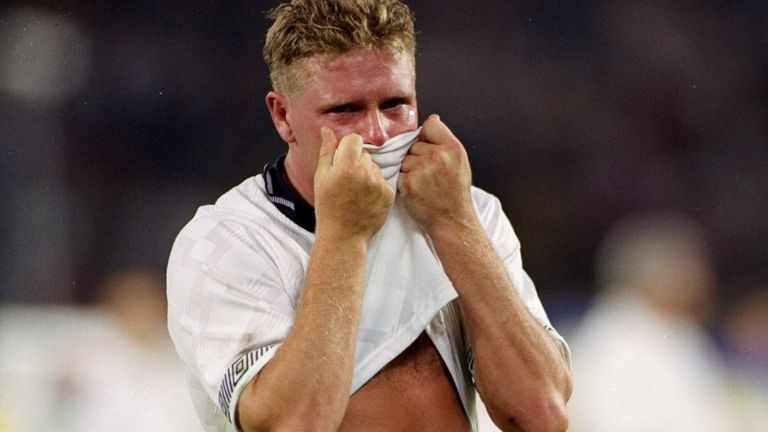
Lineker's Tottenham teammate, Paul Gascoigne, had been one of the heroes of the tournament. This Newcastle-area native with the great skills, but also the great self-destructive streak, had thrilled TV audiences, and "Gazzamania" was born. For the first generation of English people not old enough to remember their country's win in 1966, the 1990 edition remains their favorite World Cup.

But in extra time, in the 99th minute, Gazza fouled Thomas Berthold, another German player in the Italian league, playing for A.S. Roma. Gazza could remain in this game, but, due to yellow card accumulation, he would be suspended for the Final if England won this game. The sight of Gazza wiping both tears and rain out of his eyes became an iconic image, and summed up what happened to England in this tournament:

Lineker told Robson to substitute Gazza off, because his head was no longer in the game: Using a classic English expression, Lineker told Robson, "He's lost the plot!" Robson left him Gazza, but he was useless for the game's last 20 minutes. So much passion, so much promise, but, in the end...
Paul Gascoigne

In the end, Bodo Illgner, goalkeeper for F.C. Köln of Cologne, held off the penalty of Stuart Pearce, and Chris Waddle -- a former teammate of Gazza at Newcastle, and of both Gazza and Lineker at Spurs, now with French club Olympique de Marseille -- blasted his shot over the bar, and the Germans advanced to the Final. They'd lost the last 2 Finals, to Italy in 1982 and to Argentina in 1986. Now, they would play Argentina again.

But after 2 great Semifinals, the Final, on July 8 at the Stadio Olimpico, was an anticlimax. TNT, Turner Network Television, broadcast it live in the U.S. The Germans had a few chances in the 1st half, but could not capitalize on them. Argentina played its usual dirty game, and were getting away with it. Twice, the Germans appealed for penalties, on a handball in the box by Oscar Ruggeri in the 13th minute, and a dirty tackle in the box by Simón on Rudi Völler in the 18th. Referee Edgardo Codesal, born in Uruguay but a citizen of Mexico, refused to grant either. Argentina had just one chance in the half, late, but Maradona sent a kick over the crossbar.

In the 58th minute, Argentine goalkeeper Sergio Goycochea took Klaus Augenthaler down inside the penalty area. Again, Codesal refused to award a penalty. Finally, in the 65th minute, Pedro Monzón of Independiente became the 1st player ever sent off in a World Cup Final, with Codesal showing him a straight red card for a reckless studs-up challenge on Jürgen Klinsmann. Still, despite Argentina being down to 10 men, West Germany couldn't score.

Finally, in the 83rd minute, Roberto Sensini brought Völler down in the box, and Codesal awarded a penalty. Brehme took it, and it was 1-0 to West Germany.

Gustavo Dezotti had already been cautioned in the 5th minute. In the 87th, he received a straight red card when he hauled Jürgen Kohler down with what The New York Times described as a "neck tackle right out of professional wrestling." After dismissing Dezotti, Codesal was surrounded and jostled by the rest of the Argentinian team, with Maradona receiving a yellow card for dissent.

Argentina were down to 9 men, and they were lucky to end the game with that many. West Germany hung on for the 1-0 win, as their opponents now had over half of their intended squad unavailable due to injury or suspension.

Beckenbauer joined Brazil's Mário Zagallo as only the 2nd man to both play on and manage a World Cup winner. He has been followed by France's Didier Deschamps.

UPDATE: An article for ESPN.com, published after the 2026 World Cup, ranking all 23 tournaments, rated this one 16th, citing the amount of dull games seeming to cancel out the large amount of star power.

*

July 8, 1990 was a Sunday. These Major League Baseball games were played:

* The New York Yankees lost to the Minnesota Twins, 6-3 at Yankee Stadium. David West outpitched Tim Leary. Mike Blowers hit a home run, but it was a rotten season for the Yankees, who finished last for only the 4th time in their history -- and, through the 2021 season, the last.

* The New York Mets beat the Atlanta Braves, 2-1 at Atlanta-Fulton County Stadium. Frank Viola was the winning pitcher.

* The Houston Astros beat the Montreal Expos, 5-3 at the Olympic Stadium in Montreal.

* The Philadelphia Phillies beat the Cincinnati Reds, 4-3 at Veterans Stadium in Philadelphia.

* The Seattle Mariners beat the Toronto Blue Jays, 6-3 at the SkyDome (now the Rogers Centre) in Toronto. Ken Griffey Jr. went 2-for-4 with a walk.

* The Oakland Athletics beat the Cleveland Indians, 8-3 at Cleveland Municipal Stadium. Rickey Henderson went 1-for-3 with 2 walks, a stolen base and an RBI.

* The Detroit Tigers beat the Kansas City Royals, 10-4 at Tiger Stadium in Detroit. George Brett went 1-for-3 with 2 walks and an RBI.

* The Baltimore Orioles beat the Chicago White Sox, 8-6 at Comiskey Park in Chicago. Mike Devereaux doubled home 2 runs in the top of the 11th inning. Cal Ripken went 1-for-5.

* The Milwaukee Brewers beat the California Angels, 20-7 at Milwaukee County Stadium. The Brewers scored 6 runs in the 4th inning, and 13 in the 5th inning.

* The Texas Rangers beat the Boston Red Sox, 4-3 at Arlington Stadium in the Dallas suburb of Arlington, Virginia. Gary Pettis hit a ground ball that Boston shortstop Luis Rivera bobbled, allowing Jack Daugherty to score the winning run in the bottom of the 11th.

* The St. Louis Cardinals beat the San Diego Padres, 4-1 at Jack Murphy Stadium in San Diego. Tony Gwynn did not play.

* The Pittsburgh Pirates beat the Los Angeles Dodgers, 7-2 at Dodger Stadium in Los Angeles. Barry Bonds went 2-for-4 with a walk and 3 RBIs.

* And the San Francisco Giants swept a doubleheader from the Chicago Cubs, 5-3 and 10-4 at Candlestick Park in San Francisco.

December 31, 1999 & January 1, 2000: The Millennium

December 31, 1999:  The Millennium arrives. The people of planet Earth survived. At a terrible cost. But we hadn't destroyed ourselves. ...