Showing posts with label india. Show all posts

Monday, December 26, 2022

December 26, 2004: The Boxing Day Earthquake and Tsunami

December 26, 2004: An earthquake, measured at 9.2 on the Richter scale, occurs under the Indian Ocean, near the island of Sumatra in Indonesia.

The result is one of the largest tsunamis ever observed, which flowed east to west, with waves up to 30 feet high crashing into the coastal regions of the surrounding nations of Indonesia, Malaysia, Thailand, Myanmar, Bangladesh, India, Sri Lanka and the Maldives.

It remains the deadliest natural disaster of the 21st Century, and the worst on Earth since the 1976 Tangsun Earthquake in China. Its death toll is estimated at 227,898. More than half, 167,540, occurred in Indonesia. There were 35,000 deaths in Sri Lanka, 1,000 of them in a single train wreck caused by the tsunami. It is believed that 1.75 million people, roughly the population of Philadelphia, were left  homeless.

Among the notable people killed in the disaster were Jane Attenborough, British arts activist and a member of the show-business Attenborough family; Troy Broadbridge, an Australian Rules Football star who was on his honeymoon, though his wife survived; Poom Jensen, a grandson of the then-reigning King of Thailand; and Sujeewa Kamalasuriya, a Sri Lankan cricket star. 

The earthquake became known as the Sumatra-Andaman Earthquake. Another name, given that some of these nations were once part of the British Empire, and still retain some British traditions, including celebrating the day after Christmas as "Boxing Day," is the Boxing Day Tsunami.

Aid came in from all over the world: $820 million from nearby Australia, $660 million from Germany, $500 million from Japan, $350 million from the United States, $343 million from Canada, $250 million from the World Bank, $183 million each from Norway and the Netherlands, and $113 million from Italy.

*

December 26, 2004 was a Sunday. Pro Football Hall-of-Famer Reggie White and longtime New York Yankees organist Eddie Layton died that day.

Baseball was out of season. And the NHL team owners had locked the players out. These games were played in the NFL:

* The New York Giants lost to the Cincinnati Bengals, 23-22 at Paul Brown Stadium (now Paycor Stadium) in Cincinnati.

* The New York Jets lost to their arch-rivals, the New England Patriots, 23-7 at Giants Stadium in the Meadowlands.

* The Houston Texans beat the Jacksonville Jaguars, 21-0 at Alltel Stadium (now EverBank Stadium) in Jacksonville. The Texans and the Jags are in the same Division, the AFC South, as the Tennessee Titans. The irony of this is that the Titans used to be the previous Houston team, the Houston Oilers; and, before moving to Nashville, threatened to move to Jacksonville if they didn't get the lease concessions they wanted in Houston. They got them, but later decided it wasn't enough, and moved, anyway.

* The Carolina Panthers bear the Tampa Bay Buccaneers, 37-20 at Raymond James Stadium in Tampa.

* The Miami Dolphins beat the Cleveland Browns, 10-7 at Pro Player Stadium (now Hard Rock Stadium) in Miami Gardens, Florida.

* The New Orleans Saints beat their arch-rivals, the Atlanta Falcons, 26-13 at the Superdome in New Orleans.

* The Dallas Cowboys beat their arch-rivals, the Washington Redskins, 13-10 at Texas Stadium in the Dallas suburb of Irving, Texas.

* The Pittsburgh Steelers beat the Baltimore Ravens, 20-7 at Heinz Field (now Acrisure Stadium) in Pittsburgh.

* The Detroit Lions beat the Chicago Bears, 19-13 at Ford Field in Detroit.

* The Indianapolis Colts beat the San Diego Chargers, 34-31 at the RCA Dome (formerly the Hoosier Dome) in Indianapolis.

* The Buffalo Bills beat the San Francisco 49ers, 41-7 at Candlestick  Park (then named Monster Park) in San Francisco.

* The Seattle Seahawks beat the Arizona Cardinals, 24-21 at Qwest Field (now Lumen Field) in Seattle.

* The day before, Saturday, Christmas Day, The Kansas City Chiefs beat their arch-rivals, the Oakland Raiders, 31-30 at Arrowhead Stadium in Kansas City.

* Also on Christmas Day, the Denver Broncos beat the Tennessee Titans, 37-16 at The Coliseum (later renamed Nissan Stadium) in Nashville.

* The day before that, Friday, Christmas Eve, the Green Bay Packers beat the Minnesota Vikings, 34-31 at the Metrodome in Minneapolis.

* And the night after, on ABC Monday Night Football, the St. Louis Rams beat the Philadelphia Eagles, 20-7 at the Edward Jones Dome (now The Dome at America's Center) in St. Louis.

There were no college football bowl games. There were no games in the NHL: The team owners locked the players out for the entire season. There were 9 games in the NBA:

* The New York Knicks beat the expansion Charlotte Bobcats (later to reclaim the Hornets name), 91-82 at Madison Square Garden.

* The Houston Rockets beat the Los Angeles Clippers, 96-79 at the Toyota Center in Houston.

* The Cleveland Cavaliers beat the New Orleans Hornets (later to be renamed the Pelicans), 100-91 at the Gund Arena (now the Rocket Arena) in Cleveland.

* The Milwaukee Bucks beat the Chicago Bulls, 99-92 at the Bradley Center in Milwaukee. Michael Redd scored 39 points.

* The Minnesota Timberwolves beat the Washington Wizards, 109-74 at the Target Center in Minneapolis.

* The Dallas Mavericks beat the Denver Nuggets, 102-88 at the Pepsi Center (now the Ball Arena) in Denver. Dirk Nowitzki scored 36 points.

* The San Antonio Spurs beat the Boston Celtics, 107-90 at the SBC Center (now the Frost Bank Arena) in San Antonio.

* The Phoenix Suns beat the Toronto Raptors, 106-94 at the America West Arena (now the Mortgage Matchup Center) in Phoenix.

* And the Golden State Warriors beat the Sacramento Kings, 98-94 at the ARCO Arena in Sacrmamento.

And in English soccer, North London team Arsenal beat West London team Fulham, 2-0 at the Arsenal Stadium, a.k.a. Highbury.

Friday, December 2, 2022

December 2, 1984: The Bhopal Disaster

December 2, 1984: A pesticide plant owned Union Carbide leaks highly toxic methyl isocyanate gas in Bhopal, in the state of Madhya Pradesh, India. Over 500,000 people are exposed to the gas, and estimates suggested that over 16,000 of them died, half of them in the 1st 2 weeks, with another 4,000 suffering disabling injuries. It is believed to be the worst industrial disaster in world history.

Sued by so many, Union Carbide knew it couldn't win the cases, so they settled, paying $470 million. They sold the complex to an India-based company, which took over the cleanup. It took until 1998 before the Indian federal government was satisfied that the site was once again safe for human occupancy. Dow Chemical bought the site in 2001, and operates it now.

It took until 2010 for prosecutions to be completed, with 7 Indian executives, including the chairman of UC's India division, convicted of death by negligence, and sentenced to 2 years imprisonment. An 8th was convicted but died before sentencing.

1984 was a horrible year for India. The country was already in the middle of a big period of emigration that saw large numbers of Indian citizens leaving for Britain and America, changing the character of all three countries. Prime Minister Indira Gandhi went overboard in suppressing Sikh separatists at the Golden Temple in Amristar. Later in the year, she was assassinated for this. And the year closed with the Bhopal Disaster.

*

December 2, 1984 was a Sunday. These NFL games were played that day:

* The New York Giants beat the New York Jets, 20-10 at Giants Stadium at the Meadowlands. This was the Jets' 1st season at the Meadowlands, after 20 seasons at Shea Stadium. But the way the schedule worked out, this was officially a home game for the Jets, with their season-ticket holders rooting against the Giants.

* The football version of the St. Louis Cardinals beat the New England Patriots, 33-10 at Sullivan Stadium (formerly Schafer Stadium, later Foxboro Stadium) in the Boston suburb of Foxborough, Massachusetts.

* The Dallas Cowboys beat the Philadelphia Eagles, 26-10 at Veterans Stadium in Philadelphia.

* The San Francisco 49ers beat the Atlanta Falcons, 35-17 at Atlanta-Fulton County Stadium.

* The Los Angeles Raiders beat the Miami Dolphins, 45-34 at the Orange Bowl in Miami.

* The Buffalo Bills beat the Indianapolis Colts, 21-15 at Rich Stadium (formerly Ralph Wilson Stadium) in the Buffalo suburb of Orchard Park, New York.

* The Cincinnati Bengals beat their arch-rivals, the Cleveland Browns, 20-17 at Cleveland Municipal Stadium. Jim Breech won it with a 35-yard field goal in overtime.

* The Green Bay Packers beat the Tampa Bay Buccaneers, 27-14 at Lambeau Field in Green Bay, Wisconsin.

* The Kansas City Chiefs beat the Denver Broncos, 16-13 at Arrowhead Stadium in Kansas City. Nick Lowery kicked 3 field goals, all in the 4th quarter, including a 42-yarder as time ran out in regulation.

* The Houston Oilers beat the Pittsburgh Steelers, 23-20 at the Astrodome in Houston. Joe Cooper won the game with a 30-yard field goal in overtime.

* The Los Angeles Rams beat the New Orleans Saints, 34-21 at Anaheim Stadium (now Angel Stadium of Anaheim).

* The Seattle Seahawks beat the Detroit Lions, 38-17 at the Kingdome in Seattle.

* Three days earlier, the Washington Redskins beat the Minnesota Vikings, 31-17 at the Metrodome in Minneapolis.

* And the next night, on ABC Monday Night Football, the San Diego Chargers beat the Chicago Bears, 20-7 at Jack Murphy Stadium in San Diego.

Baseball was out of season. There were 3 games played in the NBA:

* The New Jersey Nets lost to the Philadelphia 76ers, 114-112 at The Spectrum in Philadelphia. Moses Malone led all scorers on the day with 34 points.

* The Boston Celtics beat the Cleveland Cavaliers, 122-99 at the Boston Garden.

* And the Chicago Bulls beat the Los Angeles Lakers, 113-112 at The Forum outside Los Angeles in Inglewood, California. Quintin Dailey had 28 points for the Bulls despite coming off the bench, Orlando Woolridge had 23, and a rookie named Michael Jordan had 20. For the Lakers, Kareem Abdul-Jabbar had 32, while Magic Johnson was limited to 12.

Two games were played in the NHL. The Washington Capitals beat the Pittsburgh Penguins, 9-1 at the Capital Center in the Washington suburb of Landover, Maryland. Bobby Carpenter and Larry Murphy each had 2 goals. And the Winnipeg Jets beat the Calgary Flames, 8-6 at the Winnipeg Arena. Paul MacLean and Doug Smail scored 2 goals for the Jets, while Eddy Beers scored 2 for the Flames.

Monday, November 21, 2022

November 21, 1962: The Sino-Indian War Ends

November 21, 1962: The Sino-Indian War ends, preventing a conflict between the 2 most populous nations on Earth from expanding into a wider war, possibly even World War III.

During the 1959 Tibetan uprising in southwestern China, India had granted political asylum to Tenzin Gyatso, who, as the 14th Dalai Lama, was the spiritual head of Tibetan Buddhism, and the head of state of Tibet. Previous Chinese leaders had given Tibet varying measures of autonomy. But, since Mao Zedong founded it in 1949, the People's Republic of China has recognized Tibet as part of their country, and the Dalai Lama fled.

Since the '59 uprising, there were violent border skirmishes between China and India. Throughout 1962, there had been diplomatic attempts to reach a settlement, but they failed. On October 20, China invaded India at Ladakh.

Most of the fighting was in the mountains, with neither country using its navy (understandable) or its air force (considerably less understandable, as one or the other using it might have made a difference).

President John F. Kennedy, already dealing with the Cuban Missile Crisis (which the world at large did not know about until October 22), was never going to aid China, because he viewed it as an ally of the Soviet Union. But, surprising the world, the Soviets supported India, selling them MiG fighter jets. Now knowing, for the first time -- perhaps a failure of the CIA and MI6 -- that there was a Sino-Soviet split, the U.S. and Britain announced their neutrality in the conflict.

As JFK and Soviet Premier Nikita Khrushchev settled their conflict peacefully, the one between China and India turned into a stalemate. On November 20, China declared a ceasefire, and withdrew behind their border. Prime Minister Jawaharlal Nehru of India took this as a victory, and left things at that, refusing to punish China with an invasion of their territory.

China claimed to have lost 722 men, and killed 5,000 Indian troops. India claimed to have lost 1,383 men, and killed around the same number of Chinese troops. Despite various tensions, the 2 countries have never fought each other again.

As of November 21, 2022, the 14th Dalai Lama is 87 years old, and still promoting peace and his faith around the world. In 1989, he was awarded the Nobel Peace Prize.

*

November 21, 1962 was a Wednesday. Gospel singer Steven Curtis Chapman was born.

Baseball season was over. Football was in midweek. There were 4 games played in the NBA:

* The New York Knicks beat the Chicago Zephyrs, 137-108 at the Chicago Coliseum. Terry Dischinger scored 37 in defeat for the Zephyrs, who became the Baltimore Bullets the next season, and are now the Washington Wizards.

* The Boston Celtics beat the St. Louis Hawks, 115-106 at the Boston Garden.

* The Syracuse Nationals beat the Detroit Pistons, 122-120 at Cobo Hall (now Huntington Place) in Detroit. The Nats became the Philadelphia 76ers the next season.

* And the Cincinnati Royals beat the San Francisco Warriors, 143-139 at the Cow Palace in the San Francisco suburb of Daly City, California. For the Royals, Oscar Robertson scored 40, and Jack Twyman scored 31. For the Warriors, Wilt Chamberlain scored 61 and had 22 rebounds, while Guy Rodgers scored 26.

Monday, October 31, 2022

October 31, 1984: The Assassination of Indira Gandhi

October 31, 1984: Prime Minister Indira Gandhi of India is assassinated, in the garden of the official Prime Minister's residence at 1 Safdarjung Road, in the national capital of New Delhi. She was 66 years old.

Indira Priyadarshini Nehru was born on November 19, 1917 in Allahabad, in what was then known as British India. Her father, Jawaharlal Nehru, and his friend, Mohandas K. Gandhi, a.k.a. the Mahatma, were the leaders of India's independence movement, achieved in 1947. Jawaharlal Nehru became the 1st Prime Minister. Gandhi was assassinated just 5 months later.

Nehru's daughter, Indira, married a Member of Parliament, Feroze Gandhi. He was not related to the Mahatma: He had changed the spelling of his surname, Ghandy, in tribute. Indira Gandhi served her father unofficially as a personal assistant during his tenure as Prime Minister. Towards the end of the 1950s, Gandhi served as the President of the Congress.

After her father's death in 1964, she was appointed a member of the upper house of the Indian Congress, the Rajya Sabha, and served in the Cabinet of Prime Minister Lai Bahadur Shastri, as Minister of Information and Broadcasting. When Shastri died in 1966, the Congress Party elected her as Leader on January 24, making her the Prime Minister. Since she was a woman, other party leaders hoped to use her as a puppet, with the Hindi media calling her "Goongi Goodiya": "Dumb Doll."

They were all in for a surprise. Having become an elected leader before nearly any other woman in history, she understood how crucial her role could be. Having served at her father's side and in his successor's Cabinet, she was no political rookie. And, at 48, she was just entering her political prime.

Following some initial setbacks, both in governing and in an election, she was expelled from the Congress Party by its President, Siddavanahalli Nijalingappa. She then formed a new party, and pulled enough members away to gain a new majority, making her again the leader of the Congress Party, and expelled Nijalingappa.

Like the recent American President Lyndon Johnson, she launched a war on poverty, which gained her support throughout the country, and she gained seats in the 1971 election. This was immediately followed with the Indo-Pakistani War, which India won, leading to the separation of East Pakistan as the new nation of Bangladesh.

She maintained good relations with Britain and the other nations of the British Commonwealth, including Canada, Australia, and some of the former British colonies in Africa. And she was opposed to Red China, with whom India had fought a brief war in 1962.

But she was not all on the West's side in the Cold War. She was also seen as friendly to the Soviet Union, and was opposed to America's role in the Vietnam War. And, despite majority-Hindu India's rivalry with all-Muslim Pakistan, she cultivated good relationships with the Muslim nations of the Middle East, and was critical of Israel. 

She had gotten along with President John F. Kennedy when they met in 1962 (before she was Prime Minister), and LBJ in 1966. When she met with President Richard Nixon in November 1971, he was publicly cordial to her. But once she left, he let loose in a conversation with his National Security Advisor, Henry Kissinger, recorded on his infamous Oval Office tapes. Nixon said, "This is just the point when she is a bitch." Kissinger, speaking about Pakistan, responded, "Well, the Indians are bastards, anyway. They are starting a war there."

Like most other democracies, India was hit hard by the 1973 oil embargo. On top of the combined inflation and recession striking the world's largest democracy, including the world's largest middle class, she was accused of electoral malpractice. This led to some civil unrest, as both her supporters and her opponents were intense.

She declared an emergency in 1975, assuming greater emergency powers, in which her son, Sanjay Gandhi, began to exercise some power. This led to the contradictory claims of her opponents that she was too powerful, and that she was actually weak and that it was her son who was using the power. Having an opposition to herself was one thing, but having an opposition to her son as well was too far for some people. She called an election for March 24, 1977, hoping to vindicate herself, but the Congress Party lost, and among the seats lost were those of both mother and son.

Indira won a by-election in 1978, getting back into Parliament. And the new government couldn't hold things together, leading to a new election on January 7, 1980, which the Congress Party won. She was back in charge, but tragedy soon struck: On June 23, Sanjay was killed in a plane crash. (It was not suspicious: Witnesses all agreed he was attempting an unnecessary aerobatic maneuver.) He was only 33 years old.

This led Indira to do the same thing that Joseph P. Kennedy Sr. did when his eldest son was killed in World War II: Elevate the next son, in spite of his reluctance to enter the family business, to be the hope of the family's political future. But the move from Sanjay to Rajiv Gandhi, who at 36 was actually older, was less a move from Joe Kennedy Jr. to John F. Kennedy, and more a move from the hotheaded Sonny Corleone to the cooler, but ultimately more ruthless, Michael.

She did not meet with either Gerald Ford or Jimmy Carter while they were President, the latter being a problem because she was out of office for most of his Presidency. Having regained the Premiership, she met with President Ronald Reagan twice, and they got along well, giving America hope for improved relations with the only more populous nation on Earth that was a democracy.

In the Summer of 1982, a Sikh separatist movement gained momentum, led by Jarnail Singh Bhindranwale. He based his forces in the Golden Temple, the holiest site in the Sikh faith, in Amritsar, less than 20 miles east of the Pakistan border.

On June 6, 1984, after nearly 2 years of negotiations refused to get Bhindranwale to stand down, the Prime Minister launched Operation Blue Star. Heavy artillery caused heavy damage to the Temple, and the death toll, including Bhindranwale, is disputed, but has been described as "many hundreds to many thousands." Opponents said she was using the attack to shore up support for the Congress Party in elections set for the end of the year.

But it was her own bodyguards she had to watch out for. Since Sikhs have a reputation as warriors, they are assigned as protective detail for the Prime Minister. On October 31, 1984, she was walking through the garden (backyard) of her official residence, about to give an interview with British actor Peter Ustinov for a documentary. She never made it, because 2 bodyguards, Satwant Singh and Beant Singh, not related to each other ("Singh" is as common as "Smith" among Sikhs), drew their service weapons, and fired 33 shots at her. Doctors worked on her for 5 hours, but she never had a chance.

They were taken to another room, where Beant Singh was immediately shot. He was 25. Satwant Singh was tried, was convicted, and was executed at the Tihar Jail in New Delhi on January 6, 1989. He was 26.

After the assassination, the Congress Party immediately elected Rajiv Gandhi as Prime Minister. At 40, he was, and remains, the youngest in the country's history. He was defeated for re-election in 1989. On May 21, 1991, running to regain the office, he was campaigning in Chennai when he, too, was assassinated.

In 2022, Rahul Gandhi, son of Rajiv, is out of office, but has been President of the Congress Party. His sister, Priyanka Gandhi, is the Party's General Secretary. Varun Gandhi, son of Sanjay, is a member of the other major party, the Bharatiya Janata Party, led by the current Prime Minister, the right-wing and Hindu nationalist Narendra Modi. If Modi should ever give up power willingly, it could lead to a civil war within the family -- and, perhaps, in the country.

*

October 31, 1984 was a Wednesday. Baseball season was over. Football was in midweek. There were 3 NBA games that night:

* The New Jersey Nets lost to the Boston Celtics, 116-105 at the Boston Garden.

* The Dallas Mavericks beat the Indiana Pacers, 101-100 at the Market Square Arena in Indianapolis.

* And the Milwaukee Bucks beat the Washington Bullets, 105-79 at the Milwaukee Exposition, Convention Center and Arena, or "The MECCA." Since 2014, it has been named the UW-Panther Arena.

And there were 6 games in the NHL:

* The New Jersey Devils lost to the Pittsburgh Penguins, 7-6 at the Brendan Byrne Arena in the Meadowlands. Uli Heimer scored a hat trick for the Devils. But Wayne Babych and Warren Young each scored 2 goals for the Penguins, and rookie Mario Lemieux added 1.

* The Quebec Nordiques beat the Hartford Whalers, 5-3 at the Hartford Civic Center (now the PeoplesBank Arena).

* The Washington Capitals beat the Calgary Flames, 4-3 at the Capital Centre in the Washington suburb of Landover, Maryland. Mike Gartner scored the winning goal, with 3:02 left in overtime.

* The Philadelphia Flyers and the Buffalo Sabres played to a tie, 3-3 at the Buffalo Memorial Auditorium.

* The St. Louis Blues beat the Toronto Maple Leafs, 6-5 at the St. Louis Arena. Brian Sutter scored the winning goal with 3:52 left in overtime.

* And the Los Angeles Kings beat the Vancouver Canucks, 10-3 at the Pacific Coliseum in Vancouver. Dave Taylor had a hat trick.

Monday, October 24, 2022

October 24, 1946: The Bihar Riots

October 24, 1946: The Bihar Riots take place in Bihar, West Bengal, India. They are in response to the Calcutta Killings the previous August 16, and the Noakhali Riots on October 10, both actions by Muslims against Hindus.

There was wide variation in estimates of the number of casualties. A statement given to the British Parliament put the death toll at 5,000. The Indian National Congress put it at 2,000. Mohammed Ali Jinnah of the Muslim League stated that 30,000 people had been killed. Another estimate stated that 35,000 had fled the fighting.

The riots were severe enough that Jawaharlal Nehru, then the head of the interim government, set up to assist the transition to independence, threatened to bombard rioters from the air. On November 5, Nehru issued a statement, saying, "We must put an end to this madness. We can argue later," and adding "What has happened and what is happening in certain parts of Bihar province is terrible, and I can hardly believe that human beings can behave in such a manner."

That same day, Mohandas Gandhi, who was in Calcutta (now named Kolkata) visiting riot-stricken areas, stated that he would fast unto death if the violence in Bihar did not stop within 24 hours. His statement was broadcast nationally. The violence finally stopped on November 11 -- just as it did in World War I.

Independence took place on August 15, 1947, but Muslims get their separate nation of Pakistan, with Jinnah becoming its 1st Prime Minister. But there was new violence, and, to this day, with religion being the key, the two nations still hate each other's guts.

*

October 24, 1946 was a Thursday. Baseball season was over. Football was in midweek. The 1st season of the league that would become the NBA was 8 days away. And while the NHL season was underway, there were no games scheduled. So there were no scores on this historic day.

Sunday, October 16, 2022

October 16, 1952: The 1st India-Pakistan Cricket Match

October 16, 1952: India and Pakistan, both having become independent from Britain 5 years earlier, play each other in cricket, a sport they inherited from their former colonial masters and kept because they loved it, for the 1st time. From October 16 to 19, at Feroz Shah Kotla Stadium in New Dehli, India, they play a traditional 5-day test match, and India win, by an innings and 70 runs.
The original stand at Feroz Shah Kotla Stadium opened in 1883.
In 2019, it was renamed Arun Jaitley Cricket Stadium.

(The current national capital of New Dehli was created as a separate district from the wider city of Dehli, and includes the venue for this test match, which is now named Arun Jaitley Stadium. The renaming came in 2019 after the death of Jaitley, former President of the Dehli & District Cricket Association.)

But such international cricket competitions usually come in runs of 5 tests. At the University Ground in Lucknow, Pakistan won the 2nd Test, October 23 to 26, by an innings and 43 runs. At Brabourne Stadium in Bombay (now known by its native name, Mumbai), India won the 3rd Test, November 13 to 16, by 10 wickets. At MA Chidambaram Stadium in Madras, the 4th Test, November 28 to December 1, was drawn. And at Eden Gardens in Calcutta, the 5th Test, December 12 to 15, was also drawn. So, India won, 2-1-2.

I've been told by an Indian who I know online from our shared fandom of London soccer team Arsenal that this is the greatest sports rivalry in the world. It carries with it the weight of history and the influence of religion: Most Indians are Hindu, while Pakistanis are, by definition, Muslim.

Despite India's massive edge in population -- 1.38 billion, as opposed to 243 million -- they've only beaten Pakistan 71 times, while Pakistan has beaten India 88 times. There have been 43 draws. India has won the Cricket World Cup in 1983 and 2011, while Pakistan won it in 1992. (The tournament, which began in 1975, has also been won by Australia 5 times, in 1987, 1999, 2003, 2007 and 2015; the West Indies team twice, in 1975 and 1979; Sri Lanka in 1996, and England in 2019.)

*

October 16, 1952 was a Thursday. Baseball season had ended 9 days earlier, with the New York Yankees beating the Brooklyn Dodgers in the World Series. Football was in midweek. The NBA season started 15 days later. The NHL's entire "Original Six" were in action:

* The New York Rangers lost to the Montreal Canadiens, 3-1 at the Montreal Forum.

* The Boston Bruins beat the Toronto Maple Leafs, 2-1 at the Boston Garden.

* And the Detroit Red Wings beat the Chicago Black Hawks, 7-0 at the Olympia Stadium in Detroit.

Monday, August 22, 2022

August 22, 1943: The Bengal Famine

August 22, 1943: A photograph in The Statesman, an English-language newspaper in India, shows the effects of the Bengal Famine.

The Bengal province, today, consists of the nation of Bangladesh and the Indian states of West Bengal and Odisha. Up to 3 million people died of malnutrition and its direct causes, such as malaria and unsanitary conditions. The state of health care in the region was woefully inadequate to the situation. People fled the countryside and headed for cities like Bombay, Calcutta and Madras -- known today as, respectively, Mumbai, Kolkata and Chennai. This overflow into the cities helped spread disease as well, contributing to the death toll.

British Prime Minister Winston Churchill acted as though he didn't care: He had previously called Indians "a beastly people with a beastly religion," and accused them of "breeding like rabbits." Nevertheless, he couldn't ignore it forever: He finally ended up asking President Franklin D. Roosevelt and Prime Minister John Curtin of Australia for wheat, and got it. Churchill didn't want 1940s India to become 1840s Ireland. But it was too late: The death toll in India was 3 times that of the Irish potato famine. Revisionist historians have accused Churchill of genocide, though a fairer term would be "neglect."

Mohandas Gandhi had already started the "Quit India Movement" the year before. The famine accelerated the independence movement. As long as World War II was on, Britain was never going to give "the jewel in the crown of the British Empire" its independence. After the war, the new Prime Minister, Clement Attlee, started the process. On August 15, 1947, 2 years and 1 day after V-J Day, independence was declared.

*

August 22, 1943 was a Sunday. These baseball games were played:

* The New York Yankees were swept in a doubleheader by the Detroit Tigers, 12-0 and 8-3 at Briggs Stadium (later renamed Tiger Stadium) in Detroit. Dizzy Trout pitched a 9-hit shutout in the opener.

* The New York Giants were swept in a doubleheader by the Chicago Cubs, 6-2 and 4-3 at the Polo Grounds. Mel Ott, by now the manager of the Giants, did not put himself into either game.

* The Brooklyn Dodgers swept a doubleheader with the Pittsburgh Pirates, 6-1 and 8-6 at Ebbets Field. Bobby Bragan, Augie Galan and Howie Schultz hit home runs for Dem Bums in the 1st game; Al Glassop hit one in the 2nd game.

* The St. Louis Cardinals swept the Boston Braves, 6-1 and 5-1 at Braves Field in Boston. Over the 2 games, Stan Musial went 4-for-9 with a walk and an RBI. Walker Cooper went 3-for-5 with a home run and 5 RBIs in the 1st game, and had an RBI sacrifice fly in the 2nd game.

* The Cincinnati Reds swept the Philadelphia Phillies, 4-3 and 20-6 at Shibe Park in Philadelphia.

* The Cleveland Indians swept a doubleheader from the Boston Red Sox, 6-0 and 7-6 at Cleveland Municipal Stadium. Jack Salveson pitched a 2-hit shutout in the opener. In the nightcap, Oris Hackett singled home the winning run in the bottom of the 13th inning.

* The Chicago White Sox swept a doubleheader from the Philadelphia Athletics, 5-2 ang 3-2 at Comiskey Park in Chicago.

* A doubleheader was split at Sportsman's Park in St. Louis. The St. Louis Browns won the 1st game, 8-5. The Washington Senators won the 2nd game, 4-2. Mickey Vernon hit a sacrifice fly to score George Case in the top of the 10th inning.

Monday, August 15, 2022

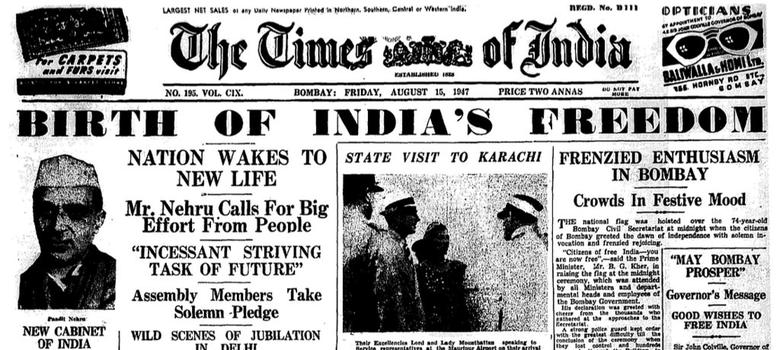
August 15, 1947: India and Pakistan Independent

August 15, 1947: The partition of India takes effect, and the nations of India and Pakistan are created out of the former British "Raj."

The independence took effect at midnight, Delhi time. Pakistan is 1 hour behind, so they celebrate their independence on August 14, India theirs on August 15.

Jawaharlal Nehru, India's 1st Prime Minister, tried to echo President Franklin D. Roosevelt's words about how America "had a rendezvous with destiny": Over the network All India Radio, he said that the new country with an ancient civilization "had a tryst with destiny."
Despite a great deal of trouble, he kept winning elections until his death on May 27, 1964. And when he died, for once, the world’s great powers were in agreement. Lyndon Johnson said, "Perhaps more than any other world leader he has given expression to man's yearning for peace. This is the issue of our age. In his fearless pursuit of a world free from war he has served all humanity."

And Nikita Khrushchev said, "Jawaharal Nehru is known as an outstanding statesman of modern times who devoted his entire life to the struggle for strengthening friendship and cooperation among peoples and for the progress of humanity."

His daughter eventually became Prime Minister, lost the office, regained it, and was assassinated while still in it. Indira Gandhi took her husband’s family name, but he was not related to her father’s friend Mohandas Gandhi. A member of the Nehru-Gandhi family was Prime Minister for 37 of the country’s 1st 44 years of independence.

As with India's 1st head of government, Pakistan's had been a lawyer before becoming an activist. Muhammad Ali Jinnah served as the leader of the All-Indian Muslim League from 1913 until 1947, and was a natural choice to lead his new country. But he had long suffered from tuberculosis, and died on September 11, 1948, at 71, only a year into independence.
Pakistan calls Jinnah "The Father of the Nation." But historian Akbar S. Ahmed calls him "the most maligned person in recent Indian history ... In India, many see him as the demon who divided the land." Thus, they hold him responsible for the conflict that followed, which was, for all intents and purposes, a civil war. British actor Christopher Lee starred in the film Jinnah in 1998, and called it the finest performance of his career.

The title "Empress of India" was created by the British Parliament for Queen Victoria in 1877. She held it until her death in 1901. The title "Emperor of India" was subsequently held by her son, King Edward VII, until his death in 1910; by his son, King George V, until his death in 1936; by his son, King Edward VIII, until his abdication later that year; and by his brother, King George VI, who renounced the title on June 22, 1948, 10 months after independence. Officially, he remained head of state as King of India until the country became a republic on January 26, 1950. He remained King of Pakistan until his death in 1952. His daughter, Queen Elizabeth II, was Queen of Pakistan until that country became a republic on March 23, 1956.

India remains a member of the successor organization to the British Empire, the Commonwealth of Nations, informally known as the British Commonwealth. Pakistan left it in 1972, but rejoined in 1989.

One thing that both countries kept from Britain is the love of the sport of cricket, which is baseball's cousin. The similarities are easy to see, but the differences can be very confusing.

To this day, no native of South Asia has ever played in Major League Baseball. Some Indian-born players -- all trained as cricket bowlers, the equivalent of pitchers -- have played in the North American minor leagues, but haven't reached the majors.

One former major leaguer was born in Afghanistan: Jeff Bronkey, born in the capital of Kabul in 1965 to an Afghan father and an American mother, who raised him in Oregon. He pitched, mostly in relief, for the Texas Rangers in 1993, and the Milwaukee Brewers in 1994 and '95, going 2-2 with 2 saves and a 4.04 ERA.

*

The NFL, the NBA and NHL were all in their off-seasons, and did not play on August 15, 1947, a Friday. These Major League Baseball games were played: 

* The New York Yankees beat the Boston Red Sox, 10-6 at the old Yankee Stadium. George "Snuffy" Stirnweiss hit a home run for the Bronx Bombers. Joe DiMaggio went 2-for-3 for the Yanks, Ted Williams 4-for-5 for the BoSox. Joe Page was the winning pitcher, in relief of Karl Drews.

* The New York Giants lost to the Boston Braves, 8-7 at Braves Field in Boston.

* The Brooklyn Dodgers beat the Philadelphia Phillies, 8-1 at Shibe Park in Philadelphia.

* The Philadelphia Athletics beat the Washington Senators, 3-0 at Griffith Stadium in Washington.

* The St. Louis Cardinals beat the Pittsburgh Pirates, 7-4 at Forbes Field in Pittsburgh.

* The Chicago Cubs beat the Cincinnati Reds, 6-5 at Crosley Field in Cincinnati.

* The Detroit Tigers beat the Chicago White Sox, 9-2 at Comiskey Park in Chicago.

* And the Cleveland Indians beat the St. Louis Browns, 2-0 at Sportsman's Park in St. Louis.

None of these games went to extra innings. 

Tuesday, April 12, 2022

April 13, 1919: The Amritsar Massacre

April 13, 1919: The Armitsar Massacre occurs in British India. It is a turning point in the move toward Indian independence.

A large, peaceful crowd had gathered at the Jallianwala Bagh, a garden near the Golden Temple, sacred to the Sikh people, in Amritsar, Punjab, to protest against the Rowlatt Act, and the arrest of pro-independence activists Saifuddin Kitchlew and a doctor who went by the mononym Satyapal.

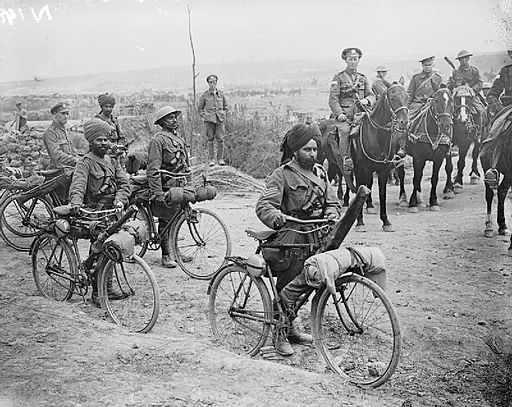
In response to the public gathering, the temporary Brigadier General, Reginald Dyer, surrounded the protesters with his Gurkha, Baloch, Rajput and Sikh troops from 2-9th Gurkhas, the 54th Sikhs and the 59th Sind Rifles of the British Indian Army. The Jallianwala Bagh could only be exited on one side, as its other three sides were enclosed by buildings. After blocking the exit with his troops, he ordered them to shoot at the crowd, continuing to fire even as the protestors tried to flee. The troops kept on firing until their ammunition was exhausted. Estimates of those killed vary between 379 and 1,500 people, and over 1,200 other people were injured.

Responses polarized both the British and the Indian peoples. Anglo-Indian author Rudyard Kipling, already known as a racist and an apologist for the British Empire, declared at the time that Dyer "did his duty as he saw it." The massacre shocked Rabindranath Tragore, an Indian polymath and the first Asian to win a Nobel Prize, to such an extent that he renounced his knighthood.

The massacre caused a re-evaluation by the British Army of its military role against civilians to "minimal force whenever possible." But later British actions during the Mau Mau rebellion, in the 1950s in the Kenya Colony, showed that the new policy could be put aside.

The level of casual brutality, and lack of any accountability, stunned the entire Indian nation, resulting in a wrenching loss of faith of the general public in the intentions of the United Kingdom. Although Winston Churchill, then Secretary of State for War, would later call Indians "a beastly people with a beastly religion," he condemned the attack as "unutterably monstrous." The event galvanized the independence movement, and probably moving the achievement of independence up by many years. The British government has never formally apologized for the massacre, but expressed "deep regret" in 2019, on the event's 100th Anniversary.

*

April 13, 1919 was a Sunday. Actor Howard Keel, best known for his roles in 1950s film musicals, was born on this day. All major sports were out of season: Even the baseball season didn't start for another 6 days. So there were no scores on this historic day.

Wednesday, April 6, 2022

April 6, 1930: Mohandas Gandhi Completes His Salt March

April 6, 1930: Mohandas K. Gandhi completes the Salt March, his 1st major act against British imperialism in India. The "Mahatma" (meaning "Great Soul") was already 60 years old.

He had already long stood for oppressed peoples as a lawyer in India and South Africa, including acts of civil disobedience. But the march was the action that got the world's attention.

It began on March 12, in Sabarmati Ashram, and lasted 239 miles to Dandi, on the west coast of India, in Gandhi's native state of Gujarat. The Raj, the British government in India, refused to let the natives produce their own salt, forcing them to pay the Raj a salt tax. Gandhi started marching with 78 people. When it ended, there were thousands of people with him. He was arrested on May 4, and held until the following February. Recognizing the parallel with the Boston Tea Party of 1773, Time magazine named Gandhi its Man of the Year for 1930.

It would take until 1947 for India to achieve independence.

*

April 6, 1930 was a Sunday. There were no scores on this historic day: Baseball was in Spring Training, football was out of season, the NBA hadn't been founded yet, and the hockey season had ended 3 days earlier, with the Montreal Canadiens beating the Boston Bruins for the Stanley Cup.

Monday, February 28, 2022

March 1, 1892: Rudyard Kipling Publishes "Barrack-Room Ballads"

March 1, 1892: Rudyard Kipling publishes Barrack-Room Ballads and Other Verses. It marks him as the defining poet of the Victorian Age British Army -- for good, and for ill.

It had been said since the 16th Century that "The Sun never sets on the British Empire," because, at every point during a calendar day, the Sun was shining on some spot of land in the Empire. Stretching east to Asia and Australia, south to Africa, and west to Canada and the Caribbean.

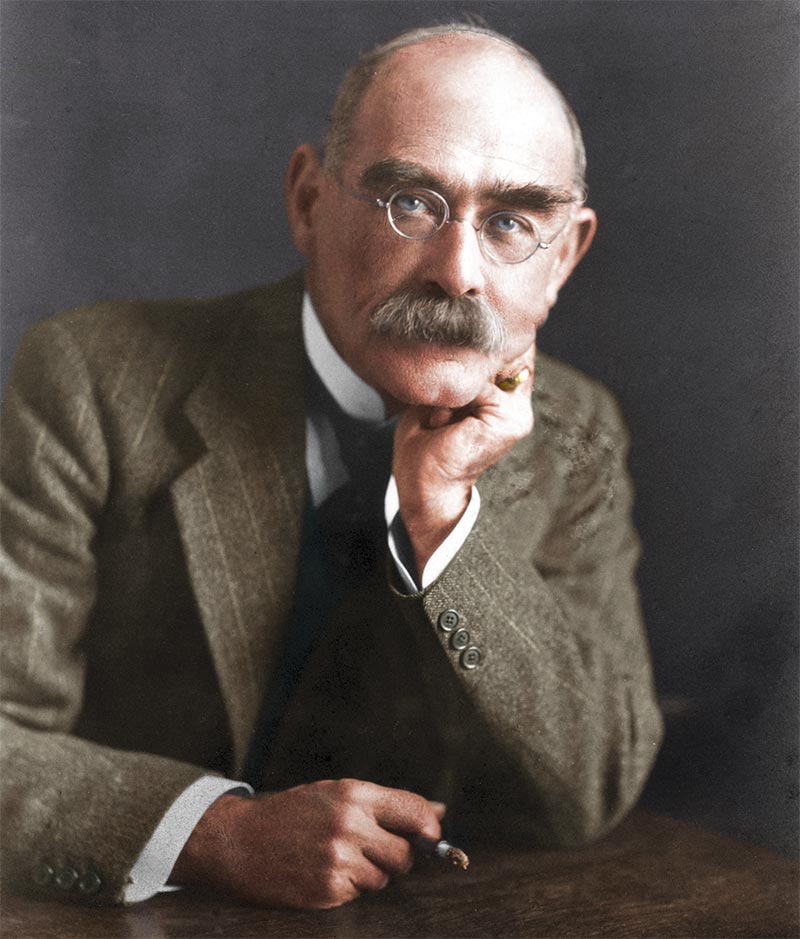
Joseph Rudyard Kipling was a product of this Empire, born in India in 1865. Hearing tales of the British Army from India, Afghanistan, and the African colonies, he immortalized them in verse. Barrack-Room Ballads included perhaps his best-known work, "Gunga Din." The narrator has mistreated the title character, an Indian water-bearer. Then the soldier is shot, but Gunga saves his life, at the cost of his own, forcing the soldier to admit, in the poem's last line, "You're a better man than I am, Gunga Din!"

His tales of brave Brits in far-off lands made him enormously popular throughout the English-speaking world. Author Henry James said, "Kipling strikes me personally as the most complete man of genius, as distinct from fine intelligence, that I have ever known." In 1907, he became the 1st English-language winner of the Nobel Prize for Literature. He was 41, and no one younger has won the award. He died in 1936, still very popular.

A common joke of the era had a man trying to find out a woman's tastes: "How do you like Kipling?" And she said, "I don't know, you naughty boy. I've never kippled!"

But as time went by, people saw the horrid racism in his poems and stories, including in such children's tales as The Jungle Book (published in 1894). Many people have heard the expression "The White Man's Burden," but might not know where it comes from. It was a poem Kipling wrote in 1899, telling America to not only put down the Philippine Insurrection, but to colonize and anglicize -- if not quite "Americanize" -- the island nation.

Kipling's son John was rejected for an officer's commission in World War I, due to poor eyesight. The father bought it off, anyway. The son died in the Battle of Loos in 1915. This left his daughter, Elsie, as his only surviving child. She died in 1976, having married but not having had children, and so the family line died out.

The racism continued after his death: A film based on Gunga Din was released in 1939, with the title role played by Sam Jaffe, not an Indian but an Eastern European Jew with bad makeup. At least when The Jungle Book was filmed in 1942, Mowgli was played by an Indian actor, Sabu Dastagir (using only his first name). But as late as 1967, when Disney did a cartoon version, the stereotypes were still pretty cringey.

Perhaps it would be better to leave on this note: In 1910, Kipling wrote "If-- " an inspirational poem:

If you can keep your head when all about you
    Are losing theirs and blaming it on you;
If you can trust yourself when all men doubt you,
    But make allowance for their doubting too:
If you can wait and not be tired by waiting,
    Or being lied about, don't deal in lies,
Or being hated don't give way to hating,
    And yet don't look too good, nor talk too wise;

If you can dream -- and not make dreams your master;
    If you can think -- and not make thoughts your aim,
If you can meet with Triumph and Disaster
    And treat those two impostors just the same:
If you can bear to hear the truth you've spoken
    Twisted by knaves to make a trap for fools,
Or watch the things you gave your life to, broken,
    And stoop and build 'em up with worn-out tools;

If you can make one heap of all your winnings
    And risk it on one turn of pitch-and-toss,
And lose, and start again at your beginnings
    ⁠And never breathe a word about your loss:
If you can force your heart and nerve and sinew
    To serve your turn long after they are gone,
And so hold on when there is nothing in you
    ⁠Except the Will which says to them: 'Hold on!'

If you can talk with crowds and keep your virtue,
    Or walk with Kings -- nor lose the common touch,
If neither foes nor loving friends can hurt you,
    If all men count with you, but none too much:
If you can fill the unforgiving minute
    With sixty seconds' worth of distance run,
Yours is the Earth and everything that's in it,
    ⁠And -- which is more -- you'll be a Man, my son!

But how wise is it? It sounds like a lot of pressure to put on a young man.

Besides, if you can keep your head when all about you are losing theirs, maybe they know something that you need to know.

*

March 1, 1892 was a Tuesday. There were no scores on this historic day, because baseball and football were out of season, hockey was still all-amateur, and basketball had been invented only a few weeks before.

Tuesday, February 15, 2022

February 15, 1968: The Beatles and the Maharishi

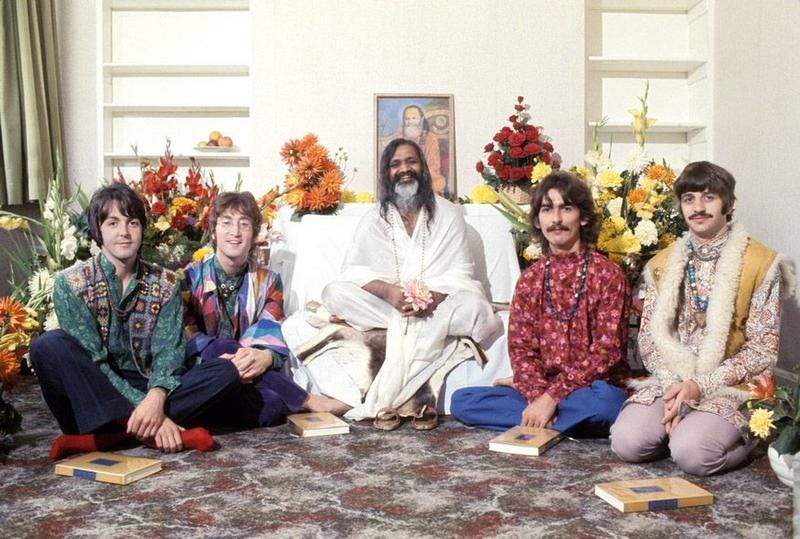
Left to right: Paul McCartney, John Lennon,
Maharishi Mahesh Yogi, George Harrison, Ringo Starr

February 15, 1968: The Beatles and their entourage arrive in Rishikesh, India, to study with the Maharishi Mahesh Yogi. I can't fault them for trying to find peace in a world which seemed to have gone mad all around them, but they weren't going to find it with that charlatan.

Born in 1911 in what is now Chhattisgarh, India, Mahesh Prasad Varma invented "Transcendental Meditation" in 1955. As a Hindu teacher, he took on the title "Yogi," and began calling himself "Maharishi," meaning "Great seer."

The TM technique involves the silent repetition of a mantra or sound, and is practiced for 15–20 minutes twice per day. Those it helped swore by it, but it has been criticized and ridiculed as pseudoscience.

The Maharishi was a confidence man, a "con artist." He saw the individual Beatles, very wealthy due to their fame, and emotionally vulnerable due to their disillusionment with it, as the ultimate mark, especially since George Harrison had already expressed a strong interest in India, through his friendship with sitar player Ravi Shankar.

The group met the Maharishi on August 24, 1967, and traveled to his retreat in Bangor, Wales the next day. On the 26th, at Bangor, they announced they were giving up drugs. Three of the four did, but John Lennon found it a bit harder. On the 27th, they found out about the death of their manager, Brian Epstein -- leaving them even more emotionally vulnerable.

They arrived at the Maharishi's ashram in Rishikesh on February 15, 1968. But they all ended up souring on the experience. Ringo Starr left on March 1, allegedly because he was allergic to much of the food, and his then-wife Maureen Starkey had had it with the insects. Paul McCartney and his then-girlfriend, actress Jane Asher, left shortly thereafter due to business commitments.

On April 12, John, his then-wife Cynthia Lennon, George and his then-wife Patti Boyd left, because they found out the Maharishi was hitting on actress Mia Farrow and her sister Prudence, and because the Maharishi wanted the Beatles to donate 25 percent of the next album's profits to him as a "tithe," to which John said, "Over my dead body."

John would later write a song titled "Maharishi" about him, but, scared that the Maharishi might have some kind of weird magic to use to punish him, George told him to retitle it, and it became "Sexy Sadie."

Twelve years later, John was the first Beatle to have a dead body. Beatles roadie Mal Evans, with them in India, was murdered earlier than John, in 1976. Cancer claimed Maureen in 1994 and George in 2001. The Maharishi lived on until 2008. As of February 15, 2022, Paul, Ringo, Jane, Mia and Prudence -- about whom John wrote the song "Dear Prudence" -- are still alive. (Yoko Ono and Linda Eastman had entered the picture by that point, but were not on the trips to Bangor or Rishikesh.)

*

February 15, 1968 was a Thursday. Baseball and football were out of season. There were 3 games in the NBA:

* The Cincinnati Royals beat the Seattle SuperSonics, 132-119 at the Cincinnati Gardens. Oscar Robertson scored 32 points and had 16 assists. Jerry Lucas had 19 points and grabbed 25 rebounds. Walt Hazzard led the expansion Sonics with 31.

* The Los Angeles Lakers beat the Chicago Bulls, 132-105 at the Chicago Stadium. Flynn Robinson scored 32 points.

* And the San Francisco Warriors beat the San Diego Rockets, 134-114 at the San Diego Sports Arena (now the Pechanga Arena). Fred Hetzel scored 33 points.

There were 3 games in the 1st-season American Basketball Association:

* The Minnesota Muskies beat the Indiana Pacers, 122-101 at the Indiana State Fair Coliseum (now the Corteva Coliseum) in Indianapolis.

* The Dallas Chaparrals beat the New Orleans Buccaneers, 121-113 in overtime at the Dallas Memorial Auditorium. Doug Moe scored 32 points in defeat for the Bucs, while 4 different Chaps scored between 23 and 26 points.

* And the Denver Rockets beat the Anaheim Amigos, 142-108 at the Denver Auditorium Arena. Les Selvage led all scorers on the night with 38 points.

And there were 2 games in the NHL. The New York Rangers beat the Minnesota North Stars, 6-2 at the Metropolitan Sports Center in the Minneapolis suburb of Bloomington, Minnesota. And the Montreal Canadiens beat the Detroit Red Wings, 2-0 at the Olympia Stadium in Detroit.

Monday, February 14, 2022

February 14, 1989: The Fatwa Against Salman Rushdie

February 14, 1989: Ayatollah Ruhollah Khomeini, supreme leader of Iran, issues a fatwa, a death sentence under Islamic law, against novelist Salman Rushdie.

Ahmed Salman Rushdie was born on June 19, 1947 in Bombay (now Mumbai), India. His father was a lawyer, educated at England's Cambridge University. He was inspired to become a writer by reading The Wizard of Oz. Although India gained independence 2 months after his birth, he retained his British citizenship, and he claimed to be "obsessed with P.G. Wodehouse and Agatha Christie." He also became fascinated by fantasy, especially J.R.R. Tolkien's Lord of the Rings books; and science fiction, Ray Bradbury and Arthur C. Clarke.

But, given what he wrote later, the author that may have had the most effect on him was Kurt Vonnegut. Absurdist novels like Cat's Cradle and Slaughterhouse-Five inspired his debut novel, Grimus, in 1975; and Midnight's Children, in 1981. Midnight's Children won the Booker Prize, awarded annually to "the best single work of sustained fiction written in the English language, which was published in the United Kingdom or Ireland."

In 1988, Rushdie published The Satanic Verses. The title refers to a group of Quarnic verses about three pagan (pre-Islamic) Meccan goddesses: The sisters Al-Lat, goddess of war, peace, combat, and prosperity; Al-Uzza, goddess of might and protection; and Manāt, Goddess of fate, fortune, time, death, and destiny.

The main story involves 2 actors, Indians raised as Muslims but now living in Britain, much like Rushdie himself (except he wasn't an actor). The book takes on a fantasy element, a weird one that I won't get into here, but Rushdie used this framing to describe the Indian and Muslim experiences in Britain.

The book's straying from reality wasn't enough for Islamic fundamentalists, and the Ayatollah issued his fatwaA little more than 3 months later, it was not Rushdie, but Khomeini, who was dead -- although being 89 years old had something to do with that. Today, Rushdie is still alive.

In 1991, Ettore Capirolo, Rushdie's Italian translator, was stabbed at his home in Milan, though he survived. Ten days later, Hitoshi Igarashi, Rushdie's Japanese translator, was stabbed to death in his office at the University of Tsukuba. In 1993, 37 people died when arsonists set fire to a hotel in Siva, Turkey, where Aziz Nesin, Rushdie's Turkish translator, was staying. He survived. Four months later, William Nygaard, Rushdie's Norwegian publisher, was shot, and needed months of recovery.

In March 2016, the bounty for the Rushdie fatwa was raised to $3 million.

Rushdie was a fan of Tottenham Hotspur Football Club, of North London. This was not the reason for the fatwa. It is, however, a good reason to go into hiding. (I'm a fan of Spurs' North London arch-rivals, Arsenal.)
In 2007, Rushdie was knighted by Queen Elizabeth II, for "services to literature." To most of the world, he is a hero of the fight for freedom of speech.

UPDATE: On August 12, 2022, Rushdie faced his closest call yet. He was attacked onstage while speaking at an event of the Chautauqua Institution, in Chautauqua, in the southwestern corner of New York State.

He was flown by medivac helicopter to a hospital in nearby Erie, Pennsylvania. Rushdie had 14 separate wounds. He lost the use of his right eye, lost function in his left hand, and sustained liver damage. He was 75 years old.

And yet, the doctors were able to save his life. One told him he was very lucky that the guy who attacked him didn’t know how to kill a person with a knife. He described himself as "a medical miracle," and wrote a book about the Knife: Meditations After an Attempted Murder.
He said the book was about 3 people: Himself; the assailant, who represented Death; and his wife, Rachel Eliza Griffiths, an African-American visual artist, who represented Love. He said, "Love wins." (He had been married 4 times before, including to Indian television personality Padma Lakshmi, and has a son with his 1st wife and a son with his 3rd.)

He did not mention the assailant's name. His was Hadi Matar, 24, from Fairview, Bergen County, New Jersey. He was convicted in 2025, and faces up to 25 years in prison. The Iranian government denied any involvement in the attack, but Iranian media celebrated it.

*

February 14, 1989 was a Tuesday. Baseball and football were out of season. There were 11 games in the NBA:

* The New York Knicks beat the Charlotte Hornets, 129-117 at the Charlotte Coliseum.

* The New Jersey Nets lost to the Milwaukee Bucks, 132-91 at the Bradley Center in Milwaukee.

* The Cleveland Cavaliers beat the Miami Heat, 109-98 at the Miami Arena.

* The Dallas Mavericks beat the Los Angeles Clippers, 117-98 at the Reunion Arena in Dallas.

* The Houston Rockets beat the Boston Celtics, 137-123 at The Summit in Houston. When the Rockets moved to the Toyota Center in 2003, televangelist Joel Osteen bought The Summit, and converted it into the Central Campus of his Lakewood Church. It must bother him that he will never be as popular in that building as a black Muslim immigrant named Hakeem Olajuwon, who, on this night, scored 35 points and grabbed 19 rebounds for the Rockets.

* The Philadelphia 76ers beat the Indiana Pacers, 113-108 at the Market Square Arena in Indianapolis.

* The Atlanta Hawks beat the Chicago Bulls, 106-98 at the Chicago Stadium. Dominique Wilkins, "the Human Highlight Film," scored 36 points for the Hawks.

* The Utah Jazz beat their arch-rivals, the Denver Nuggets, 119-105 at the Salt Palace in Salt Lake City, Utah.

* The Detroit Pistons beat the Los Angeles Lakers, 111-103 at The Forum outside Los Angeles in Inglewood, California. James Worthy scored 33 points. This was a rematch of the previous season's NBA Finals, won by the Lakers. It turned out to be a preview of this season's Finals, won by the Pistons.

* The Washington Bullets beat the Sacramento Kings, 107-99 at the ARCO Arena in Sacramento.

* And the Seattle SuperSonics beat the San Antonio Spurs, 129-113 at the Seattle Center Coliseum.

And there were 6 games in the NHL:

* The New York Rangers lost to the Philadelphia Flyers, 3-1 at The Spectrum in Philadelphia.

* The New York Islanders beat the Edmonton Oilers, 5-3 at the Nassau Coliseum.

* The Pittsburgh Penguins beat the Buffalo Sabres, 7-3 at the Civic Arena in Pittsburgh.

* The Chicago Blackhawks beat the Minnesota North Stars, 4-2 at the Metropolitan Sports Center in the Minneapolis suburb of Bloomington, Minnesota.

* The Washington Capitals beat the St. Louis Blues, 5-3 at the St. Louis Arena.

* And the Vancouver Canucks beat the Boston Bruins, 5-2 at the Pacific Coliseum in Vancouver.

December 31, 1999 & January 1, 2000: The Millennium

December 31, 1999:  The Millennium arrives. The people of planet Earth survived. At a terrible cost. But we hadn't destroyed ourselves. ...