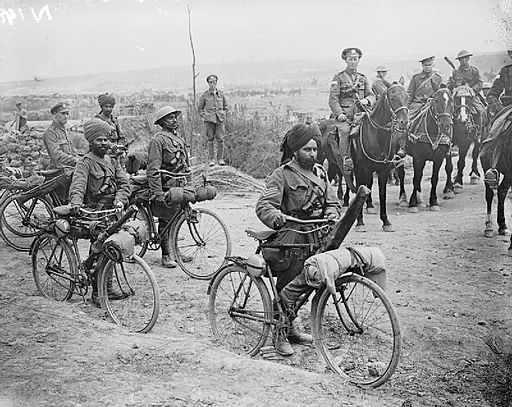
April 13, 1919: The Armitsar Massacre occurs in British India. It is a turning point in the move toward Indian independence.
A large, peaceful crowd had gathered at the Jallianwala Bagh, a garden near the Golden Temple, sacred to the Sikh people, in Amritsar, Punjab, to protest against the Rowlatt Act, and the arrest of pro-independence activists Saifuddin Kitchlew and a doctor who went by the mononym Satyapal.
In response to the public gathering, the temporary Brigadier General, Reginald Dyer, surrounded the protesters with his Gurkha, Baloch, Rajput and Sikh troops from 2-9th Gurkhas, the 54th Sikhs and the 59th Sind Rifles of the British Indian Army. The Jallianwala Bagh could only be exited on one side, as its other three sides were enclosed by buildings. After blocking the exit with his troops, he ordered them to shoot at the crowd, continuing to fire even as the protestors tried to flee. The troops kept on firing until their ammunition was exhausted. Estimates of those killed vary between 379 and 1,500 people, and over 1,200 other people were injured.
Responses polarized both the British and the Indian peoples. Anglo-Indian author Rudyard Kipling, already known as a racist and an apologist for the British Empire, declared at the time that Dyer "did his duty as he saw it." The massacre shocked Rabindranath Tragore, an Indian polymath and the first Asian to win a Nobel Prize, to such an extent that he renounced his knighthood.
The massacre caused a re-evaluation by the British Army of its military role against civilians to "minimal force whenever possible." But later British actions during the Mau Mau rebellion, in the 1950s in the Kenya Colony, showed that the new policy could be put aside.
The level of casual brutality, and lack of any accountability, stunned the entire Indian nation, resulting in a wrenching loss of faith of the general public in the intentions of the United Kingdom. Although Winston Churchill, then Secretary of State for War, would later call Indians "a beastly people with a beastly religion," he condemned the attack as "unutterably monstrous." The event galvanized the independence movement, and probably moving the achievement of independence up by many years. The British government has never formally apologized for the massacre, but expressed "deep regret" in 2019, on the event's 100th Anniversary.
*
April 13, 1919 was a Sunday. Actor Howard Keel, best known for his roles in 1950s film musicals, was born on this day. All major sports were out of season: Even the baseball season didn't start for another 6 days. So there were no scores on this historic day.


No comments:
Post a Comment