Showing posts with label winston churchill. Show all posts

Monday, August 22, 2022

August 22, 1943: The Bengal Famine

August 22, 1943: A photograph in The Statesman, an English-language newspaper in India, shows the effects of the Bengal Famine.

The Bengal province, today, consists of the nation of Bangladesh and the Indian states of West Bengal and Odisha. Up to 3 million people died of malnutrition and its direct causes, such as malaria and unsanitary conditions. The state of health care in the region was woefully inadequate to the situation. People fled the countryside and headed for cities like Bombay, Calcutta and Madras -- known today as, respectively, Mumbai, Kolkata and Chennai. This overflow into the cities helped spread disease as well, contributing to the death toll.

British Prime Minister Winston Churchill acted as though he didn't care: He had previously called Indians "a beastly people with a beastly religion," and accused them of "breeding like rabbits." Nevertheless, he couldn't ignore it forever: He finally ended up asking President Franklin D. Roosevelt and Prime Minister John Curtin of Australia for wheat, and got it. Churchill didn't want 1940s India to become 1840s Ireland. But it was too late: The death toll in India was 3 times that of the Irish potato famine. Revisionist historians have accused Churchill of genocide, though a fairer term would be "neglect."

Mohandas Gandhi had already started the "Quit India Movement" the year before. The famine accelerated the independence movement. As long as World War II was on, Britain was never going to give "the jewel in the crown of the British Empire" its independence. After the war, the new Prime Minister, Clement Attlee, started the process. On August 15, 1947, 2 years and 1 day after V-J Day, independence was declared.

*

August 22, 1943 was a Sunday. These baseball games were played:

* The New York Yankees were swept in a doubleheader by the Detroit Tigers, 12-0 and 8-3 at Briggs Stadium (later renamed Tiger Stadium) in Detroit. Dizzy Trout pitched a 9-hit shutout in the opener.

* The New York Giants were swept in a doubleheader by the Chicago Cubs, 6-2 and 4-3 at the Polo Grounds. Mel Ott, by now the manager of the Giants, did not put himself into either game.

* The Brooklyn Dodgers swept a doubleheader with the Pittsburgh Pirates, 6-1 and 8-6 at Ebbets Field. Bobby Bragan, Augie Galan and Howie Schultz hit home runs for Dem Bums in the 1st game; Al Glassop hit one in the 2nd game.

* The St. Louis Cardinals swept the Boston Braves, 6-1 and 5-1 at Braves Field in Boston. Over the 2 games, Stan Musial went 4-for-9 with a walk and an RBI. Walker Cooper went 3-for-5 with a home run and 5 RBIs in the 1st game, and had an RBI sacrifice fly in the 2nd game.

* The Cincinnati Reds swept the Philadelphia Phillies, 4-3 and 20-6 at Shibe Park in Philadelphia.

* The Cleveland Indians swept a doubleheader from the Boston Red Sox, 6-0 and 7-6 at Cleveland Municipal Stadium. Jack Salveson pitched a 2-hit shutout in the opener. In the nightcap, Oris Hackett singled home the winning run in the bottom of the 13th inning.

* The Chicago White Sox swept a doubleheader from the Philadelphia Athletics, 5-2 ang 3-2 at Comiskey Park in Chicago.

* A doubleheader was split at Sportsman's Park in St. Louis. The St. Louis Browns won the 1st game, 8-5. The Washington Senators won the 2nd game, 4-2. Mickey Vernon hit a sacrifice fly to score George Case in the top of the 10th inning.

Friday, August 19, 2022

August 19, 1953: The CIA-Aided Coup In Iran

August 19, 1953: A military coup overthrows the democratically-elected government of Iran, and restores the deposed monarch, the Shah (Emperor), Mohammed Reza Pahlavi.

Mohammad Mosaddegh, who had served in the Majlis, Iran's Parliament, since 1923, was appointed Prime Minister in 1951, and won a contentious election in 1952. He was a populist, enormously popular in the country; and a nationalist, resisting the influence of both the Soviet Union and the Western nations that had long dominated his country, mostly America, Britain and France. Time magazine named him their Man of the Year for 1951.
He sought to audit the documents of the Anglo-Iranian Oil Company (now part of British Petroleum, or BP), to verify that AIOC was paying the contracted royalties to Iran, and to limit the company's control over Iran's vast oil reserves. Upon the AIOC's refusal to cooperate with the Iranian government, the Majlis voted to nationalize Iran's oil industry, and to expel foreign corporate representatives from the country.

That infuriated British Prime Minister Winston Churchill, who instigated a worldwide boycott of Iranian oil to pressure Iran economically. For all his leadership in opposing fascism in World War II, Churchill was innately racist, and didn't trust any native peoples anywhere to run things that he thought should be run by Britain.

Judging Mosaddegh to be unamenable, and fearing the growing influence of the Tudeh Party, Iran's Communists, Churchill met with officials of the Administration of President Harry S Truman, and proposed a coup. Truman rejected this, fearing the precedent that would be set by America's Central Intelligence Agency (CIA) being involved in such an enterprise.

But with the election of Dwight D. Eisenhower in 1952 came the appointment of John Foster Dulles as U.S. Secretary of State, and his brother Allen Dulles as Director of the CIA. Both men were among the iciest of the Cold Warriors, and had no problem agreeing to Churchill's wishes.

The CIA, under Kermit Roosevelt Jr., grandson of Theodore Roosevelt, ran Operation Ajax, in conjunction with Britain's MI6, in Operation Boot. They hired mobsters to stage pro-Shah riots in the capital of Tehran. Between 200 and 300 people were killed in rioting. Finally, General Fazlollah Zahedi moved in, and formed a new government, which allowed the Shah to retake power.

Mossadegh was arrested, tried, and convicted of treason by the Shah's military court. He was sentenced to 3 years in prison, and then was kept under house arrest until his death in 1967, at the age of 84. Zahedi served as Prime Minister from 1953 to 1955, retired, and lived until 1963.

The Shah ran a very progressive country in many ways, and Iran was seen as a modern nation. But it was a fascist nation, with SAVAK becoming one of the world's most dreaded secret police. In 1979, the Shah was overthrown in an Islamic Revolution, led by the Ayatollah Ruhollah Khomeini. Already dying of cancer, he was too weak to mount an opposition, fled the country, and died the next year.

Never forgiving the Americans for their role in the 1953 coup, militants captured the American Embassy in Tehran, and held 52 Americans hostage for over a year. Over the next 10 years, Iran sponsored terrorist attacks on American military units around the Middle East.

In 2013, on the 60th Anniversary of the coup, the U.S. government formally acknowledged its predecessor's role in the 1953 Iran coup, releasing a bulk of previously classified government documents that show it was in charge of both the planning and the execution of the coup, including the bribing of Iranian politicians, security and army high-ranking officials, as well as pro-coup propaganda. The CIA is quoted acknowledging the coup was carried out "under CIA direction" and "as an act of U.S. foreign policy, conceived and approved at the highest levels of government."

Relations between America and Iran remain very cold, as cold as any between the U.S. and the Soviet Union were during the Cold War.

*

August 19, 1953 was a Wednesday. Republican political strategist Mary Matalin was born.

These baseball games were played that day:

* The New York Yankees beat the Washington Senators, 2-0 at Yankee Stadium. Jim McDonald pitched a 4-hit shutout. Yogi Berra hit a home run. Mickey Mantle did not play.

* The Brooklyn Dodgers beat their arch-rivals, the New York Giants, 7-5 at Ebbets Field.

* The Boston Red Sox beat the Philadelphia Athletics, 6-4 at Fenway Park in Boston. Ted Williams, having returned from the Korean War, hit a home run.

* The Pittsburgh Pirates beat the Philadelphia Phillies, 5-3 at Connie Mack Stadium in Philadelphia.

* The Milwaukee Braves beat the Cincinnati Reds, 3-2 at Crosley Field in Cincinnati.

* The Detroit Tigers beat the Cleveland Indians, 4-2 at Briggs Stadium in Detroit. (The ballpark was renamed Tiger Stadium in 1961.)

* The St. Louis Browns beat the Chicago White Sox, 4-3 at Comiskey Park in Chicago. The Browns scored 2 runs in the top of the 10th inning, on a triple by Les Moss and a sacrifice bunt by Vic Wertz (normally a slugger, not a bunter). The White Sox got 1 back in the bottom of the 10th, on a double by Nellie Fox, but couldn't find the tying run.

The Browns would go 12-21 the rest of the way, and move to Baltimore to become the Orioles for the 1954 season.

* And the Chicago Cubs beat their arch-rivals, the St. Louis Cardinals 5-3 at the last Sportsman's Park in St. Louis, which had just been rebranded as the 1st Busch Stadium. Stan Musial went 0-for-2 with 2 walks.

Wednesday, August 17, 2022

August 17, 1943: The Quebec Conference

Left to right: WLMK, FDR, WLSC

August 17, 1943: While the provisional, post-Mussolini government of "a disintegrating Italy" declares Rome to be an "open city," the Château Frontenac hotel, atop the famed Citadelle, hosts the Québec Conference.

Hosting are Canada's Governor-General, Alexander Cambridge, 1st Earl of Athlone, brother of Britain's Dowager Queen Mary and a great-grandson of King George III; and its Prime Minister, William Lyon Mackenzie King. Britain's Prime Minister, Winston Leonard Spencer Churchill, and Foreign Minister, Robert Anthony Eden (himself a future Prime Minister), are guests, as is America's President Franklin Delano Roosevelt and his Secretary of State, Cordell Hull.

They meet through August 24, discussing strategy in both the European Theater and the Pacific Theater of World War II. This included both which Japanese-held Pacific installations to attack and how to invade the European Continent to take on the Nazis. FDR and Churchill met one-on-one, as did Hull and Eden, and everybody involved met collectively.

The Citadelle was built in 1690, and was almost immediately the site of the Battle of Quebec in what is usually called King William's War. It was a French victory over the British, and led to the war ending in a stalemate. The British came back in 1759 and, in that Battle of Quebec, took New France and won what North America calls the French and Indian war, and their part in what Europe calls the Seven Years' War. The War of 1812, between the U.S. and Britain, led to a new fort, which was completed in 1850.
The Château Frontenac opened in 1893, built by the Canadian Pacific Railway Company. Since 2001, it has been run by Fairmont Hotels, and has officially been named The Fairmont Le Château Frontenac. It is said to be the most-photographed hotel in the world, as is generally considered to be Quebec City's most familiar structure.
A second Quebec Conference would be held there from September 12 to 16, 1944.

*

August 17, 1943 was a Tuesday. These baseball games were played:

* The New York Yankees beat the Chicago White Sox, 4-2 at Comiskey Park in Chicago. Not yet in the war, left fielder Charlie Keller and 3rd baseman Billy Johnson each had 2 hits. Butch Wensloff was the winning pitcher.

* The New York Giants lost to the Cincinnati Reds, 10-4 at the Polo Grounds. Giants player-manager Mel Ott went 1-for-5 with an RBI.

* The Brooklyn Dodgers lost to the St. Louis Cardinals, 7-3 at Ebbets Field.

* The Pittsburgh Pirates swept a doubleheader from the Boston Braves, 8-0 and 4-3. In the opener, Hank Gornicki pitched a 6-hit shutout. In the nightcap, Pete Coscarart singled Johnny Podgajny home with the winning run in the top of the 11th inning.

* The Chicago Cubs beat the Philadelphia Phillies, 7-5 at Shibe Park in Philadelphia.

* The Detroit Tigers beat the Philadelphia Athletics, 4-3 at Briggs Stadium (later Tiger Stadium) in Detroit.

* The St. Louis Browns beat the Boston Red Sox, 4-1 at Sportsman's Park in St. Louis.

* And the Cleveland Indians and the Washington Senators were not scheduled.

Sunday, August 14, 2022

August 14, 1941: The Atlantic Charter

August 14, 1941: Franklin Delano Roosevelt, President of the United States, and Winston Leonard Spencer Churchill, Prime Minister of the United Kingdom of Great Britain and Northern Ireland, issue a joint statement, allying themselves in the cause of freedom for all the world. It becomes known as the Atlantic Charter.

The two men had first met on July 29, 1918, at Gray's Inn in London. Roosevelt was then the U.S. Assistant Secretary of the Navy; Churchill, the U.K.'s Minister of Munitions. Both were men on the rise. Both had serious setbacks in the years to come: Roosevelt was stricken with polio in 1921, Churchill with appendicitis and election defeat the next year.

Both would return to office, and rise to become their nations' heads of government: Roosevelt was elected President in 1932, and Churchill became Prime Minister in 1940. That year, Roosevelt was elected to a 3rd term as President, for pretty much the same reason Churchill was named Prime Minister: Because of the threat of Nazi Germany.

By mid-June 1940, all of Europe was now either ruled by, or allied with, the Nazis, except for those eastern parts ruled by, or allied with, the Soviet Union. Churchill had just replaced the ineffectual Neville Chamberlain as Prime Minister. In July, the Nazis began bombing Britain, but the Royal Air Force kept turning them back. In June 1941, the Nazis broke the Non-Aggression Pact with the Soviets, and invaded. Still, there was no indication that the U.S. Congress was going to allow Roosevelt to take the nation to war against the Nazis.

It was time for Roosevelt and Churchill to meet in person and talk about their plans for facing the Nazis together. Roosevelt told the press that he was going on a 10-day fishing trip to Campobello Island, in New Brunswick, Canada, where the family had long maintained a vacation home, and where he was first diagnosed with polio. And he wasn't lying: He did go there, and did do some fishing.

It was also about 1,100 miles by sea from Naval Station Argentia, a U.S. Naval base on the island of Newfoundland, then a British Dominion. (It became a Province of Canada in 1949.) Britain had given this base to the U.S. in exchange for some destroyers. So Argentia became a convenient meeting place for the two titans.

On August 9, the battleship HMS Prince of Wales steamed into Placentia Bay, anchoring next to the cruiser USS Augusta. Churchill disembarked from the Prince of Wales, boarded the Augusta, and said, "At long last, Mr. President." And Churchill said, "Glad to have you aboard, Mr. Churchill." Churchill delivered a letter from King George VI to Roosevelt, from one nation's head of state to the other's. (America is one of the few democratic nations where the head of state is also the head of government.)

They met for 5 years, and on August 14, they issued a statement, detailing their goals for the war and for the postwar world:

  1. No territorial gains were to be sought by the United States or the United Kingdom.
  2. Territorial adjustments must be in accord with the wishes of the peoples concerned.
  3. All people had a right to self-determination.
  4. Trade barriers were to be lowered.
  5. There was to be global economic co-operation and advancement of social welfare.
  6. The participants would work for a world free of want and fear.
  7. The participants would work for freedom of the seas.
  8. There was to be disarmament of aggressor nations and a common disarmament after the war.
 

At he meeting of the Inter-Allied Council in London, on September 24, representatives of the Free French Forces, the Soviet Union, and the governments-in-exile of Belgium, Czechoslovakia, Greece, Luxembourg, the Netherlands, Norway, Poland and Yugoslavia, unanimously adopted adherence to the common principles of policy set forth by Britain and United States.

On January 1, 1942, a larger group of nations, which adhered to the charter's principles, issued a joint Declaration by United Nations, which stressed their solidarity in the defense against Hitlerism. This was the 1st public use of the term "United Nations," which became the name of the worldwide peacekeeping organization after the war, what people hoped the League of Nations would be after World War I.

On December 7, the Japanese attacked Pearl Harbor. The next day, America declared war on Japan. Two days after that, HMS Prince of Wales was sunk by Japanese aircraft, with a loss of 327 men. The day after that, in solidarity with Japan, Nazi Germany declared war on America, which responded in kind.

USS Augusta would be used in many American war missions, including D-Day. She was taken out of service in 1946, and scrapped in 1959.

Naval Base Argentia is now Bristol Field, an airport in Placentia, Newfoundland and Labrador.

In 2021, a book co-written by American historian Michael Kluger and British historian Richard Evans was published, titled Roosevelt's and Churchill's Atlantic Charter: A Risky Meeting at Sea that Saved Democracy.

*

August 14, 1941 was a Thursday. Singer David Crosby was born on this day. He is 2-time inductee into the Rock and Roll Hall of Fame: As a member of The Byrds; and as a member of Crosby, Stills, Nash & Young.

These baseball games were played that day:

* The New York Yankees swept a doubleheader from the Washington Senators, 7-0 and 10-3 at Yankee Stadium. Marius Russo pitched a 3-hit shutout in the opener, backed by home runs from Tommy Henrich and Charlie Keller. Johnny Sturm homered in the nightcap, in support of Atley Donald. Over the 2 games, Joe DiMaggio went 4-for-8 with 2 walks and 4 RBIs.

* The New York Giants beat the Boston Braves, 4-3 at Braves Field in Boston. Mel Ott went 3-for-5 with 2 RBIs. 

* A doubleheader was split at Shibe Park in Philadelphia. The Boston Red Sox beat the Philadelphia Athletics in the 1st game, 11-8. Jimmie Foxx beat his former team with a home run in the top of the 11th. The A's won the 2nd game, 10-8. Over the 2 games, Ted Williams went 2-for-9 with a home run, 2 walks, and 3 RBIs, dropping his batting average... to .408.

* The Chicago Cubs beat the Pittsburgh Pirates, 6-2 at Forbes Field in Pittsburgh.

* The Chicago White Sox swept a doubleheader from the Detroit Tigers, 3-1 and 3-0 at Comiskey Park in Chicago. Johnny Humphries pitched a 6-hit shutout in the 2nd game.

* The Cleveland Indians and the St. Louis Browns were tied 3-3 after 10 innings at Sportsman's Park, when the game was rained out. Bob Feller had pitched 4 1/3rd innings of relief for the Indians, for no decision.

* And the Brooklyn Dodgers, the Cincinnati Reds, the Philadelphia Phillies and the St. Louis Cardinals were not scheduled.

Sunday, July 10, 2022

July 10, 1940: The Battle of Britain Begins

St. Paul's Cathedral survived the Blitz.
Lots of buildings in London didn't.

July 10, 1940: The Battle of Britain begins. Although Nazi Germany had previously attacked British troops, had conducted Luftwaffe (air force) bombing raids on the British mainland as early as June 26 (what became known as Störangriffe, or "nuisance raids"), and had occupied the Channel Islands (closer to the coast of France than to that of England) since June 30, the 10th of July is recognized as the day the battle began.

This is because it was the night of the 1st large-scale attacks on British cities, known as the Blitz. This lasted until May 11, 1941, destroying 2 million British homes, about 60 percent of them in London, and killing about 42,000 civilians. To put that in an American perspective: That's 16 "9/11s." Or a new 9/11 every 138 days. And we thought our suffering in 2001 was bad. Seaport cities were hit especially badly: London, Portsmouth, Southampton, Liverpool, Newcastle, Cardiff, Belfast.

Many families who could afford it moved out into the countryside. The House of Windsor did not. As Queen Elizabeth, wife of King George VI and mother of Princesses Elizabeth and Margaret, said in a public statement: "The Princesses will never leave without me. And I will never leave without the King. And the King will never leave."

They did not leave. And, at one point, a bomb fell on Buckingham Palace. Inspecting the damage, the Queen, later known as Elizabeth the Queen Mother to differentiate her from her reigning daughter, said, "Now, we can look the East End in the face." The East End had been specifically targeted, as London's industrial center.

But Britain's Royal Air Force was ready. Between July 10 and October 31, they lost 1,542 pilots, but the Nazis lost 2,585 of them. October 31 was the last day of sustained daytime bombing, as oncoming colder weather made it difficult to get the planes ready. The British pilots, many of them flying Supermarine Spitfire interceptor aircraft, stood their ground, and their air, and held the enemy off. As it turned out, the Channel Islands would be the only British territory that ever came under Nazi control.  
A Spitfire LF Mark IX,
1 of about 60 known to still be operable.

And the RAF made Adolf Hitler's "Operation Sea Lion," the invasion of the British mainland, inadvisable in the Summer of 1940, and all but impossible in the Autumn and Winter. It wasn't tried in the Spring of 1941, either. By the Summer, Hitler had turned his attention to the Soviet Union. Whether invading Britain would have been the biggest mistake he could have made, we'll never know. What we do know is that invading the Soviet Union became his biggest mistake -- not counting starting World War II in the first place.

The RAF moved Britain's Prime Minister Winston Churchill to say, "Never in the field of human conflict was so much owed by so many to so few."

"The Few," as they have become known, are now as few as it is possible to be. There is one left that is still alive. John Allman Hemingway, born July 17, 1919 in Dublin, Ireland, left the Republic of Ireland to enlist in the Royal Air Force. He provided air cover during the Battle of Dunkirk a few weeks before the Battle of Britain, and aided in the Allied invasions of Italy in 1943 (which included my grandfather, serving under General George S. Patton) and Normandy in 1944 (D-Day, which included eventual Baseball Hall-of-Famer Yogi Berra).

Lieutenant Hemingway was shot down 4 times before the war ended, but survived. He remained in the RAF after the war, stationed in the Middle East and France, and finally at the Air Ministry in London, retiring in 1969 with the rank of Group Captain. He lives in a nursing home in Dublin, and if he makes it to July 17, 2022, he will be 103 years old.

When England play Germany in soccer, English fans like to sing, to the tune of "She'll Be Coming 'Round the Mountain":

There were ten German bombers in the air.
There were ten German bombers
Ten German bombers
Ten German bombers in the air.

And the RAF of England shot one down.
And the RAF of England
RAF of England
RAF of England shot one down.

There were nine German bombers in the air...

And so on, until, "Now, there's no German bombers in the air... 'cause the RAF of England shot them down!"

This leads to the paradox of Great Britain fielding teams as a single United Kingdom for the Olympic Games, and related tournaments like track and field's World Championships; but break them up into separate "Home Nations" for everything else, including international soccer, and even the Commonwealth Games, the British Commonwealth's "mini-Olympics": England, Wales, Scotland and Northern Ireland, with the Republic of Ireland being separate from the U.K. in both cases.

The RAF had Welshmen, Scotsmen, Irishmen (North and South), exiled men from nations such as France and Poland, and even Americans who wanted to get in on the Nazi-killing but weren't allowed to do so in their own country's armed forces prior to the Japanese attack on Pearl Harbor on December 7, 1941. If it had only been an "RAF of England," the war might have been lost.

*

July 10, 1940 was a Wednesday. There were no scores on this historic day: Football, basketball and hockey were all out of season, and baseball was in its All-Star Break. The day before, July 9, the All-Star Game was played at Sportsman's Park in St. Louis. The National League defeated the American League, 4-0. Paul Derringer of the Cincinnati Reds was the starting, and winning, pitcher for the NL. Max West of the Boston Bees (as the Braves were known from 1936 to 1940) hit the game's only home run. 

Tuesday, July 5, 2022

July 5, 1945: The Order of the Boot

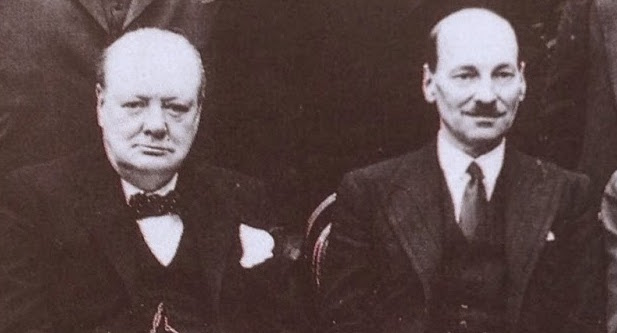
Winston Churchill (left) and Clement Attlee

July 5, 1945: The United Kingdom of Great Britain and Northern Ireland holds its 1st general election since the start of World War II. And their message to the incumbent head of government was, "Thank you for saving our arses, now, cheerio."

The war wasn't over yet -- V-J Day was still 40 days away -- but the Nazis had been defeated, and Britain's part in that, as Prime Minister Winston Churchill predicted it would be, was "their finest hour." In spite of his policy that had led to the deaths of 3 million people in British India, Churchill was arguably the most popular person on Earth. After all, the other contenders for that title were Franklin Roosevelt, who was already dead; and Joseph Stalin, who was probably the most hated living person, following the death of Adolf Hitler.

But the people of Britain had long memories. They knew that Churchill, while a great war leader, hadn't previously been good for them in peacetime. And so, they handed his Conservative Party a tremendous defeat, and elected to the Labour Party, led by Clement Attlee. Before the election, the Conservatives, or "Tories," had 386 seats in the House of Commons, while Labour had 154. Afterward, Labour had 393, the Tories 197.

Not that it mattered, any more than it matters over the Electoral College in elections for President of the United States, but, in this election, Labour won 47.7 percent of the popular vote, the Tories 36.2, the Liberal Party 9.0 (12 seats), the National Liberal Party 2.9 (11 seats), and all other parties 4.0 (29 seats).

Attlee thus became only the 2nd Prime Minister from the Labour Party, after James Ramsay MacDonald, who had last held the office 10 years earlier. His postwar program for rebuilding Britain included the National Health Service and educational reforms, which made Britain a less class-stratified country. The Conservatives called it "socialism." The British people decided they liked it.

Despite having been "booted from office," Churchill remained personally popular. After King George VI offered him the Order of the Garter, he accepted, saying, "I had just gotten the Order of the Boot." When his wife, Clementine, told him the defeat was "a blessing in disguise," he told her, "It was very well disguised."

Turnabout is fair play: By the early 1950s, the people of Britain decided that Labour wasn't doing enough, and in the 1950 election, the Tories gained a lot of seats, although not enough to take control. Attlee hung on for another year and a half, but miscalculated, calling for a snap election for October 25, 1951. The Tories won, 321-295, and Churchill served 3 more years as Prime Minister. Attlee never regained the job. Both men resigned as their parties' respective leaders in 1955, Churchill after 15 years, Attlee after 20.

*

July 5, 1945 was a Thursday. Michael Blake, author of Dances With Wolves, was born. This was also the day that Prime Minister John Curtin of Australia died in office. I have a separate entry for that event.

These baseball games were played that day:

* The New York Yankees lost to the Cleveland Indians, 3-2 at League Park in Cleveland. Jeff Heath hit a home run leading off the bottom of the 11th inning to win it. Ed Klieman went the distance for the Indians, Ernie "Tiny" Bonham for the Yankees.

* The New York Giants lost to the St. Louis Cardinals, 7-5 at the Polo Grounds.

* The Brooklyn Dodgers lost to the Cincinnati Reds, 8-4 at Ebbets Field.

* The Chicago Cubs beat the Boston Braves, 5-4 at Braves Field in Boston.

* The Detroit Tigers beat the Boston Red Sox, 9-8 at Briggs Stadium (later renamed Tiger Stadium) in Detroit.

* The Washington Senators beat the Chicago White Sox, 5-2 at Comiskey Park in Chicago.

* The St. Louis Browns beat the Philadelphia Athletics, 4-3 at Sportsman's Park in St. Louis. The A's tied the game in the top of the 9th inning, but the Browns won it in the bottom of the 11th, on a bases-loaded walk drawn by Frank Mancuso.

* And the Philadelphia Phillies and the Pittsburgh Pirates were rained out at Shibe Park in Philadelphia. It was made up as part of a doubleheader on August 8. The Pirates won the opener, 4-0. Elwin "Preacher" Roe, later to star with the Brooklyn Dodgers, allowed 8 hits, but kept the shutout. The Phillies won the nightcap, 5-0. Dick Mauney also pitched an 8-hit shutout.

Tuesday, June 14, 2022

June 14, 1940: The Fall of Paris

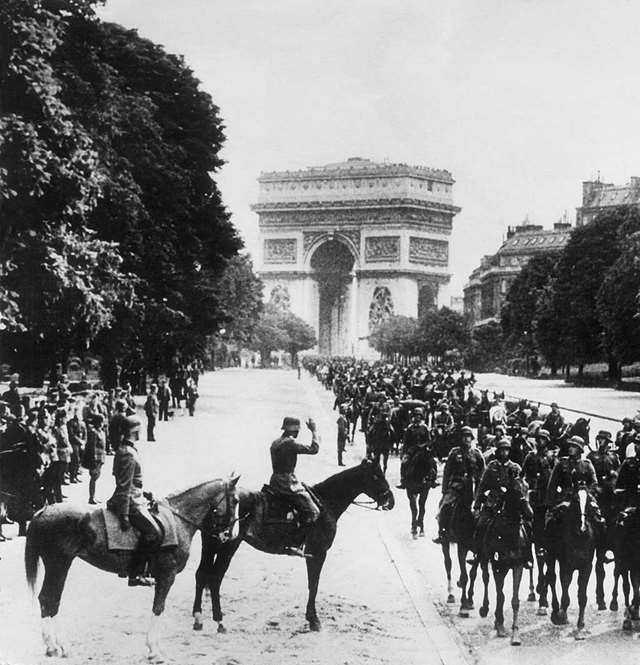
June 14, 1940: The government of France flees the capital of Paris, for Bordeaux, just ahead of the advancing Heer, the army of Nazi Germany. The City of Light has fallen to the forces of darkness. The Third Republic is dead.

France, along with its ally Britain, had been at war with the Nazis since September 3, 1939, when the Nazis invaded Poland. For a while, it was called a sitzkrieg, a "sit-down war" or a "phony war," because nothing seemed to be happening.

But on May 10, 1940, the blitzkrieg, or "lightning war," began. German forces invaded the Low Countries: Tiny Luxembourg was conquered by the end of the 1st day, the Netherlands fell on May 17, and Belgium was conquered on May 28.

With those events, the British policy of appeasement saw its failure completed. Neville Chamberlain resigned as Prime Minister, and Winston Churchill was given the job. On May 13, he gave his first speech to Parliament, saying, "I have nothing to offer but blood, toil, tears and sweat."

On that same day, the Germans faced the supposedly unbreachable Maginot Line at Sedan, the site of their greatest victory in the Franco-Prussian War of 1870, and simply went around it, over ground the French thought couldn't be gone over. The Maginot Line proved to be the most overrated thing since the "unsinkable" cruiseliner RMS Titanic, 28 years earlier.

On May 20, the Nazis opened their largest concentration camp, near Oświęcim, Poland. In German, the town's name becomes "Auschwitz." Their "Final Solution" was still a year and a half away from beginning. On May 26, the 300,000-man British Expeditionary Force began evacuating from France at the port of Dunkirk.

On June 3, The Nazi Air Force, the Luftwaffe, bombed Paris for the 1st time. On June 4, the Dunkirk evacuation was completed. Churchill told Parliament that it didn't matter when, or how, the Nazis came for Britain: 

Even though large tracts of Europe and many old and famous States have fallen, or may fall, into the grip of the Gestapo and all the odious apparatus of Nazi rule, we shall not flag or fail.

We shall go on to the end. We shall fight in France, we shall fight on the seas and oceans, we shall fight with growing confidence and growing strength in the air, we shall defend our island, whatever the cost may be.

We shall fight on the beaches, we shall fight on the landing grounds, we shall fight in the fields and in the streets, we shall fight in the hills. We shall never surrender. And if, which I do not for a moment believe, this island or a large part of it were subjugated and starving, then our Empire beyond the seas, armed and guarded by the British Fleet, would carry on the struggle, until, in God's good time, the New World, with all its power and might, steps forth to the rescue and the liberation of the old.

The Nazi advance continued. On June 7, the royal family of Norway evacuated their country. And on June 13, knowing that the Nazis were now close, the French government declared Paris to be an open city. They fled the next day.

The bad news continued. Also on June 14, on the Eastern Front, the Soviet Union annexed the Baltic states of Estonia, Latvia and Lithuania. While decrying the "imperialism" of the West. They would hold on to those "republics" for half a century.

It was a great day for Adolf Hitler. It was a great day for Joseph Stalin. It was a great day for the concept of dictatorship in general. It was a horrible day for civilization. It might have been the worst day in human history.

France's humiliation continued. On June 15, the fortress of Verdun, which had famously refused to surrender in World War I, surrendered. On June 16, Philippe Pétain, known as the Lion of Verdun for his refusal to surrender at that place and at that time (declaring, "They shall not pass!"), accepted the post of France's head of state, and began negotiating with the Nazis.

On June 18, General Charles de Gaulle began a series of radio broadcasts from exile in London, calling on French people, wherever they were in the world, to join him in resistance. He said, "France has lost a battle. But France has not lost the war."

Also on June 18, Churchill spoke to the world from Parliament:

The Battle of France is over. The Battle of Britain is about to begin. Upon this battle depends the survival of Christian civilization. Upon it depends our own British life, and the long continuity of our institutions and our Empire. The whole fury and might of the enemy must very soon be turned on us. Hitler knows that he will have to break us in this island or lose the war. If we can stand up to him, all Europe may be freed and the life of the world may move forward into broad, sunlit uplands.

But if we fail, then the whole world, including the United States, including all that we have known and cared for, will sink into the abyss of a new dark age made more sinister, and perhaps more protracted, by the lights of perverted science. Let us therefore brace ourselves to our duties, and so bear ourselves, that if the British Empire and its Commonwealth last for a thousand years, men will still say, "This was their finest hour."

On June 23, Nazi Chancellor Adolf Hitler visited Paris, copying the visit of Kaiser Wilhelm I in 1871, and achieving what Kaiser Wilhelm II could not do from 1914 to 1918.

The Battle of Britain began on July 10. No hour in the war seemed to remain the darkest for long.

The film Casablanca dramatized the events of the fall of Paris in a flashback sequence. And there was this sequence in the film's "present," in December 1941, right before the U.S. entered the war, in the title city, in the French colony of Morocco:

Major Heinrich Strasser (played by Conrad Veidt): Are you one of those people who cannot imagine the Germans in their beloved Paris?

Rick Blaine (Humphrey Bogart): It's not exactly MY beloved Paris.

Colonel Heinze (Richard Ryen): Can you imagine us in London?

Rick, knowing they haven't gotten there yet: When you get there, ask me!

Captain Louis Renault (Claude Rains): Hm! Diplomats!

Strasser, feeling full of himself: How about New York?

Rick: Well, there are certain sections of New York, Major, that I wouldn't advise you to invade.

On August 25, 1944, after 4 years, 2 months and 15 days of the city under Nazi control, the Allies liberated Paris. On April 30, 1945, Hitler killed himself. On May 8, the Nazis surrendered.

*

June 14, 1940 was a Friday. It was the off-season for the NFL and the NHL, and the NBA had not yet been founded. But there was a full slate of Major League Baseball games that day:

* The New York Yankees beat the St. Louis Browns, 12-3 at Sportsman's Park in St. Louis. Charlie Keller hit 2 home runs in support of Monte Pearson.

* The Brooklyn Dodgers beat the Cincinnati Reds, 2-0 at Ebbets Field. Luke Hamlin pitched a 2-hit shutout.

* The New York Giants beat the Pittsburgh Pirates, 8-6 at the Polo Grounds.

* The Boston Bees beat the Chicago Cubs, 4-2 at Braves Field in Boston. This would be the last of the Boston National League team's 5 seasons under the Bees name, as it just didn't catch on, and they once again became the Braves for 1941.

* The St. Louis Cardinals beat the Philadelphia Phillies, 6-2 at Shibe Park in Philadelphia.

* The Cleveland Indians beat the Philadelphia Athletics, 8-0 at League Park in Cleveland. Johnny Allen pitched a 2-hit shutout.

* The Detroit Tigers beat the Washington Senators, 10-1 at Briggs Stadium (later Tiger Stadium) in Detroit.

* And the Boston Red Sox beat the Chicago White Sox, 5-1 at Comiskey Park in Chicago.

Saturday, June 4, 2022

June 4, 1940: The Evacuation of Dunkirk & Churchill's Promise to Fight

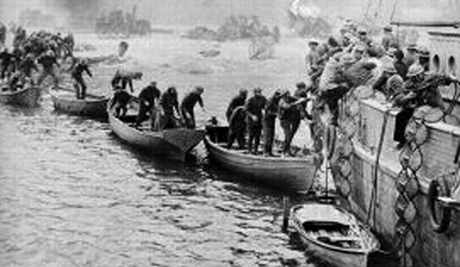
June 4, 1940: Operation Dynamo, the evacuation of British and allied troops from the French port of Dunkirk, is completed. It is known as the Miracle of Dunkirk.

After Nazi Germany invaded Poland on September 1, 1939, France and the British Empire declared war on Germany, and imposed an economic blockade. The British Expeditionary Force was sent to help defend France. After the "Phoney War" of October 1939 to April 1940, Germany invaded Belgium, the Netherlands and France on May 10, 1940.

Those countries were overwhelmed. By May 21, German forces had trapped the BEF, the remains of the Belgian forces, and three French field armies along the northern coast of France. The BEF's commander, General John Vereker, 6th Viscount Gort, immediately saw evacuation across the English Channel as the best course of action, and began planning a withdrawal to Dunkirk, the closest good port.

From May 28 to 31, in the Siege of Lille, the remaining 40,000 men of the French First Army fought a delaying action against seven German divisions, giving the evacuation a fighting chance. -- About 338,000 men were carried across the Channel by a hastily assembled fleet of over 800 vessels, including 39 Royal Navy destroyers, 4 Royal Canadian Navy destroyers, 3 French Navy destroyers, and a variety of civilian merchant ships, including a few pleasure yachts and poor people's fishing boats.

The BEF lost 68,000 soldiers during the French campaign, and had to abandon nearly all of its tanks, vehicles, and equipment. But the British Army would live to fight another day. A humiliating defeat had been turned into a massive act of heroism.

Among the British soldiers killed was Joe Carr, a fullback for Sheffield United, and a gunner for the Royal Artillery.

Prime Minister Winston Churchill spoke over the radio to the entire British Empire, with America's networks also broadcasting it. He refused to accept this humiliating defeat as the end for his country:

Even though large tracts of Europe and many old and famous states have fallen, or may fall, into the grip of the Gestapo and all the odious apparatus of Nazi rule, we shall not flag or fail. We shall go on to the end.

We shall fight in France. We shall fight on the seas and oceans. We shall fight with growing confidence and growing strength in the air. We shall defend our island, whatever the cost may be.

We shall fight on the beaches. We shall fight on the landing grounds. We shall fight in the fields and in the streets. We shall fight in the hills. We shall never surrender.

And even if, which I do not for a moment believe, this island, or a large part of it, were subjugated and starving, then our Empire beyond the seas, armed and guarded by the British Fleet, would carry on the struggle, until, in God's good time, the New World, with all its power and might, steps forth to the rescue and the liberation of the Old.

America's President, Franklin Delano Roosevelt, surely recognized this as the same tone he used in his Inaugural Address, 7 years earlier, when it was an economic emergency, rather than a political one, that seemed to have doomed his country, which he countered with the words, "Let me assert my first belief that the only thing we have to fear is... fear itself!" As with America with FDR in 1933, Britain in 1940 heard Churchill, and were ready to stand with him. They believed it because he believed it.

Four years and two days later, the British Army, along with American, Canadian and French troops, went back across the English Channel, and took France back from the Nazis.

*

June 4, 1940 was a Tuesday. These baseball games were played that day:

* The New York Yankees lost to the Chicago White Sox, 7-3 at Yankee Stadium. Eddie Smith went the distance, outpitching Red Ruffing. The White Sox got 2 home runs from Joe Kuhel and 1 from Taffy Wright. The Yankees got 1 from Joe DiMaggio. The following year, In a White Sox victory over the Yankees, Smith would give up a single to DiMaggio, starting the Yankee Clipper's 56-game hitting streak.

* The New York Giants beat the Cincinnati Reds, 5-4 at Crosley Field in Cincinnati. Mel Ott went 0-for-4, but had an RBI through drawing a bases-loaded walk.

* The Brooklyn Dodgers beat the St. Louis Cardinals, 10-1 at Sportsman's Park in St. Louis.

* The St. Louis Browns beat the Boston Red Sox, 5-3 at Fenway Park in Boston. Jimmie Foxx went 0-for-4. Ted Williams went 1-for-5.

* The Philadelphia Athletics beat the Detroit Tigers, 8-6 at Shibe Park in Philadelphia. Hank Greenberg went 1-for-5 with an RBI.

* A doubleheader was split at Griffith Stadium in Washington. The Washington Senators won the opener, 7-2. The Cleveland Indians won the nightcap, 3-2. Al Smith got into trouble in the 9th, and Bob Feller had to come on to get the last out and the save.

* The Pittsburgh Pirates beat the Boston Bees, 14-2 at Forbes Field in Pittsburgh. Paul Waner went 2-for-5 with an RBI. Lloyd Waner did not play. This was the last season of the unpopular 5-run as the Bees for the Boston franchise of the National League, before they went back to being the Braves.

* And the Chicago Cubs beat the Philadelphia Phillies, 12-6 at Wrigley Field in Chicago.

Tuesday, May 31, 2022

May 31, 1902: The Boer War Ends

May 31, 1902: The Boer War ends, in a British victory.

What is usually now referred to as "The Boer War" was actually the Second Boer War. The First Boer War, also known as the Transvaal Rebellion, was fought from December 16, 1880 to March 23, 1881, and resulted in a Boer victory, and the eventual independence of the South African Republic.

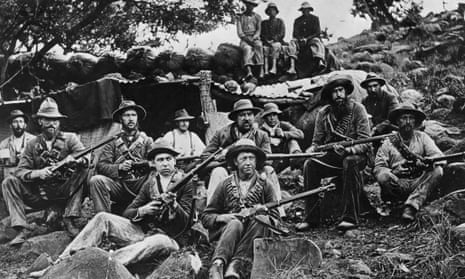
The Second Boer War was the 2nd war to be captured on film, after the Spanish-American War in 1898. It was a conflict fought between the British Empire and the 2 Boer Republics: The South African Republic and the Orange Free State. The Boers were, and are, the descendants of the Dutch-speaking Free Burghers of the Eastern Cape Frontier in southern Africa during the 17th, 18th and 19th Centuries. The word "Boer" means "farmer" in Dutch and its offshoot language, Afrikaans.

Following the discovery of gold in the Boer republics, there was a gold rush. These incoming "foreigners," mostly British from the Cape Colony, were regarded as unwelcome visitors. The Boers protested to the British authorities in the Cape, things broke down, and war broke out on October 11, 1899.

The Boers won some early minor victories, including the Battle of Spion Kop on January 24, 1900. Spion Kop was a hill near the town of Ladysmith, and while the British fought hard to defend it, they had to retreat. The name "Spion Kop" would soon be given to steeply-graded end stands at soccer stadiums. Few of these survive, although the southwest stand at Liverpool Football Club's Anfield stadium is still known as simply "The Kop."

Soon enough, the British overwhelmed them, and occupied the republics. The Boers turned to guerrilla warfare, and that led the British to turn to scorched-earth policies, including perhaps the first concentration camps in the modern world. This ultimately led to the Boers coming to the negotiating table, and surrendering.

The Boer War was the last of the British "wars of adventure" in Africa and Asia. Tales of heroism spread throughout the Empire, including a firsthand account of a soldier, a 25-year-old son of a prominent political family, being captured by the Boers, and escaping, leading to his winning a seat in the House of Commons. The young man's name was Winston Churchill.

So when British troops went off to World War I in August 1914, the sense of adventure, the idea that war could be romantic, was still there. Soon, it was shattered forever. They should have paid more attention to the fact that it took 2 1/2 years to overcome the Boers, who were not as well equipped as the Germans turned out to be in 1914.

*

May 31, 1902 was a Saturday. In America, the only team sport in season was baseball:

* The Brooklyn Superbas swept a doubleheader from the Boston Beaneaters at Washington Park in Brooklyn. The Superbas -- managed by Ned Hanlon, so named for a famous circus troupe, Hanlon's Superbas -- won both games by a 2-1 score, with the nightcap taking 10 innings.

In 1911, the Superbas became the Dodgers. The Beaneaters would go through a few name changes, finding a keeper in 1912: The Boston Braves.

* The New York Giants lost to the Philadelphia Phillies, 3-0 at the Polo Grounds.

* The Detroit Tigers beat the Boston Americans, 13-7 at the Huntington Avenue Grounds in Boston. The Americans became the Boston Red Sox in 1908.

* The Philadelphia Athletics beat the St. Louis Browns, 7-6 at Columbia Park in Philadelphia.

* The Cleveland Bronchos beat the Baltimore Orioles, 6-3 at Oriole Park in Baltimore. At the end of the season, the Baltimore franchise was revoked, and a new one was created in New York, which would become the Yankees.

The Bronchos were renamed for their star 2nd baseman and manager, Napoleon Lajoie: The Cleveland Naps. He did not play in this game, but the winning pitcher was another Hall-of-Famer, Addie Joss. After Lajoie left in 1914, they became the Cleveland Indians. In 2022, they became the Cleveland Guardians.

* The Chicago White Sox beat the Washington Senators, 4-1 at American League Park in Washington.

* The St. Louis Cardinals beat the Cincinnati Reds, 9-3 at Robison Field in St. Louis.

* And the Pittsburgh Pirates and the Chicago Orphans were rained out at Exposition Park in Pittsburgh. The game was made up on July 18, and the Orphans won, 2-0. Honus Wagner went 1-for-4 fort he Pirates.

"Orphans"? For 22 years, the Chicago club's 1st baseman was Adrian Constantine Anson. He became their team captain, and was known as Cap. For most of that time, their team name was the Chicago White Stockings. Eventually, Anson became their manager, and got to be so old -- he was 45 in his final season, 1897 -- that they started calling him Pop. When he left, the team became known as the Orphans, "because they missed their Pop." In 1903, because they had such a youthful roster, they changed their name to the Chicago Cubs.

Friday, May 13, 2022

May 13, 1940: Winston Churchill's Offer

May 13, 1940: Winston Churchill makes his 1st speech as Prime Minister of the United Kingdom of Great Britain and Northern Ireland.

Three days earlier, with the preceding Prime Minister, Neville Chamberlain, already seeing his government falling apart, Nazi Germany invaded the Netherlands, Belgium and Luxembourg, with France the obvious next target. Chamberlain's policy of appeasement toward the Nazis had failed, and so had the way he had conducted Britain's effort in World War II.

Chamberlain had to go to King George VI, and tell him that he could no longer form a government. The choice for a new Prime Minister was down to Churchill and Edward Wood, the 1st Earl of Halifax. Like Chamberlain, Lord Halifax had been part of the Conservative Party's appeasement wing. Churchill had been the foremost anti-Nazi in Parliament, but he had not seriously been trusted with a high government office since his failure as First Lord of the Admiralty in World War I.

But the King knew Churchill was the right man for the moment. After reorganizing the government into a true War Cabinet, Churchill gave his 1st speech as Prime Minister on May 13, before the House of Commons.

He had already heard of an event in The War from earlier in the day: The Nazis decided to not try to breach France's "unbreachable" Maginot Line. Instead, they just went around it, over ground the French thought couldn't be gone over. As the English might have said, the French were buggered.

The phrase from the speech that remains the most familiar had been, in one form or another, used before. Ancient Roman figures Cicero and Livy had both used the phrase "sweat and blood." In 1611, John Donne wrote, "That 'tis in vaine to dew, or mollifie / It with thy Teares, or Sweat, or Bloud." In 1823, Lord Byron had written of "Blood, sweat, and tear-wrung millions." In 1849, rallying his revolutionary forces in Rome, Giuseppe Garibaldi had said, "I offer hunger, thirst, forced marches, battle and death."

In 1897, in an address to the Naval War College in Newport, Rhode Island, the new U.S. Assistant Secretary of the Navy, Theodore Roosevelt, said, "Every man among us is more fit to meet the duties and responsibilities of citizenship because of the perils over which, in the past, the nation has triumphed; because of the blood and sweat and tears, the labor and the anguish, through which, in the days that have gone, our forefathers moved on to triumph."

As early as 1931, Churchill himself had given a speech speaking of "new structures of national life erected upon blood, sweat, and tears." But on May 13, 1940, broadcast all over the world by the BBC, he told the Commons this:

I would say to the House, as I said to those who have joined this government: I have nothing to offer but blood, toil, tears and sweat. We have before us an ordeal of the most grievous kind. We have before us many, many long months of struggle and of suffering.

You ask, what is our policy? I will say: It is to wage war, by sea, land and air, with all our might and with all the strength that God can give us; to wage war against a monstrous tyranny, never surpassed in the dark and lamentable catalogue of human crime. That is our policy.

You ask, what is our aim? I can answer in one word: Victory. Victory, at all costs. Victory, in spite of all terror. Victory, however long and hard the road may be. For, without victory, there is no survival.

Churchill immediately changed his perception among many people. This would be followed by his speeches of June 4, in which he said, "We shall fight on the beaches," and so on and so forth, adding, "We shall never surrender"; and of June 18, when he spoke of those defending the nation that it would be the nation's "finest hour." In the space of 36 days, he had become one of the most renowned public speakers in human history. In December, Time magazine named Churchill its Man of the Year for 1940.

None of which would have mattered had the Nazis won the war. They did not. As a result, in 1949, Time named Churchill its Man of the Half-Century -- ahead of America's own wartime leader, President Franklin Delano Roosevelt. (Time boss Henry Luce was a Republican, and, in a reluctant congratulations to FDR after he won a 3rd term in 1940, wrote, "We, who hate your gaudy guts, salute you.")

At some point, it was generally decided that "toil" and "sweat" were roughly the same thing, and so the saying was altered in the public mind to "Blood, Sweat and Tears." A rock band named Blood Sweat & Tears was big in 1968, '69 and '70.

On April 9, 1963, the Congress of the United States passed a resolution, making Churchill, who lived until 1965, the 1st honorary citizen of the United States. Since December 16, 2014, there are have been 8 individuals so honored: Pennsylvania founders William and Hannah Penn, Swedish diplomat and Holocaust rescuer Raoul Wallenberg, Mother Teresa, and 3 Europeans who aided the American cause during the Revolution: The Marquis de Lafayette, Count Casimir Pulaski, and Bernardo Gálvez y Madrid, 1st Count of Gálvez, for whom the Texas city of Galveston is named.

Time magazine named Churchill its Man of the Year for 1940, and later, in 1949, named him its Person of the Half-Century.

In a 2016 episode of the YouTube series Epic Rap Battles of History, "Epic" Lloyd Ahlquist played Theodore Roosevelt, while British comedian Dan Bull played Winston Churchill. Although Churchill became great friends and allies with TR's cousin FDR, he and TR met only once, at a dinner at the Governor's Mansion in Albany, New York on December 10, 1900, with TR about to leave the Governorship as Vice President-elect, and Churchill, then only 26 years old but already a hero of the Boer War and a member of Britain's House of Commons, on a lecture tour of America.

Although the two men would seem to have a lot in common, TR once wrote a letter about the then-young British politician and writer, saying, "I do not like Winston Churchill," accusing both him and his father, Lord Randolph Churchill, a former Chancellor of the Exchequer, of "inordinate thirst for that cheap form of admiration which is given to notoriety, as to make them poor public servants." Winston's feelings about TR do not appear to have been recorded. TR's daughter Alice suggested it was because they were so much alike that they didn't get along. Churchill biographer Robert Pilpel wrote, "It was a case of likes repelling."

*

May 13, 1940 was a Monday. There were only 3 games played in what would later be called Major League Baseball. The New York Yankees were not in any of them:

* The Brooklyn Dodgers beat the Philadelphia Phillies, 6-3 at Ebbets Field.

* The New York Giants beat the Boston Bees, 11-15 at National League Park in Boston. This was the last season of the failed rebrand of the Boston Braves and Braves Field.

* And the St. Louis Cardinals played the Cincinnati Reds at Crosley Field. The game was tied 8-8 after 14 innings. Johnny Mize hit 3 home runs for the Cards. But the game was stopped -- not because of darkness, as Crosley was the 1st MLB stadium with lights, but because of the scheduling. This game was already a rainout makeup, and both teams had to catch trains to get to their next series. 

Tuesday, May 10, 2022

May 10, 1940: "Blitzkrieg" Brings Neville Chamberlain Down

May 10, 1940: Nazi Germany invades the Low Countries: The Netherlands, Belgium and Luxembourg. The "Phony War" (or "Sitzkrieg") is over -- the "Lightning War" (or "Blitzkrieg") has begun.

Luxembourg is a tiny country, and it fell in 8 hours. The Netherlands held out for Belgium held out for 18 days.

Also on May 10, Neville Chamberlain resigns as Prime Minister of Great Britain. His policies have utterly failed, at home and abroad. None more so than the appeasement policy he used at the Munich Conference in 1938, from which he returned to London and told the people of the British Empire he had achieved "peace for our time."

He goes on radio and gives a resignation speech asking the Empire to rally around the new Prime Minister. Queen Elizabeth, the wife of King George VI, tells him that their daughter, Princess Elizabeth (the Queen Elizabeth we know), wept hearing it.
It wasn't known at the time that Chamberlain already had cancer. He would be dead in 6 months.

Winston Churchill, a man who had been politically given up for dead 3 times, becomes Prime Minister. Five years later – to the week – it will have all fallen apart for the Nazis.

The Blitzkrieg was mentioned as one of the actions claimed by the Devil, played by Mick Jagger, in The Rolling Stones' 1968 song "Sympathy for the Devil." 

*

May 10, 1940 was a Friday. These baseball games were played:

* The New York Yankees lost to the Boston Red Sox, 3-2 at Yankee Stadium. In the top of the 10th inning, Doc Cramer grounded to short, and Frank Crosetti made the play at 3rd base, allowing Johnny Peacock to score what turned out to be a winning run. Joe DiMaggio went 1-for-4 with a walk. Ted Williams went 0-for-2 with 3 walks. Jimmie Foxx went 0-for-4.

* The New York Giants beat their arch-rivals, the Brooklyn Dodgers, 7-2 at Ebbets Field. Mel Ott went 1-for-5.

* The Philadelphia Athletics beat the Washington Senators, 8-7 at Shibe Park in Philadelphia.

* The Cleveland Indians beat the St. Louis Browns, 9-4 at League Park in Cleveland.

* The Detroit Tigers beat the Chicago White Sox, 3-0 at Briggs Stadium (later Tiger Stadium) in Detroit. Bobo Newsom pitched a 7-hit shutout. Hank Greenberg did not play.

* The Pittsburgh Pirates beat the Chicago Cubs, 8-3 at Wrigley Field in Chicago.

* The Cincinnati Reds and the St. Louis Cardinals agreed to move their game on this day, at Sportsman's Park in St. Louis, to May 12, for a Sunday doubleheader, meaning higher gate receipts and more money. The Reds swept, 7-1 and 13-4.

* And the Boston Bees (as the Braves were known from 1936 to 1940), the Philadelphia Phillies were not scheduled.

December 31, 1999 & January 1, 2000: The Millennium

December 31, 1999:  The Millennium arrives. The people of planet Earth survived. At a terrible cost. But we hadn't destroyed ourselves. ...