Showing posts with label medicare. Show all posts

Friday, October 28, 2022

October 28, 1980: Ronald Reagan Debates His Way to the Presidency

October 28, 1980: The only debate between the 2 major-party nominees in this election is held at Public Hall in Cleveland. The Democratic incumbent, President Jimmy Carter, was struggling with the Iran Hostage Crisis, the Cold War, and inflation and interest rates running out of control -- but not, yet, high unemployment.
The Republican challenger, former Governor Ronald Reagan of California, had been hammering Carter on the stump, using his skills honed as an actor and, before that, as a remote announcer (using telegraphed-in plays) for the Chicago Cubs at a radio station in Des Moines, Iowa.
Carter said that, if elected, Reagan and the Republicans in Congress would cut spending on Medicare. Reagan laughed, and said, "There you go again." Translation: "Oh, no we won't. You Democrats are always saying that, and it's never true."
Reagan used his closing argument to ask, "Are you better off than you were four years ago?" More Americans could truthfully answer that question "No" than "Yes," and Reagan won in a landslide a week later, taking 44 States.
Four years later, his opponent, conveniently, was Carter's Vice President, Walter Mondale. Mondale said the Democrats would never cut Medicare. Reagan said, "You know, I wasn't going to say this, but... There you go again!" Big cheers from the audience. And Mondale correctly pointed out that, four years earlier, Carter was right: Reagan and the Republicans did cut spending on Medicare. And that got a bigger round of applause from the audience. Mondale had called Reagan a liar, right to his face.
But at the end, Reagan asked the question again" Are you better off than you were four years ago?" This time, enough Americans could say "Yes," despite a lot of evidence that millions of others were not better off -- the national unemployment rate was actually higher in November 1984 than in November 1980, although inflation and interest rates had been tamed -- that Reagan won 49 out of 50 States, despite Mondale beating him badly in both debates. Sometimes, Americans would rather feel good than admit the truth.
Ever since Reagan, the "better off" line has usually told the story of the Presidential election -- but not always:
* 1988: More Americans could say they were better off than couldn't. Republican George H.W. Bush beat Democrat Michael Dukakis.
* 1992: More Americans could not say it than could. Democrat Bill Clinton beat Bush.
* 1996: More Americans could say it than not. Clinton beat Republican Bob Dole.
* 2000: More Americans could say it than not. Democrat Al Gore won the popular vote over Republican George W. Bush. But Bush won the Electoral Vote, by stealing Florida.
* 2004: It was a close call, but Bush scared voters about what they could expect from Democrat John Kerry. Bush won the popular vote, but may again have won the Electoral Vote by stealing a big State, in this case Ohio.
* 2008: More Americans could not say it than could. Democrat Barack Obama beat Republican John McCain.
* 2012: More Americans could say it than not. Obama beat Republican Mitt Romney.
* 2016: More Americans could say it than not. Democrat Hillary Clinton won the popular vote over Republican Donald Trump. But Trump scared enough people that the States of Pennsylvania, Michigan and Wisconsin became close enough to steal, and he won the Electoral Vote.
2020: Over 231,000 Americans -- 77 "9/11s" -- were dead from the COVID-19 epidemic by the time of Election Day. Over 11 million jobs had been net lost under Trump. Police brutality was every bit as epidemic as COVID-19. Until the epidemic, it seemed as though there was a mass shooting every day of the Trump Administration.
Anybody who said he was better off in November 2020 than he was 4 years earlier was either super-rich or a liar. And Joe Biden beat Trump.
Remember: The old line, "Don't change horses in midstream" doesn't apply when the current has knocked you off your horse, your horse has been swept away, and there's a man with a lifeline on the other side.
*
October 28, 1980 was a Tuesday. The baseball season had ended the week before, with the Philadelphia Phillies beating the Kansas City Royals in the World Series. Football was in midweek. There were 7 games played in the NBA that night:
* The Atlanta Hawks beat the Kansas City Kings, 119-109 at The Omni in Atlanta. Despite the Kings' loss, their Scott Wedman led all scorers on the night with 34 points.
* The Philadelphia 76ers beat the Cleveland Cavaliers, 119-101 at The Coliseum in the Cleveland suburb of Richfield, Ohio.
* The Milwaukee Bucks beat the Chicago Bulls, 106-99 at the Chicago Stadium.
* The Utah Jazz beat the expansion Dallas Mavericks, 104-96 at the Reunion Arena in Dallas.
* The San Antonio Spurs beat the Portland Trail Blazers, 120-112 at the HemisFair Arena in San Antonio.
* The Los Angeles Lakers beat the San Diego Clippers, 131-101 at the San Diego Sports Arena (now named the Pechanga Arena).
* And the Seattle SuperSonics beat the Golden State Warriors, 119-102 at the Seattle Center Coliseum.
And there were 5 games played in the NHL:
* The New York Rangers lost to the St. Louis Blues, 5-4 at the St. Louis Arena. Rookie Jörgen Pettersson had a hat trick for the Blues.
* The New York Islanders beat the Montreal Canadiens, 6-4 at the Nassau Coliseum. The guard had bene changed: The Canadiens won 4 straight Stanley Cups from 1976 to 1979, but the Islanders were now in the process of winning the next 4.
* The Philadelphia Flyers beat the Calgary Flames, 8-0 at The Spectrum in Philadelphia. The Flyers got 2 goals each from Behn Wilson and Bill Barber.
* The Chicago Black Hawks and their arch-rivals, the Detroit Red Wings, played to a 2-2 tie at the Joe Louis Arena in Detroit.
* And the Los Angeles Kings beat the Colorado Rockies, 8-4 at the McNichols Arena in Denver. It was actually 4-4, 7 minutes into the 3rd period, but the Kings broke out. Dave Taylor scored a hat trick.

Saturday, July 30, 2022

July 30, 1965: Medicare and Medicaid Become Law

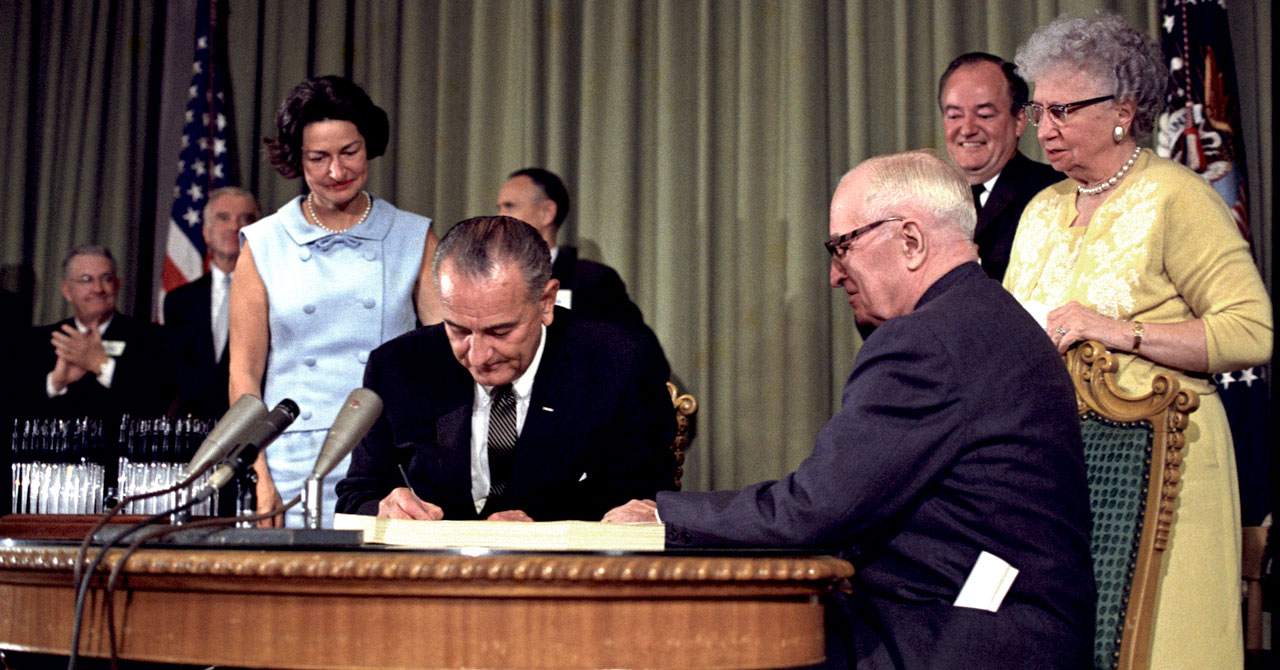
July 30, 1965: President Lyndon B. Johnson signs the Social Security Amendments of 1965 into law, in a ceremony at the Harry S Truman Presidential Library and Museum, in Independence, Missouri, outside Kansas City.

Former President Truman had tried to get a national health service, offering universal coverage, similar to Britain's passed in 1949, but failed. Holding the signing ceremony at his library was a tribute to his efforts. Also in attendance were each man's wife, Claudia "Lady Bird" Johnson and Elizabeth "Bess" Truman; Vice President Hubert Humphrey, and Governor Warren Hearnes of Missouri, for whom the University of Missouri's arena is named.

Although the Amendments increased benefits for people who met the legal definition of being disabled, the two main components were Medicare and Medicaid. Medicare provides coverage for healthcare for people aged 65 and up. Medicaid helps with health care costs for people of limited income, including nursing home and personal care services, which Medicare doesn't cover.

Medicare and Medicaid joined the Office of Economic Opportunity (a.k.a. "the War On Poverty"), and two major education reform bills to form Johnson's "Great Society." Within days of signing this bill, LBJ would add the Voting Rights Act of 1965. It remains the high point of American liberalism.

Canada passed National Health Service with universal coverage in 1967. Australia did so in 1984. In both cases, they use the term Medicare. In America, however, that term is still limited to health care for senior citizens.

*

July 30, 1965 was a Friday. It was the offseason for the NFL, the NBA and the NHL. However, there was a full slate of Major League Baseball games played:

* The New York Yankees lost to the Cleveland Indians, 5-0 at Yankee Stadium. The Yankees were shut out by Sonny Siebert, who allowed only 4 hits, 2 of them by Elston Howard.

* The New York Mets lost to the Philadelphia Phillies, 5-3 at Connie Mack Stadium in Philadelphia.

* The Pittsburgh Pirates beat the Chicago Cubs, 3-1 at Forbes Field in Pittsburgh.

* The Cincinnati Reds beat the Houston Astros, 7-1 at Crosley Field in Cincinnati.

* The Detroit Tigers beat the Chicago White Sox, 3-1 at Comiskey Park in Chicago.

* The San Francisco Giants beat the Milwaukee Braves, 9-2 at Milwaukee County Stadium.

* The Minnesota Twins beat the Baltimore Orioles, 3-2 at Metropolitan Stadium in the Minneapolis suburb of Bloomington, Minnesota.

* The Los Angeles Dodgers beat the st. Louis Cardinals, 4-2 at Busch Stadium, formerly Sportsman's Park, in St Louis.

* The Washington Senators beat the Kansas City Athletics, 3-1 at Kansas City Municipal Stadium.

* And the California Angels beat the Boston Red Sox, 9-2 at Dodger Stadium in Los Angeles. From 1962 to 1965, the Angels shared Chavez Ravine with the city's National League team, before opening Anaheim Stadium for 1966, now named Angel Stadium. 

Thursday, July 28, 2022

July 28, 1965: LBJ's Big Draft Increase

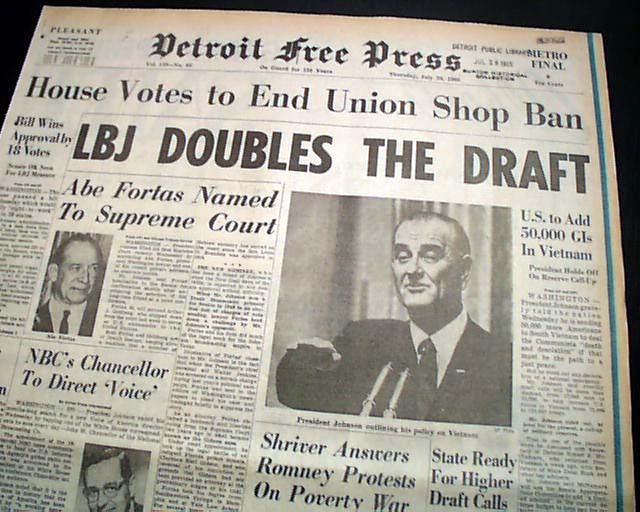
July 28, 1965: President Lyndon B. Johnson announces his order to increase the number of United States troops in South Vietnam from 75,000 to 125,000, and to more than double the number of men drafted per month, from 17,000 to 35,000.

Until now, Vietnam had been just a name to most Americans. And the protests of the war had been small, manned by just a few thousand people -- most still with suits and short hair. They certainly didn't look like radicals.

LBJ probably figured, with his signing ceremonies for Medicare and the Voting Rights Act coming up, most people wouldn't notice this increase in the draft rolls. (That's why embarrassing stories are often leaked by politicians on Fridays or just before holiday weekends, and it's not just the nature of the holiday that leads to pardons on Christmas Eve.)

But the Watts riot was about to happen -- between that and this, the Johnson Administration had peaked, and would never be so popular again. Most Presidents usually get a "honeymoon" that lasts 100 days after their Inauguration, January 20 to April 30, with good media coverage, without serious criticism. Because he had become President following the assassination of John F. Kennedy, LBJ had gotten over a year and a half, including an actual election. But it was coming to an end.

There was another change the following month: On August 26, 1965, LBJ signed an Executive Order, ending the exemption for married men from being drafted. Any marriage performed after Midnight, local time, on August 26 would be powerless to save someone from the draft under the U.S. Selective Service Act.

All across America, young couples scrambled to say their "I dos" before the clock struck 12. In one Las Vegas courthouse, which usually handled 10 to 12 weddings a day under the liberal marriage (and divorce) laws of the State of Nevada, 171 frantic couples tied the knot on August 26, most of them between the hours of 10:00 PM and 12:00 Midnight.

The backlash had already begun. On April 17, in a demonstration organized by Students for a Democratic Society (SDS), 25,000 people marched against the war in Washington. On May 5, 40 men burned their draft cards, the 1st time this was publicly done, at the University of California, Berkeley, and a coffin was marched to the Berkeley Draft Board. As far as I can tell, this is the first public burning of draft cards in the Vietnam era.

*

July 28, 1965 was a Wednesday. These baseball games were played that day:

* The New York Yankees lost to the Detroit Tigers, 4-3 at Yankee Stadium. Starter Jack Cullen and reliever Steve Hamilton fell apart in the top of the 8th inning, including a home run to Norm Cash. Al Kaline went 2-for-4. For the Yankees, Tony Kubek hit a home run, and Mickey Mantle went 1-for-4.

* The New York Mets were swept in a doubleheader by the Chicago Cubs, 7-2 and 9-0 at Wrigley Field in Chicago. Larry Jackson pitched a 5-hit shutout in the 2nd game. Over the 2 games, Ernie Banks went 5-for-9 with a home run and 3 RBIs.

* The Boston Red Sox beat the Kansas City Athletics, 6-0 at Fenway Park in Boston. Carl Yastrzemski hit a home run. Bill Monbouquette allowed 8 hits, but kept the shutout.

* The Baltimore Orioles beat the California Angels, 5-1 at Memorial Stadium in Baltimore. Brooks Robinson went 1-for-4.

* The Minnesota Twins beat the Washington Senators, 8-1 at District of Columbia Stadium (later Robert F. Kennedy Stadium) in Washington. Harmon Killebrew hit a home run.

* The Philadelphia Phillies beat the Pittsburgh Pirates, 1-0 at Forbes Field in Pittsburgh. Cliché Alert: Walks can kill you. With 1 out in the top of the 14th inning, Don Schwall walked Tony González, Johnny Callison and Dick Allen. Alex Johnson singled Rojas home with the winning run. Vernon Law had pitched 12 shutout innings for the Pirates. Jim Bunning pitched 2-hit shutout ball for 8 innings, and Jack Baldschun allowed 3 runs over 6 innings to be the winning pitcher.

* The Cleveland Indians beat the Chicago White Sox, 4-2 at Cleveland Municipal Stadium.

* The Milwaukee Braves beat the Houston Astros, 6-4 at the Astrodome in Houston. Hank Aaron went 0-for-2 with a walk and an RBI on a sacrifice fly. Rookie Joe Morgan hit a home run for the Astros.

* The Cincinnati Reds beat the Los Angeles Dodgers, 4-1 at Dodger Stadium in Los Angeles. Sammy Ellis outpitched Sandy Koufax, including getting more strikeouts, 12-8. Frank Robinson went 0-for-4. Pete Rose went 1-for-4 with an RBI.

* And the San Francisco Giants beat the St. Louis Cardinals, 8-5 at Candlestick Park in San Francisco. Willie Mays went 0-for-3 with a walk.

Sunday, May 22, 2022

May 22, 1964: President Lyndon Johnson's "Great Society" Speech

May 22, 1964: President Lyndon B. Johnson gives the commencement address at the graduation ceremony at the University of Michigan, in Ann Arbor. Although he had already used the phrase "a Great Society" 15 days earlier, on the campus of Ohio University in Athens, this address becomes known as "the Great Society Speech."

Johnson had been a young aide to Representative Richard Kleberg of Texas in 1933 when President Franklin D. Roosevelt launched his "New Deal" in response to the Great Depression. The New Deal contained emergency measures, but some of them, such as banking insurance and Social Security, worked so well that they were kept in operation.

Johnson was a Congressman himself in 1944 when, with American troops marching toward victory in World War II, FDR created the G.I. Bill of Rights, allowing for a postwar economic boom.

With the economy booming again in the early 1960s, in part due to the measures enacted over the previous 3 years by the recently assassinated President John F. Kennedy, Johnson thought now was the time for another New Deal -- not out of necessity, like in 1933; or out of gratitude, like in 1944; but out of opportunity. There had never been a better chance for the American federal government to help the people who had "fallen through the cracks." He told the commencement crowd:

For a century, we labored to settle and to subdue a continent. For half a century, we called upon unbounded invention and untiring industry to create an order of plenty for all of our people.
The challenge of the next half century is whether we have the wisdom to use that wealth to enrich and elevate our national life, and to advance the quality of our American civilization.
Your imagination, your initiative, and your indignation will determine whether we build a society where progress is the servant of our needs, or a society where old values and new visions are buried under unbridled growth. For in your time we have the opportunity to move not only toward the rich society and the powerful society, but upward to the Great Society.
The Great Society rests on abundance and liberty for all. It demands an end to poverty and racial injustice, to which we are totally committed in our time. But that is just the beginning.
The Great Society is a place where every child can find knowledge to enrich his mind and to enlarge his talents. It is a place where leisure is a welcome chance to build and reflect, not a feared cause of boredom and restlessness. It is a place where the city of man serves not only the needs of the body and the demands of commerce but the desire for beauty and the hunger for community.
It is a place where man can renew contact with nature. It is a place which honors creation for its own sake and for what it adds to the understanding of the race. It is a place where men are more concerned with the quality of their goals than the quantity of their goods.
But most of all, the Great Society is not a safe harbor, a resting place, a final objective, a finished work. It is a challenge constantly renewed, beckoning us toward a destiny where the meaning of our lives matches the marvelous products of our labor.
Johnson had already declared "War On Poverty" in his State of the Union Address on the preceding January 8. That war, with the founding of the Office of Economic Opportunity (OEO), became a subset of the Great Society. He noted in his speech that the University of Michigan was the birthplace of the Peace Corps, and he added VISTA, Volunteers In Service To America, as a kind of "domestic Peace Corps" for poor places on our own shores, both urban and rural.

Head Start created better preschools for millions of children. His Higher Education Act of 1965 expanded college access. The Social Security Act of 1965 created Medicaid for the poor and Medicare for people age 65 and up.

Most of all, despite being a white Southerner, LBJ attacked the problem of racism. He created the Equal Employment Opportunity Commission (EEOC) to alleviate discrimination in hiring based on race and gender. He saw JFK's civil rights bill through to passage as the Civil Rights Act of 1964. He demanded, and got, the Voting Rights Act of 1965. And the Civil Rights Act of 1968, the Fair Housing Act, made it easier for black people to move into houses wherever they wanted, and to repair the homes they already had.

LBJ gave the speech just as the 1964 Republican Presidential Primaries were nearing their conclusion. Senator Barry Goldwater of Arizona won the nomination, and ran against the Great Society -- what had already been passed, and what LBJ had hinted -- and, beyond that, what the conservative movement suspected was yet to come -- as "overreach." He believed such things were unconstitutional, powers not specifically granted to the federal government by the Constitution of the United States.

It is likely that Johnson would have defeated Goldwater solidly even if Goldwater hadn't voted against the Civil Rights Act of 1964, which he challenged on constitutional grounds. He may have forgotten that the Constitution, in its very Preamble, says it was ordained an established in part to perform the rather vaguely worded tasks to "promote the general welfare and secure the blessings of liberty to ourselves and our posterity."

But the full term that Johnson won would be stricken with a different challenge: The Vietnam War. In essence, he got one full term as President, 4 years: From JFK's assassination on November 22, 1963 until November 30, 1967, when Senator Eugene McCarthy of Oregon announced he would challenge him in the 1968 Democratic Primaries, LBJ pretty much had free rein to govern how he wanted.

This was true in large part because he was backed by large Congressional majorities. In the 1964 election, led by LBJ as JFK's "heir," the Democrats gained 37 seats in the U.S. House of Representatives, giving them 295 seats for the 1965-66 term, which remains their highest total since the 1937-38 session. And they gained 2 Senate seats, giving them 68, which remains their highest total since 1939-40.

But in the 1966 elections, while they only lost 4 Senate seats, they lost 47 seats in the House, proving that LBJ was not invincible. And the public turned on him. So did the media: On August 1, 1967, Herbert Block, the editorial cartoonist for The Washington Post, under the name "Herblock," drew Johnson arm-in-arm with a trash-looking woman, whose mink stole was labeled "VIETNAM WAR," while he pointed a finger at a thin woman in a raggedy dress labeled "U.S. URBAN NEEDS," and tells her, "There's money enough to support both of you - Now doesn't that make you feel better?"
(In addition, Barbara Garson, one of the University of California students who was arrested during the "Free Speech Movement" protest of late 1964, wrote a satirical play titled MacBird! in 1966, imagining LBJ as Macbeth, assassinating JFK, and talking about his plan for "The Smooth Society." Interviewed in 2006, she said it was just a satire, and that she never believed that LBJ had anything to do with the assassination, adding, "If he did, it's the least of his crimes.")

The intraparty challenge by McCarthy made LBJ nervous. But then, JFK's brother, Senator Robert F. Kennedy of New York, got into the race. Unlike McCarthy, with his obsession with Vietnam, RFK was not a one-issue candidate, and could out-promise LBJ on issues connected with the Great Society, because, as his brother's Attorney General, he had a record on such issues, one that LBJ had built on.

On March 31, 1968, LBJ announced he wouldn't run for a 2nd full term. In June, RFK knocked McCarthy out, then was assassinated. LBJ's Vice President, Hubert Humphrey, was nominated, then lost the general election to former Vice President Richard Nixon.

How Nixon handled it depends on who you talk to. Most liberals thought that Nixon "dismantled" the Great Society. He did end the OEO, and cut spending on many programs. But many conservatives, especially those affiliated with the later Presidency of Ronald Reagan, thought that Nixon had let them down on the issue, especially with his institution of what became known as "Food Stamps": After Nixon's death in 1994, Fred Barnes of The New Republic said that Nixon "let the Great Society flower."

After leaving office, Johnson told his aide Doris Kearns -- who would later marry Richard Goodwin, author of the Great Society Speech -- with his usual away-from-microphones earthiness:

I knew from the start that I was bound to be crucified, either way I moved. If I left the woman I really loved, the Great Society, in order to get involved in that bitch of a war on the other side of the world, then I would lose everything at home. All my programs, all my hopes, all my dreams.

But if I left that war and let the Communists take over South Vietnam, then I would be seen as a coward, and my nation would be seen as an appeaser, and we would both find it impossible to accomplish anything, for anybody, anywhere on the entire globe.

Johnson died in 1973. Running for President in 1980, Reagan said in his speeches, "We fought a war on poverty, and poverty won." He wasn't lying, but he was far from completely correct: Just as FDR's New Deal had cut poverty in America by 1/3rd in its 1st 30 years, 1933 to 1963, so too did LBJ's Great Society cut poverty in America by another 1/3rd in its 1st 30 years, 1964 to 1994.

*

May 22, 1964 was a Friday. These baseball games were played:

* The New York Yankees beat the Los Angeles Angels, 4-3 at Yankee Stadium. Whitey Ford started, but left after 3 innings due to an injury, and Pete Mikkelsen ended up as the winning pitcher. Mickey Mantle went 2-for-4 with an RBI. Roger Maris went 1-for-4.

* The New York Mets beat the Houston Colt .45s, 2-1 at Colt Stadium in Houston. The Colts became the Houston Astros the next season.

* The Kansas City Athletics beat the Boston Red Sox, 4-3 at Fenway Park in Boston. Earl Wilson was the Boston starter and loser, despite hitting a home run in his own cause. Carl Yastrzemski went 1-for-4.

* The Baltimore Orioles beat the Minnesota Twins, 6-5 at Memorial Stadium in Baltimore. The O's trailed 5-4 in the bottom of the 9th, but got back-to-back home runs by Sam Bowens and John Orsino to win it. Bowens had already homered. Brooks Robinson went 0-for-4. Harmon Killebrew went 3-for-3 with 2 walks and 2 RBIs.

* The Cleveland Indians beat the Detroit Tigers, 5-3 at Cleveland Municipal Stadium. Al Kaline went 0-for-4, although he did draw a walk.

* The Chicago Cubs beat the Cincinnati Reds, 9-1 at Crosley Field in Cincinnati. Ernie Banks did not play. Frank Robinson went 1-for-4. Pete Rose went 0-for-4.

* The Chicago White Sox beat the Washington Senators, 3-1 at Comiskey Park in Chicago.

* The St. Louis Cardinals beat the Milwaukee Braves, 6-1 at Milwaukee County Stadium. Hank Aaron went 0-for-4.

* The Philadelphia Phillies beat the Los Angeles Dodgers, 2-0 at Dodger Stadium in Los Angeles. Chris Short allowed 8 hits, but kept the shutout, and beat Don Drysdale.

* And the San Francisco Giants beat the Pittsburgh Pirates, 8-3 at Candlestick Park in San Francisco. The Giants got home runs from Willie Mays, Willie McCovey, Orlando Cepeda and Tom Haller. For the Pirates, Roberto Clemente went 0-for-5, and Willie Stargell went 1-for-4 with an RBI.

Thursday, May 19, 2022

May 19, 1962: Marilyn Monroe Sings "Happy Birthday" to JFK

May 19, 1962: The Democratic Party holds a fundraiser at the old Madison Square Garden in New York City. 

Marilyn Monroe appeared, in a very glittery, very tight, low-cut gown, designed by noted costume designer Bob Mackie, and sang "Happy Birthday" to President John F. Kennedy -- though his actual birthday was 10 days later. (He was turning 45.)

The President then took the stage, saying, "I can now retire from politics after having had 'Happy Birthday' sung to me in such a sweet, wholesome way." That got a big laugh.

During his speech, Kennedy addresses the need for Medicare, the name for the plan to reduce health care costs for retired Americans. It does little good: Medicare doesn't pass Congress until 1965, and is signed into law by his successor as President, Lyndon Johnson.

After the show, a photograph was taken with the two of them and JFK's brother, Attorney General Robert F. Kennedy. Rumors of her having an affair with JFK have circulated ever since. Rumors of her also having an affair with RFK are ridiculous, and are usually only spread by people with an axe to grind against the Kennedys.
"My eyes are up here, Jack."

She made this trip to New York during a break from filming Something's Got to Give, but she got sick. The studio dropped hints to the media that she was faking it. The film was running behind, and Fox was already having similar problems with Cleopatra. While Marilyn and that film's star, Elizabeth Taylor, didn't know each other well, Liz sent Marilyn a letter of support, and Marilyn sent Liz a very grateful return letter.

But on June 7, Fox fired Marilyn from the film, and it was finally released in 1964 as Move Over, Darling, with Doris Day. Marilyn died on August 4, from an overdose of barbiturates, only 36 years old.

*

May 19, 1962 was a Saturday. These baseball games were played:

* The New York Yankees beat the Minnesota Twins, 2-1 at Yankee Stadium. Ralph Terry went the distance for the win. Mickey Mantle was injured, and did not play. Yogi Berra went 1-for-4. Roger Maris went 0-for-4. The Twins' only run came on a solo home run by Harmon Killebrew.

* The New York Mets beat the Milwaukee Braves, 6-5 at Milwaukee County Stadium. Frank Thomas (the Big Donkey, not the later Big Hurt) hit a home run for the Mets. Hank Aaron went 2-for-4.

* The Los Angeles Angels beat the Boston Red Sox, 6-5 at Fenway Park in Boston. Buck Rodgers singled home the winning run in the top of the 10th inning. Carl Yastrzemski went 1-for-4.

* The Philadelphia Phillies beat the Chicago Cubs, 7-5 at Connie Mack Stadium in Philadelphia. Ernie Banks went 1-for-5.

* The Kansas City Athletics beat the Washington Senators, 8-4 at District of Columbia Stadium (later Robert F. Kennedy Stadium) in Washington.

* The Detroit Tigers beat the Cleveland Indians, 9-3 at Cleveland Municipal Stadium. Al Kaline went 0-for-3 with a walk.

* The Baltimore Orioles beat the Chicago White Sox, 11-6 at Comiskey Park in Chicago. Brooks Robinson went 3-for-4 with a walk.

* The St. Louis Cardinals beat the Los Angeles Dodgers, 8-1 at Dodger Stadium in Los Angeles. Ray Sadecki outpitched Don Drysdale. Stan Musial went 1-for-5.

* And the San Francisco Giants beat the Houston Astros, 10-2 at Candlestick Park in San Francisco. Willie Mays, Orlando Cepeda and Ed Bailey hit home runs.

Saturday, January 8, 2022

January 8, 1964: President Lyndon Johnson's "War On Poverty" Speech

January 8, 1964: President Lyndon B. Johnson delivers his 1st State of the Union Address before a joint session of Congress. Behind him, in the seat normally occupied by the Vice President of the United States, an office made vacant by his rise to the Presidency following the assassination of President John F. Kennedy, was the Speaker of the House of Representatives, John McCormack of Massachusetts. In the other seat, normally occupied by the Speaker, was the President Pro Tempore of the Senate, Carl Hayden of Arizona.

It is the boldest State of the Union since, at least, Franklin D. Roosevelt's "Four Freedoms" address, 23 years earlier:

We have, in 1964, a unique opportunity and obligation: To prove the success of our system; to disprove those cynics and critics at home and abroad who question our purpose and our competence.

If we fail, if we fritter and fumble away our opportunity in needless, senseless quarrels between Democrats and Republicans, or between the House and the Senate, or between the South and North, or between the Congress and the Administration, then history will rightfully judge us harshly. But if we succeed, if we can achieve these goals by forging in this country a greater sense of union, then, and only then, can we take full satisfaction in the State of the Union.

Here in the Congress you can demonstrate effective legislative leadership by discharging the public business with clarity and dispatch, voting each important proposal up, or voting it down, but at least bringing it to a fair and a final vote.

Let us carry forward the plans and programs of John Fitzgerald Kennedy, not because of our sorrow or sympathy, but because they are right.

In his memory today, I especially ask all members of my own political faith, in this election year, to put your country ahead of your party, and to always debate principles, never debate personalities...

America cannot afford to stand still. Our population is growing. Our economy is more complex. Our people's needs are expanding...

Unfortunately, many Americans live on the outskirts of hope -- some because of their poverty, and some because of theft color, and all too many because of both. Our task is to help replace their despair with opportunity.

This administration today, here and now, declares unconditional war on poverty in America. I urge this Congress and all Americans to join with me in that effort.

It will not be a short or easy struggle, no single weapon or strategy will suffice, but we shall not rest until that war is won. The richest Nation on earth can afford to win it. We cannot afford to lose it. One thousand dollars invested in salvaging an unemployable youth today can return $40,000 or more in his lifetime.

This speech, and his speech later in the year outlining what he called "The Great Society," was written by Richard Goodwin, one of the few holdovers from the Kennedy loyalists that LBJ trusted. Goodwin would work with the various agencies established by the War On Poverty, as LBJ's Great Society was designed to not only surpass JFK's New Frontier, but to provide the same kind of impact in the 1960s that FDR's New Deal did in the 1930s.

Following this speech, Congress passed the Economic Opportunity Act, which established the Office of Economic Opportunity. As its 1st Director, LBJ appointed JFK's brother-in-law, Sargent Shriver. Two later directors when on to serve as Secretary of Defense in Republican Administrations: Donald Rumsfeld and Frank Carlucci.

Also passed over the next 2 years would be Medicare for the elderly, Medicaid for the poor, Head Start for pre-kindergarten kids, and programs that would be like domestic versions of JFK's Peace Corps: The Job Corps and VISTA (Volunteers In Service To America).

But no matter what LBJ did to reduce poverty, it wouldn't go away completely. Subsequent Presidents Richard Nixon (Republican), Gerald Ford (also Republican) and Jimmy Carter (Democratic but not the same kind of Democrat as Johnson) tried the kind of approach that Bill Clinton (Democratic) would later call "Mend it, but don't end it."

But, running for President in 1980, archconservative Republican Ronald Reagan said in his speeches, "We fought a war on poverty, and poverty won." He said he would cut back on social spending. Unfortunately, one promise that he kept was the abolition of the OEO.

But he couldn't abolish all of the War On Poverty programs, especially Medicaid, because they were too popular. Just as FDR's New Deal had cut poverty in America by 1/3rd in its 1st 30 years, 1933 to 1963, so too did LBJ's Great Society cut poverty in America by another 1/3rd in its 1st 30 years, 1964 to 1994.

Things have a weird way of working out: After the end of his 1st marriage, Richard Goodwin married Doris Kearns, who had first worked for a challenge to Johnson within the Democratic Primaries, then, with his having been impressed by her writing ability, he hired her to work for him. She later wrote the first full biography of him after his death, Lyndon Johnson and the American Dream.

*

January 8, 1964 was a Wednesday. Baseball was out of season. Football season had just ended. There were 3 games played in the NBA:

* The New York Knicks lost to the Los Angeles Lakers, 136-118 at the Los Angeles Memorial Sports Arena. Jerry West scored 39 points.

* The Cincinnati Bengals beat the Philadelphia 76ers, 126-110 at the Cincinnati Gardens.

* And the Baltimore Bullets beat the Detroit Pistons, 106-99 at Cobo Hall (now Huntington Place) in Detroit.

And the NHL's entire "Original Six" were in action:

* The New York Rangers beat the Detroit Red Wings, 5-3 at the old Madison Square Garden.

* The Montreal Canadiens beat the Boston Bruins, 5-1 at the Montreal Forum.

* And the Toronto Maple Leafs beat the Chicago Black Hawks, 3-0 at Maple Leaf Gardens in Toronto.

December 31, 1999 & January 1, 2000: The Millennium

December 31, 1999:  The Millennium arrives. The people of planet Earth survived. At a terrible cost. But we hadn't destroyed ourselves. ...