Showing posts with label philadelphia athletics. Show all posts

Friday, December 16, 2022

December 16, 1953. The Yankees Trade Vic Power

Vic Power at Yankee Stadium -- after the trade

December 16, 1953. The New York Yankees trade Vic Power, Don Bollweg, Jim Finigan, Johnny Gray, Bill Renna and Jim Robertson to the Philadelphia Athletics for Loren Babe, Harry Byrd, Tom Hamilton, Carmen Mauro and Eddie Robinson.

Byrd was a decent pitcher, who simply didn't get run support with the A's. But he didn't do much for the Yankees. Other than him, the only name in this trade that you really need to know is Vic Power. Or, legally, Victor Pellot, which is what he always called himself.

Born in 1927 in Arecibo, Puerto Rico as Victor Felipe Pellot Pove (first name, middle name, father's family name, mother's family name, as is common in Spanish-speaking places), Power was a sensational fielder at 1st base, and in the 1952 season batted .331 with 40 doubles, 17 triples, 16 home runs and 109 RBIs for the Yankees' top farm team, the Kansas City Blues, playing in Blues Stadium, which eventually became Kansas City Municipal Stadium, and was always a pitcher's park.

In 1953, Power batted .349 for the Blues, winning the American Association batting title, with 39 doubles, 10 triples, 16 homers and 93 RBIs. At the time of the trade, he was already 27 years old.

And still, the Yankees hadn't yet brought him up to the majors. This at a time when the Yanks' starting 1st baseman was Joe Collins. He was a good player, but Power was probably already better.

(For comparison's sake: Mickey Mantle was 24 when he won the Triple Crown in 1956; Reggie Jackson, not yet a Yankee, was 23 when he hit 47 home runs in 1969; and Aaron Judge was 25 when he hit 52 home runs in 2017.)

So why would the Yankees trade Vic Power for 5 guys who amounted to nothing in Pinstripes? The official reason was that he was "too flashy" or a "hot dog," for the way he fielded at 1st base. It wasn't "the Yankee way."

Turned out that the real reason was that general manager George Weiss was a bigot, and didn't want black players on the Yankees. To make matters worse, Power was dating a white woman at the time. This was the final straw. How "uppity," as was said at the time of black men who acted out of line with what white men in positions of power demand. Off you go, to the House of Mack.

The A's had already been integrated for 5 years, and Power broke into their starting lineup right away in 1954, and became a star after their move to Kansas City, where he'd starred in Triple-A, and later with the Cleveland Indians.

He won 7 straight Gold Gloves, batted over .300 3 times, led the AL in triples in 1958 with 10, and made 4 All-Star teams. In 12 big-league seasons, he batted .284, collected 1,716 hits, including 290 doubles, 49 triples and 126 homers. And, in the media, he never seemed to be all that controversial after leaving the Yankees.

After his retirement, he went back to Puerto Rico and became a youth baseball coach, living until 2005, dying of cancer at age 78.

Late in life, as the number of Hispanic players in the majors grew, and interest in their forebears did the same, he gave some interviews in English, and did not seem particularly bitter about his treatment by the Yankees.

Was the decision to trade him justified? In any way? Well, in 1954, the Yankees did get a new starting 1st baseman, Bill "Moose" Skowron, and he was terrific for them until 1962, playing the position superbly, and hitting with more power than any righthanded Yankee would between Joe DiMaggio and Dave Winfield.

And, a year later, in 1955, tired of the mounting criticism from civil rights groups, Yankee owners Dan Topping and Del Webb overruled Weiss, and promoted outfielder/catcher Elston Howard to become the 1st black Yankee. He was 26.

Unlike Power, he was quiet, unflashy, already married to a woman of his own race, and did his job well, and was thus "worthy of the Yankee uniform." He became the 1st black Most Valuable Player award winner in the American League -- in 1963, after the National League had already had black MVPs Jackie Robinson, Roy Campanella (3 times), Willie Mays (the 1st of 2 he would win), Don Newcombe, Hank Aaron, Ernie Banks (twice), Frank Robinson and Maury Wills.

Based on the successes of Skowron and Howard, it can be argued from a competitive standpoint -- if not from a moral one -- that the Yankees lost nothing by trading Power away. Still, they should have gotten something more for him than 5 who's-he's.

And I wonder how much good it would have done in the community to have a terrific player who was not only black, but Hispanic. But Weiss thought it would upset the Yankee fan base, which he considered to be white commuters from Westchester, Connecticut and North Jersey. If only he had known that the real base was working-class Irish and Italians, guys who wore T-shirts, jeans and boots to work, and only wore suits for weddings and funerals. You know: Just like the fans at the Polo Grounds and Ebbets Field.

Power, despite playing less than 4 full seasons with the Indians, was named one of the team's 100th Anniversary 100 Greatest Players. Howard is honored with a Plaque in Yankee Stadium's Monument Park. But Weiss has no Monument Park Plaque, although he is, unlike the other two, in the Hall of Fame.

*

December 16, 1953 was a Wednesday. Baseball and football were out of season. There were 2 games played in the NBA. The Boston Celtics beat the Fort Wayne Pistons, 91-74 at the Boston Garden. And the Minneapolis Lakers beat the Milwaukee Hawks, 69-63 at the Milwaukee Arena. In 1974, it was renamed the Milwaukee Exposition, Convention Center and Arena, or "The MECCA." Since 2014, it has been named the UW-Panther Arena.

One game was played in the NHL: The New York Rangers beat the Boston Bruins, 4-3 at the old Madison Square Garden. Ron Murphy scored the winning goal with 3:41 left in regulation.

Monday, December 12, 2022

December 12, 1933: The 2nd Athletics Fire Sale

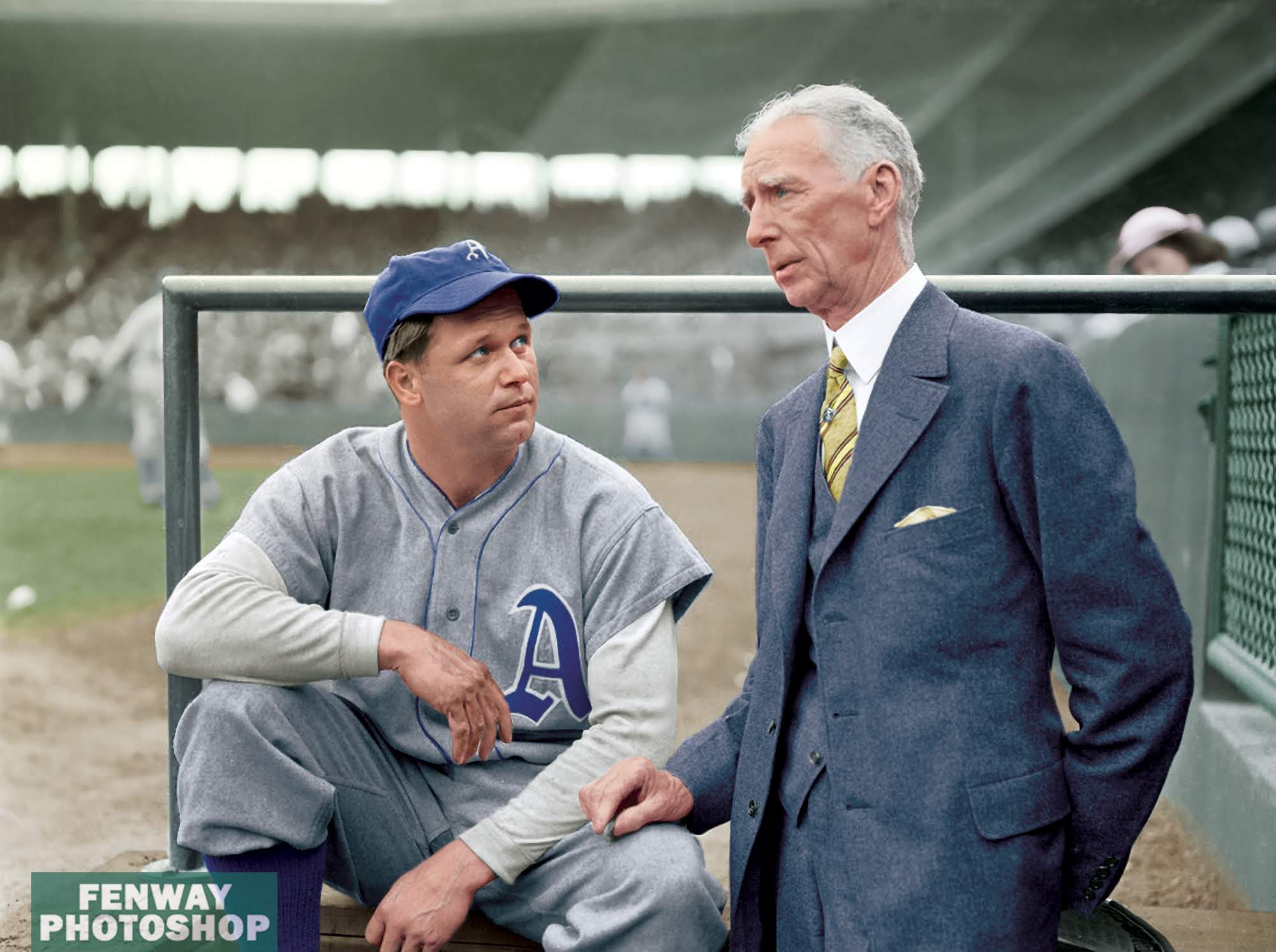
Jimmie Foxx (left) and Connie Mack

September 28, 1932: Connie Mack begins the breakup his of his Philadelphia Athletics. The 1st time he'd done so, in 1914-15, it was because he couldn't keep up with the salaries being offered by the Federal League teams. This time, it was personal.

In 1925, the A's went 88-64, and were only 8 1/2 games behind the 1st-place Washington Senators. But the rise of the "Murderers' Row" Yankees delayed Philadelphia's return to greatness. In 1929, they began a run of 3 seasons in which they won 313 games, and game within a Game 7 loss in 1931 of winning 3 straight World Series.

But Mack lost all of his non-baseball holdings in the stock market Crash of 1929. He couldn't fund the A's with any other income. So, after the 1932 season, despite a strong 94-60 record (but 13 games behind the Pennant-winning Yankees), he began to sell of his 2nd generation of stars.

On September 28, 1932, he sent left fielder Al Simmons, 3rd baseman Jimmy Dykes, and center fielder Mule Haas are all sold to the Chicago White Sox, for $100,000. Simmons would be elected to the Baseball Hall of Fame, and Dykes and Haas would have been perennial All-Stars had the All-Star Game been founded before 1933.

But the big day was December 12, 1933, when Mack made 3 separate moves:

* Pitchers Lefty Grove and Rube Walberg, and 2nd baseman Max Bishop, are traded to the Boston Red Sox for Bob Kline and Rabbit Warstler and $125,000. Along with Carl Hubbell, Grove was 1 of the 2 best lefthanded pitchers in the game, and would go to the Hall of Fame. Walberg was the 3rd starter on the A's, behind Grove and George Earnshaw, but would have been the ace on many teams.

Key to this deal was the fact that Tom Yawkey had recently turned 30 and come into his inheritance, and had bought the Red Sox, and could afford to spend whatever he wanted to build a championship team. He did try, but the Yankees' dynasty that was restarted in 1936 thwarted his early efforts.

Grove's 199 wins during the 1930s made him the winningest pitcher of the decade.

* Catcher Mickey Cochrane was traded to the Detroit Tigers for Johnny Pasek and $100,000. The Tigers subsequently named Cochrane player-manager, and won the next 2 American League Pennants.

* Finally, before the ink was dry on the previous 2 trades, Mack traded Pasek and Earnshaw to the White Sox for Charlie Berry and $100,000. So, in 1 day, Mack sold off his 3 best pitchers.

The A's went from 94-60 in 1932 to 79-72 in 1933, to 68-82 in 1934, to 58-91 in 1935. On December 10, 1935: 1st baseman Jimmie Foxx and pitcher Johnny Marcum were traded to the Red Sox for Gordon Rhodes, George Savino and $150,000. Foxx was the best righthanded slugger in the game, and would go to the Hall of Fame. Marcum was the Mackmen's best pitcher following the '33 fire sale, and Mack dumped him, anyway.

The A's never recovered, and the Mack family ended up selling the A's in 1954, to a buyer who moved them to Kansas City. They failed there as well, and Charlie Finley bought them in 1960, moving them to Oakland in 1968. After 5 straight AL Western Division titles, 1971-75, including 3 straight World Series wins, 1972-74, he broke them up, and the team crashed. New owner Walter Haas rebuilt them in the early 1980s, but the pitching collapsed, preventing a new dynasty. The A's rebuilt again, and won 3 straight Pennants, 1988-90, but after another Division title in 1992, were broken up again.

The pattern held: By 2000, the "Moneyball" regime built a team that reached the Playoffs 5 times in 7 years, but won no Pennants. They sold off, rebuilt, and made 3 straight Playoffs, 2012-14. They couldn't afford to keep it going, sold off, rebuilt, and made 3 straight Playoffs, 2018-20. They couldn't afford to keep it going, and sold off. In 2022, the A's lost 102 games, their most since the Finley fire sale bottomed out at 108 in 1979.

Rumors of the A's moving again have been renewed, since they haven't been able to get a deal to replace the Oakland Coliseum. If they do move, how long will it be before they win again? And, if so, how long before they have a 9th fire sale?

One thing is for sure: The A's are not moving back to Philadelphia, where the Phillies, having won the 2022 NL Pennant, are overwhelmingly popular. The city can certainly support one winning team, but not two teams. But, wherever they go, or if they stay, at some point, the A's will go back to their Philadelphia roots, and break it all down and start all over again.

In 1949, Ogden Nash, my grandmother's favorite poet, wrote "Line-Up for Yesterday" for Sport magazine, an alphabetical list of star players. For the letter Q, Nash had to cheat a little, and wrote:

Q is for Don Quixote
Cornelius Mack;
Neither Yankees nor years
Can halt his attack.

He also had to cheat a little for the letter X:

X is the first

of two x's in Foxx
Who was right behind Ruth
with his powerful soxx.

*

December 12, 1933 was a Tuesday. Baseball was out of season. The NBA hadn't been founded yet. The NFL was going to play its 1st official Championship Game the following Sunday, and the Chicago Bears won it, 23-21 over the New York Giants.

There were 4 games played in the NHL that night:

* The Toronto Maple Leafs beat the Boston Bruins, 4-1 at the Boston Garden. This was the game in which Eddie Shore hit Ace Bailey over the head with his stick, ending his career. I have a separate entry for that event.

* The New York Americans beat the New York Rangers, 3-0 at the old Madison Square Garden, which was still fairly new at the time. The company that ran the Garden owned the Rangers, and the Amerks were tenants, so any win the tenants had over the landlords was considered big.

* The Detroit Red Wings beat the Chicago Black Hawks, 4-1 at the Olympia Stadium in Detroit.

* And the Montreal Canadiens and the Ottawa Senators played to a 1-1 tie at the Ottawa Auditorium.

Friday, December 9, 2022

December 10, 1876: New York & Philadelphia Are Kicked Out of the National League

William Hulbert.
I looked for photos of the teams' operators,
William Cammeyer of New York and Al Wright of Philadelphia,
but it appears none of either survive.

December 10, 1876: The teams representing New York, the biggest city in the country, and Philadelphia, the 3rd-biggest, are kicked out of the National League, the only major league in the sport, or in any sport in North America, at the time.

The NL had begun play in 1876, with 8 teams. Going east to west, they were: The Boston Red Caps, the Hartford Dark Blues, the New York Mutuals, the Philadelphia Athletics, the Cincinnati Reds, the Louisville Grays, the Chicago White Stockings and the St. Louis Brown Stockings. (At this point, coming up with a clever name for your team was not necessary.)

The 1st game was played on April 22, at the Jefferson Street Grounds in Philadelphia. Boston beat Philadelphia, 6-5. There was a decent Pennant race, with Chicago finishing 6 games ahead of both Hartford and St. Louis, 15 ahead of Boston (who had won the last 4 titles in the National Association, and would win the next 2 titles in the NL), 22 ahead of Louisville, 26 ahead of New York, and 34 1/2 ahead of Philadelphia.

It was not treated as odd that the top 2 teams were Chicago, owned by NL founder William Hulbert; and Hartford, owned by the NL's President, Morgan Bulkeley, a Hartford banker who would later be elected Mayor of Hartford, and as Connecticut's Governor and U.S. Senator. But it was a bit odd that New York and Philadelphia hadn't done well.

The New York Mutuals had been founded in 1857, and won more games recognized as "official" than any other team in 1863 and 1864. While the Boston Red Stockings (who became the Red Caps, and went through several name changes before settling in 1912 on "Braves") dominated the National Association, the "Mutes" finished 3rd in 1872 and 2nd in 1874.

They played their home games not in Manhattan, but in Brooklyn, which would be a separate city until 1898. Their owner, William Cammeyer, had built the first enclosed baseball facility, the Union Grounds, in the Williamsburg section of Brooklyn, in 1862, and the Mutes continued to play there.

Like the Mutes, the Philadelphia Athletics were considered one of the top teams in baseball's amateur era, before professionalism came in 1869. They had been founded in 1860, won more games than any other team in 1867, and finished 2nd in 1865, 1866 and 1868. In 1871, they won the NA's 1st Pennant.

But the depression that began with the Panic of 1873 hit baseball hard. NA teams couldn't afford to complete their schedules by going on roadtrips. This was a major reason that Hulbert founded the NL: He wanted teams to stick to their schedules, to make the Pennant race more honest. Chicago beat Hartford at home, 7-6, on September 26, to clinch the Pennant. (As early as 1858, the team with the best overall record would be permitted to fly a flag, or "pennant," reading, "CHAMPIONS" at their ballpark, and the name stuck.)

On September 11, 1876, Al Wright, manager of the Athletics, informed the NL office that they could not afford to make their last Western roadtrip, to Chicago and St. Louis. He did, however, have a backup officer: The White Stockings and Brown Stockings could come east, play additional games in Philadelphia, and take a larger than normal portion of the gate receipts, so they could raise enough money to finish their schedule. The NL denied this reasonable suggestion. On September 16, the Mutuals announced that they couldn't afford to make their last roadtrip, either.

And so, on December 10, the NL held its Winter Meetings in Cleveland. After Bulkeley declined to run for re-election, Hulbert was elected President. He immediately moved for the expulsion of the Mutuals and the Athletics from the League. In spite of the role each already had in baseball's relatively short history, the other team owners did Hulbert's bidding.

It would be 1883 before both cities returned to the NL, with the teams that would become known as the New York Giants and the Philadelphia Phillies. By the start of the 1878 season, only 2 of the original 8 teams would be left: Boston and Chicago. But those 2 teams still exist, as the Atlanta Braves and the Chicago Cubs.

*

December 10, 1876 was a Sunday. The NL forbid games on Sundays, but, apparently, they were more than willing to make decisions affecting any and all League teams on the day. Since basketball did not yet exist, hockey barely did, and college football, itself in its early days, did not play on Sundays, there were no scores on this historic day.

Thursday, December 8, 2022

December 8, 1914: The 1st Athletics Fire Sale

December 8, 1914: Connie Mack breaks up his champion Philadelphia Athletics. It sets a pattern for the franchise that lasts to this day.

Founded in 1901 with the American League, and not the first baseball team with that name, the Philadelphia Athletics were owned by Benjamin Shibe, with Connie Mack -- the former catcher shortened his name so it would fit better in a box score, but never legally changed his name from Cornelius Alexander McGillicuddy -- as the team's manager, treasurer, and 25 percent owner.

They won the American League Pennant in 1902, before the World Series was instituted. They won the Pennant in 1905, losing the World Series to the National League Champions, the New York Giants. They fell a little short of the Pennant in 1907 and 1909, before winning it in 1910, defeating the Chicago Cubs in the World Series. They won the Pennant again in 1911 and 1913, each time beating the Giants in the World Series. They won another Pennant in 1914, but lost the World Series to the Boston Braves, in the competition's 1st major upset.

But 1914 was also the 1st year of the Federal League, which considered itself not bound by the reserve clause, as the AL and the NL agreed to be. So the FL could offer higher salaries, and Mack, as treasurer and part-owner, could not keep up.

On December 2, 1914, Mack's best pitcher, Eddie Plank, signed with the FL's St. Louis Terriers. Three days later, his next-best pitcher, Charles Albert "Chief" Bender, signed with the FL's Baltimore Terrapins. Both pitchers would be elected to the Baseball Hall of Fame. Mack could have sold or traded either of them, and gotten something for them. Instead, he got nothing for them.
Eddie Plank

So he began to sell off his best players. Here's the starting players, and the remaining main pitchers, from the 1914 World Series, and what happened to them:

* December 8, 1914: Sold 2nd baseman Eddie Collins, a future Hall-of-Famer, to the Chicago White Sox, for $50,000. 

* Sometime before the 1915 season: Released pitcher Jack Coombs, who would be signed by the Brooklyn Robins (as the Dodgers were then known). 

* June 6, 1915: Waived pitcher Herb Pennock, who would be claimed by the Boston Red Sox. 

* June 28, 1915: Sold pitcher Bob Shawkey to the New York Yankees for $3,000. So much is made of the Red Sox' owner, Harry Frazee, selling their pitchers to help build the Yankees' 1920s dynasty, but Mack had a big role in that as well.

* July 2, 1915: Sold shortstop Jack Barry to the Boston Red Sox for $10,000. 

* July 15, 1915: Sold right fielder Eddie Murphy to the White Sox, for $11,500. 

* February 15, 1916: After 3rd baseman John Franklin "Frank" or "Home Run" Baker, a future Hall-of-Famer, sat out the entire 1915 season in a salary dispute, Mack sold him to the Yankees for $37,500. 

* July 1, 1916: Released left fielder Reuben "Rube" Oldring. 

* August 30, 1916: Traded center fielder Jimmy Walsh to the Red Sox for Raymond Haley. 

* December 14, 1917: Traded catcher Wally Schang, pitcher Bullet Joe Bush and center fielder Amos Strunk to the Red Sox for Sylveanus "Vean" Gregg, Merlin Kopp, Chester "Pinch" Thomas and, perhaps most importantly, $60,000.

* January 10, 1918: Traded 1st baseman John "Stuffy" McInnis to the Boston Red Sox for Forrest Cady, Larry Gardner and Tillie Walker. McInnis, Collins, Barry and Baker were known as "The $100,000 Infield." 

The results were staggering, in both directions. Coombs helped the Brooklyn Dodgers win the 1916 NL Pennant. Collins helped the White Sox win the 1917 World Series and the 1919 AL Pennant, before 7 of their players "threw" the World Series. (Collins was not in on the fix.)

Pennock, Shawkey, Schang, Bush would help the Red Sox win the 1918 World Series, then would be acquired by the Yankees, as they built their 1920s dynasty. McInnis would also help the Red Sox win that World Series, but did not go on to the Yankees, though he did play a reserve role on the Pittsburgh Pirates when they won the 1925 World Series. Baker would also be a part of that Yankee team, before retiring after the 1922 season.

As for the A's: They went 99-53 in 1914, but dropped to 43-109 in 1915. That net loss of 56 games has never seriously been approached in baseball history. In 1916, they went 36-117. Those 117 losses were the most of an MLB team between the 134 of the 1899 Cleveland Spiders and the 120 of the 1962 New York Mets, and remained the most ever in the AL until the Detroit Tigers lost 119 in 2003. The '16 A's' "winning" percentage of .235 remains the lowest in the major leagues since the 1899 Spiders.

When asked about this worst season in AL history, Mack said something that entered the American lexicon: "Well, you can't win them all."

Slowly, but surely, Mack began to rebuild. Ben Shibe died in 1922, and his sons, Tom and Jack, were amenable to Mack doing pretty much whatever he wanted. Although most teams didn't have full farm systems until the 1930s, Mack developed a working relationship with the Baltimore Orioles, who dominated the International League in the 1920s.

In 1925, the A's went 88-64, and were only 8 1/2 games behind the 1st-place Washington Senators. But the rise of the "Murderers' Row" Yankees delayed Philadelphia's return to greatness. In 1929, they began a run of 3 seasons in which they won 313 games, and game within a Game 7 loss in 1931 of winning 3 straight World Series.

But Mack lost all of his non-baseball holdings in the stock market Crash of 1929. He couldn't fund the A's with any other income. So, after the 1932 season, despite a strong 94-60 record (but 13 games behind the Pennant-winning Yankees), he began to sell of his 2nd generation of stars. The team never recovered, and the Mack family ended up selling the A's in 1954, to a buyer who moved them to Kansas City.

They failed there as well, and Charlie Finley bought them in 1960, moving them to Oakland in 1968. After 5 straight AL Western Division titles, 1971-75, including 3 straight World Series wins, 1972-74, he broke them up, and the team crashed. New owner Walter Haas rebuilt them in the early 1980s, but the pitching collapsed, preventing a new dynasty. The A's rebuilt again, and won 3 straight Pennants, 1988-90, but after another Division title in 1992, were broken up again.

The pattern held: By 2000, the "Moneyball" regime built a team that reached the Playoffs 5 times in 7 years, but won no Pennants. They sold off, rebuilt, and made 3 straight Playoffs, 2012-14. They couldn't afford to keep it going, sold off, rebuilt, and made 3 straight Playoffs, 2018-20. They couldn't afford to keep it going, and sold off. In 2022, the A's lost 102 games, their most since the Finley fire sale bottomed out at 108 in 1979.

Rumors of the A's moving again have been renewed, since they haven't been able to get a deal to replace the Oakland Coliseum. If they do move, how long will it be before they win again? And, if so, how long before they have a 9th fire sale?

One thing is for sure: The A's are not moving back to Philadelphia, where the Phillies, having won the 2022 NL Pennant, are overwhelmingly popular. The city can certainly support one winning team, but not two teams. But, wherever they go, or if they stay, at some point, the A's will go back to their Philadelphia roots, and break it all down and start all over again.

To this day, Plank holds the record for most games won by a Philadelphia-based pitcher: 284 of his 326 major league wins came with the A's. This tops Steve Carlton, who won 241 of his 329 with the Phils; Robin Roberts, who won 234 of his 286 with the Phils; Lefty Grove, who won 195 of his even 300 with the A's; and Grover Cleveland Alexander, who won 190 of his 373 with the Phils.

In 1949, Ogden Nash, my grandmother's favorite poet, wrote "Line-Up for Yesterday" for Sport magazine, an alphabetical list of star players. For the letter P, he wrote, citing Plank's World Series matchups with the Giants' Christy Mathewson: 

P is for Plank,
The arm of the A's;
When he tangled with Matty
Games lasted for days.

UPDATE: The A's made a deal to leave Oakland after the 2024 season, play at the Class AAA ballpark in Sacramento for 3 years, and then build a domed stadium in Las Vegas to open in 2028.

*

December 8, 1914 was a Tuesday. Baseball was out of season. Football was in midweek. Professional basketball barely existed. There was professional hockey, in the forms of Eastern Canada's National Hockey Association, and Western Canada's Pacific Coast Hockey Association.

The NHA season didn't begin until December 26, but the PCHA season opened on December 8, with 1 game: The Vancouver Millionaires beat the Portland Rosebuds, 6-3 at the Portland Ice Arena. The Millionaires would win the PCHA title, and beat the NHA Champion Ottawa Senators for the Stanley Cup. No Vancouver team has won the Cup since.

This was also the day that the Southwest Conference was founded. I have a separate entry for that event.

Tuesday, November 8, 2022

November 8, 1954: The Death of the Philadelphia Athletics

Connie Mack and Bobby Shantz, who turned out to be
the last living former player for the Philadelphia Athletics

November 8, 1954: The American League owners approve the shift of the Philadelphia Athletics franchise to Kansas City. Roy and Earle Mack, sons of the now-senile 88-year-old Connie Mack, sell the A's to Arnold Johnson, a Chicago-based trucking magnate.

Johnson's bid is $3‚375‚000 for the team and stadium‚ Shibe Park, recently renamed Connie Mack Stadium. He says he will sell the stadium to the Phillies for $1‚675‚000, although Phils owner Bob Carpenter, a very wealthy man as a member of both the Carpenter and the duPont families, says, "I need Shibe Park like I need a hole in the head."

One of the offers for the team is from a wealthy Texas group that proposes to move the A's to Los Angeles. This would have meant that the expansion team of 1961 that we currently know as the Los Angeles Angels would have been established elsewhere. However, given that the A's were in the American League, Walter O'Malley still might have moved the National League's Brooklyn Dodgers there.

But the A's did not go to L.A. Kansas City, long a hotbed of minor league and Negro League baseball, gets major league status for the 1st time since the Kansas City Packers of the Federal League in 1915 – or, if you don’t count that, since the Kansas City Cowboys of the old American Association in 1889.

The A's had won AL Pennants in 1902, 1905, 1910, 1911, 1913, 1914, 1929, 1930 and 1931. They had won the World Series in 1910, 1911, 1913, 1929 and 1930. Connie Mack had built 2 dynasties, then broke them up because he needed money.

Unlike in Boston, where the Red Sox stayed and the Braves left, and St. Louis, where the Cardinals stayed and the Browns left, in Philadelphia, the more historically successful team was the one that moved. But while the A's had 9 Pennants to the Phillies' 2, and 5 titles to the Phils' none, the Phils had money, and the A's didn't. And, since both teams couldn't survive in the city, the one without the money went.

Would Philadelphia have been better off if it had been the A's that stayed and the Phils that moved? Imagine, instead, that the Carpenters had bought the A's from the Macks in 1943, instead of buying the Phils from William D. Cox at that time. Here is what the teams won from 1931 to 1970:

Phillies: 1950 Pennant, plus that agonizing near-miss of 1964
A's: Nothing

Doesn't sound good for either team, but at least the Phils won something, right? Hold on, here's 1971 to 2006:

A's: 1971 AL West, 1972 World Series, 1973 World Series, 1974 World Series, 1975 AL West, 1981 AL West, 1988 Pennant, 1989 World Series, 1990 Pennant, 1992 AL West, 2000 AL West, 2001 AL Wild Card, 2002 AL West, 2003 AL West, 2006 AL West

Phils: 1976 NL East, 1977 NL East, 1978 NL East, 1980 World Series, 1981 NL East (1st half), 1983 Pennant, 1993 Pennant

Better for both, but now, it favors the A's. Now, check it out from 2007 onward:

Phils: 2007 NL East, 2008 World Series, 2009 Pennant, 2010 NL East, 2011 NL East, 2022 Pennant

A's: 2012 AL West, 2013 AL West, 2014 AL Wild Card, 2018 AL Wild Card, 2019 AL Wild Card, 2020 AL Wild Card

So, now, the A's have the edge. Here it is, overall, 1901 to 2014:

A's: 30 postseason appearances, 15 Pennants, 9 World Championships
Phillies: 15 postseason appearances, 8 Pennants, 2 World Championships

Definitely, the A's were the ones that should have stayed. At least then, they'd have been in a better stadium than either the Oakland Coliseum or Veterans Stadium by 2004.

Vic Power played until 1965, making him the last active Philadelphia Athletic.

UPDATE: On September 26, 2025, Bobby Shantz celebrated his 100th birthday. By that point, he was the last living Philadelphia Athletic, and the last living man who had played for Connie Mack.

*

November 8, 1954 was a Monday. Baseball season was over. Football was in midweek: There would be no Monday Night Football for another 16 years. And the NBA and NHL seasons were underway, but no games were scheduled in either. So there were no scores on this historic day.

Monday, November 7, 2022

November 7, 1933: Pennsylvania Legalizes Sunday Sports

November 7, 1933: The Pennsylvania legislature votes to repeal the law banning the playing of professional sports on Sunday. Governor Gifford Pinchot signs the bill into law.

Pinchot was a Republican. He was elected in 1922, but the State Constitution then forbid Governors from serving consecutive terms, so he couldn't run again in 1926. He ran again in 1930, and won, but couldn't run again in 1934. A new Constitution, in 1968, made Governors eligible for 2 consecutive terms, but not 3. It's possible that Pinchot would have lost in the Democratic landslide of 1934, anyway.

For centuries, Christians followed the Commandment of "Remember the Sabbath Day, and keep it holy," defining it as 12:00 AM to 11:59 PM on Sunday, and not doing any work on the day. Of course, there would always be people who tried to get around this. But when professional sports became viable, some people of faith fought to get laws passed banning it on Sundays. They also tried to get laws passed banning other things on Sundays, like shopping. They called themselves "Sabbatarians."

Baseball was the first sport in America to really go professional. And when the National League was founded in 1876, the team owners chose not to challenge the laws: They refused to schedule games on Sundays. But this meant that that, since most people worked a six-day week, and permanent lights at a ballpark were not yet practical, thus making night games any day of the week possible, there would be no day on which the average working man could go to a baseball game.

In 1882, the American Association was founded, and they chose to play on Sunday -- where it was legal. Some teams got around this by playing games outside the city limits, or in neighboring States. A Boston team might play in neighboring Providence, Rhode Island; a Pittsburgh team might play in Wheeling, West Virginia: and a Detroit team might play in Toledo, Ohio.

The AA folded in 1891, but the American League, founded in 1901, adopted this "play on Sunday where and when you can" philosophy. The 1903 National Agreement between the NL and the AL allowed the NL to play on Sunday, where and when legal.

By that point, Saturday had become a non-mandatory workday for many people, allowing big crowds on the day; and professional football had become viable. The National Football League was founded in 1920, and began playing on Sunday because they didn't want to compete with college football, which played on Saturday.

It took until 1929 for Massachusetts to legalize Sunday sports. Right on time: The Great Depression came, and the Boston Red Sox, the Boston Braves, and anyone thinking of funding an NFL team in Boston needed those big crowds badly. (Of course, the big crowds still didn't come for George Preston Marshall's Boston Redskins, so he moved them to Washington in 1937.) Even so, for the 1929 season, the Red Sox made a deal with the Braves to play Sunday home games at Braves Field, because Fenway Park was "too close to a church." People really thought about such ridiculous things at the time.

In 1931, the NFL's Philadelphia team, the Frankford Yellow Jackets, folded. Their Frankford Stadium in Northeast Philadelphia had burned down, and they had trouble securing a new home field, since they couldn't play on Sunday, and most football stadiums of any size in the city had a college team playing there on Saturday afternoons.

In 1933, the rights to a Philly NFL team were bought by Bert Bell (later to be the Commissioner of the NFL) and Lud Wray, and they founded the Philadelphia Eagles. The same year, Art Rooney founded a football team named the Pittsburgh Pirates, which he would rename the Pittsburgh Steelers in 1940. Together, Bell and Rooney lobbied the Pennsylvania legislature to make Sunday sports legal, and they succeeded, making the long-term success of their teams possible.

The Pirates/Steelers debuted on September 20, at home at Forbes Field, and lost to the New York Giants, 23-2. The Eagles debuted on October 15, also against the Giants, and they were nearly strangled in their crib, losing 56-0 at the Polo Grounds. Three days later, playing their 1st home game, at Baker Bowl, home of the Phillies in North Philadelphia, they lost 25-0 to the Portsmouth Spartans, the team that would become the Detroit Lions the next season. 

Angelo Cataldi of Philadelphia sports-talk radio station WIP says of the city, "This place is wired for football." That's a little misleading: Philadelphia is a basketball city, but Pennsylvania is a football State. As political consultant James Carville, a graduate of Louisiana State University, said after getting Bob Casey Sr. elected Governor in 1986, "Pennsylvania is Philadelphia and Pittsburgh, with Alabama in between." He wasn't kidding: In neighboring New Jersey, we call the rural portions of the State "Pennsyltucky." The State is absolutely nuts about football.

In hindsight, legalizing Sunday sports was inevitable. Now, it is impossible to imagine an Autumn Sunday without a big percentage of the State's people in Eagles green and white, and another in Steelers black and gold.

*

November 7, 1933 was a Tuesday. Baseball season was over. Football was in midweek. The NBA hadn't been founded yet. And the NHL season started 2 days later. So there were no scores on this historic day, despite it being a day that made some scores possible.

Wednesday, October 19, 2022

October 19, 1949: The Philadelphia Athletics Trade Nellie Fox

October 19, 1949: Three weeks after acquiring shortstop Chico Carrasquel from the Brooklyn Dodgers organization for cash and 2 minor leaguers‚ the Chicago White Sox all but steal 2nd baseman Nellie Fox from the Philadelphia Athletics for catcher Joe Tipton.
Carrasquel was not the 1st good shortstop to get stuck behind Pee Wee Reese in Brooklyn, nor the last, but he might have been the best. But the Mack family's financial situation meant that they had to sell. If they had held on to Fox? With Ferris Fain winning 2 batting titles? With Bobby Shantz winning 24 games and the MVP in 1952? With Vic Power coming in for the 1954 season? Could the A's have survived, while the Phillies would have been the team that moved? No: The Carpenter family, owners of the Phillies, had money; the Mack family had precious little.
In Chicago, Fox combined with Carrasquel, and then with an even better shortstop from Venezuela, Luis Aparicio, and helped the "Go-Go White Sox" win the American League Pennant in 1959. He died in 1975, only 47 years old, of cancer -- not of lung, throat or oral cancer, as might have been guessed, as he was often seen with a mouth full of chewing tobacco, but skin cancer. He did not live to see himself elected to the Baseball Hall of Fame, which happened in 1997.
*
October 19, 1949 was a Wednesday. Lynn Dickey, quarterback for the Houston Oilers in the early 1970s, and the Green Bay Packers in the late '70s and early '80s, was born on this day.
Baseball season had ended 10 days earlier, when the New York Yankees beat the Brooklyn Dodgers in the World Series. Football was in midweek. The NBA season started 10 days later. But the NHL's entire "Original Six" were in action that day:
* The New York Rangers lost to the Detroit Red Wings, 6-1 at the Olympia Stadium in Detroit.
* The Boston Bruins beat the Chicago Black Hawks, 7-4 at the Boston Garden
* And the Montreal Canadiens beat the Toronto Maple Leafs, 3-1 at Maple Leaf Gardens in Toronto.

Sunday, October 16, 2022

October 17, 1911: The Origin of Home Run Baker

October 17, 1911: John Franklin Baker of the Philadelphia Athletics becomes the only man in baseball history to receive "Home Run" as a nickname.

The A's had played the New York Giants in the 1905 World Series, and lost. Now, they were playing each other again, alternating home field: The Polo Grounds in New York, rebuilt in the Spring after a fire, for the odd-numbered games; and Shibe Park in Philadelphia, later to be renamed Connie Mack Stadium for the A's manager, for the even-numbered games.

Remembering that the Giants had beaten the A's in 5 games in 1905 while wearing all-black uniforms, Giant manager John McGraw chose to wear them again, hoping it would be good luck. The smartest, most scientific manager of the era -- mainly because he was one of the few scientific managers the game had yet seen -- was not generally superstitious, but he was also not one to take any chances.

The Giants won Game 1 at home, 2-1, with the Giants' ace, Christy Mathewson, who went 26-13 that season, outpitching the A's Albert "Chief" Bender, 17-5. This was the height of immigration to America, and when opposing fans would make "Indian war whoops" at Bender, he, a Native American from the Chippewa tribe, would yell, "You lousy foreigners! Go back where you came from!"

The A's won Game 2, 3-1. It was another battle of future Hall-of-Famers, as Eddie Plank, who went 23-8 that season, beat Richard "Rube" Marquard, who went 24-7. In the next day's paper, in a nationally-syndicated column "ghost-written" for him by an unknown sportswriter, Mathewson criticized Marquard's pitching, especially to Frank Baker, the A's 3rd baseman, who hit a home run in the game.

Was such criticism really Mathewson's intention? He probably shouldn't have arranged for the column in the first place, but it's understandable that he did it, given how much baseball team owners paid their players before free agency. Even Mathewson, the most popular player in the game and the best pitcher the sport had yet seen, was underpaid.

Mathewson took the mound for Game 3, against Jack Coombs, who went 28-12 that season. Matty took a 1-0 lead into the top of the 9th. With 1 out‚ he faced Baker. One of the earliest pitchers to throw the screwball, or the "fadeaway" as he called it, he threw it to Baker. Baker lined it over the right field fence to tie the game. This was the Dead Ball Era, so hitting home runs in back-to-back World Series games -- especially against a pair of pitchers like Marquard, then Mathewson, was a very big deal.

The game goes to extra innings. Errors by Giant 3rd baseman Buck Herzog and shortstop Art Fletcher give the A's 2 unearned runs in the top of the 11th. New York scores once‚ but the A's win 3-2.

And in the next day's paper, in "his own" column, Marquard chided Mathewson for the way he pitched to Baker. Quickly, Frank receives the nickname "Home Run" Baker.

Like I said, it was the Dead Ball Era. He only hit 96 home runs in his entire 13-season career, although he did have a .307 lifetime batting average and a very strong 135 OPS+, is regarded as one of the best 3rd basemen of the 1st half of the 20th Century, and is in the Hall of Fame. He, shortstop Jack Barry, 2nd baseman Eddie Collins (who would also make the Hall of Fame) and 1st baseman John "Stuffy" McInnis became known as the $100,000 Infield.

But the World Series, already later in the calendar year than any had yet been played (at least, in the current version that began in 1903), was not over -- and wouldn't be for a while. The Northeast got drenched by day after day of rain. It would not resume until October 24, in Philly. The A's won, 4-2, with Bender beating Mathewson.

Game 5 in New York had a controversial ending. It was 3-3 in the bottom of the 10th when Larry Doyle scored on a sacrifice fly. Or did he? Home plate umpire Bill Klem later said that Doyle didn't touch home plate when he slid in. But the A's did not appeal the play, and so Klem had to let the run, and the Giants' 4-3 win, stand.

The A's won Game 6, 13-2, to take the Series. They got 4 runs in the 4th inning, and 7 in the 7th, more than enough support for Bender. It was the 2nd straight World Championship for the A's. It turned out to be the 1st of 3 straight World Series losses for the Giants.

Baker would help the A's win the Series again in 1913, but they would lose it in 1914. Mack and team owners Tom and Jack Shibe began to break the team up, due to the salary war with the Federal League. Refusing to take a pay cut, Baker sat out the entire 1915 season, and the A's crashed to last place. (So an A's fire sale was not an Oakland invention of Billy Beane -- or Charlie Finley.)

Mack sold him to the New York Yankees, as Jacob Ruppert began to build a dynasty. He sat out the entire 1920 season, as his wife and his twin daughters died from scarlet fever. Grief and mental health were an issue back then as well. He returned, helped the Yankees win their 1st 2 Pennants in 1921 and 1922, and retired to the farm on which he was born in Trappe, on Maryland's Eastern Shore.

He remarried, but had no other children. In 1924, in nearby Easton, he intervened to save a black man from being lynched. He later ran Trappe's bank and served on its town council, was elected to the Hall of Fame in 1955, and appeared at Old-Timers' Day at Yankee Stadium that year, as part of a celebration of Hall-of-Famers. He died in 1963, at the age of 77.

In 1978, the Philadelphia Phillies founded the Philadelphia Baseball Wall of Fame. Each year until 2003, they elected one Athletics figure, starting with Connie Mack. Also elected from their 1910-14 dynasty were Baker, 2nd baseman Eddie Collins, outfielder Rube Oldring; and pitchers Eddie Plank, Chief Bender and Jack Coombs. Mack, Baker, Plank, Bender, Eddie Collins and Herb Pennock have also been elected to the Philadelphia Sports Hall of Fame.

*

October 17, 1911 was a Tuesday. Football was in midweek, and basketball and hockey barely existed at the professional level. So there were no other scores on this historic day.

Thursday, October 13, 2022

October 14, 1905: Christy Mathewson's 3rd World Series Shutout

October 14, 1905: The New York Giants win the World Series, with Christy Mathewson pitching his 3rd shutout of the Series.

After refusing to play the American League Champions in a World Series in 1904 -- remember, the World Series had only started in 1903 -- the New York Giants got tired of being called cowards. So team owner John T. Brush got together with National League President Harry Pulliam and AL President Ban Johnson, and wrote the rules for the World Series.

Now, manager John McGraw told his Giants that they had to win. After all, it was one thing to look like cowards and then make up for it. It was another thing to look like fools.

The AL Champions were the Philadelphia Athletics, managed by Connie Mack. Cornelius Alexander McGillicuddy -- he shortened his name so that it would fit in a box score, but never legally changed it -- and John Joseph McGraw were both Irishmen from the Northeastern United States, and both loved baseball, and both were geniuses at it.

Those were their similarities. But their differences were bigger. Mack, 42 years old at the time, was "lace-curtain Irish," described with words like "patrician," "courtly" and "gentlemanly." McGraw was more the stereotype that "Yankee" Protestants made of Irish Catholics: Loud, obnoxious, hard-drinking, hard-fighting. Mack was tall and thin, known as "the Tall Tactician." McGraw, 31, was short and chubby, known as "the Little Napoleon of Baseball."

They were different as players. Mack was a catcher, a good fielder and a good handler of pitchers, but not much of a hitter, batting .245 in a career that lasted from 1886 to 1896. McGraw was a 3rd baseman, a good fielder, and a great hitter, whose .466 career on-base percentage still ranks 3rd all-time behind Ted Williams' .482 and Babe Ruth's .474. McGraw was not yet officially retired as a player, although the 1903 season saw him sustain a knee injury that left him playing only sparingly until finally quitting in 1907, and be hit in the nose by a throw, which gave him breathing problems for the rest of his life.

And they were different as managers. Mack wore a suit in the dugout, and thus wasn't allowed on the field. So he would stand on the top step of the dugout, and maneuver his fielders with his scorecard, like a conductor leading an orchestra. McGraw would storm out of the dugout and argue with an umpire over anything, and was a pioneer in arguing not because he thought an ump was wrong, but because he wanted his players to see him standing up for them.

They both knew great pitching when they saw it. And each had an ace who had gone to college (an unusual thing for a baseball player at the time) in Pennsylvania: Eddie Plank of Gettysburg College, and Christy Mathewson of Bucknell University. Mathewson would be 1 of the 1st 5 inductees into the Baseball Hall of Fame, in 1936; Plank was elected in 1946. (Mack and McGraw would be the 1st men elected as managers, part of the 2nd class of 8 inductees in 1937.)

Game 1, October 9, at Columbia Park in Philadelphia. Mathewson allowed just 4 hits, while the Giants scored 2 runs off Plank in the 7th inning and another in the 9th, and won, 3-0.

Game 2, October 10, at the Polo Grounds in New York. Albert Bender, a Chippewa tribesman known as "Chief," outpitched "Iron Man" Joe McGinnity. Again, the score was 3-0, but, this time, it was the A's that won. Red Ames pitched the 9th inning for the Giants, facing 5 batters. Between them, in this Series, Mathewson and McGinnity faced 359 out of 364.

Game 3, October 12, back in Philadelphia. On just 2 days' rest, Mathewson allowed only 4 hits. The Giants chased Andy Coakley from the mound in the 5th inning, and won, 9-0.

Game 4, October 13, in New York. McGinnity and Plank each allowed only 5 hits, but an A's error in the 4th led to a 1-0 Giants win.

Game 5, October 14, in New York. It was Mathewson, on 1 day of rest, against Bender, on 3. The Giants scored a run in the 5th and another in the 8th. If Matty was tired, he didn't show it, allowing just 5 hits. The Giants won, 2-0, becoming the undisputed World Champions of baseball for the 1st time since 1889.

The Giants had outscored the A's 15-3. Mathewson went 3-0, with an ERA of 0.00, allowing 13 hits and 1 walk for a WHIP of 0.519, and struck out 18 -- all in a span of 6 days. It was the greatest pitching performance baseball had yet seen -- and one that would be nearly impossible within 20  years, due to the arrival of the Lively Ball Era.

The Giants and A's would play each other again in the World Series of 1911 and 1913, with the A's winning both times, including winning games against Mathewson. Mathewson died of tuberculosis in 1925, only 45 years old. McGraw retired as Giants manager in 1932, although he came out of retirement to manage the NL side in the 1st All-Star Game in 1933, with Mack managing the AL side.

McGraw died the next year. Mack, doing so long after he should have stopped, but by then the majority owner of the A's and unwilling to fire himself, continued to manage the A's until 1950, at age 87, before his family finally ganged up on him and forced him to retire. They couldn't run the team any better than he could, and sold the team in 1954, to Arnold Johnson, who moved them to Kansas City. Mack died in 1956. The following year, the Giants announced their move to San Francisco. McGraw's widow, Blanche, was honored at the last game of the season, and said the move would have broken her husband's heart. She lived long enough to attend the New York Mets' 1st home game at the Polo Grounds in 1962.

The athletic complex at St. Bonaventure University in McGraw's hometown of Olean, New York is named for him. The football stadium at Bucknell is named for Mathewson. And Shibe Park, where the A's played from 1909 to 1954 and the Phillies played from 1938 to 1970, was renamed Connie Mack Stadium in 1953.

In 1978, the Philadelphia Phillies established the Philadelphia Baseball Wall of Fame. From that year until 2003, they elected one Athletics figure every year, starting with Mack. Also elected from the 1905 team were pitchers Eddie Plank, Rube Waddell and Chief Bender. Mack, Plank and Bender have also been elected to the Philadelphia Sports Hall of Fame.

*

October 14, 1905 was a Tuesday. The World Series clincher was the only score on that historic day.

October 14, 1888: "Roundhay Garden Scene"

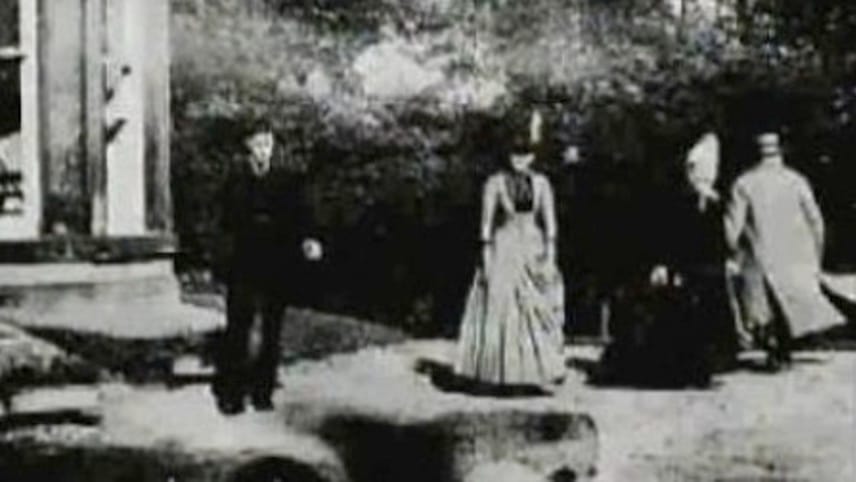
October 14, 1888: The oldest known surviving motion picture is filmed, in the backyard -- or, as the English would call it, the garden -- of a house in the Roundhay section of Leeds, West Yorkshire, England. It is known as Roundhay Garden Scene, is recorded by Frenchman Louis Le Prince, and features his son Adolphe, and his English in-laws, Joseph and Sarah Whitley, who owned the home. It lasts all of 2.11 seconds.
Louis Le Prince

A little over 2 years later, Louis Le Prince disappeared from a Dijon-to-Paris train, and was never seen again. He was 49, and it is suspected that he left the train at some point, and drowned.

*

October 14, 1888 was a Sunday. There was no pro football yet. But despite it being late in the year by today's standards, there were regular-season baseball games, all in the American Association, none in the National League, which then banned Sunday baseball:

* The Brooklyn Bridegrooms beat the Baltimore Orioles, 5-2 at Washington Park in Brooklyn. The Dodgers-to-be had seen several members get married a couple of off-seasons earlier. Both of these teams would join the National League, but the Orioles went out of business after the 1899 season.

* The Philadelphia Athletics beat the Cleveland Blues, 7-3. Since Pennsylvania forbid Sunday sports until 1933, this game was played at the Gloucester Point Grounds, across the Delaware River in Gloucester City, Camden County (not Gloucester County), New Jersey.

These Athletics folded after the 1890 season, and had no connection to the later American League team of the same name. The Blues became the Cleveland Spiders, joined the NL, and, like the Orioles, failed after the 1899 season.

* A doubleheader was split at League Park in Cincinnati. The St. Louis Browns, who would go on to win the AA Pennant, won the 1st game, 6-1. The Cincinnati Red Stockings won the 2nd game, 10-1. Both teams would join the National League, and are still in it today.

These Red Stockings were founded in 1882, and bear no connection to those of 1869-70. So when the modern Reds call themselves "baseball's oldest professional team," they're lying. The Browns became the Cardinals, and bear no direct connection to the later American League Browns.

* The Louisville Colonels swept a doubleheader from the Kansas City Cowboys, at Eclipse Park in Louisville. The hosts won the 1st game, 2-1; and the 2nd game, 9-1. The Colonels would join the NL, but, like Baltimore and Cleveland, fail after the 1899 season. The Cowboys only lasted through 1889.

October 13, 1914: The Miracle Braves

October 13, 1914: The Boston Braves defeat the Philadelphia Athletics, 3-1, at Fenway Park in Game 4, and complete the first-ever sweep of a World Series.

The "Miracle Braves" completed one of the most amazing seasons any baseball team had ever had, although it is nearly forgotten now, partly because of the passage of time, meaning that just about everybody who attended a game of theirs is now dead, and partly because the Braves have since moved twice. The team didn’t win another Pennant for 35 years, and didn’t win another World Series until after leaving Boston for Milwaukee in the spring of 1953. Today, when people speak of a World Series win being a "miracle," they're usually referring to the 1969 Mets.

Why did they move? Simple: Red Sox owner Tom Yawkey had money, and Braves owner Lou Perini didn't. If Yawkey hadn't bought the Sox in 1933, they probably would have been the ones to move. After all, they probably wouldn't have won the 1946 American League Pennant, and once the Braves won the National League Pennant in 1948, it would have stamped the Braves as New England's Number 1 baseball team. Plus, at the time, Fenway Park was hardly beloved.

The Braves -- so named because team owner James Gaffney was a "Brave," an official in New York's Tammany Hall Democratic political machine -- were in last place on July 4, but went on a tear, and won the Pennant by 10 1/2 games over the 3-time defending Champion New York Giants. Then they demolished the A's, who had won 3 of the last 4 World Series.

They were managed by George Stallings, whom the Highlanders had foolishly fired as manager late in the 1910 season, rather than release the dishonest star 1st baseman Hal Chase. They had 2 future Hall-of-Famers: Johnny Evers, the 2nd baseman who had starred on the Chicago Cub Pennant winners of 1906-07-08-10, and Walter "Rabbit" Maranville, a rookie who would go on to be known for slick fielding and heavy drinking. Catcher Hank Gowdy was also considered a star.

Their leading hitters were 1st baseman Butch Schmidt and left fielder Joe Connolly, while their top pitchers were Dick Rudolph, Bill James (no relation to the baseball stats guru of the same name) and Cuban star Adolfo "Dolf" Luque. They clinched the Pennant on September 30, beating the New York Giants in the 1st half of a doubleheader at the Polo Grounds, leaving them 10 games up with 9 to play.

The Braves had abandoned their 43-year-old home field, the antiquated and too-small South End Grounds, in August 1914, choosing to rent Fenway from the Sox while awaiting construction of Braves field, which would seat 40,000 when it opened in August 1915. When the Sox won the Pennant in 1915, 1916 and 1918, the Braves returned the favor of 1914 by letting the Sox play their Series games at Braves Field. Despite the Sox winning 3 Pennants in 4 years, there were no World Series games played at Fenway between 1912 and 1946.

Fighting the rise of salaries caused by the Federal League, A’s owner-manager Connie Mack sold off most of his stars after this Series, ending a run of 4 Pennants and 3 World Championships in 5 seasons. In fact, he had won 6 of the first 14 AL Pennants and was in the race nearly every year. In 1915, the A’s would collapse to last place, and in 1916 they would produce a record of 36-117, the most losses in the major leagues between the 1899 Cleveland Spiders and the 1962 New York Mets, and still the lowest winning percentage since 1899, .235. To this, Mack is alleged to have said, perhaps coining the now-familiar phrase, “Well, you can’t win them all.” It would take Mack until 1927 to get the A’s back into a Pennant race and 1929 to get them back into the Series.

The Braves would not be unable to maintain their prosperity, either. They finished 2nd in 1915 and 3rd in ’16, but in ’17, Gowdy became the 1st big-leaguer to enlist in World War I. (In fact, he would go on to become the only big-leaguer to serve in that war and World War II.) Like the A’s, the Braves would go on to become symbolic of baseball frustration: From 1917 to 1932, the Braves would have one season above .500, and 4 seasons of at least 100 losses. A 4th-place finish in 1933 was followed by a 38-115 season in 1935, a .248 winning percentage that’s the lowest in baseball in the last 98 years and the lowest in the NL in 115, even less than the 40-120 ’62 Mets’ .250. Not until 1947 would they get back into a Pennant race, not until 1948 would they win another Pennant, and by the time they won another World Series, 1957, they would be in Milwaukee, and the Red Sox would be in Boston all alone.

Braves Field saw only 1 more Series, in 1948. It has not been totally demolished: The right field pavilion is now Nickerson Field, the sports stadium for Boston University, and the iconic Spanish-style ticket booth is now BU's police headquarters. Like Fenway, it can be seen from the Massachusetts Turnpike.

The last survivor from the 1914 Braves was shortstop Jack Martin. A native of Plainfield, New Jersey, he later lived in the Shore town of Brick, and died in 1980, a few days after attending Old-Timers' Day at Yankee Stadium. At the time of his death, he was also the last living New York Highlander (as the Yankees were called until 1912), and the oldest living Phillie.

The Atlanta Braves hardly even acknowledge their Boston past, as none of the Braves’ 4 National Association and 11 National League Pennants, including the 1914 World Series title, are acknowledged with the Pennants on the façade of the left-field stands at Turner Field. (Nor are their 1957 World Series and 1958 Pennant win from Milwaukee.) The closest the Braves come to honoring their Boston history in any way is the retired Number 21 of Warren Spahn, who debuted with Boston 28 years after the last Boston title.

From 1871 (the founding year of the National Association) through 1914, the Boston Red Stockings/Beaneaters/Rustlers/Doves/Braves won 13 Pennants in 44 years, an enviable achievement that marked them as the most successful sports franchise in North America to that point. In the 100 years since, they've won a grand total of 8 -- only 3 in the 76 seasons from 1915 to 1990. In Boston, Milwaukee, and Atlanta, they have been one of the more underachieving sports franchises of the last 100 years. Maybe their World Series wins of 1957 and 1995 were the real "miracles."

*

October 13, 1914 was a Tuesday. The baseball season was over. Football was in midweek. Basketball and hockey barely existed at the professional level. So there were no other scores on this historic day.

Wednesday, October 12, 2022

October 12, 1929: The Athletics' 10-Run Comeback

Haas scoring on his inside-the-park homer

October 12, 1929: Game 4 of the 1929 World Series, at Shibe Park in Philadelphia, remains one of the wildest in postseason history. Having started a seemingly washed-up Howard Ehmke in Game 1 and having it work, this time, Philadelphia Athletics owner-manager Connie Mack started 45-year-old Jack Quinn. (Already approaching his 67th birthday, Mack was not yet known as "The Grand Old Man of Baseball," but, apparently, he already had an affinity for veterans.)

This seemed to work, too, until the 6th inning, when the Chicago Cubs start scoring. By the time they stopped, they led, 7-0. Cub manager Joe McCarthy started Charlie Root, who would later become a victim of McCarthy's Yankees, including Babe Ruth’s "called shot," though this quirk of history/legend does not do Root justice, as he was a fine pitcher for many years. Root entered the bottom of the 7th with an 8-0 lead.

Then the A's came storming back. Slugging left fielder Al Simmons led off with a home run. Jimmie Foxx singled. Edmund "Bing" Miller singled. Jimmy Dykes singled Foxx home. Joe Boley singled Miller home. Mack sent George Burns (a former All-Star outfielder, not the comedian) up to pinch-hit for pitcher Eddie Rommel. He popped up, but Max Bishop singled Dykes home. It was 8-4 Cubs.

McCarthy took Root out, and brought in Art Nehf, the ace pitcher of the New York Giants' 1921 and '22 World Champions. Lewis "Hack" Wilson, a great slugger but not the best of outfielders even when not drunk or hungover, misjudged a fly ball from George "Mule" Haas, and it turned into a 3-run inside-the-park home run, making the score 8-7 Cubs.

Simmons began jumping around in the dugout, yelling, "We're back in the game, boys!" His momentum caused him to crash into Mack – as I said, nearly 67, if not the elderly figure some of us imagine him to have always been. Simmons apologized profusely, but Mack, a former big-league catcher and familiar with ballplayers crashing into him, was just as enthused, and told him, "That's all right, Al."

Mickey Cochrane drew a walk, and McCarthy brought in a 3rd pitcher, John "Sheriff" Blake. The A's had now batted around, and Simmons singled. Foxx singled Cochrane home, and the game was tied. McCarthy brought in a 4th pitcher, Pat Malone. Malone would later help McCarthy win 2 Pennants with the Yankees. This time, he hit with Miller with a pitch, and allowed a double to Dykes that scored Simmons and Foxx.

Malone finally ended the onslaught by striking out Boley and Burns, but 10 runs had scored, and that remains a Series record for a single inning. Mack brought in his ace Lefty Grove, to relieve and finish the Cubs off, and 10-8 remained the final score. The A's closed the shellshocked Cubs down 2 days later -- not being able to play the next day, because sports on Sunday were still illegal in Pennsylvania until 1933.

In 1981, baseball historian John Thorn published Baseball's 10 Greatest Games. He included this game as one of them.

The 1929 Philadelphia Athletics are remembered as one of the greatest teams in baseball history. They might have been the greatest non-Yankee team in American League history. They won the World Series again the next season, beating the St. Louis Cardinals. They won a 3rd straight Pennant in 1931, with 107 regular-season wins, but lost Game 7 of the World Series, to the Cardinals.

They finished a distant 2nd to the Yankees in 1932, and Mack then broke up his team due to the financial constraints of the Great Depression. The team would not win another Pennant until 1972, 41 years -- and two moves to other cities -- later.

In 1978, the Philadelphia Phillies established the Philadelphia Baseball Wall of Fame. From then until 2003, they elected an Athletics figure every year, starting with Mack. From the 1929-31 dynasty, they also elected Jimmie Foxx, Lefty Grove, Al Simmons, Mickey Cochrane, Jimmy Dykes, Eddie Rommel, Bing Miller, George Earnshaw and Rube Walberg. Mack, Foxx, Grove, Simmons, Cochrane and Dykes have also been elected to the Philadelphia Sports Hall of Fame.

UPDATE: The Cubs also have a team Hall of Fame. Inducted from their 1929 Pennant winners have been catcher Charles "Gabby" Hartnett, 1st baseman Charlie Grimm, 2nd baseman Rogers Hornsby, left fielder Riggs Stephenson, center fielder Lewis "Hack" Wilson, right fielder Hazen "Kiki" Cuyler, pitcher Charlie Root, manager Joe McCarthy, team owner William Wrigley Jr., executive Margaret Donahue, and public address announcer Pat Pieper.

*

October 12, 1929 was a Saturday. This was the only baseball game played that day. Pro football was in midweek. Pro basketball was still strictly minor-league. And the NHL season didn't begin until November 14.

But there were college football scores. Most notably, Sanford Stadium opened in Athens, Georgia. The University of Georgia opened it with a 15-0 win over Yale. I have a separate entry for this event. Other notable games played that day:

* The top team in the South, Tulane University, beat Mississippi A&M, 34-0 at Tulane Stadium in New Orleans. (A&M would rename itself Mississippi State in 1932.)

* Notre Dame beat Navy, 14-7 at Municipal Stadium in Baltimore. From 1950 to 1954, piece by piece, it was converted into Memorial Stadium, longtime home of the Orioles and Colts. Notre Dame went 9-0, and were retroactively declared National Champions.

* The University of Pittsburgh also claim a National Championship for this season. They went 9-1, including on this day, winning their annual "Backyard Brawl" with West Virginia, 27-7.

* Purdue beat Michigan, 30-16 at Ross-Ade Stadium in West Lafayette, Indiana. This game decided the Big Ten Conference title.

* The top team on the Pacific Coast, USC beat the University of Washington, 48-0 at Husky Stadium in Seattle.

* In New York City, Fordham beat New York University, 26-0 at the Polo Grounds.

* And City College of New York lost to St. Lawrence University, 22-0 at Weeks Field in Canton, New York.

* In New Jersey, Princeton lost to Brown, 13-12 at Palmer Stadium in Princeton.

* And Rutgers lost to Holy Cross, 20-3 at Fitton Field in Worcester, Massachusetts.

Monday, October 10, 2022

October 10, 1937: Yankees 6, Red Sox 5, A's 5

Left to right: Manager Joe McCarthy, team owner Jacob Ruppert,
Joe DiMaggio, Lou Gehrig and Tony Lazzeri

October 10, 1937: The New York Yankees defeat the New York Giants, 4-2 in Game 5 at the Polo Grounds, and win their 2nd straight World Series, their 6th overall. This moves them past the Boston Red Sox and the Philadelphia Athletics, who both have 5, to become the team with the most Series won. They have never seriously been threatened as such.
How unserious has it been? Through the 2021 season, these franchises have won at least 7 World Series: The Yankees, 27; the St. Louis Cardinals, 11; the Red Sox, 9; the A's, 9, and that's divided between 5 in Philadelphia and 4 in Oakland; the Giants, 8, and that's divided between 5 in New York and 3 in San Francisco; and the Dodgers, 7, and that's divided between 1 in Brooklyn and 6 in Los Angeles. 
This is the last game in a Yankee uniform for Tony Lazzeri. "Poosh-em-up Tony" went 1-for-3. Joe DiMaggio and Myril Hoag hit home runs, to make a winner out of Lefty Gomez. The Yankees released Lazzeri, making him a free agent and allowing him to sign with anyone he wanted. He signed with the Cubs, and won another Pennant in 1938, but lost to the Yankees in the World Series.

As for the Giants, here is a team that had Hall-of-Famers in Mel Ott, Carl Hubbell and player-manager Bill Terry, and had won their 3rd Pennant in the last 5 seasons, but had only won the Series in 1 of them, and would only win 1 more over the next 72 seasons. So not only did the club not get the credit it deserved at the time, but the franchise has never really been the same, either.
The last survivor of the 1937 Yankees was Tommy Henrich, who died in 2009, at the age of 96.  He was also the last survivor of the Yankee World Championship teams of 1938, 1939, 1940 and 1941.
UPDATE: Among the Yankees' many traditions is Monument Park at Yankee Stadium. From the 1936-39 team that won 4 straight World Series, they have honored 1st baseman Lou Gehrig and center fielder Joe DiMaggio with Monuments; and given Plaques to team owner Jacob Ruppert, general manager Ed Barrow, catcher Bill Dickey, and pitchers Charles "Red" Ruffing and Vernon "Lefty" Gomez. They have retired Gehrig's Number 4, DiMaggio's 5 and Dickey's 8.
*
October 10, 1937 was a Sunday. The only other scores on this day were in the NFL:
* The Philadelphia Eagles beat the Washington Redskins, 14-0 at Griffith Stadium in Washington. The 'Skins shook this off, and Sammy Baugh became the 1st rookie quarterback to lead a team to an NFL Championship. Over half a century into the Super Bowl era, he remains the only one.
* The Chicago Bears beat the Cleveland Rams, 20-2 at League Park in Cleveland. The Rams moved to Los Angeles in 1946, to St. Louis in 1995, and back to Los Angeles in 2016.
* The Detroit Lions beat the Pittsburgh Pirates, 7-3 at Titan Stadium in Detroit. The Pirates were renamed the Steelers in 1940.
* The Green Bay Packers beat the Chicago Cardinals, 34-13 at the Dairy Bowl in the Milwaukee suburb of West Allis, Wisconsin. The Dairy Bowl was a football stadium built in the infield of a speedway, now known as the Milwaukee Mile, at the Wisconsin State Fair Park.
* And the 2 NFL teams in New York City, named after the baseball teams with whom they were respectively groundsharing, the New York Giants and the Brooklyn Dodgers, were not scheduled.

December 31, 1999 & January 1, 2000: The Millennium

December 31, 1999:  The Millennium arrives. The people of planet Earth survived. At a terrible cost. But we hadn't destroyed ourselves. ...