Showing posts with label nelson rockefeller. Show all posts

Saturday, November 19, 2022

November 19, 1961: The Disappearance of Michael Rockefeller

November 19, 1961: Michael Rockefeller, a member of one of the nation's leading families in business, banking and politics, disappears in Dutch New Guinea.

Michael Rockefeller was born on May 18, 1938, the 5th and last child of Nelson Rockefeller and his 1st wife, the former Mary Todhunter. He had a twin sister, Mary. He went to the Buckley School in Manhattan, and Philips Exeter Academy of New Hampshire. He graduated from Harvard University, and served in the U.S. Army.

Following his military service, Rockefeller went on an expedition for Harvard's Peabody Museum of Archaeology and Ethnology to study the Dani tribe of western Dutch New Guinea. The expedition filmed Dead Birdsan ethnographic documentary film for which Rockefeller was the sound recordist.

His great-grandfather, John D. Rockefeller, had built America's 1st billion-dollar fortune, through oil. His grandfather, John D. Rockefeller Jr., had expanded the family fortune into banking, and had become America's leading philanthropist. His sons, including Michael's father Nelson, had further expanded the businesses and philanthropic efforts, and had begun to run for public office. So Michael's generation could afford to stick to philanthropic and other humanitarian efforts. As he put it, "It's the desire to do something adventurous, at a time when frontiers, in the real sense of the word, are disappearing."

On November 17, 1961, he and Dutch anthropologist René Wassing were overturned in their double pontoon boat. Their two local guides swam for help, but it was slow in coming. After drifting for some time, early on November 19, Rockefeller said to Wassing: "I think I can make it." According to Wassing, Rockefeller created a float for himself out of a jerry can and the boat's gas tank, took a compass and knife, and set off for the shore between 7 and 8 AM on the 19th. Wassing's last sight of him was about 30 minutes later: "I saw him in a straight line going towards shore until I just saw three dots: The two cans and his head."

Wassing was rescued the next day, but Rockefeller was never seen again, despite an intensive and lengthy search effort. According to Rockefeller's surviving twin Mary Morgan, who accompanied her father to South Papua to participate in the search for her brother, "The Dutch and Australian naval and air units had been sending out helicopters and boats to participate in the search, along with the local Dutch control officers. And many of the Asmat villagers were valiantly combing the small rivers in their canoes for some evidence of Michael."

But he was never found, either dead or alive, and was declared legally dead in 1964. Theories included drowning, murder by villagers, or him surviving and adopting a "white modern god ruling over primitive people" role, similar to that of Kurtz in Joseph Conrad's novel Heart of Darkness.

He never married, and left no known children. Some of the artifacts he gathered were taken to the Metropolitan Museum of Art, and placed in the Michael C. Rockefeller Wing, named in his memory, and home to native art from the Pacific, Africa and Latin America.

In 1963, the Kingdom of the Netherlands transferred Dutch New Guinea to the Republic of Indonesia.

*

November 19, 1961 was a Sunday. Baseball was out of season. These games were played in the NFL:

* The New York Giants beat the Pittsburgh Steelers, 42-21 at Yankee Stadium.

* The Baltimore Colts beat the football version of the St. Louis Cardinals, 16-0 at Memorial Stadium in Baltimore.

* The Cleveland Browns beat the Philadelphia Eagles, 45-24 at Cleveland Municipal Stadium.

* The Green Bay Packers beat the Los Angeles Rams, 35-17 at the new Green Bay City Stadium, later renamed Lambeau Field.

* The Detroit Lions beat the Minnesota Vikings, 37-10 at Metropolitan Stadium in the Minneapolis suburb of Bloomington, Minnesota.

* The Washington Redskins and the Dallas Cowboys played to a tie, 28-28 at the Cotton Bowl in Dallas.

* And the San Francisco 49ers beat the Chicago Bears, 41-31 at Kezar Stadium in San Francisco.

There were 3 games in the AFL:

* The New York Titans, forerunners of the Jets, lost to the Houston Oilers, 49-13 at Jeppesen Stadium (later Robertson Stadium) in Houston.

* The Buffalo Bills beat the Denver Broncos, 23-10 at Bears Stadium (later Mile High Stadium) in Denver.

* And the San Diego Chargers beat the Dallas Texans, forerunners of the Kansas City Chiefs, 24-14 at Balboa Stadium in San Diego.

There were 2 games in the NBA. The Cincinnati Royals beat the Detroit Pistons, 128-112 at the Cincinnati Gardens. And the Philadelphia Warriors beat the Chicago Packers, 122-114. Just another day at the office for Wilt Chamberlain: 51 points.

Yes, football fans: "Chicago Packers." Fans didn't like that combination of names, and the team was a lousy expansion team besides, and they didn't show up to support them. The next season, the name was changed to the Chicago Zephyrs, and fans still didn't show up. The next season, they moved, becoming the Baltimore Bullets. They are now known as the Washington Wizards.

And the NHL's entire "Original Six" was in action:

* The New York Rangers beat the Toronto Maple Leafs, 5-3 at the old Madison Square Garden.

* The Detroit Red Wings beat the Boston Bruins, 6-2 at the Boston Garden.

* And the Montreal Canadiens and the Chicago Black Hawks, played to a tie, 3-3 at the Chicago Stadium.

Thursday, September 22, 2022

September 22, 1975: President Gerald Ford Faces Another Assassination Attempt

September 22, 1975: Gerald Ford becomes the 1st President to face 2 close assassination attempts. And they happen just 18 days, and 86 miles, apart.

Ford, for 25 years a Republican Congressman from Michigan, had been nominated for Vice President by President Richard Nixon, seemingly because he was liked by everybody in Washington and offended hardly anybody. He replaced Spiro Agnew, who resigned the office on October 10, 1973, due to his conviction for income tax evasion. On August 9, 1974, Nixon resigned due to his role in the Watergate scandal, and Ford, who was planning to retire after the 1976 election if the Republicans didn't take Congress in 1974, which would have made him Speaker of the House, became the 38th President of the United States.

Ford started with a lot of goodwill, but, a month into his Presidency, he pardoned Nixon. This infuriated many people, and seemed to make him a lame duck before he even announced that he was running for a term of his own in 1976. A recession was underway, but people blamed him for it instead of Nixon (or the Democratic Party). Ford had nothing to do with causing the recession, but his efforts to fix it were, thus far, falling short.

On September 5, 1975, on his way to meet with Governor Jerry Brown at the California State Capitol in Sacramento, Lynette "Squeaky" Fromme, a member of Charles Manson's "Family" cult, tried to shoot him, but had forgotten to properly load the gun, and no shot came out. Ford was taken to safety.

It had been 3 years since Governor George Wallace had been shot and paralyzed while running for President, 5 years since Pope Paul VI had faced an assassin with a knife, 7 years since Dr. Martin Luther King and Senator Robert F. Kennedy were shot and killed, 10 years since Malcolm X was shot and killed, and 12 years since President John F. Kennedy and NAACP executive Medgar Evers were shot and killed. Still, Ford said he would not stop meeting with the people.

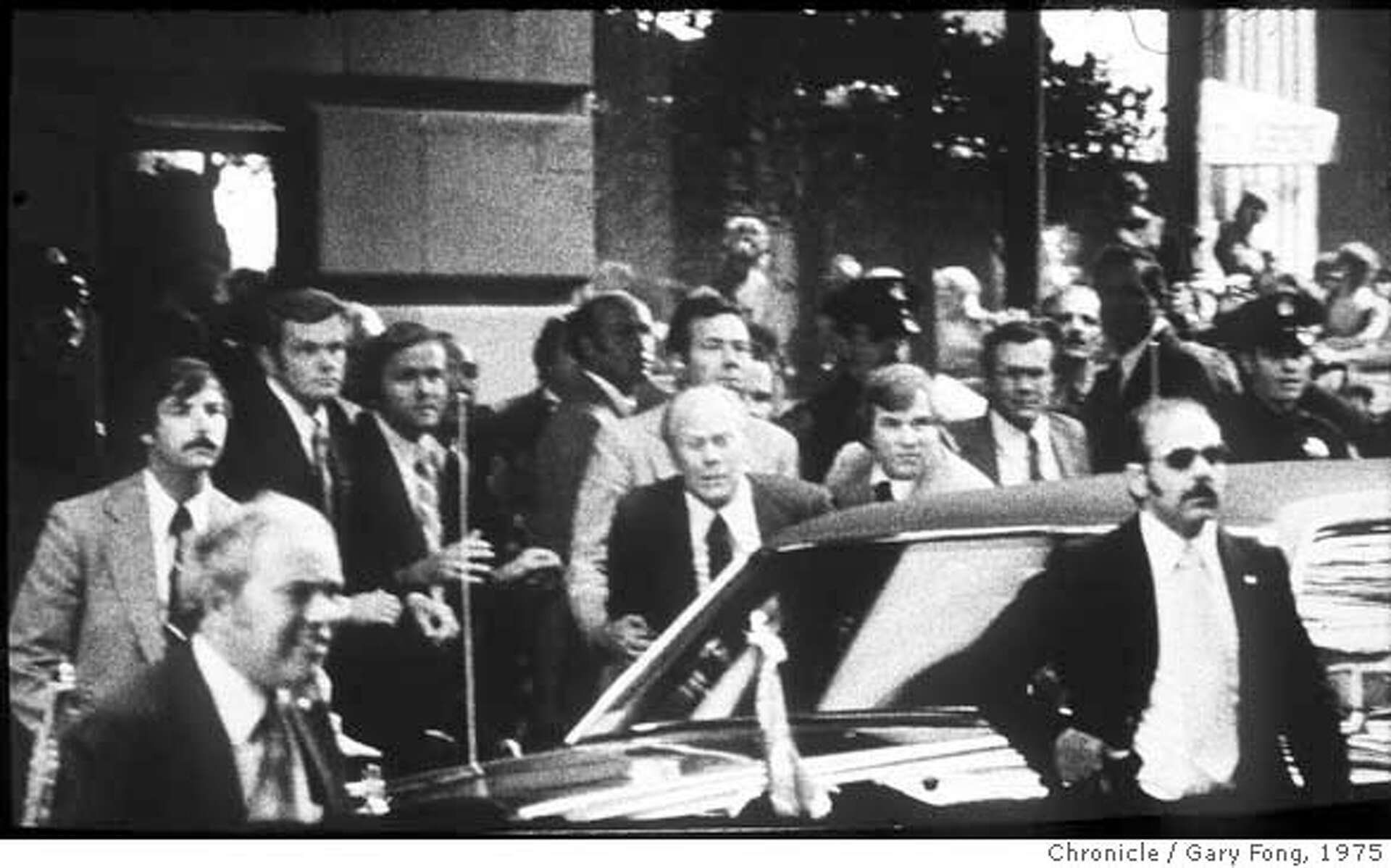
He made another trip to California on September 22. He was in San Francisco, for a meeting of the World Affairs Council. He returned to the city's famed St. Francis Hotel, off Union Square. At 3:30 PM, he walked out of the hotel's Post Street entrance, and stopped short of his limousine to wave the crowd, when a shot rang out.

The shot missed Ford's head by about 5 inches. On the film, he can be heard yelling, "Hey!" A bystander named Oliver Sipple grabbed the shooter's arm as she pulled the trigger a 2nd time. Her shot hit John Ludwig, a taxi driver standing outside the hotel. He also survived.

San Francisco Police Captain Timothy Hettrich grabbed the shooter, and pulled her gun away. The Secret Service shoved Ford into his limo. Donald Rumsfeld, then his White House Chief of Staff, covered him, and the limo was sped back to San Francisco International Airport, where Air Force One was waiting. After waiting for First Lady Betty Ford to arrive, the plane returned to Washington.

Had either attempt succeeded, Vice President Nelson Rockefeller would have become President. Next in line was the Speaker of the House of Representatives, Carl Albert of Oklahoma.

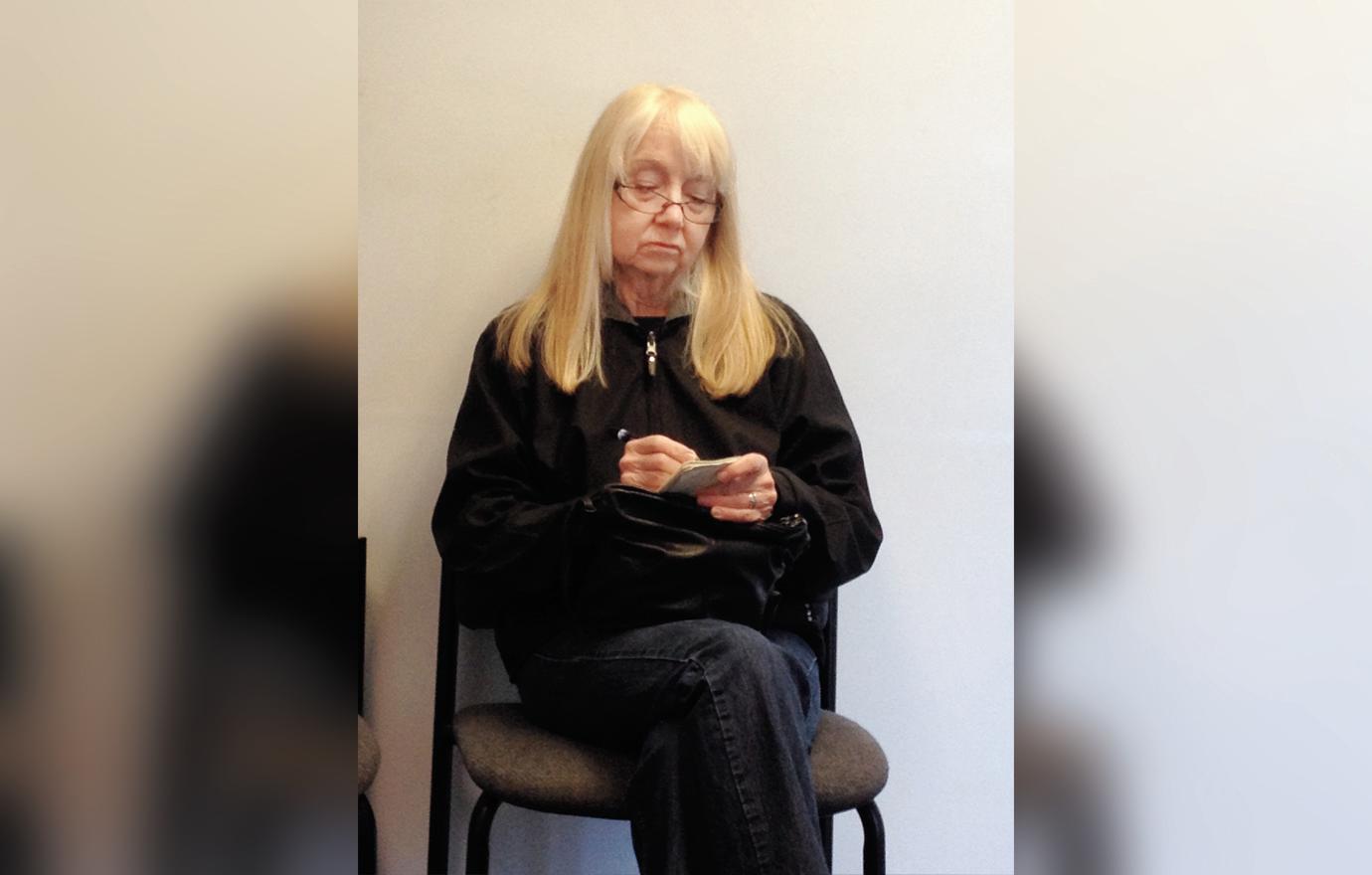
The shooter was Sara Jane Moore. Born on February 15, 1930, in Charleston, West Virginia as Sara Jane Kahn, the former accountant had been married and divorced 5 times, with 4 children. She had no connection to either Fromme or Manson, but had become fascinated by another crime in San Francisco, the kidnapping of Patty Hearst.
The day before the shooting, the San Francisco Police Department arrested her on an illegal handgun charge. They decided to call the Secret Service, and they evaluated her, they confiscated her .44 caliber revolver and 113 rounds of ammunition... and they told the SFPD to let her go, as they believed she posed no danger to the President's visit the next day.

They were wrong. The next day, September 22, she bought a new gun, a .38 caliber revolver, a cheap one, a Charter Arms Bulldog -- a smaller version of the one David Berkowitz began using in New York the next year, becoming known as the .44-Caliber Killer and the Son of Sam. The sight on Moore's gun was 6 inches off. That's why, despite being only 40 feet away, she missed Ford. She pleaded guilty.

Before her sentencing, she said, "Am I sorry I tried? Yes and no. Yes, because it accomplished little except to throw away the rest of my life. And, no, I'm not sorry I tried, because, at the time, it seemed a correct expression of my anger." She was sentenced to life in prison.

Ford was defeated for a term of his own in 1976, and lived until 2006. A year earlier, Moore was released from prison after serving 32 years. At that time, she said, "I am very glad I did not succeed. I know now that I was wrong to try." As of September 22, 2022, she is 92 years old, and lives in Northern California.
Oliver Sipple was a decorated Marine in the Vietnam War, but it was apparently saving Ford's life that made him a well-known hero. The Secret Service officially commended him, and Ford sent him a thank-you letter.
But the popular San Francisco Chronicle columnist Herb Caen was tipped off to the fact that Sipple was gay, and had worked for Harvey Milk, then running for the City's version of a City Council, the Board of Supervisors. (Milk would lose that election, but won in 1977, before being assassinated in 1978.)

Caen asked Milk if he should reveal this information, and Milk said yes, because the wider public needed to see that gay people could be heroes. Caen did not ask Sipple, whose life went into a tailspin. His parents, in Detroit, refused to see him for years. He sued for invasion of privacy, and lost. He started drinking heavily, and died in 1989, only 47 years old.

As for the other injured man, John Ludwig, he'd already been through a lot, having fled Nazi Germany, only to end up in Shanghai, China when it was occupied by Imperial Japan, and he was shot by a Japanese soldier. He survived, working with the Chinese resistance at the age of 12, and was reunited with his family in San Francisco in 1948. He became a taxi driver. retired to Sacramento (the site of the 1st assassination attempt, something of an irony), published a memoir in 2004, and died in 2015, age 81.

About Captain Timothy Hettrich, who grabbed Moore's gun, the only information I can find is that he was still alive as of 2006.

UPDATE: Sara Jane Moore died on September 24, 2025, 2 days after the 50th Anniversary of her attempt, at the age of 95.

*

September 22, 1975 was a Monday. On ABC Monday Night Football, the Oakland Raiders beat the Miami Dolphins, 31-21 at the Orange Bowl in Miami. And these Major League Baseball games were played:

* The New York Yankees lost to the Boston Red Sox, 6-4 at Yankee Stadium. Fred Lynn, soon to become the 1st player ever to win either League's Most Valuable Player and Rookie of the Year in the same season, and Deron Johnson each got 3 hits. Carl Yastrzemski went 1-for-5. Rick Wise outpitched a rookie named Ron Guidry. Thurman Munson hit a home run. The Red Sox went on to win the American League Pennant.

* A doubleheader was split at Jarry Park in Montreal. The St. Louis Cardinals won the opener, 6-4. Ted Simmons won it with a home run in the top of the 12th inning. The Montreal Expos won the nightcap, 8-5. After not playing in the opener, Lou Brock went 1-for-5.

* The Pittsburgh Pirates beat the Philadelphia Phillies, 11-3 at Three Rivers Stadium in Pittsburgh. Dave Parker hit a home run, and Willie Stargell went 3-for-3 with 2 walks, 2 RBIs, and 4 runs scored. Mike Schmidt went 0-for-4.

* The Cleveland Indians beat the Milwaukee Brewers, 7-6 at Cleveland Municipal Stadium. For the Indians, Charlie Spikes and George Hendrick hit home runs. Frank Robinson, MLB's 1st black manager and not yet retired as a player, did not put himself into the game.

For the Brewers, George Scott went 4-for-5 with 2 home runs. Robin Yount went 1-for-5. Hank Aaron appeared as a pinch-hitter, but struck out. Scott's 2nd homer gave the Brewers a 6-5 lead in the top of the 9th, but the Indians loaded the bases in the bottom of the 9th, and Oscar Gamble singled home the tying and winning runs.

* The Kansas City Royals beat the Texas Rangers, 2-1 at Royals Stadium (now Kauffman Stadium) in Kansas City. George Brett went 1-for-2 with 2 walks.

* The Houston Astros beat the Cincinnati Reds, 5-1 at the Astrodome in Houston. Pete Rose went 1-for-3. Johnny Bench got the night off.

* The San Diego Padres beat their arch-rivals, the Los Angeles Dodgers, 6-5 at San Diego Stadium (later Jack Murphy Stadium and Qualcomm Stadium). Hector Torres won it with a home run in the bottom of the 11th inning. Willie McCovey drove in a run with a sacrifice fly, and was later replaced in right field by Dave Winfield, who drew a walk in his only plate appearance.

* The California Angels beat the Chicago White Sox, 3-0 at Anaheim Stadium (now Angel Stadium of Anaheim). The game went 16 innings, and Adrian Garrett won it with a 3-run home run of Rich Gossage. To be fair, it was the 7th inning for "The Goose," after Jim Kaat had pitched shutout ball into the 9th. Frank Tanana pitched 13 shutout innings for the Angels, and Don Kirkwood pitched the last 3.

* The Minnesota Twins beat the Oakland Athletics, 2-1 at the Oakland Coliseum. Rod Carew went 1-for-4. Reggie Jackson went 0-for-4.

* And the New York Mets, the Atlanta Braves, the Chicago Cubs, the San Francisco Giants, the Baltimore Orioles and the Detroit Tigers were not scheduled.

Tuesday, September 13, 2022

September 13, 1971: The Attica Prison Riot

September 13, 1971: The Attica Prison Riot is put down after 4 days. It was one of those early 1970s events that served as the "hangover on the morning after" for the 1960s.

Central New York has a lot of European city names on their cities. Syracuse was named after Siracusa in Sicily, and next-door is a town named Liverpool. They have a Paris, an Amsterdam, a Rome, a Lisbon, and a Manchester. A Milan is in the Lower Hudson Valley, a Berlin is outside Albany, a Hamburg is outside Buffalo, and a Madrid is considerably further North, on the St. Lawrence River. 

Named for the region of Greece that includes the capital of Athens, Attica is another. It is in Wyoming County, 37 miles east of Buffalo. The Attica Correctional Facility opened in 1931, and has counted among its inmates bank robber Willie Sutton, Black Panther leader H. Rap Brown, 1970s serial killer David "Son of Sam" Berkowitz, John Lennon's killer Mark Chapman, 1990s serial killer Joel Rifkin, and Long Island Rail Road shooter Colin Ferguson. (Berkowitz, Chapman, Rifkin and Ferguson are all still alive as of September 13, 2022, but each has since been moved to a different prison.)

On September 9, inspired by the various civil rights movements that had been happening over the last 10 years, 1,281 of the 2,200 inmates rioted, and took control of the prison, taking 42 staff hostage. Over the next 4 days, authorities agreed to 28 demands. What they would not agree to was complete amnesty for the rioters, or for the removal of the prison's superintendent.

Nelson Rockefeller, beginning his 4th term as Governor of New York, and generally considered to be the national leader of the Republican Party's liberal wing (there was such a thing at the time), decided he had to be as tough a Governor as the rising star of the Party's conservative wing, Ronald Reagan of California. He sent the State Police in. The death toll was 43: 33 inmates, and 10 correctional officers and civilian employees.

In the aftermath, some changes were made to the New York State Prison system, to make life more tolerable, especially for nonviolent offenders. There has not been a major incident in a prison in the State since.

But the excess of killing helped to damage Rockefeller's reputation. He resigned in 1973, a year before his 4th term ended, and a few months after his draconian new drug laws infuriated people further. He served as Vice President in the last 2 years of Gerald Ford's Presidency, but was not nominated for a full term in 1976, and died under scandalous circumstances in 1979.

Three movies have been made about the riot: Attica in 1980, Against the Wall in 1994, and The Killing Yard in 2001. In the 1975 film Dog Day Afternoon, a dramatization of a bank robbery gone wrong in Brooklyn in 1972, Al Pacino's character, holding hostages, sees the large police presence outside, and starts chanting, "Attica! Attica! Attica!" and the crowd gathered outside joins in. That scene has been parodied many times.

*

September 13, 1971 was a Monday. Fashion designer Stella McCartney, daughter of Paul and Linda, was born. So was Goran Ivanišević, the Croatian tennis player who won Wimbledon in 2001.

It was the off-season for the NBA, the ABA and the NHL. The NFL season started the next week, so there was no Monday Night Football game on the night. But there were Major League Baseball games scheduled:

* The New York Yankees beat the Boston Red Sox, 4-0 at Fenway Park in Boston. Stan Bahnsen pitched a 3-hit shutout, and was backed by 3 hits and 2 RBIs by Roy White.

* The New York Mets beat the Montreal Expos, 4-2 at Shea Stadium, in a game shortened to 5 innings due to rain. Mike Jorgensen hit a home run.

* A doubleheader was split at Memorial Stadium in Baltimore. The Baltimore Orioles won the opener 9-1, and the Detroit Tigers won the nightcap 10-5. In the nightcap, the Orioles' Frank Robinson hit the 500th home run of his career.

* The Cincinnati Reds beat the Atlanta Braves, 2-1 at Riverfront Stadium in Cincinnati. The game was tied in the bottom of the 13th inning. With Johnny Bench up, manager Sparky Anderson called for a double steal. Pete Rose was safe at 3rd base, and Braves 3rd baseman Darrell Evans couldn't handle the throw from catcher Earl Williams, allowing Rose to score. Hank Aaron appeared as a pinch-hitter, but did not reach base.

* The Pittsburgh Pirates beat the Chicago Cubs, 5-1 at Wrigley Field in Chicago.

* The Chicago White Sox beat the Milwaukee Brewers, 6-3 at Milwaukee County Stadium.

* The Philadelphia Phillies beat the St. Louis Cardinals, 6-5 at Busch Memorial Stadium in St. Louis. Willie Montanez won it with a home run in the top of the 10th.

* The Oakland Athletics beat the Kansas City Royals, 2-1 at Kansas City Municipal Stadium. Rick Monday drove in the winning run with a single in the top of the 11th.

* The Houston Astros beat the San Diego Padres, 3-2 at the Astrodome in Houston.

* A doubleheader was split at Anaheim Stadium in the Los Angeles suburbs. The California Angels won the 1st game 3-2, and the Minnesota Twins won the 2nd game 1-0. Jim Kaat allowed 9 hits, but kept the shutout.

* The Los Angeles Dodgers beat their arch-rivals, the San Francisco Giants, 5-4 at Candlestick Park in San Francisco. The Dodgers got home runs from Dick Allen (in his only season with them), Willie Davis and Willie Crawford. The Giants got one from Jim Ray Hart. Willie Mays was hit by a pitch in the 1st inning, didn't get a hit, and had to leave the game after 5 innings.

* And the Cleveland Indians and the Washington Senators got rained out at Cleveland Municipal Stadium. The game was rescheduled as part of a doubleheader the next day. The Indians won the opener 6-1.

The nightcap made everybody regret the doubleheader idea, especially the Indians. They led 5-2 going into the 9th inning, but the Senators tied it. It went 16 innings before being suspended by the 1:00 AM curfew the American League had at the time. It was completed on September 20, moved to Robert F. Kennedy Stadium in Washington, but with the Indians still the official home team and batting 2nd.

Sam McDowell was brought into pitch for the top of the 17th, but he lost his control in the top of the 20th inning, and his defense didn't help, as an error helped a 3-run Washington inning. The Indians took a run back in the bottom of the 20th, and had the tying runs on base and the winning run at the plate, but Vada Pinson struck out to end it as an 8-6 Senators win.

The winning pitcher for the Senators was Denny McLain, who, like McDowell, had pitched the entirety of the 4-inning resumption on September 20. It was the 127th win of the former Detroit hero-turned-rogue's career. He would win only 4 more before shoulder miseries ended his career.

Ten days later, the Senators played their last home game, the announcement that they were moving to the Dallas area to become the Texas Rangers already made. Only 14,000 people showed up at the 45,000-seat RFK Stadium, and before the Senators could get the last out of a 7-5 win over the Yankees, some of them stormed the field, and the umpires awarded the game to the Yankees by forfeit. So this 20-inning win over the Indians was the last hurrah for Washington baseball until the Expos became the Washington Nationals in 2005.

Monday, September 5, 2022

September 5, 1975: President Gerald Ford Faces an Assassination Attempt

September 5, 1975: President Gerald Ford faces an assassination attempt on a visit to Sacramento, the capital of California.

He was visiting the city to attend the annual Sacramento Host Breakfast, a gathering of wealthy California business leaders at the Sacramento Convention Center. The new Governor, Jerry Brown -- Edmund G. Brown Jr., son of former Governor Edmund G. "Pat" Brown -- refused to attend, because he wanted to show them, after 8 years of the archconservative Ronald Reagan, the new Governor wasn't going to be their friend.

To spite Brown, a Democrat, who was already talking about running for President in 1976 -- or, perhaps, to counter-spite him -- they invited President Ford, a Republican, as was Reagan. Ford, who had become President 13 months earlier upon the resignation of Richard Nixon, knew that winning a term of his own would be difficult, and that California would be crucial. (This included in the Republican Primaries, in which Reagan was expected to run.) So he accepted.

In August 1975, The New York Times printed an article detailing Ford's visit to California in September. It included the fact that, as a Congressman from Michigan, he had voted against the Clean Air Act of 1970.

This angered Lynette Alice Fromme. Born on October 22, 1948 in the Los Angeles suburb of Santa Monica, California, As a child, she was a member of the Westchester Lariats, a Los Angeles-based dance group that appeared on The Lawrence Welk Show -- and had even been invited to perform at the White House, when Dwight D. Eisenhower was President. As far as I know, this is the only time that someone who would go on to attempt to assassinate a President would visit the White House before that President took office.

In 1967, she became a follower of cult leader Charles Manson. Another of his followers, George Spahn, noticed that she made a sound like a squeak when he touched her, so he gave her the nickname "Squeaky." She was not charged in connection with the Tate-Labianca Murders, unlike Manson and some of his other followers.

In 1975, she was 26 years old, still committed to the imprisoned Manson, and paranoid about the environment. When she saw the article about Ford, she saw a chance to strike a blow for both the environment and Manson.
Ford was crossing L Street from the Senator Hotel to the State Capitol, shaking hands, at 10:02 AM. Fromme got within 2 feet of him. In his memoir, Ford wrote, "As I stopped, I saw a hand come through the crowd in the first row, and that was the first active gesture that I saw, but in the hand there was a gun."

Fromme didn't know that she needed to pull back the gun slide to insert a cartridge into the pistol's chamber. She pulled the trigger, and nothing happened. Secret Service Agent Larry Buendorf grabbed the gun, and forced Fromme to the ground. Other Agents pulled Ford away, and dragged him to the Capitol's entrance.

Ford was unhurt, and, when the Agents determined that the threat was over, he resumed his schedule, including meeting with Governor Brown. He returned to Washington that night. He would go back to California later in the month -- and face another assassination attempt, totally unconnected to this one.

Had the attempt succeeded, Vice President Nelson Rockefeller would have become President. Next in line was the Speaker of the House of Representatives, Carl Albert of Oklahoma.

Ford lost the California Primary to Reagan in 1976, and almost lost the nomination to him. He won it, and did win California in the general election, but narrowly lost both the popular vote and the Electoral Vote to former Governor Jimmy Carter of Georgia. In 1981, he opened his Presidential Museum in his hometown of Grand Rapids, Michigan. The U.S. Attorney's office in Sacramento donated Fromme's gun to the Museum. Ford lived until 2006.

Fromme was convicted of attempted murder, and sentenced to life in prison. On Christmas Eve 1987, she escaped, but was captured 2 days later. She was released in 2009, after serving 34 years.
As of September 5, 2022, she is 72 years old, and lives with a fellow ex-con in Marcy, New York, outside Syracuse. Unlike most of Manson's followers, she has never renounced him.

*

September 5, 1975 was a Friday. These Major League Baseball games were played that day:

* The New York Yankees were swept by the Baltimore Orioles in a doubleheader Memorial Stadium, the result of a rainout on the preceding May 6. The O's won the opener, 5-4. Ken Singleton, later to broadcast for the Yankees, hit a home run for the O's. Brooks Robinson went 0-for-2 with a walk.
Graig Nettles and Chris Chambliss each had 3 hits for the Yanks, in support of George "Doc" Medich, but to no avail.

The O's won the nightcap, 2-1. Ross Grimsley outpitched Larry Gura, and this was one of the games that led Yankee manager Billy Martin to ask that Gura be traded, which led to him pitching well against the Yankees for the Kansas City Royals over the next few years. Brooks only appeared as a pinch-hitter in this game, and did not reach base. Future Yankee Rick Dempsey got 3 hits, but the rest of the Yankees only got 2 hits: A home run by Bobby Bonds, and a single by Sandy Alomar Sr.

* The New York Mets beat the St. Louis Cardinals, 5-2 at Shea Stadium. Dave Kingman hit a home run for the Mets, not exactly a surprise. Mike Vail also hit one for them, which was a bit of a surprise. Tom Seaver only went 6 innings, but got his 21st win of the season. Lou Brock went 1-for-4 with a stolen base.

* The Detroit Tigers beat the Cleveland Indians, 11-2 at Cleveland Municipal Stadium. Willie Horton hit 2 homers for the Tigers. Indians manager Frank Robinson, not yet retired as a player, did not put himself into the game.

* A doubleheader was split at Jarry Park in Montreal, the result of a rainout on the previous July 2. In the 1st game, the Montreal Expos beat the Pittsburgh Pirates, 4-3. Richie Zisk hit a home run, and Willie Stargell had a single as a pinch-hitter. Pepe Mangual drew a bases-loaded walk off Kent Tekulve to win the game in the bottom of the 10th inning. The Pirates won the 2nd game, 5-2. This time, Stargell went 1-for-4, his hit a solo home run.

* A doubleheader was split at Veterans Stadium in Philadelphia, the result of a rainout on the previous August 6. In the 1st game, the Chicago Cubs beat the Philadelphia Phillies, 4-3. Bill Bonham outpitched Steve Carlton. In the 2nd game, the Phillies won, 6-3. Mike Schmidt went 4-for-8 with a homer and 2 RBIs over the 2 games.

* The Los Angeles Dodgers beat the Atlanta Braves, 5-2 at Atlanta-Fulton County Stadium.

* The Cincinnati Reds beat the San Francisco Giants, 4-3 at Riverfront Stadium in Cincinnati. Pete Rose went 2-for-5 with a homer and 2 RBIs. Johnny Bench went 0-for-3, but did draw a walk.

* The Chicago White Sox beat the Minnesota Twins, 3-2 at Comiskey Park in Chicago. Uncharacteristically, Rod Carew went 0-for-4.

* The Milwaukee Brewers beat the Boston Red Sox, 4-2 at Milwaukee County Stadium. Hank Aaron went 1-for-3 with a walk and an RBI. Carl Yastrzemski went 1-for-4 with an RBI.

* The Houston Astros beat the San Diego Padres, 2-1 at the Astrodome in Houston. Dave Winfield went 2-for-4.

* The Kansas City Royals beat the California Angels, 5-2 at Anaheim Stadium (now named Angel Stadium of Anaheim). George Brett went 5-for-5 with 4 RBIs.

* And the Texas Rangers beat the Oakland Athletics, 4-2 at the Oakland Coliseum. Reggie Jackson went 0-for-3.

Saturday, July 23, 2022

July 23, 1960: The Compact of Fifth Avenue

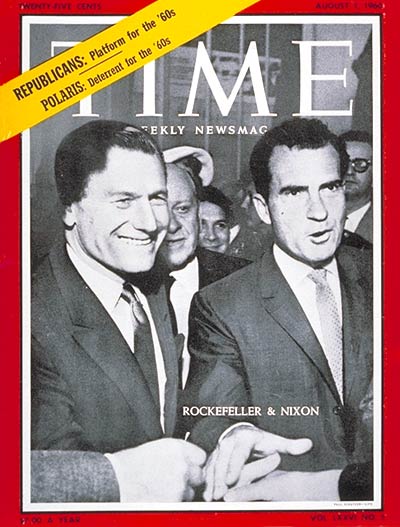
July 23, 1960: Vice President Richard Nixon and Governor Nelson Rockefeller of New York conclude a late-night meeting at Rockefeller's penthouse at 810 5th Avenue, at 62nd Street, on the Upper East Side of Manhattan, with an agreement on a platform for the upcoming Republican National Convention. A newspaper headline writer called it "The Compact of Fifth Avenue," although it has also been called "The Treaty of Fifth Avenue."
810 Fifth Avenue

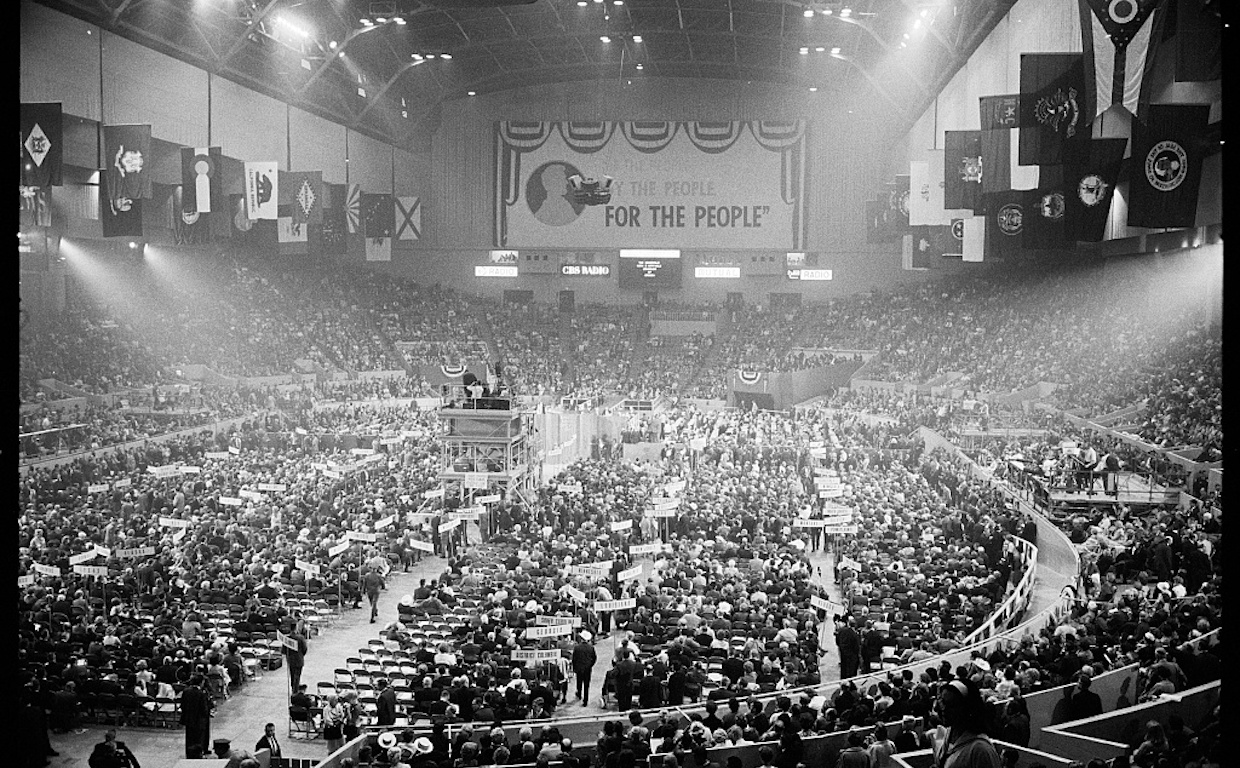
Two days later, on July 25, the Republican Convention convened, at the International Amphitheatre in Chicago. Dwight D. Eisenhower is the 1st President limited to 2 terms by the 22nd Amendment to the Constitution, something the Republicans wanted as a swipe at the memory of Franklin Roosevelt, and now, it comes back to bite them. Though "Ike" might not have wanted to run for a 3rd term anyway.

With Rockefeller out of the way, the path for Nixon to be nominated for President was clear. For Vice President, the Party nominated the U.S.' Ambassador to the United Nations, Henry Cabot Lodge – who had been defeated for re-election to the Senate from Massachusetts in 1952 by the man the Democratic Party just nominated for President, John F. Kennedy.

The conservative wing of the Republican Party wasn't happy over Nixon's nomination, any more than they were about Wendell Willkie's in 1940, Thomas Dewey's in 1944 and 1948, and Eisenhower's in 1952. They wanted one of their own nominated. Never mind that conservatism was still identified with Herbert Hoover and the Great Depression. Senator Barry Goldwater of Arizona was the only other Presidential candidate to get any Delegates: 10, all of them from Louisiana, to Nixon's 1,321.

Before the vote tally, Goldwater spoke, and asked that his name be withdrawn from consideration, as a gesture of unity. He told his supporters, and any others who opposed Nixon's nomination, "We've had our chance. We've fought our battles. Now, let's put our shoulders to the wheel of Dick Nixon and push him across the line... Let's grow up, conservatives. If we want to take this party back, and I think we can someday, let's get to work." He had just published a political manifesto, The Conscience of a Conservative, and it became one of the defining texts of the movement.

Following Kennedy's win over Nixon, the Republican Party would follow Goldwater's lead in the next election. Rockefeller ran again in 1964, but the conservative wing never forgave him for getting in their way, and they treated him shabbily. Goldwater was nominated, but lost badly.

Rockefeller ran again in 1968, but so did Nixon, and there was no true conservative alternative. There wouldn't be until 1976, when Ronald Reagan nearly beat out incumbent President Gerald Ford, and Rockefeller, by then Ford's Vice President, was hounded off the ticket. In 1980, Reagan won, to the delight of Goldwater and the conservatives.

*

July 23, 1960 was a Saturday. These baseball games were played:

* The New York Yankees lost to the Chicago White Sox, 5-3 at Yankee Stadium. Bob Shaw outpitched Whitey Ford. Minnie Miñoso went 4-for-5 with 3 RBIs. Bill "Moose" Skowron hit a home run, Yogi Berra went 2-for-4 with an RBI, Roger Maris went 0-for-4, and Mickey Mantle only appeared as a pinch-hitter, and did not reach base.

* The Cleveland Indians beat the Boston Red Sox, 4-2 at Fenway Park in Boston. Ted Williams, in his final season, hit his 508th career home run.

* A doubleheader was split at Memorial Stadium in Baltimore. The Detroit Tigers won the opener, 4-1. The Baltimore Orioles won the nightcap, 4-3. Al Kaline sat it out, after going 1-for-4 in the opener. Over the 2 games, Brooks Robinson went 4-for-8 with an RBI.

* The Washington Senators beat the Kansas City Athletics, 8-3 at Griffith Stadium in Washington.

* The St. Louis Cardinals beat the Cincinnati Reds, 7-5 at Crosley Field in Cincinnati. Each team scored 2 runs in the 9th inning, but Walt "Moose" Moryn hit a home run in the top of the 10th inning to win it. Stan Musial appeared as a pinch-hitter, and did not reach base. Frank Robinson and Wally Post hit home runs for the Reds.

* The Milwaukee Braves beat the Chicago Cubs, 3-0 at Wrigley Field in Chicago. Juan Pizarro took a shutout into the 9th inning, striking out 12, but allowed 8 hits and 3 walks, and Ron Piché had to get the last 2 outs and preserve the shutout. Hank Aaron and Eddie Mathews both hit home runs. Ernie Banks went 0-for-4.

* The Los Angeles Dodgers beat the Philadelphia Phillies, 2-0 at the Los Angeles Memorial Coliseum. Roger Craig pitched a 3-hit shutout. Dallas Green went the distance for the Phils. Each man would go on to become a rare thing, a former pitcher who managed a team to a Pennant.

* And the San Francisco Giants beat the Pittsburgh Pirates, 3-1 at Candlestick Park in San Francisco. Juan Marichal outpitched Harvey Haddix. Willie Mays went 3-for-4 with a home run and 2 RBIs. Roberto Clemente went 0-for-2 with a walk.

Saturday, July 16, 2022

July 16, 1964: Extremism In the Defense of Liberty

July 16, 1964: Senator Barry M. Goldwater of Arizona accepts the Republican Party's nomination for President, at their National Convention, at the Grand National Livestock Pavilion, a.k.a. the Cow Palace, just outside San Francisco in Daly City, California.

The site of the 1964 Republican National Convention may surprise people who know San Francisco as the most liberal city in America, which might not even be accurate. But, like all cities, San Francisco has its "old money" conservative elite. And this was the 2nd time the Grand Old Party had held its convention at the Cow Palace, built in 1940 for rodeo shows but later adapted for professional sports and concerts. They had previously nominated Dwight D. Eisenhower for a 2nd term there in 1956.

Then 55 years old, Goldwater was a Presbyterian, but had a Jewish grandfather, as the family name was originally Goldwasser. This makes the 1964 Republican Convention the closest either major party has ever come to nominating a Jewish person for President.

He was also very Western, living on a ranch outside Phoenix, with a solar-powered flagpole: Every morning, when the Sun came up, it raised the Stars & Stripes; every evening, when the Sun went down, the mechanism lowered the flag into a box.

A bomber pilot in World War II, Goldwater had been elected to the Phoenix City Council, and in 1952 defeated an incumbent Democrat for the U.S. Senate. Re-elected in 1958, he thought he could be the conservative alternative in 1960 to Vice President Richard Nixon, once considered the anti-Communist hard right's man, but now widely seen as more moderate -- the very thing that gave him a legitimate chance of election.

What is a conservative? According to Franklin D. Roosevelt, who knew difficulty walking, "A conservative is a man who, despite having two good legs, has never learned to walk forward." Comedian Mort Sahl said, "A conservative is someone who believes in reform -- but not now." Educator John Holt said, "Conservatism is the worship of dead radicals -- emphasis on the 'dead.'" (That quote is one of many that has been misattributed to Mark Twain.) Years later, Robert Orban would say, "A conservative is someone who wants the rules changed so that no one can make a pile the way he did."

No true conservative had been elected President since 1928, and that was Herbert Hoover, on whose watch the Great Depression began, and whose policies were seen as having made it worse, leading to his landslide loss to FDR in 1932. Every Republican nominee since had basically said, "We accept the New Deal, but we can do it better, and more efficiently, and with fewer Communists."

But there was another alternative to Nixon in 1960: Governor Nelson Rockefeller of New York, who had replaced a previous holder of his office, 1944 and 1948 Presidential nominee Thomas Dewey, as the leader of the moderate-to-liberal Eastern wing of the GOP. He wanted to be President, too. But he also wanted to win. So he invited Nixon to his apartment, and made a deal where he would endorse Nixon to hold off any conservative challenge. It became known as "The Compact of Fifth Avenue."

So, at the 1960 Republican Convention in Chicago, Goldwater told his supporters that they could take their party back, if they were properly organized: "Let's grow up, conservatives!"

Whether the conservative movement, as it came to be known, "grew up" is debatable: Conservatism has often listed from side to side, from old and stuffy to very childish. But they were very well organized, and, on the morning of November 22, 1963, with Nixon branded as a "loser," Goldwater and Rockefeller were the 2 leaders for the Party's nomination in 1964.

That day, John F. Kennedy, who had beaten Nixon in 1960, was assassinated. In his memoir, Goldwater admitted that his chance of winning had died with Kennedy. The 2 men had been friendly rivals, and Goldwater had really looked forward to a clash of ideas with JFK.

But with Vice President Lyndon B. Johnson now President, and sure to be the Democratic nominee in 1964, any chance for a real clash of ideas was doomed: LBJ would do anything to win, including "making Kennedy's ghost his running mate." His actual Vice Presidential nominee turned out to be Senator Hubert Humphrey of Minnesota, but he essentially "ran with JFK" every bit as much as Harry Truman ran with Franklin Roosevelt in 1948.

Goldwater told his advisers that he didn't want to run against Johnson. They told him that he had to do it, anyway, as the best way to continue the building of the conservative takeover of the Republican Party. To use a sports analogy, they were asking him to sacrifice himself, to "take one for the team."

And so he ran. He ran his campaign as a moral crusade, to bring down government spending, to end welfare programs that encouraged "immoral behavior," and to stand up to the Communist world better than the Democrats had.

His supporters took the "morality" thing even further, citing the fact that Rockefeller had divorced his first wife and quickly remarried -- as if that had anything to do with his qualifications for the job. When Goldwater refused to campaign in the Oregon Primary, and Rockefeller went, accompanied by signs saying, "He cared enough to come," Goldwater knew that the California Primary was it: Win it, or you're out.

And when Margaretta "Happy" Rockefeller gave birth to Nelson Rockefeller Jr. just 3 days before the Primary, it bolstered the "morality" argument by reminding voters of Rocky's divorce and remarriage --and the fact that Happy gave up custody of the children she already had, in order to more quickly gain the divorce, in order to more quickly marry the Governor. Goldwater won California, and clinched the nomination.

But right after that came the Senate's vote on the Civil Rights Act of 1964. Most of those voting against it were Southern Democrats. A higher percentage of Republicans than Democrats voted for it, because the Senate Minority Leader, Everett Dirksen of Illinois, was for it, and all but the most conservative of Republican Senators followed his lead.

But Goldwater voted against it -- on constitutional grounds, he said. But the vote tarred him as a racist, even though he wasn't one. He had gone out of his way to appeal to black, Hispanic, and Native American voters in Arizona. But most people outside that State didn't know that. There was no social media for people from Arizona to tell the other 49 States, "Hey, he's not like that! Let me show you what he's doing here!"

The fact that Senator Strom Thurmond of South Carolina, the "States' Rights" Presidential nominee of 1948, switched from the Democratic Party to the Republican Party after LBJ signed the bill, and then endorsed Goldwater, didn't help Goldwater at all -- at least, not outside the Deep South.

Jackie Robinson, the 1st black player in modern baseball, had been a Republican because he believed their favoring of "self-reliance" would be good for African-Americans. He had worked with Rockefeller on civil rights-friendly initiatives, all over New York State, and that had helped Rockefeller win black voters over.

Starting with his role as a Delegate from New York to the 1964 Republican National Convention, Robinson never voted for another Republican nominee for President. He told journalist Roger Kahn, who once covered Robinson's team, the Brooklyn Dodgers, for the New York Herald Tribune, "It would make everything I've worked for meaningless if baseball were integrated, but America's political parties were segregated."

That 1964 Convention set the standard for future ugly GOP Conventions to come in 1992, 2004 and 2016. Goldwater chose Representative William E. Miller of Western New York, then also the Chairman of the Republican National Committee, as his Vice Presidential nominee, "Because he drives Lyndon Johnson nuts."
The Cow Palace during the Convention

There was a proposed plank for the Party platform denouncing "extremist groups," specifically mentioning, on the left, the Communist Party; and, on the right, the Ku Klux Klan and the John Birch Society. They did not specifically mention liberal groups like Americans for Democratic Action (ADA), Students for a Democratic Society (SDS), or the Student Nonviolent Coordinating Committee (SNCC). The Black Panther Party had not yet been founded, so they couldn't be mentioned.

The problem was, many of Goldwater's supporters were in the Birch Society, including Fred Koch, an oil baron whose sons Charles and David followed in his footsteps as major conservative/libertarian donors, hated by liberals as "The Koch Brothers."

When Rockefeller came on to speak in favor of the plank, Goldwater supporters in the seats tried to boo him off the stage. It was a disgraceful spectacle, but Rocky stood up to them, and finished his speech. The plank was easily voted down, making the GOP look like extremists.
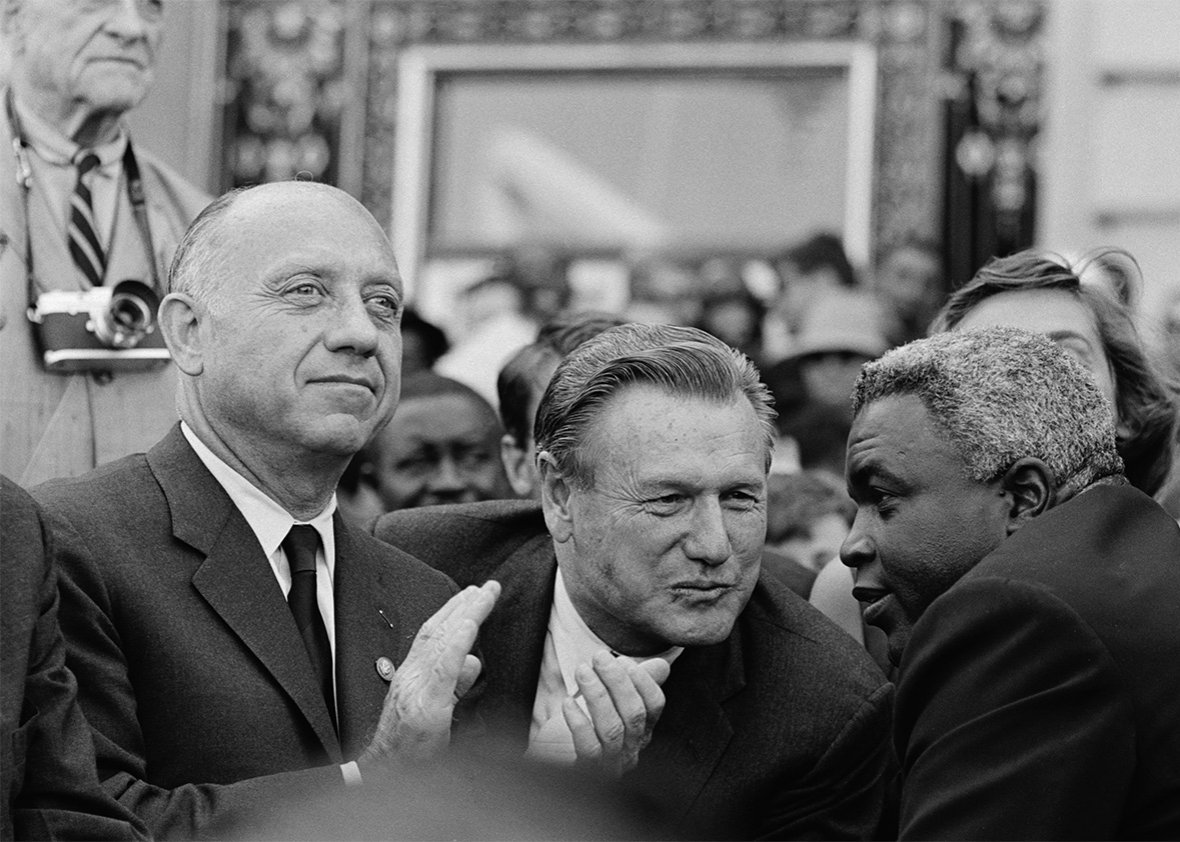
Three Delegates from New York. Left to right: Senator Jacob Javits,
Governor Nelson Rockefeller, and Jackie Robinson.

So, to use another sports analogy, Goldwater knew he needed a home run for his speech. He started off well: "This Party, with its every action, every word, every breath, and every heartbeat, has but a single resolve, and that is freedom. Freedom made orderly for this nation by our constitutional government. Freedom under a government limited by laws of nature and of nature's God. Freedom, balanced, so that order, lacking liberty, will not become the slavery of the prison cell; balanced, so that liberty, lacking order, will not become the license of the mob and of the jungle."

He knew that if he attacked the late President Kennedy and his policies, he had no chance. So he attacked the Democratic way in general: "During four futile years, the administration which we shall replace has distorted and lost that faith. It has talked and talked and talked and talked the words of freedom. Now, failures cement the wall of shame in Berlin. Failures blot the sands of shame at the Bay of Pigs. Failures mark the slow death of freedom in Laos. Failures infest the jungles of Vietnam."

This was a few days before what became known as the Gulf of Tonkin Incident. At the time, Berlin and Cuba were more familiar to Americans than Vietnam. At the time JFK took office, even Laos was more familiar.

Goldwater gave a few more platitudes about freedom, and fired a few more potshots at the Democrats. If he had then gone into his summation, it would have been a terrific speech. Instead, he addressed the need for unity within the Party's own ranks, and threw the Democrats a bone that they chewed on the rest of the way:

Anyone who joins us in all sincerity, we welcome. Those who do not care for our cause, we don't expect to enter our ranks in any case.

And let our Republicanism, so focused and so dedicated, not be made fuzzy and futile by unthinking and stupid labels.

Johnson would not go on to say it, but I can imagine a still-living Kennedy responding to this by saying, "I would remind you, my fellow Americans, that extremism in the defense of liberty is no defense of liberty."

What Johnson did go on to say was, "Extremism in the defense of liberty is an unpardonable vice. And moderation in the pursuit of justice is the highest virtue."

The Goldwater campaign produced buttons saying, "In your heart, you know he's right." The Johnson campaign produced buttons countering this, saying, "In your guts, you know he's nuts." And it produced other suggestions that he was too extreme to be President, including an ad known as the Daisy Spot.

Goldwater ended up winning only 6 States: His home State of Arizona, barely, and 5 Southern States who liked his apparent stance on civil rights, and may have been swayed by the Thurmond endorsement. In a few other Western States, embracing the idea of a Westerner becoming President, he came close.

But in most States, extremism was rejected as a defense of liberty. Richard Nixon, Ronald Reagan and both George Bushes learned from this campaign, and put a human face on conservative policies.

*

July 16, 1964 was a Thursday. Miguel Induráin, the Spanish (Basque) cyclist who won 5 straight Tours de France from 1991 to 1995, was born on this day.)

These baseball games were played:

* The New York Yankees lost to the Baltimore Orioles, 6-1 at Yankee Stadium. Steve Barber outpitched Jim Bouton, and helped his own cause with a home run. To counter the quote that Barber had in Bouton's later book Ball Four, Barber's arm wasn't sore, and it wasn't even a little stiff. Brooks Robinson went 1-for-2 with 2 walks. Mickey Mantle went 0-for-2 with 2 walks. Roger Maris went 0-for-4.

* The New York Mets lost to the Chicago Cubs, 11-1 at Wrigley Field in Chicago. Ernie Banks went 2-for-4 with 2 RBIs. The winning pitcher was Ernie Broglio, recently acquired for Curt Flood. For the rest of his tenure with the Cubs -- and in the major leagues -- he would go 9-15.

* The Chicago White Sox beat the Boston Red Sox, 9-3 at Fenway Park. Carl Yastrzemski and Tony Conigliaro both went 0-for-4.

* The Philadelphia Phillies beat the Pittsburgh Pirates, 7-5 at Forbes Field in Pittsburgh. Roberto Clemente went 2-for-5.

* The Cincinnati Reds beat the Houston Colt .45s, 3-2 at Crosley Field in Cincinnati. Frank Robinson went 0-for-4, and Pete Rose went 1-for-4. The Colt .45s became the Houston Astros the next year.

* The Milwaukee Braves beat the San Francisco Giants, 6-0 at Milwaukee County Stadium. Hank Fischer outpitches Gaylord Perry. Hank Aaron, Joe Torre and Denis Menke hit home runs for the Braves. Willie Mays went 1-for-4.

* The Washington Senators beat the Minnesota Twins, 7-2 at Metropolitan Stadium in the Minneapolis suburb of Bloomington, Minnesota. The only Twin runs came on solo homers by Bob Allison and Tony Oliva. Harmon Killebrew went 0-for-4.

* The Los Angeles Dodgers beat the St. Louis Cardinals, 10-2 at Busch Stadium (formerly Sportsman's Park) in St. Louis. Lou Brock went 2-for-4 in defeat.

* The Cleveland Indians beat the Kansas City Athletics, 12-9 at Kansas City Municipal Stadium. Woody Held won it with a home run in the top of the 10th inning.

* And the Detroit Tigers and the Los Angeles Angels were not scheduled to play.

Sunday, May 8, 2022

May 8, 1973: The Rockefeller Drug Laws

May 8, 1973: Governor Nelson Rockefeller of New York signs into law a series of bills designed to fight the possession and sale of narcotics. They become known as the Rockefeller Drug Laws.

"Rocky" had previously backed drug rehabilitation, job training and housing as strategies, having seen drugs as a social problem rather than a criminal one. But he did an about-face during a period of mounting national anxiety about drug use and crime. Having already made 3 failed attempts at the Republican Party's nomination for President, each shot down because he was considered unacceptable by the Party's conservative wing, he pushed the State legislature hard for the laws in his State of the State Address in January.

Under the new laws, the penalty for selling two ounces or more of heroin, morphine, "raw or prepared opium," cocaine, or cannabis (marijuana), or possessing four ounces or more of the same substances, was a minimum of 15 years to life in prison, and a maximum of 25 years to life. The original legislation also mandated the same penalty for committing a violent crime while under the influence of the same drugs, but this provision was subsequently omitted from the bill, and was not part of the legislation Rockefeller ultimately signed. The section of the laws applying to marijuana was repealed in 1977.

The adoption of the Rockefeller Drug Laws gave New York State the distinction of having the most severe laws of this kind in the entire United States. By the 1980s, the drug laws were a major reason for increased incarceration in New York City, as the New York Police Department started policing street-level drug markets much more intensively.

If Rockefeller's critics thought his drug laws were just a cynical maneuver to start him off on one more run for GOP's Presidential nomination in 1976, they miscalculated: On December 18, 1973, with a year left in his term, and with 2 years and change before voting for 1976 started, he resigned as Governor to run the Commission on Critical Choices for Americans. Malcolm Wilson, his Lieutenant Governor from day one of his Administration in 1959, assumed the Governorship, served out the last year of the 4th term, ran for a term of his own in 1974, and lost to Representative Hugh Carey.

When Gerald Ford became President following the resignation of Richard Nixon, he offered Rockefeller the Vice Presidency, and he held that job for the rest of the term. The conservative wing tried to stop his confirmation, and let him, and Ford, know in no uncertain terms, that he would not be accepted for the Vice Presidency in a full Ford term, or the Presidency himself if Ford didn't run. He died in 1979, under mysterious circumstances.

In 2002, attorney Meile Rockefeller was arrested during a protest of the laws bearing her grandfather's name. Eventually, the message got through, and the Rockefeller Drug Laws were scaled back in bills signed by Governors George Pataki in 2004 and David Paterson in 2009, with treatment becoming more of an option than incarceration.

*

May 8, 1973 was a Tuesday. Game 4 of the NBA Finals was played at Madison Square Garden. The New York Knicks beat the Los Angeles Lakers, 103-98. The Knicks won the title 2 days later in Inglewood.

Game 5 was played in the ABA Finals. The Indiana Pacers beat the Kentucky Colonels, 89-86 at the Indiana State Fairgrounds Coliseum (now named the Corteva Coliseum). The Colonels won Game 6 in Louisville, before the Pacers won Game 7 on May 12, for their 3rd ABA Championship in 4 seasons.

Game 6 of the Stanley Cup Finals was played, and it turned into a slugfest at the Montreal Forum. The Chicago Black Hawks beat the Montreal Canadiens, 8-7. Stan Mikita scored 2 goals and had 2 assists. Jim Pappin also scored 2 goals. For the Canadiens, Claude Larose scored 2. Both Frank and Pete Mahovlich scored, with Frank assisting on Pete's goal, and also assisting on one by Henri Richard. However, 2 days later, in Chicago, the Canadiens won Game 7 and the Cup.

The 1st World Hockey Association season had ended 2 days earlier, when the New England Whalers beat the Winnipeg Jets in Game 5 of their Finals.

Football was out of season. And these Major League Baseball games were played:

* The New York Yankees beat the Minnesota Twins, 14-4 at Metropolitan Stadium in the Minneapolis suburb of Bloomington, Minnesota. Mel Stottlemyre was the winning pitcher. Ron Blomberg went 2-for-4 with a home run and 4 RBIs. Thurman Munson went 3-for-5 with an RBI. For the Twins, Harmon Killebrew went 0-for-4, but Tony Oliva hit a home run.

* The New York Mets lost to the Atlanta Braves, 10-6 at Shea Stadium. Hank Aaron went 1-for-4 with a walk. His hit was not a home run. Davey Johnson hit 2 for the Braves. It would be another 13 years before he managed the Mets to win a World Series.

* The Montreal Expos beat the Houston Astros, 4-3 at Jarry Park in Montreal.

* The Cincinnati Reds beat the Philadelphia Phillies, 7-1 at Veterans Stadium in Philadelphia. Pete Rose went 3-for-4 with 3 RBIs. Johnny Bench went 3-for-4 with a home run and 4 RBIs.

* The Cleveland Indians beat the California Angels, 2-0 at Cleveland Municipal Stadium. Gaylord Perry pitched a 4-hit shutout. Dave Duncan, now usually remembered as one of Tony La Russa's coaches on the teams he managed, hit a home run for the Indians. For the Angels, Frank Robinson went 2-for-4.

* The Chicago White Sox beat the Boston Red Sox, 1-0 at Comiskey Park in Chicago. Eddie Fisher (6 2/3rds innings, not to be confused with the 1950s singer) and Terry Forster combined for a 3-hit shutout. Carl Yastrzemski went 0-for-3 with a walk.

* The Texas Rangers beat the Milwaukee Brewers, 5-3 at Milwaukee County Stadium.

* The Kansas City Royals beat the Detroit Tigers, 7-2 at Royals Stadium (now Kauffman Stadium) in Kansas City. Al Kaline went 1-for-3 with a walk.

* The Chicago Cubs beat the San Diego Padres, 3-2 at San Diego Stadium (later Jack Murphy Stadium and Qualcomm Stadium). Joe Pepitone -- yes, he played for the Cubs toward the end of his career -- doubled Ken Rudolph home in the top of the 12th inning.

* The Los Angeles Dodgers beat the Pittsburgh Pirates, 7-4 at Dodger Stadium in Los Angeles. Willie Stargell hit 2 home runs, and Al Oliver 1, but those accounted for all of the Pirate runs, and it wasn't enough.

* The San Francisco Giants beat the St. Louis Cardinals, 9-7 at Candlestick Park in San Francisco.

* And the Baltimore Orioles and the Oakland Athletics were rained out at Memorial Stadium in Baltimore. The game was made up as part of a doubleheader on July 6. The A's won the opener, 7-5.  Catfish Hunter outpitched Jim Palmer, despite home runs from Brooks Robinson, Boog Powell and Al Bumbry. The O's won the nightcap, 5-3. Dave McNally outpitched Vida Blue. Merv Rettenmund and Enos Cabell homered for the O's, Bill North and Deron Johnson for the A's. Over the 2 games, Reggie Jackson went 1-for-8.

Wednesday, January 26, 2022

January 26, 1979: The Strange Death of Nelson Rockefeller

January 26, 1979: Nelson Rockfeller dies of a heart attack at his desk at Rockefeller Center in Midtown Manhattan. Or so the initial story goes.

Born on July 8, 1908 in Bar Harbor, Maine, and raised in Pocantico Hills, Westchester County, New York, "Rocky" was the grandson of America's 1st oil billionaire, John D. Rockefeller Sr.; and the son of John D. Rockefeller Jr., building of Rockefeller Center in Midtown Manhattan, and operating it for his father. He was Assistant Secretary of State for American Republic Affairs for Presidents Franklin D. Roosevelt and Harry S Truman during World War II, a Republican appointed by Democrats.

He went on to be friendly with TV anchorman Howard K. Smith. At the Rainbow Room atop the RCA Building, the centerpiece of Rockefeller Center, he invited Smith to lunch, and told him, "Order anything you want, it's on me. Anything except Oysters Rockefeller. I can't stand them." (Named for his grandfather, the dish consists of oysters on the half-shell, topped with a rich sauce of butter, parsley and other green herbs, and bread crumbs, then baked or broiled. Lemon wedges are the typical garnish.) When Smith reminded Rockefeller that FDR, his fellow Dutchess County, New York native, loved them, Rockefeller said, "He would."

"Rocky" later served as an Undersecretary of Health, Education and Welfare under President Dwight D. Eisenhower. In 1958, he was elected Governor of New York, beating the Democratic incumbent, from another fabulously wealthy New York State family, Averell Harriman, with 54 percent of the vote to Harriman's 44.

He was re-elected in 1962, defeating U.S. Attorney Robert Morgenthau, 53-44; 1966, defeating New York City Council President and former Queens District Attorney Frank O'Connor, 44-38 (former Congressman Franklin D. Roosevelt Jr. got 8 percent); and 1970, defeating former Secretary of Labor and Supreme Court Justice Arthur Goldberg, 52-40.

Rockefeller revamped State government, and vastly expanded the State University of New York (SUNY) system, which had been created by Governor Thomas E. Dewey in 1948. He was stronger on civil rights than most politicians of either major party, and baseball legend Jackie Robinson admired him so much that he worked for him. Harlem, Rochester and Buffalo each had race riots during his tenure, but he managed to keep things from spiraling out of control.

Rockefeller often feuded with John Lindsay, a fellow patrician and "Establishment Republican" who served as Mayor of New York City from 1966 to 1973, and I've often thought that each man would have been better and happier in the other man's job. Mario Cuomo, who lost to Ed Koch for Mayor in 1977 and beat him for Governor in 1982, once remarked that New York was the only city where the Mayor wanted to be the Governor and the Governor wanted to be the Mayor. And that has happened since.

Like many Governors of New York, before and after him, Nelson Rockefeller wanted to be President. Certainly, he was qualified. But the hard right wing of the Republican Party already didn't like him for his massive government spending. He would say, "I'm with them on taxes and Communism. What more do they want?"

He made a halfhearted run in 1960, then backed Vice President Richard Nixon to keep a conservative insurgent such as Senator Barry Goldwater of Arizona from getting any traction. The conservatives never forgave him for this.

Nor did they forgive him for his private life. In 1930, he married Mary Todhunter Clark. They had 5 children. Mary divorced him on March 16, 1962 in Reno, Nevada, on grounds of "extreme mental cruelty." Had that happened, with those words, in a 24-hour news cycle era, Rockefeller would have been destroyed, and probably lost his bid for re-election that year.

It is believed that he was already fooling around with Margaretta Fitler, who was 19 years younger, considerably more attractive, and married to Dr. James Slater Murphy. Margaretta, known as "Happy," gave birth to Malinda Fitler Murphy in 1960. Even at the time, people around the Governor spoke of Malinda as being the Governor's daughter, not the Doctor's. And when Rocky and Happy married on May 4, 1963, only a little over a year after the divorce, many conservatives, with their self-appointment as America's moral arbiters, were horrified.

Although there were other candidates in the race -- including Governors William Scranton of Pennsylvania and George Romney of Michigan, and the party's 1960 Vice Presidential nominee, Ambassador and former Senator Henry Cabot Lodge Jr. of Massachusetts -- the 1964 nomination was always going to come down to Rockefeller vs. Goldwater. (It would not be Nixon: He had run for Governor of California in 1962, and lost, branding him a "loser.")

When Goldwater refused to campaign in the Oregon Primary, Rockefeller went, accompanied by signs saying, "He cared enough to come," and won. Goldwater knew that the California Primary was it: Win it, or you're out. But when Happy gave birth to Nelson Rockefeller Jr. just 3 days before the Primary, it bolstered the "morality" argument by reminding voters of Rocky's divorce and remarriage. Goldwater won California, and clinched the nomination.

The Republican Convention, at the Cow Palace outside San Francisco (they'd also met there in 1956), set the standard for future ugly GOP Conventions to come in 1992, 2004 and 2016. There was a proposed plank for the Party platform denouncing "extremist groups," specifically mentioning, on the left, the Communist Party; and, on the right, the Ku Klux Klan and the John Birch Society. The problem was, many of Goldwater's supporters were in the Birch Society.

When Rockefeller came on to speak in favor of the plank, Goldwater supporters in the seats tried to boo him off the stage. It was a disgraceful spectacle, but Rocky stood up to them, and finished his speech. The plank was easily voted down, making the GOP look like extremists.

Rockefeller ran for President again in 1968. But Nixon had made a comeback, having picked up some political I.O.U.s by supporting many of the Republican Congressional candidates who won in 1966, and so Rockefeller supporters reminded the undecided Delegates, "He has never lost an election." Of course, he had; just not a general election. But the hard right, with their new favorite son, Governor Ronald Reagan of California, not yet ready for the big time, settled for Nixon, and Rocky's last, perhaps best chance was gone.

In 1971, faced with the Attica Prison Riot, he decided he had to be as tough a Governor as Reagan. He sent the State Police in. The death toll was 43: 33 inmates, and 10 correctional officers and civilian employees. This helped to damage Rockefeller's reputation. He resigned on December 18, 1973, a year before his 4th term ended, and a few months after his draconian new drug laws infuriated people further.

On August 20, 1974, President Gerald Ford appointed him to be Vice President under the 25th Amendment to the Constitution. He was seriously opposed by both liberals in the Democratic Party and conservatives among his fellow Republicans, but there were enough people in the middle that, on December 19, he was confirmed, and sworn in.

Angry conservatives told Ford that they would not support him for a full term in 1976 if he kept Rockefeller on the ticket. He dumped Rockefeller, in favor of Senator Bob Dole of Kansas. Rockefeller served for the remainder of the Ford Presidency, until January 20, 1977. He then published a memoir, titled I Never Wanted to be Vice President of Anything.

In 1975, he welcomed a new employee onto his staff: Megan Marshack, a Los Angeles native who had been working as a radio news reporter for the Associated Press. His term as Vice President over, he took her back to his office at Rockefeller Center.
On January 26, 1979, Nelson Rockefeller died of a heart attack at his desk at Rockefeller Center in Midtown Manhattan. Or so the initial story told. Actually, he had died a few blocks away, at a townhouse he owned at 13 West 54th Street. Marshack was with him at the time. In bed. He was 70, she was 25.

Marshack tried to stay out of the public eye, but she soon began dating cartoonist Charles Addams, creator of The Addams Family, who lived in the same New York apartment building. In 1992, she was a news writer for WCBS-Channel 2. In 1994, she was promoted to producer. In 2008, she married a journalist, and moved back to Los Angeles. She has never publicly commented on her relationship with Rockefeller.

Neither of Rockefeller's wives ever married again. Mary lived until 1999, Happy until 2015.

UPDATE: Marshack died in October 2, 2024, from liver failure, a few days short of turning 71, in Sacramento, California. A year earlier, she had lost her husband of 20 years, a fellow journalist, in a car crash. She had no children. She wrote her own obituary for The New York Times, and, while she seemed to have been proud of working for Rockefeller, she gave no hint as to being anything other than his employee.

*

January 26, 1979 was a Friday. This was also the day the TV series The Dukes of Hazzard premiered. I have a separate entry for that event.

Baseball was out of season. Football season had ended 5 days earlier, when the Pittsburgh Steelers beat the Dallas Cowboys in Super Bowl XIII. There were 8 games played in the NBA:

* The New York Knicks lost to the Phoenix Suns, 108-107 at the Arizona Veterans Memorial Coliseum in Phoenix.

* The New Jersey Nets beat the New Orleans Hornets, 110-104 at the Rutgers Athletic Center (now the Jersey Mike's Arena) in Piscataway, New Jersey.

* The Indiana Pacers beat the Boston Celtics, 119-106 at the Market Square Arena in Indianapolis.

* The San Diego Clippers beat the Chicago Bulls, 107-91 at the Chicago Stadium.

* The Kansas City Kings beat the Washington Bullets, 142-128 at the Kemper Arena (now the Hy-Vee Arena) in Kansas City. Otis Birdsong of the Kings led all scorers on the night, with 39 points.

* And the San Antonio Spurs beat the Seattle SuperSonics, 125-108 at the HemisFair Arena in San Antonio.

* The Denver Nuggets beat the Los Angeles Lakers, 119-107 at the McNichols Arena in Denver.

* The Philadelphia 76ers beat the Golden State Warriors, 105-96 at the Oakland Coliseum Arena.

There were 2 games in the NHL. The Atlanta Flames beat the Toronto Maple Leafs, 4-2 at The Omni in Atlanta. And the Vancouver Canucks beat the St. Louis Blues, 4-1 at the Pacific Coliseum in Denver.

And there were 2 games in the World Hockey Association. The Birmingham Bulls beat the New England Whalers, 5-4 at the Birmingham-Jefferson County Civic Center (now the Birmingham-Jefferson Convention Complex). And the Cincinnati Stingers beat the Edmonton Oilers, 5-2 at the Northlands Coliseum in Edmonton.

December 31, 1999 & January 1, 2000: The Millennium

December 31, 1999:  The Millennium arrives. The people of planet Earth survived. At a terrible cost. But we hadn't destroyed ourselves. ...