Showing posts with label 1963 world series. Show all posts

Thursday, October 6, 2022

October 6, 1963: Barbra Streisand Appears On "The Judy Garland Show"

October 6, 1963: Barbra Streisand, just 22 years old but coming off her debut album, appears on The Judy Garland Show on CBS. Although Judy was, by no means, ready to pack it in at age 41, even she could see that this was a "passing of the torch" (or, at least, of the torch song) moment for people who loved popular music but hated rock and roll.

CBS had taken a chance on the temperamental, hard-drinking, pill-popping legend, airing her variety show on Sunday nights after The Ed Sullivan Show, starting on September 29, 1963. The episode with Streisand was taped on October 4.

Judy told Barbara, "You're so good that I... I hate you!" Barbara responded, "That's so sweet of you. Thank you. You know, you're so great, I've been hating you for years. In fact, it's my ambition to be great enough to be hated by as many singers as you." They both laughed, and said they really loved each other. But Barbara added, "But don't stop hating me, because I need the confidence!" (She wasn't kidding: Throughout her career, Barbra has struggled with stage fright.)

Together, they sang Barbra's slown-down version of "Happy Days Are Here Again," "Hooray for Love," and "Get Happy," a tune associated with Garland since her 1950 film Summer Stock. Later, Broadway legend Ethel Merman came on, and the 3 of them sang Ethel's song "There's No Business Like Show Business."

Also appearing on that episode were comedian Jerry Van Dyke, brother of Dick Van Dyke; and the Smothers Brothers, who would later get their own variety series on CBS, and have their own battles with the establishment.

Garland's unreliability, and her clashes with both producers and network brass, led to the show's cancellation after just 1 season of 26 episodes, the last airing on March 29, 1964, just 7 weeks after Ed Sullivan hosted The Beatles for the 1st time.

No one knew it yet, but, in 1976, Streisand would remake one of Garland's biggest films, itself a remake: A Star Is Born.

*

October 6, 1963 was a Sunday. The Los Angeles Dodgers completed a 4-game sweep of the New York Yankees, 2-1 at Dodger Stadium in Los Angeles. As with Game 1, 4 days earlier, Sandy Koufax outpitched Whitey Ford.

These games were played in the NFL:

* The New York Giants beat the Washington Redskins, 24-14 at District of Columbia Stadium (later Robert F. Kennedy Stadium) in Washington.

* The Philadelphia Eagles beat the Dallas Cowboys, 24-21 at Franklin Field in Philadelphia.

* The Detroit Lions beat the San Francisco 49ers, 26-3 at Tiger Stadium in Detroit.

* The Chicago Bears beat the Baltimore Colts, 10-3 at Wrigley Field in Chicago.

* The Green Bay Packers beat the Los Angeles Rams, 42-10 at City Stadium (later renamed Lambeau Field) in Green Bay, Wisconsin.

* The football version of the St. Louis Cardinals beat the Minnesota Vikings, 56-14 at Metropolitan Stadium in the Minneapolis suburb of Bloomington, Minnesota.

* The day before, the Cleveland Browns beat their arch-rivals, the Pittsburgh Steelers, 35-23 at Cleveland Municipal Stadium. (Scheduling it for the Saturday made no sense, since Ohio State was also playing that day, and beat Indiana, 21-0 at Memorial Stadium in Bloomington, Indiana.)

And in the American Football League:

* The Kansas City Chiefs beat the Houston Oilers, 28-7 at Kansas City Municipal Stadium.

* The Denver Broncos beat the San Diego Chargers, 50-34 at Bears Stadium (later renamed Mile High Stadium) in Denver.

* The day before, the New York Jets beat the team that would one day become their arch-rivals, then known as the Boston Patriots, 31-24 at the Polo Grounds. The Jets would play 4 more games at the old Harlem Horseshoe before closing it out, and moved the Shea Stadium in Queens, which they would share with the Mets for 20 seasons.

* Also the day before, the Buffalo Bills beat the Oakland Raiders, 12-0 at War Memorial Stadium in Buffalo.

Monday, October 3, 2022

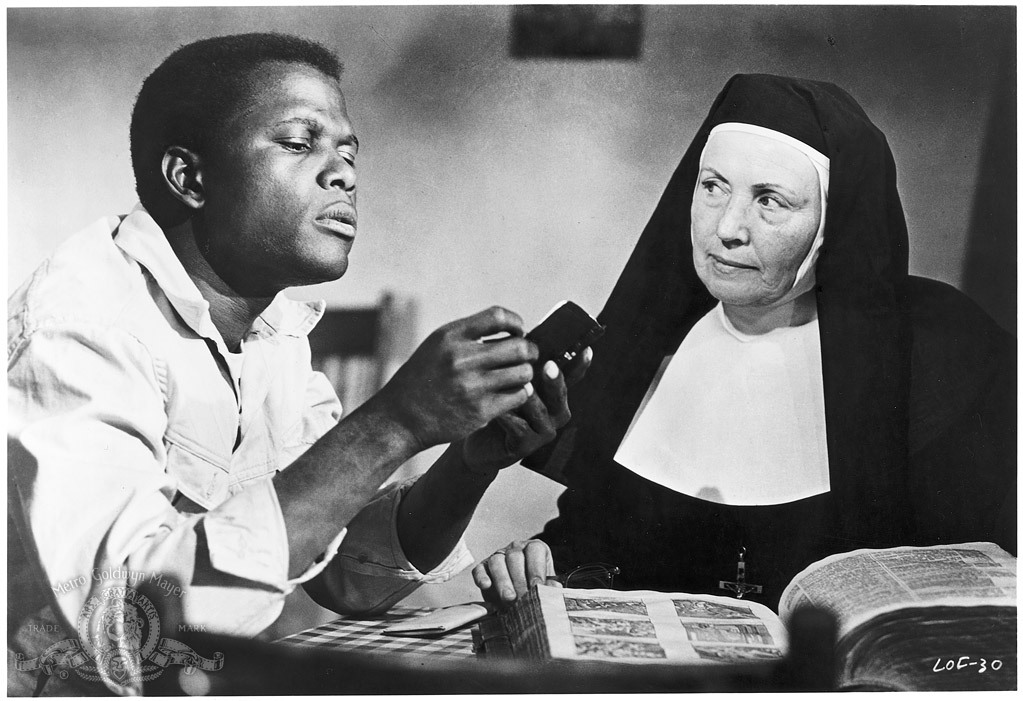
October 3, 1963: "Lilies of the Field" Premieres

October 3, 1963: Lilies of the Field premieres, based on the novel by William Edmund Barrett, published the year before. Ralph Nelson directed.

Sidney Poitier plays Homer Smith, a traveling handyman. He stops in the Arizona desert to get water for his car, when he sees some women trying to fix a fence. They are nuns: German, Austrian and Hungarian. The mother superior, Mother Maria asks him to fix the roof of their convent. But instead of paying him, she offers him a free dinner. Since all the nuns speak German, he doesn't understand them. He teaches them some helpful English phrases.

The next morning, again instead of paying him for his work, Mother Maria gives him breakfast and asks him to build them a chapel. Knowing that she is taking advantage of him and his work, he responds in a way he thinks she will understand, by quoting Scripture, Luke 10:7: "The laborer is worthy of his hire." She comes right back, with Matthew 6:28 and 29: "Consider the lilies of the field, how they grow; they toil not, neither do they spin. And yet I say unto you that even Solomon in all his glory was not arrayed like one of these." He is smart enough to know that, this time, he is not going to win a battle of words and knowledge.

The nuns -- who call Homer "Schmidt," the German version of his surname "Smith" -- need the chapel because their church is a long walk away. Homer drives them to Mass on Sunday. At the trading post next door, he meets the shopkeeper, a Mexican immigrant named Juan, who tells him that the nuns had escaped from Eastern Europe, over the Berlin Wall, leaving everything they had behind, to come to America. They had no money, living off the land, selling whatever vegetables they could grow, but told Juan that Homer would build a chapel. Homer comes to understand it's not for the nuns, but for the locals, all Mexican-Americans, quite poor, and many of them also far from the church.

Homer admits that he had wanted to be an architect, but couldn't afford college. By day, he works on the chapel, eventually being joined by the locals. By night, he teaches the nuns English (except for Mother Maria, the only one who was already fluent). They teach him Catholic chants, and he teaches them Baptist hymns and "Amen," a recent hit song by the Chicago-based rhythm & blues group The Impressions, which serves as the film's opening and closing theme -- a bold move for a film intended for white audiences in 1963. Indeed, as Homer drives off at the end of the film, his work done and the nuns singing inside the chapel, instead of "The End," the closing graphic reads, "Amen."

This is one of my mother's all-time favorite movies. She told me she rarely watches a movie more than once, but she once insisted that I watch it with her, and that it was the 4th time she'd seen it. The following Spring, Poitier became the 1st black man to win an Academy Award. (Hattie McDaniel, 24 years earlier, for her supporting role in Gone with the Wind, had become the 1st black person to win one.)

Lilia Skala, who fled Austria from the Nazis instead of Germany from the Communists, lived until 1994. Sir Sidney Poitier, born in Miami to Bahamian parents and raised in the Bahamas, and thus a British subject and eligible for a knighthood, one of the most beloved actors in American history, passed away on January 6, 2022.

*

October 3, 1963 was a Thursday. There was only 1 score on this historic day. It was Game 2 of the World Series. The Los Angeles Dodgers beat the New York Yankees, 4-1 at Yankee Stadium. Johnny Podres, who had shut the Yankees out for the Brooklyn version of the Dodgers in Game 7 in 1955, beats them again. Al Downing, the 1st black pitcher for the Yankees and the 1st black pitcher to lead the American League in strikeouts, is valiant in defeat.

Willie Davis doubled in 2 runs in the top of the 1st inning. Bill "Moose" Skowron, the 1st baseman who had helped the Yankees win 8 Pennants and 4 World Series, but was traded away to make room for the rising Joe Pepitone, gets revenge by hitting a home run in the 4th. He is only the 2nd player ever to hit home runs in World Series play for both Leagues, following Enos Slaughter, who did it for the Yankees in 1956 after doing it for the St. Louis Cardinals.

Sandy Koufax had struck out 15 Yankees, setting a Series record that would last for 5 years, in Game 1. Don Drysdale would shut the Yankees out in Game 3 in Los Angeles, and Koufax would complete the sweep in Game 4. It was the 1st time the Yankees had ever been swept in a World Series. The Cincinnati Reds would do it to them in 1976.

Sunday, October 2, 2022

October 2, 1963: Sandy Koufax Conquers the Yankees

October 2, 1963: Game 1 of the World Series. Ten years to the day after Carl Erskine struck out 14 Yankees for the Brooklyn edition of the Dodgers, Sandy Koufax fanned 15 of them for the Los Angeles version, stunning opposing pitcher Whitey Ford and 69,000 fans at Yankee Stadium.

Unlike other sports, especially college football, baseball has never had a media establishment that previews games as "The Game of the Century." After all, if a Series goes to 7 games, then, theoretically, the aces could face each other 3 times. In spite of Ford then being the defining pitcher in World Series history, and Koufax being the biggest pitching star of the season, and the hype for Game 1 being strong, this Series didn't go 7. Besides, while Koufax had become a star, he hadn't yet become a legend. It was this game that made him one.

After the 1962 season, knowing that they had Joe Pepitone coming up to play 1st base, the Yankees traded Bill "Moose" Skowron, who had helped them win 7 Pennants and 4 World Series, to the Dodgers for pitcher Stan Williams. Moose made them pay for that in this game, singling home the Dodgers' 1st run in the 2nd inning. This was followed by a single by Dick Tracewski and a home run by John Roseboro. The Dodgers were up 4-0, and the game was effectively over.

Koufax allowed 6 hits and 3 walks, but was completely dominant. He had a perfect game until the 5th inning, when Elston Howard singled. Perhaps the most surprising thing about this game is that Koufax didn't pitch a shutout: Tom Tresh hit a 2-run home run in the 8th, but that's all the Yankees got, losing 5-2.

After the game, in which he did not play, leading up to his retirement as a player and his subsequent hiring to replace Ralph Houk as the Yankees' manager, Yogi Berra said, "I understand how he won 25 games. What I don't understand is how he lost 5."

Koufax was already known to be a great pitcher. But, in those days, the way baseball was covered in the media, sometimes a player needed the spotlight of the World Series to show how great he was. Now, the whole country saw how great Sandy Koufax was.

This game would be referenced in the 1975 film version of One Flew Over the Cuckoo's Nest, in which the head nurse, Mildred Ratched (Louise Fletcher), won't let the inmates watch it on television, so Randle McMurphy (Jack Nicholson) points them to the unplugged TV, and provides an imaginary broadcast for them. This deviates from the novel by Ken Kesey, because it was published in 1962, before the game in question.

October 2, 1963 was a Wednesday. It was the only baseball game played. Football was in midweek. And the 1963-64 basketball and hockey seasons hadn't started yet. So there were no other scores on this historic day.

Maria Ressa, Philippine journalist, and co-winner of the 2021 Nobel Peace Prize along with Russian journalist Dmitry Muratov, was born on this day.

December 31, 1999 & January 1, 2000: The Millennium

December 31, 1999:  The Millennium arrives. The people of planet Earth survived. At a terrible cost. But we hadn't destroyed ourselves. ...