Showing posts with label easter. Show all posts

Tuesday, November 8, 2022

November 8, 1956: "The Ten Commandments" Premieres

November 8, 1956: The Ten Commandments premieres, produced, directed and narrated by Cecil B. DeMille, in big, splashy color, and with over-the-top dialogue.
DeMille had previously made a film with that title in 1923, in black-and-white, and silent. This was his last film (he died in 1959, age 77), and he got lucky on the timing: He got to film at the actual locations (in Egypt, including Mount Sinai) before the Suez Canal crisis began later in the year, at which point filming on location would have been harder than parting the Red Sea.
It was, up to that point, the most expensive movie ever made, costing $13 million -- about $141 million in today's money, which doesn't sound like the big deal it would have been even at the turn of the 21st Century. It made more money than any movie released that year, including My Fair Lady, Around the World In 80 Days and The King and I.
ABC has aired it in connection with the Jewish holiday of Passover and the Christian Easter season, every year since 1973, except in 1999. In theaters, it ran 3 hours and 40 minutes. With commercials, it runs 4 hours and 44 minutes, so it has to begin at 7:00 PM Eastern Time, and pushes back the local 11:00 news. It was usually aired on Palm Sunday or Easter Sunday, but since 2006 has aired on Easter Saturday.
The film tells the story of the Bible's book of Exodus, from the birth to the death of Moses, played as an adult by Charlton Heston. Yul Brynner (who also starred in The King and I) plays the main antagonist, the Pharoah Rameses II (as his name was spelled in the film's credits). The real Ramesses II (as it's usually spelled in English) reigned 66 years, 1279 to 1213 BC, and may not have been as vindictive as Brynner's portrayal; and the Exodus, if it happened at all, may have preceded him.
(An estimated date of 1300 BC has been suggested. This would put it at about 100 years before the Trojan War is said to have been fought, and about 300 years before the time of King David. However, it has been suggested that the loss of hundreds of thousands of people would have been noted in Egyptian records, and the surviving records make no such mention.)
The film is star-studded: Anne Baxter, Edward G. Robinson, Yvonne De Carlo, Debra Paget, John Derek, Cedric Hardwicke, Nina Foch, Judith Anderson and Vincent Price.
In the 1980s, Billy Crystal, himself Jewish, developed a comedy routine about the film, based largely on the campy dialogue, including his belief that Robinson, best known for his gangster roles in the 1930s, should never be in a biblical movie.
I guess he forgot that Robinson was Jewish, born Emanuel Goldenberg. (And, like Price, he was an amateur painter and a major art collector.) What's more, Robinson had been not quite blacklisted, but "graylisted" for alleged Communist activities. The virulently anti-Communist DeMille's casting of him restored his career.
In the years to come, Heston would become a gun rights activist, and it was said by his detractors that he acted as if he thought he really was Moses, bringing the Word of God, and treating the 2nd Amendment like it was one of the Commandments.
In a 2012 episode of the YouTube series Epic Rap Battles of History, "Nice" Peter Shukoff played Santa Claus, with "Epic" Lloyd Ahlquist played 3 different elves, against rapper Snoop Dogg as Moses.
A movie like The Ten Commandments could not be made today. Not because it would cost so much, or because it reminds us that the Jews were oppressed, but because it reminds us that people believing the lies of a demagogue and worshiping a golden idol look like the bad guys.
*
November 8, 1956 was a Thursday. Baseball season was over. Football was in midweek. Although the NBA season had begun, there were no games scheduled for this day.

But the NHL's entire "Original Six" was in action.

* The New York Rangers lost to the Montreal Canadiens, 4-2 at the Montreal Forum. 

* The Boston Bruins beat the Detroit Red Wings, 3-1 at the Boston Garden.

* And the Chicago Black Hawks beat the Toronto Maple Leafs, 5-2 at the Chicago Stadium.

Thursday, April 21, 2022

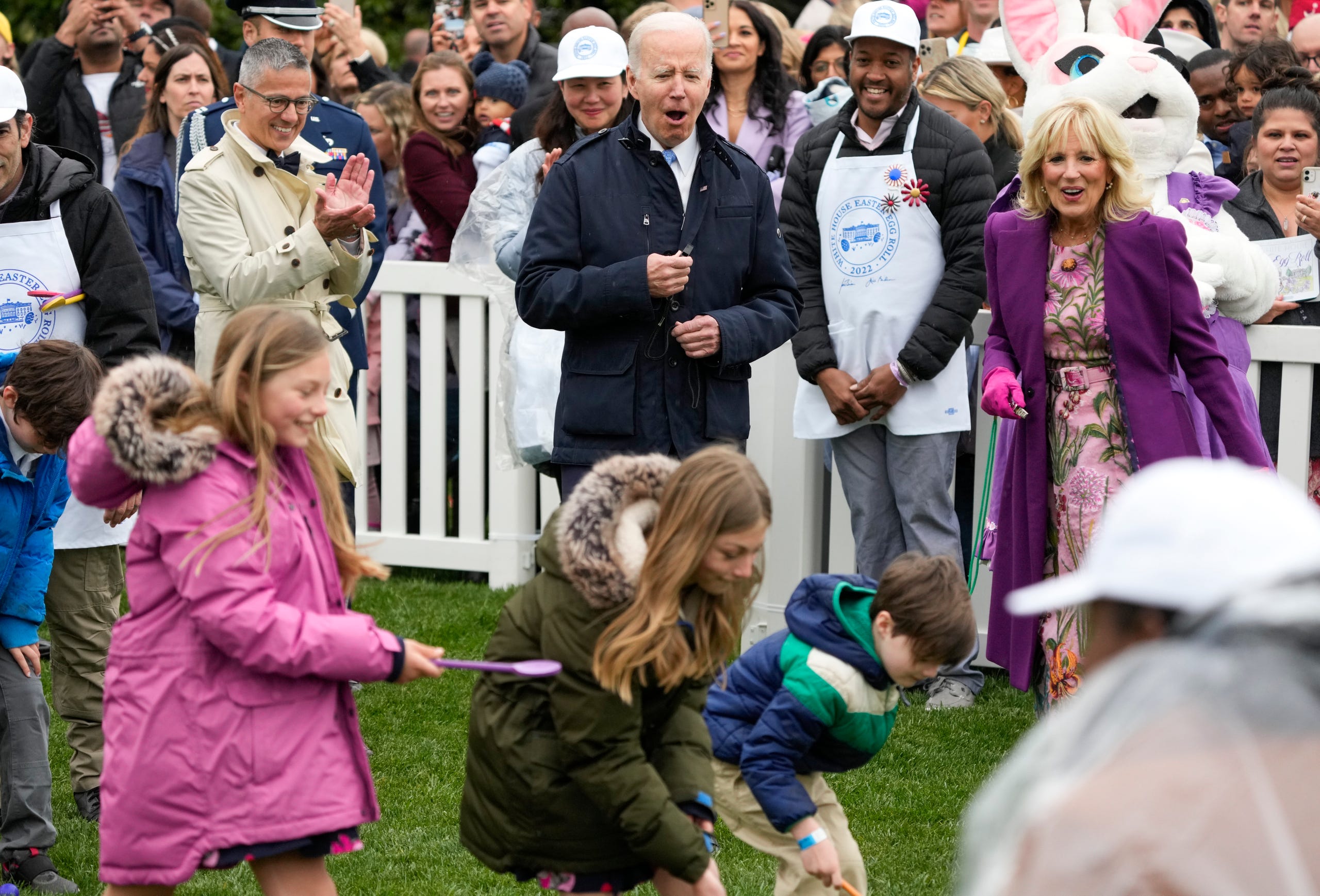
April 22, 1878: The 1st White House Easter Egg Roll

Joe and Jill Biden, and the Easter Bunny, presiding, April 18, 2022.
No, this is not the original in 1878. Joe's not that old.

April 22, 1878: The 1st White House Easter Egg Roll is held, on the South Lawn.

In Christianity, for the celebration of Eastertide, Easter eggs symbolize the empty tomb of Jesus. Additionally, eggs carry a Trinitarian significance, with shell, yolk, and albumen being three parts of one egg. During Lent, eggs are among the foods that are traditionally abstained from. After the 40-day Lenten season concludes and Eastertide begins, eggs may be consumed again, giving rise to various traditions such as the rolling of hard-boiled eggs, usually decorated. This also symbolizes the angel rolling away the stone at the entrance of the tomb.
According to tradition, Dolley Madison, wife of President James Madison, began the event in 1814. Hundreds of children brought their decorated eggs to join in games. Children rolled eggs on Easter Monday at the Capitol, the White House, and other parks and open spaces in Washington.
In 1876, shortly after a particularly rambunctious Easter egg roll destroyed much of the lawn at the Capitol, Congress passed a law making it illegal to use the Capitol complex as a children's playground. Heavy rain prevented much egg rolling in 1877, so the ban was not tested until 1878.
At the request of a number of children, including his own, then President Rutherford B. Hayes and his wife Lucy Hayes brought the event to the White House lawn in 1878. From that year on, the Egg Roll would be an annual and popular White House event, with a few exceptions:
* 1917: Moved to the Washington Monument.
* 1918, 1919 and 1920: Canceled due to food shortages, with the addition reason in 1919 of the Spanish Flu epidemic.
* 1942 through 1952: With the U.S. entering World War II, President Franklin D. Roosevelt put several traditions on hold, including 2 Spring traditions associated with the Presidency: The Easter Egg Roll and the ceremonial first ball to open the baseball season. The 1942 Easter Egg Roll was moved to the Capitol West Lawn.
The next 3 editions were canceled, to save the eggs for the armed force. The 2 after that were canceled, to save the eggs for the Marshall Plan in its rebuilding of Western Europe. The renovation of the White House made it the South Lawn unavailable from 1948 to 1952.
President Dwight D. Eisenhower restored the tradition in 1953, and First Lady Mamie Eisenhower noticed that no black children were participating. The District of Columbia was still racially segregated. She ordered that the Roll be opened to black children, and the 1954 edition, and all since, have been.
* 2020 and 2021: Canceled due to COVID-19 restrictions. It was resumed in 2022.
The President and the First Lady usually attend, along with someone wearing an Easter Bunny costume. With a crowd usually estimated at around 30,000, it is the most-attended annual White House event, surpassing the lighting of the National Christmas Tree
*
April 22, 1878, as the day after Easter, was a Monday. The only sport in season in America at the time was baseball, and no games were scheduled for the day.

Wednesday, April 13, 2022

April 14, 1895: The Birth of Brazilian Football

Charles William Miller

April 14, 1895: What is generally recognized as the first soccer, or "football," game in Brazil is played. Although it is unquestionably the match that popularized the sport in the largest nation in South America, its status as the first match is in dispute.

One alternate theory is that the 1st game was played in 1874, by foreign sailors on the beaches of Rio de Janeiro. In 1878, crew members of the ship Criméia faced each other in an exhibition for Princess Isabel, daughter and regent of Emperor Pedro II. There appears to have been a match in Pará in May 1890, between two groups of employees of English corporations.

Charles William Miller, the son of a railway company employee, is widely credited as the "father of Brazilian football." Miller was born in 1874 in São Paulo, to a Scottish railway engineer and a Brazilian mother of English descent. He went to England to study at Banister Court School. He became interested in football, and, in 1894, when he returned to Brazil, he brought with him two balls in his suitcase. In an interview in 1952, a year before his death, he recalled:

On a cold fall afternoon in 1895, I gathered my friends and invited them to play a game of football. The name was a novelty in itself, since they had only known cricket at that time.

- What is this game like? - some ask.

- What ball are we going to play with? - others asked.

- I have the ball. What we need to do is to fill it up.

- Fill it with what - they asked.

- With air.

- Then go and get it and I'll fill it up.

And on April 14, 1895, at Várzea do Carmo in São Paulo, Miller captained a team of employees of the São Paulo Railway Company to a 4-2 win over employees of the São Paulo Gaz Company. All of them were Englishmen, or, like Miller, Brazilian-born sons of Englishmen.
In 1902, Miller founded the soccer team at the São Paulo Athletic Club, and their league, Liga Paulista de Foot-Ball, now known as the Campeonato Paulista, the State Championship of São Paulo. SPAC won it in 1902, 1903, 1904 (all with Miller in goal) and 1911. He also founded SPAC's rugby team, and is thus also considered the father of rugby union in Brazil. Although the Club stopped playing soccer in 1912, it has won rugby's Campeonato Brasileiro 10 times, most recently in 1999. Miller got rich in real estate, and died in 1953, at the age of 78.
By that point, Brazil had become one of the defining countries of soccer -- but, to their 1950 dismay, not yet the defining country of it.
*

April 14, 1895 was a Sunday -- Easter Sunday. There were no scores in North American sports on this day: Baseball was in Spring Training, football was out of season, basketball barely existed, and hockey season had ended a month earlier, with the Montreal Victorias winning the Stanley Cup.

December 31, 1999 & January 1, 2000: The Millennium

December 31, 1999:  The Millennium arrives. The people of planet Earth survived. At a terrible cost. But we hadn't destroyed ourselves. ...