Showing posts with label 1878. Show all posts

Tuesday, June 14, 2022

June 15, 1878: Eadweard Muybridge Invents Motion Pictures

June 15, 1878: Eadweard Muybridge invents motion pictures. Yes, it goes that far back.

He was born born Edward James Muggeridge on April 9, 1830 in Kingston upon Thomas, Surrey, England. He was interested in Old English, and took the archaic version of his given named, "Eadweard," and made his surname a similarly archaic one, so his name would, presumably, be pronounced "ED-word MIGH-bridge."

He moved to America in 1850, and became a bookseller. In 1860, he returned to Kingston, and took up photography. He returned to America in 1867, and made and sold some stunning photographs of the West, including his adopted hometown of San Francisco. In 1875, he discovered his wife was having an affair, shot and killed the other man, and was acquitted on the grounds of "justifiable homicide."
In June 1878, Muybridge created sequential series of photographs, now with a battery of 12 cameras along the race track at Stanford's Palo Alto Stock Farm, now the campus of Stanford University (which is still called "The Farm"). The shutters were automatically triggered when the wheel of a cart or the breast or legs of a horse tripped wires connected to an electromagnetic circuit.

For a session on June 15, 1878, the press and a selection of turf men were invited to witness the process. An accident with a snapping strap was captured on the negatives and shown to the attendees, convincing even the most skeptical witnesses. The news of this success was reported worldwide.

Newspapers were not yet able to reproduce detailed photographs, so the images were widely printed as woodcut engravings. Scientific American was among the publications at the time that carried reports and engravings of Muybridge's groundbreaking images. Six different series were soon published as cabinet cards, entitled The Horse in Motion.

Many people were amazed at the previously unseen positions of the horse's legs in action, particularly the fact that a running horse had all four hooves in the air at regular intervals. This did not take place when the horse's legs were extended to the front and back, as imagined by illustrators of the time, but when its legs were collected beneath its body as it switched from "pulling" with the front legs to "pushing" with the back legs.

In his later years, Muybridge gave many public lectures and demonstrations of his photography and early motion picture sequences, travelling frequently in England and Europe to publicize his work. He retired to his native England permanently in 1894, and died on May 8, 1904.

*

June 15, 1878 was a Saturday. Three games were played in baseball's National League:

* The Boston Red Stockings beat the Indianapolis Blues, 7-4 at the original version of the South End Grounds in Boston.

* The Cincinnati Reds beat the Providence Grays, 11-3 at the Messer Street Grounds in Providence, Rhode Island.

* And the Chicago White Stockings beat the Milwaukee Grays, 12-2 at the Union Grounds in Chicago.

Tuesday, May 24, 2022

May 25, 1878: "HMS Pinafore" Makes Gilbert & Sullivan Legends

William S. Gilbert (left) and Arthur Sullivan

May 25, 1878: H.M.S. Pinafore; or, The Lass That Loved a Sailor, premieres at the Opera Comique in London. It runs for 571 performances, and makes stars of its authors, Gilbert and Sullivan.

William Schwenck Gilbert was born on November 18, 1836 in Central London. As a young man, he illustrated the novels written by his father, a former naval surgeon. The father's Royal Navy background inspired much of the son's comedic writing, which began in magazines in the early 1860s.

Arthur Seymour Sullivan was born on May 13, 1842 in Lambeth, South London. He also drew on his father's military experience, as a military bandmaster. Thus, he became a Chapel Royal chorister, and even composed a work that was played at the wedding of the Prince and Princess of Wales, the future King Edward VII and Queen Alexandra. In 1871, he wrote the music to the hymn "Onward Christian Soldiers," whose lyrics were written by Sabine Baring-Gould in 1865.

Sullivan was writing comic operas as early as 1863, but was not successful until meeting Gilbert in 1870. Together, they wrote minor hits. Pinafore was their 1st major hit, and included "He Is an Englishman," "I Am the Monarch of the Sea," "When I Was a Lad" and "A British Tar," which are still known today.

It launched them on a career that made them Britain's foremost musical composers of the 19th Century. Among their other successful works were The Pirates of Penzance in 1879, with its legendary "Major-General's Song"; The Mikado in 1885; The Yeomen of the Guard in 1888; and The Gondoliers in 1889.

In 1890, after this long and profitable creative partnership, Gilbert quarrelled with Sullivan and Carte concerning expenses at the Savoy Theatre; the dispute is referred to as the "carpet quarrel". Gilbert won the ensuing lawsuit, but the argument caused hurt feelings among the partnership. Although Gilbert and Sullivan were persuaded to collaborate on two last operas, they were not as successful as the previous ones. Their finale was The Grand Duke, in 1896.

Sullivan was knighted by Queen Victoria in 1883; Gilbert, by King Edward VII in 1907. Sullivan's health was never good, and died of heart failure in London on November 25, 1900, at 58. Gilbert lived on until May 29, 1911, dying from a heart attack at his country estate, Grim's Dyke, in Northwest London, at 74.

*

May 25, 1878 was a Saturday. This was the birthdate of African-American actor and dancer Bill "Bojangles" Robinson, in Richmond, Virginia.

The only major professional sports league in America at the time was baseball's National League. There were only 6 teams in the League that season, and all 6 were in action on this day:

* The Boston Red Stockings beat the Providence Grays, 17-10 at the original version of the South End Grounds in Boston. The Grays won the Pennant in 1879 and 1884, but went out of business after the 1885 season. The Red Stockings won the Pennant in 1877 and 1878; became the Boston Beaneaters, and won the Pennant in 1883, 1891, 1892, 1893, 1897 and 1898; became the Braves, and won the Pennant in 1914 and 1948; then moved to Milwaukee in 1953 and Atlanta in 1966.

* The Cincinnati Reds beat the Chicago White Stockings, 10-8 at Lakefront Park in Chicago. The Reds went out of business after the season, and the Reds team that exists today can only trace itself back to a team founded in 1882 in the American Association. The White Stockings went through some name changes, becoming the Cubs in 1903.

* And the Milwaukee Grays beat the Indianapolis Blues, 10-7 at Eclipse Park in Milwaukee. Both teams folded after the season, and the NL brought on new teams for 1879.

Tuesday, May 10, 2022

May 10, 1878: New Jersey Passes the Borough Act

May 10, 1878: The New Jersey Legislature passes the Borough Act of 1878, creating several smaller towns out of bigger ones.

Among New Jersey's 564 municipalities, the "Borough" is the most common form of local government, though the majority of state residents actually reside in "Townships," with "Cities" being the next-most-populated. In 2022, there are 253 Boroughs in New Jersey.

However, Boroughs were not always so common. In 1875, only 17 Boroughs had been created, all by special acts of the legislature. These original Boroughs were subdivisions of Townships, established by state charter. Elizabeth was the first, established by royal charter in 1740, within the now defunct Elizabeth Township. About half of them had been dissolved, or changed into other forms of government, often Cities.

The Township Act of 1798 formally incorporated 104 municipalities in 13 Counties in New Jersey, setting standards on format for government of Townships. Those 13 Counties would eventually divide into 21.

The Borough Act of 1878 allowed any Township, or portion thereof, with a land area of no more than four square miles and a population not exceeding 5,000, to establish itself as an independent Borough through a petition and referendum process on a self-executing basis.

As enacted, a Borough would be governed by an elected Mayor, serving a one-year term, and a six-member council, elected to staggered three-year terms. The Mayor would preside at council meetings, but had no vote except to break ties. (Length of terms became changeable with later legislation.) This system resulted in a period, known as "Boroughitis," where large numbers of small Boroughs were created. Bergen County is home to the highest number of boroughs of any County in New Jersey, with 56.

In 1894, the Legislature passed an act requiring each Township to have a single school district. A wave of Borough incorporations followed, as one part of several Townships decided that it would prefer the cost of being a separate municipality to paying for the other schools.

To use my own hometown as an example:

* New Brunswick was incorporated as a Town in 1736, and chartered as a City in 1784.

* North Brunswick and South Brunswick were separated from New Brunswick by the Township Act of 1798. Despite the name, North Brunswick is actually south of New Brunswick. South Brunswick is further south.

* East Brunswick, first settled in 1677, 4 years earlier than New Brunswick, was separated from New Brunswick as a Township on February 28, 1860. While it is southeast of New Brunswick, it is east of North Brunswick.

* On February 23, 1870, Helmetta, Milltown, Spotswood and Washington Town were formed as Towns within the Township of East Brunswick.

* The Borough of Helmetta was separated and established on March 20, 1888.

* The Borough of Milltown was separated and established on January 29, 1889.

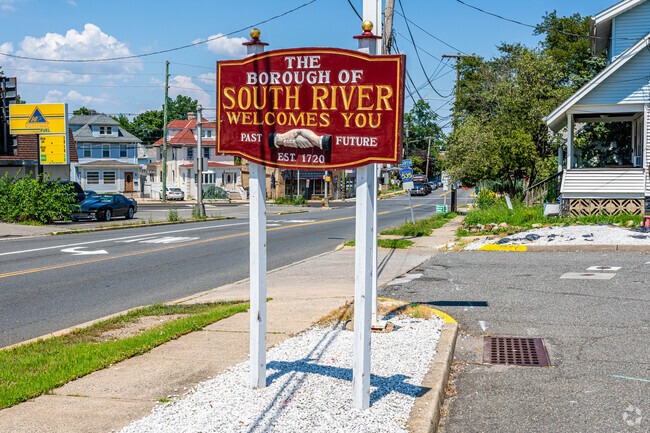
* Washington Town, first settled in 1683 -- the 1720 date on that welcome sign refers to a settlement there by Samuel Willett, leading to a previous name of Willettstown -- became independent as the Borough of South River on February 28, 1898.

* And the Borough of Spotswood was separated and established on April 15, 1908.

My family has lived in East Brunswick since 1972, although a branch has since moved to adjoining South River. Ironically, in terms of schools, it's worked the other way around: South River High School was founded in 1891, and East Brunswick sent its high school students there until opening its own high school in 1958. My sister and I went to E.B.'s public schools, but her children have gone to South River's.

*

May 10, 1878 was a Friday. The only major sports league in business in North America at the time was baseball's National League. And only 1 game was played in it: The Indianapolis Blues beat the Milwaukee Grays, 6-1 at South Street Park in Indianapolis. This was the only season at the major league level for both of these teams, which had joined from minor leagues, and then went out of business. 

Thursday, April 21, 2022

April 22, 1878: The 1st White House Easter Egg Roll

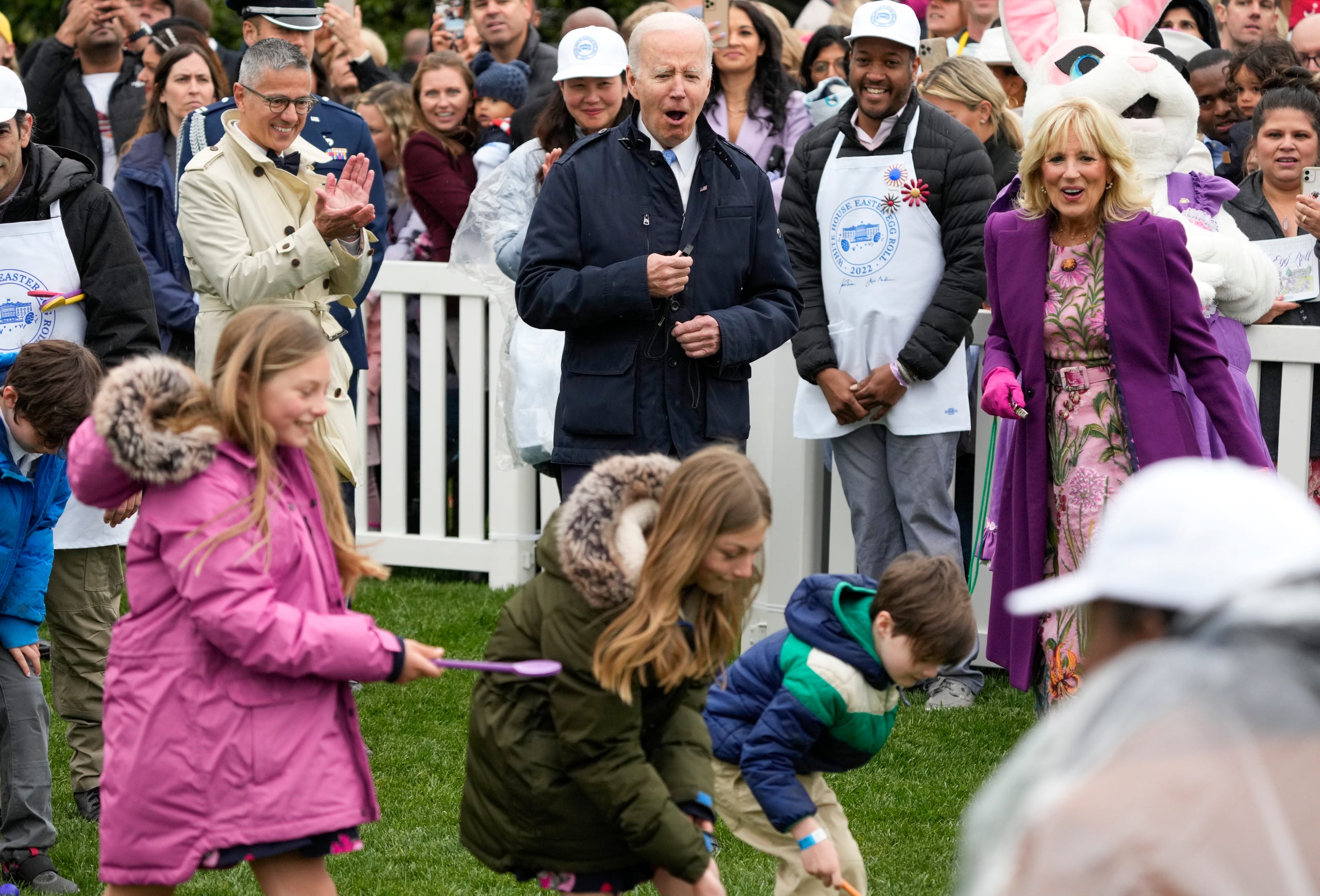
Joe and Jill Biden, and the Easter Bunny, presiding, April 18, 2022.
No, this is not the original in 1878. Joe's not that old.

April 22, 1878: The 1st White House Easter Egg Roll is held, on the South Lawn.

In Christianity, for the celebration of Eastertide, Easter eggs symbolize the empty tomb of Jesus. Additionally, eggs carry a Trinitarian significance, with shell, yolk, and albumen being three parts of one egg. During Lent, eggs are among the foods that are traditionally abstained from. After the 40-day Lenten season concludes and Eastertide begins, eggs may be consumed again, giving rise to various traditions such as the rolling of hard-boiled eggs, usually decorated. This also symbolizes the angel rolling away the stone at the entrance of the tomb.
According to tradition, Dolley Madison, wife of President James Madison, began the event in 1814. Hundreds of children brought their decorated eggs to join in games. Children rolled eggs on Easter Monday at the Capitol, the White House, and other parks and open spaces in Washington.
In 1876, shortly after a particularly rambunctious Easter egg roll destroyed much of the lawn at the Capitol, Congress passed a law making it illegal to use the Capitol complex as a children's playground. Heavy rain prevented much egg rolling in 1877, so the ban was not tested until 1878.
At the request of a number of children, including his own, then President Rutherford B. Hayes and his wife Lucy Hayes brought the event to the White House lawn in 1878. From that year on, the Egg Roll would be an annual and popular White House event, with a few exceptions:
* 1917: Moved to the Washington Monument.
* 1918, 1919 and 1920: Canceled due to food shortages, with the addition reason in 1919 of the Spanish Flu epidemic.
* 1942 through 1952: With the U.S. entering World War II, President Franklin D. Roosevelt put several traditions on hold, including 2 Spring traditions associated with the Presidency: The Easter Egg Roll and the ceremonial first ball to open the baseball season. The 1942 Easter Egg Roll was moved to the Capitol West Lawn.
The next 3 editions were canceled, to save the eggs for the armed force. The 2 after that were canceled, to save the eggs for the Marshall Plan in its rebuilding of Western Europe. The renovation of the White House made it the South Lawn unavailable from 1948 to 1952.
President Dwight D. Eisenhower restored the tradition in 1953, and First Lady Mamie Eisenhower noticed that no black children were participating. The District of Columbia was still racially segregated. She ordered that the Roll be opened to black children, and the 1954 edition, and all since, have been.
* 2020 and 2021: Canceled due to COVID-19 restrictions. It was resumed in 2022.
The President and the First Lady usually attend, along with someone wearing an Easter Bunny costume. With a crowd usually estimated at around 30,000, it is the most-attended annual White House event, surpassing the lighting of the National Christmas Tree
*
April 22, 1878, as the day after Easter, was a Monday. The only sport in season in America at the time was baseball, and no games were scheduled for the day.

Sunday, February 6, 2022

February 7, 1878: The Longest-Reigning Pope

Not only is this the earliest known photograph of a Pope,
but it's a photograph of a man born in 1792.

February 7, 1878: Pope Pius IX dies of a heart attack in the Vatican. He was 85 years old, and had reigned for 31 years. Aside from the 1st Pope, Saint Peter himself, 34 years, he is the longest-reigning Supreme Pontiff of the Roman Catholic Church.

He was born on May 13, 1792, in Senigallia, in the Marche region of Italy, on the coast of the Adriatic Sea, with the name Giovanni Maria Mastai Ferretti. In 1814, as a theology student in his hometown of Sinigaglia, he met Pope Pius VII. The following year, he entered the Papal Noble Guard, but was soon dismissed after an epileptic seizure. He threw himself on the mercy of Pius VII, who elevated him, and supported his continued theological studies.

His seizures became less frequent. He was ordained as a priest in 1819, and earned the trust of the next Pope, Leo XII, who appointed him Archbishop of Spoleto in 1827. Pope Gregory XVI named him a Cardinal in 1839, and Cardinal Ferretti was named his successor on June 16, 1846, at the age of 54. He took the regnal name Pius IX, in honor of his patron, Pius VII.

He modernized the Papal States, before they were absorbed into the Kingdom of Italy in 1870. He was also Pope during the Irish Potato Famine of 1845 to 1849, for which he raised aid; the European Revolutions of 1848, which led him to become considerably more conservative; the rise (1852) and fall (1870) of France's Second Empire; the Crimean War of 1853 to 1856, which he did nothing to end; the American Civil War of 1861 to 1865, which he did nothing to end, nor did he do anything to encourage the abolition of slavery in America; the unification of Germany in 1871, which saw him at odds with Chancellor Otto von Bismarck; and the Paris Commune, also in 1871, which he opposed.

He convened the First Vatican Council in 1869, which raised the role of Mary in the Church, and ratified his doctrine of Papal infallibility.

He developed erysipelas, especially on his legs, which made walking painful and eventually nearly impossible. A heat wave in 1877 sent his health into decline, but he lived long enough to see the death of his former enemy, King Victor Emmanuel II of Italy, on January 9, 1878. On February 7, he had a seizure, which gave him a fatal heart attack.

He was beatified in 2000, but, as of 2022, has not been canonized as a saint. In 1874, while he was still alive, a street in Montreal was named for him: Pie-IX Boulevard (pronounced "Pee-noof"). It forms part of Quebec Route 125, and part of the border of Montreal's 1976 Olympic Park. The station serving that Park on the Montreal Metro (subway) system is named Pie-IX. In 1937, as part of the Boulevard, the Pie-IX Bridge was built over the Prairies River. It was rebuilt in 1967.

Pius IX was succeeded by Leo XIII, and he reigned for 25 years. So, for 56 years, 1846 to 1903 -- in America, the Presidencies of James K. Polk to Theodore Roosevelt -- there were 16 Presidents, but only 2 Popes. (Of course, there had only recently been a 2nd monarch of Great Britain, as Queen Victoria had been on that throne from 1837 to 1901, succeeded by King Edward VII.)

Leo XIII was followed in 1903 by Pius X, in 1914 by Benedict XV, in 1922 by Pius XI, in 1939 by Pius XII, in 1958 by John XXIII, in 1963 by Paul VI, in 1978 by John Paul I, and then, after just 33 days, the shortest-reigning modern Pope, by John Paul II. His reign of 26 years is the 2nd-longest in the modern era. He was succeeded in 2005 by Benedict XVI. He resigned in 2013 (all the other changes mentioned here were through the death of the preceding Pope), and was succeeded by Francis.

*

February 7, 1878 was a Thursday. There were no scores on this historic day.

December 31, 1999 & January 1, 2000: The Millennium

December 31, 1999:  The Millennium arrives. The people of planet Earth survived. At a terrible cost. But we hadn't destroyed ourselves. ...