May 10, 1878: The New Jersey Legislature passes the Borough Act of 1878, creating several smaller towns out of bigger ones.
Among New Jersey's 564 municipalities, the "Borough" is the most common form of local government, though the majority of state residents actually reside in "Townships," with "Cities" being the next-most-populated. In 2022, there are 253 Boroughs in New Jersey.
However, Boroughs were not always so common. In 1875, only 17 Boroughs had been created, all by special acts of the legislature. These original Boroughs were subdivisions of Townships, established by state charter. Elizabeth was the first, established by royal charter in 1740, within the now defunct Elizabeth Township. About half of them had been dissolved, or changed into other forms of government, often Cities.
The Township Act of 1798 formally incorporated 104 municipalities in 13 Counties in New Jersey, setting standards on format for government of Townships. Those 13 Counties would eventually divide into 21.
The Borough Act of 1878 allowed any Township, or portion thereof, with a land area of no more than four square miles and a population not exceeding 5,000, to establish itself as an independent Borough through a petition and referendum process on a self-executing basis.
As enacted, a Borough would be governed by an elected Mayor, serving a one-year term, and a six-member council, elected to staggered three-year terms. The Mayor would preside at council meetings, but had no vote except to break ties. (Length of terms became changeable with later legislation.) This system resulted in a period, known as "Boroughitis," where large numbers of small Boroughs were created. Bergen County is home to the highest number of boroughs of any County in New Jersey, with 56.
In 1894, the Legislature passed an act requiring each Township to have a single school district. A wave of Borough incorporations followed, as one part of several Townships decided that it would prefer the cost of being a separate municipality to paying for the other schools.
To use my own hometown as an example:
* New Brunswick was incorporated as a Town in 1736, and chartered as a City in 1784.
* North Brunswick and South Brunswick were separated from New Brunswick by the Township Act of 1798. Despite the name, North Brunswick is actually south of New Brunswick. South Brunswick is further south.
* East Brunswick, first settled in 1677, 4 years earlier than New Brunswick, was separated from New Brunswick as a Township on February 28, 1860. While it is southeast of New Brunswick, it is east of North Brunswick.
* On February 23, 1870, Helmetta, Milltown, Spotswood and Washington Town were formed as Towns within the Township of East Brunswick.
* The Borough of Helmetta was separated and established on March 20, 1888.
* The Borough of Milltown was separated and established on January 29, 1889.
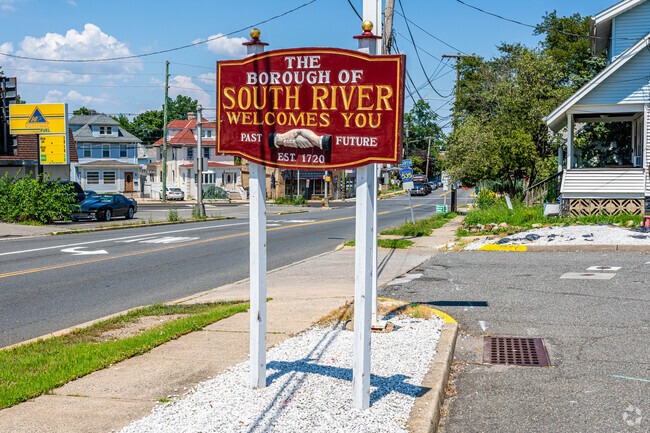
* Washington Town, first settled in 1683 -- the 1720 date on that welcome sign refers to a settlement there by Samuel Willett, leading to a previous name of Willettstown -- became independent as the Borough of South River on February 28, 1898.
* And the Borough of Spotswood was separated and established on April 15, 1908.
My family has lived in East Brunswick since 1972, although a branch has since moved to adjoining South River. Ironically, in terms of schools, it's worked the other way around: South River High School was founded in 1891, and East Brunswick sent its high school students there until opening its own high school in 1958. My sister and I went to E.B.'s public schools, but her children have gone to South River's.
*
May 10, 1878 was a Friday. The only major sports league in business in North America at the time was baseball's National League. And only 1 game was played in it: The Indianapolis Blues beat the Milwaukee Grays, 6-1 at South Street Park in Indianapolis. This was the only season at the major league level for both of these teams, which had joined from minor leagues, and then went out of business.


No comments:
Post a Comment