Showing posts with label museum. Show all posts

Wednesday, December 21, 2022

December 22, 1877: The American Museum of Natural History Opens

December 22, 1877: The American Museum of Natural History opens in New York, on land bordered by West 81st Street, Central Park West (8th Avenue), West 77th Street and Columbus Avenue (9th Avenue). President Rutherford B. Hayes attends the dedication ceremony.

The Museum is directly across Central Park, 1 mile away, from the Metropolitan Museum of Art. The Museum complex comprises 20 interconnected buildings housing 45 permanent exhibition halls, in addition to the Rose Center for Earth and Space (formerly the Hayden Planetarium) and a library. The museum collections contain about 35 million specimens of plants, animals, fungi, fossils, minerals, rocks, meteorites, human remains, and human cultural artifacts, as well as specialized collections for frozen tissue and genomic and astrophysical data, of which only a small fraction can be displayed at any given time.

The Museum occupies more than 2.5 million square feet, has a full-time scientific staff of 225, sponsors over 120 special field expeditions each year, and averages about 5 million visits annually. It is a private 501(c)(3) organization. Its mission statement is: "To discover, interpret, and disseminate -- through scientific research and education -- knowledge about human cultures, the natural world, and the universe."

The main entrance and lobby, on Central Park West, were built in 1936, as the official New York State Memorial to Theodore Roosevelt. The 26th President of the United States was the 1st President born in New York City -- Donald Trump was the 2nd, but we don't count him -- and the Roosevelt family has been a major benefactor to the museum, dating back to his father, also named Theodore Roosevelt. TR's 1909-10 hunting trip to Africa resulted in hundreds of specimens that he sent back to the Museum.
In 1940, an equestrian statue of TR, sculpted by James Earle Fraser, was placed at the Central Park West entrance. Unfortunately, on either side of the horseborne TR is a Native American man and a sub-Saharan African man. The statue has thus been called racially insensitive. TR's grandson, investment banker Theodore Roosevelt IV, supported the calls for its removal, which was done in 2022.
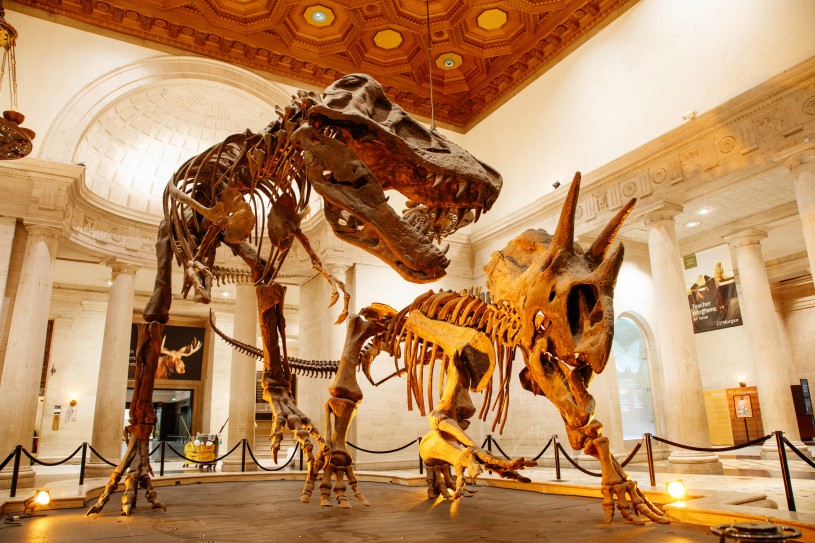
Part of the dinosaur display. TR was a bit old-fashioned,
and he could be intimidating, but he was not a dinosaur.

When I was a kid, the Museum was my favorite place in the whole world. All those stuffed animals, and the dinosaur skeletons, and the Milstein Hall of Ocean Life, opening in 1924, with the giant blue whale suspended from the ceiling. The Planetarium hit my interest in astronomy.
We went there many times between my ages of 4 and 15. I didn't get to go back until my nieces were old enough to go. By that point, my legs were in such bad shape that all that walking on hard floors left me in misery. Fortunately, I've since gotten my hips replaced, and have been to other museums with them without pain.

*

December 22, 1877 was a Saturday. There were no scores on this historic day. 

Friday, May 27, 2022

May 27, 1933: The Century of Progress World's Fair

May 27, 1933: The Century of Progress Exhibition, a World's Fair, opens in Chicago. It celebrated the Centennial of the city's incorporation in 1833. It ran for 2 years, until October 31, 1934.

The theme of the fair was technological innovation, and its motto was "Science Finds, Industry Applies, Man Adapts," trumpeting the message that science and American life were wedded. Its architectural symbol was the Sky Ride, a transporter bridge perpendicular to the shore on which one could ride from one side of the fair to the other.

One description of the Fair noted that the world, "then still mired in the malaise of the Great Depression, could glimpse a happier not-too-distant future, all driven by innovation in science and technology." Fair visitors saw the latest wonders in rail travel, automobiles, architecture and even cigarette-smoking robots. The exposition "emphasized technology and progress, a utopia, or perfect world, founded on democracy and manufacturing."

The fair buildings were multi-colored, to create a "Rainbow City," as compared to the "White City" of the World's Columbian Exposition, the Chicago World's Fair of 40 years earlier. The buildings generally followed Moderne architecture, in contrast to the neoclassical themes used at the 1893 Fair.

One famous feature of the fair were the performances of Sally Rand, a "fan dancer," who used feathered "fans" to flash skin at viewers, so as to show that she was naked, but not appear totally so. Other popular exhibits were the various auto manufacturers, the Midway (filled with nightclubs such as the Old Morocco, where future stars Judy Garland, The Cook Family Singers, and The Andrews Sisters performed), and a recreation of important scenes from Chicago's history.
Sally Rand

The Fair also contained exhibits that would seem shocking to modern audiences, including offensive portrayals of African-Americans, a "Midget City" complete with "sixty Lilliputians," and an exhibition of incubators containing real babies. This may have been the 1st year of President Franklin D. Roosevelt's "New Deal," and many of the exhibits may have been looking to the future, as those at World's Fairs tend to do; but much of the social attitudes were still trapped in the past.

Arch Ward, the sports editor of the Chicago Tribune, thought there should be a baseball game in connection with the Fair. So the 1st Major League Baseball All-Star Game was held at Comiskey Park on July 6, with a team of players from the American League beating one from the National League, 4-2.

The following year, the Chicago College All-Star Game, featuring recently graduated players taking on the defending Champions of the NFL, was played at Soldier Field, which was made part of the Fair's grounds. The 1st of those games, between the College All-Stars and the Chicago Bears, ended in a 0-0 tie.
Among the remaining buildings from the Fair are on the Museum Campus, including Soldier Field, the Museum of Science & Industry, the Field Museum and the Shedd Aquarium. Northerly Island, connected to the mainland by Solidarity Drive, includes another museum, the Adler Planetarium. It once house an airport, Meigs Field, which has been converted back into a public park.
*

May 27, 1933 was a Saturday. This was also the day that the film Gold Diggers of 1933 premiered. I have a separate entry for that event.

These baseball games were played that day:

* The New York Yankees beat the Chicago White Sox, 15-11 at Yankee Stadium. Yes, that's a baseball score, not a football score. Pitcher Ted Lyons went 3-for-4 for the White Sox, but got knocked out of the box in the 8th inning, when the Yankees came back from 11-3 down to score 12 runs. Lou Gehrig and Bill Dickey hit home runs. Babe Ruth did not, but did go 1-for-4 with a walk and 2 RBIs.

* The Brooklyn Dodgers lost to the Cincinnati Reds, 4-3 at Redland Field in Cincinnati. The ballpark was renamed Crosley Field the next season.

* The Cleveland Indians beat the Boston Red Sox, 6-0 at Fenway Park in Boston. Wes Ferrell allowed 9 hits, but kept the shutout.

* The Philadelphia Athletics beat the Detroit Tigers, 5-2 at Shibe Park in Philadelphia. Mickey Cochrane hit 2 home runs, and Lefty Grove pitched 3 innings of scoreless relief to get the save for Tony Freitas. Jimmie Foxx did not play in this game. A year later, due to owner-manager Connie Mack's Depression-forced fire sale, Cochrane would be managing and playing for the Tigers, and Grove would be pitching for the Red Sox. Two years after that, Foxx would be with the Red Sox.

* The St. Louis Cardinals beat the Philadelphia Phillies, 10-1 at Sportsman's Park in St. Louis. Frankie Frisch, Joe Medwick, Ripper Collins and Jimmie Wilson each had 3 hits for the Cards, while Ethan Allen went 2-for-5 with 3 RBIs.

* The Boston Braves and the Chicago Cubs were rained out at Wrigley Field in Chicago. The game was made up as part of a doubleheader the next day. The Cubs swept, 5-1 and 3-2.

* The Washington Senators and the St. Louis Browns were rained out at Griffith Stadium in Washington. The game was made up as part of a doubleheader on July 15. The Senators swept, 1-0 and 2-0. Lefty Stewart pitched a 9-hit shutout in the opener, and Bobby Burke a 5-hit shutout in the nightcap.

* And the New York Giants and the Pittsburgh Pirates were rained out at Forbes Field in Pittsburgh. The game was made up as part of a doubleheader on July 22. The Giants won the 1st game, 1-0. Carl Hubbell pitched a 6-hit shutout. The Pirates won the 2nd game, 7-2. Over the 2 games, Giants 1st baseman-manager Bill Terry went 3-for-7 with a walk, Mel Ott went 2-for-7 with a walk and an RBI, Pie Traynor went 0-for-7 with an RBI, Paul Waner went 2-for-7 with an RBI, and Lloyd Waner went 2-for-8 with a walk.

Tuesday, May 10, 2022

May 10, 1939: The Museum of Modern Art Opens

May 10, 1939: The Museum of Modern Art opens, at 11 West 53rd Stret, between 5th and 6th Avenues in Midtown Manhattan. It was the brainchild of Abby Aldrich Rockefeller, wife of John D. Rockefeller Jr. The Rockefeller family has always had art collections, and Abby made substantial donations from her own collection.

There would later be donations from her children, including Nelson, later Governor of New York and Vice President of the United States; and David, longtime director of Chase Manhattan Bank. Nelson was president of the museum from 1939 until his 1st election as Governor in 1958, and David succeeded him.

The original "MoMA" opened on November 7, 1929, in the Hecksher Building (now the Crown Building) at 730 5th Avenue and 57th Street. It stayed until 1932, then moved to temporary locations until the current building opened. As seen above, the building itself is a work of modern art, in contrast to many of the surrounding buildings, which, typical of post-World War II architecture in New York, are really bland.

Among the legendary paintings on display, in chronological order: The Bather by Paul Cézanne, Starry Night by Vincent van Gogh, Les Demoiselles d'Avignon by Pablo Picasso, The Dance I by Henri Matisse, I and the Village by Marc Chagall, and Campbell's Soup Cans by Andy Warhol. Each of those painters has other works on display there.

MoMA is the 4th-most-visited museum in America, behind the Smithsonian Institution's National Museum of Natural History and National Gallery of Art in Washington, and the Metropolitan Museum of Art uptown.

And yet, despite living close to New York my whole life, I never visited until 2022. I should have gone years earlier. 
The author, in front of van Gogh's Starry Night.
This was 2 years after the COVID outbreak,
and the museum was still insisting on masks.

*

May 10, 1939 was a Wednesday. These baseball games were played:

* The New York Yankees beat the St. Louis Browns, 7-1 at Sportsman's Park in St. Louis. Lefty Gomez was injured after getting the 1st out, and ended up missing his next 2 starts. Bump Hadley went the rest of the way for the win. Joe DiMaggio did not play, and Lou Gehrig had taken himself out of the lineup (for the last time, though that wasn't yet known) 8 days earlier. But Bill Dickey and George Selkirk hit home runs.

* The New York Giants lost to the Pittsburgh Pirates, 5-0 at the Polo Grounds. Rip Sewell pitched a 6-hit shutout, and helped his own cause with a home run. Paul and Lloyd Waner each went 1-for-4 with a walk, and Lloyd added an RBI. Mel Ott went 1-for-3 with a walk.

* The Brooklyn Dodgers beat the Cincinnati Reds, 10-5 at Ebbets Field.

* The Boston Bees beat the Chicago Cubs, 6-2 at National League Park in Boston. After a disastrous 1935 season, the Boston Braves, as we would say today, "rebranded" as the Boston Bees, and Braves Field was renamed National League Park, and nicknamed the Bee Hive. The new names never caught on, and in 1941, they switched back.

* The St. Louis Cardinals beat the Philadelphia Phillies, 4-3 at Shibe Park in Philadelphia.

* The Cleveland Indians beat the Philadelphia Athletics, 7-4 at league Park in Cleveland. Bob Feller went the distance for the win.

* The Detroit Tigers beat the Washington Senators, 5-1 at Briggs Stadium (now Tiger Stadium) in Detroit. Hank Greenberg went 0-for-4, but had an RBI on a groundout.

* And the Boston Red Sox and the Chicago White Sox were postponed at Comiskey Park in Chicago. According to Baseball-Reference.com, it wasn't due to rain, but to "cold" -- on May 10. The game was made up as part of a doubleheader on July 18. The Red Sox won the opener, 13-10. Elden Auker didn't get out of the 2nd inning, but hit a home run, and Boston won, anyway.

The White Sox won the nightcap, 8-5. Over the 2 games, Jimmie Foxx went 4-for-9 with a home run, a walk, and 3 RBIs, and rookie Ted Williams went 6-for-10 with a home run and 4 RBIs.

Saturday, April 30, 2022

May 1, 1893: The World’s Columbian Exposition

May 1, 1893: The World’s Columbian Exposition opens in Chicago, celebrating -- a year later -- the 400th Anniversary of Christopher Columbus' voyage to "The New World," the incorrectly celebrated "discovery of America."

The site was on the South Side, in Jackson Park, from 56th to 67th Street, from Stony Island Avenue to Lake Michigan. The centerpiece was an artificial lake that represented the Atlantic Ocean that Columbus crossed from August 3 to October 12, 1492. Around it were nearly 200 temporary buildings of neoclassical design, with (as most World's Fairs have) pavilions from countries and their colonies.

Among the surviving buildings is the Art Institute of Chicago, the foremost art museum in America outside New York City. Among the paintings on display is A Sunday Afternoon on the Island of La Grande Jatte by Georges Seurat. In the 1986 film Ferris Bueller's Day Off, the protagonists visit the museum, and Cameron Frye (played by Alan Ruck) stares at this painting intensely.

Among the others there are, in chronological order: An 1887 self-portrait by Vincent van Gogh, The Child's Bath by Mary Cassatt, At the Moulin Rouge by Henri de Toulouse-Lautrec, The Old Guitarist by Pablo Picasso, Water Lilies by Claude Monet, American Gothic by Grant Wood, and Nighthawks by Edward Hopper.
Over 27 million people attended from the May 1 opening until the October 30 closing, a record for any World's Fair, due in large part to Chicago already being America's rail center. As the Great Exhibition of 1851 became the announcement of Britain's Victorian era, this fair introduced to the world the idea of "American exceptionalism." It also inspired the "City Beautiful" movement that inspired such structures as New York's 42nd Street Public Library, Penn Station and Grand Central Terminal.

It also represented the city's comeback from the Great Fire of 1871, just as the Century of Progress Fair of 1933-34 represented America's rebound from the depth of the Great Depression. Other "comeback fairs" include the 1915 Pan-Pacific Exposition, San Francisco's comeback from its 1906 earthquake.

There are 4 6-pointed stars on Chicago's city flag, and 1 represents the Columbian Exposition, another the Century of Progress Fair. The others represent the Great Fire and the founding of Fort Dearborn in 1803.
The top blue bar represents Lake Michigan and the North Branch of the Chicago River, and the bottom blue bar represents the South Branch of the River and the Chicago Sanitary and Ship Canal. The 3 white background areas represent the North South and West Sides.

"Christopher Columbus" is the English name for the explorer, based on the Latin form, Christophorus ColumbusHis name in the dialect of his hometown of Genoa, Italy was Cristoffa Corombo. He was born in 1451, became an accomplished sailor early, and, with the Ottoman Empire having made travel to the East problematic following the fall of Constantinople (now Istanbul, Turkey) in 1453, he wanted to find a way to reach the East by sailing West.

By this point, pretty much everybody already knew the world was round. What hardly anybody knew, including Columbus, was just how far a man would have to sail to reach the Far East from Europe; and that there were not one, but two continents in the way. He convinced Spain to fund his journey, and, on October 12, 1492, he arrived on what is now named San Salvador, an island of the Bahamas.

He made a total of 4 voyages to "the New World," but the closest he ever came to what is now American soil was Puerto Rico. He never set foot on what is now the U.S. mainland. He introduced slavery and smallpox to the Americas -- named for a different Italian sailor, Amerigo Vespucci, most of whose work was done in South America -- and went to his grave in 1506 still believing he had reached India. Hence, "Native Americans" were called "Indians."
The most familiar image of Columbus,
a posthumous (1519) painting by Sebastiano del Piombo,
although it might not be of Columbus.

Many places in the Americas are named for him, including the capital city of Ohio, Columbus; the capital city of South Carolina, Columbia; Columbus Circle, a major intersection in New York City; and the Columbia River in the Pacific Northwest, on which the city of Portland, Oregon stands. Columbus Day, a holiday honoring him, and Italian-Americans, is celebrated on the 2nd Monday in October, close to the "discovery" date of October 12.

But since it is known that the Vikings reached North America about 500 years earlier, and that there were already people on the North American continent, the idea that "Columbus discovered America" has been completely discredited. And there are many Italian-Americans worthy of a holiday, but Columbus himself is not worthy of it.

In a 2011 episode of the YouTube series Epic Rap Battles of History, "Nice" Peter Shukoff played Columbus, against "Epic" Lloyd Ahlquist as Star Trek character Captain James T. Kirk.

*

May 1, 1893 was a Monday. Baseball's National League was the only pro sports league running at the time, and these 4 games were played:

* The New York Giants beat the Baltimore Orioles, 9-5 at the Polo Grounds.

* The Boston Beaneaters beat the Philadelphia Phillies, 3-2 at the Philadelphia Base Ball Grounds.

* The Washington Senators beat the Brooklyn Bridegrooms, 15-2 at Boundary Field in Washington.

* The St. Louis Browns beat the Louisville Colonels, 11-1 at Sportsman's Park in St. Louis.

* The Chicago Colts, the Cincinnati Reds, the Cleveland Spiders and the Pittsburgh Pirates were not scheduled.

The Orioles, the Spiders, the Colonels and the Senators were consolidated out of the NL after the 1899 season. 

The St. Louis Browns became the Cardinals in 1900, and the American League's St. Louis team took on the Browns name. The Chicago Colts became the Cubs in 1903. The Brooklyn Bridegrooms became the Dodgers in 1911. The Boston Beaneaters became the Braves in 1912.

Tuesday, April 12, 2022

April 13, 1870: The Metropolitan Museum of Art Is Founded In New York

April 13, 1870: The Metropolitan Museum of Art is founded in New York. It opens a physical location on February 20, 1872, at 681 5th Avenue, at 54th Street -- right around the corner from where its eventual rival, the Museum of Modern Art, would be built.

Its permanent location opened on March 30, 1880, at 1000 5th Avenue, just inside Central Park from 80th to 84th Streets, with its main entrance at 82nd. The Museum is directly across Central Park, 1 mile away, from the American Museum of Natural History. Both would be hallmarks of the Gilded Age.
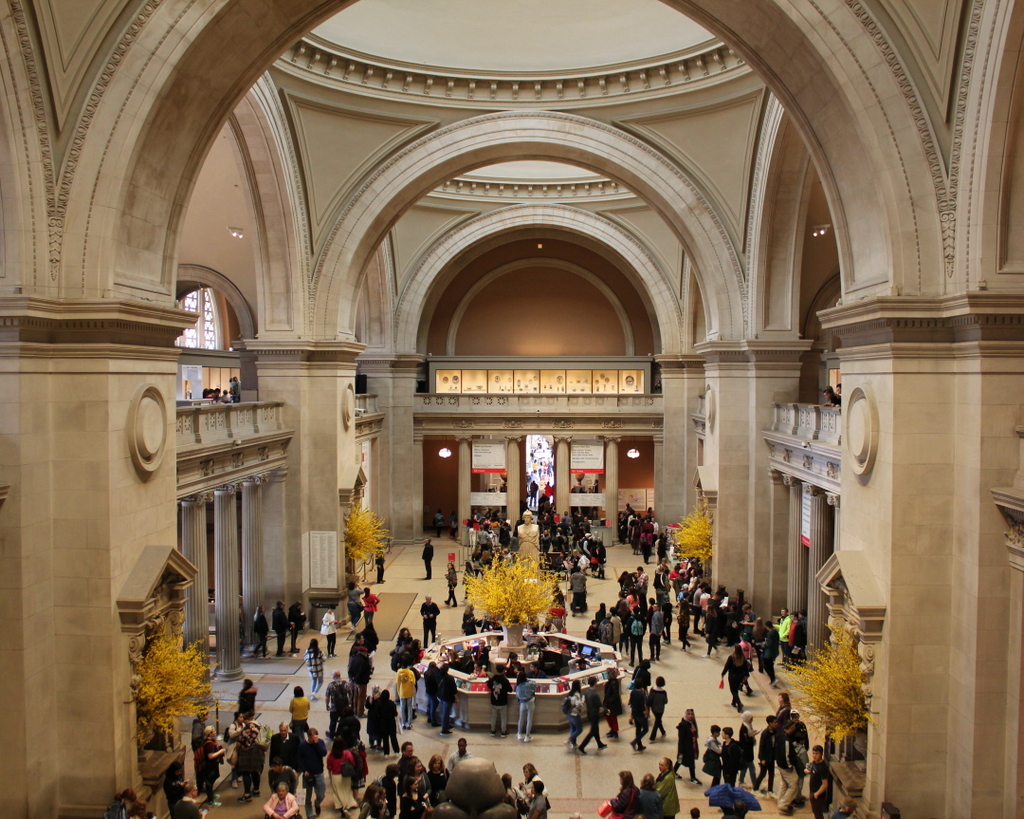
The Great Hall at the 82nd Street entrance

The stretch of 5th Avenue alongside the Park is known as Museum Mile, and also includes the Frick Collection at 70th Street, the Ukrainian Institute of America at 79th, Neue Galerie New York at 86th, the Solomon R. Guggenheim Museum at 88th, the Cooper Hewitt Museum at 91st, the Jewish Museum at 92nd, and the Museum of the City of New York and the Hispanic-themed Museo del Barrio, on opposite sides of 104th.

The permanent collection of "The Met" -- not to be confused with the Metropolitan Opera, or its House at Lincoln Center, or Citi Field, home of baseball's New York Mets -- has works of art from all over the world: Ancient Egypt, Greece, Byzantine, Islamic art, Asia and the Pacific Rim. It has encyclopedic collections of musical instruments, costumes, decorative arts, textiles, interior designs, jewelry, weapons and armor.

Among the well-known paintings are Manuel Osorio Manrique de Zúñiga (a.k.a. The Red Boy) by Francisco Goya, Portrait of Madame X by John Singer Sargent, Self-portrait with Straw Hat by Vincent van Gogh, The Card Players by Paul Cézanne, The Gulf Stream by Winslow Homer, and I Saw the Figure 5 in Gold by Charles Demuth.

The Museum also contains works by Michelangelo Caravaggio (usually referred to by his surname, so he's not confused with Michelangelo Buonarotti), Rembrandt van Rijn (usually referred to by his first name), Johannes Vermeer, Eugene Delacroix, Pablo Picasso, and, confusing some, Édouard Manet and Claude Monet.

There are also some noteworthy statues, including a copy of Augustus Saint-Gaudens' nude of the archer goddess Diana. But this is not the version that topped the 1891-1925 version of Madison Square Garden, 56 blocks down 5th Avenue. That one is at the Philadelphia Museum of Art. (You know, the one whose steps Rocky Balboa ran up.) Ironically, it was a Philadelphia art critic who wrote a savage review of the statue.

The Met established the world's first museum shop in 1908, and it's worth a visit all by itself. In 1954, it opened the Grace Rainey Rogers Concert Hall, and the classical concerts staged there proved so successful, they started an art lecture series there in 1956.

Today, The Met is the largest art museum in America, in terms of exhibition space, and the 4th-largest in the world, behind the Louvre in Paris, the State Hermitage Museum in St. Petersburg, and the British Museum in London. It ranks 3rd, behind the British Museum and the Hermitage, in number of objects available to display. It is the 3rd-most-visited museum in the U.S., behind the National Museum of Natural History and the National Gallery of Art, both of them part of the Smithsonian Institution in Washington.

*

April 13, 1870 was a Wednesday. Baseball was the only team sport in North America at the time, and the season hadn't started yet. So there were no scores on this historic day. 

Saturday, January 1, 2022

January 1, 1934: The Franklin Institute Opens In Philadelphia

January 1, 1934: The current building of the Franklin Institute opens in Philadelphia, at 222 North 20th Street, at the northwestern edge of Center City, and along the Benjamin Franklin Parkway. The Philadelphia Museum of Art, the Rodin Museum and The Academy of Natural Sciences are also along the Parkway.

Dr. Franklin (born January 17, 1706 in Boston; died April 17, 1790 in Philadelphia) was the most famous American before independence in 1776, and arguably the most important figure in the American Revolution, ahead of even George Washington. Even before the Revolution, he was America's leading printer, its first postmaster, its first fire marshal, the founder of the University of Pennsylvania (who have played at a stadium named Franklin Field since 1895), and its greatest scientist.

The story that he "discovered electricity" in 1752 by flying a kite in a storm is ridiculous. Electricity was already known. What he did was suggest that flying a kite in a storm could prove that lightning was electricity, but whether he actually carried the experiment out is unclear. Of course, Ben knew the value of a good story, even if it wasn't true, and did nothing to discourage its telling.

Franklin was one of five men assigned by the Continental Congress to compose The Declaration of Independence in 1776, along with John Adams, Roger Sherman, Robert R. Livingston, and the man who did the actual writing, Thomas Jefferson. The other four edited Jefferson's words, some to his objections. During the debate over independence, Franklin, already known for his wisdom and witticisms, told the delegates, "We must all hang together, or, surely, we shall all hang separately."

He then went to France, to enlist their aid against their common enemy, Britain. America would not have won that war without France. He represented America at the signing of the peace treaty, the Treaty of Paris, in 1783.

Six men signed both The Declaration and, in 1787, the Constitution of the United States, both at what is now named Independence Hall in Philadelphia: From Pennsylvania, Franklin, Robert Morris, George Clymer and James Wilson; from Connecticut, Sherman; and from Delaware, George Read.

Washington had been chosen as President of the Constitutional Convention. His chair had the image of half a Sun on it. After the Constitution was approved, Franklin said, "Now, I know: It is a rising, and not a setting, Sun." But when he left the Hall, someone asked him what kind of government was approved. He said, "A republic, if you can keep it."
From 1948 to 1963, Franklin's right profile appeared on the half-dollar, the 50-cent coin. Since 1914, his portrait has appeared on the $100 bill. Since the Roman numeral for 100 is the letter C, $100 bills have been nicknamed C-notes. However, due to Franklin's picture, they have also been called Big Bens, and hip-hop culture has led to them being called Benjamins.

Towns all over America have been named for Franklin, including in Somerset County and Sussex County, New Jersey. There are high schools named for him in East Harlem, Manhattan's East Harlem, New Orleans, and, as you might guess, Philadelphia, on North Broad Street, about a mile from the Institute.

He has been played by Walter Walker in the 1938 film Marie Antoinette, Orson Welles in the 1954 film Affairs at Versailles, Welles again in the 1961 film La Fayette, Howard da Silva in the 1972 film version of the musical 1776, Robert Symonds in the 1976 PBS miniseries The Adams Chronicles, Fredd Wayne in the 1987 film A More Perfect Union, Philip Bosco in the 1997 PBS miniseries Liberty! The American Revolution, Richard Easton in the 2002 PBS miniseries Benjamin Franklin, Tom Wilkinson in the 2008 HBO miniseries John Adams, and Dean Norris in the 2015 History Channel series Sons of Liberty. In another PBS documentary titled Benjamin Franklin, directed by Ken Burns in 2022, he was voiced by Mandy Patinkin. Oddly, while he is mentioned in Lin-Manuel Miranda's 2015 Broadway musical Hamilton, he does not appear onstage as a character.

Given Franklin's penchants for both science humor, it's not surprising that he has featured in time-travel stories and comedies. The TV shows Bewitched, Saturday Night Live and MADtv have all brought him forward in time to comment on what were then current events. John Sumner played him in a 2001 episode of the syndicated TV series Jack of All Trades, showing his proposed submarine as a successful invention, even though the show takes place in 1801, well after his death. "Epic" Lloyd Ahlquist played him on a 2011 episode of the YouTube series Epic Rap Battles of History, in which he is portrayed as a salesman, fully aware of events since his death, against the late TV commercial pitchman Billy Mays.

Franklin's life and career were key to the plot of the 2004 film National Treasure, which filmed on location at both the Franklin Institute and Independence Hall. The lead character, played by Nicolas Cage, is named Benjamin Franklin Gates. Other notable fictional characters named for him include Lieutenant Benjamin Franklin Pinkerton in the 1904 opera Madama Butterfly, Dr. Benjamin Franklin "Hawkeye" Pierce (Alan Alda), on M*A*S*H, baseball star Benjamin Franklin "Benny the Jet" Rodriguez (Mike Vitar) in The Sandlot, and teacher Benjamin Franklin Chang (Ken Jeong) in Community. And the mascot for the NBA's Philadelphia 76ers is a dog named Franklin.

*

On February 5, 1824, Samuel Vaughan Merrick and William H. Keating founded The Franklin Institute of the State of Pennsylvania for the Promotion of the Mechanic Arts. Within 3 years of its founding, that promotion had already taken place through public lectures, a high school, a library, public exhibitions, and a research journal. Many of these endeavors remain core activities of The Franklin Institute (TFI) to this day.

Since then, The Franklin Institute has played a central, yet constantly evolving, role in meeting America's educational needs in the fields of science and technology. For the organization's 1st century, classes were offered in mechanics, drafting, and engineering, and promoted science and invention.

In 1930, despite the Great Depression, The Franklin Institute and the Poor Richard Club began to seek funds to build a new science museum and memorial hall. In just 12 days, the community contributed $5.1 million, and in 1932, the cornerstone of the new Franklin Institute was laid at 20th Street and the Benjamin Franklin Parkway.

The Franklin Institute Science Museum opened to the public on January 1, 1934, titling itself a "Wonderland of Science," and was one of the first museums in the nation to offer a hands-on approach to learning about the physical world. Three major capital campaigns (1990, 2003, and 2012) enabled physical and programmatic expansion, resulting in the existing facility, which contains more than 400,000 square feet of exhibit space and two auditoriums.

TFI also operates the Fels Planetarium, the second oldest planetarium in the Western Hemisphere. The museum is home to the Benjamin Franklin National Memorial, which was fully restored in 2010 and is open free to the public. It is one of just a handful of national memorials in the custody of a private institution.

In 2014, the museum opened the 53,000-square-foot Nicholas and Athena Karabots Pavilion, which houses a STEM education and conference center, a climate-controlled traveling exhibition gallery, the award-winning exhibit Your Brain, in which visitors can explore neuroscience and their own senses.

Today, TFI offers three floors of permanent exhibits that provide hands-on learning experiences that introduce and reinforce key science concepts in creative and engaging ways. The museum also hosts renowned traveling exhibits that draw local, national and international visitors to the museum, such as King Tut, the most visited museum exhibit in the world in 2007; and Body Worlds in 2010.

As an American Association of Museums-accredited organization, the museum holds curatorial collections, particularly those related to Franklin and the Wright Brothers, that are considered national treasures.

*

January 1, 1934 was a Monday. This was also the date that Columbia University beat Stanford University in a big upset in the Rose Bowl. I have a separate entry for that event.

It would take until the next year for the Orange Bowl and the Sugar Bowl to be first played, and 2 more years for the Cotton Bowl. The NFL season had ended on December 17, with the Chicago Bears beating the New York Giants in the Championship Game. Baseball was in the off-season. And the NBA wouldn't be founded until 1946. There was 1 NHL game played that day: The Toronto Maple Leafs beat the Chicago Black Hawks, 2-1 at the Chicago Stadium.

And it was the date on which Alan Berg, the Denver radio show host who was the subject of Eric Bogosian's play and movie Talk Radio, murdered in 1984 for his political views, was born in Chicago.

December 31, 1999 & January 1, 2000: The Millennium

December 31, 1999:  The Millennium arrives. The people of planet Earth survived. At a terrible cost. But we hadn't destroyed ourselves. ...