Showing posts with label baker bowl. Show all posts

Sunday, October 9, 2022

October 10, 1900: The 1st Red River Showdown

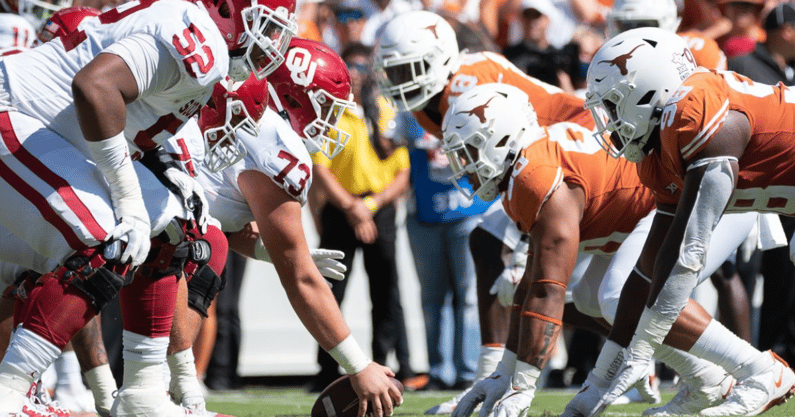
October 10, 1900: The University of Texas and the University of Oklahoma play each other in football for the 1st time, on the Texas campus in Austin. This was 7 years before Oklahoma gained Statehood. Texas wins, 28-2.

The game became an institution, and has several nicknames: The Red River Showdown (the Red River separates the States), the Red River Rivalry, the Red River Classic and the Red River Shootout. It was played in Austin from 1900, 1901, 1902, 1903, 1904, 1907, 1909, 1910, 1911 and 1923; Norman in 1901, 1903 (played twice in those seasons), 1908 and 1922; Oklahoma City in 1905 and 1906; Houston in 1913; and in Dallas every other time, including every season since 1929. A deal has been made to keep the game at the Cotton Bowl through at least 2025.
The fact that it's played in Texas would seem to give the Longhorns an unfair advantage. However, each school gets half the tickets, and it's actually closer to the OU campus in Norman (190 miles) than it is to the UT campus in Austin (197 miles).
As of the 2022 game, Texas' 49-0 win, the biggest blowout in the rivalry's history, Texas leads the rivalry 63-50-5. Oklahoma beat Texas in the 2018 Big 12 Conference Championship Game, which was also played in the Dallas area, but at the Cowboys' new AT&T Stadium in suburban Arlington.
A running joke is that, unlike the Longhorns' rivalries with Texas A&M and Arkansas, and the Sooners' with Oklahoma State and Nebraska, this is a rivalry not for the people but the rich, and that millionaires have bet ranches and oil wells on the outcome, many regretting it.

*

October 10, 1900 was a Wednesday, not a Saturday as is the case for most college football games today. There were other games played that day:

* Columbia and Williams College played to a 0-0 tie at Columbia Field in Manhattan.

* Manhattan College lost to Lafayette College, 11-0 at March Field in Easton, Pennsylvania.

* Princeton beat Penn State, 26-0 at Osborne Field in Princeton, New Jersey.

* Bowdoin College beat Colby College, 68-0 in Brunswick, Maine.

* Harvard beat cross-State Amherst, 18-0 at Soldiers' Field in Boston.

* Yale beat Bates College, 50-0 at Yale Field in New Haven, Connecticut.

* The University of Pennsylvania beat Dickinson College, 35-0 at the original Franklin Field in Philadelphia.

* And Illinois beat Chicago Physicians and Surgeons College, 6-0 at Illinois Field in Champaign, Illinois. CPSC is now part of the University of Illinois system, the University of Illinois College of Medicine.

And there was 1 baseball game played: The Philadelphia Phillies beat the Boston Beaneaters, 5-2 at National League Park in Philadelphia. In 1912, the Boston team of the National League, having gone through several names, settled on "Braves." The following season, the Phillies' ballpark was renamed Baker Bowl.

This was also the birthdate of actress Helen Hayes, known as "The First Lady of the American Theater."

October 9, 1915: The 1st President at a World Series Game

Woodrow Wilson. Edith Galt is under his left arm.

October 9, 1915: Game 2 of the World Series is played at Baker Bowl in Philadelphia. President Woodrow Wilson becomes the 1st incumbent President to attend a World Series game, and the 1st to throw out a ceremonial first ball at one. He is accompanied by his fiancĂ©e, Edith Galt.

The Philadelphia Phillies, in the National League since 1883, had won their 1st Pennant, managed by Pat Moran. Their pitching staff allowed the fewest runs in the NL, led by Grover Cleveland Alexander, who, though no one thought of the term at the time, won "the Triple Crown of Pitching": Leading the NL in wins (going 31-10), strikeouts (241) and earned-run average (ERA, 1.22).

Baker Bowl

And right fielder Clifford Carlton "Gavvy" Cravath, the NL's top slugger in that "dead ball" decade, led it in home runs with 24 and RBIs with 115. (In the 1910s, the last decade of the "Dead Ball Era," Cravath hit the most home runs: 116. He led the NL 6 times, peaking in in this 1915 season, with those 24.
Gavvy Cravath

The Boston Red Sox, World Champions in 1912, were back, managed by Bill Carrigan, led by center fielder Tris Speaker, and a starting rotation of Smoky Joe Wood, George "Rube" Foster, Ernie Shore, Hubert "Dutch" Leonard, and a rookie lefthander named George Herman "Babe" Ruth, who was 18-8 with a 2.44 ERA. Had there been a Rookie of the Year award at the time, he surely would have won the AL's award.

At the time, home-field advantage in the World Series was decided by a coin flip, which the Phillies won. William F. Baker, their owner, who had renamed the ballpark for himself, chose to have Games 1 and 2 at home. The Phillies won Game 1, 3-1, with Alexander outpitching Shore. Ruth pinch-hit for Shore in the 9th inning, and grounded to 1st. It would be his only appearance in the Series.

No one knew it at the time, but the Phillies would not win another World Series game for 65 years.

Wilson threw out the first ball for Game 2, and Foster not only went the distance for Boston, but singled home the winning run in the top of the 9th. The Red Sox won, 2-1.

The season before, when the Boston Braves won the NL Pennant, they were in the process of building Braves Field to replace the small, antiquated South End Grounds, and the Red Sox offered them the use of the larger Fenway Park. They won the World Series. This time, with the even larger Braves Field opened, the Braves returned the favor, and the Red Sox played their World Series home games there in 1915, 1916 and 1918, instead of a mile to the east at Fenway.

They felt right at home on Commonwealth Avenue: They won Game 3, 2-1, with Leonard beating Alexander; Game 4, 2-1, with Shore outpitching George Chalmers; and Game 5, 5-4, with Harry Hooper hitting 2 home runs, aiding Foster as he outpitched Eppa Rixey to clinch the title.

The Red Sox won again in 1916, beating the Brooklyn Dodgers. Carrigan then resigned, and remains the only manager to lead a Boston team to back-to-back World Series wins. Under Ed Barrow, they won again in 1918.

Pat Moran had been a catcher, and had retired after the previous season to become the Phils' manager. He was fired after the 1918 season, was immediately hired by the Cincinnati Reds, and led them to win the 1919 World Series. Rixey would later pitch for him on the Reds, and reach the Hall of Fame.

Shortly before the 1924 season began, while still officially the Reds' manager, he died at the age of 48, of nephritis, a kidney ailment known as Bright's disease -- treatable with antibiotics today, but, at the time, a death sentence within 5 years. Boxer Billy Miske, who had fought Jack Dempsey for the Heavyweight Championship of the World, had just died from it. So did Wilson's 1st wife, Ellen, in 1914. So did Theodore Roosevelt's 1st wife, Alice, in 1884. And so did former President Chester Arthur, in 1886.

In 1978, the Phillies instituted the Philadelphia Baseball Wall of Fame, electing a Phillies figure every year since, and a Philadelphia Athletics figure every year until 2003. From the 1915 Pennant winners, the Phils have elected only Grover Cleveland Alexander and Gavvy Cravath.

It says something about the quality of the Phillies' 1st 90 years of existence that, of the players who played for them from their founding in 1883 until 1914, but not on the 1915 Pennant winners, the only ones elected to that Wall of Fame have been Sam Thompson, Billy Hamilton, Ed Delahanty and Sherry Magee. And that, of the players who played for them from 1916 to 1949, but not on the 1915 or the 1950 Pennant winners, the only ones have been Cy Williams and Chuck Klein.

Thompson, Delahanty, Alexander, Cravath, Williams, Klein and Bucky Walters -- Walters mainly because he was from Philadelphia but excelled elsewhere, with the Cincinnati Reds -- have also been elected to the Philadelphia Sports Hall of Fame.

*

October 9, 1915 was a Saturday. Author Belva Plain was born on this day. So was Clifford Hansen, who served as the 1st President of the University of Nebraska system, and as U.S. Secretary of Agriculture from 1969 to 1971.

Among the college football games played that day were these:

* Army beat Gettysburg College, 22-0 on The Plain at West Point, New York.

* Navy lost to the University of Pittsburgh, 47-12 at Worden Field in Annapolis, Maryland.

* Harvard beat the post-Jim Thorpe Carlisle Indian School, 29-7 at Harvard Stadium in Boston.

* Penn State beat the University of Pennsylvania, 13-3 at the original Franklin Field in Philadelphia.

* Notre Dame beat Haskell Indian Institute, 34-0 at Cartier Field in South Bend, Indiana. Now the Haskell Indian Nations University, they compete in the NAIA, essentially NCAA Division IV.

* The University of Chicago beat Northwestern, 7-0 at Northwestern Field in the Chicago suburb of Evanston, Illinois.

* Colorado Agricultural College beat the University of Colorado, 23-6 at Gamble Field in Boulder, Colorado. CAC became Colorado A&M in 1935, and Colorado State University in 1957.

* And in New Jersey, Rutgers beat Rensselaer Polytechnic Institute (RPI), 96-0 at Neilson Field in New Brunswick; while Princeton beat Syracuse, 3-0 at Palmer Stadium in Princeton.

And in English soccer, North London team Arsenal went to Hertfordshire, and lost to Watford FC, 1-0 at Cassio Road in Watford.

Wednesday, October 5, 2022

October 6, 1894: America's 1st Professional Soccer League

The 1894 Philadelphia Phillies... soccer team.

October 6, 1894: The American League of Professional Football, the 1st pro soccer league in the United States, begins play. The 1st game is played in Philadelphia, at the home of the Phillies, what would later be known as Baker Bowl. The New York World, Joseph Pulitzer's splashy, sometimes trashy, newspaper, prints this story: 

Philadelphia, Oct. 6 -- The championship season of American League Professional Football opened here this afternoon on the Philadelphia baseball grounds, with a game between Philadelphia and New York's clubs.

The visitors won by a score of 5 to 0. Two halves of 45 minutes were played.

After 40 minutes of play in the first half, Connolly of New York kicked the first goal.

In the second half, the home players did not back each other up properly, and New York had little trouble in making four more. Gavin scored two and Lupton scored two.

There was a good crowd present, and the liveliest interest was maintained. The New York XI showed excellent teamwork, and the coaching of their captain Trainor had a good effect.

The sporting public in this vicinity are not going to die of heart disease caused from over-enthusiasm for professional football.

Still, it seems to be gaining in popularity. It is an open question whether football can succeed baseball.

There were 6 teams in the ALPF, all named after the baseball teams in town. In alphabetical order: The Baltimore Orioles, the Boston Beaneaters, the Brooklyn Bridegrooms, the New York Giants, the Philadelphia Phillies and the Washington Senators.

Baltimore won their 1st 4 games by a combined margin of 24-3, but couldn't afford to stay in business, and had to fold. Since the standings were decided by points, 2 for a win and 1 for a tie, the standings were as follows: Brooklyn 10, Baltimore 8, Boston 8, New York 4, Philadelphia 4 and Washington 2. A dispute with a competing soccer authority and the depression of the 1890s combined to prevent a 2nd season in the Autumn of 1895.

New York and Philadelphia would become important cities in American professional soccer, and both would have teams in the American Soccer League, the original North American Soccer League, and, with the 2010 establishment of the Philadelphia Union, Major League Soccer. But Americans simply have never cared enough about soccer to put in on the same level as baseball. That would not be the case with the game we call "football."

*

October 6, 1894 was a Saturday. The baseball season was over. Hockey was all-amateur. And basketball had barely been invented. But there were college football games played. Among them were the following:

* Army beat Amherst, 18-0 on The Plain at West Point, New York.

* Harvard beat Andover, 46-0 at Soldiers' Field in Boston.

* Michigan were held to a 12-12 tie by the Michigan Military Academy, at Regents Field in Ann Arbor, Michigan.

* The University of Chicago beat nearby Northwestern, 46-0 at Marshall Field in Chicago.

* And in New Jersey, Rutgers beat Lafayette, 12-10 at Neilson Field in New Brunswick.

In England, there was professional soccer, including Woolwich Arsenal, which would one day move to North London and became the Arsenal team I support, beating Lincoln City, 4-1 at the Manor Ground in Plumstead, then in Kent, now in Southeast London.

Monday, August 8, 2022

August 8, 1903: The Baker Bowl Disaster

August 8, 1903: The worst sports-related disaster in American history occurs, at the home field of the Philadelphia Phillies.

The National League baseball team had opened a ballpark on the southwestern corner of Broad Street and Lehigh Avenue, near the North Philadelphia stations of both the Pennsylvania Railroad and the Reading Railroad, in 1887. It burned down in 1894, and was replaced by a stadium of brick and steel, a first. This stadium would be officially known as National League Park, until 1913, when it was renamed Baker Bowl, for team owner William F. Baker.

The shape of the land it was on forced the right field fence to be very close, with no seating behind it. As a result, a high wall was built to discourage "cheap" home runs. For much of its history, this wall was covered with a huge soap advertisement, reading, "The Phillies use LIFEBUOY." The easy response was, "And they still stink!"

Not in 1915, though: They won the Pennant that season, although they lost the World Series to the Boston Red Sox -- who would later have a Lifebuoy ad on their close left field wall, later removed to be plain green, and nicknamed the Green Monster. (And, yes, the joke went with them.)

On August 8, 1903, a doubleheader was scheduled for the park, between the Phillies and the Boston Beaneaters (forerunners of the Atlanta Braves). In the 1st game, the Beaneaters scored 2 runs in the top of the 12th inning, and a Philly comeback resulted in only 1 run, and a 5-4 Boston victory.

The 2nd game was never played. After the 1st game ended, 2 drunks were walking along 15th Street. A group of children began to tease them. One of the drunks grabbed one of the children, a 13-year-old girl, who screamed. This attracted attention from fans on the adjacent 3rd base stands, and 300 of them ran over to get a better view.

This caused the balcony's supports to become detached from their connectors at the wall. The balcony fell 30 feet, killing 12 people and injuring 232 others. It became known as Black Saturday, and is the closest any North American sports venue has come to a disaster on the level of Hillsborough 1989 or Ibrox 1971 in Britain.
The American League's Philadelphia Athletics offered the Phillies the use of Columbia Park while repairs were made. The Phillies played 16 games at Columbia Park before returning home.

The ballpark hosted another disaster on May 14, 1927. Two sections of the lower-deck extension on the right field line collapsed. No one died, but a subsequent stampede injured 50 people, and 1 person died of heart failure.

In 1938, the Phillies moved out of the increasingly unsuitable Baker Bowl, and began groundsharing with the Athletics at Shibe Park. Baker Bowl remained a venue for "midget auto" racing until 1950, and was demolished. Retail is on the site now, including a gas station.

The A's moved out of Shibe Park, and Philadelphia, in 1954. The Phillies remained, renamed the ballpark Connie Mack Stadium, and left in 1970 for Veterans Stadium. A church now occupies the site.

*

August 8, 1903 was a Saturday. These other games were played in baseball that day:

* The New York Highlanders beat the Washington Senators, 7-2 at Hilltop Park in Upper Manhattan. The Highlanders officially became the New York Yankees in 1913.

* The New York Giants swept the Brooklyn Sueprbas in a doubleheader at the Polo Grounds. The Giants won the opener, 6-1; and the nightcap, 4-3. The Superbas became the Dodgers in 1911.

* The Boston Americans beat the Philadelphia Athletics, 11-6 at the Huntington Avenue Grounds in Boston. The Americans became the Red Sox in 1908.

* The Detroit Tigers beat the Cleveland Naps, 6-5 in 11 innings at League Park in Cleveland. The Cleveland team was named for its manager and 2nd baseman, Napoleon "Nap" Lajoie. They became the Cleveland Indians in 1915, and the Cleveland Guardians in 2022.

* The Pittsburgh Pirates beat the Chicago Cubs, 2-1 at West Side Park in Chicago.

* The St. Louis Browns beat the Chicago White Sox, 4-2 at South Side Park in Chicago.

* And a doubleheader was split at Robison Field in St. Louis. The St. Louis Cardinals won the 1st game, 5-3. The Cincinnati Reds won the 2nd game, 11-1.

Monday, May 30, 2022

May 30, 1935: Babe Ruth's Last Major League Game

May 30, 1935: A doubleheader is played at Baker Bowl in Philadelphia. The National League's Philadelphia Phillies beat the Boston Braves, 11-6 in the 1st game, and 9-3 in the 2nd game.

A full house of 18,000 comes out to the rickety ballyard at the corner of Broad Street and Lehigh Avenue in North Philadelphia, 7 blocks to the east of the home of the American League's Philadelphia Athletics, Shibe Park.

It wasn't much of a matchup. The Braves would finish 8th and last, winning only 38 games and losing 115, the most of any NL team between the 1899 Cleveland Spiders and the 1962 New York Mets. The Phillies were much better, but still finished 7th, at 64-89 -- and, by their standards, that was a good finish.

The Braves' season was so bad, that for the 1936 season, they decided to, as would be said today, rebrand: They changed their name to the Boston Bees, and the name of their ballpark from Braves Field to National League Park, a.k.a. the Bee Hive. The new names never caught on, and the old ones were restored in 1941.

But the opener of this doubleheader was the end of an era: It was the last major league game for Babe Ruth.

Ruth had started his career in Boston, with the 1914 Red Sox. He became a star with them, and was sold to the New York Yankees for the 1920 season, becoming the biggest star in the history of North American sports.

But he wanted to manage, and the Yankees wouldn't let him. After the 1934 season, Yankee owner Jacob Ruppert gave him his release, so that he could seek a managing job elsewhere. Judge Emil Fuchs, owner of the Braves, desperate for attendance in the Great Depression, told Ruth he would be "assistant manager" to Bill McKechnie for 1935, and would become manager for 1936, with the promise of a part-ownership of the team. The Sultan of Swat jumped at the chance, and returned to Boston.

The Babe was often very gullible, but he wasn't stupid. He soon saw that McKechnie wasn't listening to him in the slightest -- not that he needed to, having already won a World Series managing the Pittsburgh Pirates in 1925 -- and that the Braves had absolutely no intention of making him the manager the next season. (McKechnie remained their manager through 1937, and won another World Series managing the Cincinnati Reds in 1940.) The Great Bambino was nothing more than a drawing card to the Braves, and he figured it out.

To make matters worse, the 40-year-old Ruth hurt his elbow, making it difficult to swing. When he wasn't in pain, he could still hit. He hit a home run on Opening Day, April 16, giving the Braves a win over the New York Giants. He hit another on April 21. But then the injury got worse, and he went into a slump. By the time he hit his next home run, an entire month later, he was batting just .149.

On May 25, the Braves played the Pirates at Forbes Field. Ruth his 3 home runs, the last one off Guy Bush, over the right-field roof, the 1st ever hit there. It may have been the longest home run in the ballpark's history. It was the 714th home run of his career, and his 2,873rd hit.

Legend has it that, thinking it wasn't going to get any better than that, he retired right after that game. Maybe he should have. But he didn't. The next day, he pulled a muscle playing the field. He continued to try to play every day, but that homer over the Forbes Field roof wasn't just his last home run, it was his last hit.

On May 30, at Baker Bowl, Ruth started the game in left field, batting in his usual 3rd position. In the top of the 1st inning, batting against rookie Jim Bivin, he grounded to 1st baseman Dolph Camilli, who made the putout himself.

In the bottom of the 1st, Ruth was unable to get to a fly ball, and it dropped in for a hit. The next batter, Lou Chiozza, hit another fly to left. Not only couldn't the Babe catch it, but it rolled past him, all the way to the wall. While he wasn't always the fat man of the public imagination, by this point, his gut and his pulled muscle rendered him as slow as molasses. When he finally got to the ball, Chiozza was trying to stretch it into an inside-the-park home run. With the left arm that had won 94 games as a pitcher still strong, Ruth threw the ball to 3rd baseman Pinky Whitney, who threw to catcher Al Spohrer, and Chiozza was out. Ruth got credit for an assist.

It was his last statistic. Instead of going back to the dugout, he walked to center field, where both teams' clubhouses were located. The fans, realizing he was taking himself out of the game, gave him a standing ovation. Three days later, he announced his retirement.

Ruth was lucky that there was no constant replaying of his fielding, so he wasn't embarrassed the way Willie Mays was with the New York Mets, and Johnny Unitas with the San Diego Chargers, both in 1973. Or Joe Namath with the 1977 Los Angeles Rams. Or any number of boxers having one last fight too many, like Joe Louis against Rocky Marciano in 1951 or Muhammad Ali against Larry Holmes in 1980. No ESPN to show him as a Boston Brave, the way they showed Michael Jordan as a Washington Wizard, or Jerry Rice as a Denver Bronco, or Roger Clemens in his 2nd go-round with the Yankees.

The Babe never did get an offer to manage a major league team. The Brooklyn Dodgers hired him as their 1st base coach in 1938, but they really hired him to hit pregame batting practice, as they were in a rebuilding year, and were desperate for attendance. Ruth played in old-timers' games to raise money for war bonds at Yankee Stadium in 1942 and 1943, batting against Walter Johnson, and that was it. He died of cancer in 1948.

*

May 30, 1935 was a Thursday, Memorial Day. Until 1968, Memorial Day was always May 30, not necessarily the last Monday in May. These other games were played in what would eventually be called Major League Baseball:

* The New York Yankees swept a doubleheader from the Washington Senators at Griffith Stadium in Washington. The Bronx Bombers won the opener, 4-0. Vito Tamulis (I know, it sounds like a disease) pitched a 6-hit shutout. The Yanks also won the nightcap, 9-3.

* The New York Giants swept a doubleheader from their arch-rivals, the Brooklyn Dodgers, at the Polo Grounds. The Jints won the 1st game 8-3, and the 2nd game 6-0, as Freddie Fitzsimmons pitched a 2-hit shutout. "Fat Freddie" seemed to relish beating the Dodgers, but in 1941, they picked him up, and he turned out to be a key figure in their successful Pennant drive, and became more popular in Brooklyn than he ever was in the rest of the city.

* A doubleheader was split at Fenway Park in Boston. The Boston Red Sox won the 1st game, 7-4. The Philadelphia Athletics exploded for 5 runs in the top of the 11th inning, and won the 2nd game ,13-8. 

* A doubleheader was split at Forbes Field in Pittsburgh. The Chicago Cubs won the 1st game, 6-4. The Pittsburgh Pirates won the 2nd game, 4-1.

* A doubleheader was split at Navin Field in Detroit. The St. Louis Browns won the 1st game, 10-7. The Detroit Tigers won the 2nd game, 2-0. Tommy Bridges pitched a 3-hit shutout.

* A doubleheader was split at Comiskey Park in Chicago. The Chicago White Sox won the 1st game, 8-4. The Cleveland Indians won the 2nd game, 4-0. Willis Hudlin pitched a 2-hit shutout.

* And the St. Louis Cardinals swept a doubleheader from the Cincinnati Reds at Sportsman's Park in St. Louis. The Cards won the 1st game, 12-5, and the 2nd game, 4-2.

December 31, 1999 & January 1, 2000: The Millennium

December 31, 1999:  The Millennium arrives. The people of planet Earth survived. At a terrible cost. But we hadn't destroyed ourselves. ...