Showing posts with label moonlight graham. Show all posts

Wednesday, October 12, 2022

October 12, 1918: The Yankee Who Died In War

October 12, 1918: A player for the New York Yankees dies for America in a war. And, most likely, you've never heard of him.
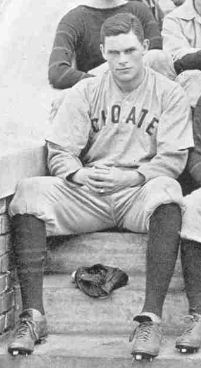
Alexander Thomson Burr was born on November 1, 1893 in Chicago. Usually listed as "Alex Burr" in baseball reference sources, but known as "Tom Burr" to his friends, he went east to attend the Choate prep school (now Choate Rosemary Hall) in Wallingford, Connecticut, and became a star pitcher. He then attended Williams College in Williamstown, in the Berkshire Mountains, in the northwestern corner of Massachusetts, bordering the States of New York and Vermont.
He signed a pro contract before ever appearing in a college game, so he never played for Williams. But he didn't last long. Frank Chance, the legendary Chicago Cubs manager now struggling to lift the Yankees to success, was impressed with him in Spring Training, and brought him north with the club.
But Tom Burr appeared in exactly 1 major league game, on April 21, 1914, at the Polo Grounds, and not as a pitcher. He played center field for the New York Yankees -- not yet an exalted position. He only played in the field, in the 10th inning, had no fielding chances, and never came to bat -- a true "Moonlight Graham." The Yankees went on to beat the Washington Senators 3-2.
He was soon released, and never reached the majors again. He played 7 games for the Jersey City Skeeters of the International League. He went back to Williams, but when the U.S. got into World War I in April 1917, he enlisted in the U.S. Army without getting his degree, and became a pilot.

On October 12, 1918, just 1 month before the Armistice ended the war, Tom Burr was killed in action in a plane crash, in Cazaux, France. It was an accident: Rather than being shot down, another U.S. pilot crashed into him -- what became known as "friendly fire." His plane caught fire, and crashed into a lake. It took 12 days to find his body.
He wasn't quite 25 years old, and was buried at Arlington National Cemetery. He was 1 of 8 major league players killed in "The War to End All Wars." Another, former St. Louis Cardinals catcher Harry Glenn, died of pneumonia the same day as Burr. I have a separate entry honoring him.
For all their history, and for all their attention to it, the Yankees make no mention at Yankee Stadium of the one and only player from their ranks to have died in military service. This becomes all the more glaring when you remember how much longtime team owner George Steinbrenner, whose prep school was Culver Military Academy in Culver, Indiana, pandered to patriotism and to our armed forces, down to the Monument to the 9/11 victims and rescuers in Yankee Stadium's Monument Park.

Where did The Boss go to college? Williams, also the alma mater of Tom Burr. You'd think he would have seen some kind of memorial there, and remembered it.
*
October 12, 1918 was a Saturday. Another player, Harry Glenn, also died in service on this day, albeit from pneumonia rather than a combat wound. And the Cloquet Fire broke out in Minnesota. I have separate entries for these events.
The War Department had ordered that the baseball season end a month early, in September, and that all players obey the "work or fight order": Enlist, or get a job in an industry essential to the war effort, or get an otherwise necessary job (like police or firemen), or be subject to the military draft. Hockey season hadn't started yet. Professional basketball barely existed.
And even college football was affected by the manpower drain of the war. That day, the following schools played military teams: The Universities of California, Chicago, Illinois, Minnesota and Texas; Lehigh University; and Texas A&M.
* Georgia Tech beat Furman, 118-0 at Grant Field in Atlanta. It had been 2 years and 5 days since Tech had beaten Cumberland College 222-0, college football's all-time biggest blowout.
* Ohio State beat Denison University, 34-0 at Ohio Field in Columbus. Before coaching Ohio State to glory, Woody Hayes would graduate from Denison in 1935.
* Michigan State beat Hillsdale College, 66-6 at College Field in East Lansing, Michigan. Hillsdale, of Hillsdale, Michigan, no longer fields sports teams.
* Iowa beat Coe College, 27-0 at Iowa Field in Iowa City. Coe is now an NCAA Division III school.
* And the Multnomah Athletic Club, a semi-pro team, beat the University of Oregon, 20-0 at Hayward Field in Eugene, Oregon.

Tuesday, June 28, 2022

June 29, 1905: The Moonlight Graham Game

June 29, 1905: The New York Giants beat the Brooklyn Superbas, 11-1 at Washington Park in Brooklyn. This was already an arch-rivalry, for Superbas -- they would become the Dodgers in 1911 -- if not for the Giants.

Not surprisingly, Christy Mathewson won the game for the Giants. Very surprisingly, he only pitched 4 innings, with Claude Elliott going the last 4.

For the Giants, shortstop Bill Dahlen went 3-for-4 with a walk and an RBI; 1st baseman Dan McGann and catcher William "Boileryard" Clarke hit home runs. For the Superbas, shortstop Charlie Babb performed an unusual feat: He went 0-for-0, but drew 4 walks. Their only run came on a groundout by catcher Lew Ritter.

Babb's sequence would seem to be the most unusual part of this game, 1 of 105 that the Giants won on the way to winning the World Series for the 1st time. But it would be completely forgotten today, if not for a novel titled Shoeless Joe, by W.P. Kinsella; and the later film based on it, Field of Dreams. The novel mentions a player who got into the game, didn't get to bat, and never got into another game.

He was born Archibald Wright Graham on November 12, 1877, in Fayetteville, North Carolina. His brother, Frank Graham, was President of the University of North Carolina system from 1930 to 1949, when he was appointed served North Carolina in the U.S. Senate from then until 1950, when he lost a primary for a full term due his too-progressive-for-that-era's-South stance on civil rights.

Archie Graham went to UNC, and played baseball there. Upon graduation, he made his professional debut with the Durham Bulls in 1900. In 1905, he was played for the Binghamton Bingoes in the New York State League, when the Giants bought his contract.

He reported to them on May 23. He didn't get into a game until June 29, when Giant manager John McGraw sent him out to replace George Browne in right field. He was on deck when the top of the 9th ended, and played the bottom of the 9th in the field. He made no putouts. He did not come to bat. He is in the box score, but with zeroes in all the columns.

For reasons known only to McGraw, he didn't get into another game, and, 16 days later, was sold to the Scranton Miners of the New York State League (even though Scranton is in Pennsylvania). He played for them through the 1908 seasons, and then left baseball.

He had studied medicine at the University of Maryland, and, despite having already played baseball both at another college and professionally, the rules of the time allowed him to play football (but not baseball) there.

Having gotten his medical degree, he moved to Chisholm, Minnesota, in the Iron Range, 70 miles from the Canadian border, and practiced medicine there until his death on August 25, 1965. "Doc" Graham, as he was known there, was a beloved figure in his adopted hometown. He was married to a woman named Alicia Madden, but did not have children.

And how did he get the nickname? One night, on the road with his team, he couldn't sleep, and went out for a walk, and a teammate looked at the window, saw him standing in the dark, under a streetlight, and confused it for moonlight, and he was "Moonlight Graham" from then on, until he went to Minnesota. He seemed to have put baseball in his past, until someone found out he'd played for the Giants, and the local newspaper wrote an article about him, which embarrassed him a little: He wanted to be known as a doctor, not a ballplayer.

The novel Shoeless Joe told his true story, aside from making him a character in the book. When Ray Kinsella inadvertently travels through time, and meets Graham in 1955 Chisholm, Graham tells the story like it was. It also said that Ray Kinsella and author J.D. Salinger already knew that Graham was dead before they made their trip to Minnesota in the Summer of 1979.

But the movie really changed things. The message on the Fenway Park scoreboard that Ray (played by Kevin Costner) believes, at first, that only he can see said that Graham's one and only game for the Giants was in 1922, 67 years earlier, and didn't say that he was dead, leaving hope that he might still be alive.

Instead, when Ray and Terence Mann (James Earl Jones playing a character made up for the moving, sharing some traits with Salinger, who wasn't used for fear of a lawsuit) reach Chisholm, only then do they found out that Graham died in 1972, and it's to that year that Ray travels to meet Doc Graham (Burt Lancaster). Graham changes things further by saying he was born in Chisholm (Lancaster certainly didn't give the character a Southern accent), that his game was the last game of the season, and that he knew he'd be sent back down, so he quit baseball completely.

Ray, who built a baseball field on his Iowa farm, where old ballplayers had come back to life, offers Graham the chance to make his dream come true. Graham tells him it has. Ray says that most men, if they'd only been a major league ballplayer for 5 minutes and never come to bat, would consider it a tragedy. Graham tells him, "If I'd only gotten to be a doctor for 5 minutes, now, that would've been a tragedy." 

When Ray and Terence head to Ray's farm in Iowa, they pick up a young hitchhiker (Frank Whaley), who says he's looking to catch on with a semi-pro team, in what were called industrial leagues, and he says his name is Archie Graham.

Archie suits up and plays on the field, and gets a hit. Unfortunately, like Ray Liotta's portrayal of Shoeless Joe Jackson, Whaley plays Graham as a righthanded hitter, when he was lefthanded in real life. When Ray's daughter Karin (Gaby Hoffmann) needs medical attention, Archie comes to the edge of the field, and stops. None of the other "ghosts" can leave the field and enter the real world. Archie does, and turns into the suited, elderly Doc Graham, and saves Karin's life. Then he walks back across the ballfield, still an old man, and into the cornfield from whence the players came.

*

June 29, 1905 was a Thursday. These other baseball games were played that day:

* The New York Highlanders beat the Philadelphia Athletics, 13-4 at Hilltop Park in Manhattan. The Highlanders became the Yankees in 1913. Al Orth, known as "The Curveless Wonder," outpitched Albert Bender, a Chippewa tribesman known as "Chief," who would be elected to the Baseball Hall of Fame. So would Wee Willie Keeler, who hit a home run, the best way of living up to his own advice: "Hit 'em where they ain't." In spite of this game, the A's went on to win the American League Pennant, before losing the World Series to the National League Champion Giants.

* The Philadelphia Phillies swept a doubleheader from the Boston Beaneaters at Baker Bowl in Philadelphia, 3-2 and 2-1. The Beaneaters became the Braves in 1912.

* The Boston Americans beat the Washington Senators, 4-3 at the Huntington Avenue Grounds in Boston. The Americans became the Red Sox in 1908.

* A doubleheader was split at League Park in Cleveland. The Cleveland Naps won the opener, 8-3. The Detroit Tigers won the nightcap, 3-2. Napoleon "Nap" Lajoie, the Cleveland team's 2nd baseman, best hitter, manager and namesake, went 4-for-7 over the 2 games. Two months later, on August 30, Ty Cobb would make his major league debut for the Tigers. The Naps would become the Indians in 1915.

* The St. Louis Browns beat the Chicago White Sox, 4-2 at South Side Park in Chicago.

* And the Chicago Cubs, the Cincinnati Reds, the Pittsburgh Pirates and the St. Louis Cardinals were not scheduled to play.

December 31, 1999 & January 1, 2000: The Millennium

December 31, 1999:  The Millennium arrives. The people of planet Earth survived. At a terrible cost. But we hadn't destroyed ourselves. ...