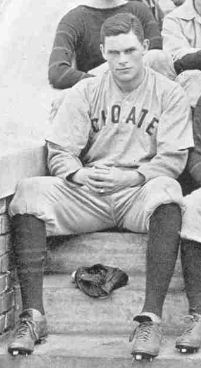
October 12, 1918: A player for the New York Yankees dies for America in a war. And, most likely, you've never heard of him.
Alexander Thomson Burr was born on November 1, 1893 in Chicago. Usually listed as "Alex Burr" in baseball reference sources, but known as "Tom Burr" to his friends, he went east to attend the Choate prep school (now Choate Rosemary Hall) in Wallingford, Connecticut, and became a star pitcher. He then attended Williams College in Williamstown, in the Berkshire Mountains, in the northwestern corner of Massachusetts, bordering the States of New York and Vermont.
He signed a pro contract before ever appearing in a college game, so he never played for Williams. But he didn't last long. Frank Chance, the legendary Chicago Cubs manager now struggling to lift the Yankees to success, was impressed with him in Spring Training, and brought him north with the club.
But Tom Burr appeared in exactly 1 major league game, on April 21, 1914, at the Polo Grounds, and not as a pitcher. He played center field for the New York Yankees -- not yet an exalted position. He only played in the field, in the 10th inning, had no fielding chances, and never came to bat -- a true "Moonlight Graham." The Yankees went on to beat the Washington Senators 3-2.
He was soon released, and never reached the majors again. He played 7 games for the Jersey City Skeeters of the International League. He went back to Williams, but when the U.S. got into World War I in April 1917, he enlisted in the U.S. Army without getting his degree, and became a pilot.
On October 12, 1918, just 1 month before the Armistice ended the war, Tom Burr was killed in action in a plane crash, in Cazaux, France. It was an accident: Rather than being shot down, another U.S. pilot crashed into him -- what became known as "friendly fire." His plane caught fire, and crashed into a lake. It took 12 days to find his body.
On October 12, 1918, just 1 month before the Armistice ended the war, Tom Burr was killed in action in a plane crash, in Cazaux, France. It was an accident: Rather than being shot down, another U.S. pilot crashed into him -- what became known as "friendly fire." His plane caught fire, and crashed into a lake. It took 12 days to find his body.
He wasn't quite 25 years old, and was buried at Arlington National Cemetery. He was 1 of 8 major league players killed in "The War to End All Wars." Another, former St. Louis Cardinals catcher Harry Glenn, died of pneumonia the same day as Burr. I have a separate entry honoring him.
For all their history, and for all their attention to it, the Yankees make no mention at Yankee Stadium of the one and only player from their ranks to have died in military service. This becomes all the more glaring when you remember how much longtime team owner George Steinbrenner, whose prep school was Culver Military Academy in Culver, Indiana, pandered to patriotism and to our armed forces, down to the Monument to the 9/11 victims and rescuers in Yankee Stadium's Monument Park.
Where did The Boss go to college? Williams, also the alma mater of Tom Burr. You'd think he would have seen some kind of memorial there, and remembered it.
Where did The Boss go to college? Williams, also the alma mater of Tom Burr. You'd think he would have seen some kind of memorial there, and remembered it.
*
October 12, 1918 was a Saturday. Another player, Harry Glenn, also died in service on this day, albeit from pneumonia rather than a combat wound. And the Cloquet Fire broke out in Minnesota. I have separate entries for these events.
The War Department had ordered that the baseball season end a month early, in September, and that all players obey the "work or fight order": Enlist, or get a job in an industry essential to the war effort, or get an otherwise necessary job (like police or firemen), or be subject to the military draft. Hockey season hadn't started yet. Professional basketball barely existed.
And even college football was affected by the manpower drain of the war. That day, the following schools played military teams: The Universities of California, Chicago, Illinois, Minnesota and Texas; Lehigh University; and Texas A&M.
* Georgia Tech beat Furman, 118-0 at Grant Field in Atlanta. It had been 2 years and 5 days since Tech had beaten Cumberland College 222-0, college football's all-time biggest blowout.
* Ohio State beat Denison University, 34-0 at Ohio Field in Columbus. Before coaching Ohio State to glory, Woody Hayes would graduate from Denison in 1935.
* Michigan State beat Hillsdale College, 66-6 at College Field in East Lansing, Michigan. Hillsdale, of Hillsdale, Michigan, no longer fields sports teams.
* Iowa beat Coe College, 27-0 at Iowa Field in Iowa City. Coe is now an NCAA Division III school.
* And the Multnomah Athletic Club, a semi-pro team, beat the University of Oregon, 20-0 at Hayward Field in Eugene, Oregon.


No comments:
Post a Comment