Showing posts with label middleweight champion of the world. Show all posts

Saturday, October 22, 2022

October 22, 1926: The Tragedy of Harry Greb

October 22, 1926: Harry Greb, a former Middleweight Champion of the World, dies in Atlantic City, New Jersey. He was only 32 years old.

Edward Henry Greb was born on June 6, 1894 in Pittsburgh, leading to his nicknames: "The Pittsburgh Windmill," "The Smoke City Wildcat" and "The Pittsburgh Bearcat." I thought his surname might have been shortened (either by him or his father) from a longer one, either Slavic or Italian, but, apparently, that was it, and he was of German descent.

By 1915, he was fighting world-class opposition, including 2 fights, though not sanctioned for the title, against Middleweight Champion George Chip. He lost both fights by what was then called a "newspaper decision." In 1917, he set a record that will almost certainly never be broken with 37 officially sanctioned fights -- an average of 1 every 9.8 days. He won 34 of them. He beat Barney "Battling" Levinsky, the Light Heavyweight Champion, although, again, the title was not officially on the line. Starting in 1918, he won 52 straight fights, including fights against Levinsky, and Billy Miske and Mike Gibbons, both of whom would later fight Jack Dempsey for the Heavyweight Championship.

In 1921, during a fight with light heavyweight Kid Norfolk, he was thumbed in the right eye, which is believed to have resulted in a retinal tear. He would eventually lose all sight in the eye, and lose some vision in his left eye as well. He kept this a secret from everybody except his wife and his closest friends. If even one State boxing commission found out, it would have notified the commissions in the other 47 States then in the Union, and Greb wouldn't have been able to box anywhere in America.

Despite the injury, Greb won the fight via a newspaper decision, and got a fight for the American light heavyweight title. On May 23, 1922, he faced champion Gene Tunney at the 2nd Madison Square Garden. In the 1st round, Greb broken Tunney's nose. Somehow, Tunney, a wealthy and cultured man who had learned to box while serving in the Marine Corps during World War I, managed to avoid getting knocked down, let alone out. Greb was announced as the winner, and The Ring magazine named it Fight of the Year.

It was the only professional fight Tunney ever lost. They fought at the 2nd Garden again on February 23, 1923, and Tunney won by a split decision. They fought there a 3rd time on December 10, 1923, and Tunney won by a unanimous decision. They fought a 4th time, on September 17, 1924 at the Olympic Arena in Cleveland, and it was ruled a draw. They fought a 5th time on March 27, 1925 at the St. Paul Auditorium in Minnesota, and Tunney won another unanimous decision.

A boxer facing a man 5 times? Greb fought Levinsky 6 times, and won them all. He also faced former Light Heavyweight Champion Tommy Loughran 6 times, losing the 4th, drawing the 6th, and winning the rest.

On August 31, 1923, Greb finally got his shot at a World Championship, winning a unanimous decision over Middleweight Champion Johnny Wilson at the Polo Grounds. He successfully defended the title 5 times, including a rematch against Wilson at The Garden in 1924; and one over then-Welterweight, later Middleweight, Champion Mickey Walker, "The Toy Bulldog," at the Polo Grounds in 1925.

On February 26, 1926, 2 months after the 3rd Madison Square Garden, the building that would become known as "The Old Garden," opened, he lost the title in a split decision to Theodore "Tiger" Flowers, who thus became the 1st black fighter to win the Middleweight title. After winning 2 tuneup fights, Greb fought a rematch, but Flowers won on an even more controversial split decision. This time, the fans stormed the ring to protest the outcome. Greb later stated, "Well, that was one fight I won, if I ever won any."

Officially, he won 108, lost 8, and drew 3. Of those 8 losses, 3 were to Tunney and 2 were to Flowers. Of those 108 wins, 33 of them were over 16 different members of the International Boxing Hall of Fame, and Greb is still the all-time leader in that category.

But he had to retire. His health, as had his face, had taken a beating. Not only did he have to have his right eye removed and replaced with a glass prosthesis, but damage to his nose had led to breathing issues. It forced him to turn down a job as a sparring partner for Dempsey, who was about to defend the Heavyweight Championship against Tunney in Philadelphia. Knowing both men's styles well, Greb was sure that Tunney would win that fight. He was right, and Tunney won the rematch as well, which became known as the "Long Count Fight."

Greb He checked into a hospital in Atlantic City for surgery, but complications set in, causing a heart attack that killed him on October 22, 1926. He has been called the greatest middleweight fighter of all time, and one of the very greatest boxers, pound-for-pound, who has ever lived. But the thing that stands out the most about him isn't his fight totals, or his holding of a championship for 3 years, but the fact that he was the only man ever to beat Tunney, who remains the only man ever to retire while still Heavyweight Champion and stay retired.

*

October 22, 1926 was a Friday. This was also the day that The Sun Also Rises by Ernest Hemingway was published. I have a separate entry for that event.

The baseball season had just ended, with the St. Louis Cardinals beating the Yankees in the World Series. Football was in midweek. The NBA hadn't yet been founded. And the NHL season wouldn't begin until November 16. So there were no scores on this historic day. 

Friday, October 14, 2022

October 15, 1910: The Murder of Stanley Ketchel

October 15, 1910: Stanisław Kiecal, a.k.a. Stanley Ketchel, a.k.a. the Michigan Assassin, Middleweight Champion of the World since 1907, is murdered at the Conway, Missouri ranch where he was training. He was just 24 years old.

The murderer was a ranch hand named Walter Dipley. He and the ranch's cook, Goldie Smith, were a couple (but not married), and set Ketchel up to be robbed. Dipley was captured the next day. At the trial, Smith said she had no idea Dipley was going to rob Ketchel. They were both convicted of murder anyway, and sentenced to life in prison, but Smith's conviction was overturned, and she served just 17 months. Dipley served 23 years.

The writer John Lardner (son of Ring and brother of Ring Jr.) wrote, "Stanley Ketchel died yesterday, shot by the husband of the woman who was cooking his breakfast" – the implication being that Dipley was a jealous husband who had caught Ketchel having an affair with his wife. It was great writing, but it wasn't true.

Ketchel's manager, a con artist named Wilson Mizner, was told about Ketchel's death, and said, "Tell 'em to start counting ten over him, and he'll get up." Mizner is also believed to be the source of the classic lines, "If you copy from one author, it's plagiarism. If you copy from two, it's research" and "Be kind to the people you meet on the way up, because you're going to meet the same people on the way down."

*

October 15, 1910 was a Saturday. Despite the lateness of the year, there was still one regular-season major-league baseball game to be played. The Chicago Cubs, having already clinched the National League Pennant, beat the team that would become their arch-rivals, the St. Louis Cardinals, 4-1 at the West Side Grounds in Chicago. The World Series started 2 days later, and the Cubs lost to the Philadelphia Athletics, 4 games to 1.

These notable college football games were played that day:

* The University of Pittsburgh, retroactively named Co-National Champions, beat Waynesburg University, also of Western Pennsylvania, 42-0 at Forbes Field in Pittsburgh.

* Harvard, the other Co-National Champions, beat Amherst, 17-0 at Harvard Stadium in Boston.

* Army beat Yale, 9-3 on The Plain at West Point, New York. But Yale would go on to taint Harvard's undefeated season with 0-0 tie.

* New York University and Williams College played to a 3-3 tie at Ohio Field in The Bronx.

* Princeton beat Lafayette, 3-0 at Taylor Field in Easton, Pennsylvania.

* Rutgers beat Swarthmore, 21-6 at Neilson Field in New Brunswick, New Jersey.

* Ohio State beat Western Reverve, now Case Western Reserve of Cleveland, 6-0 at Ohio Field in Columbus.

* Michigan beat Michigan Argicultural, the school that would become Michigan State, 6-3 at Ferry Field in Ann Arbor, Michigan.

* The University of Illinois -- or so it now claims -- hosts the 1st Homecoming, the tradition of welcoming back former students and members. Illinois beats the University of Chicago, 3-0 at Illinois Field in Champaign.

* Vanderbilt beat arch-rival Tennessee, 18-0 at Dudley Field in Nashville. There would be no Southeastern Conference until 1933, but Vandy were the best team among eventual SEC teams that season.

* Georgia beat Alabama, 22-0 at the Birmingham Fairgrounds in Birmingham, Alabama.

* The University of Washington, the best team on the West Coast, defeated the University of Puget Sound, 51-0 in Tacoma, Washington.

And in English soccer, Woolwich Arsenal, later to be the pride of North London, beat Lancashire team Blackburn Rovers, 4-1 at the Manor Ground in Plumstead, South-East London.

Friday, June 10, 2022

June 10, 1948: Zale vs. Graziano III

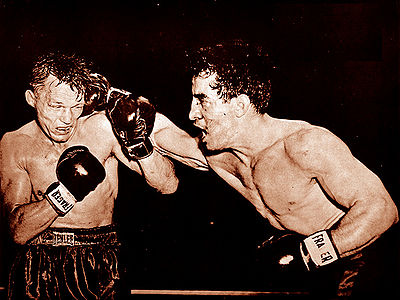
Tony Zale (left) and Rocky Graziano

June 10, 1948: For the 3rd time, Rocky Graziano and Tony Zale fight for the Middleweight Championship of the World.

Thomas Rocco Barbella was born on January 1, 1919 in Brooklyn, and grew up in Manhattan's East Village. He was a bad kid, in and out of reform schools, and deserted from the U.S. Army during World War II. He was dishonorably discharged, and sent to the federal prison in Leavenworth, Kansas. His father was a boxer, and it was in Leavenworth that he took up boxing, and used the name Rocky Graziano. He was released, and built a record of 43-6-5 by the Spring of 1946, getting him his 1st title shot.

That shot would be against Anthony Florian Zaleski, born on May 29, 1913 in Gary, Indiana, a steel-producing city 30 miles southeast of Chicago. Because of his hometown, the fighter who shortened his name to Tony Zale became known as "The Man of Steel." Around the same time, the comic book character Superman gained the same nickname. Soviet dictator Joseph Jughashvili chose the name "Stalin" because it meant the same thing.

Zale built a 42-14-2 record by the Summer of 1940, when he got a shot at the share of the Middleweight Championship of the World that was sanctioned by the National Boxing Association (NBA). On July 19, he fought Champion Al Hostak at Civic Stadium in Seattle (torn down and replaced by Memorial Stadium in 1947), and knocked him out in the 13th round.

He won a rematch with Hostak in Chicago on May 28, 1941. On November 28, he faced Georgie Abrams at the old Madison Square Garden for the recognition of the Middleweight title by the New York State Athletic Commission and The Ring magazine, a.k.a. "The Bible of Boxing." It had been vacated by the retirement of Billy Soose, who had beaten Zale in a non-title bout. The Zale-Abrams fight went the distance, and Zale was named the winner in a unanimous decision. Now, he was the undisputed Middleweight Champion of the World.

Three months later, in a non-title fight, also at The Garden, Zale lost to Light Heavyweight Champion Billy Conn. Due to World War II, Zale didn't fight again for 4 years, serving in the U.S. Navy. He won his 1st 6 postwar fights, and then fought Graziano at Yankee Stadium. Zale knocked Graziano down in the 1st round, but that only seemed to make Graziano mad: Over the next 4 rounds, Graziano clobbered Zale, and seemed on the verge of knocking him out. But in the 6th round, Zale rallied, and knocked Graziano out, to retain the title.

Certainly, Graziano had earned a rematch. After 5 interim bouts for Zale, all knockouts 6 rounds or shorter, and 2 for Graziano, knockouts which totaled 6 rounds, they had their 2nd fight, July 17, 1947, at the Chicago Stadium. It was the reverse of the 1st fight: Zale took the early lead, opening a cut over Graziano's left eye that nearly led the referee to stop the fight. But Graziano rallied, and knocked Zale out in the 6th.

Graziano had his title. He took the ring microphone afterward, and overheard by millions over nationwide radio, announced to his mother, "Somebody up there likes me." It may have been the 1st time a professional athlete thanked God for helping him win.

Bert Randolph Sugar, the sports historian who knew more about boxing than anybody, once said, "Their first two fights are among the 10 greatest of all time." It seemed only natural the rivalry become a trilogy. To warm up, Graziano had 1 fight, a unanimous decision over Sonny Horne; while Zale had 3 fights, all knockouts, totaling 9 rounds.

The 3rd fight was held at Ruppert Stadium, home of minor-league baseball's Newark Bears, in the Ironbound section of Newark, New Jersey. It was (and remains) a hardscrabble area, and the fight was a match for it. The 1st 2 rounds were hard, but the 3rd would be harder for Graziano, as Zale plunged a right into his body, and then a left hook into his jaw. Graziano was out cold, and Zale had regained the title.

For most of boxing history, a professional fight was set for a maximum of 15 rounds. Tony Zale and Rocky Graziano fought 3 times, and they totaled 15 rounds. And they were as rough as any 3 fights between any 2 fighters in boxing history, including Muhammad Ali and Joe Frazier.

But, just as the 3 fights with Frazier took a lot out of Ali, the 3 fights between them took a lot out of Graziano and Zale. Graziano commented that years later he would wake up in a cold sweat, having had the recurring nightmare of being back in the ring with Zale, who he said "really was a man of steel."

Indeed, Ray Zale recalled his uncle as "a very mild-mannered, non-egotistical person. He was not really outgoing, but would talk to any kid who came up to him." As a teenager, Ray was in the crowd at his uncle's last 2 fights with Graziano, and didn't recognize what he saw. "It was very difficult to believe this was the same guy," he said. "It was like Jekyll and Hyde. Once he got into the ring, he was like Mr. Hyde."

But the fights with Graziano got to Zale, too. Just 3 months later, at Roosevelt Stadium in Jersey City, right across Newark Bay from Ruppert Stadium, Moroccan-French boxer Marcel Cerdan pounded him to the point that Zale had to quit in the 11th round. It was Zale's last fight: He was 35, and although many boxers have something left at that point, he felt he didn't.

Graziano kept fighting, but only got 1 more title shot, in 1952. By that point, the Middleweight Champion was Sugar Ray Robinson, who destroyed him in 3rd rounds. Graziano retired after losing his very next fight, a 10-round decision to Chuck Davey.

Graziano wrote an autobiography, titled Somebody Up There Likes Me, about his rise from street hoodlum to boxing champion. A film was commissioned, and James Dean was supposed to play him, but was killed in a car crash. The role went to Paul Newman, and made a star out of him. Director Robert Wise asked Zale to play himself, but when they rehearsed the boxing scenes, Newman was tentative, fearing that, if he hit Zale too hard, Zale would hit him harder. With that in mind, Wise replaced Zale with a professional actor, Courtland Shepard.

Graziano became an actor, and my generation knows him best from seeing him in commercials for OTB, New York City's now-defunct "Off-Track Betting" service for horse racing. 

He was married to Norma Unger from 1943 until his death on May 22, 1990, at 71. They had 2 children.

Zale coached boxing, and one of his students was later heavyweight contender Ernie Terrell. In 1968, he campaigned with Senator Robert F. Kennedy, helping him win the Indiana Primary. He married late in life, in 1970, to Philomena "Frisco" Gianfranciso, who played from 1943 to 1947, as Philomena "Frisco" Gianfranciso, she played in the All-American Girls Baseball League from 1943 to 1947. They had no children, and she died in 1992. Tony Zale died on March 20, 1997, at 83.

Zale and Graziano were elected to the International Boxing Hall of Fame, in Canastota, New York, together in 1991.

*

June 10, 1948 was a Thursday. These baseball games were played that day:

* The New York Giants lost to the Chicago Cubs, 6-4 at Wrigley Field in Chicago.

* The Brooklyn Dodgers lost to the Pittsburgh Pirates, 4-1 at Forbes Field in Pittsburgh. Carl Furillo hit a home run. The Dodgers' only other hit was a single by Gene Hermanski. Jackie Robinson went 0-for-3.

* The Boston Red Sox beat the Cleveland Indians, 15-7 at Fenway Park in Boston. Joe Dobson was the winning pitcher. Bob Feller was knocked out of the box in the 3rd inning. Ted Williams went 2-for-4 with with a walk and 2 RBIs.

* The Philadelphia Athletics beat the Detroit Tigers, 10-4 at Shibe Park in Philadelphia.

* The Washington Senators beat the St. Louis Browns, 5-4 at Griffith Stadium in Washington.

* The Boston Braves beat the St. Louis Cardinals, 10-2 at Sportsman's Park in St. Louis. Stan Musial hit a home run.

Wednesday, April 6, 2022

April 6, 1987: Sugar Ray vs. Marvelous Marvin

April 6, 1987: One of the biggest non-heavyweight fights in the history of boxing takes place. The result is still in dispute.

The 1980s was the last real glory period for boxing, especially in the lower divisions. In the Middleweight and Welterweight divisions alone, there was Roberto Durán, Ray Leonard, Thomas Hearns and Marvin Hagler. They are remembered by their nicknames: Respectively, "Hands of Stone," "Sugar Ray," " The Hit Man" and "Marvelous Marvin."

On November 30, 1979, Hagler got his 1st shot at the Middleweight Championship of the World, at Caesars Palace outside Las Vegas, against the Champion, Italian boxer Vito Antuofermo. As a pro, Hagler was 46-2-1; Antuofermo, a similar 45-3-1. The fight went the distance, 15 rounds. Most ringside observers thought Hagler had won. But the judges made it a draw, and Antuofermo kept the title.

Four months later, also at Caesars, Antuofermo lost the title, losing to Englishman Alan Minter on a split decision. Three months later, a rematch was held at the Empire Pool in London (a.k.a. the Wembley Arena), and Minter knocked Antuofermo out.

On September 27, 1980, on Minter's home ground at the Wembley Arena, Hagler beat the hell out of him, and the referee stopped the fight in the 3rd round. The London crowd was furious that the fight was stopped, apparently preferring that their man die than give up. Hagler and his cornermen needed a police escort back to the locker room, as bottles and glasses were thrown at them. Clive Gammon, covering the fight for Sports Illustrated, titled his article, "It Was Blood, Sweat and Beers."

On June 13, 1981, at the Boston Garden, came the fight that people wanted to see: Hagler-Antuofermo II. It was a bloodbath, almost literally: Hagler shredded Antuofermo's face, and after 4 rounds, Vito's handlers threw in the towel.

His fights at "The Gahden" made Hagler possibly the 1st black athlete truly beloved by Boston area sports fans. They admired Bill Russell of the Celtics, Jim Nance of the Patriots, and Jim Rice of the Red Sox, but never really loved them. Hagler became New England's favorite boxer since Rocky Marciano. His fights drew big ratings on HBO. However, their announcers refused to call him by his nickname, Marvelous Marvin. So, in 1982, he had his name legally changed to "Marvelous Marvin Hagler."

On November 10, 1983, he fought Durán, the longtime Lightweight Champion and briefly the Welterweight Champion, at Caesars. For once, it was Hagler who got cut, and after 13 rounds, Durán was leading on points. But Hagler found something in reserve, and won the last 2 rounds, and kept the title.

On April 15, 1985, Hagler fought Hearns at Caesars. The Detroit native had held the WBA version of the Welterweight title, before losing a tough unification fight with Leonard in 1981. He now held the Light Middleweight title, and was moving up in class. He was 40-1, Leonard being the only man to beat him thus far. It was advertised as "The War."

It lived up to the billing. The 1st round was one of the best rounds any fight fan had ever seen, with each man landing some great blows. But it took too much out of Hearns, and despite opening a cut on Hagler's famously bald head, he was wobbly.

Referee Richard Steele stopped the fight for a moment to look at the cut, and determined that it wasn't interfering with Hagler's vision. Knowing that the rules meant that another stoppage would end the fight with a TKO in Hearns' favor, Hagler unloaded, and, in the 3rd round, crashed a right hand into Hearns' chin. Hearns got up at the count of 9, but Steele wisely stopped the fight.

On March 10, 1986, Hagler knocked out John "The Beast" Mugabi at Caesars. Finally, the last of the fights that everyone wanted to see was set up: Marvelous Marvin Hagler vs. Sugar Ray Leonard, at Caesars, on April 6, 1987. Many great fights have been held on Saturday nights, and Friday Night at the Fights was a popular early TV show. But this was a Monday, and it was the boxing equivalent of the Super Bowl being played on Monday Night Football.

Leonard was 33-1, his only loss his 1st fight against Durán. Due to an eye injury sustained in the fight with Hearns, he had fought just once in the last 5 years, but he thought he was ready to take on the Marvelous One.

Hagler wanted more money. Leonard had conditions for that: A larger ring, 22 feet square instead of the usual 20; 10-ounce gloves, instead of the usual 8-ounce; and 12 rounds instead of 15. Nevertheless, Hagler was favored.

Leonard came out quickly, and was credited with winning the 1st 2 rounds. Hagler changed tactics, and by the 5th round, Leonard was tiring. The round ended with Leonard on the ropes. Steele was referee again, and gave Leonard 30 warnings for holding, but never deducted any points. The fight became more even, but Hagler couldn't put Leonard back in serious danger. When it was over, Hagler celebrated, thinking he'd won. He later said that Leonard told him, "You beat me, man."

The judges told a different story. And all 3 of them stood by their stories. Lou Filippo scored the fight 115-113 for Hagler: "Hagler was doing all the work. The referee, Richard Steele, warned Leonard at least once every round about holding. Leonard fought in spurts. Leonard would run in and grab and hold. He did what he had to do. But I can't see a guy holding that much and getting points for it."

Dave Moretti scored it 115-113 for Leonard: "Obviously, Hagler was the aggressor, but he was not the effective aggressor. You can't chase and get hit and chase and get hit, and get credit for it. Besides, the hardest punching was by Leonard."

And JoJo Guerra scored it... 118-110 for Leonard, his card having given Hagler only 2 rounds. He later said he should have given Hagler 2 more rounds. But that would still have given the fight to Leonard. Guerra said, "Leonard outpunched Hagler, outsmarted him, outboxed him... He made Marvin Hagler come to him. He dictated the fight."

The experts couldn't agree, either:

* Picking Leonard: Howard Cosell of ABC, 117-112; Hall of Fame boxing judge Harold Lederman, 115-113; Michael Katz of the New York Daily News, 117-112; and the boxing correspondents for the Baltimore Sun, 115-113; the Boston Herald, 116-113; the Houston Chronicle, 115-114; KO Magazine, 118-111; the Los Angeles Times, 117-111; the Oakland Tribune, 117-112; the Philadelphia Daily News, 116-112; United Press International (UPI), 116-112; and USA Today, 115-113.
* Picking Hagler: Bob Verdi and Bernie Lincicome, both covering it for The Chicago Tribune, both scoring it 115-113; Ron Borges of The Boston Globe, Hagler's hometown paper, 115-113; Jerry Izenberg of the Newark-based Star-Ledger, 115-113; Al Bernstein of ESPN, 115-113; and the boxing correspondents for the Associated Press (AP), 117-112; the Miami Herald, 116-112; the Miami News, 116-112; Newsday of Long Island, 115-114; the San Jose Mercury-News, 116-115; and the Seattle Times, 115-113.
* Calling it a flat-out draw: Larry Merchant, longtime boxing columnist for the Philadelphia Daily News and the New York Post, calling the fight for HBO's crew; Dave Anderson, longtime sports columnist for The New York Times; and the boxing correspondent for The Washington Post, all of them calling it 114-114.
Even the so-called "Bible of Boxing," The Ring magazine, couldn't agree: Correspondent Nigel Collins called it 115-113 for Leonard; but another, Phill Marder, called it a 114-114 draw.
* Nor could the CBS broadcast crew agree: Tim Ryan, who called over 300 prizefights, and was also an expert on hockey (he's Canadian) and tennis, scored it 115-114 for Hagler; but Hall of Fame trainer Gil Clancy judged it 115-113 for Leonard.
* Nor could Sports Illustrated, whose boxing coverage was extraordinary at the time, agree. One of their main boxing writers, William Nack, also their main horse racing writer, called it 116-114 for Leonard. But Pat Putnam called it 115-113 for Hagler. And Hugh McIlvanney, the great Scottish sportswriter who specialized in soccer, hired by SI for additional coverage, called it 116-112 for Hagler.

I was a senior in high school, and, having watched him on TV since I saw him in the Olympics when I was 6, I was predisposed to want Leonard to win. (Me being a Yankee Fan, and Hagler being from the Boston area, home of the Red Sox, had nothing to do with it.) But I had never seen the fight in full until I wrote this post. I wanted to know what I was talking about before I wrote my result.

I went against the usual story, and gave Hagler Round 1. I also gave him Rounds 3, 7, 9 and 10. I gave Leonard Rounds, 2, 4, 5, 6, 8, 11 and 12. However, I took a point off Leonard for a low blow in Round 4. I called Rounds 4 and 9 ties. Overall, I scored it 114-112 for Leonard. In my now-fully-informed opinion, Hagler was not robbed, and JoJo Guerra was right: Leonard controlled the fight, as much psychologically, from beginning to end. 

On the tape, Gil Clancy kept calling Hagler "slow," saying he wasn't fighting his own fight, fighting orthodox-style (righthanded) instead of his usual southpaw (lefthanded); and suggesting that Hagler's best chance to win was to go for the knockout, instead of trying to "outbox" Leonard.

Nobody ever outboxed Sugar Ray Leonard. Even in his 1st fight with Durán, which Leonard definitively lost, Durán outpunched him and out-thought him, even taunting him. Leonard learned from that, and turned the tables on Durán in the rematch, and played mind games with Hagler. Which isn't surprising: Leonard's trainer, from the beginning, was Angelo Dundee, who had also trained the master of mind games, Muhammad Ali. At times, Leonard even seemed to be doing "The Ali Shuffle" around the ring.

Feeling robbed of his title, Hagler shook his head, "No," as he left the ring. He told Tim Ryan of CBS, "I beat him. I beat him, and he knows it. Everybody knows it." 

He had nobody to blame but himself: If he had fought a Marvin Hagler fight, he would have won. Instead, he let Leonard dictate the fight and get in his head. He blew it.

He wanted a rematch. Any sensible boxing observer had to admit that one was called for. But Leonard chose to retire. True, he had little left to prove, but it did make it look like Leonard was ducking him.

A year later, Hagler retired. But Leonard came out of retirement. How cynical can you get? I lost a lot of respect for Leonard.

In 1990, Leonard finally offered Hagler a rematch. This time, it was Hagler who turned it down. He had moved to Italy, and gone into acting in its film capital of Milan. "After I had nothing to prove to myself, it was the best thing to walk away," he said. He was one of the few boxers who stayed retired the first time. His record: 62-3-2.

The Ring magazine named Leonard their Fighter of the Year in 1979 and 1981. They gave Hagler that honor in 1983 and 1985. Boxing Illustrated named him Fighter of the Decade for the 1980s.

There were 4 truly great welterweight and middleweight fighters in the 1980s: Leonard, Hagler, Roberto Durán and Thomas Hearns. Leonard split 2 fights with Durán, before winning another later in both men's careers. Leonard won a very tough decision over Hearns, who absolutely destroyed Durán. Hagler knocked Hearns out in the 3rd round, surviving a furious fusillade, in one of the greatest short fights ever.
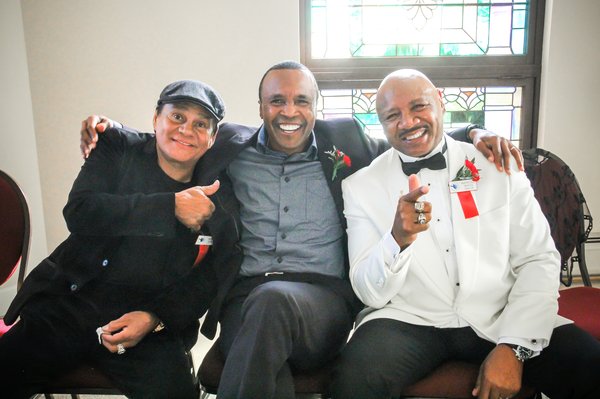
Left to right: Durán, Leonard, Hagler.
I found a photo of Leonard, Durán and Hearns together,
but not one of all 4 of them together.

Despite the various controversies between them, the 4 of them became friends after their careers, as boxers tend to do. There usually is a healthy respect between worthy opponents. Hagler died of a heart attack in 2021, at the age of 66. As of November 25, 2022, the other 3 are still alive.

UPDATE: In 2026, Ronald Hearns, also a boxer, places his father Thomas under conservatorship, as he has begun to show signs of boxing-related dementia. Hagler is not suspected of having had it. Nor is Leonard or Durán.

*

April 6, 1987 was a Monday. It was Opening Day of the Major League Baseball season:

* The New York Yankees beat the Detroit Tigers, 2-1 at Tiger Stadium in Detroit. Rickey Henderson doubled Claudell Washington home with the winning run in the top of the 10th inning, making Dave Righetti a winning pitcher in relief of Dennis Rasmussen. Dave Winfield went 1-for-4. Don Mattingly went 0-for-5.

* The Baltimore Orioles beat the Texas Rangers, 2-1 at Memorial Stadium in Baltimore. Larry Sheets drove in the winning run, Rene Gonzales, with a sacrifice fly in the bottom of the 9th. Eddie Murray went 1-for-4, and Cal Ripken went 0-for-4.

* The Toronto Blue Jays beat the Cleveland Indians, 7-3 at Exhibition Stadium in Toronto.

* The Cincinnati Reds beat the Montreal Expos, 11-5 at Riverfront Stadium in Cincinnati.

* The Milwaukee Brewers beat the Boston Red Sox, 5-1 at Milwaukee County Stadium. Paul Molitor went 2-for-4 with an RBI. Robin Yount went 2-for-4 with 2 RBIs.

* The Chicago White Sox beat the Kansas City Royals, 5-4 at Royals Stadium (now Kauffman Stadium) in Kansas City. George Brett hit a home run.

* The Houston Astros beat the Los Angeles Dodgers, 4-3 at the Astrodome in Houston. Mike Scott outpitched Orel Hershiser.

* The San Francisco Giants beat the San Diego Padres, 4-3 at Candlestick Park in San Francisco. Chili Davis singled Jeffrey Leonard home with the winning run in the bottom of the 12th inning. Tony Gwynn went 1-for-4.

* And the New York Mets, the Atlanta Braves, the Chicago Cubs, the Philadelphia Phillies, the Pittsburgh Pirates, the St. Louis Cardinals, the California Angels, the Minnesota Twins, the Oakland Athletics and the Seattle Mariners each opened their seasons the next day.

There was more baseball news. Late that night, ABC's news program Nightline dedicated its show to the 40th Anniversary of Jackie Robinson and the Brooklyn Dodgers desegregating MLB. (The anniversary was on the 15th). One of the guests was Al Campanis, general manager of the now-Los Angeles Dodgers. He made remarks inappropriate to that occasion, or to any occasion. I have a separate entry for that event.

Football was out of season. The NHL was between its regular season and the Stanley Cup Playoffs. There were 6 games played in the NBA:

* The New York Knicks beat the Philadelphia 76ers, 108-101 at Madison Square Garden.

* The Atlanta Hawks beat the Cleveland Cavaliers, 110-105 at The Omni in Atlanta. Dominique Wilkins scored 41 points.

* The Phoenix Suns beat the Dallas Mavericks, 118-110 at the Arizona Veterans Memorial Coliseum in Phoenix.

* The Sacramento Kings beat the Utah Jazz, 110-104 at the Salt Palace in Salt Lake City, Utah.

* The Los Angeles Lakers beat the Los Angeles Clippers, 135-112 at The Forum outside Los Angeles in Inglewood, California.

* And the Houston Rockets beat the Portland Trail Blazers, 114-108 at the Portland Memorial Coliseum.

Monday, February 14, 2022

February 14, 1951: Boxing's St. Valentine's Day Massacre

February 14, 1951: The Middleweight Championship of the World is contested at the Chicago Stadium. It is a brutal fight, one that brought up memories of a previous February 14 in the same city, in 1929, when Chicago crime boss Al Capone had members of rival Bugs Moran's gang killed. Like that event, this fight gets the nickname "The St. Valentine's Day Massacre."

Walker Smith Jr., born in 1921 in Georgia and raised in Manhattan's Harlem, fought under the name Sugar Ray Robinson. He fought professionally 75 times before first winning a title, the Welterweight Championship of the World, by beating Tommy Bell in 1946. In those 75 fights, he had only 1 loss and 1 draw.

Giacobbe LaMotta, nicknamed Jake, was born in 1922 on Manhattan's Lower East Side, and grew up in The Bronx. "The Bronx Bull" had to fight even more times to get a title shot, going 72-13-3 before winning the Middleweight Championship of the World in 1949, beating French fighter Marcel Cerdan at Briggs Stadium in Detroit. (It was renamed Tiger Stadium in 1961.) Though not a heavyweight, and not lefthanded, essentially, he was "Rocky" before Sylvester Stallone wrote his movie.

In 1970, LaMotta wrote a memoir, Raging Bull. In 1980, Martin Scorcese made a film of it, and Robert de Niro won an Academy Award for playing LaMotta, making him a star -- though hardly a role model -- to a new generation. He became a popular after-dinner speaker, with lines like, "I fought Sugar Ray so often, I almost got diabetes!"

They fought 6 times. Here were the 1st 5:

* 1. October 2, 1942, at the old Madison Square Garden. Robinson won a unanimous decision after 10 rounds.

* 2. February 5, 1943, at the Olympia Stadium in Detroit. Also a decision after 10 rounds, but, this time, LaMotta won. This would be the only defeat in Robinson's 1st 133 fights: Going in, he was 40-0.

* 3. February 26, 1943, also at the Olympia. Just 3 weeks later, it went the full 10 rounds, and Robinson was declared the winner.

* 4. February 23, 1945, at Madison Square Garden. Another 10-round win by decision for Robinson.

* 5. September 26, 1945, at Comiskey Park in Chicago. It went 12 rounds, and Robinson won by a split decision. The 1st 4 decisions had not been controversial. This one was close, but few people thought LaMotta had been "robbed."

By February 14, 1951, LaMotta had defended the Middleweight Championship 6 times, and was 78-14-3. Robinson was 121-1-2, and had willingly given up the Welterweight Championship to move up in weight class and try to take the Middleweight title. To do it, he would have to fight LaMotta for a 6th time, at Chicago Stadium, home of the NHL's Chicago Black Hawks (the NBA's Bulls hadn't been founded yet), and already the site of some big fights.

This time, the fight was not really a contest. Although LaMotta was one of the hardest hitters the fight game has ever known, Robinson was a smarter fighter. LaMotta was a "puncher," but Robinson was a "boxer," a stylist instead of a mere hitter. Some boxing historians have considered Robinson to be "pound-for-pound, the greatest boxer who ever lived." They rank him ahead of Heavyweight Champions Joe Louis and Muhammad Ali; and ahead of the Welterweight and Middleweight Champions who dominated the early 1980s: Marvelous Marvin Hagler, Thomas Hearns, Roberto Durán, and a man who would alter his real name to evoke memories of Robinson, Sugar Ray Leonard.

Robinson outboxed LaMotta for the first 10 rounds. Had the fight been set for only 10 rounds, it would probably not be well-remembered today, and would be considered just another of Sugar Ray's many wins. But he then unleashed a series of savage combinations on LaMotta for 3 rounds. In the 13th round, he dealt LaMotta his 1st legitimate knockout loss in 95 professional bouts. (LaMotta had lost by knockout to Billy Fox earlier in his career. However, that fight was later ruled to have been fixed.) Because of the date, the location in Chicago, and its brutality, the fight became known as the St. Valentine's Day Massacre.

The people of France hated LaMotta for beating Cerdan, even more so when Cerdan, trying to fly back across the Atlantic Ocean for a rematch, was killed in a plane crash. Robinson went to Europe after beating LaMotta, bringing his pink Cadillac on the cruise ship with him, and was wildly cheered in Paris as the man who had avenged Cerdan.

It was a working vacation: He kept fighting. He fought in Paris, Zürich, Antwerp, Berlin and Turin. But on July 10, just 9 days after his Turin fight, and getting into the ring for the 7th time in as many weeks, Robinson took his 129-1-2 record into the Earl's Court Arena in London, and lost his title to British boxer Randy Turpin.

He got the title back from Turpin, 3 months later at the Polo Grounds in New York. He ended up winning and losing the Middleweight title 5 times. In 1952, he tried to move up to the Light Heavyweight Championship, but in a brutally hot Yankee Stadium, the Champion, Joey Maxim, defeated him. For the rest of his life, people told Maxim the only reason he lost is that Robinson couldn't handle the heat. "Maybe you think it wasn't hot for me," he told such people.

Sugar Ray Robinson last won a title fight in 1958, last lost one in 1961, and finally retired in 1965, at the age of 44, with a record of 174-19-6. He ran a famous restaurant in Harlem, but developed dementia, probably as a result of having had nearly 200 professional fights, and died in 1989. Johnny Barnes played him in Raging Bull.

Jake LaMotta never had another title fight after getting destroyed by Robinson in Chicago. He kept fighting until 1954, retiring with a record of 83-19-4. He ran a bar in Miami, and became an actor, before writing his memoir and going on the after-dinner circuit. He died in 2017.

*

February 14, 1951 was a Wednesday. English soccer legend Kevin Keegan was born on this day.

Baseball and football were out of season. There was 1 game in the NHL: The New York Rangers beat the Chicago Black Hawks, 5-1 at the old Madison Square Garden.

And there were 4 games in the NBA:

* The New York Knicks beat the Rochester Royals, 81-65 at the old Madison Square Garden. This turned out to be a preview of the NBA Finals, but the result would be reversed, as the Royals won in 7 games. The Royals became the Cincinnati Royals in 1957, the Kansas City Kings in 1972, and the Sacramento Kings in 1985.

* The Fort Wayne Pistons beat the Syracuse Nationals, 77-75 at North Side High School in Fort Wayne, Indiana. The Pistons moved to Detroit in 1957. The Nats became the Philadelphia 76ers in 1963.

* The Tri-Cities Blackhawks beat the Indianapolis Olympians, 98-91 at the Wheaton Field House in Moline, Illinois. The "Tri-Cities" were Moline and Rock Island, Illinois, and, across the Mississippi River, Davenport, Iowa. Today, Bettendorf, Iowa is usually included, and the region is known as the "Quad Cities." The Blackhawks became the Milwaukee Hawks the next season, the St. Louis Hawks in 1955, and the Atlanta Hawks in 1968.

* And the Minneapolis Lakers beat the Baltimore Bullets, 99-71 at the Minneapolis Auditorium. The Lakers moved to Los Angeles in 1960. The Bullets folded in 1954, and had no connection to the Baltimore Bullets that began in 1963, moved to Washington in 1973, and were renamed the Wizards in 1997.

December 31, 1999 & January 1, 2000: The Millennium

December 31, 1999:  The Millennium arrives. The people of planet Earth survived. At a terrible cost. But we hadn't destroyed ourselves. ...