Showing posts with label jim bunning. Show all posts

Friday, September 30, 2022

September 30, 1964: The Phillie Phlop Is Completed

Unused game program from the 1964 World Series,
which was to be sold at Connie Mack Stadium,
with the other flag blank, since the opponent was yet to be determined.

September 30, 1964: The Philadelphia Phillies complete what remains the most stunning regular-season collapse in Major League Baseball history, losing their 10th straight game, 8-5 to the St. Louis Cardinals at Busch Stadium (formerly Sportsman's Park) in St. Louis. 
Going into the games of September 21, the Phillies led the National League by 6 1/2 games. There were 12 games left. Their Magic Number to clinch the Pennant was 6: All they had to do was win half of their remaining games, 6 out of 12, and it wouldn't have mattered what any other team did. The Phils would have won the Pennant.
Unused 1964 World Series press pin for the Phillies
Instead, the following happened:
* 1. September 21, at Connie Mack Stadium in Philadelphia: Cincinnati Reds 1, Phillies 0. The only run came in the top of the 6th inning, when Hiraldo "Chico" Ruiz stole home plate, while Frank Robinson, the greatest power hitter the Reds franchise has ever had, was at the plate. It would have been an incredibly dumb move had it failed. But it worked. "The Chico Ruiz Game" has haunted Phillies fans ever since.
* 2. September 22, at Connie Mack Stadium: Reds 9, Phillies 2. This time, Robinson did hit a home run, and Chris Short, 17-7 going into the game, didn't get out of the 5th inning.
* 3. September 23, at Connie Mack Stadium: Reds 6, Phillies 4. This time, it was Ruiz hitting a home run, and Vada Pinson 2 of them.
* 4. September 24, at Connie Mack Stadium: Milwaukee Braves 5, Phillies 3. Jim Bunning came into the game 18-5, but lost.
* 5. September 25, at Connie Mack Stadium: Braves 7, Phillies 5. Manager Gene Mauch seemed to have pushed the right buttons all season long, until now. In this game, he started Short on just 2 days' rest, and he pitched 6 shutout innings, but allowed 2 runs in the 7th and 1 in the 8th. Johnny Callison homered for the Phils in the bottom of the 8th, momentarily saving them.
Both teams scored 2 runs in the 10th, the Braves on a home run by Joe Torre, the Phils on an inside-the-park home run by eventual NL Rookie of the Year Richie Allen (who hadn't yet begun to insist upon being called "Dick Allen"). But a bad throw by catcher Clay Dalrymple on a stolen base by Gene Oliver allowed the Braves to win it the 12th.
* 6. September 26, at Connie Mack Stadium: Braves 6, Phillies 4. The Phils led 4-0 after 2 innings, and 4-3 going into the 9th, with Art Mahaffey putting in a good start on full rest. But Bobby Shantz, the former Philadelphia Athletics ace back in his hometown, couldn't hold the lead, due in part to an error by 2nd baseman Tony Taylor, and Rico Carty hit a bases-loaded triple. It was Shantz's 39th birthday, and he made only 1 more big-league appearance, 3 days later. Hank Aaron went 2-for-5. Joe Torre went 3-for-4.
* 7. September 27, at Connie Mack Stadium: Braves 14, Phillies 8. Callison hit 3 home runs, helping to cement his case as the NL Most Valuable Player, should the Phils win the Pennant. But Bunning, sent out by Mauch on 2 days' rest, didn't get out of the 4th inning. He and his replacement 7 allowed straight hits, and allowed runs to score on 6 straight plays. Torre hit a home run (although not in the 4th).

There was a small omen for the Phillies: The pitcher who relieved Bunning would go on to become one of the most important figures in team history. He was a 20-year-old righthander from nearby Newport, Delaware. His name was Dallas Green.

* 8. September 28, at Busch Stadium in St. Louis: Cardinals 5, Phillies 1. Again, Mauch sent Short out on 2 days' rest, against Bob Gibson. Future Yankee broadcaster and NL President Bill White went 3-for-4 with an RBI. Future Cardinal broadcaster Mike Shannon went 1-for-3 with 3 RBIs.

* 9. September 29, at Busch Stadium: Cardinals 4, Phillies 2. Dennis Bennett was fully-rested, but didn't get out of the 2nd inning. For the Cards, Ray Sadecki got his 20th win of the season.

* 10. September 30, at Busch Stadium: Cardinals 8, Phillies 5. Tim McCarver hits a home run for the Cards, while Alex Johnson hits one for the Phils. Ironically, the winning pitcher for the Cards is Curt Simmons, whose drafting into the Korean War in 1950 cost him the chance to pitch for the Phils in their last World Series to this point, in 1950. Simmons also turned out to be the last surviving player from those 1950 Phillies "Whiz Kids."

None of it would have mattered if the Reds hadn't won 9 straight from September 20 to 27 (3 of them over the Phillies); and the Cardinals hadn't won 8 straight from September 24 to 30 (the last 3 over the Phillies). The Cards' Ken Boyer ended up winning the MVP.

Now, despite a Rookie of the Year season from Allen, a near-MVP season from Callison, and a near-Cy Young Award season from Bunning, they are 2 1/2 behind the Cardinals, while the Cincinnati Reds are 1 game back. The Phils have 2 games left, the Cards 3, the Reds 4. The Phils could still win the Pennant if they win their last 2 games, although a 3-way tie for the Pennant is still possible.

It was not to be. And, for those people in the Delaware Valley old enough to remember the Phillie Phlop of '64, not even the World Series wins of 1980 and 2008 could erase the scar on their hearts with "1964" branded onto it.

In 1978, the Phillies founded the Philadelphia Baseball Wall of Fame, electing a Phillies figure every year since, and a Philadelphia Athletics figure every year from 1978 to 2003. From the 1964 team, they have elected Jim Bunning, Chris Short, Dick Allen, Johnny Callison, Tony Taylor, general manager John Quinn, and, for what he did as their later manager, Dallas Green. Richie Ashburn, by then a broadcaster, has also been elected. Interestingly, they have not elected manager Gene Mauch. Allen, Callison, Ashburn and Campbell have also been elected to the Philadelphia Sports Hall of Fame.

*

September 30, 1964 was a Wednesday. These other baseball games were played that day:

* The New York Yankees swept a doubleheader from the Detroit Tigers at Yankee Stadium. This was crucial, because the American League race was also coming down to the wire with multiple teams still in it. The Yankees would end up winning the Pennant by just 1 game over Chicago and 2 over Baltimore.

The Yankees won the opener, 7-6. Mickey Mantle and Joe Pepitone hit home runs for the Yankees, Al Kaline for the Tigers. Ralph Terry was the winning pitcher, in relief of Al Downing. The Yankees won the nightcap, 11-8. Kaline homered for the Tigers again, and Bill Roman also hit one. But Tom Tresh hit one for the Pinstripes. Jim Bouton, later the author of Ball Four, started and won.

* The New York Mets lost to the Milwaukee Braves, 6-5 at Milwaukee County Stadium. Denis Menke won the game with a home run off Willard Hunter in the bottom of the 12th inning. Hank Fischer started, Warren Spahn pitched the 9th and 10th innings in relief, and Clay Carroll, later a bullpen mainstay of the Cincinnati Big Red Machine, was the winning pitcher.

Hank Aaron went 0-for-4, but he did draw 2 walks. Joe Torre went 1-for-6 with an RBI. Jim Hickman went 5-for-6 with an RBI for the Mets, and Charley Smith went 3-for-6 with 2 RBIs, but it wasn't enough.

* The Cleveland Indians shut the Boston Red Sox out for the entirety of a doubleheader at Fenway Park, 5-0 and 3-0. A young Luis Tiant, later to pitch so well for the Red Sox, allowed them just 4 hits in the 1st game, 2 of them by FĂ©lix Mantilla.

Carl Yastrzemski went 0-for-4 in the 1st game, and didn't play in the 2nd; while Tony Conigliaro, just 19 years old, didn't play in the 1st game, and went 2-for-4 in the 2nd. But the rest of the Red Sox only got 5 hits off Sam McDowell in that 2nd game.

* A doubleheader was split at Memorial Stadium in Baltimore, but the 2 teams then in the Chesapeake region. The Baltimore Orioles won the 1st game, 8-4, with Jerry Adair hitting 2 homers. The Washington Senators won the 2nd game, 6-3. Brooks Robinson went 2-for-4 in each game, and had an RBI in the 1st one.

* The Pittsburgh Pirates beat the Cincinnati Reds, 1-0 at Crosley Field in Cincinnati. Jerry May singled home future Met World Series hero Donn Clendenon with the winning run -- in the top of the 16th inning. Roberto Clemente did not play. Nor did Willie Stargell. Jerry May got 3 hits, the entire rest of the Pirates only 2 -- in 16 innings. Chico Ruiz went 4-for-8, but the rest of the Reds lineup got only 5 hits. Pete Rose went 0-for-7. Frank Robinson went 1-for-4, and drew 3 walks.

The Reds' Jim Maloney, who would go on to take 2 no-hitters into the 10th inning the next season, keeping 1 but losing the other game in the 11th inning, here went 11 innings allowing no runs on 3 hits. The Pirates' Bob Veale went 12 1/3rd, allowing no runs on 7 hits. Veale struck out 16 batters, Maloney 13. The winning pitcher was Al McBean, the losing pitcher Lou Tsitouris.

* The Minnesota Twins beat the Kansas City Athletics, 6-1 at Metropolitan Stadium in the Minneapolis suburb of Bloomington, Minnesota. Harmon Killebrew went 0-for-4, but Jimmie Hall and Don Mincher homered for the Twins.

* The Los Angeles Dodgers beat the Chicago Cubs, 2-0 at Dodger Stadium in Los Angeles. A 2-hit shutout was pitched by -- no, not Sandy Koufax, and not Don Drysdale, but John Purdin. It was his 1st major league win. There would be only 5 more. Both Cub hits were by catcher Dick Bertell.

* The San Francisco Giants beat the Houston Colt .45s, 2-1 at Candlestick Park in San Francisco. Houston 3rd baseman Bob Aspromonte made an error on Jim Davenport's grounder in the bottom of the 11th, allowing Tom Haller, who had homered earlier, to score the winning run. Willie Mays went 0-for-4, but did draw a walk. The next season, the Colt .45s would rename themselves the Houston Astros.

* And the Chicago White Sox and the Los Angeles Angels were not scheduled for this day. The White Sox won their last 9 to finish within 1 of the Yankees, but it wasn't enough.

And in one of the best things that could have happened on any day, Italian actress Monica Bellucci was born.

Sunday, July 24, 2022

July 24, 1965: Casey Stengel's Last Game

July 24, 1965: The New York Mets lose to the Philadelphia Phillies, 5-1 at Shea Stadium. Jim Bunning allows only 2 hits, striking out 12, while the Phils hit 3 home runs: By Wes Covington, Johnny Lewis and Dick "Dr. Strangeglove" Stuart. Nothing unusual for the early Mets.

What is unusual is that it was Casey Stengel's last game in a major league uniform. The Mets had an Old-Timers game that weekend, and that night, at Toots Shor's restaurant in Midtown Manhattan, with old friends from his various travels around baseball -- going back to his debut as a player in 1912, 53 years earlier -- the 75-year-old Stengel, who drank as much as any player he ever had, got hurt and broke his hip.

The details aren't clear. Maybe he fell off a barstool. Maybe he slipped and fell in the men's room. Maybe he slipped and fell getting into a taxi on the way out. Maybe he slipped and fell getting out of it. If that was the case, maybe it happened outside the Essex House on Central Park South (59th Street), where Casey had kept his New York residence since he first managed the Yankees in 1949. It was just a few blocks from Toots'. Or maybe it happened at the home of Joe DeGregorio, the Mets' comptroller, who lived in Whitestone, Queens, close to Shea, because it would be easier for Casey to get to the stadium in the morning that way. Whatever happened, he woke up in the morning and felt a lot worse, and was taken to the hospital, and was properly diagnosed.

He had been falling asleep while sitting in the dugout during games for years. When the Yankees' owners, Dan Topping and Del Webb, fired him after the 1960 season, Stengel said, "I'll never make the mistake of being 70 again." But the Mets' founding owner, Joan Payson, and hired outgoing Yankee general manager George Weiss, and he said hiring Casey would be great for public relations, and they would need all they could get, because the team would be bad for years to come, no matter what.

By the start of the 1965 season, Mrs. Payson, who loved Casey, and her team president, M. Donald Grant, who loved nothing but money and privilege, wanted Casey to retire, because he couldn't do the job anymore. He thought he still could. And they knew that, if they fired him, all the goodwill they'd gotten as New York's "loveable losers" and team of "human beings" as opposed to the Yankees' "corporate culture" would evaporate. They had to appease Casey.

Now, Casey admitted that if he couldn't walk out to the mound and take a pitcher out of a game, he couldn't manage. (Connie Mack of the Philadelphia Athletics, who was 87 when his sons finally ganged up on him and forced him out, never left the dugout, but that was because of a rule saying that a man had to be in uniform to take the field, and Mack wore suits.) And so, at 75, the injury forced Casey out, and Mrs. Payson and Grant were given the dignified way out.

On August 30, with one of his coaches, former New York Giants catcher Wes Westrum, having managed the Mets in the interim, Casey officially announced his retirement, and Westrum was given the job full-time.

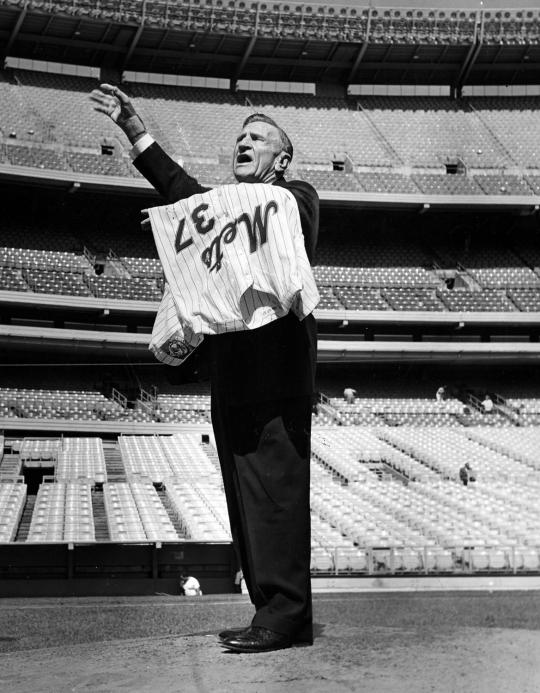
On September 2, on the field at Shea, with Casey leaning on a cane, Weiss, himself to retire after the season, announced that Casey's uniform Number 37 would be retired, the team's 1st such honoree, and the uniform would be placed in a glass case on display at the stadium. Casey, with one last witticism, said, "I hope they don't make a mummy out if me and put me under glass!"

Well, maybe that wasn't the last one. Somebody asked Casey what he was going to do with the rest of his life. He said, "How should I know? Most people my age are dead, and you could look it up!"

Officially, Casey was still on the Mets' payroll, as a "vice president." For the most part, he stayed with his wife, Edna (they had no children), at their modest house in the Los Angeles suburb of Glendale, California, where they owned a bank, and made money on that and on oil wells they owned in Texas and Oklahoma. One of the reasons Casey could be so outspoken is that, unlike most men in baseball, he didn't need the money, and wasn't beholden to owners and GMs.

He flew to St. Petersburg, Florida for the Mets' Spring Training. He was elected to the Baseball Hall of Fame in 1966. He attended All-Star Games, World Series games, Old-Timers games, and the Hall of Fame's induction ceremonies. In 1969, he got to see the Mets, whom he had sarcastically given the tag "Amazing," actually become amazing and win the World Series. (They have been "The Amazins" ever since.) On August 8, 1970, he returned to Yankee Stadium, as new ownership had retired Number 37 for him, making him the 1st man in baseball to have his number retired by 2 different teams.

He died of cancer on September 29, 1975, at the age of 85. Jim Murray, the great sports columnist for the Los Angeles Times, began his column the next day by saying, "Well, God is certainly getting an earful today." The following year, the Yankees gave Casey a Plaque for Monument Park at the renovated Yankee Stadium.

As for that glass case with Casey's Mets uniform in it: I never saw it, despite a few trips to Shea, until the Mets opened their team Hall of Fame at Citi Field in 2010. They also had the original uniform of the Mr. Met mascot; surviving seats from Ebbets Field, the Polo Grounds, and Shea; and the team's 2 World Championship trophies, from 1969 and 1986.

*

July 24, 1965 was a Saturday. These other baseball games were played:

* The New York Yankees lost to the Cleveland Indians, 3-0 at Cleveland Municipal Stadium. Sam McDowell pitched a 5-hit shutout, striking out 10. Leon Wagner hit a home run. Mickey Mantle went 0-for-4, supplying 3 of the strikeouts. Roger Maris was injured, and did not play.

* The Boston Red Sox beat the California Angels, 8-5 at Fenway Park in Boston. Carl Yastrzemski went 1-for-4, and future Seattle Pilot Jim Gosger hit a home run. "Yeah, surrre." Yeah, sure: He hit it in the 7th inning, off Jim Sukla.

* The Baltimore Orioles beat the Minnesota Twins, 3-1 at Memorial Stadium in Baltimore. Boog Powell hit a home run. Brooks Robinson went 0-for-2 with a walk. Harmon Killebrew went 0-for-3 with a walk.

* The Washington Senators beat the Kansas City Athletics, 9-2 at District of Columbia Stadium (later Robert F. Kennedy Stadium) in Washington. Doc Lock hit 2 home runs.

* The Detroit Tigers beat the Chicago White Sox, 7-4 at Tiger Stadium in Detroit. Al Kaline, Norm Cash and Bill Freehan all homered for the Tigers.

* The Pittsburgh Pirates beat the Chicago Cubs, 8-5 at Wrigley Field in Chicago. Roberto Clemente and Bill Virdon homered for the Pirates, Ron Santo and Billy Williams for the Cubs. Ernie Banks went 0-for-4, and Willie Stargell went 0-for-5.

* A doubleheader was split at the Astrodome in Houston. The Houston Astros won the opener, 4-2. The Cincinnati Reds won the nightcap, 2-0, as Joe Nuxhall, once the youngest player ever to enter an MLB game but now in his final season, allowed just 1 hit and 2 walks, striking out 11. Over the 2 games, Frank Robinson went 3-for-7 with an RBI, Pete Rose went 3-for-8 with 2 RBIs, and Joe Morgan went 1-for-7 with a walk and an RBI -- for the Astros.

* The St. Louis Cardinals beat the Los Angeles Dodgers, 3-2 at Dodger Stadium in Los Angeles. In this game, Cardinal catcher, and future Milwaukee Brewers broadcaster and comic actor, Bob Uecker hit 1 of his 14 career home runs, off Sandy Koufax. I have a separate entry for this event.

The loss wasn't Koufax's fault: He pitched 9 innings, allowing just 2 runs, including Uecker's homer. But the Cards' Ray Sadecki was equal to the task, and the game went to extra innings. The Cards won it in the 10th inning, when Dodger center fielder Willie Davis mishandled a fly ball by the Dick Groat, allowing Lou Brock to score.

* And the San Francisco Giants beat the Milwaukee Braves, 4-2 at Candlestick Park in San Francisco. Willie Mays went 0-for-3, but Tom Haller hit a home run. Hank Aaron went 0-for-4, but Mack Jones hit a home run.

Tuesday, June 21, 2022

June 21, 1964: The Murders in the Mississippi Freedom Summer

Left to right: Michael Schwerner, James Chaney and Andrew Goodman

June 21, 1964: Three men working on the "Mississippi Freedom Summer" project are murdered by agents of the Ku Klux Klan, outside the small city of Philadelphia, Mississippi. The assassination infuriates the nation.

Andrew Goodman was 20 years old, from the Upper East Side of Manhattan. Michael Schwerner was 24, from The Bronx. Both being Jewish, the felt the sense of the underdog from watching African-Americans struggle for their civil rights, and volunteers for the Freedom Summer project of the Congress of Racial Equality (CORE) in 1964, attempting to register black people to vote, and to change the course of governance in the Magnolia State. James Chaney was 20, a native of Meridian, Mississippi, and had been on the Freedom Rides in the early 1960s.

Goodman, Schwerner and Chaney were investigating the burning of Mt. Zion Methodist Church, which had been a site for a CORE Freedom School. In the wake of Schwerner and Chaney's voter registration rallies, parishioners had been beaten by Ku Klux Klan members. They accused the sheriff's deputy, Cecil Price, of stopping their caravan and forcing the deacons to kneel in the headlights of their own cars, while white men beat them with rifle butts. The same Klansmen who beat them were also identified as having burned the church.

Price arrested Chaney, Goodman, and Schwerner for an alleged traffic violation, and took them to the Neshoba County Jail. They were released that evening, without being allowed to telephone anyone. On the way back to Meridian, they were stopped by patrol lights and two carloads of KKK members on Highway 19, then taken in Price's car to another remote rural road. The men approached then shot and killed Schwerner, then Goodman, both with one shot in the heart; then Chaney with three shots, after severely beating him. They buried the young men in an earthen dam nearby.

The men's bodies remained undiscovered for 44 days. The FBI was brought into the case by John Doar, the U.S. Department of Justice representative in Mississippi monitoring the situation during Freedom Summer. The missing civil rights workers became a major national story, especially coming on top of other events as civil rights workers were active across Mississippi in a voter registration drive; and, the previous year, the March On Washington, and the uses in Birmingham, Alabama of firehoses and police dogs on demonstrators and the bombing of a church.

Schwerner's widow, Rita, who also worked for CORE in Meridian, expressed indignation that the press had ignored previous murders and disappearances of blacks in the area, but had highlighted this case because 2 white men from New York had gone missing. She said she believed that if only Chaney were missing, the case would not have received nearly as much attention.

The assassination inspired the songs "Mississippi Goddam" by Nina Simone and "Here's to the State of Mississippi" by Phil Ochs; and the 1988 film Mississippi Burning.

In 1967, the federal government charged 10 men with conspiracy to deprive the 3 murdered men of their civil rights, under the Enforcement Act of 1870, the only federal law then applying to the case. The jury convicted 7 men, including Deputy Sheriff Price; but 3 were acquitted, including Edgar Ray Killen, the former KKK organizer who had planned and directed the murders.

Price was sentenced to 6 years in prison, and served 4. He died in 2001. In 2005, the State of Mississippi convicted Killeen of 3 counts of manslaughter, and sentenced him to 60 years in prison. He died in prison in 2018, nearly 93 years old, having gotten away with the crime for 41 years.

The historical markers marking the locations of the murders of Emmett Till and of civil rights workers Andrew Goodman, Michael Schwerner and James Chaney, 9 years earlier, are 117 miles apart.

*

June 21, 1964 was a Sunday. This was also the day that Fascist Spain defeated the defending Champions, the Communist Soviet Union, to win the European Football Championship. I have a separate entry for that event.

As was often the case in that era, Sundays often featured baseball doubleheaders. These games were played:

* The Philadelphia Phillies swept a doubleheader from the New York Mets, 6-0 and 8-2 at Shea Stadium. In the opener, Jim Bunning pitched a perfect game for the Phillies, the 1st perfect game in the National League since 1880. It was Father's Day, and Bunning was already the father of 6 children. He would eventually have 9. It made him only the 2nd pitcher ever to pitch a no-hitter in each League: He had previously pitched one in the American League, for the Detroit Tigers in 1958. I have a separate entry for this event, too.
* The New York Yankees had one of their longest days, but a successful one, sweeping the Chicago White Sox, 2-0 and 2-1 at Comiskey Park in Chicago. In the opener, Jim Bouton pitched 3-hit shutout ball over 7 2/3rds innings, then Pete Mikkelsen went the rest of the way, completing a 4-hit shutout. Mickey Mantle and Elston Howard hit home runs.

The nightcap went 17 innings. With 1 out in the top of the 17th, HĂ©ctor LĂłpez doubled of Don Mossi. White Sox manager Al LĂłpez (no relation to HĂ©ctor) ordered that Howard be intentionally walked. But Mossi unintentionally walked Phil Linz to load the bases. Having no more available pinch-hitters, Yankee manager Yogi Berra sent pitcher Bill Stafford up to bat for himself. He hit a grounder to short, and future Met hero Al Weis bobbled it, allowing to HĂ©ctor to score. Stafford finished the South Siders off, getting the win. Al Downing had started, going 12 innings.

The games took a combined 26 innings to play, but, in time, just 6 hours and 42 minutes. To really show how times have changed, over those 26 innings, the Yankees used just 5 pitchers, although Mikkelsen pitched in both games. The Yankees ended up beating the White Sox for the Pennant by only 1 game, so this day may have decided the title.

* The Boston Red Sox beat the Baltimore Orioles, 9-6 at Memorial Stadium in Baltimore. Carl Yastrzemski went 3-for-4 with a walk and 2 RBIs. Brooks Robinson went 1-for-4 with a walk.

* The Chicago Cubs swept the Pittsburgh Pirates, 2-1 and 7-2 at Forbes Field in Pittsburgh. Ernie Banks went 1-for-8 with a walk and 2 RBIs, and Roberto Clemente went 0-for-8.

* A doubleheader was split at Crosley Field in Cincinnati. The Los Angeles Dodgers won the 1st game, 4-2. Sandy Koufax outpitched Bob Purkey. The Cincinnati Reds won the 2nd game, 2-1. Over the 2 games, Frank Robinson went 3-for-8. Pete Rose only appeared as a pinch-hitter in the 1st game, and did not reach base.

* The Houston Astros swept the Milwaukee Braves, 5-2 and 5-4 at Milwaukee County Stadium. Rusty Staub hit 2 home runs in the 1st game. Bob Bruce outpitched Warren Spahn. Ken Johnson won the 2nd game, and helped his own cause with a homer. Hank Aaron went 2-for-9 with 3 RBIs, but none was on a home run.

* The Detroit Tigers beat the Minnesota Twins, 4-2 at Metropolitan Stadium in the Minneapolis suburb of Bloomington, Minnesota. Al Kaline went 0-for-3, but drew a walk. Harmon Killebrew went 1-for-4.

* The San Francisco Giants beat the St. Louis Cardinals, 7-3 at Busch Stadium (formerly Sportsman's Park) in St. Louis. Willie Mays and Hal Lanier hit home runs for the Giants, while the newly-acquired Lou Brock did so for the Cardinals. Gaylord Perry pinch-hit for Giants starter Jack Sanford in the 6th, and had a sacrifice bunt. He then pitched the rest of the way for the save.

* The Washington Senators swept the Kansas City Athletics, 13-2 and 5-2 at Kansas City Municipal Stadium.

* And the Los Angeles Angels beat the Cleveland Indians, 4-1 at Dodger Stadium in Los Angeles, where the Angels groundshared with the Dodgers until their stadium in suburban Anaheim could open.

December 31, 1999 & January 1, 2000: The Millennium

December 31, 1999:  The Millennium arrives. The people of planet Earth survived. At a terrible cost. But we hadn't destroyed ourselves. ...