Showing posts with label julie andrews. Show all posts

Saturday, August 27, 2022

August 27, 1964: “Mary Poppins” Premieres

August 27, 1964: Walt Disney's film version of Mary Poppins premieres. It becomes one of the most popular Disney films of all time, and turns Julie Andrews from a Broadway star to a Hollywood star.

Born in a pre-independence Australia in 1899, Helen Lyndon Goff moved to England in 1923, took the name Pamela Lyndon Travers, and published Mary Poppins under the name P.L. Travers in 1934. She kept writing them, eventually taking the series to 8 in 1988, before her death in 1996.

Walt Disney had long wanted to make a film of the original book the magical nanny in 1910 London, and Travers had long resisted. Finally, in 1961, after giving her consultant rights on the film, she relented. It took until 1964 to release the mostly live-action, but partly animated, film.

My parents started dating right after Christmas 1964. Their 1st date was to see Mary Poppins, at a theater in their hometown of Newark, New Jersey. It was re-released in 1973, having moved to nearby East Brunswick with me, age 3, they went to see it at the Turnpike Theater Drive-In. Unfortunately, they took me with them. This is not a movie to take a 3-year-old to.

The 2013 film Saving Mr. Banks depicted the making of the 1964 film. Disney's sequel to the 1964 film, Mary Poppins Returnswas released in 2018, and starred Emily Blunt as Poppins.

*

August 27, 1964 was a Thursday. These 4 baseball games were played:

* The Detroit Tigers beat the Boston Red Sox, 5-4 at Fenway Park in Boston. Al Kaline went 0-for-2 with 2 walks. Carl Yastrzemski went 1-for-4 with an RBI.

* The Minnesota Twins beat the Chicago White Sox, 6-2 at Comiskey Park in Chicago. Harmon Killebrew went 0-for-4.

* The Milwaukee Braves beat the San Francisco Giants, 13-0 at Candlestick Park in San Francisco. Rico Carty and Lee Maye hit home runs. Hank Aaron did not hit a home run, but went 3-for-4 with 2 RBIs. And 2nd baseman Woody Woodward, later to become one of baseball's top executives, went 2-for-4 with 4 RBIs.

Hank Fischer went the distance on the shutout, allowing 3 hits. Willie Mays didn't get any of them. Nor did Willie McCovey. Nor did Orlando Cepeda. Hal Lanier got 2, and JesĂșs Alou got the other. In contrast, Giants starter Bobby Bolin didn't get out of the 1st inning.

* And the Los Angeles Angels beat the Kansas City Athletics, 7-1 at Kansas City Municipal Stadium.

Tuesday, March 15, 2022

March 15, 1956: "My Fair Lady" Premieres

March 15, 1956: The musical My Fair Lady premieres at the Mark Hellinger Theatre in New York. Alan Jay Lerner (book and lyrics) and Frederick Loewe (music) based it on George Bernard Shaw's 1913 play Pygmalion, itself based on a Greek myth about a sculptor who falls in love with a statue he had carved.

Rex Harrison plays Henry Higgins, a linguistics professor in 1912 London, who bets that he can take Eliza Doolittle, a Cockney flower girl one step ahead of homelessness, played by Julie Andrews; and, within six months, pass her off as a Duchess at a ball.

Eliza's Cockney accent makes this the greatest challenge of Higgins' career. He accepts her offer of 1 shilling, thinking it as being like 60 or 70 pounds from a millionaire. In 2022 money, that 1 shilling would be about £7.75, or about $10.85. In contrast, £60 would be about £8,100, or about $11,340.

Ultimately, Eliza applies herself out of spite, because Higgins is a misogynist and an elitist who pushes her so hard. Or, as the man himself puts it, "I find the moment I let a woman make friends with me, she becomes jealous, exacting, suspicious, and a damned nuisance. And I find that the moment I make friends with a woman, I become selfish and tyrannical." 

Spoiler alert: Higgins was already selfish and tyrannical, as seen in his first song, a bigoted piece that asks, "Why can't the English learn to speak?" In it, he insults the Cockneys of London's East End, Yorkshiremen, Cornishmen, the Scots and the Irish, remarking, "There even are places where English completely disappears: Well, in America, they haven't used it for years!"

Act I of the play is about Eliza's transformation. Act II is about her reaction to it, and Higgins' reaction to that. In the original play, Pygmalion, she chooses to marry Freddy Eynsford-Hill, a well-to-do, well-meaning but not very bright young man who fell for her before the transformation was complete, an "I knew you when" situation.

In the musical, she goes back to Higgins, who will always see her as the flower girl that she was. The play was written for pre-World War I Britain by the egalitarian, socialist Shaw; the musical was written for post-World War II, male-dominant America.

The musical won 6 Tony Awards, including Best Musical, and Best Actor for Harrison. It was filmed in 1964, by director George Cukor for Warner Brothers, and won 8 Oscars, including Best Picture, and Best Actor for Harrison.

Audrey Hepburn replaced Andrews as Eliza, because Cukor didn't want an actress who had never acted in a film before. Well, Hepburn became the latest actress to get her singing dubbed by Marni Nixon, and was beaten out for Best Actress by... Andrews, for her 1st film role, Mary Poppins, in which she spectacularly did her own singing.

The Mark Hellinger Theatre was at 237 West 51st Street. In 1989, the building was converted, or so to speak, into The Times Square Church, and is still in use as such today.

George Bernard Shaw died in 1950, Stanley Holloway (Eliza's father, Alfred, in both musical and film) in 1982, Robert Coote (who appeared in the musical as Colonel Hugh Pickering, the linguist who bets that Higgins can't do it, but nonetheless stands up for Eliza) also in 1982, George Cukor in 1983, Alan Jay Lerner in 1986, Frederick Loewe in 1988, Wilfrid Hyde-White (Pickering in the film) in 1991, Audrey Hepburn in 1993, Jeremy Brett (Freddy in the film) in 1995, and John Michael King (Freddy in the musical) in 2008. As of March 15, 2022, Julie Andrews is still alive.

*

March 15, 1956 was a Thursday. This was also the day the science fiction film Forbidden Planet premiered. I have a separate entry for that event.

Baseball was in Spring Training. Football was out of season. Only one game was played in the NBA that night: The New York Knicks lost to the Syracuse Nationals, 82-77 at the Onondaga County War Memorial in Syracuse.

There were 2 games played in the NHL. The New York Rangers and the Detroit Red Wings played to a 2-2 tie at the old Madison Square Garden. And the Montreal Canadiens beat the Chicago Black Hawks, 5-2 at the Montreal Forum. The Boston Bruins and the Toronto Maple Leafs were not scheduled.

Wednesday, March 2, 2022

March 2, 1965: The Film Version of "The Sound of Music" Premieres

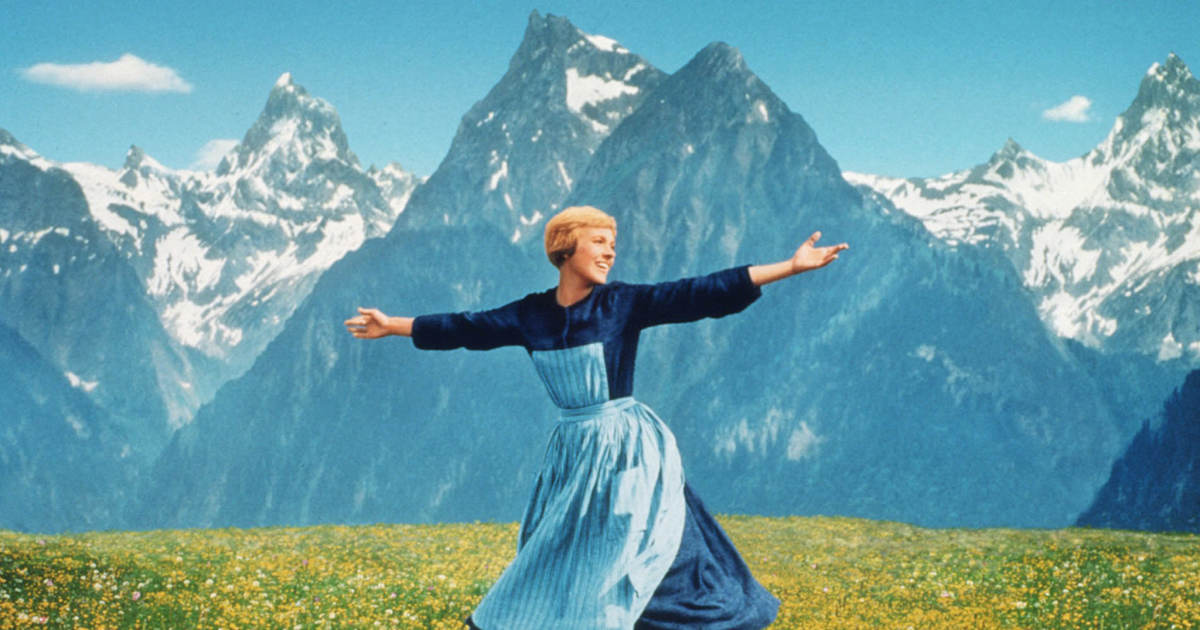
March 2, 1965: The film version of the 1959 musical The Sound of Music premieres, starring Julie Andrews and Christopher Plummer. It proves to be more significant than the musical on which it was based.

The musical was written by Richard Rodgers and Oscar Hammerstein II, and based on The Story of the Trapp Family Singers, published in 1949 by Maria von Trapp. It premiered on November 16, 1959, at the Lunt-Fontanne Theatre. It starred Mary Martin -- already a Broadway legend, and her son Larry Hagman had already begun his acting career) as the woman who begins the story as Sister Maria Rainer and ends it was Mrs. von Trapp; and Theodore Bikel as Captain Georg von Trapp. It ran for 3 1/2 years, and won the Tony Award for Best Musical, with Martin winning the Tony for Best Actress.

Multiple directors were chosen for the film adaptation, before Robert Wise, who had done the film version of West Side Story, was chosen. His only choice to play Maria was Julie Andrews, who had originated the Broadway roles of Eliza Doolittle in My Fair Lady and Queen Guinevere in Camelot. She had been rejected for the film version of My Fair Lady, in favor of Audrey Hepburn, because she'd never been in a movie before. Result? In her 1st movie, Mary Poppins, she beat Hepburn for the Academy Award for Best Actress.

Wise had to talk Broadway veteran Christopher Plummer into playing Captain von Trapp. He ended up hating the film for the rest of his life, but he was great in it. Some of the filming was done in Salzburg, Austria, hometown of the Captain -- and of Wolfgang Amadeus Mozart.

The story begins in 1938, just before Austria was annexed by Nazi Germany in the Anschluss. The nuns at an abbey are wondering about a free-spirited novice: The song is titled "How Do You Solve a Problem Like Maria?" (Definitely not to be confused with the "Maria" song from West Side Story.) She is loaned out to be the governess of the 7 children of the widowed retired naval officer, Captain Georg von Trapp. The children have chased several governesses away, but Maria wins them over.

She even wins over the hard-hearted, strict Captain, who had been engaged to be married to a Baroness, but, seeing that he has feelings for Maria, she breaks the engagement. Maria gets permission from the convent to leave the order and marry Georg. She has been instructing the children in music, and they enter the Salzburg Festival.

But the Anschluss comes first, and Georg is ordered to report to the Kriegsmarine, the Nazi Navy. Georg despises the Nazis, but an agreement is reached: The family will be allowed to compete in the festival, and after it, he will be escorted to the naval base. They sing, and win, but the nuns aid them in escaping. The final scene shows them escaping over the border into Switzerland: The song is "Climb Ev'ry Mountain."

Other songs include the title tract, "Sixteen Going on Seventeen," "The Lonely Goatherd," "Do-Re-Mi," "Edelweiss," "So Long, Farewell," and "My Favorite Things." This last song had been considered one of the most saccharine ever written in its Broadway period, but jazz saxophonist John Coltrane had turned it into a long instrumental masterpiece.

The film was nominated for 10 Oscars, winning 5, including Best Picture, and Best Director for Wise. Andrews was nominated, but lost to Julie Christie for Darling. Plummer was not nominated. These other heavyweights were: Richard Burton for The Spy Who Came In from the Cold, Laurence Olivier for Othello, Rod Steiger for The Pawnbroker, Oskar Werner for Ship of Fools, and the winner, Lee Marvin, for Cat Ballou.

How accurate was the story? Many details were correct, but the names of the children were changed, to protect their real-life privacy. Maria's surname in the movie was Rainer (perhaps a tip of the hat to Oscar-winning German actress Luise Rainer), when, in real life, it was the much harsher Kutschera. And she married Georg not in 1938, but all the way back in 1927. It's been reported that Georg wasn't that strict in real life, that this was exaggerated for dramatic effect. Likewise, the real Maria was, apparently, not very nice. But it was, by all accounts, a loving marriage.

The musical suggests that "Edelweiss," named for a white flower that grows in the Alps, was a traditional Austrian folk song. In fact, it was written for the musical, and was unknown in Austria until after the film was released. It was the last song written by Hammerstein, who died in 1960. Rodgers lived on until 1979.

And the Von Trapps did not try to escape Austria by going over the mountains -- because that would have taken them right into not just Germany, but Berchtesgaden, almost literally into Hitler's backyard. Indeed, their "escape" was not dramatic at all. The family simply walked to the Salzburg Hauptbahnhof and boarded a train to Italy. They were entitled to Italian citizenship since Georg had been born in Zadar, now in Croatia, but then part of the Austro-Hungarian Empire, and had been annexed by Italy after World War I. They were able to emigrate to the United States, via the United Kingdom, on their Italian passports.

The family moved to Stowe, Vermont, where they ran a hotel and ski lodge. Georg died in 1947. Maria never remarried, and lived until 1987. Of the real-life versions of the children: Martina died in 1953 (only 32 years old), Hedwig in 1972, Rupert in 1992, Johanna in 1994, Werner in 2007, Agathe in 2010, Maria Franziska in 2014; and, of the children Georg and Maria had together, Eleonore died in 2021, while Rosemarie and Johannes are still alive. (UPDATE: Rosemarie died on May 13, 2022, age 93.) Various descendants of the various children now make up the touring Trapp Family Singers, while others run the lodge.

Mary Martin died in 1990, Robert Wise in 2005, Theodore Bikel in 2015, and Christopher Plummer in 2021. As of March 2, 2022, Julie Andrews is still alive.

*

March 2, 1965 was a Tuesday. Baseball was in Spring Training. Football was out of season. No NHL games were scheduled. There were 3 games in the NBA:

* The New York Knicks lost to the St. Louis Hawks, 99-98 at the old Madison Square Garden.

* The Cincinnati Royals beat the San Francisco Warriors, 121-105 at the Cincinnati Gardens.

* And the Los Angeles Lakers beat the Philadelphia 76ers, 126-117 at the Los Angeles Memorial Sports Arena. Jerry West scored 34 points.

December 31, 1999 & January 1, 2000: The Millennium

December 31, 1999:  The Millennium arrives. The people of planet Earth survived. At a terrible cost. But we hadn't destroyed ourselves. ...