Showing posts with label league park. Show all posts

Friday, December 16, 2022

December 16, 1945: The Cleveland Rams' Championship Farewell

Number 24 is Jim Gillette, who scored the winning touchdown.

December 16, 1945: The NFL Championship Game is played. The winning team... moves to another city.

You know how, when the Cleveland Browns announced during the 1995 season that they were moving, their fans had such a fit, and talked about how loyal they were? Well, at the time, they were averaging 66,772 fans per home game, which, given the capacity of Cleveland Municipal Stadium, was an average of about 14,000 empty seats.

The Cleveland Rams would have gladly taken that. Founded in 1936, they had hoped to use Municipal Stadium for their home games, but ticket demand was usually so low, instead, they played at 22,000-seat League Park, or the even smaller Shaw Stadium, a high school facility.

In 1945, Adam Walsh was named head coach. He was the center on Notre Dame's 1924 National Championship team, leading the line known as the Seven Mules, so named because they blocked for the backfield known as the Four Horsemen. He saw to it that they drafted UCLA quarterback Bob Waterfield.
Bob Waterfield. Teammate Fred Gehrke,
a graphic artist, invented the modern helmet logo
by painting rams' horns on the helmets in 1948.

And they went 9-1, their best season yet. They played all their home games at League Park, and averaged just 19,402 fans. Granted, a lot of would-be fans were still overseas, as the end of World War II did not mean that every serviceman went home at once. Still, their away games did better: A crowd of 46,219 saw them beat the New York Giants at the Polo Grounds, 40,017 saw them beat the Detroit Lions at Briggs Stadium (later renamed Tiger Stadium), and 38,149 saw their only loss, to the Philadelphia Eagles at Shibe Park.

Since it was the Western Division Champion's turn to host the NFL Championship Game, Rams owner Dan Reeves -- no relation to the later coach of the same name -- booked Municipal Stadium for it, hoping for a big crowd. Certainly, he got the right opponent: The Eastern Division Champions were the Washington Redskins, with superstar quarterback Sammy Baugh, in their 5th Championship Game in the last 9 seasons. (They'd won in 1937 and 1942, and lost in 1940 and 1943.)

But the weather did not cooperate: At kickoff time, it was 8 degrees below zero, the coldest NFL Championship Game ever to that point. (That temperature has only been exceeded once, and that once with an asterisk: The 1967 NFL Championship Game, "The Ice Bowl," was not the World Championship Game.)

As a result, in the football-mad State of Ohio, where Ohio State had played to 4 crowds of 69,000 or more that season, only 32,178 fans paid their way into the big stadium on the shore of Lake Erie. In contrast, playing in Griffith Stadium, which barely seated 35,000 with added seating for football, the Redskins drew more than 32,178 fans in 9 of their 10 regular-season games, home and away.

From 1933 to 1973, the goalposts were on the goal line, not the end line. In the 1st quarter of this game, Baugh faded back from his own 5-yard line, into the end zone, and made a bad throw, which hit the goal post. Under the rule of the time, this was a safety for the Rams, who now led, 2-0. It would matter. 
Sammy Baugh

Each team scored a touchdown in the 2nd quarter. Baugh left the game due to bruised ribs, and Frank Filchock came into replace him. The backup to Slingin' Sammy was called Flingin' Frank, and he threw a 38-yard touchdown pass to Steve "Jack Rabbit" Bagarus. Waterfield threw a 37-yard touchdown pass to Jim Benton, and it was 9-7 Cleveland at the half.

In the 3rd quarter, Waterfield threw a 44-yard touchdown pass to Jim Gillette. However, Waterfield, also the Rams' placekicker, missed the extra point, and it was 15-7. Early in the 4th quarter, Filchock threw an 8-yard touchdown pass to Bob Seymour. Joe Aguirre kicked the extra point, and it was 15-14 in the Rams' favor.
Joe Aguirre

But Aguirre, nicknamed "Hot-Toe," blew 2 chances to win the title, missing 2 field goals in the 4th quarter. The 15-14 score held, and the difference wasn't just Aguirre's toe going cold, it was Baugh's end-zone goof.

Redskins owner George Preston Marshall, who had been the driving force behind several notable rule changes, led the NFL to change the rule for the 1946 season: A forward pass that strikes the goal post would now be ruled an incomplete pass. That rule held until the posts were moved back to the end line for the 1974 season, making such a play impossible: It would have required crossing the end line, which has always been a safety.

Reeves lost $64,000 owning the Rams in the 1945 season. And, with the war over, a new league was being formed, the All-America Football Conference. And they would have a Cleveland team, soon to be named the Browns. Reeves knew that it would be folly to stay in Cleveland.

So he went to the previously untapped market of Los Angeles, and moved the Rams there. Since football is only played once a week, teams taking trains to the West Coast and back was the same kind of problem it would have been for baseball teams before jet travel made it easier. Over a decade before baseball's Brooklyn Dodgers moved there, the Los Angeles Rams became the toast of the town, reaching 4 NFL Championship Games between 1949 and 1955, winning in 1951.

Ironically, Joe Aguirre also went west in 1946, kicking for the AAFC's Los Angeles Dons. They did well at the box office, but couldn't outdraw the Rams, and folded with the league. Aguirre went to the Canadian Football League, and was its leading scorer in 1950 and 1954. But he never won a title in any league.

The Redskins got old in a hurry. And Marshall's policy of refusing to sign black players held the team back in the 1950s. Marshall's eventually fatal illness and incapacity held the team back in the 1960s. It would be 27 years before the team reached another championship game, under any name.

*

December 16, 1945 was a Sunday. Baseball was out of season. The NBA hadn't been founded yet. There were 2 games played in the NHL. The Boston Bruins beat the New York Rangers, 8-7 at the Boston Garden. And the Montreal Canadiens and the Chicago Black Hawks played to a tie, 4-4 at Chicago Stadium.

Saturday, October 1, 2022

October 2, 1908: Ed Walsh vs. Addie Joss

Addie Joss (left) and Ed Walsh

October 2, 1908:  In a wild 3-team American League race, every bit as tight as the 3-team race going on in the National League at the same time, the AL has perhaps its greatest pitching duel ever, between 2 future Hall-of-Famers, at League Park in Cleveland.

Big Ed Walsh of the White Sox strikes on 15 batters, setting a new AL record that stood for 30 years. It was his 40th win of the season. But it's not enough, as Addie Joss, a.k.a. the Human Hairpin for his slender build and his tight pitching motion, pitches a perfect game for the Cleveland Naps, who win, 1-0. Joss advanced to 24-11. Walsh "fell" to 39-15.

Napoleon Lajoie, one of the greatest all-around players of the era, a member of the 3,000 Hits Club and a great fielder, too, was the Cleveland team's 2nd baseman and manager. They were renamed the Naps in his honor in 1903, after being named the Blues. He left after the 1914 season, and they were renamed the Indians, which they would remain until becoming the Cleveland Guardians in 2022.

So the ChiSox and the Naps had played the greatest game in the American League's 8-year history, with both really needing it to win the Pennant. And yet, neither team does. The Detroit Tigers do, the Naps finishing half a game behind, the White Sox 1 1/2 behind: Detroit 90-63, Cleveland 90-64, Chicago 88-64.

Why wasn't the Tigers' missing 154th game made up? I don't know: Neither The Unforgettable Season by G.H. Fleming nor Crazy '08 by Cait Murphy explains why.

It's the 2nd of 3 straight Pennants for the Tigers. The ChiSox had won in 1901 and 1906. The Naps/Indians will not get this close to a Pennant again until they win it all in 1920.

Joss died of meningitis on April 14, 1911, the eve of what would have been his 10th in the major leagues. He was only 31. In 1978, the Baseball Hall of Fame gave him a special waiver on the rule that says players must have played at least 1 game in at least 10 different seasons to qualify for election, since he would have pitched in 1 such game had he been stricken just 1 week later. He was soon elected. It was deserved: He was 160-97, his WHIP of 0.968 is the lowest ever, and his ERA of 1.89 is the 2nd-lowest.

The lowest? Walsh, at 1.82. And his WHIP, exactly 1.000, is 2nd all-time to Joss. He would pitch a no-hitter of his own in 1911. He went 192-126 for his career. And, unlike Joss, he played on a Pennant winner, as the White Sox won the 1906 World Series. He died on May 26, 1959, the day Harvey Haddix pitched a perfect game for 12 innings for the Pittsburgh Pirates, but lost the game to the Milwaukee Braves in the 13th inning.

*

October 2, 1908 was a Friday, the start of the last weekend of one of baseball's greatest regular seasons. Both Leagues had 3-way races.

* The Detroit Tigers beat the St. Louis Browns, 7-6 at Bennett Park in Detroit. Ty Cobb went 1-for-3 with 2 walks and 2 RBIs.

* The New York Highlanders lost to the Washington Senators, 12-2 at Hilltop Park in Manhattan. The proto-Yankees went 51-103 that season, and it remains the most games they've ever lost in a season.

* The Boston Red Sox lost to the Philadelphia Athletics, 8-1 at Columbia Park in Philadelphia.

* In the National League, the New York Giants beat the Philadelphia Phillies, 7-2 at Baker Bowl in Philadelphia.

* The Chicago Cubs beat the Cincinnati Reds, 5-0 at the Palace of the Fans in Cincinnati. Mordecai "Three-Finger" Brown pitched a 4-hit shutout.

* The Pittsburgh Pirates swept a doubleheader from the St. Louis Cardinals at Robison Field in St. Louis, 7-4 and 2-1. Over the 2 games, Honus Wagner went 3-for-8 with an RBI.

* And the Brooklyn Superbas (Dodgers) beat the Boston Doves (Braves), 3-2 at Washington Park in Brooklyn.

Monday, September 12, 2022

September 13, 1936: Bob Feller, Baseball Prodigy

September 13, 1936: The Cleveland Indians sweep a doubleheader from the Philadelphia Athletics, 5-2 and 5-4 at League Park in Cleveland. In the opener, Bob Feller set an American League record with 17 strikeouts. He also walked 9 batters. But he allowed only 2 runs on 2 hits, and went the distance. So it was a very strong performance.

It was his 11th major league appearance. He was 17 years and 315 days old.

Robert William Andrew Feller was born on November 3, 1918 in Van Meter, Iowa, about 20 miles west of the State Capitol in Des Moines. In their 1981 book The 100 Greatest Players In Baseball History, Lawrence S. Ritter and Donald Honig wrote, "Bob Feller remains baseball's only prodigy." The book was written after the exploits of Mickey Mantle, Herb Score and Tony Conigliaro; but those of Dwight Gooden and Bryce Harper have not changed this.

"Rapid Robert" debuted with the Cleveland Indians in 1936, right after high school graduation. In his 1st game, on July 19, he pitched the last inning of a 9-5 loss away to the Washington Senators, and presaging the control issues he would have early in his career, walked 2 batters, but allowed no hits and no runs. On August 23, after 6 relief appearances, he made his 1st major league start. He struck out 15 batters, still a record for a 1st major league start. He walked 4, allowed 1 run on 6 hits, and the Indians beat the St. Louis Browns, 4-1.

In addition to those 17- and 15-strikeout games, he had 2 10-strikeout games. He went 5-3 with a 3.44 ERA. Pretty good for a 17-year-old making 8 starts. He went 9-7 in 1937, again starting late because he was finishing high school. In 1938, his 1st full season, he went 17-11, and led the AL with 240 strikeouts. He also broke his own single-game AL strikeout record, with 18. It would be another 36 years before an AL pitcher fanned 19 in a 9-inning game.

Despite missing nearly 4 full seasons due to World War II, Feller went 266-162, with a 3.25 ERA, 2,581 strikeouts, and 3 no-hitters. He helped the Indians win the AL Pennant in 1948 and 1954, and the World Series in 1948. He was elected to the Hall of Fame in his 1st year of eligibility, and became one of baseball's foremost elder statesmen, living until 2010.

*

September 13, 1936 was a Sunday. It was too early for the NFL season to start. In addition to the Tribe's sweep of the A's, these games were played:

* The New York Yankees swept the St. Louis Browns, 10-7 and 13-1 at Sportsman's Park in St. Louis. Kemp Wicker won the opener, in relief of Lefty Gomez. Johnny Murphy, normally a reliever, went the distance in the nightcap. Over the 2 games, Lou Gehrig went 3-for-7 with 2 home runs, 2 walks, and 3 RBIs. Rookie Joe DiMaggio went 5-for-9 with 3 home runs, a walk, and 6 RBIs.

* A doubleheader was split at the Polo Grounds. The New York Giants won the 1st game, 8-4. Freddie Fitzsimmons won it. The St. Louis Cardinals won the 2nd game, 4-3. Dizzy Dean got the save with 2 innings of relief of winning pitcher Roy Parmelee. Giant manager Bill Terry, in his last month as an active player, went 1-for-4 with an RBI in the 1st game, and drew a walk as a pinch-hitter in the 2nd game. Over the 2 games, Mel Ott went 4-for-9 with 2 home runs and 4 RBIs.

* A doubleheader was split at Ebbets Field. The Brooklyn Dodgers won the 1st game, 6-3. The Chicago Cubs won the 2nd game, 9-7.

* A doubleheader was split at National League Park, a.k.a. the Bee Hive, in Boston. The Cincinnati Reds won the 1st game, 2-1. The Boston Bees won the 2nd game, 6-1. This was the 1st of 5 seasons that the former Boston Braves tried to distance themselves from a horrible 1935 season by changing the names of their team and their stadium. It didn't take hold with the public, and in 1941, the names "Boston Braves" and "Braves Field" were restored.

* A doubleheader was split at Baker Bowl in Philadelphia. The Pittsburgh Pirates won the 1st game, 5-3. The Philadelphia Phillies won the 2nd game, 4-3. Over the 2 games, Paul Waner went 3-for-6 with 2 walks and an RBI, and Lloyd Waner went 3-for-4 with 2 walks and an RBI.

* The Boston Red Sox beat the Detroit Tigers, 7-4 at Navin Field in Detroit. (It was renamed Briggs Stadium in 1938, and Tiger Stadium in 1961.) Jimmie Foxx went 2-for-4 with a home run, a walk, and 2 RBIs. Hank Greenberg was injured, and did not play.

* And the Chicago White Sox and the Washington Senators were not scheduled -- which seems odd for a Sunday, but, according to Baseball-Reference.com, there is no explanation. No mention of a rainout. If there was, then it was never made up.

Wednesday, August 10, 2022

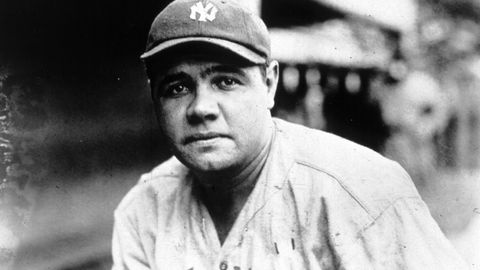
August 11, 1929: Babe Ruth Starts the 500 Home Run Club

August 11, 1929: The Cleveland Indians beat the New York Yankees, 6-5 at League Park in Cleveland. The Indians won in spite of Babe Ruth and Lou Gehrig, the leaders of the Yankees' "Murderer's Row," both hitting home runs.

In Ruth's case, it was his 30th of the season, and the 500th of his career. At this point, the man in 2nd place on the all-time home run list was Rogers Hornsby, and he had 261. (Gehrig's homer was his 27th of the season, and the 183rd of his career.)

League Park was jammed into a city block at the northeastern corner of 66th Street and Lexington Avenue, on the East Side of Cleveland. Because of the size of the block, the right field foul pole was only 290 feet from home plate, and there was no room for seats beyond it. To discourage "cheap" home runs, the wall was 40 feet high. In contrast, the left field pole was 375 feet away, and the fence was only 5 feet high. Ruth hit the ball well over the right field fence, and it would have been a home run in any stadium in the major leagues at the time.

The original version of League Park was mainly wooden, and stood from 1890 to 1909, and hosted the National League's Cleveland Spiders until 1899, and then the American League team now known as the Cleveland Guardians, starting in 1901.

It was torn down, and replaced with a new ballpark of concrete and steel, seating 21,000. The Indians won the World Series while playing there in 1920. It was also home to the Negro Leagues' Cleveland Buckeyes, who won the Negro World Series in 1945; and several football teams, including the Cleveland Bulldogs in their 1924 NFL Championship season.

In 1931, the vast, 85,000-seat Cleveland Municipal Stadium opened. The Indians began using it for select games in 1932, including night games starting in 1939. Lights were never installed at League Park. The Indians played their last game there in 1946, and played at Municipal Stadium exclusively until 1993. The following year, they moved into Jacobs Field, which was renamed Progressive Field in 2007.

Despite giving up both home runs, Willis Hudlin went the distance for the Indians, allowing 5 runs, 4 of them earned, on 8 hits, 4 walks, 1 of them intentional (to Bill Dickey), and struck out 2. Still, giving up this Ruth milestone was the most notable thing about Hudlin: In a career lasting from 1926 to 1940, plus a 1-game comeback with the St. Louis Browns in 1944 due to the manpower shortage of World War II, Hudlin went 158-156 with a 4.41 ERA. That 1929 season was his best, going 17-15 with a 3.34 ERA. A native of Wagoner, Oklahoma, he died in 2002, at age 96.

Ruth would hit his 600th home run in 1931, his 700th in 1934, and his 714th and last in 1935. He held the career record from 1921, when he hit his 138th, until 1974, when Hank Aaron hit his 715th. Aaron would raise the record to 755. In 2007, Barry Bonds, through tainted means, would raise the record to 762.

Because the disease that came to bear his name forced Gehrig to retire with 493 career home runs, there would not be a 2nd member of what came to be known as the 500 Home Run Club until 1940, when Jimmie Foxx hit his 500th.

They have been followed by: Mel Ott in 1945, Ted Williams in 1960, Willie Mays in 1965, Mickey Mantle and Eddie Mathews in 1967, Aaron in 1968, Ernie Banks in 1970, Harmon Killebrew and Frank Robinson in 1971, Willie McCovey in 1978, Reggie Jackson in 1984, Mike Schmidt in 1987, Eddie Murray in 1996, Mark McGwire in 1999, Bonds in 2001, Sammy Sosa and Rafael Palmeiro in 2003, Ken Griffey Jr. in 2004; Frank Thomas, Alex Rodriguez and Jim Thome, all in 2007; Manny Ramirez in 2008, Gary Sheffield in 2009, Albert Pujols in 2014, David Ortiz in 2015, and Miguel Cabrera in 2021.

That makes 28 members as of August 11, 2022. However, McGwire, Bonds, Sosa, Palmeiro, Rodriguez, Ramirez, Sheffield and Ortiz were all established as steroid users, so their totals cannot be taken seriously. So, it's really 20 members.

Let the record show that the steroids they took weren't even available in Ruth's time. Given the hot dogs he ate and the alcohol he drank, it's safe to say that the chemicals that Ruth ingested were not performance-enhancing. Which makes his achievements all the more amazing.

*

August 11, 1929 was a Sunday. At the time, it was still illegal for professional sports to be played in Pennsylvania. As a result, the Philadelphia Phillies did not play on this day, while the Philadelphia Athletics and the Pittsburgh Pirates were on the road. The Phillies played a doubleheader with the St. Louis Cardinals at Baker Bowl the day before. The Phils won the opener, 7-1; while the Cards won the nightcap, 11-9 in 11 innings.

The Athletics lost to the Detroit Tigers, 9-8 at Navin Field (later renamed Briggs Stadium and Tiger Stadium) in Detroit. Despite 4 hits, including a home run, from Bing Miller, and 3 from Al Simmons, the A's couldn't hold the lead. George Earnshaw ran out of gas in the bottom of the 9th, and was also betrayed by his defense, and the Tigers scored 4 runs to send the game to extra innings. Roy Johnson won it for Detroit with a home run in the bottom of the 11th. In spite of this loss, the A's went on to win the World Series.

The Pirates lost to the Brooklyn Robins (as the Dodgers were known while Wilbert Robinson managed them from 1914 to 1931), 5-3 at Ebbets Field in Brooklyn. The Robins got homers from Johnny Frederick, Harvey Hendrick and Del Bissonette. For the Pirates, Pie Traynor went 1-for-4 with an RBI, Paul Waner went 0-for-4, and Lloyd Waner went 1-for-3 with an RBI.

In other games:

* The New York Giants beat the Cincinnati Reds, 6-1 at the Polo Grounds. Carl Hubbell outpitched his future Giant teammate Adolfo Luque. Travis Jackson hit a home run, Bill Terry went 2-for-3 with a walk, and Mel Ott went 0-for-3 with a walk.

* The Chicago Cubs beat the Boston Braves, 3-1 at Braves Field in Boston.

* The Chicago White Sox beat the Boston Red Sox, 6-3 at Comiskey Park in Chicago.

* And the Washington Senators beat the St. Louis Browns, 7-5 at Sportsman's Park in St. Louis.

Sunday, July 24, 2022

July 24, 1911: The Addie Joss Benefit Game

July 24, 1911: A benefit game is played at League Park in Cleveland, for the family of Addie Joss.

Adrian Joss was born on April 12, 1880 outside Milwaukee in Woodland, Wisconsin. Known as the Human Hairpin for his slender build and his tight pitching motion, he pitched for the Cleveland Naps from 1902 to 1910, going 160-97.

The Cleveland Whats? Napoleon Lajoie, one of the greatest all-around players of the era, a member of the 3,000 Hits Club and a great fielder, too, was the Cleveland team's 2nd baseman and manager. Starting as the Cleveland Blues in 1901, and the Cleveland Bronchos in 1902, they were renamed the Cleveland Naps in his honor in 1903. He left after the 1914 season, and they were renamed the Indians, which they would remain until becoming the Cleveland Guardians in 2022.

Addie Joss' career WHIP -- walks plus his, divided by innings pitches -- of 0.968 is the lowest ever, and his ERA of 1.89 is the 2nd-lowest. The lowest ERA belongs to Ed Walsh of the Chicago White Sox, at 1.82. And his WHIP, exactly 1.000, is 2nd all-time to Joss. In the 1900s (the 1900-09 decade), Joss and Walsh were the 2 best pitchers in the American League.

On October 2, 1908, they opposed each other as their teams and the Detroit Tigers all went down to the wire for the AL Pennant. Walsh struck out 15 batters, and AL record that stood for 30 years. But Joss pitched a perfect game, and the Naps won, 1-0. It remains the greatest pitching duel in AL history, but it ended up not mattering, as the Tigers won the Pennant, by half a game over the Naps and one and a half over the ChiSox.

Joss led the major leagues in wins in 1907, and led the major leagues in ERA in 1904 and 1908. On April 20, 1910, he pitched a no-hitter against the White Sox, making him the 1st pitcher to pitch no-hitters against the same team twice. Only one pitcher since has matched that: Tim Lincecum of the San Francisco Giants, against the San Diego Padres in 2013 and 2014.
Addie Joss

Joss died of meningitis on April 14, 1911, the eve of what would have been his 10th in the major leagues. He was only 31. Upon hearing of his death, the Cleveland Press newspaper wrote "every train brings flowers" and "floral tributes by the wagonload are hourly arriving at the Joss home from all sections of the country." Billy Sunday, then America's foremost evangelist, had been a major league pitcher from 1883 to 1890, mostly with the team now known as the Chicago Cubs, and accepted the Joss' family's request to preside over Addie's funeral.

A benefit "all-star" game for Joss's family was scheduled by the Naps for July 24, 1911. They invited players from the other 7 AL teams to play against them. Jimmy McAleer would manage the All-Stars against Lajoie. At the time, he was the manager of the Washington Senators. He had been the Cleveland team's 1st manager in 1901, and had played for their previous National League team, the Cleveland Spiders. He said, "The memory of Addie Joss is sacred to everyone with whom he ever came in contact. The man never wore a uniform who was a greater credit to the sport than he."

Cy Young, who had also played for the Spiders, was in his last season in the major leagues, and started for the Naps, pitching the 1st 3 innings. (He would be traded later in the season, to the Boston team that became known as the Braves, and end his career there.) Lajoie played in the game, but went 0-for-2. "Shoeless" Joe Jackson, in his 1st big season in the majors, also went 0-for-2. From the other 7 teams:

* From the Boston Red Sox: Pitcher "Smoky" Joe Wood (who started, and pitched the 1st 2 innings), center fielder Tris Speaker (who would be traded to Cleveland in 1916 and lead them to the 1920 World Series).

* From the Detroit Tigers: Right fielder Ty Cobb (who forgot his Tigers uniform, so he wore a Cleveland road uniform during the game), and left fielder Sam Crawford.

* From the New York Highlanders: 1st baseman Hal Chase, and pitcher Russ Ford, who pitched the last 4 innings.

* From the Philadelphia Athletics: 2nd baseman Eddie Collins, 3rd baseman Frank Baker (who would become known as "Home Run Baker" for his heroics in that year's World Series), and catcher Patrick "Paddy" Livingston.

* From the St. Louis Browns: Shortstop Bobby Wallace.

* From the Washington Senators: Pitcher Walter Johnson (who told the press, "I'll do anything they want for Addie Joss' family"), and pitched the 3rd, 4th and 5th innings; catcher Gabby Street and center field Clyde Milan.

* Only the Chicago White Sox did not send a representative. Ed Walsh had volunteered to play, but the team's travel schedule simply didn't allow it.

The game was attended by approximately 15,270 fans, and raised nearly $13,000 (about $40,000 in 2022 money) to help Joss' family members pay remaining medical bills. The All-Stars beat the Naps, 5–3. No home runs were hit.

Baseball would not have an official All-Star Game until 1933, when a team of AL stars beat a team of NL stars at Comiskey Park in Chicago, making the All-Star Game an annual event. Oddly, in 1920, when Ray Chapman, shortstop for the team by then known as the Cleveland Indians, became the only player ever to die as a result of an in-game incident, there was no benefit game for his family.

In 1978, the Baseball Hall of Fame gave Joss a special waiver on the rule that says players must have played at least 1 game in at least 10 different seasons to qualify for election, since he would have pitched in 1 such game had he been stricken just 1 week later. He was soon elected. It was deserved.

*

July 24, 1911 was a Monday. One reason why this date was chosen for the game is that only 3 games were scheduled. All were in the National League:

* The New York Giants beat the Cincinnati Reds, 8-3 at the Palace of the Fans in Cincinnati. Rube Marquard went the distance for the win.

* The Brooklyn Dodgers lost to the Pittsburgh Pirates, 8-2 at Forbes Field in Pittsburgh. Honus Wagner went 0-for-3, but did draw a walk.

* And the St. Louis Cardinals beat the Philadelphia Phillies, 10-2 at Baker Bowl in Philadelphia.  

Friday, July 22, 2022

July 22, 1923: Walter Johnson Starts the 3,000 Strikeout Club

July 22, 1923: The Washington Senators beat the Cleveland Indians, 3-1 at League Park in Cleveland. Indians player-manager Tris Speaker goes 2-for-3 with 2 walks. Walter Johnson of the Senators not only outpitches fellow future Hall-of-Famer Stan Coveleski, but strikes him out, for the 3,000th strikeout of his career. "The Big Train" is the 1st pitcher to reach this milestone. There will not be a 2nd for another 51 years.

Although the batting milestones of 3,000 hits and 500 home runs, and the pitching milestone of 300 wins, were long considered to be automatic qualification for the Baseball Hall of Fame -- the Hall's rules for election specifically state that there shall be no feat that will be considered automatic qualification -- 3,000 strikeouts is not held in the same regard.

For example: When he retired, Bert Blyleven had 3,701 strikeouts, more than any pitcher except Nolan Ryan and Steve Carlton. And he had won 287 games, more than many pitchers who were in the Hall. Yet it took him 14 tries to get in. Roger Clemens and Curt Schilling, both of whom with at least 3,000, but also with serious questions of moral character, including but not limited to the fact that they are both suspected of using steroids, are not in.

There are now 19 pitchers in the 3,000 Strikeout Club. Johnson was joined by Bob Gibson in 1974, Gaylord Perry in 1978, Nolan Ryan in 1980, Tom Seaver and Steve Carlton in 1981, Ferguson Jenkins in 1982, Don Sutton in 1983, Phil Niekro in 1984, Bert Blyleven in 1986, Roger Clemens in 1998, Randy Johnson (no relation to Walter) in 2000, Greg Maddux in 2005, Curt Schilling in 2006, Pedro Martinez in 2007, John Smoltz in 2008, CC Sabathia and Justin Verlander in 2019, and Max Scherzer in 2021.

*

July 22, 1923 was a Sunday. These other baseball games were played on that day:

* The New York Yankees beat the Detroit Tigers, 7-4 at Navin Field in Detroit. (The ballpark would later be renamed Briggs Stadium and Tiger Stadium.) Babe Ruth went 1-for-5 with 2 RBIs. Tigers manager Ty Cobb did not put himself into the game.

* The New York Giants were leading the Philadelphia Phillies, 5-4 after 5 innings at the Polo Grounds, when the game was called due to rain.

* Rain in New York City did not prevent 18 full innings from being played at Ebbets Field in Brooklyn. The Dodgers -- or the Robins, as they were known while Wilbert Robinson managed them from 1914 to 1931 -- lost the opener to the Boston Braves, 14-0. But they won the nightcap, 7-5.

* The Chicago White Sox beat the Boston Red Sox, 9-2 at Comiskey Park in Chicago.

* The St. Louis Cardinals beat the Cincinnati Reds, 2-0 at Redland Field in Cincinnati. (The ballpark would later be renamed Crosley Field.) Jesse Haines pitched a 4-hit shutout.

* The St. Louis Browns beat the Philadelphia Athletics, 9-4 at Sportsman's Park in St. Louis. George Sisler did not play for the Browns.

* And neither the Philadelphia Phillies nor the Pittsburgh Pirates played. Professional sports on Sunday would remain illegal in Pennsylvania until 1933.
 

Wednesday, April 20, 2022

April 21, 1910: Halley's Comet & Mark Twain

April 21, 1910: Halley's Comet makes its closest approach to Earth on its 75 1/2-year trip around the Sun. It had last done so on November 30, 1835.

On that date, in Hannibal, Missouri, on the Mississippi River, a boy was born. He was named Samuel Langhorne Clemens. He would go on to do a lot of things with his life, including work on riverboats, drive a wagon on a westward wagon train, and write for newspapers from coast to coast.

From his work on riverboats, he took the pen name Mark Twain. "Mark" meaning distance and "Twain" meaning "two," the combined meaning of "Mark Twain" was, roughly, the point at which water became safe to travel -- or unsafe. And he did often seem to live his life on the border between safe and unsafe -- but also on the border between America's slaveholding South and its abolitionist North, and on the border between its established East and its then-wide-open, freewheeling "Wild West."

William Faulkner called him "The Father of American Literature," based mainly on The Adventures of Tom Sawyer, published in 1876, the 1st major American novel written on a typewriter; and its sort-of sequel, The Adventures of Huckleberry Finn, published in 1884.

He became America's leading lecture-circuit figure, unafraid to mock the high and the mighty and point out that their foibles were much the same as those of the low and the powerless. As has been said of journalists since, he sought to comfort the afflicted, and afflict the comfortable.

On June 2, 1897, the New York Journal, the hub of the journalism empire of William Randolph Hearst, ran a rebuttal to an article it had written, claiming that Twain had died, including Twain's own words:

I can understand perfectly how the report of my illness got about, I have even heard on good authority that I was dead. James Ross Clemens, a cousin of mine, was seriously ill two or three weeks ago in London, but is well now. The report of my illness grew out of his illness. The report of my death was an exaggeration.

This was one of many quotes of Twain that have either been gotten wrong, or incorrectly attributed to him. It is usually remembered as, "Reports of my death have been greatly exaggerated." A friend of his, novelist Charles Dudley Warner, said, "Everybody complains about the weather, but nobody does anything about it." And Twain went out of his way to credit Warner for the line. But most people credit it to Twain.

One quote definitely correctly attributed to Twain came in 1909:

I came in with Halley's Comet in 1835. It is coming again next year, and I expect to go out with it. It will be the greatest disappointment of my life if I don't go out with Halley's Comet. The Almighty has said, no doubt: "Now here are these two unaccountable freaks, They came in together, they must go out together."

Twain's prediction was accurate: He died of a heart attack on April 21, 1910, at Stormfield, his home in Redding, Connecticut. (The house burned down in 1923, and a replica was built on the site.) He was buried in Woodlawn Cemetery in Elmira, New York. So were Hal Roach, producer of the Laurel & Hardy and Our Gang films; and Ernie Davis, the 1st black Heisman Trophy winner.

*

April 21, 1910 was a Thursday. These baseball games were played that day:

* The New York Highlanders beat the Philadelphia Athletics, 1-0 at Shibe Park in Philadelphia. Russ Ford -- that's Russ, pitching for the team that would officially become the Yankees in 1913, not Whitey -- outpitched Cy Morgan. Despite this game, while the Highlanders did finish 2nd, they would be 14 1/2 games behind the Pennant-winning A's.

* The New York Giants beat the Boston Doves, 3-2 at the Polo Grounds. Rube Marquard was the winning pitcher, and Larry Doyle hit a home run, once again proving his quote: "It's great to be young and a Giant." The Doves, named for their owners, the Dovey brothers, became the Boston Braves in 1912.

* The Brooklyn Superbas lost to the Philadelphia Phillies, 1-0 at Washington Park in Brooklyn. Lew Moren pitched a 2-hit shutout, outpitching Irvin Wilhelm, already known as "Kaiser" in those pre-World War I years. The Superbas officially renamed themselves the Dodgers the next season.

* The Boston Red Sox beat the Washington Senators, 10-3 at the Huntington Avenue Grounds in Boston. Tris Speaker went 2-for-3 with a walk and an RBI.

* The Pittsburgh Pirates beat the St. Louis Cardinals, 9-4 at Forbes Field in Pittsburgh. Honus Wagner went 1-for-3 with 2 walks.

* The Detroit Tigers beat the Cleveland Naps, 5-0. This was the 1st game played at the 2nd League Park in Cleveland, replacing the one that stood at the same location, East 66th Street & Lexington Avenue, since 1891. Ty Cobb went 0-for-4. Napoleon "Nap" Lajoie, Cleveland's 2nd baseman, manager and namesake, went 1-for-4.

The team was renamed the Cleveland Indians in 1915, and the Cleveland Guardians in 2022. They played all their games at League Park until 1932, then alternated between there and Municipal Stadium until 1946, then only at Municipal Stadium until 1993, and then moved into Jacobs Field in 1994, renaming it Progressive Field in 2008.

* The Chicago Cubs beat the Cincinnati Reds, 6-1 at the West Side Grounds in Chicago.

* And the St. Louis Browns beat the Chicago White Sox, 4-1 at Sportsman's Park in St. Louis.

December 31, 1999 & January 1, 2000: The Millennium

December 31, 1999:  The Millennium arrives. The people of planet Earth survived. At a terrible cost. But we hadn't destroyed ourselves. ...