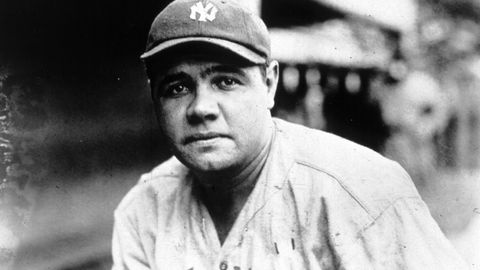
August 11, 1929: The Cleveland Indians beat the New York Yankees, 6-5 at League Park in Cleveland. The Indians won in spite of Babe Ruth and Lou Gehrig, the leaders of the Yankees' "Murderer's Row," both hitting home runs.
In Ruth's case, it was his 30th of the season, and the 500th of his career. At this point, the man in 2nd place on the all-time home run list was Rogers Hornsby, and he had 261. (Gehrig's homer was his 27th of the season, and the 183rd of his career.)
League Park was jammed into a city block at the northeastern corner of 66th Street and Lexington Avenue, on the East Side of Cleveland. Because of the size of the block, the right field foul pole was only 290 feet from home plate, and there was no room for seats beyond it. To discourage "cheap" home runs, the wall was 40 feet high. In contrast, the left field pole was 375 feet away, and the fence was only 5 feet high. Ruth hit the ball well over the right field fence, and it would have been a home run in any stadium in the major leagues at the time.
The original version of League Park was mainly wooden, and stood from 1890 to 1909, and hosted the National League's Cleveland Spiders until 1899, and then the American League team now known as the Cleveland Guardians, starting in 1901.
It was torn down, and replaced with a new ballpark of concrete and steel, seating 21,000. The Indians won the World Series while playing there in 1920. It was also home to the Negro Leagues' Cleveland Buckeyes, who won the Negro World Series in 1945; and several football teams, including the Cleveland Bulldogs in their 1924 NFL Championship season.
In 1931, the vast, 85,000-seat Cleveland Municipal Stadium opened. The Indians began using it for select games in 1932, including night games starting in 1939. Lights were never installed at League Park. The Indians played their last game there in 1946, and played at Municipal Stadium exclusively until 1993. The following year, they moved into Jacobs Field, which was renamed Progressive Field in 2007.
Despite giving up both home runs, Willis Hudlin went the distance for the Indians, allowing 5 runs, 4 of them earned, on 8 hits, 4 walks, 1 of them intentional (to Bill Dickey), and struck out 2. Still, giving up this Ruth milestone was the most notable thing about Hudlin: In a career lasting from 1926 to 1940, plus a 1-game comeback with the St. Louis Browns in 1944 due to the manpower shortage of World War II, Hudlin went 158-156 with a 4.41 ERA. That 1929 season was his best, going 17-15 with a 3.34 ERA. A native of Wagoner, Oklahoma, he died in 2002, at age 96.
Ruth would hit his 600th home run in 1931, his 700th in 1934, and his 714th and last in 1935. He held the career record from 1921, when he hit his 138th, until 1974, when Hank Aaron hit his 715th. Aaron would raise the record to 755. In 2007, Barry Bonds, through tainted means, would raise the record to 762.
Because the disease that came to bear his name forced Gehrig to retire with 493 career home runs, there would not be a 2nd member of what came to be known as the 500 Home Run Club until 1940, when Jimmie Foxx hit his 500th.
They have been followed by: Mel Ott in 1945, Ted Williams in 1960, Willie Mays in 1965, Mickey Mantle and Eddie Mathews in 1967, Aaron in 1968, Ernie Banks in 1970, Harmon Killebrew and Frank Robinson in 1971, Willie McCovey in 1978, Reggie Jackson in 1984, Mike Schmidt in 1987, Eddie Murray in 1996, Mark McGwire in 1999, Bonds in 2001, Sammy Sosa and Rafael Palmeiro in 2003, Ken Griffey Jr. in 2004; Frank Thomas, Alex Rodriguez and Jim Thome, all in 2007; Manny Ramirez in 2008, Gary Sheffield in 2009, Albert Pujols in 2014, David Ortiz in 2015, and Miguel Cabrera in 2021.
That makes 28 members as of August 11, 2022. However, McGwire, Bonds, Sosa, Palmeiro, Rodriguez, Ramirez, Sheffield and Ortiz were all established as steroid users, so their totals cannot be taken seriously. So, it's really 20 members.
Let the record show that the steroids they took weren't even available in Ruth's time. Given the hot dogs he ate and the alcohol he drank, it's safe to say that the chemicals that Ruth ingested were not performance-enhancing. Which makes his achievements all the more amazing.
*
August 11, 1929 was a Sunday. At the time, it was still illegal for professional sports to be played in Pennsylvania. As a result, the Philadelphia Phillies did not play on this day, while the Philadelphia Athletics and the Pittsburgh Pirates were on the road. The Phillies played a doubleheader with the St. Louis Cardinals at Baker Bowl the day before. The Phils won the opener, 7-1; while the Cards won the nightcap, 11-9 in 11 innings.
The Athletics lost to the Detroit Tigers, 9-8 at Navin Field (later renamed Briggs Stadium and Tiger Stadium) in Detroit. Despite 4 hits, including a home run, from Bing Miller, and 3 from Al Simmons, the A's couldn't hold the lead. George Earnshaw ran out of gas in the bottom of the 9th, and was also betrayed by his defense, and the Tigers scored 4 runs to send the game to extra innings. Roy Johnson won it for Detroit with a home run in the bottom of the 11th. In spite of this loss, the A's went on to win the World Series.
The Pirates lost to the Brooklyn Robins (as the Dodgers were known while Wilbert Robinson managed them from 1914 to 1931), 5-3 at Ebbets Field in Brooklyn. The Robins got homers from Johnny Frederick, Harvey Hendrick and Del Bissonette. For the Pirates, Pie Traynor went 1-for-4 with an RBI, Paul Waner went 0-for-4, and Lloyd Waner went 1-for-3 with an RBI.
In other games:
* The New York Giants beat the Cincinnati Reds, 6-1 at the Polo Grounds. Carl Hubbell outpitched his future Giant teammate Adolfo Luque. Travis Jackson hit a home run, Bill Terry went 2-for-3 with a walk, and Mel Ott went 0-for-3 with a walk.
* The Chicago Cubs beat the Boston Braves, 3-1 at Braves Field in Boston.
* The Chicago White Sox beat the Boston Red Sox, 6-3 at Comiskey Park in Chicago.
* And the Washington Senators beat the St. Louis Browns, 7-5 at Sportsman's Park in St. Louis.


No comments:
Post a Comment