Showing posts with label north carolina. Show all posts

Monday, December 26, 2022

December 27, 1892: The Birth of Black College Football

A modern game between Livingstone (left) and Smith

December 27, 1892: A college football game is played in Salisbury, North Carolina. Livingston College hosts Biddle University, of Charlotte, North Carolina, 41 miles to the southwest.

Based on information currently available, this is believed to have been the 1st football game between two schools that would now be called "historically black colleges and universities," or HBCUs. It is known as "The Birth of Black College Football."

The game was set up between two friends, Charles Shute of Biddle and William J. Trent of Livingstone. The former school had been playing on what would now be called an intramural level for 2 years. When Shute learned that Livingston was starting a football team, he contacted Trent, and the game was set up.

A rare snowstorm had hit the Carolinas over the Christmas holiday, and the site chosen for the field, a converted cow pasture in what is now Livingstone's front campus, had to be cleared of 5 inches of snow.

Apparently, the experience mattered: Biddle won, 4-0. Under the scoring system in use at the time, that's one touchdown to none. Under today's scoring, presuming they made their extra point, it would be 7-0. The name of the scoring player was not recorded. Nor was an estimate of the attendance.

Biddle University was named for the Biddle family of Philadelphia, an "old-money" family involved in banking, which had donated money to start the school in 1867. In 1921 to 1922, Jane Berry Smith donated funds to the school, to build a theological dormitory, a science hall, a teachers' cottage, a memorial gate, and an endowment in memory of her late husband, Johnson C. Smith, a Pittsburgh businessman and a member of the Presbyterian Church, with which Biddle was affiliated. In 1923, in recognition of this, the school's board of trustees renamed the school Johnson C. Smith University.

Trent went on to become not just the president of Livingstone, but its longest-serving president, and the last surviving player from the game, on either side.

Livingstone College was founded in 1879, affiliated with the African Methodist Episcopal Church. It was founded in 1879 as Zion Wesley Institute, named for Zion, another name for Israel; and John Wesley, the founder of Methodism. In 1887, it was renamed for Dr. David Livingstone, the famous Victorian-era Scottish physician and missionary in Africa.

Both the Smith Golden Bulls and the Livingstone Blue Bears now compete in NCAA Division II. Their rivalry continues as fellow members of the Central Intercollegiate Athletic Association (CIAA), and their annual game is named the Commemorative Classic.

*

December 27, 1892 was a Tuesday -- then as now, an unusual day for a football game, at any level. There appear to have been no other scores on this historic day: For most college football teams, the season ended on Thanksgiving or earlier; baseball was out of season; hockey was all-amateur; and basketball had only been invented 1 year earlier.

Friday, December 16, 2022

December 17, 1903: The Wright Brothers Take Flight

December 17, 1903: The brothers Orville and Wilbur Wright made the 1st verified heavier-than-air flight, at Kill Devil Hill, in the Outer Banks of North Carolina.

Wilbur, 36, and Orville, 32, had been bicycle builders in their native Dayton, Ohio. They took what they learned in aerodynamics from that, and put it to work in building gliders, and finally their first airplane, the Wright Flyer.

They chose Kitty Hawk -- the site is now in the town of Kill Devil Hill, which broke away decades later -- because of the favorable wind conditions. Their 1st flight lasted only 12 seconds, and went just 120 feet. But they did it. By the end of the day, they were able to fly for a full minute.
They made improvements, built new planes, and by 1908, they were ready to show the world -- particularly France, which was challenging them for pioneer status in this regard -- that they had forever put to rest the old saying, "If man was meant to fly, God would have given him wings."

Wilbur died in 1912, from typhoid fever, only 45 years old. No antibiotics in those days. Orville saw how airplanes could be used in warfare, exacting a terrible toll in both World Wars. But he also saw the achievements of people like Charles Lindbergh, Charles Kingsford Smith, Wiley Post, Amelia Earhart, and Chuck Yeager. On January 30, 1948, 3 months after Yeager became the 1st person to fly faster than the speed of sound, Orville died, at 76. It would be another 13 years before man flew in space.

The Wright Flyer is now a featured exhibit in the Smithsonian Institution's National Air and Space Museum, on the National Mall in Washington, D.C. And because of their achievement, when the Commemorative Quarters for each State were produced by the U.S. Mint, the Wrights were depicted for both Ohio and North Carolina.

In a 2012 episode of the YouTube series Epic Rap Battles of History, YouTube personalities Rhett McLaughlin and Charles Lincoln "Link" Neal played Wilbur and Orville Wright, respectively; against "Epic" Lloyd Ahlquist as Mario and "Nice" Peter Shukoff as Luigi, of the Mario Brothers franchise.

*

December 17, 1903 was a Thursday. Erskine Caldwell was born on that day. He wrote the novels Tobacco Road and God's Little Acre. Although North Carolina, where the Wright Brothers made their 1st flight, is a tobacco-producing State, and its multi-sided basketball rivalry has been nicknamed "Tobacco Road," Caldwell had actually written about his native Georgia.

Baseball was out of season. Football season had ended as well. Basketball did not exist at the professional level. There may have been league hockey games that day, but they weren't professional, either. The Ottawa Hockey Club, nicknamed the Silver Seven and later to be known as the original Ottawa Senators, were the holders of the Stanley Cup, and would play the Winnipeg Rowing Club on December 30, 1903; and January 1 and 4, 1904, to keep the Cup.

Wednesday, November 9, 2022

November 10, 1898: The Wilmington Insurrection

November 10, 1898: The Wilmington Insurrection of 1898 is carried out in Wilmington, North Carolina. The white press in Wilmington originally described the event as a race riot, caused by black people. Since the late 20th Century and further study, the event has been characterized as a violent overthrow of a duly elected government by a group of white supremacists.

The coup was the result of a group of the State's white Southern Democrats conspiring and leading a mob of 2,000 white men to overthrow the legitimately elected local Fusionist biracial government in Wilmington. They expelled opposition black and white political leaders from the city, destroyed the property and businesses of black citizens built up since the American Civil War, including the only black-owned newspaper in the city, and killed an estimated 60 to more than 300 people.

The Wilmington Insurrection is considered a turning point in Southern politics. It was part of an era of more severe racial segregation and effective disenfranchisement of African-Americans in the region, which had been underway since the passage of a new State Constitution in Mississippi in 1890, which raised barriers to the registration of black voters. Other States soon passed similar laws.

Historian Laura Edwards writes, "What happened in Wilmington became an affirmation of white supremacy not just in that one city, but in the South and in the nation as a whole," as it affirmed that invoking "whiteness" eclipsed the legal citizenship, individual rights, and equal protection under the law that black Americans were guaranteed under the 14th Amendment.

In other words, a State could nullify not just a federal law, but a human being’s federally-guaranteed rights. It has been just 33 years since there had literally been a war over it, and their side lost the war in 1865. But they “won the peace,” and it would take until 1965 for the right thing to be done.

*

November 10, 1898 was a Thursday. Baseball was out of season. Football was in midweek. Professional basketball and hockey did not exist. So there were no scores on this historic day.

Sunday, November 6, 2022

November 6, 1990: Michael Jordan Helps Jesse Helms Get Re-Elected

November 6, 1990: Jesse Helms is elected to a 4th term as a U.S. Senator from North Carolina. He did not deserve this, but he got it. There are several people to blame.

One of them is Michael Jordan.

Nike signed Jordan as an NBA rookie in 1984, thinking he would be the next NBA superstar. They were right: Despite an injury-plagued rookie season, his scoring and dunking made him the player ever kid who loved basketball wanted to be -- even though he went through his 1st 6 seasons without having reached the NBA Finals.

Although born in New York City -- on February 17, 1963, at Cumberland Hospital in Brooklyn, where boxer Mike Tyson would be born 3 years later -- Jordan lived in Wilmington, North Carolina from age 5 until he began studying and playing at the University of North Carolina in 1981. Despite having maintained a home in Chicago since his rookie year, he has always considered North Carolina his home State.

He had helped the University of North Carolina win the National Championship as a freshman in 1982, but, with his head coach having instituted his passing-first "Four Corners" offense, it became a joke among NBA fans that the only man who could hold Michael Jordan to under 20 points was Dean Smith.

Although from conservative Kansas, Smith was a Democrat, who had helped integrate the athletic program at UNC. So was Harvey Gantt, who, in 1963, became the 1st black student at Clemson University in South Carolina. The 2nd was Lucinda Brawley, who became Gantt's wife. An architect, he was elected to the City Council in Charlotte in 1973, and Mayor in 1982 and 1986. In 1990, the Democrats nominated him to run for the U.S. Senate for North Carolina, against Jesse Helms.

He was born on October 18, 1921, in Monroe, outside Charlotte. Ironically, he got his start as a sportswriter, with the News & Observer, out of Raleigh. He moved into the news section, then became a newscaster for WRAL-Channel 5 in Raleigh. He did TV editorials, promoting white supremacy. He helped elect Willis Smith to the U.S. Senate in North Carolina, and later for Senator Richard Russell of Georgia. He was twice elected to the Raleigh City Council, then went back to WRAL, doing editorials with the same kind of noxious racism.

Like many Southern Democrats, he switched to the Republican Party over civil rights. He called the Civil Rights Act of 1964 "the single most dangerous piece of legislation ever introduced in the Congress." He was elected to the Senate in 1972, using the slogan, "Jesse: He's One of Us." He became a darling of the conservative movement, particularly the religious conservatives, opposing abortion, labor unions, environmental causes, food stamps and the Equal Rights Amendment; and was a staunch anti-Communist.

He stood by President Richard Nixon all the way, remaining his friend even after his 1974 resignation; and supported Governor Ronald Reagan's campaign against incumbent Republican President Gerald Ford in the 1976 Primaries, his support of Reagan in the North Carolina Primary vital in keeping that campaign going, keeping Reagan viable in 1980, when he won.

In 1984, the Democrats sensed that Helms was vulnerable in a run for a 3rd term. The other most popular politician in the State, James B. Hunt, limited to 2 consecutive terms as Governor, was nominated, and it was very close: Helms won 51.7 percent of the vote, to Hunt's 47.8, a margin of less than 87,000 votes. Had Reagan not overwhelmingly won re-election, Helms likely would have lost.

His reputation as "Senator No" increased, as he opposed everything the Democrats wanted, and even some things that less-conservative Republicans wanted. He would have to run for a 4th term in 1990 without the "coattails" of a popular Republican President -- George H.W. Bush was now in office, and wasn't especially popular as the Congressional campaign began -- and Democrats thought Gantt could beat him.
The North Carolina Republican Party mailed over 125,000 notices, almost exclusively to black voters, telling them that they were not eligible to vote, and warned that if they went to the polls they could be prosecuted for voter fraud. The U.S. Department of Justice sued the Helms campaign. A settlement was reached, and the activity was stopped.

With the polls neck and neck, Helms aired a late-running television commercial titled "Hands." It showed a white man's hands crumpling up a rejection notice. a voiceover says, "You needed that job, and you were the best qualified. But they had to give it to a minority because of a racial quota. Is that really fair?"
The advertisement compared Helms to Gantt by saying that Gantt was "for racial quotas" and that Helms was against them. In particular, it accused Gantt of supporting "Ted Kennedy's racial quota law." Such a law did exist, and the Massachusetts Senator was hardly its only supporter. But, as a stand-in for everything conservatives hated about liberals, Ted was a convenience, even though he and Helms remained friendly in the Senate chamber.

Another Helms television commercial accused Gantt of running a "secret campaign" in homosexual communities and of being committed to "mandatory gay rights laws" including "requiring local schools to hire gay teachers." There was no such campaign.

Desperate to get rid of the Senator who had embraced his role as the biggest bigot in American politics, now that former Governor George Wallace of Alabama had repented somewhat in his later career, Democratic activists in North Carolina asked Michael Jordan to do a TV ad endorsing Gantt. Jordan's own mother asked him to do the ad. Jordan said, "Look, Mom, I’m not speaking out of pocket about someone I don’t know. But I will send a contribution to support him." And he did. But he didn't do the ad.
On November 6, Helms got 52.5 percent of the vote, to Gantt's 47.4, a winning margin of 106,000 votes. No stranger to sports and its lore, Helms paraphrased Casey at the Bat"There's no joy in Mudville tonight. The mighty ultra-liberal establishment, and the liberal politicians and editors and commentators and columnists, have struck out."

The Democrats gained only 1 seat in the Senate, and 7 in the House. Among the new Senators were Democrat Paul Wellstone of Minnesota, who eventually died in a plane crash while running for a 3rd term; and Republican Larry Craig of Idaho, whose career crashed and burned at an airport, through his own folly.

In 1992, Carol Moseley-Braun of Illinois became the 1st black Democrat, and only the 2nd black person (after Republican Ed Brooke of Massachusetts in 1966), to be elected to the U.S. Senate by popular vote. In a widely publicized incident on July 22, 1993, she reported that Helms deliberately sought to offend her by whistling the Southern song "Dixie" as the two shared an elevator.

Also in 1992, Bill Clinton was elected President. On November 22, 1994, the anniversary of the assassination of President John F. Kennedy, Helms said of his home State, "Mr. Clinton better watch out if he comes down here. He'd better have a bodyguard." He said Clinton was unpopular, and that he had not meant it as a threat. (For the record, although Clinton finished 2nd in North Carolina to Bush in a 3-way race with Ross Perot, it was by 71,000 votes, and he got more votes in the State than Helms had ever gotten to that point.)

In October 1993, Jordan stepped away from basketball, for reasons that are still debated. In March 1995, he returned. Chicago Tribune beat reporter Sam Smith, in his book The Second Coming, wrote about the attempt to get Jordan to endorse Gantt, who was getting read for a rematch with Helms in 1996. Smith wrote that Jordan said he wasn't into politics, didn't know the issues -- "And, as he later told a friend, 'Republicans buy shoes, too.'" This soon entered the public mind as, "Republicans buy sneakers, too."

People who opposed Helms were furious. They thought Jordan had sold out, putting Nike and what it paid him ahead of his own people. Basketball legend Kareem Abdul-Jabbar said, "He took commerce over conscience." Football legend Jim Brown said, "Money has changed today's black athletes. Those who have the ability as African men to bring a change in a community that so desperately needs it are concentrating only on their own careers, some charities and how much money they can make." A joke developed: "Jordan stays at the Ritz, because he sold out to crackers."

Gantt himself didn't seem to mind, saying, "It's been blown way out of proportion. They make it sound almost as if had he endorsed my campaign, we would have won. We don't know that. I don't hold it against him."

In 1996, his comeback complete and his legend as an all-time great secured, Jordan hosted a fundraiser for Gantt at his Chicago steakhouse. It didn't work: Helms won 52.6 percent to Gantt's 45.9. Gantt has never run for office again.

Helms served out that 5th term in the Senate, and did not run again in 2002. He died on July 4, 2008, with Senator Barack Obama of Illinois the nominee-in-waiting, though not yet the official nominee, for President of the Democratic Party. Had Helms lived just 4 more months, he would have seen America elect a black President.

Helms died of vascular dementia: Heart trouble causing dysfunction of the brain, confounding those who doubted that he had either. When he announced in 2001 that his health had convinced him not to run for another term, Washington Post political columnist David S. Broder called him "the last prominent unabashed white racist politician in this country." As we have since seen, Broder was grossly premature. Even as he died, newspeople pussyfooted around his hideous rhetoric, toward various groups that he perceived as enemies of God and America.

In 2008 and 2012, Jordan endorsed Obama. In 2016, responding to the Black Lives Matter movement, Jordan said, "I can no longer stay silent."

In 2017, in response to a nasty tweet that Donald Trump issued against Steph Curry of the NBA Champion Golden State Warriors, LeBron James tweeted to Trump, "U bum." Apparently, despite also being signed to Nike, LeBron didn't give a damn whether Republicans bought sneakers, too. Asked about this, Jordan said, "I support L.J."

*

November 6, 1990 was a Tuesday. Soccer star André Schürrle and Saturday Night Live performer Bowen Yang were born.

Baseball was out of season. Football was in midweek. There were 11 games played in the NBA:

* The New York Knicks lost to the Dallas Mavericks, 96-91 at Madison Square Garden.

* The New Jersey Nets lost to the Charlotte Hornets, 113-105 at the Charlotte Coliseum.

* The Cleveland Cavaliers beat the Orlando Magic, 102-95 at the Orlando Arena.

* The Milwaukee Bucks beat the Miami Heat, 106-94 at the Miami Arena.

* The Indiana Pacers beat the Minnesota Timberwolves, 98-96 at the Market Square Arena in Indianapolis.

* The Boston Celtics beat the Chicago Bulls, 110-108 at the Chicago Stadium. Jordan scored 33.

* The Houston Rockets beat the Denver Nuggets, 145-135 at The Summit in Houston. (It's now the Central Campus of Joel Osteen's Lakewood Church.) Kevin Smith scored 35 for the Rockets.

* The Golden State Warriors beat the Los Angeles Clippers, 130-109 at the Oakland Coliseum Arena.

* The Portland Trail Blazers beat the Los Angeles Lakers, 125-123 in overtime at The Forum outside Los Angeles in Inglewood, California.

* The Atlanta Hawks beat the Sacramento Kings, 102-85 at the ARCO Arena in Sacramento.

* And the Seattle SuperSonics beat the Detroit Pistons, 100-92 at the Seattle Center Coliseum.

And there were 7 games in the NHL:

* The New York Islanders beat the Toronto Maple Leafs, 4-3 at the Nassau Coliseum.

* The Washington Capitals beat the Quebec Nordiques, 4-1 at the Colisée de Québec.

* The Chicago Blackhawks and the Hartford Whalers played to a tie, 1-1 at the Hartford Civic Center (now the PeoplesBank Arena).

* The Pittsburgh Penguins beat the Calgary Flames, 6-5 at the Civic Arena in Pittsburgh.

* The St. Louis Blues beat the Edmonton Oilers, 2-1 at the St. Louis Arena.

* The Philadelphia Flyers beat the Winnipeg Jets, 4-2 at the Winnipeg Arena.

* And the Vancouver Canucks beat the Detroit Red Wings, 6-3 at Pacific Coliseum in Vancouver.

Thursday, September 15, 2022

September 15, 1938: Thomas Wolfe Dies

September 15, 1938: Thomas Wolfe dies, ending what could have been one of the world's great literary careers.

Thomas Clayton Wolfe was born on October 3, 1900 in Asheville, North Carolina. He was the youngest of 8 children, 6 of whom lived who adulthood. His father was a stone carver, and used an angel in the window to attract customers, and it became symbolic of his youth. He graduated from the University of North Carolina, where plays he wrote were staged. He got a master's degree from Harvard University, and began teaching English at New York University (NYU), while submitting plays in the hope of their being produced for Broadway.

He wrote an 1,100-page novel about his youth, renaming Asheville "Altamont," and changing the names of everyone in his family -- except for the twin brothers who had been named after Presidents Benjamin Harrison and Grover Cleveland, the latter twin having died young of typhoid in both reality and book.

Scribner's took the novel, and sent Maxwell Perkins, who had edited F. Scott Fitzgerald and Ernest Hemingway, to cut it to a sellable length. It became Look Homeward, Angel, and was published right before the stock market's Crash of 1929. The book sold really well, but the people of Asheville were not fooled by the name changes, and many of them, including most of his family, were upset by it.

He submitted another very long novel to Scribner's, and it was cut to become Of Time and the River. This time, the people of Asheville were upset because Wolfe had gone out of his way to not include portrayals of them.

He was popular in Europe, and spent time there, noticing the treatment of Jews in Nazi Germany, and writing the short story "I Have a Thing to Tell You," which was published in The New Republic. The Nazi government prohibited him from returning, and banned all of his books.

He returned to Asheville in 1937, for the 1st time since Look Homeward, Angel was published. Time had not healed the wounded feelings of the people he once knew. He told this to journalist Ella Winter, who had been married to journalist Lincoln Steffens, and she said to Wolfe, "Don't you know you can't go home again?" Wolfe then asked Winter for permission to use the phrase as the title of his book.

Toward the end, Wolfe has his analogue for himself realize: "You can't go back home to your family, back home to your childhood... back home to a young man's dreams of glory and of fame... back home to places in the country, back home to the old forms and systems of things which once seemed everlasting, but which are changing all the time – back home to the escapes of Time and Memory."

He would not live to see You Can't Go Home Again published. In July 1938, he developed pneumonia, which left him susceptible to other infections, and he developed miliary tuberculosis, which spread to his brain. On September 6, he was sent to Baltimore's Johns Hopkins Hospital for treatment by Walter Dandy, the most famous neurosurgeon in the country, but an operation revealed that the disease had overrun the entire right side of his brain. Without regaining consciousness, he died on September 15, 18 days before his 38th birthday.

The New York Times' obituary of him said:

His was one of the most confident young voices in contemporary American literature, a vibrant, full-toned voice which it is hard to believe could be so suddenly stilled. The stamp of genius was upon him, though it was an undisciplined and unpredictable genius...

There was within him an unspent energy, an untiring force, an unappeasable hunger for life and for expression which might have carried him to the heights and might equally have torn him down.

Published posthumously would be The Web and the Rock in 1939, You Can't Go Home Again in 1940, The Hills Beyond in 1941, The Hound of Darkness in 1986, and The Good Child's River in 1991. Pat Conroy, author of The Prince of Tides, said, "My writing career began the instant I finished Look Homeward, Angel." Jack Kerouac idolized him, and his novels about his own hometown of Lowell, Massachusetts, such as The Town and the City and Doctor Sax, were deeply influenced by Wolfe's descriptions of Asheville. Hunter S. Thompson took the words "fear and loathing" from The Web and the Rock, and used them in the titles of two of his books.

NBC broadcast a TV-movie of Look Homeward, Angel in 1972, with Timothy Bottoms playing the Wolfe analogue, Eugene Gant. You Can't Go Home Again has never been filmed. Jude Law played Wolfe in the 2016 film Genius

*

September 15, 1938 was a Thursday. Gaylord Perry, the pitcher who admitted to occasionally throwing a spitball, but was elected to the Baseball Hall of Fame anyway, was born on this day.

These baseball games were played that day:

* While the entire American League was in action, only 1 game was played in the National League: The New York Giants lost to the Pittsburgh Pirates, 7-2 at the Polo Grounds. Mel Ott went 0-for-1, drawing a walk, and being hit by 3 pitches. The box score doesn't say whether any of those were intentional.

* The New York Yankees lost to the Detroit Tigers, 6-4 at Briggs Stadium in Detroit. (The ballpark was renamed Tiger Stadium in 1961.) George Coffman outpitched Bump Hadley. Hank Greenberg went 0-for-3 with a walk. Lou Gehrig went 1-for-4. Joe DiMaggio went 2-for-5.

* A doubleheader was split at League Park in Cleveland. The Cleveland Indians won the opener, 3-2. The Boston Red Sox won the nightcap, 3-2. Bob Feller pitched 8 innings, but Johnny Humphries blew the game in the 9th. Jimmie Foxx went 0-for-6, but drew 2 walks, 1 with the bases loaded, and also had an RBI on a sacrifice fly.

* A doubleheader was split at Comiskey Park in Chicago. The Chicago White Sox won the 1st game, 5-4. The Philadelphia Athletics won the 2nd game, 1-0. George Caster pitched a 4-hit shutout.

* The Washington Senators beat the St. Louis Browns, 6-4 at Sportsman's Park in St. Louis.

Saturday, September 3, 2022

September 3, 1995: Jacksonville & the Carolinas Go Major League

September 3, 1995: The Jacksonville Jaguars play their 1st game, at Jacksonville Municipal Stadium (now EverBank Field). Ironically, it's against a team that had, in the late 1980s, threatened to move to Jacksonville, the Houston Oilers. The Oilers win, 10-3. After starting 0-4, the Jags won their 1st game on October 1, away to the Oilers, 17-16.

The irony was deepened when, after the Oilers did move to become the Tennessee Titans, the 2 franchises developed a regional rivalry, and played each other in the 1999 AFC Championship Game, which the Titans won.

Jacksonville is far from the most famous city in the State of Florida, but it is by far the most populous, with just under 1 million people according to the 2020 Census, to Miami with 442,000, Tampa with 403,000, Orlando with 308,000, St. Petersburg (part of Tampa Bay) with 258,000. But in terms of metropolitan areas, it's Miami 6.5 million, Tampa Bay 3.4 million, Orlando 2.9 million, Jacksonville 1.8 million. Meaning Jacksonville is the 4th-largest market in its own State. It's also the smallest market in the AFC South Division, compared with Houston at 7.8 million, and Indianapolis and Nashville both at 2.1 million.

This comparatively small size carries over to other sports. Jacksonville has only had minor-league teams: They have Class AAA in baseball, only recently promoted from AA; they have the ECHL, generally considered to be a 2nd-class team even by the standards of minor-league hockey; and in basketball, they recently lost their NBA G-League team. In college sports, Jacksonville University only moved up to what would now be classified as NCAA Division I in 1969, and the University of North Florida only got there in 2009, with both schools being in what's known as "mid-major" conferences.

Which is not to say that Jacksonville doesn't have football tradition. The Gator Bowl has been played in the city since 1946, at the old Gator Bowl Stadium until 1993 and at the new stadium since 1995. The annual rivalry game between the universities of Florida and Georgia, a.k.a. "The World's Largest Outdoor Cocktail Party," has been played on the site since 1933. The exceptions were 1994, when both games were moved to UF's Ben Hill Griffin Stadium while the old stadium was torn down and the new one built on the site; and 1995, when, to be fair, the WLOCP was played at UGa's Sanford Stadium.

The Gator Bowl stadium previously had the Jacksonville Sharks in the World Football League in 1974, and the Jacksonville Bulls in the United States Football League in 1984 and 1985. Neither team made its league's Playoffs.

Not surprisingly, the Jags struggled in their 1st season, going 4-12. But in their 2nd, they went 9-7, and made it all the way to the AFC Championship Game. They've won Division Championships in 1998 and 1999 in the AFC Central, and in 2017 in the AFC South; and reached the AFC Championship Game in 1996, 1999 and 2017. But they have yet to reach a Super Bowl.

They hosted Super Bowl XXXIX in 2005, with the New England Patriots beating the Philadelphia Eagles, 24-21. But complaints about insufficient hotel room capacity and poor access to the stadium made it a fiasco, and the city has never again been seriously considered as a Super Bowl host.

Attendance has been an issue, and the Jaguars have been convinced -- which might be a polite way of putting it -- to give up home games to play 9 games at the new Wembley Stadium in London. (UPDATE: Through the 2025 season, that number has grown to 14, and they are scheduled to play 1 more game there in both the 2026 and 2027 seasons.)

*

The Carolina Panthers made their regular-season debut on the same day as the Jaguars, against their newly-installed geographical rivals, the Atlanta Falcons, at the Georgia Dome in Atlanta. They lost, 23-20 in overtime, having blown a 10-0 lead. Blowing a big lead and letting the Falcons come back, can you believe that?

The Panthers played their 1st season's home games at Clemson University's Memorial Stadium in Clemson, South Carolina, and their st home game was on September 17, a 31-10 loss to the newly-moved St. Louis Rams. After starting 0-5, the Panthers won their 1st game on October 15, home to the New York Jets, 26-15, and were a surprisingly respectable 7-9 in their 1st season.

Opening Ericsson Stadium (now Bank of America Stadium) in downtown Charlotte the next season, their 1st regular-season home game there was a 29-6 win over the Falcons. Their 2nd season was a stunning success, winning their Division and beating the Dallas Cowboys to reach the NFC Championship Game, where they lost to the Green Bay Packers.
The Carolinas had previously had the Charlotte Hornets of the World Football League, the Carolina Cougars of the American Basketball Association, and an NBA team borrowing the Hornets name starting in the 1988 season. That team moved to New Orleans in 2002, was replaced by the expansion Charlotte Bobcats in 2004, and the Hornets name was restored in 2014 after the New Orleans team gave it up, becoming the Pelicans.

Having an NBA team or an NHL team is one thing, but a city, a metropolitan area, or a region is generally not considered to be "major league" until it gets an MLB team, or at least an NFL team. So the NBA Hornets didn't raise Charlotte, or the Carolinas as a whole, to that level. The Panthers did.

The Hartford Whalers became the Carolina Hurricanes in 1997, playing 2 years at the Greensboro Coliseum before their arena in the State capital of Raleigh opened in 1999. They remain the only major league team in the Raleigh-Durham area.

Both Carolinas have long been home to multiple minor-league baseball teams, but no major-league team. Charlotte, which has become a major banking center, has about 900,000 people; Raleigh, about 500,000. In metro area terms, Charlotte has about 2.9 million; Raleigh, about 1.5 million. North Carolina has about 10.5 million; South Carolina, about 5.1 million. The total of around 15.6 million is enough of a market to sustain an NFL team 8 times a year, and an NBA team and an NHL team 41 times a year each; but not an MLB team 81 times a year.

Add in the fact that the Atlanta Braves seem to have a hammerlock on MLB fandom in South Carolina, and it seems unlikely that Charlotte, whose metro area stretches into South Carolina -- and whose Class AAA team, the Charlotte Knights, played over the State Line in Fort Mill from 1989 to 2013, before moving to downtown Charlotte, close to both Bank of America Stadium and the new Hornets' Spectrum Center -- will ever get an MLB team.

The Panthers have won Division titles in 1996, 2003, 2013, 2014 and 2015; reached the NFC Championship Game in 1996, 2003, 2005 and 2015; and, unlike their expansion brethren in Jacksonville, they have reached the Super Bowl, losing Super Bowl XXXVIII to the New England Patriots and Super Bowl 50 to the Denver Broncos.

UPDATE: The Jaguars have a team hall of fame, called Pride of the Jaguars. Its members include quarterback Mark Brunell, running back Fred Taylor, receiver Jimmy Smith, offensive tackle Tony Boselli, founding owners Wayne and Delores Weaver, and head coach Tom Coughlin. Boselli and Coughlin have also been elected to the Florida Sports Hall of Fame.

The Panthers also have a team hall of fame, called the Carolina Panthers Hall of Honor. They have honored quarterback Jake Delhomme, receivers Steve Smith Sr. and Muhsin Muhammad, tight end Wesley Walls, offensive tackle Jordan Gross, defensive end Julius Peppers, linebacker Sam Mills, original general manager Mike McCormack, and the Personal Seat License owners who made the building of Bank of America Stadium possible. Smith, Peppers and Mills have also been elected to the North Carolina Sports Hall of Fame.

*

September 3, 1995 was a Sunday. This was also the day that the Oakland Raiders played their 1st game back in their former city, after 13 seasons in Los Angeles. They beat the San Diego Chargers, 17-7 at the Oakland Coliseum. I have a separate entry for that event.

These other NFL games were played:

* The New York Jets lost to the Miami Dolphins, 52-14 at Joe Robbie Stadium (now Hard Rock Stadium) in Miami Gardens, Florida.

* The New England Patriots beat the Cleveland Browns, 17-14 at Foxboro Stadium in the Boston suburb of Foxborough, Massachusetts.

* The Tampa Bay Buccaneers beat the Philadelphia Eagles, 21-6 at Veterans Stadium in Philadelphia.

* The Washington Redskins beat the Arizona Cardinals, 27-7 at Robert F. Kennedy Stadium in Washington.

* The Pittsburgh Steelers beat the Detroit Lions, 23-20 at Three Rivers Stadium in Pittsburgh.

* The Cincinnati Bengals beat the Indianapolis Colts, 24-21 at the RCA Dome (formerly the Hoosier Dome) in Indianapolis.

* The Chicago Bears beat the Minnesota Vikings, 31-14 at Soldier Field in Chicago.

* The St. Louis Rams, representing St. Louis for the 1st time after 48 seasons representing Los Angeles, beat the Green Bay Packers, 17-14 at Lambeau Field in Green Bay, Wisconsin.

* The San Francisco 49ers beat the New Orleans Saints, 24-22 at the Superdome in New Orleans.

* The Denver Broncos beat the Buffalo Bills, 22-7 at Mile High Stadium in Denver.

* The Kansas City Chiefs beat the Seattle Seahawks, 34-10 at the Kingdome in Seattle.

* And the next night, on ABC Monday Night Football, the Dallas Cowboys beat the New York Giants, 35-0 at Giants Stadium in the Meadowlands.

These games were played in Major League Baseball:

* The New York Yankees lost to the Oakland Athletics, 10-9 at Yankee Stadium. So both outdoor Oakland teams won on this day. Rickey Henderson went 2-for-6 with the game-winning home run in the top of the 10th inning, a stolen base, and 2 RBIs. David Cone started for the Yankees, but John Wetteland gave up the homer. Tony Fernández went 4-for-5 with a home run and 3 RBIs for the Yankees. Don Mattingly went 3-for-6.

* The New York Mets beat the San Francisco Giants, 11-6 at Candlestick Park in San Francisco. Carl Everett went 3-for-5 with 3 RBIs for the Mets. Barry Bonds and Deion Sanders each hit home runs for the Giants.

* The Boston Red Sox beat the California Angels, 8-1 at Fenway Park in Boston.

* The Seattle Mariners beat the Baltimore Orioles, 9-6 at Camden Yards in Baltimore. Ken Griffey Jr. only appeared as a late defensive replacement, and did not come to bat. Alex Rodriguez, then a rookie, did not appear at all. Cal Ripken Jr. went 2-for-5 with 2 RBIs.

* The Atlanta Braves beat the Chicago Cubs, 2-0 at Atlanta-Fulton County Stadium. Jason Schmidt pitched 8 innings of 6-hit shutout ball, and Mark Wohlers completed the 6-hit shutout.

* The Pittsburgh Pirates beat the Cincinnati Reds, 7-3 at Riverfront Stadium in Cincinnati.

* The Cleveland Indians beat the Detroit Tigers, 9-8 at Tiger Stadium in Detroit. Omar Vizquel singled Wayne Kirby home with the winning run in the top of the 10th inning.

* The Chicago White Sox beat the Toronto Blue Jays, 6-5 at the new Comiskey Park (now Rate Field) in Chicago.

* The Milwaukee Brewers beat the Minnesota Twins, 7-6 at the Metrodome in Minneapolis.

* The Colorado Rockies beat the St. Louis Cardinals, 5-4 at Busch Memorial Stadium in St. Louis. Joe Girardi singled Andrés Galarraga home with the winning run in the top of the 11th inning.

* The Kansas City Royals beat the Texas Rangers, 8-5 at The Ballpark (now Choctaw Stadium) in the Dallas suburb of Arlington, Texas.

* The Florida Marlins beat the Houston Astros, 8-7 at the Astrodome in Houston. The Marlins scored 2 runs in the top of the 11th, and the Astros only 1 in the bottom of the 11th.

* The Philadelphia Phillies beat the San Diego Padres, 3-2 at Jack Murphy Stadium in San Diego. Tony Gwynn went 3-for-4 with an RBI.

* And the Los Angeles Dodgers beat the Montreal Expos, 6-3 at Dodger Stadium in Los Angeles.

September 3, 1991: The Imperial Foods Fire

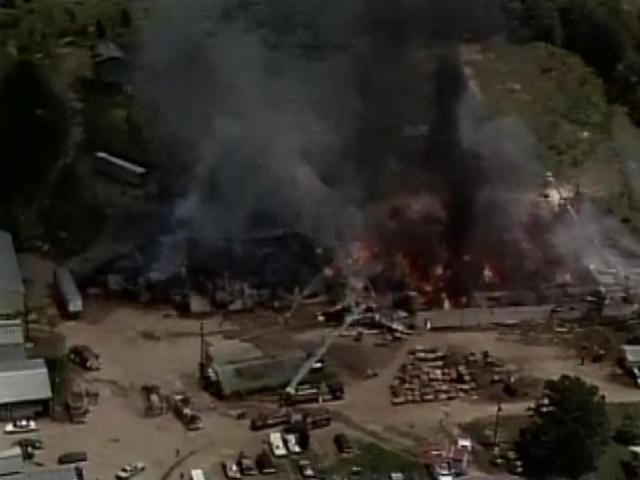
September 3, 1991: A grease fire breaks out at the Imperial Foods chicken processing plant in Hamlet, North Carolina, killing 25 people.

Despite three previous fires in 11 years of operation, the plant had never received a safety inspection. The fire killed 25 people and injured 54, many of whom were unable to escape due to locked exits. 

This was 80 years after the Triangle Shirtwaist Factory Fire in New York, and long after the reforms put in place after it -- making it even more disgraceful.

*

September 3, 1991 was a Tuesday. These Major League Baseball games were played:

* The New York Yankees lost to the Texas Rangers, 5-1 at Arlington Stadium in the Dallas suburb of Arlington, Texas. José Guzmán outpitched Jeff Johnson. The Rangers got home runs from Rubén Sierra (who might have been a steroid user) and Iván Rodríguez (who probably was). Don Mattingly went 1-for-4.

* The New York Mets beat the Houston Astros, 6-1 at Shea Stadium. Anthony Young was the winning pitcher. It was the 1st major league win for the rookie, having already had his 1st loss. Over the rest of his tenure with the Mets, he would go 4-34.

* The Atlanta Braves beat the Montreal Expos, 4-1 at the Olympic Stadium in Montreal. John Smoltz was the winning pitcher.

* The California Angels beat the Boston Red Sox, 2-0 at Fenway Park in Boston. Mark Langston had a 4-hit shutout going with 1 out in the 7th, but manager Buck Rodgers took him out, and replaced him with Mark Eichhorn, who got through the 8th. Bryan Harvey pitched a perfect 9th, to preserve the 4-hit shutout.

* The Cincinnati Reds beat the Philadelphia Phillies, 8-5 at Veterans Stadium in Philadelphia.

* The Baltimore Orioles beat the Toronto Blue Jays, 8-4 at the SkyDome (now the Rogers Centre) in Toronto. Cal Ripken went 1-for-4. Former Red Sock right fielder Dwight Evans went 4-for-5 with 3 RBIs, including his 385th career home run. It turned out to be his last. Former Astro 1st baseman Glenn Davis went 3-for-5 with 2 RBIs, including his 172nd home run. Once the Astros' all-time home run leader, it was thought that moving into Camden Yards the next season, with a short right-field fence, would help him. But he was now beset by injuries, and would finish with 190 homers.

* The Kansas City Royals beat the Chicago White Sox, 8-0 at the new Comiskey Park (now Rate Field) in Chicago. Kevin Appier pitched a 5-hit shutout, outpitching Jack McDowell. George Brett was injured, and did not play.

* The Milwaukee Brewers beat the Oakland Athletics, 5-3 at Milwaukee County Stadium. Robin Yount, Jim Gantner and B.J. Surhoff hit home runs for the Brew Crew. Paul Molitor went 0-for-4 with a walk. Rickey Henderson went 1-for-5.

* The San Diego Padres beat the Chicago Cubs, 4-1 at Jack Murphy Stadium in San Diego. Tony Gwynn went 2-for-4.

* The Los Angeles Dodgers beat the St. Louis Cardinals, 5-4 at Dodger Stadium in Los Angeles.

* The Pittsburgh Pirates beat the San Francisco Giants, 5-3 at Candlestick Park in San Francisco. Tom Prince hit a home run in the bottom of the 9th to send the game to extra innings, but Steve Buchele singled Orlando Merced home with the winning run in the top of the 10th inning. Barry Bonds went 0-for-4 with a walk.

* The Seattle Mariners beat the Detroit Tigers, 1-0 at the Kingdome. Brian Holman pitched 8 innings of 5-hit shutout ball, and Bill Swift completed the 5-hit shutout. They outpitched Scott Aldred, who allowed only 4 hits, including a 3rd-inning single by Harold Reynolds, to score Dave Valle with the game's only run.

* And, for reasons that Baseball-Reference.com does not give, the Cleveland Indians and the Minnesota Twins played at the Metrodome in Minneapolis the day before, and the day after, but not on September 3.

Thursday, July 14, 2022

July 15, 1870: The Reunion of the Union Is Completed

The Flag of the United States, with 37 Stars,
in use from July 4, 1867 to July 4, 1877,
including when most of the former Confederate States
were readmitted to the Union.

July 15, 1870: The last of the States that had seceded from the United States of America to form the Confederate States of America is readmitted, completing the reunion of the Union.

Those States seceded over what they called "States' Rights," but each one's Ordinance of Secession mentioned slavery as one of those "rights." The secessions began after the election of Abraham Lincoln, who opposed the future expansion of slavery, as the President of the United States on November 6, 1860.

This was the order of secession:

1. December 20, 1860: South Carolina.
2. January 9, 1861: Mississippi.
3. January 10, 1861: Florida.
4. January 11, 1861: Alabama.
5. January 19, 1861: Georgia.
6. January 26, 1861: Louisiana.
7. February 23, 1861: Texas.

Lincoln was Inaugurated on March 4. On April 12, Confederate ships fired on Fort Sumter in Charleston, South Carolina, starting the American Civil War. This was followed by more secessions:

8. May 6, 1861: Arkansas.
9. May 20, 1861: North Carolina.
10. May 23, 1861: Virginia.
11. June 1, 1861: Tennessee.

On January 3, 1861, Delaware voted not to secede. On January 29, Kansas was admitted as the 34th State in the Union. On March 19, Missouri overwhelmingly vote to remain in the Union. On April 29, Maryland voted not to secede.

This was key: The District of Columbia, the seat of the Union's government, was between Maryland and Virginia, and Virginia was already considering secession. If both had seceded, the federal government would be trapped. As it was, when Virginia seceded, the U.S.A. literally had its capital on the border with an enemy nation. Fortunately, the C.S.A. didn't have engineers capable of building a bridge across the Potomac River to invade. Nor did they have cannons capable of reaching the U.S. Capitol or the White House.

On May 20, Kentucky declared its neutrality. But on November 18, delegates from 68 of Kentucky’s 110 Counties met, passed an ordinance of secession, adopted a new state seal, and elected a secessionist as Governor. Kentucky was admitted to the Confederacy on December 10. However, the elected State government did not secede, and Kentucky remained in the Union.

Still, the Confederate Flag -- and its variation that is more familiar today, the Confederate Battle Flag -- had 13 stars, one for each State that had seceded, and one each for Kentucky and Missouri, which had not. So the States of Delaware, Maryland, Kentucky and Missouri remained in the Union, despite still keeping slavery legal within their borders.

Several Western Counties in Virginia voted to secede from the rest of the State, and on June 20, 1863, those Counties, collectively, were admitted to the Union as West Virginia, the 35th State. This included Harpers Ferry, home to the federal arsenal that abolitionist John Brown tried and failed to capture in 1859.

The idea that Virginia went to the Confederacy and West Virginia stayed loyal to the Union will seem strange to people whose experience watching those States only goes back far enough to know Virginia as a State regularly voting Democratic and West Virginia as one regularly voting Republican.

Nevada was admitted as the 36th State on October 31, 1864. Because it was admitted during the Civil War, and immediately sent troops to the Union Army, the State’s motto is "Battle Born."

The Confederate States of America surrendered, piece by piece, in the Spring of 1865. This was the order of readmission to the Union, based on acceptance of the Constitution of the United States, including the Reconstruction Amendments: The 13th, prohibiting slavery; the 14th, guaranteeing citizenship and equal protection of the laws to all people born in the United States; and the 15th, guaranteeing the right to vote to all male American citizens age 21 and up:

1. July 24, 1866: Tennessee.
2. June 22, 1868: Arkansas.
3. June 25, 1868: Florida.
4. July 4, 1868: North Carolina.
5. July 9, 1868: Louisiana.
6. July 9, 1868: South Carolina (same day as Louisiana).
7. July 13, 1868: Alabama.
8. January 26, 1870: Virginia.
9. February 23, 1870: Mississippi.
10. March 30, 1870: Texas.
11. July 15, 1870: Georgia.

During this process, another State was admitted to the Union: Nebraska, the 37th State, on March 1, 1867. The 38th wouldn’t come until 1876, Colorado.

Of the 33 States in the Union when South Carolina became the 1st to secede, slavery had been banned in 18. Of the 37 States in the Union when Georgia became the last to rejoin, it had been banned in all 37.

So 1870 marked the final reunion of the Union. On October 12, Robert E. Lee, the leading General of the CSA, died from the effects of a stroke, in Lexington, Virginia. He was 63 years old. Jefferson Davis, the one and only President of the C.S.A., previously a U.S. Senator from Mississippi and Secretary of War under President Franklin Pierce, lived on until 1889.

*

July 15, 1870 was a Friday. By an odd coincidence, this was also the day that Manitoba became a Province of Canada, ending the Red River Rebellion. I have a separate entry for this event.

The only organized team sport in America at this point was baseball, and it was just starting the professional era. The difference between those teams that had turned pro and those that hadn't became stark. The only score I can find for this historic day involves the 1st team to openly turn pro, the Cincinnati Red Stockings, who beat the Eagle Base Ball Club of Louisville, Kentucky, 39-8. That season, against pro teams, the Red Stockings went 27-6; against amateur teams, they went 40-0.

December 31, 1999 & January 1, 2000: The Millennium

December 31, 1999:  The Millennium arrives. The people of planet Earth survived. At a terrible cost. But we hadn't destroyed ourselves. ...