Showing posts with label last stand. Show all posts

Wednesday, October 26, 2022

October 26, 1951: Joe Louis' Last Stand

October 26, 1951: Desperate for money to pay a mounting tax bill, Joe Louis, who stood as Heavyweight Champion of the World longer than anyone (12 years, 1937-49) and defended the title more than anyone (25 times), climbs into the ring at the old Madison Square Garden for a purse of $300,000 – about $3.4 million in 2022 money.
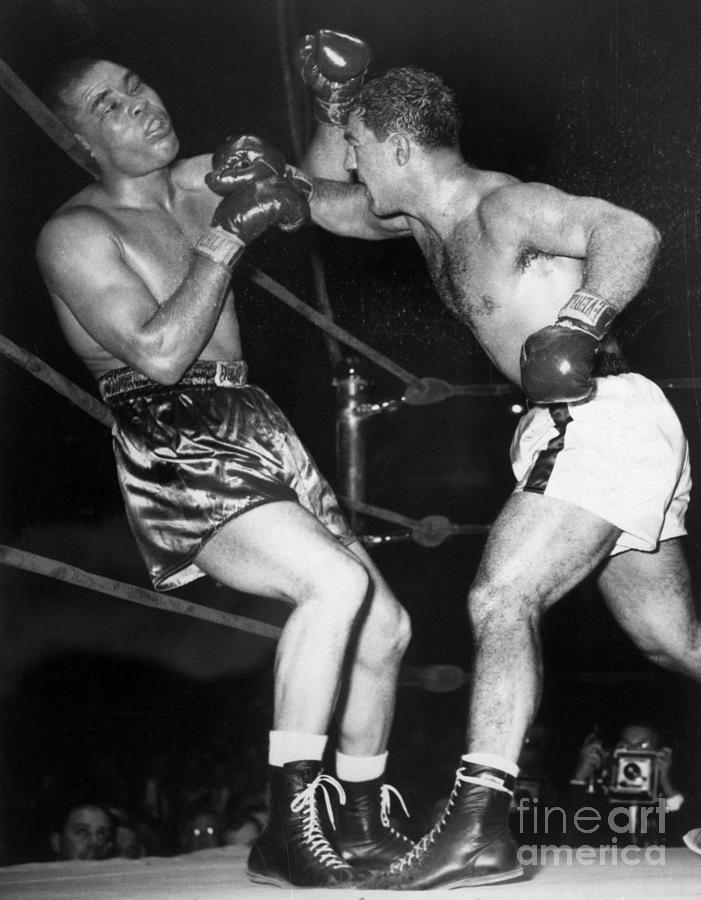
He fights Rocky Marciano, then a rising contender who comes into the fight at 37-0. He idolized Louis: telling the press, "This is the last guy I want to fight." It had nothing to do with his own ability, or whatever Louis had left.
It is a mismatch: Marciano is 28, is in superb shape, and has a sledgehammer for a right hand; Louis is 37, struggles with his weight, and his arms and legs, once the fastest in the fight game despite his being a heavyweight, have terribly slowed. Marciano actually knocks Louis out of the ring in the 8th round. Ruby Goldstein, maybe the best referee in the business and himself a former lightweight contender, wisely stopped the fight at that point.
Marciano went back to his dressing room, and cried over what he had done to his greatest hero, and even went over to see him, and said, "I'm sorry, Joe." Sugar Ray Robinson, then Middleweight Champion, was in Louis' dressing room to console him, and was also crying.
Eleven months later, Marciano knocked Jersey Joe Walcott out to become the Heavyweight Champion. He held the title for 3 years, then retired undefeated at 49-0. Louis, still needing money, humiliated himself as a professional wrestler, and not a very good one.
Both men's lives ended badly: Marciano's in a plane crash in Iowa in 1969, just before his 46th birthday; Louis' in a wheelchair, unable to pay his medical bills, with Frank Sinatra hosting a benefit concert for him in Las Vegas in 1978, which kept Louis afloat until he finally passed away in 1981, at 67.
As a Sergeant in the U.S. Army in World War II, he was laid to rest at Arlington National Cemetery, on the order of President Ronald Reagan, and with Sinatra delivering the eulogy. Marciano was interred in a crypt at Forest Lawn Memorial Cemetery in Fort Lauderdale, Florida.
*
October 26, 1951 was a Friday. William "Bootsy" Collins, bass guitarist for George Clinton's P-Funk Empire, was born on this day.

The baseball season was over. Football was in midweek. The NBA season wouldn't start for another 6 days. The NHL season had started, but no games were scheduled. So there were no scores on this historic day.

Saturday, October 15, 2022

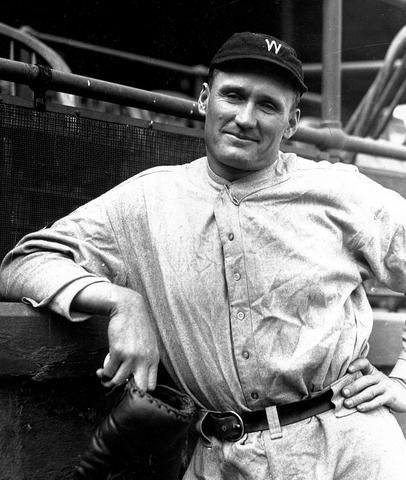
October 15, 1925: Walter Johnson's Last Stand

October 15, 1925: A steady downpour yesterday and today has left the field at Forbes Field in Pittsburgh a muddy mess, as Game 7 of the World Series is scheduled to be played. The weather forecast suggested rain for the next 3 days for both cities involved, Pittsburgh and Washington, making the moving of Game 7 to Washington pointless, and Commissioner Kenesaw Mountain Landis was anxious to get it over with.

I've never seen film of this game. I don't even know if any survives, although YouTube has footage from earlier in the Series, and of the Game 7s of 1924 and 1926. Maybe the film crews didn't want to risk getting electrocuted in the rain. At any rate, all we have to go on for the inclement weather are news reports.

UPDATE: On August 8, 2025, as commemorations for the 100th Anniversary of this Series began, I saw a photograph of a rather dubious method of drying the infield: Dousing it with gasoline and setting it on fire.
This insane tactic actually happened. It wasn't the only time, either.

But it would have been just plain wrong to play if the rain were as bad as what Philadelphia and Tampa Bay faced when Game 5 of the 2008 Series was suspended. There was a 6-day delay due to rain in 1911, and there were 3-day delays in 1962 and 1975. It could have been done again.

It was a short day for Pirate starter Vic Aldridge: 3 walks and 2 hits‚ and he was out of there with just 1 out in the 1st. Walter Johnson, the winningest pitcher in American League history, who finally became a World Series hero the year before, took a 4-0 lead to the mound. In what became known as "Johnson's Last Stand," the Bucs clobbered the 38-year-old Big Train for 15 hits‚ good for 24 total bases. Max Carey's 4-for-5 gave him a Series-high batting average of .458.

The Senators made the most of 7 hits‚ scoring 7 runs‚ including shortstop Roger Peckinpaugh's home run‚ the 12th homer of the Series by both teams combined‚ then a Series record, despite Forbes Field and Washington's Griffith Stadium both having some of the most distant fences in the game. Johnson would have fared better but for 2 more errors by Peckinpaugh‚ his 7th and 8th‚ still the Series record for any position. The Senators made only 1 other error in the 7 games.

Ray Kremer picked up his 2nd win with a 4-inning relief effort‚ as the Pirates won, 9-7. This was the Pirates' 1st World Championship in 16 years, and only one player remains from that 1909 title with Honus Wagner: Charles "Babe" Adams, who had pitched and won 3 games in '09, and was riding out the string in '25. It would take until 2019 for another Washington team to get that close to a World Series win.

In the next day's New York TimesJames Harrison wrote, "In a grave of mud was buried Walter Johnson's ambition to join the select panel of pitchers who have won three victories in one World Series. With mud shackling his ankles and water running down his neck, the grand old man of baseball succumbed to weariness, a sore leg, wretched support and the most miserable weather conditions that ever confronted a pitcher."

The last surviving member of the 1925 Pirates was shortstop Glenn Wright, who lived until 1984.

UPDATE: The Pirates have a team Hall of Fame. From their 1925 and 1927 National League Champions, including the 1925 World Series win, they have inducted 3rd baseman Harold "Pie" Traynor, center fielder Max Carey (who left after 1926), right fielders Hazen "Kiki" Cuyler and Paul Waner (who arrived in 1926), and Paul's brother, center fielder Lloyd Waner (who arrived in 1927).

*

October 15, 1925 was a Thursday. There was 1 other score on this historic day, a college football rivalry: North Carolina beat North Carolina State, 17-0 at Riddick Field on the N.C. State campus in Raleigh.

Thursday, October 6, 2022

October 6, 1938: Dizzy Dean's Last Stand

October 6, 1938: The Yankees defeat the Cubs, 6-3 at Wrigley Field, and take a 2-games-to-0 lead in the World Series. Dean, now with the Cubs following an arm injury that will ultimately end his meteoric career at age 31, takes a 3-2 lead into the 8th inning, but Frank Crosetti's homer gives the Yanks a lead they will not relinquish. Joe DiMaggio added a homer in the 8th. It becomes known as Dizzy Dean's Last Stand, although he did pitch another 3 seasons.

The winning pitcher is Gomez, making him 6-0 in World Series play. Although he appears in 3 more Series with the Yankees, this will be his last Series decision. But although Whitey Ford with 10 and Bob Gibson with 7 will win more Series games, Gomez has the best winning percentage in Series history to this day.

Diz was born Jay Hanna Dean, but sometimes told people his name was Jerome Herman Dean. He was born in 1910, but sometimes told people it was 1911, or 1912. He was born in Lucas, Arkansas, but sometimes told people that he was born elsewhere in Arkansas. Or places in Tennessee. Or Mississippi. Or Louisiana. Or Texas. Or Oklahoma. He was one of three, or four, or five, or more siblings. He explained that he wanted every reporter to have an exclusive.

He had a brother who was born in 1912, in Lucas, Arkansas: Paul Dee Dean. Because Jay was called Dizzy, Paul was called Daffy. And Paul really hated that, because, unlike is freewheeling brother, he was a very thoughtful man.

Dizzy was not. He once said, "The Good Lord was good to me. He gave me a strong right arm, a good body and a weak mind." He later went into broadcasting, and took his homespun talk with him. He was a lot like later football star Terry Bradshaw, figuring out that if people think you're an under-educated hick who knows nothing except his sport, but knows that very well, use it to your advantage before they can use it to theirs.

At any rate, Paul was a very good pitcher. Not as good as Dizzy, but capable of winning 19 games in 1934, including a no-hitter in the the 2nd game of a doubleheader, after Dizzy pitched a 3-hit shutout in the 1st game. Dizzy said, "Gee, Paul, if I'd a-known you was gonna throw a no-hitter, I'd a-thrown one, too!"

Another of Dizzy's quotes was, "If you can do it, it ain't braggin'." Before the 1934 season, he said, "Me an' Paul is gonna win 50 games." Not quite: Diz won 30, and Paul won 19, for a total of 49. But by going 30-7, Diz became the last National League pitcher, to this day, to win 30 games in a season. He also said, "Men an' Paul are gonna win this here World Series." This time, he was right: The Cardinals beat the Detroit Tigers, 4 games to 3, and each brother won 2 games, including Diz pitching a shutout in Game 7.

From 1933 to 1937, Diz was, along with Carl Hubbell and the Negro Leagues' Satchel Paige, 1 of the 3 best pitchers on the planet. Then, in the 1937 All-Star Game in Washington, Earl Averill, the Hall of Fame center fielder for the Cleveland Indians, hit a line drive back up the middle, off his foot. The doctor told him his big toe was fractured. And the undereducated country boy said, "Fractured, hell, the damn thing's broken!"

He came back too soon, and, to favor the toe, he altered his pitching motion, and wrecked his elbow. At age 27, he went from one of the best pitchers in baseball to a man who couldn't pitch without pain. The Cardinals traded him to the Cubs before the 1938 season, and he was only able to make 10 starts. But he went 7-1 with a 1.81 ERA, and the Cubs made a big comeback to win the Pennant. Dean pitched well in Game 2, but the Yankees beat him. He didn't run out of gas so much as he fell victim to the Yankees' comeback ability, known in those days of 3:00 PM starts as "Five O'Clock Lightning."

Dizzy Dean retired after the 1941 season, with a record of 150-83. Ordinarily, 150 wins wouldn't be enough to get a player into the Baseball Hall of Fame. But his 5 years of dominance got him there. He became a beloved broadcaster, and died in 1974. Paul went 50-34 in a career lasting from 1934 to 1943, and died in 1981.

*

October 6, 1938 was a Thursday. Football was in midweek. The NBA wasn't founded yet. And the NHL season was a month away. So there were no other scores this day.

Sunday, October 2, 2022

October 2, 1980: Muhammad Ali's Last Stand

Even in defeat, Ali was the main story,
not the man who actually won the fight.

October 2, 1980: Muhammad Ali, 38 years old, tries to win the Heavyweight Championship of the World for the 4th time.
Sugar Ray Robinson and Archie Moore had been champion boxers in their 40s, but it was a mistake for Ali to even think about getting back in the ring. He is already beginning to show signs of Parkinson's disease, from the poundings he had taken in the ring from 1975 to 1978.
He hadn't fought in 2 years. He has gotten his weight down to 217 1/2 pounds, his lowest since he won the title for the 2nd time, from George Foreman in 1974. But, at the same time, he'd lost too much weight too fast, and it had drained him, as it had Jim Jeffries against Jack Johnson in 1910, and Joe Louis against Rocky Marciano in 1951.
And he was facing Larry Holmes, who was 30, and 35-0, with 26 knockouts. The native of Easton, in northeastern Pennsylvania, was already known as "The Easton Assassin," and had beaten Earnie Shavers, who nearly beat Ali in 1977, twice; Ken Norton, who beat Ali in 1973, lost to him later that year, and nearly beat him in 1976; Alfredo Evangelista, whom Ali beat in 1977; and Mike Weaver, who would later win a share of the Heavyweight Championship.
The fight was held at the outdoor boxing stadium at Caesar's Palace, outside Las Vegas in Paradise, Nevada. It was a mismatch: Holmes won each of the 1st 10 rounds, and Ali looked like, in boxing terms, a very old man. His trainer, Angelo Dundee, stopped the fight. It was the only time in his 61 professional fights that The Greatest neither won nor at least went the distance.
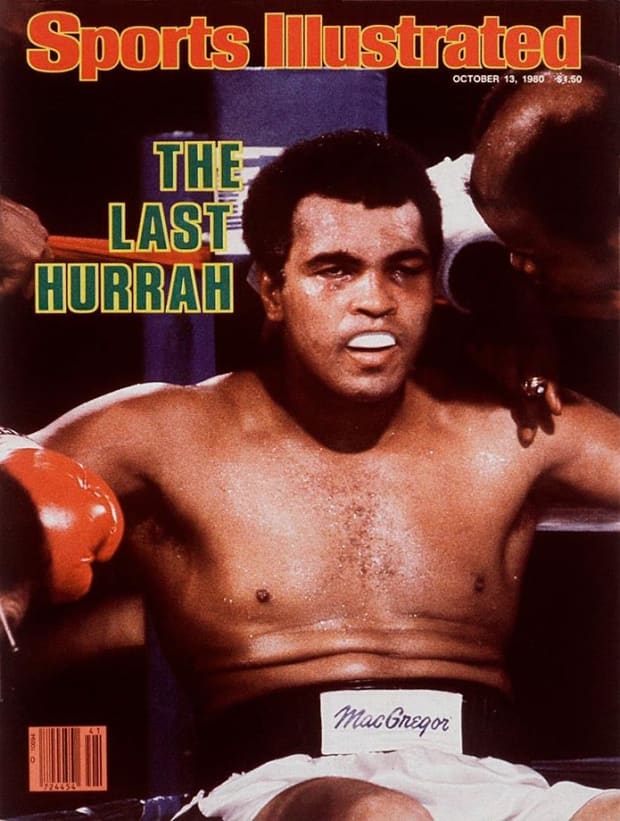
For the only time in its history, Sports Illustrated put the loser, but not the winner, of a prizefight on its cover, with the headline "THE LAST HURRAH," invoking Edwin O'Connor's 1956 novel about an aging politician in his last campaign. Ali had lost 3 times before, but this was the first time he had truly looked like a beaten man. The expression on his face in the cover photo shows that he knew it. For its article on the fight, SI titled it "Doom In the Desert."
Like the rising Marciano, when he inflicted a similar punishment on the aging Louis in 1951, Holmes was seen crying after his victory. He gained very little from the win, and may even have lost respect from many of Ali's fans. This was unfair: If there's anybody with whom they should have been angry, it should have been Ali, for even trying this fight.
Father Time doesn't always win, but he always wins the rematch. Watching this was like watching Elvis in Omaha in the last TV special.
And still, Ali fought once more, on December 11, 1981, losing to Trevor Berbick in Nassau. It became known as "The Trauma in Bahama." That fight may have damaged him even further. He did as much good as he could in the last 34 years of his life, but Parkinson's severely limited this. He really should have quit after the 3rd fight with Joe Frazier in 1975, "The Thrilla in Manila."
*
October 2, 1980 was a Thursday. Football was in midweek, and the NBA and the NHL were in their preseasons. These Major League Baseball games were played:
* The New York Yankees beat the Detroit Tigers, 3-2 at Yankee Stadium. Ron Guidry outpitched Jack Morris, and was supported by home runs from Reggie Jackson and Oscar Gamble.
* The Boston Red Sox beat the Toronto Blue Jays, 4-1 at Fenway Park in Boston. Carl Yastrzemski did not play.
* The Philadelphia Phillies beat the Chicago Cubs, 4-2 at Veterans Stadium in Philadelphia.
* The Chicago White Sox beat the Oakland Athletics, 9-4 at Comiskey Park in Chicago. Rookie Rickey Henderson went 2-for-5 with a home run and 3 RBIs, but no stolen bases.
* The Kansas City Royals beat the Seattel Mariners, 6-2 at Royals Stadium (later Kauffman Stadium) in Kansas City. George Brett went 0-for-2 with a walk, and an RBI on a sacrifice fly. His batting average, which had been up to .401 in early September, dropped to .389, and he would finish at .390.
* The Minnesota Twins swept a doubleheader from the Texas Rangers, 6-3 and 4-1 at Arlington Stadium in the Dallas suburb of Arlington, Texas.
* The Houston Astros beat the Atlanta Braves, 3-2 at the Astrodome in Houston.
* The San Francisco Giants beat the Los Angeles Dodgers, 3-2 at Candlestick Park in San Francisco.
* And the New York Mets, the Baltimore Orioles, the California Angels, the Cincinnati Reds, the Cleveland Indians, the Milwaukee Brewers, the Montreal Expos and the San Diego Padres were not scheduled.

Friday, June 24, 2022

June 25, 1876: The Battle of the Little Bighorn

June 25, 1876: The Battle of the Little Bighorn is fought in the Montana Territory. The 7th Cavalry of the U.S. Army fights several tribes of Native Americans. The tribes win.

The main group of Natives was the Lakota Sioux, led by Sitting Bull and Crazy Horse. The Cavalry was led by Lieutenant Colonel George Armstrong Custer. He had graduated 35th and last in his class at the U.S. Military Academy at West Point in 1861. Because the Civil War was raging, he rose fast, and had the brevet (temporary) rank of Major General. After the war, his questionable actions led the Army to drop him back down to Lieutenant Colonel.
Custer had managed some victories against Natives in the intervening 11 years, and began to believe he was invincible. But on the Little Bighorn River, he found out otherwise. The legend that there were no U.S. Army survivors isn't even close to being true, but of the 700 men under Custer's command, 274, including Custer himself, a 36-year-old Ohioan, died. The Natives lost about half that many, out of around 2,500.

Reports of the battle began to reach the Eastern United States on Centennial Day, July 4, 1876. The anger of "the white man" toward "the red man" was stronger than ever. A year later, Crazy Horse was captured and executed. Sitting Bull, too, would eventually face what the white man would call "justice," in 1890, at Standing Rock, South Dakota, not long before the last major battle with the Natives, called Wounded Knee.
The most familiar photograph of Sitting Bull.
There is no known photograph of Crazy Horse,
due to a Native superstition about a camera "capturing the soul."

The battle was nicknamed Custer's Last Stand, and Custer was seen as a hero. In truth, he was an unearned egomaniac, and deserves to be ridiculed by history.

The site of the battle is now part of the Crow Indian Reservation, in the southeastern part of the State of Montana. The closest city is Billings, 60 miles to the northwest. The closest major league city is Denver, nearly 500 miles south -- unless you consider the Canadian Football League to be a "major league," in which case the closest is Regina, home of the Saskatchewan Roughriders, 460 miles northeast.

In 1960, novelty singer Larry Verne had a Number 1 hit with "Mr. Custer." Even by the standards of that time, in which Westerns dominated television and were still big in movies, it was racist as hell toward Natives. It also perpetuated the myth of the cavalry charge order, "Forward, ho!" No such order has ever existed in the U.S. Army.

*

June 25, 1876 was a Sunday. As a result, even though this was the 1st season of baseball's National League, there were no games, because the NL forbid Sunday ball until 1892. Football was in its infancy, hockey was a newborn sport even at the most mildly organized level, and basketball wouldn't be invented for another 15 years. So there were no scores on this historic day.

Sunday, April 10, 2022

April 10, 1934: Charlie Gardiner's Last Stand

April 10, 1934: The Chicago Black Hawks win the Stanley Cup for the 1st time, thanks to a spectacular Finals performance by goaltender Charlie Gardiner. He never played again.

(Note on names: Gardiner was alternately listed as "Charlie" and "Chuck." I've seen "Charlie" used more, so that's what I'm going with. And the team was also listed as "Black Hawks," two words, until 1986, when someone found their original charter admitting them to the NHL, and saw that it was written as one word, "Blackhawks." They notified the NHL office, who made the single word official, and they've been the "Chicago Blackhawks" ever since. But since they were using "Chicago Black Hawks" at the time, that's what I'm using here.)

The Black Hawks and the Detroit Red Wings had both entered the NHL for the 1926-27 season, after the collapse of the Western Hockey League. The Hawks were originally staffed by the players of the WHL's Portland Rosebuds, while the Wings' owners bought the players from the Victoria Cougars, and they named their new team the Detroit Cougars, with new owners renaming them the Detroit Falcons in 1930 and the Detroit Red Wings in 1932.

However, the NHL does not recognize the Chicago team as a continuation of the Portland team, nor the Detroit team as a continuation of the Victoria team. In 1916, the Portland Rosebuds became the 1st U.S.-based team to play in the Stanley Cup Finals. In 1925, the Victoria Cougars were the last team from outside the NHL to win the Stanley Cup, but the Wings do not claim this title, nor would the NHL recognize it if they did.

The Black Hawks reached the Stanley Cup Finals for the 1st time in 1931, losing to the Montreal Canadiens. By the 1933-34 season, they were loaded with stars. They featured wingers Harold "Mush" March, Paul Thompson and Johnny Gottselig; defensemen Clarence "Taffy" Abel, Lionel Conacher and Art Coulter; and goaltender Charlie Gardiner.

(Conacher, brother of Toronto Maple Leafs star Charlie Conacher, is the only man in both the Hockey and Canadian Football Halls of Fame, and also starred in rugby and lacrosse, 2 sports that are considerably bigger in Canada than in America. He even played minor-league baseball. In 1950, he was voted Canada's Athlete of the Half-Century.)

The Wings were also laden with talent, allowing them to reach the Finals for the 1st time. They had right wing Larry Aurie, left wing Herbie Lewis, centers Ralph "Cooney" Weiland and Ebenezer "Ebbie" Goodfellow, and defenseman Doug Young. Their goalie was Wilf Cude, not exactly a star. And it would be the goalies who would decide the Finals, which, at the time, was best-3-out-of-5. (It became best-4-out-of-7 in 1939.)

The 1st 2 games were played at the Olympia Stadium in Detroit. Game 1 went to double overtime before Thompson won it. The Hawks also won Game 2, 4-1, giving them a commanding lead going back to the Chicago Stadium. The Wings struck back in Game 3, scoring 3 goals in a little over 6 minutes in the 3rd period, and winning 5-2 to keep their hopes alive.

Gottselig was the 2nd Russian-born player in the NHL, and the 1st Russian-born star, although he, and most people in his birthplace of Klosterdorf (now named Gammalsvenskby, and located in Ukraine) were ethnically German. He emigrated to Canada with his family, and grew up in Regina, Saskatchewan.
Johnny Gottselig

Gardiner had been born in Edinburgh, Scotland, but moved to Winnipeg, Manitoba, Canada with his family at age 7. Cude had immigrated from Wales to Winnipeg, and he and Gardiner became friends. Gardiner became a local star in both baseball and Canadian football before concentrating on hockey. The Black Hawks acquired him in 1927, and in 1932, he won the Vezina Trophy as the NHL's top goalie. He was the 1st lefthanded goalie to win it, catching pucks with his right hand.

But trouble was on the horizon. The following season, he developed a tonsil infection, which drained his strength. On Christmas Eve, 1932, he made 55 saves to help the Hawks beat the Toronto Maple Leafs, earning public praise from opposing star Charlie Conacher and NHL President Frank Calder. But he collapsed in the locker room afterward, and was taken to a Toronto hospital.

By the start of the 1933-34 season, was so admired by his teammates, they named him team Captain. He is 1 of 6 goalies to have served as Captain of an NHL team. In 1949, a rule was established prohibiting goalies from being Captains, because leaving the crease to talk to officials, which only the Captain (not even the head coach) can do, was considered an unfair timeout.

In 1934, he was again awarded the Vezina Trophy, and was selected as the starting goalie for the NHL All-Stars against the Toronto Maple Leafs in the Ace Bailey Benefit Game. But the month before the game would be played, the team was on a train back to Chicago, when the pain in Gardiner's throat became severe, and spread throughout his body. He had to be hospitalized again, and it was determined that the infection had spread to his kidneys. This was before antibiotics, so he could have died right there.

Throughout the season, he still refused to have the tonsils removed, so that he wouldn't miss any games, and played in the Benefit Game on February 14 anyway. He could often be seen slumped over the crossbar of the goal when the action was at the other end. On March 29, in a Playoff game, he shut the Montreal Maroons out, but had a fever of 102 degrees, and a doctor tended to him during the intermissions.

Maybe Gardiner's infection was bothering him in Game 3 of the Stanley Cup Finals, as he allowed 5 goals, after allowing just 1 in each of the 1st 2 games. Whatever was going on inside him, he didn't show it in Game 4 in Chicago. Nor did Cude. Not only did regulation end scoreless, but it was still 0-0 at the end of the 1st overtime period. Finally, at 10:05 of the 2nd overtime, March scored, and it was over: Chicago 1, Detroit 0.
Mush March

For the 1st time, the Cup belonged to an NHL team west of Toronto. As Calder was the Commissioner, it was his job to hand the Cup to the winning Captain, and that was Gardiner. In the Hawks' 3 wins, totaling 231 minutes, he had allowed just 2 goals, averaging a goal every 115 minutes. Counting the 5 he allowed in Game 3, it was a goal every 41 minutes. Had there been a most valuable player award for the Playoffs at that time, he surely would have won it.

Two months later, on June 10, 1934, in his hometown of Winnipeg, Gardiner collapsed and fell into a coma. He died 3 days later, from a brain hemorrhage brought on by the infection. He was only 29 years old.

Upon hearing of his death, Red Wings head coach and general manager Jack Adams, for whom the NHL's Coach of the Year trophy and its now-discarded Adams Division would be named, called him "a grand chap. One could not help but like him. He was undoubtedly the finest netminder in the League. What is more, he always played the game as a gentleman."

The Hawks lost another player in the off-season. Center Jack Leswick, only 24 years old, had played 37 games for them in the regular season, which turned out to be his only NHL season. On August 4, 1934, his body was found in the Assiniboine River in Winnipeg, without his wallet. Foul play was never confirmed, but it could have been either an accident or a suicide.
Jack Leswick

His brothers Pete and Tony also played in the NHL, and Tony's overtime goal in Game 7 of the 1954 Finals gave the Red Wings the Stanley Cup. Another brother, Terry Leswick, abandoned his family, and his wife remarried. They'd already had a son, who took his stepfather's last name. He became a baseball star: Lenny Dykstra.

With this Cup, and the Chicago Bears winning the NFL Championship Game on December 17, 1933, Chicago became the 2nd city, after New York in 1927-28, to have both the NFL Championship and the Stanley Cup at the same time; and the 1st city to have won the most recent NFL Championship Game and Stanley Cup Final.

They have been followed by the Detroit Lions and Red Wings in 1936, 1952 and 1954; the Pittsburgh Steelers and Penguins in 2009; and the Tampa Bay Buccaneers and Lightning in 2021. The New York Giants and Rangers were NFL and NHL titleholders in 1928, but that was before the institution of the NFL Championship Game.

With much the same team, but with Mike Karakas in goal, the Black Hawks won the Stanley Cup again in 1938. They reached the Finals again in 1944, still with some holdovers from 1934, but lost to the Canadiens. Gardiner would have been 39, so he could still have been playing, and possibly made the difference. By this point, antibiotics had been developed that could have saved his life. But it wasn't possible in 1934.

In 1945, the Hockey Hall of Fame was established. Of the 1st 9 players elected, 2 were goalies: Gardiner, and the man for whom the league's trophy for goaltending was named, Georges Vézina of the Canadiens. He, too, had died early, from tuberculosis, at 39, in 1926. Gardiner has also been elected to Canada's Sports Hall of Fame and the Manitoba Sports Hall of Fame. In 2018, an arena in his old neighborhood in Winnipeg was renamed the Charlie Gardiner Arena.

The Blackhawks named him to their 75th Anniversary Team in 2001. They retired his uniform Number 1, but for a later goalie, Glenn Hall. He was not named to the NHL's 100th Anniversary 100 Greatest Players in 2017. But in 1998, at a time when there were considerably more people still alive who had seen him play, The Hockey News ranked him 76th on their list of the 100 Greatest Hockey Players.

The Blackhawks and Red Wings have faced each other in the Finals only once more, with the Hawks winning again in 1961. But they have played each other in the Playoffs 16 times, with the Hawks leading, 9-7.

In 2001, in celebration of their 75th Anniversary, the Blackhawks named an All-Time Team. But from the 1934 and 1938 Cup winners, only right wing Harold "Mush" March was selected. Goaltender Charlie Gardiner, and defensemen Lionel Conacher, Art Coulter and Earl Seibert (there in '38 but not in '34), Hall-of-Famers all, were not selected. Neither were should-be-Hall-of-Famers defenseman Taffy Abel and left wings Paul Thompson and Johnny Gottselig. Owner Frederic McLaughlin is also in the Hall. So are the man he sold the team to, James D. Norris; and his son, James E. Norris.

*

April 10, 1934 was a Tuesday. This was the only hockey game that was played. The NBA hadn't been founded yet. Football was out of season. And the baseball season didn't start for another 7 days. So this was the only score on this historic day.
Tuesday, January 25, 2022

January 26, 1885: The Battle of Khartoum & the Death of Charles Gordon

January 26, 1885: The Battle of Khartoum is fought. It becomes one of the great "last stands" in military history, and a rare example of a man becoming a legend in defeat.

Charles George Gordon was born on January 28, 1833, in Woolwich, then in Kent, now a part of South-East London. He saw action in the Crimean War of the 1850s, as an officer in the British Army. However, he made his military reputation in China, where he was placed in command of the "Ever Victorious Army," a force of Chinese soldiers led by European officers, which was instrumental in putting down the Taiping Rebellion in 1864, regularly defeating much larger forces. For these accomplishments, he was given the nickname "Chinese Gordon," and honors from both his own country's government and China's.

With British government approval, he entered the service of Isma'il Pasha, the Khedive of Egypt, in 1873, and later became the Governor-General of the Sudan, then a British colony, where he did much to suppress revolts and the local slave trade. He then resigned and returned to Europe in 1880.

Gordon's abrupt mood swings and contradictory advice confirmed the Cabinet's view of him as mercurial and unstable. Even an observer as sympathetic as Winston Churchill wrote about Gordon: "Mercury uncontrolled by the force of gravity was not on several occasions more unstable than Charles Gordon. His moods were capricious and uncertain, his passions violent, his impulses sudden and inconsistent. The mortal enemy of the morning had become a trusted ally by night."

Gordon never married, and historians agree on the reason, if not on the cause. He was a "married to his work" type, putting his life into his service, and thus repressing his urges and converting them into patriotism and a religious fervor. It's also been suggested that he had Asperger's syndrome, which made him uncomfortable when talking to women. It has also been theorized -- mostly in books published well after he died -- that he was gay, and thus, with his strong religious beliefs, he had to repress himself so much that martyrdom eventually became a wish.

A serious revolt, the Mahdist War, broke out in the Sudan, led by Muhammad Ahmad bin Abdullah bin Fahal, a Muslim religious leader who claimed to be the Mahdi: A prominent figure who is believed to appear at the End of Time, to rid the world of evil and injustice. He is said to be a descendant of the Prophet Muhammad, who will appear shortly before the Prophet ʿĪsā (the Muslim name for Jesus, who is honored in Islam, as is his mother, Mary), and will lead the Muslims to rule the entire world. That's the mythology, anyway. Muhammad Ahmad played on this to gain many followers.

In early 1884, Gordon was sent to the Sudanese capital of Khartoum, with instructions to secure the evacuation of loyal soldiers and civilians and to depart with them. In defiance of those instructions, after evacuating about 2,500 civilians, he retained a smaller group of soldiers and non-military men.

In the months before the fall of Khartoum, Gordon and the Mahdi corresponded. Gordon offered him the Sultanate of Kordofan. The Mahdi requested Gordon to convert to Islam and join him, which Gordon declined.

Besieged by the Mahdi's forces, Gordon organized a citywide defense that lasted for almost a year (the Siege of Khartoum beginning on March 13, 1884), and gained him the admiration of the British public, but not of the government, led by Prime Minister William Ewart Gladstone, who had wished him not to become entrenched there. Only when public pressure to act had become irresistible did the government, with reluctance, send a relief force.

Timing is everything: It arrived 2 days after the city had fallen and Gordon had been killed. The Mahdi had given strict orders not to kill Gordon, but they disobeyed.

His death, at the age of 51, was romanticized in General Gordon's Last Stand, a popular painting produced in 1893 by George William Joy. It showed Gordon wearing his ceremonial gold-braided blue uniform of the Governor-General together, with the Pasha's red fez, and that he went out unarmed, except with his rattan cane, to be cut down by the Mahdi's followers, the AnsarThis account was very popular with the British press, as it contained much Christian imagery with Gordon as a Christlike figure dying passively for the sins of all humanity.
In the hours following Gordon's death, an estimated 10,000 civilians and members of the garrison were killed in Khartoum. The massacre was finally halted by orders of the Mahdi. Many of Gordon's papers were saved and collected by his two sisters, Helen Clark Gordon, who married Gordon's medical colleague in China, Dr. Moffit; and Mary Augusta, and possibly his niece Augusta, who married Gerald Henry Blunt.
Gordon achieved the martyrdom he had been seeking at Khartoum, as the British press portrayed him as a saintly Christian hero and martyr who had died nobly resisting the Islamic onslaught of the Mahdi. As late as 1901, on the anniversary of Gordon's death, The Times (of London) wrote in a leader (an editorial) that Gordon was "that solitary figure holding aloft the flag of England in the face of the dark hordes of Islam." (And you thought the American media was loaded following 9/11. The Battle of Khartoum was more than 3 "9/11s.") For the psyche of Victorian England, used to feeling higher than America ever has, this was Pearl Harbor, the JFK assassination, and 9/11 all wrapped up into one.
The failure to rescue Gordon's force in Sudan was a major blow to Prime Minister Gladstone's popularity. Queen Victoria sent him a telegram of rebuke, which found its way into the press. Critics said Gladstone had neglected military affairs, and had not acted promptly enough to save the besieged Gordon. Critics called him "Judas," and inverted his acronym, "G.O.M." (for "Grand Old Man"), to "M.O.G." (for "Murderer of Gordon"). Stones were thrown at the Prime Minister's official residence at 10 Downing Street in London.
In a sermon, the Bishop of Chichester stated: "Nations who envied our greatness rejoiced now at our weakness and our inability to protect our trusted servant. Scorn and reproach were cast upon us, and would we plead that it was undeserved? No; the conscience of the nation felt that a strain rested upon it."

Evelyn Baring, the 1st Earl of Cromer, and then the Consul-General of Egypt, was among the British officials who had deeply disliked Gordon. Nevertheless, he immediately recognized the symbolism of his death: Because of the "national hysteria" caused by it, saying anything critical about him at present would be equal to questioning Christianity.

Gladstone bowed to reality and resigned on June 9, 1885. The Conservative Party's Leader, Robert Arthur Talbot Gascoyne-Cecil, 3rd Marquess of Salisbury, formed the new government. Despite the popular demand to "avenge Gordon," Lord Salisbury did nothing of the sort. The Sudan was judged to be not worth the huge financial costs it would have taken to conquer it, the same conclusion that the Liberals had reached. The Conservatives lost an election later in the year, and Salisbury ended up resigning on January 28, 1886. Gladstone was back in, but his government split over the Irish Home Rule question, and Salisbury was back 6 months later.

The Mahdi established his Islamic state, which restored slavery and imposed a very harsh rule that, according to one estimate, caused the deaths of 8 million people. But Muhammad Ahmad was not there to preside over most of it. Nature had done what the combined might of the British Empire at its peak could not: "The Mahdi" died on June 21, from typhus, at 41. In 1898, General Herbert Kitchener led Britain to victory in the Battle of Omdurman, ending the Mahdist State, and, in the minds of many "avenging Gordon."
Sudan achieved independence in 1956, and has been ruled by dictatorships for most of its history, including an Islamic one of which Muhammad Ahmad would surely have approved.
Charlton Heston played Gordon in the 1966 film Khartoum. The very English Laurence Olivier played a whitewashed version of Muhammad Ahmad, perhaps a final revenge.
With the passage of time, and his no longer being considered an untouchable figure, there came to be a joke about Gordon. Every day, a man would walk his son to school, passing a statue of Gordon on horseback. The first time, the father told the son Gordon's story. Passing the statue every day, the son would occasionally ask the father to again tell him the story of Gordon's heroism.

One day, during their walk, the son said, "Father, I have a question about Gordon. Who is that silly man riding him?"

*

January 26, 1885 was a Monday. Baseball and football were out of season. Hockey was not yet organized. And basketball had not yet been invented. So there were no scores on this historic day.

December 31, 1999 & January 1, 2000: The Millennium

December 31, 1999:  The Millennium arrives. The people of planet Earth survived. At a terrible cost. But we hadn't destroyed ourselves. ...