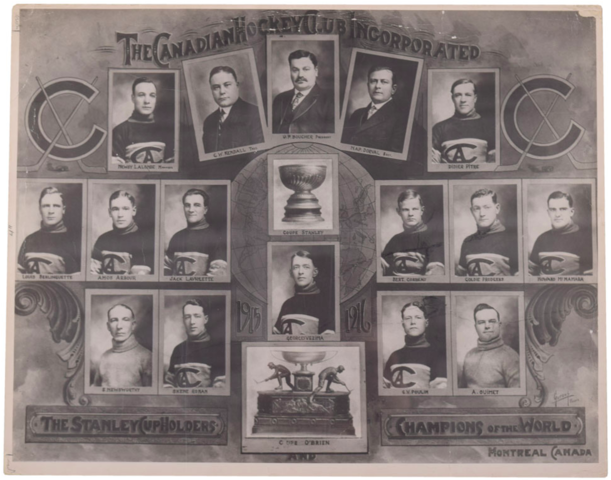
The 1916 Canadiens. Note the "CA" logo instead of "CH,"
the much smaller Stanley Cup, and the O'Brien Trophy.
Every great sporting institution had to start its greatness at some point. For hockey's greatest franchise, this was it.
March 30, 1916: The Montreal Canadiens win the Stanley Cup for the 1st time. They defeat the Portland Rosebuds, the 1st American-based team to compete for the Cup.
The team was founded in 1909, as Club Athlétique Canadien -- Canadian Athletic Club. The original logo was a Gothic C inside a maple leaf. Later, it became a "CA," for "Canadian Athletic." In the 1st NHL season of 1917-18, it became "Club de Hockey Canadien," and the logo became a "CH."
George "Tex" Rickard, the boxing promoter who built the 3rd Madison Square Garden and founded the Rangers, was once asked what the H in the Canadiens' "CH" logo stood for, and he said, "Habitantes," a reference to the early French settlers of Québec, especially farmers. This got shortened to "Habs," leading to the English chant, "Go, Habs, go!"
But at their founding, they quickly became the team of Montreal's French speakers, or "Francophones." The Montreal Wanderers, "the Little Men of Iron," Stanley Cup winners of 1906, 1908, 1909 and 1910, remained the team of the English speakers, of "Anglophones."
The Canadiens reached the Playoffs for the 1st time in 1914, and in 1916, won the Championship of the National Hockey Association, the O'Brien Cup, which was named after their founder, J. Ambrose O'Brien. This, effectively, made them the hockey champions of Eastern Canada, and entitled them to play the champions of Western Canada, the champions of the Pacific Coast Hockey Association. Only this time, it was the Portland Rosebuds, of Portland, Oregon, who won the PCHA title, becoming the 1st American team to play for the Cup.
The format was a best-3-out-of-5, and, because of the distance required for train travel in that pre-jet plane era, all the games were played at the Montreal Arena, so the Rosebuds would never have home-ice advantage. To make up for this, Games 2 and 4 would be played under Western rules, with 7 men on a side, including the "rover" position that the NHA had already eliminated, in favor of 6-a-side: Goaltender, 2 defensemen, left wing, center, right wing.
The Arena, also known as the Westmount Arena, because it was built just west over the city line, in the City of Westmount. It opened in 1898, as the 1st arena ever built specifically for ice hockey, with rounded corners, a style copied by hockey arenas ever since.

Despite playing under Eastern rules, the Rosebuds won Game 1, 2-0, holding the Canadiens to 6 shots. The Habs' Captain and best defender, Jean-Baptiste "Jack" Laviolette, got his jaw broken. And their head coach and best all-around player, Édouard Cyrille "Newsy" Lalonde, developed a bad cold, and would also miss Game 2, which would be played under Western rules. It looked like a major upset was in the making.
But the Canadiens won Game 2, anyway, 2-1, with a much tighter-checking defense. Laviolette and Lalonde both returned for Game 3. Lalonde got into a fight with Rosebuds star Ernie "Moose" Johnson, remembered by Montreal fans for his time with the Wanderers. The police had to come onto the ice to break up the fight, and Lalonde and Laviolette were both ejected from the game. Despite this, Didier "Cannonball" Pitre scored three goals -- the term "hat trick" didn't come into wide use until the 1950s -- and the Canadiens won, 6-3.
In Game 4, the Rosebuds blew a 3-0 lead, then the Canadiens blew a 4-3 lead, and the Rosebuds won, 6-5, to send the series to the distance. In Game 5, the Rosebuds took a 1-0 lead, but the Canadiens tied it, and George "Goldie" Prodgers won it for Montreal, 2-1.
It was the 26th time (counting the Cup's tenure as a "challenge cup") in 24 seasons that a Montreal team had won the Stanley Cup. But it was the first time for the Montreal Canadiens. Through the 2020-21 season, they have won 24. The only team in all of North American major league sports with more World Championships is the New York Yankees, with 27. From their 22nd Cup in 1979 until the Yankees' 24th World Series win in 1999, the Canadiens were actually in, or at least tied with the Yankees for, 1st place overall.
Hail the Champions: Goaltender, Number 1, Georges Vézina; defensemen, 2, Bert Corbeau; 3, Howard McNamara; and 8, Goldie Prodgers; centers, 4, Newsy Lalonde; 5, Didier Pitre; 6, George "Skinner" Poulin; and 12, Erskine "Skene" Ronan; and wingers, 7, Jack Laviolette; 9, Louis Berlinguette; 10, Albert John "Jack" Fournier; and 11, Amos Arbour. (Amos was a cousin of later New York Islanders coach Al Arbour.) Vézina, Lalonde, Pitre, Laviolette and O'Brien would be elected to the Hockey Hall of Fame.
The Canadiens won the NHL Championship again in 1917, but lost the Stanley Cup Finals to the Seattle Metropolitans, who thus became the 1st American team to win the Stanley Cup. They lost the 1st NHL Finals in 1918, to the team now known as the Toronto Maple Leafs. They faced the Metropolitans again in the 1919 Stanley Cup Finals, but they were called off due to the Spanish Flu epidemic hitting both teams, killing Canadien defenseman Joe Hall (who was with the Quebec Bulldogs in 1916). The Canadiens didn't win the Cup again until 1924.
The Montreal/Westmount Arena burned down in 1918, dooming the Wanderers franchise. Condominums are on the site today. The Montreal Forum was built a block away, on the other side of the Montreal City Line, in 1924. Place Alexis Nihon, a shopping mall, was built between the sites, on the Westmount side.
From the opening of the Forum in 1924 until 1938, the Montreal Maroons played there, taking the Wanderers' place as the team of Anglophone Montrealers. But despite winning the Cup in 1926 and 1935, the Great Depression did them in. The Canadiens united the city for the next 40 years.
In 1979, the NHL took on the World Hockey Association's Quebec Nordiques, and the dynamic was reversed: In the Province of Quebec, the Canadiens began to be seen as the team of Quebec's Anglophones and Canadian nationalists/federalists, while the Nords were seen as the team of Francophones and Quebec nationalists/separatists. And the rivalry got very nasty, including "the Good Friday Massacre" in the 1985 Playoffs. But in 1995, unable to get a new arena, the Nordiques' owners moved them to Denver, making them the Colorado Avalanche.
After the founding of the NHL, the O'Brien Trophy was given to the NHL Champion (even if they didn't beat the Western Champions for the Stanley Cup) until 1927, then the winners of the NHL Canadian Division until 1938, and then to the team that lost the Stanley Cup Final until the trophy was retired in 1950. In my opinion, it should be brought back, and given to the last Canadian team standing in the Stanley Cup Playoffs.
In 1998, The Hockey News released their
list of the 100 Greatest Hockey Players. Lalonde was ranked 33rd, and Vézina 75th.
*
March 30, 1916 was a Thursday. There were no other scores on this historic day: Baseball was in Spring Training, and professional football and basketball only existed on a minor-league level.


