Showing posts with label 1939. Show all posts

Thursday, December 15, 2022

December 15, 1939: "Gone With the Wind" Premieres

December 15, 1939: The film Gone With the Wind premieres at the Loew's Grand Theatre in Atlanta, the city where most of the film's action takes place.

Until July 1940, the film played only advance-ticket engagements at a limited number of theaters, with a ticket price of $1.00, more than twice the price of regular features in those days -- $20.06 in 2022 money, so a bit more than most movie prices now.

Counting promotion costs, it took $7 million to make the movie -- about $140 million today. It has made over $390 million. It would remain the highest-grossing movie of all time until 1975, surpassed by Jaws. But, with inflation factored in, it's still the highest-grossing movie ever, at $7.8 billion. In comparison, Avengers: Endgame has generated $2.8 billion; Star Wars (Episode IV: A New Hope) has made $776 million, so with inflation from 1977, that's $3.6 billion, still not half as much as Gone With the Wind.

It was the most popular movie of its era because the novel on which it was based, published by Margaret Mitchell in 1936, was the most popular book of the era. It was a story of the Southern aristocracy before, during, and after the American Civil War, and it totally idealizes that culture. It aided the myth of the “Lost Cause,” suggesting that the Confederacy was honorable, just, and heroic. It also indulged in the stereotypes of Southern black people of the era, and does nothing to suggest that slavery was bad. It was. And it does nothing to suggest that the South deserved to lose the war. It did.

And let's say it: There is no hero in this movie: Scarlett O'Hara is a spoiled bitch, and Rhett Butler is an ass -- who ultimately decides that she is too much even for him. It's easy to take his side when he leaves Scarlett, and responds to her question about what she'll do without him by saying, in a line the producers fought the Hays Code to keep in the film, "Frankly, my dear, I don't give a damn." (The line, minus the word "Frankly," was in the book.)

The screenwriter, Sidney Howard, died before the premiere. On August 23, 1939, he was working on his farm in Tyringham, Massachusetts. He had turned his tractor on in his garage, but had neglected to put the brake on, and after he got out, it lurched back, and pinned him against the wall. He was only 48 years old. Having already received a Pulitzer Prize for his 1924 play They Knew What They Wanted, he received a posthumous Oscar.

Leslie Howard (no relation to Sidney), who played Ashley Wilkes -- both "Leslie" and "Ashley" were considered masculine names in 1860s America, when and where the story was set, and in 1890s Britain, when and where he was born -- was killed in action in 1943, when his plane was shot down by the Nazis.

Mitchell was killed in 1949, hit by a car in Atlanta. Also dying that year was director Victor Fleming, who also directed The Wizard of Oz in 1939. Hattie McDaniel, who played Mammy, died in 1952. George Reeves, who played Stuart Tarleton, and would go on to play Superman on television, died of a gunshot wound in 1959, officially a suicide, but this is widely doubted. Clark Gable, who played Butler, died in 1960. Producer David O. Selznick died in 1965. Vivien Leigh, who played Scarlett, battled mental illness and alcoholism, and died in 1967.

Thelma "Butterfly" McQueen, who played Prissy, lived until 1995. Cammie King, who played Scarlett and Rhett's daughter, Bonnie Butler, lived until 2010. Olivia de Havilland, who played Melanie Wilkes Hamilton, lived to be 104 years old, dying in 2020 (not of COVID).

The last surviving castmembers? Mickey Kuhn, who died on November 20, 2022, at 90, was the last credited one. He played Beau Wilkes, son of Melanie and Ashley. Patrick Curtis died 4 days later, at 83. He played Beau Wilkes as a baby, but was not credited. He went on to become a film producer, and was, for 5 years, the 2nd of the 4 husbands of actress Raquel Welch. Caren Marsh Doll, 102, was an uncredited extra. Earlier in the year, she was Judy Garland's dance stand-in for The Wizard of Oz, making her the last surviving castmember of that film.

*

December 15, 1939 was a Friday. Singer Cindy Birdsong was born on this day. She sang with Patti LaBelle's Bluebelles from 1961 to 1966, then replaced replaced Florence Ballard in The Supremes, singing with them until 1977.

It was the off-season for baseball. The NBA hadn't been founded yet. There were no NHL games played that day. And the pro football season had just ended 5 days earlier, with the NFL Championship Game. The Green Bay Packers beat the New York Giants, 27-0, at the Dairy Bowl in the Milwaukee suburb of West Allis, Wisconsin. The stadium has since been converted into an auto racing track called the Milwaukee Mile. So there were no scores on this historic day.

Saturday, December 10, 2022

December 10, 1939: The Packers' Domination at the Dairy Bowl

December 10, 1939: The NFL Championship Game is played. At the time, the site of the game was alternated between the home fields of the Eastern Division Champions and the Western Division Champions. It was an odd-numbered year, so the Western Champions were set to host. But that was the Green Bay Packers, and Green Bay City Stadium only seated 25,000 people.

So the NFL approved the Packers' request to move the game to the nearest big city, Milwaukee. Specifically, to a stadium built in the infield of an auto racing track at the Wisconsin State Fair Park, in West Allis, 8 miles west of downtown. The stadium was quickly nicknamed the Dairy Bowl.

A year earlier, the Packers had lost the NFL Championship Game to the New York Giants, 23-17 at the Polo Grounds in New York. This time, coach Early "Curly" Lambeau had the home-field advantage -- sort-of, and a full house of 32,379 attended.

The game kicked off at 1:30 PM, Central Time (2:30 Eastern). In the 1st quarter, Arnie Herber threw a 7-yard touchdown pass to Milt Gantenbein. The game remained 7-0 into the 3rd quarter, before Engebretsen kicked a 29-yard field goal.

The Packers had 2 good quarterbacks, both throwing passes to the original great football receiver, Don Hutson. Oddly, Hutson didn't catch a single pass during the game. Later in the 3rd quarter, the other quarterback, Cecil Isbell, threw a 31-yard touchdown pass to Joe Laws.
Don Hutson

In the 4th quarter, Ernie Smith kicked a 42-yard field goal, and Eddie Jankowski ran the ball in from the 1-yard line for a touchdown. Final score: Packers 27, Giants 0.

Auto racing has been held at the State Fair Park since 1903. The Packers continued to play the occasional game there until 1951, and the Milwaukee Chiefs of the 1940 and '41 edition of the American Football League played there.

In 1954, the stadium was knocked down and the grounds renovated. An asphalt track replaced the dirt track, and a new grandstand was built. The stadium is now known as the Milwaukee Mile, and the finish line is roughly where the 50-yard line was.
The Green Bay Packers have the largest team Hall of Fame of any team in the "Big Four" North American sports: The NFL, MLB, the NBA and the NHL. From their 1939 NFL Championship, they have inducted co-founder, owner, general manager and head coach Earl "Curly" Lambeau; co-founder George Whitney Calhoun; executives Frank Jonet, Gerald F. Clifford, Fred Leicht, Emil Fischer and Lee Joannes; backs Arnie Herber, Hank Bruder, Clarke Hinkle, Joe Laws, Eddie Jankowski, Cecil Isbell, Andy Uram and Larry Craig; ends Milt Gantenbein and Don Hutson, Carl Mullenaux and Harry Jacunski; tackles Charles "Buckets" Goldenberg and Buford "Baby" Ray; guards Paul "Tiny" Engebretsen, Russ Letlow and Pete Tinsley; centers George and Bud Svendsen and Charley Brock; trainer Carl "Bud" Jorgensen and team doctor W. Webber Kelly; band director Wilner Burke; and the team's 1st broadcaster, Russ Winnie.

When the Packers won the NFL Championship again in 1944, these players were holdovers: Laws, Craig, Hutson, Mullenaux, Harry Jacunski; Goldenberg, Ray, Tinsley and Charley Brock. They were joined by backs Lou Brock, Tony Canadeo, Ted Fritsch and Irv Comp; journalist Art Daley; and the earliest Packer fan inducted, Al Schneider.

Lambeau, Herbert, Hutson, Hinkle and Canadeo have also been inducted into the Wisconsin Athletic Hall of Fame.

The Packers wouldn't win the title again until 1961. Playing for them in between, but not on either of, those 2 titles, and inducted into their Hall of Fame have been: Quarterback Tobin Rote; running backs Bob Forte, Fred Cone, Howie Ferguson and Al Carmichael; ends Bob Mann, John Martinkovic and Billy Howton; tackle Dick Wildung; linebacker Deral Teteak; and safety Bobby Dillon.

In 1999, Hutson ranked 6th on The Sporting News' 100 Greatest Football Players, and, in 2010, 65 years after his last game and 13 years after his death, Number 9 on the NFL Network's 100 Greatest Players. In each case, he was 2nd only to Jerry Rice among receivers.

*

December 10, 1939 was a Sunday. Baseball was out of season. The NBA hadn't been founded yet.

There were 3 games in the NHL. The New York Rangers beat the Boston Bruins, 3-2 at the old Madison Square Garden. The New York Americans beat the Detroit Red Wings, 3-2 at the Olympia Stadium in Detroit. And the Chicago Black Hawks beat the Montreal Canadiens, 3-2 at the Chicago Stadium. The Toronto Maple Leafs were not scheduled.

Tuesday, November 8, 2022

November 8, 1939: Shazam! Captain Marvel Debuts

November 8, 1939: Whiz Comics #2, dated February 1940, debuts on this date. Inside, 12-year-old Fawcett City orphan Billy Batson first says, "Shazam!", and "magic lightning" strikes him and turns him into Captain Marvel, a super-powered adult.

"Shazam" was the name of the ancient wizard who gave Billy his powers, his name spelled out by the initials of the gods and heroes who contributed those powers:

* S for the wisdom of Solomon.
* H for the strength of Hercules.
* A for the stamina of Atlas.
* Z for the power of Zeus.
* A for the courage of Achilles. And...
* M for the speed of Mercury.

Some of these traits overlap: Clearly, Atlas had to have significant strength; and The Iliad calls Achilles "swift-footed."

To change back into Billy, Captain Marvel says, "Shazam!" again.

Originally, Billy was said to live in New York. When DC Comics bought the rights to the characters from Fawcett Comics in 1951, it definitively wrote that Billy/Cap lived in Fawcett City. As with most DC cities, it is a fictional city whose exact location is left ambiguous. Most of the time, it's said to be in the Midwest, but this has varied from Indiana to Wisconsin to Minnesota.

The 1986 post-Crisis On Infinite Earths reboot moved Cap's adventures to San Francisco -- forcing a change in the radio station for which Billy becomes a teenage reporter from WHIZ to KWHZ, or "K-Whiz." This did not last, and by 1991, his adventures were again based in Fawcett City.

Due to copyright issues, Marvel Comics holds the trademark on the name "Captain Marvel," and has used it for a succession of superheroes. So, for legal reasons, DC can use the name Captain Marvel for its character, but can't use that name as the title of any publication or video production based on him.

As a result, their comics, cartoons, and a 1974-77 live-action Saturday-morning CBS show have had to use the title Shazam! This has led to confusion, with some people thinking that the caped hero in the red costume with the yellow lightning bolt on his chest is, in fact, named Shazam. 
Jackson Bostwick, 1974. That's 1970s hair,
but he otherwise nailed the look.

In 2012, DC just gave up, and made "Shazam" his official name. In 2022, DC renamed him again, calling him "The Captain," so that he can once again be called "Cap" for short (as is the Marvel hero Captain America), but also allowing him to say his name without calling down the lightning that will change him back into a kid without powers.
John Davey, 1975. A little too chunky for the role.

This was not the case in 1941, when 
The Adventures of Captain Marvel made him the 1st superhero ever to appear in a movie. (Superman appeared in a cartoon later in the year, but not in a live-action film until 1948, with Batman debuting onscreen in 1943.) Frank Coughlan Jr. (1916-2009), a former child actor already too old to play the part, played Billy Batson, and Tom Tyler (1903-1954) played Captain Marvel.
Tom Tyler, 1941

For the 1970s series, Michael Gray, also too old to play a teenager, played Billy, while Jackson Bostwick played Cap. He hurt his back a year later, and had to leave the show, replaced by John Davey. In the 1979 NBC special Legends of the Superheroes, Cap was played by Garrett Craig.
Garrett Craig, 1979

In 2019, Warner Brothers released the film Shazam! Asher Angel, 16 at the time of filming, played a 14-year-old Billy living in the real city of Philadelphia; while Zachary Levi, then 38, played Cap, having already played a Marvel Comics character, the Asgardian warrior Fandral, in the Thor films. The joke was that the character was more mature as Billy than he was as the adult superhero.
Zachary Levi, 2019

UPDATE: In 2023, DC released a sequel film, Shazam! Fury of the Gods. Michael Gray made a cameo appearance, wearing the same red shirt he wore on CBS nearly 50 years earlier.

*

November 8, 1939 was a Wednesday. Baseball season was over. Football was in midweek. No games were scheduled in the NHL. And the NBA hadn't been founded yet. Therefore, there were no scores on this historic day.

Tuesday, November 1, 2022

November 1, 1939: "The Arsenal Stadium Mystery" Premieres

George Allison delivering his pregame team talk

November 1, 1939: The Arsenal Stadium Mystery premieres. It is the 1st feature film set around a major professional sports team in the British Isles. Thorold Dickinson directed. He had become known for directing musicals, and would go on to direct John Gielgud as Benjamin Disraeli in The Prime Minister.

From 1930 to 1938, 9 seasons, Arsenal Football Club, based at the Arsenal Stadium, a.k.a. Highbury for its neighborhood in North London, had won 5 Football League Division One titles (1931, '33, '34, '35 and '38, and just missing in '32 and '37) and 2 FA Cups (1930 and '36, losing the Final in '32). Herbert Chapman was the manager who built this team. Upon his death in 1934, George Allison was appointed manager, and kept it going.

The story involves Arsenal FC playing an exhibition game, or a "friendly" as it's known in soccer, against the Trojans, a fictional amateur team that appears to have a decent-sized following. Arsenal's last League game of the 1938-39 season, a 2-0 win over West London team Brentford, was filmed for this movie.

Before the game, Allison is shown addressing the players in the dressing room, but none of the players has a speaking part in the film. While right back George Male, as usual during that season, served as Captain, he also served as the head coach, as Allison usually watched the game from the press box. In this film, he is shown sitting next to a radio announcer, played by E.V.H. (Edward Victor Henry) Emmett, in real life a commentator for a film newsreel, Gaumont British News.

Alf Kirchen scored in the 1st half, and Ted Drake added a goal in the 2nd half. Both goals were shown in the finished film. At halftime, Allison tells Emmett, "One-nil to The Arsenal. That's just the way we like it." The phrase "One-nil to The Arsenal" stuck in fans' minds, and, in the 1993-94 season, when it seemed like, if Arsenal won at all, it was by a 1-0 score, including in the European Cup Winners' Cup Final, they starting singing "One-nil, to The Arsenal!" to the tune of "Go West," a Village People song that had recently been covered by British pop duo Pet Shop Boys.

But, within the story of the film, halftime saw one of the Trojans players drop dead. The Arsenal team doctor determines that he has been poisoned, and suspicion falls on various people, including his teammates, and his former mistress -- who, before the film ends, also ends up poisoned. Detective Inspector Slade, played by Leslie Banks, must solve the crime. The culprit does turn out to be one of the other Trojans players.

Allison remained Arsenal manager until 1947, and lived until 1957. Emmett lived until 1971. Banks only made it until 1952.

Arsenal would again be the subject of a feature film in 1997, Fever Pitch, based on the memoir of teacher turned author Nick Hornby. That film goes back and forth between his childhood (first 1968, then 1972) and the 1988-89 season, when Arsenal struggled to stay on top of the League, finally winning it in a dramatic finale against Liverpool FC.

In 2006, Arsenal moved into the Emirates Stadium, about half a mile west of Highbury. The stadium's historic North Bank and southern Clock End were demolished, and its East and West stands were converted into apartments.

*

November 1, 1939 was a Wednesday. Actress Barbara Bosson was born.

England had already suspended Football League play for the duration of World War II, and wouldn't have been playing on a Wednesday, anyway, barring a backup of postponements. In North America, baseball season was over. Football was in midweek. The NBA hadn't been founded yet. And the NHL season didn't start until the next day. So there were no scores on this historic day.

Saturday, October 29, 2022

October 29, 1939: The Babe Siebert Memorial Game

October 29, 1939: The Babe Siebert Memorial Game is played at the Montreal Forum. It raised $15,000 for his family -- about $320,000 in today's money.

Charles Albert Siebert grew up in Zurich, Ontario, on the shore of Lake Huron, about 130 miles west of Toronto and 120 miles northeast of Detroit. He played left wing and won Stanley Cups with the 1926 Montreal Maroons and the 1933 New York Rangers. With Nels Stewart and Hooley Smith on the Maroons, he formed one of the first nicknamed forward lines in hockey, the S-Line.

In 1934, while with for the Boston Bruins, he played in the 1st All-Star benefit game for an NHL player, Ace Bailey of the Toronto Maple Leafs, whose career, and very nearly his life, was ended by a vicious check by Bruin defenseman Eddie Shore. (There had been benefits for players in the pre-NHL era, including in 1908 for the family of Montreal Wanderers star William Hodgson "Hod" Stuart, who had died in a diving accident the year before, only 28.)

Indeed, Bruins general manager Art Ross traded for Siebert specifically to convert him to a defenseman and play in place of the suspended Shore. When Shore returned, they formed a formidable defensive pairing.

But the 2 stars couldn't get along, and, in 1936, the Bruins traded him to the Montreal Canadiens. He was immediately named their Captain, led them to the Canadian Division title (though they got knocked out of the Playoffs by the Detroit Red Wings in the Stanley Cup Semifinals), and won the 1937 Hart Trophy as NHL Most Valuable Player.

The following fall, he played in another All-Star benefit game, this time for Canadiens superstar Howie Morenz, who had died in March from complications from leg surgery. The Habs had slumped since his injury, and this, plus the thought that he would never play again, and all the well-wishers coming in and bringing him booze, brought on a heart attack. With today's medicine, Morenz would have had his leg in an immobilizer, been out of the hospital the next day, and would have been back on the ice at the start of the next season, presuming he didn't want to retire. He was only 34, so he should have had several years left if he so chose.

Siebert's wife Bernice was left a paraplegic following complications during the birth of their 2nd child. Babe spent most of his income on her medical bills and various means of making life more convenient for her. Fans at the Forum routinely saw him carry his wife to her seat before every home game, and then carry her out after. This made him immensely popular with fans, especially women.

In 1939, 35 years old and plagued with injuries, he retired. This made him, probably, the last NHL player other than a goaltender to wear Number 1. He was immediately offered the Canadiens' head coaching position.

He never got the chance to coach a game. On August 25, 1939, while vacationing with his family and swimming with his daughters Judy and Joan, then just 11 and 10 years old, at a family cottage on the shore of Lake Huron, he drowned attempting to retrieve an inflatable tire they were playing with.

The league organized an all-star benefit game to aid Siebert's widow and daughters. It was the 3rd such benefit game in NHL history, and, as I said, Siebert had played in the 1st 2. The Canadiens faced an all-star team composed of the best players from the remaining teams. The All-Stars won, 5-2. Though only about 6,000 fans showed up, the organizers met their target of $15,000.

Albert "Babe" Siebert should not be confused with Earl Seibert (note the different spelling), a defenseman who also played in the 1930s, and most of the 1940s. He was a teammate of Babe Siebert on the Cup-winning 1933 Rangers, and also won the Cup with the 1938 Chicago Black Hawks.

Sadly, he was the player who got tangled up along the boards with Morenz, and, until his own death in 1990, blamed himself -- unfairly, since it wasn't the broken leg that killed Morenz. Seibert is also in the Hockey Hall of Fame, as is his father, Oliver Seibert (the 1st father & son in the Hall), and in 1998, as part of its 50th Anniversary celebrations, The Hockey News ranked him Number 72 on their list of the 100 Greatest Hockey Players. (Babe Siebert didn't make the list.)

Babe Siebert was buried in Woodland Cemetery in Kitchener, Ontario, outside Hamilton. Kitchener is the hometown of New Jersey Devils Hall-of-Famer Scott Stevens.

*

October 29, 1939 was a Sunday. The NHL's regular season began 4 days later. The NBA hadn't been founded yet. Baseball season ended 21 days earlier, with the New York Yankees' sweep of the Cincinnati Reds in the World Series. These games were played in the NFL:

* The New York Giants beat the Brooklyn Dodgers, 7-6 at Ebbets Field. The football version of the Dodgers went out of business after the 1949 season. The most notable thing about them is that they were owned by Yankees co-owner Dan Topping, and, in 1951, Topping brought the football Dodgers' public address announcer to Yankee Stadium. His name was Bob Sheppard, and he would be the Yankees' P.A. announcer until 2007, also doing the football Giants' games from 1956 to 1996.

* The Pittsburgh Pirates and the Cleveland Rams played to a tie, 14-14 at Cleveland Municipal Stadium. Pittsburgh vs. Cleveland would eventually become a great NFL rivalry, but not under those names, and not with both of those teams. The Pirates renamed themselves the Steelers in 1940. The Rams moved to Los Angeles for the 1946 season, and the Browns became Cleveland's new NFL team in 1950, after dominating the All-America Football Conference for 4 years.

* The Detroit Lions beat the Chicago Bears, 10-0 at Wrigley Field in Chicago.

* The Green Bay Packers beat the Washington Redskins, 24-14 at the Dairy Bowl in the Milwaukee suburb of West Allis, Wisconsin. The Dairy Bowl was a football stadium built in the infield of a speedway, now known as the Milwaukee Mile, at the Wisconsin State Fair Park.

* And the Philadelphia Eagles and the Chicago Cardinals each had a bye week.

Saturday, October 22, 2022

October 22, 1939: The 1st NFL Game On Television

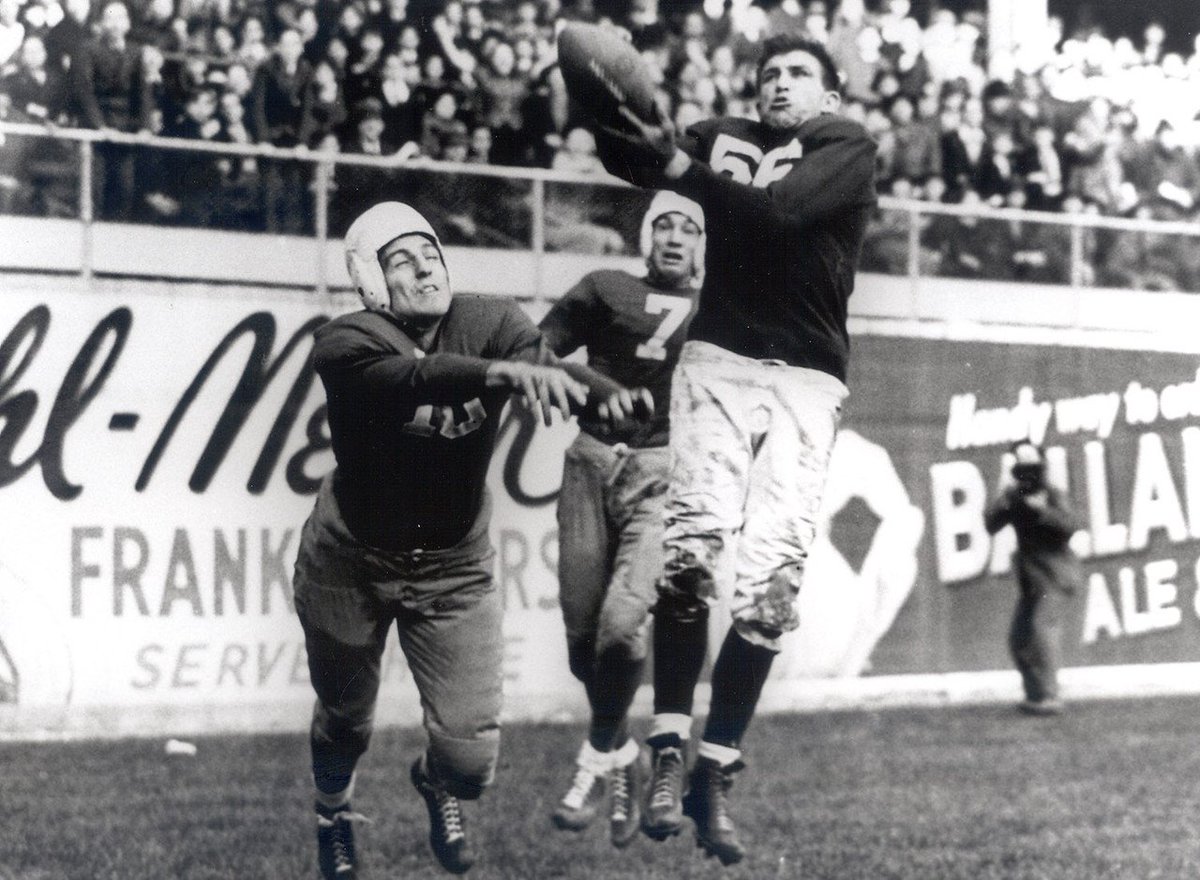
The only known photograph of the game.
Number 7 is Ace Parker. Number 56 is Bill Hewitt.
Both men are in the Pro Football Hall of Fame.
No, Hewitt hasn't lost his helmet: He didn't wear one
until the NFL passed a rule requiring it in 1940.

October 22, 1939: For the 1st time, a professional football game is televised, on experimental New York station W2XBS, the forerunner of WNBC-Channel 4. The Brooklyn Dodgers -- yes, there was an NFL team with that name -- play the Philadelphia Eagles at Ebbets Field in Brooklyn. The Dodgers win, 23-14, before only 13,057 fans.

There's no record of how many people paid to watch it in person, but there were apparently less than 300 TV sets capable of receiving the signal. No footage of the game survives, not even on newsreel.

The Dodgers struck first, on a 1-yard run by Clarence "Pug" Manders, who was in the middle of a run of 3 straight Pro Bowls. In the 2nd quarter, Fran Murray scored on a 1-yard run of his own for the Eagles. It remained 7-7 at the half, but the Dodgers took over: Ralph Kercheval kicked field goals of 44, 38 and 45 yards, and future Hall-of-Famer Clarence "Ace" Parker threw a 47-yard touchdown pass to Perry Schwartz. The Eagles added a 22-yard touchdown pass from Davey O'Brien, winner of the 1938 Heisman Trophy with Texas Christian, to Hall-of-Famer Bill Hewitt, but that would be as close as the Eagles got.

Football and television is an epic love story, but it was far from love at first sight. It would really take another 19 years, and the 1958 NFL Championship Game -- Baltimore Colts 23, New York Giants 17, in overtime at Yankee Stadium -- for it to become more than a flirtation. If there is an event that can be called "the wedding," it's probably Super Bowl III, 10 years after that, on January 12, 1969.

But the couple is inseparable, partly because of the shared TV revenue which allows Green Bay, Wisconsin, with a metropolitan area of 300,000 people, to compete on the same level as New York City, with a metro area of nearly 24 million people. It's also why the Big Ten Conference wanted to add Rutgers and the University of Maryland: Between the markets of New York, Philadelphia, Baltimore and Washington, they added about 40 million.

The NFL's TV revenue is so big (How big is it?), it's been said that the NFL can shut the doors of all 16 stadiums hosting games in a given weekend, with a total official attendance of zero, and still make a profit.

*

October 22, 1939 was a Sunday. George Cohen, the right back on the England team that won the 1966 World Cup, was born on this day.

The baseball season was over, the NHL season hadn't begun yet, and the NBA hadn't yet been founded. But there were 4 other NFL games founded:

* The New York Giants beat the Chicago Bears, 16-13 at the Polo Grounds.

* The Washington Redskins beat the Pittsburgh Pirates, 21-14 at Forbes Field in Pittsburgh. The Pirates, like the Giants named for their city's oldest baseball team, became the Pittsburgh Steelers the next season.

* The Cleveland Rams beat the Chicago Cardinals, 24-0 at Comiskey Park in Chicago. The Rams moved to Los Angeles in 1946, St. Louis in 1995, and back to Los Angeles in 2016. The Cardinals moved to St. Louis in 1960, and Arizona in 1988.

* And the Green Bay Packers beat the Detroit Lions, 26-7 at City Stadium in Green Bay. 

Monday, October 17, 2022

October 17, 1939: "Mr. Smith Goes to Washington" Premieres

October 17, 1939: Mr. Smith Goes to Washington premieres, at Constitution Hall in Washington, D.C. It was the 2nd of the 3 films that were directed by Frank Capra and starred James Stewart. The 1st was You Can't Take It With You in 1938. The 3rd was It's a Wonderful Life in 1946, which became the defining Frank Capra film and the defining Jimmy Stewart film.

U.S. Senator Sam Foley -- his State is never identified, but is said to be in the West -- dies in office. The Governor Hubert "Happy" Hopper (played by Guy Kibbee) appoints Jefferson Smith (Stewart) to replace him, thinking the young activist will be easy to manipulate. Senator Joseph Paine (Claude Rains), a friend of Smith's late father, mentors him, and Smith takes a liking to the Senator's daughter, Susan (Jean Arthur).

The Washington press take advantage of Smith's naïveté, and he ends up looking like a dim country bumpkin. He comes up with a bill to authorize a federal government loan to buy some land in his home State for a national boys' camp, to be paid back by youngsters across America. It sounds like a typical Franklin Roosevelt-style New Deal bill, and the public likes it, with donations pouring in immediately. However, the proposed campsite is already part of a dam-building graft scheme included in an appropriations bill framed by the the political machine of the State's party boss, Jim Taylor (Edward Arnold), and supported by Paine.

Unwilling to politically destroy Smith so that their graft plan will go through, Paine tells Taylor he wants out, but Taylor reminds him that Paine is in power primarily through Taylor's influence. Paine then advises Smith to keep silent about the matter. The following day, when Smith speaks out about the bill at Senate, the machine, through Paine, accuses Smith of trying to profit from his bill, by producing fraudulent evidence that Smith already owns the land in question. Smith is too shocked and angry by Paine's betrayal to defend himself, and runs away.

Saunders, who looked down on Smith at first, but has come to believe in him, talks him into launching a filibuster, to postpone the appropriations bill and prove his innocence on the Senate floor just before the vote to expel him. In his last chance to prove his innocence, he talks non-stop for about 25 hours, reaffirming the American ideals of freedom and disclosing the dam scheme's true motives. Yet none of the other Senators are convinced.

Newspapers and radio stations in Smith's home State, on Taylor's orders, refuse to report what Smith has to say, and even distort the facts against the Senator. The Boy Rangers' effort to spread the news in support of Smith results in vicious attacks on the children by Taylor's gangsters.

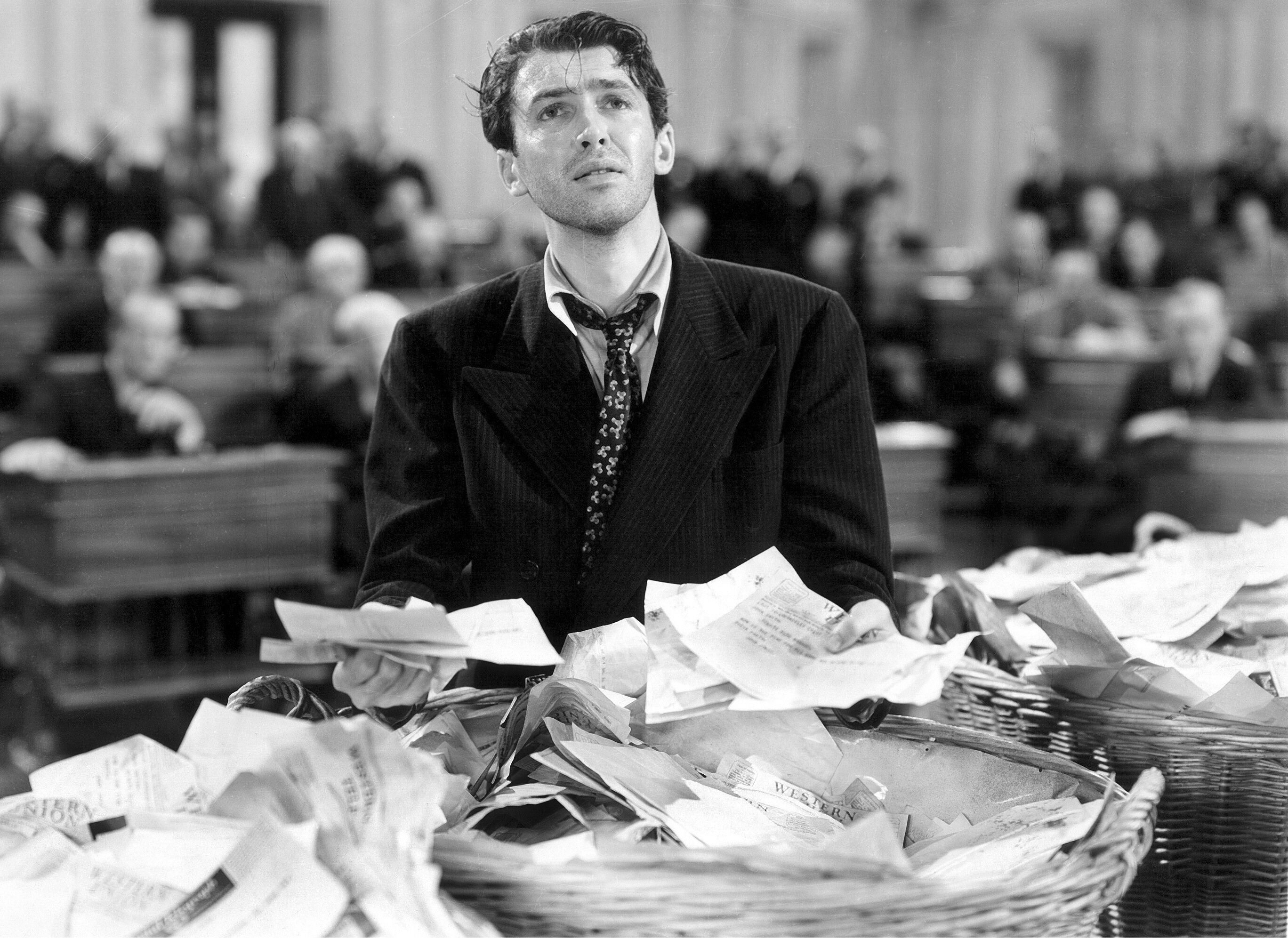
Although all hope seems lost, the Senators begin to pay attention as Smith approaches utter exhaustion. Paine has one last card up his sleeve: He brings in bins of letters and telegrams from the home State, purportedly from average people demanding his expulsion. Nearly broken by the news, Smith finds a small ray of hope in a friendly smile from the President of the Senate. Smith vows to press on until people believe him, but immediately collapses in a faint.

Overcome with the pangs of remorse, Paine leaves the Senate chamber, and attempts to commit suicide by gunshot, but is stopped by onlooking Senators. He then bursts back into the Senate chamber, shouting a confession to the whole scheme. The reformed Paine further insists that he must be expelled from the Senate, and affirms Smith's innocence.

Because the film even suggested that the American federal government might harbor corruption, it was slammed as anti-American and pro-Communist. Senator Alben Barkley of Kentucky, the Majority Leader (and later Vice President under Harry Truman), called the film "a grotesque distortion."

Joseph P. Kennedy, the U.S. Ambassador to Britain (and later father to 3 U.S. Senators, 1 of whom became President), wrote to Harry Cohn, head of Columbia Pictures, the film's distributor, and urged that it be withdrawn from European release, because it would damage America's prestige in Europe. He needn't have worried: The major Fascist dictators -- Adolf Hitler in Germany, Benito Mussolini in Italy, and Francisco Franco in Spain -- all banned it in their countries. It wasn't shown in the Soviet Union until 1950.

Since World War II, the words "Mr. Smith goes to Washington" have become code for a "citizen legislator" getting himself elected and fighting the entrenched interests in Congress. Many such candidates have proven to have been already bought by special interests before they got there.

*

October 17, 1939 was a Tuesday. Baseball season had just ended, with the New Yankees sweeping the Cincinnati Reds in the World Series. The NBA hadn't been founded yet. And the NHL season didn't start for another 2 weeks. There was one score on this historic day, and it was in college football: William & Mary and VPI played to a 6-6 tie at City Stadium in Richmond, Virginia.

"VPI" was the abbreviation for what was known from 1896 to 1944 as the Virginia Agricultural and Mechanical College and Polytechnic Institute; and from 1944 to 1970 as simply the Virginia Polytechnic Institute. Since 1970, it has been Virginia Tech University.

Sunday, October 16, 2022

October 16, 1939: “The Man Who Came to Dinner” Premieres

Bette Davis and Monty Woolley in the film version

October 16, 1939: The Man Who Came to Dinner premieres at the Music Box Theatre in New York. The play is written by George S. Kaufman and Moss Hart.

It was based on their mutual friend, theater critic Alexander Woollcott, leader of the Algonquin Round Table, visiting Hart's country home outside Philadelphia, and making a nuisance of himself. Hart told Kaufman he was lucky Woollcott hadn't broken his leg and gotten stuck there (there was no hospital within miles at the time), and Kaufman thought it would be great comedy -- should it happen to somebody else!

Monty Woolley was cast in the Woollcott role, named Sheridan Whiteside. The original cast also included Gordon Merrick as the Hart analogue, Richard Stanley; a young Mary Wickes, later known for battleaxe roles and appearing as a Match Game panelist, as Miss Preen; John Hoysradt (later known as John Hoyt) as Beverley Carlton, based on Noël Coward; and David Burns as "Banjo," a character obviously based on another friend of Kaufman and Hart, Harpo Marx.

The play was filmed in 1942, with Woolley reprising his role, Jimmy Durante as Banjo, and Ann Sheridan and Bette Davis also starring. It was filmed again in 1972, with those roles filled by, respectively, Orson Welles, Don Knotts, Lee Remick and Joan Collins.

Kaufman and Hart died a few months apart in 1961, Woollcott in 1943, Woolley in 1963, Burns in 1971, Merrick in 1988, Hoyt in 1991, and Wickes in 1995.

The Music Box Theatre is still open, at 239 West 45th Street. It hosted the premieres of Of Thee I Sing, Dinner at Eight, As Thousands Cheer, Merrily We Roll Along, Stage Door and Of Mice and Men in the 1930s; I Remember Mama and Tennessee Williams' Summer and Smoke in the 1940s, The Male Animal and Bus Stop in the 1950s, A Far Country and There's a Girl In My Soup in the 1960s, Sleuth and Deathtrap in the 1970s, Agnes of God and A Few Good Men in the 1980s, August: Osage County in the 2000s, and Dear Evan Hansen in the 2010s.

*

October 16, 1939 was a Monday. Baseball season had ended 8 days earlier, with the New York Yankees sweeping the World Series against the Cincinnati Reds. Football was in midweek. The NBA hadn't been founded yet. And the NHL season started 17 days later. So there were no scores on this historic day.

Saturday, October 8, 2022

October 8, 1939: Ernie Lombardi's "Snooze"

October 8, 1939: Game 4 of the World Series is played at Crosley Field in Cincinnati. The New York Yankees already lead the Cincinnati Reds, 3 games to none. The game is scoreless until the top of the 7th inning, when Charlie Keller and Bill Dickey hit home runs for the Yankees. The Reds come right back with 3 runs, started by an error by the normally sure-fielding Red Rolfe.

Mel Allen, then in his 1st season as a Yankee broadcaster, would later call Rolfe his all-time 3rd baseman, ahead of Pie Traynor and Eddie Mathews, the 2 most-named candidates at that point. This was while Brooks Robinson was still active, and before Mike Schmidt and George Brett debuted. So that should give an idea of how good Rolfe was, even though he is not in the Baseball Hall of Fame.

The Reds scored another run in the 8th. But their ace pitcher, Bucky Walters, ran out of gas in the 9th, and the Yankees sent the game to extra innings.

Cliché Alert: Walks can kill you, especially the leadoff variety. Frank Crosetti led off the top of the 10th by drawing a walk off Walters. Rolfe bunted him over. Keller -- nicknamed "King Kong," which he hated, because he was big, strong and hairy -- reached on an error by shortstop Billy Myers And Joe DiMaggio, already the best player in baseball at age 24, singled to right. Crosetti easily scored the go-ahead run.

It got worse for the Reds: Right fielder Ival Goodman bobbled the ball, and Keller tried to score. The throw got to catcher Ernie Lombardi, but there was a collision, and Lombardi dropped the ball. For a moment, he just lay there at home plate, in a daze. DiMaggio noticed this as he approached 3rd base, and tried to score. Lombardi snapped out of it, got the ball, and leaned over to tag DiMaggio, who executed a fantastic slide, thrown his entire body away from the plate, just brushing it with his right foot. It was 7-4 Yankees. That completed the World Series sweep, and manager Joe McCarthy's team became the first club to win 4 consecutive Fall Classics. It was their 8th World Championship overall.

The prudish press of the day said that Lombardi "swooned" or "snoozed" at the plate, but, in reality, Keller had inadvertently kneed him in the groin. His inability to act for a few seconds thereafter was understandable, even if he was wearing a cup.

Lombardi died in 1977, and was posthumously elected to the Hall of Fame in 1986. He batted .306 for his career, won 2 National League batting titles, was the NL Most Valuable Player in 1938, and was selected for 8 All-Star Games. But, because of his large nose, he was nicknamed "Schnozz." And because of that and the aforementioned play, it was said that he was "known for his schnozz and his snooze." This was unfair.

Keller looked like he might be headed for the Hall, but missed the 1944 season due to World War II, hurt his back during his service with the U.S. Merchant Marine, and was never the same player. He played his last game just after his 36th birthday, and still ended up with a .286 batting average, 189 home runs, and a career OPS+ of 152 -- considerably higher than Lombardi's 126. He retired to a farm in his native Maryland, trained racehorses with Yankee-themed names, and lived until 1990.

The last surviving player from the Yankees' 1939 World Champions -- and their 1937, 1938 and 1941 titlists as well -- was right fielder Tommy Henrich, a.k.a. Ol' Reliable, who lived until 2009. The Reds would rebound from this defeat, and win the 1940 World Series, beating the Detroit Tigers in 7 games.

*

October 8, 1939 was a Sunday. This was the only baseball game. The NHL season didn't start until the next month. The NBA hadn't been founded yet. But these NFL games were played:

* The football version of the New York Giants beat the football version of the Pittsburgh Pirates, 14-7 at Forbes Field in Pittsburgh. The football Pirates would change their name to the Pittsburgh Steelers the next season.

* The football version of the Brooklyn Dodgers lost to the Washington Redskins, 41-13 at Griffith Stadium in Washington.

* The Chicago Bears beat the Cleveland Rams, 35-21 at Cleveland Municipal Stadium. The Rams moved to Los Angeles in 1946, to St. Louis in 1995, and back to Los Angeles in 2016.

* And the Green Bay Packers beat the Chicago Cardinals, 27-20 at the Dairy Bowl in the Milwaukee suburb of West Allis, Wisconsin. The Dairy Bowl was a football stadium built in the infield of a speedway, now known as the Milwaukee Mile, at the Wisconsin State Fair Park. The Cardinals moved to St. Louis in 1960, and to Arizona in 1988.

Also, Australian actor Paul Hogan, star of the Crocodile Dundee films, was born on this day. So was "underground" cartoonist Harvey Pekar.

Saturday, October 1, 2022

October 1, 1939: Marvel Comics #1

October 1, 1939: Marvel Mystery Comics #1, produced by Timely Comics, premieres. By 1950, the company would take the name Marvel Comics. The issue now usually referred to as just "Marvel #1" featured Prince Namor of Atlantis, the Sub-Mariner; the original version of the Human Torch, an android; a gun-toting crimefighter called the Angel; and Ka-Zar the Great, a Tarzan ripoff.

In Fantastic Four #4, May 1962, as part of Marvel's attempt to re-establish itself as DC Comics' main rival, and perhaps even its superior, the new Human Torch, Johnny Storm of the titular hero team, finds the long-lost, amnesiac Sub-Mariner, and restores his memory, but with terrible results. Namor is often referred to as comic books' 1st "anti-hero": A man who helps when he feels like it, but also causes great harm.

In X-Men #1, September 1963, a new superhero named the Angel would be introduced, a man with wings who could fly. Aside from the name, and large wealth, this new Angel, Warren Worthington III, has nothing in common with his predecessor, a private detective named Thomas Halloway.

Marvel #1 sold for 10 cents, equivalent to about $2.10 today. If you can find a copy in good condition today, it will set you back about $350,000.

*

October 1, 1939 was a Sunday. It was the last day of baseball's regular season. In other words, if the film The Natural were a true story, the next day would have been the Playoff for the National League Pennant, and Roy Hobbs shooting out the lights with a walkoff home run.

In real life, these games were played:

* The New York Giants beat the Boston Bees, 5-0 at National League Park in Boston. This was during the 1936-40 experiment in changing names, an experiment that failed: Everyone still called the team the Boston Braves and the ballpark Braves Field, so they switched back. Harry Gumbert pitched a 4-hit shutout. Mel Ott, the leading Giant of his generation, did not play in this game.

* The Brooklyn Dodgers beat the Philadelphia Phillies, 3-2 at Ebbets Field.

* A doubleheader was split at Forbes Field in Pittsburgh. The Cincinnati Reds won the opener, 9-1, getting 3 hits each from Billy Werber and Ival Goodman, and 2 hits each from Lonny Frey, Frank McCormick, Harry Craft, Wally Berger and Billy Meyers.

The Pittsburgh Pirates won the nightcap, 8-0. Ken Heintzelman pitched a 4-hit shutout. Paul Waner went 3-for-5 with an RBI, and Maurice Van Robays went 2-for-5 with 3 RBIs.

* A doubleheader was split at Briggs Stadium in Detroit. The Cleveland Indians won the 1st game, 8-3, with Bob Feller as the winning pitcher. The Detroit Tigers won the 2nd game, 1-0, called after 5 innings due to darkness. (Briggs Stadium was the last ballpark in the American League to get lights, in 1948. It was renamed Tiger Stadium in 1961.) Over the 2 games, Lou Boudreau went 2-for-5 with 2 walks and an RBI, while Hank Greenberg went 1-for-7.

* The Chicago Cubs beat their arch-rivals, the St. Louis Cardinals, 2-1 at Wrigley Field in Chicago.

* The St. Louis Browns beat the Chicago White Sox, 4-3 in 10 innings at Sportsman's Park in St. Louis. This season finale might have been the highlight of the Browns' season even without the dramatics, because it put them out of their misery: They finished 43-111.

* The New York Yankees and the Boston Red Sox had each completed their schedule the day before, against each other. The Yankees went on to sweep the Reds in the World Series.

* The Philadelphia Athletics and the Washington Senators had each completed their schedule the day before, against each other.

Saturday, September 3, 2022

September 3, 1939: The Allies Declare War On Nazi Germany

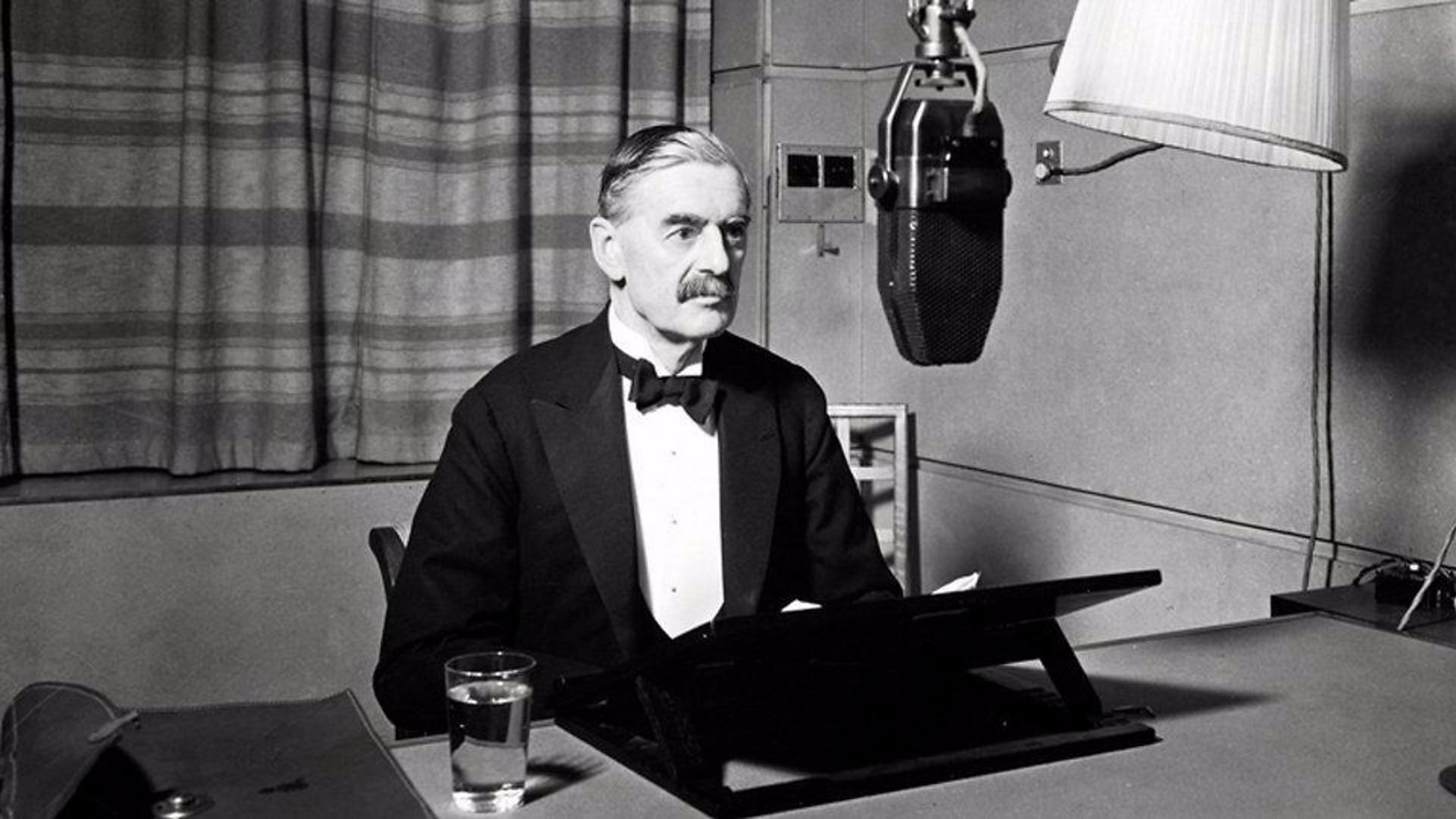
September 3, 1939: At 11:00 AM -- 12:00 Noon, Central European Time; and 6:00 AM, U.S. Eastern Time -- with the Nazis having refused his ultimatum following their invasion of Poland 2 days earlier, Neville Chamberlain, Prime Minister of Great Britain, his hope for "peace for our time" (usually misquoted as "peace in our time") of one year ago in ashes, goes onto the international radio network of the British Broadcasting Corporation, and announces that he has gotten the Parliament to declare war on Germany; and that the French Third Republic had done the same.

One of the first things France does is evacuate some paintings from The Louvre. Priorities.

In 1919, having read the Treaty of Versailles, Marshal Ferdinand Foch said, "This is not peace. It is an armistice for 20 years." He died in 1929, and turned out to be right within 2 months.

Before the war ended on August 14, 1945, 75 million people, military and civilian combined, had been killed. This included 11 million in the Nazis' concentration camps, 6 million of them for no crime other than being Jewish.

*

September 3, 1939 was a Sunday. England's Football Association suspended Football League and FA Cup play for the duration of the war. Many other sporting events would also be canceled during the war.

Though this was a Sunday, the NFL season was still 2 weeks away from beginning. These Major League Baseball games were played: 

* The New York Yankees played a doubleheader with the Boston Red Sox at Fenway Park. Boston won the 1st game, 12-11. Charlie Keller hit a home run and had 4 RBIs, but DiMaggio injured himself in the 1st inning, and had to leave the game. The Sox hit no home runs, but Joe Vosmik got 3 hits, Doc Cramer and shortstop-manager Joe Cronin each got 2, and rookie Ted Williams got 1. 

The 2nd game was called due to darkness after 7 innings, tied 5-5. DiMaggio returned, and he and Joe Gordon hit home runs for the Yankees. For the Sox, Williams hit 2 home runs, and Cronin hit 1. Foxx went 4-for-6 over the 2 games.

* The New York Giants beat the Brooklyn Dodgers, 7-1 at the Polo Grounds. Mel Ott did not play.

* The Boston Bees swept a doubleheader from the Philadelphia Phillies at Shibe Park, taking the 1st game 4-3, and the 2nd game 6-2.

* The Washington Senators beat the Philadelphia Athletics, 6-1 at Griffith Stadium in Washington.

* The Cleveland Indians beat the St. Louis Browns, 6-2 at Cleveland Municipal Stadium.

* The Cincinnati Reds beat the Chicago Cubs, 5-0 at Crosley Field in Cincinnati.

* A doubleheader was split at Comiskey Park in Chicago. The Chicago White Sox beat the Detroit Tigers 8-1 in the 1st game. The Tigers won the 2nd game 7-2. Greenberg was still injured, and did not play in either game.

* And the St. Louis Cardinals swept a doubleheader with the Pittsburgh Pirates at Sportsman's Park in St. Louis. The Cards won the 1st game 14-6, and the 2nd game 3-0.

Also, John Davey, who played Captain Marvel on the CBS TV series Shazam! from 1975 to 1977, was born. 

Thursday, September 1, 2022

September 1, 1939: World War II Begins

September 1, 1939: At 4:40 AM Central European Time -- 3:40 AM in London, 10:40 PM August 31, U.S. Eastern Time -- the bombing of WieluÅ„ in the western part of Poland commences, beginning the Battle of the Border. Shock-troops of the German Wehrmacht begin crossing the border into Poland. World War II has begun.

Five minutes later, under the cover of darkness, the German WWI-era battleship Schleswig-Holstein quietly slips her moorings at her wharf in Danzig Harbor, drifts into the center of the channel, and commences firing on a Polish military installation on Westerplatte at the northeastern mouth of the port of the internationalized Free City of Danzig, beginning the Battle of Westerplatte and the Battle of Danzig Bay.

Britain and France deliver ultimatums to Germany, to get out of Poland within 2 days. Norway, Finland, Sweden and Switzerland declare their neutrality. President Franklin D. Roosevelt states that "every effort" would be made by his administration to stay out of the war. Italy is advised that Germany does not expect to need its military support at present.

Time magazine had named Chancellor Adolf Hitler of Germany its Man of the Year for 1938, and gave the distinction to Soviet Premier Joseph Stalin for 1939, and would do so again for 1942.

The war ended on August 14, 1945. Between these 2 dates, these nations lost about this many people, military and civilian combined:

Soviet Union: 27 million
China: 20 million
Germany: 7.4 million
Dutch East Indies, later Indonesia: 4 million
Japan: 3.1 million
French Indochina, later Vietnam: 2.2 million
Yugoslavia: 1.7 million
Philippines: 1.4 million
Burma, later Myanmar: 1 million
Hungary: 864,000
Greece: 807,000
France proper: 600,000
Korea: 533,000
Italy: 514,000
Romania: 500,000
Great Britain: 451,000
United States: 419,000
Czechoslovakia: 355,000
Netherlands proper: 250,000
Singapore: 100,000
Ethiopia: 100,000
Finland: 97,000
Belgium: 88,000
Portuguese Timor (now East Timor): 70,000
Ruanda-Urundi (Belgian, now Rwanda and Burundi): 50,000
Canada: 44,000
Australia: 41,000
Albania: 30,000
Bulgaria: 22,000
Papua New Guinea: 15,000
South Africa: 12,000
New Zealand: 12,000
Norway: 11,000
Thailand: 7,600
Luxembourg: 7,100
Denmark: 6,000
Ireland: 5,100
Sweden: 2,100
Brazil: 2,000

Over 75 million people died, simply because Adolf Hitler couldn't handle Germany losing World War I, and wanted to make his country great again.

*

September 1, 1939 was a Friday. These Major League Baseball games were played:

* The New York Yankees beat the Cleveland Indians, 11-8 at Cleveland Municipal Stadium. No home runs for the Bronx Bombers, but 3 hits each for Joe DiMaggio and Bill Dickey; and 2 each for Frank Crosetti, Charlie Keller, George Selkirk and the starting pitcher, Monte Pearson. But Pearson and Bob Feller each got hit hard. Spud Chandler pitched to 3 batters, allowing 2 runs before getting 1 out, but turned out to be the winning pitcher because the Yankees scored 4 runs in the top of the 8th.

* The Brooklyn Dodgers split a doubleheader with the Chicago Cubs at Ebbets Field. The Cubs won the 1st game, 6-2; and the Dodgers won the 2nd game, 3-1.

* The Boston Bees, as the Braves were known from 1936 to 1940, beat the Philadelphia Phillies, 6-0 at Shibe Park in Philadelphia.

* And the Detroit Tigers beat the Boston Red Sox, 14-10 at Briggs Stadium (renamed Tiger Stadium in 1961. Pinky Higgins hit 2 home runs for the Tigers. Hank Greenberg, the Tigers' Jewish slugger, was injured, and did not play. For the Red Sox, Jimmie Foxx went 2-for-5, and rookie Ted Williams went 3-for-3 with 2 walks and an RBI.

* The Chicago White Sox, the Cincinnati Reds, the New York Giants, the Philadelphia Athletics, the Pittsburgh Pirates, the St. Louis Browns, the St. Louis Cardinals and the Washington Senators were not scheduled.

And comedian and actress Lily Tomlin was born.

Saturday, August 27, 2022

August 27, 1939: The Polish Soccer Team's Greatest Win -- and Almost Its Last

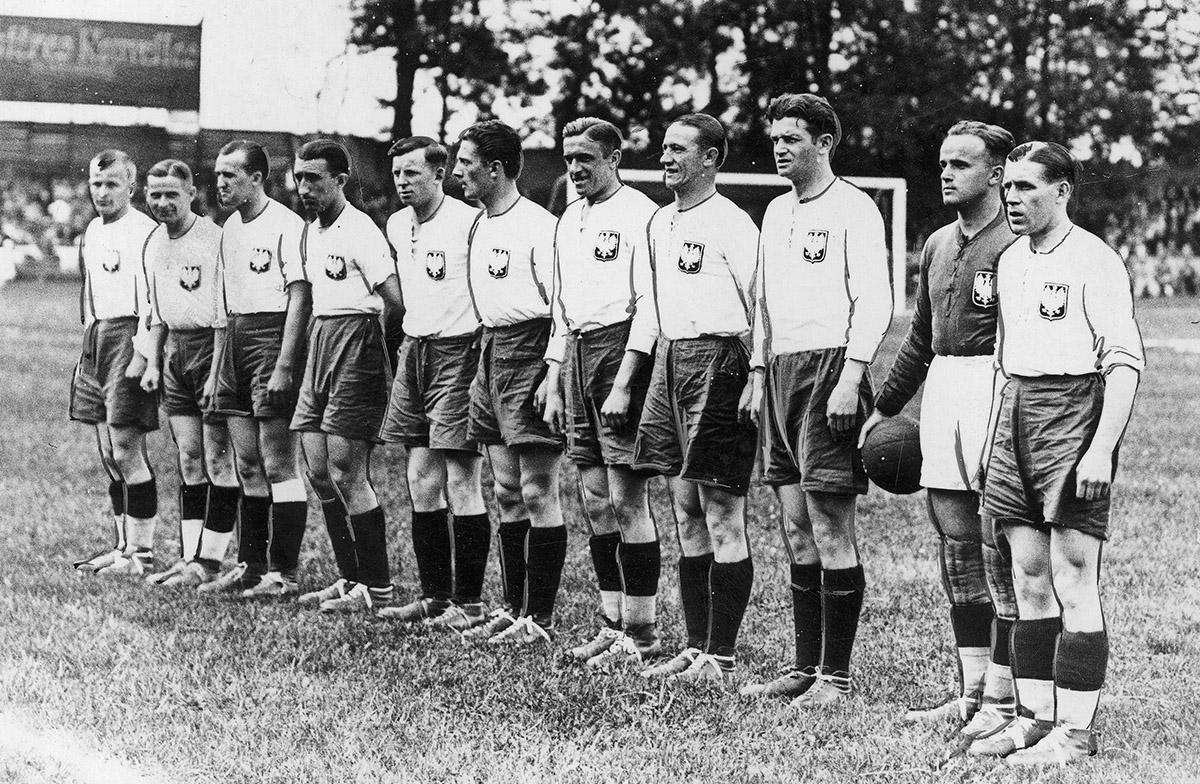
August 27, 1939: The national soccer team of Poland defeats Hungary, runners-up at the previous year's World Cup, 4-2 at Stadion Wojska Polskiego (the Polish Army Stadium) in Warsaw. Ernest "Ezi" Wilimowski scored 3 goals in the game.

Poland had never beaten Hungary in 8 previous tries, and it is considered the greatest victory in team history. Indeed, Alex James, the now-retired Scotsman who had captained the Arsenal champions earlier in the decade, had been advising the Poland team, and had told them to concentrate on defense, and "hope for a lucky draw."

It is the last game played by Poland for many years. Four days later, Nazi Germany will invade from the West, and the Soviet Union will invade from the east. Rumors of such invasions abounded, but a sellout crowd of 20,000 attended, anyway. But James had fled back to Britain.

A game had been scheduled for the following Sunday, September 3, hosting Bulgaria. The following Wednesday, September 6, Poland were scheduled to play Yugoslavia in Belgrade. On September 24, Poland were to play Romania in Warsaw. All of these games were canceled after the invasion on September 1.

Manager Jozef Kaluza did not survive the War, although his death was due to illness, not combat or imprisonment. Every one of his players, in the 2-3-5 formation common at the time, survived the War: Goalkeeper Adolf Krzyk; right back Wladyslaw Szczepaniak, left back Edmind Giemsa; midfielders Wilhelm Gora, Edward Jablonski and Ewald Dytko; and forwards Henruk Jaznicki (the last survivor, living until 2004), Ewald Cebula, Leonard Piontek, Ernst Wilimowski, Pawel Cyganek, and Stanislaw Baran, who came on as a substitute for Jaznicki.

On June 11, 1946, the Poland national team played again, losing 3-1 in a friendly against Norway, at the Ulleval Stadium in Oslo.

Built in 1930, the Polish Army Stadium has been home to the country's most successful team, Legia Warsaw, ever since. In 2010, the stadium was reconstructed, stand-by-stand, and reopened, officially renamed for both the team and the founding father of the Polish Republic: Marshall Józef PiÅ‚sudski Legia Warsaw Stadium. 

It was the home of the national team until 1993, when games were moved to Stadion ÅšlÄ…ski (the Silesian Stadium) in Chorzów. In 2011, the 58,580-seat Stadion Narodowy (National Stadium) was opened, and Poland have played most of their national team games there since.

To my regret as an American soccer fan of Polish descent, Poland's record in international competition is poor. Out of 21 World Cups staged from 1930 to 2018, they have played in only 8, having withdrawn in 1934 and 1954, and refusing to enter in 1930 and 1950. They reached the Semifinals in 1974 and 1982; the Quarterfinals in 1978; the Round of 16 in 1938 and 1986; and the Group Stage in 2002, 2006 and 2018. (UPDATE: They reached the Round of 16 in 2022, but did not qualify in 2026.)

The European Championships were established in 1960, and they didn't qualify until 2008. They qualified as co-hosts with Ukraine in 2012, and reached the knockout stage for the 1st time in 2016, getting to the Quarterfinals.

*

August 27, 1939 was a Sunday. Edward Patten, Gladys Knight's cousin and one of her Pips, was born. So was travel writer William Least Heat-Moon.

These Major League Baseball games were played:

* The New York Yankees beat the Detroit Tigers, 13-3 at Briggs Stadium (later Tiger Stadium) in Detroit. Charles "Red" Ruffing advanced to 20-4 on the season, outpitching Lynwood "Schoolboy" Rowe. Frank Crosetti, Bill Dickey and Red Rolfe hit home runs. Joe DiMaggio went 1-for-5 with an RBI. Hank Greenberg did not play.

* The New York Giants lost to the Cincinnati Reds, 7-2 at the Polo Grounds. Paul Derringer outpitched Carl Hubbell. Ival Goodman went 2-for-5 with a home run and 4 RBIs. Mel Ott went 0-for-4.

* A doubleheader was split at Ebbets Field. The Brooklyn Dodgers won the opener, 3-2. Freddie Fitzsimmons outpitched Mace Brown. The Pittsburgh Pirates won the nightcap, 9-5. Cy Blanton outpitched Al Hollingsworth. Over the 2 games, Joseph "Arky" Vaughan went 6-for-10 with 2 RBIs; Paul Waner went 3-for-8 with a walk and 2 RBIs; while Lloyd Waner went 0-for-5 in the 1st game, and did not play in the 2nd game.

* A doubleheader was split at National League Park in Boston. The Boston Bees won the 1st game, 10-4. The St. Louis Cardinals were leading the 2nd game, 6-5 in the bottom of the 8th, when the game was called due to a quirk in the law that allowed professional sports on Sundays in Massachusetts: A curfew that cut off all games at 6:00 PM.

This was during the former Boston Braves' "rebrand" (as we would call it today), following their awful 1935 season: They renamed themselves the Bees, and Braves Field was renamed National League Park. The new names never caught on, and, in 1941, the previous names were restored. (At least they didn't go back to their 1883-1906 name, the Boston Beaneaters.

* The Philadelphia Phillies swept a doubleheader from the Chicago Cubs, 4-3 and 3-2 at Shibe Park in Philadelphia. Pennsylvania also had a curfew put into their recent laws legalizing professional sports on Sundays, but both of these games came in under the wire.

* The Cleveland Indians swept a doubleheader from the Boston Red Sox, 1-0 and 5-3 at Cleveland Municipal Stadium. Bob Feller pitched a 4-hit shutout in the 1st game, outpitching Denny Galehouse. Willis Hudlin outpitched Fritz Ostermueller in the 2nd game. After going 0-for-4 in the 1st game, Hal Trosky went 2-for-4 with a home run and 4 RBIs in the 2nd game.

Over the 2 games, Lou Boudreau went 1-for-8, Jimmie Foxx went Jimmie Foxx went 3-for-8, and rookie Ted Williams went 1-for-8.

* The Philadelphia Athletics beat the Chicago White Sox, 2-0 at Comiskey Park in Chicago. Bill Beckmmann pitched a 7-hit shutout.

* And the Washington Senators swept a doubleheader from the St. Louis Browns, 8-7 and 4-3 at Sportsman's Park in St. Louis. In the 2nd game, the Senators scored 3 runs in the top of the 11th inning, and the Browns could only come back with 2 in the bottom half.

December 31, 1999 & January 1, 2000: The Millennium

December 31, 1999:  The Millennium arrives. The people of planet Earth survived. At a terrible cost. But we hadn't destroyed ourselves. ...