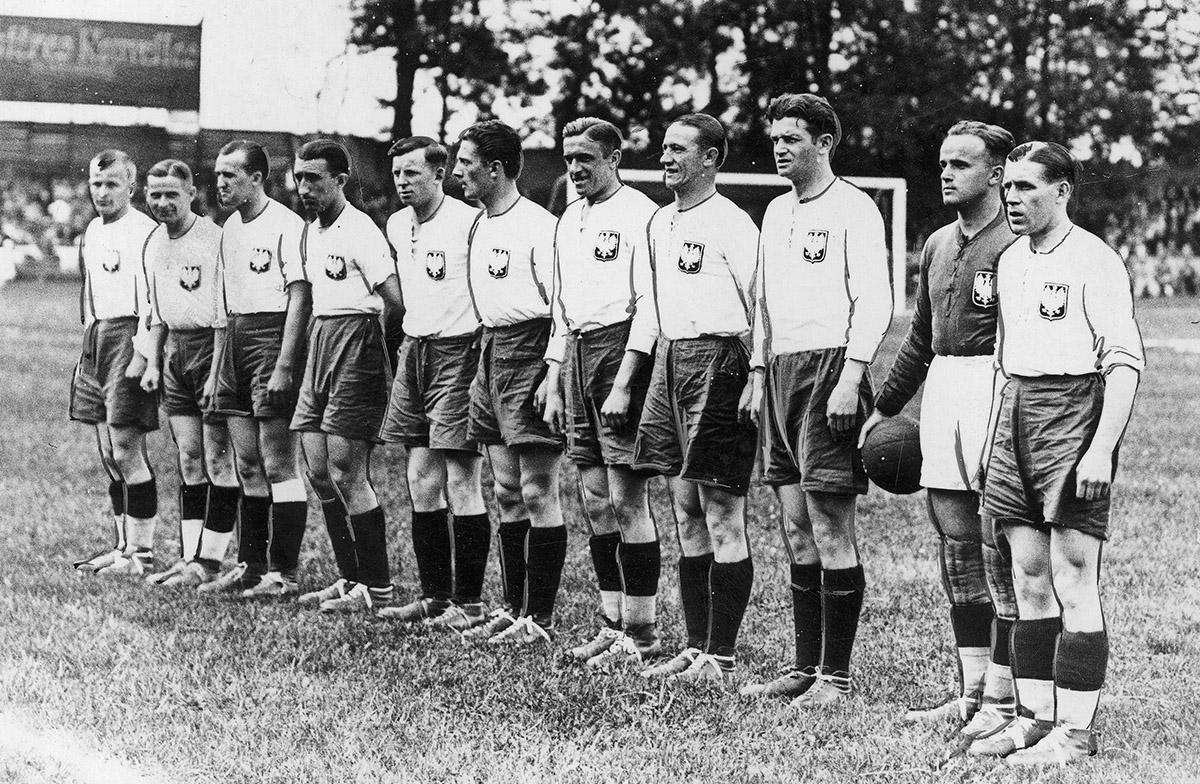
August 27, 1939: The national soccer team of Poland defeats Hungary, runners-up at the previous year's World Cup, 4-2 at Stadion Wojska Polskiego (the Polish Army Stadium) in Warsaw. Ernest "Ezi" Wilimowski scored 3 goals in the game.
Poland had never beaten Hungary in 8 previous tries, and it is considered the greatest victory in team history. Indeed, Alex James, the now-retired Scotsman who had captained the Arsenal champions earlier in the decade, had been advising the Poland team, and had told them to concentrate on defense, and "hope for a lucky draw."
It is the last game played by Poland for many years. Four days later, Nazi Germany will invade from the West, and the Soviet Union will invade from the east. Rumors of such invasions abounded, but a sellout crowd of 20,000 attended, anyway. But James had fled back to Britain.
A game had been scheduled for the following Sunday, September 3, hosting Bulgaria. The following Wednesday, September 6, Poland were scheduled to play Yugoslavia in Belgrade. On September 24, Poland were to play Romania in Warsaw. All of these games were canceled after the invasion on September 1.
Manager Jozef Kaluza did not survive the War, although his death was due to illness, not combat or imprisonment. Every one of his players, in the 2-3-5 formation common at the time, survived the War: Goalkeeper Adolf Krzyk; right back Wladyslaw Szczepaniak, left back Edmind Giemsa; midfielders Wilhelm Gora, Edward Jablonski and Ewald Dytko; and forwards Henruk Jaznicki (the last survivor, living until 2004), Ewald Cebula, Leonard Piontek, Ernst Wilimowski, Pawel Cyganek, and Stanislaw Baran, who came on as a substitute for Jaznicki.
On June 11, 1946, the Poland national team played again, losing 3-1 in a friendly against Norway, at the Ulleval Stadium in Oslo.
Built in 1930, the Polish Army Stadium has been home to the country's most successful team, Legia Warsaw, ever since. In 2010, the stadium was reconstructed, stand-by-stand, and reopened, officially renamed for both the team and the founding father of the Polish Republic: Marshall Józef Piłsudski Legia Warsaw Stadium.
It was the home of the national team until 1993, when games were moved to Stadion Śląski (the Silesian Stadium) in Chorzów. In 2011, the 58,580-seat Stadion Narodowy (National Stadium) was opened, and Poland have played most of their national team games there since.
To my regret as an American soccer fan of Polish descent, Poland's record in international competition is poor. Out of 21 World Cups staged from 1930 to 2018, they have played in only 8, having withdrawn in 1934 and 1954, and refusing to enter in 1930 and 1950. They reached the Semifinals in 1974 and 1982; the Quarterfinals in 1978; the Round of 16 in 1938 and 1986; and the Group Stage in 2002, 2006 and 2018. (UPDATE: They reached the Round of 16 in 2022, but did not qualify in 2026.)
The European Championships were established in 1960, and they didn't qualify until 2008. They qualified as co-hosts with Ukraine in 2012, and reached the knockout stage for the 1st time in 2016, getting to the Quarterfinals.
*
August 27, 1939 was a Sunday. Edward Patten, Gladys Knight's cousin and one of her Pips, was born. So was travel writer William Least Heat-Moon.
These Major League Baseball games were played:
* The New York Yankees beat the Detroit Tigers, 13-3 at Briggs Stadium (later Tiger Stadium) in Detroit. Charles "Red" Ruffing advanced to 20-4 on the season, outpitching Lynwood "Schoolboy" Rowe. Frank Crosetti, Bill Dickey and Red Rolfe hit home runs. Joe DiMaggio went 1-for-5 with an RBI. Hank Greenberg did not play.
* The New York Giants lost to the Cincinnati Reds, 7-2 at the Polo Grounds. Paul Derringer outpitched Carl Hubbell. Ival Goodman went 2-for-5 with a home run and 4 RBIs. Mel Ott went 0-for-4.
* A doubleheader was split at Ebbets Field. The Brooklyn Dodgers won the opener, 3-2. Freddie Fitzsimmons outpitched Mace Brown. The Pittsburgh Pirates won the nightcap, 9-5. Cy Blanton outpitched Al Hollingsworth. Over the 2 games, Joseph "Arky" Vaughan went 6-for-10 with 2 RBIs; Paul Waner went 3-for-8 with a walk and 2 RBIs; while Lloyd Waner went 0-for-5 in the 1st game, and did not play in the 2nd game.
* A doubleheader was split at National League Park in Boston. The Boston Bees won the 1st game, 10-4. The St. Louis Cardinals were leading the 2nd game, 6-5 in the bottom of the 8th, when the game was called due to a quirk in the law that allowed professional sports on Sundays in Massachusetts: A curfew that cut off all games at 6:00 PM.
This was during the former Boston Braves' "rebrand" (as we would call it today), following their awful 1935 season: They renamed themselves the Bees, and Braves Field was renamed National League Park. The new names never caught on, and, in 1941, the previous names were restored. (At least they didn't go back to their 1883-1906 name, the Boston Beaneaters.
* The Philadelphia Phillies swept a doubleheader from the Chicago Cubs, 4-3 and 3-2 at Shibe Park in Philadelphia. Pennsylvania also had a curfew put into their recent laws legalizing professional sports on Sundays, but both of these games came in under the wire.
* The Cleveland Indians swept a doubleheader from the Boston Red Sox, 1-0 and 5-3 at Cleveland Municipal Stadium. Bob Feller pitched a 4-hit shutout in the 1st game, outpitching Denny Galehouse. Willis Hudlin outpitched Fritz Ostermueller in the 2nd game. After going 0-for-4 in the 1st game, Hal Trosky went 2-for-4 with a home run and 4 RBIs in the 2nd game.
Over the 2 games, Lou Boudreau went 1-for-8, Jimmie Foxx went Jimmie Foxx went 3-for-8, and rookie Ted Williams went 1-for-8.
* The Philadelphia Athletics beat the Chicago White Sox, 2-0 at Comiskey Park in Chicago. Bill Beckmmann pitched a 7-hit shutout.
* And the Washington Senators swept a doubleheader from the St. Louis Browns, 8-7 and 4-3 at Sportsman's Park in St. Louis. In the 2nd game, the Senators scored 3 runs in the top of the 11th inning, and the Browns could only come back with 2 in the bottom half.


No comments:
Post a Comment