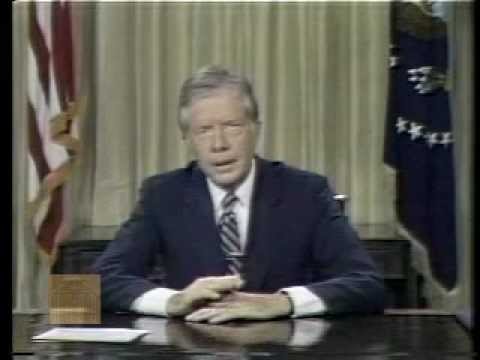
September 24, 1957: The President of the United States, Dwight D. Eisenhower, cuts short a vacation in Newport, Rhode Island, then considered a rich man's resort, to come back to Washington, and announce on TV and radio that he has ordered the U.S. Army's famed 101st Airborne Division to Little Rock, Arkansas, and federalized the Arkansas National Guard, to integrate that city's Central High School, to enforce the federal law that racial segregation in public schools was unconstitutional.
It has been said that he disagreed with the U.S. Supreme Court's 1954 decision to strike down public school segregation laws; but that, having sworn an oath to "preserve, protect and defend the Constitution of the United States," he had to send the troops in.
And he made a point of leaving his vacation to deliver the address, not just from the White House, but from the Oval Office. He said:
I could have spoken from Rhode Island, where I have been staying recently. But I felt that, in speaking from the house of Lincoln, of Jackson, and of Wilson, my words would better convey both the sadness I feel in the action I was compelled today to make, and the firmness with which I intend to pursue this course until the orders of the Federal Court at Little Rock can be executed without unlawful interference.
It was Ike's finest hour -- since 1945, anyway.
After the 1957-58 schoolyear, Governor Faubus shut Central High down. Those students who hadn't graduated had to go elsewhere. Many of the white students' parents paid through the nose to have their kids attend all-white private schools. Served those bigots right. Central reopened, integrated, for the 1959-60 schoolyear.
The Nine, and what became of them:
* Thelma Mothershed, born November 29, 1940 in Bloomburg, Texas, to parents from Little Rock, where she grew up. Despite the school's closure, she had the credits necessary to graduate. She earned Bachelor of Arts and Master of Guidance and Counseling degrees from Southern Illinois University, and, under her married name of Thelma Mothershed-Wair, taught home economics in East St. Louis, Illinois. (UPDATE: She died on October 19, 2024, a few weeks short of her 84th birthday.)
* Minnijean Brown, born September 11, 1941 in Rogers, Arkansas. She was the only one of the Nine to respond to the racial taunts at Central: After getting hit with a thrown object, she yelled out that the student who did it was "white trash." For this, she was expelled. Students at Central passed a note around which stated, "One down, eight to go." She was taken in by NAACP members in New York City, and graduated from the New Lincoln School. (At the time, naming a school for Abraham Lincoln was code for "school for black kids," the way naming one for Martin Luther King would later.)
She earned a Bachelor of Journalism degree from Southern Illinois University. Under her married name of Minnijean Brown-Trickey, and became a social worker. After her divorce, she moved to Canada and went back to school, earning a Master of Social Work degree at Carleton University in Ottawa. She returned to America, and, under the 1st President from Arkansas, Bill Clinton, she served as Deputy Assistant Secretary of Workforce Diversity in the U.S. Department of the Interior.
* Ernest Green, born September 22, 1941 in Little Rock. He graduated from Central in 1958, went to Michigan State University, where he earned Bachelor of Arts and Master of Sociology degrees. He became a social worker, and an Assistant Secretary of Labor under President Jimmy Carter. He later ran a charter school in Washington, D. C. before retiring.
* Elizabeth Eckford, born October 4, 1941 in Little Rock. She was the student photographed, from two different angles, walking into the building, carrying her books and wearing sunglasses, with white student Hazel Bryan screaming behind her, which became the defining image of the whole story. When Central closed, she went to night school, and got her diploma.
She earned a Bachelor of Arts degree from Central State University in Wilberforce, Ohio, served in the U.S. Army, married, had children, and worked several jobs, including as a history teacher, a welfare worker, and a probation officer.
* Terrence Roberts, born December 3, 1941 in Little Rock. After Central was closed, he moved in with his father in Los Angeles, and graduated from Los Angeles High School. He earned a Bachelor of Arts degree from California State University, Los Angeles (CSULA), a Master of Social Welfare from UCLA, and a Ph.D. in psychology at Southern Illinois University. He later taught at Pacific Union College and Antioch University, both in California; and served as director of mental health services at a hospital and Assistant Dean of the UCLA School of Social Welfare, before retiring.
* Melba Pattillo, born December 7, 1941, the day of the Pearl Harbor bombing, in Little Rock. With the closing of Central, she and her family moved to the San Francisco suburb of Santa Rosa, California, where she graduated from Montgomery High School. She earned a Bachelor of Arts degree from San Francisco State University, and a Master of Journalism degree from Columbia University. She married, becoming known as Melba Pattillo Beals, and divorced. She taught journalism, and later went back to school, earning a Doctor of Education degree from the University of San Francisco.
* Jefferson Thomas, born September 19, 1942 in Little Rock. He graduated from Central in 1960, and earned a Bachelor of Business Administration degree from Los Angeles State College. He served in the U.S. Army in the Vietnam War, and worked in civil service in Columbus, Ohio. He was the 1st of the Nine to die, on September 5, 2010, at the age of 67.
* Gloria Ray, born September 26, 1942 in Little Rock. After graduating from Central, she went to Chicago, and got a Bachelor of Science degree from the Illinois Institute of Technology. Under her married name of Gloria Ray Karlmark, she worked for IBM in Sweden and Philips in the Netherlands, where she stayed after retiring.
* Carlotta Walls, born December 18, 1942 in Little Rock. She outlasted the "Lost Year," and survived being the only one of the Nine to face genuine violence, as her house was bombed on February 9, 1960. Thankfully, damage was minor, and no one was hurt. She graduated from Central 4 months later. She went to Michigan State, but her father was unable to find a job in Little Rock, so the family moved to Denver, where she graduated from what's now the University of Northern Colorado. She became a real estate broker, under her married name of Carlotta Walls LaNier.
*
September 24, 1957 was a Tuesday. This was also the day the Camp Nou stadium opened in Barcelona, Spain. I have a separate entry for that.
No NFL games were played. And the starts of the NBA and NHL seasons were a month away. But a full slate of Major League Baseball games was played:
* The most significant was, as already widely believed but not yet officially confirmed, the last game at Ebbets Field in Brooklyn. I have a separate entry for that.
The Brooklyn Dodgers beat the Pittsburgh Pirates 2-0 on a 5-hit shutout by rookie lefthander Danny McDevitt. The Dodgers would have the next 2 days off, and close their history as a Brooklyn-based team away to the Philadelphia Phillies, losing the finale.
Two nights earlier, Duke Snider had hit the last 2 home runs at the ballpark. The last play was Dee Fondy grounding to short, where, appropriately, Pee Wee Reese, a Dodger since 1940, threw to Gil Hodges for the last out.
* The New York Giants, who had already announced their move to San Francisco for the 1958 season, lost to the Phillies, 5-0 at Connie Mack Stadium in Philadelphia. Curt Simmons pitched a 4-hit shutout. Willie Mays went 0-for-3. Five days later, on Sunday, September 29, the Giants would play their last game at the Polo Grounds, and lost to the Pirates, 9-1.
For the next 4 seasons, New York's National League baseball fans, unwilling to give up baseball, but unwilling to switch to the American League's New York Yankees, took the Pennsylvania Railroad from Penn Station in New York to the North Philadelphia station, and walked the 7 blocks from Broad Street down Lehigh Avenue to 21st Street, and walked into Connie Mack Stadium to watch the Phillies play the Los Angeles Dodgers or the San Francisco Giants.
If they were feeling particularly adventurous, they would drive down, and risk their cars, parking in the North Philly ghetto. Some would cheer their old heroes. Some would boo them.
In 1962, the New York Mets arrived, and the former fans of the Dodgers and the Giants would join in a "marriage of convenience" -- one which produced "The New Breed," the Met fans too young to really remember the former teams.
* The Yankees? They didn't play that night. Nor did the Baltimore Orioles, the Cleveland Indians, or the Detroit Tigers.
* The Boston Red Sox beat the Washington Senators, 2-1 at Griffith Stadium in Washington. Ted Williams hit a home run.
* The Cincinnati Redlegs -- from 1954 to 1958, the Reds used that name due to the stupidity of the Red Scare -- swept a doubleheader from the Chicago Cubs, at Crosley Field in Cincinnati. The Reds won the opener 4-3, and the nightcap 11-9. Over the 2 games, Ernie Banks went 2-for-9 with a home run and 2 RBIs for the Cubs; while, for the Reds, Frank Robinson went 1-for-6 with an RBI, and Wally Post homered in both games.
* The Milwaukee Braves, having clinched their 1st NL Pennant the night before on an 11th-inning home run by Hank Aaron, beat the St. Louis Cardinals at Milwaukee County Stadium again, this time 6-1 in the regulation 9 innings. In this game, Aaron went 1-for-5, but the hit was a grand slam. Stan Musial went 1-for-2 with 2 walks.
* And the Chicago White Sox beat the Kansas City Athletics, 7-6 at Kansas City Municipal Stadium.


:max_bytes(150000):strip_icc():focal(787x0:789x2)/john-f-kennedy-1-12fe88b5267b4d57b37c8efc29ff6e86.jpg)