Showing posts with label u.s. navy. Show all posts

Friday, December 16, 2022

December 16, 1907: The Great White Fleet Sets Sail

USS Nebraska

December 16, 1907: The Great White Fleet sets sail. It was Theodore Roosevelt's idea.

The 26th President of the United States was fond of quoting what he called an African proverb: "Speak softly and carry a big stick. You will go far." He was also a big believer in a big navy: The 1st of the 42 books he wrote, still a record for any President, was The Naval War of 1812, published in 1882, when he was only 23 years old.

After long neglecting the Navy, Congress started generous appropriations in the late 1880s, upon the request of President Benjamin Harrison and Secretary of State James G. Blaine, who famously ran for President the 3 previous times. Beginning with just 90 small ships, over one-third of them wooden and obsolete, the Navy quickly added new steel fighting vessels. 

TR dispatched 16 U.S. Navy battleships of the Atlantic Fleet on a worldwide voyage of circumnavigation from December 16, 1907 to February 22, 1909. The hulls were painted white, the Navy's peacetime color scheme, and decorated with gilded scrollwork with a red, white, and blue banner on their bows. The superstructures were painted buff. These ships later came to be known as the Great White Fleet.

The purpose of the fleet deployment was multifaceted. Ostensibly, it served as a showpiece of American goodwill, as the fleet visited numerous countries and harbors. In this, the voyage was not unprecedented. Naval courtesy calls, many times in conjunction with the birthdays of various monarchs and other foreign celebrations, had become common in the 19th Century. Port calls showcased pomp, ceremony, and militarism during a period of rising prewar nationalism.

Additionally, the voyage of the Great White Fleet demonstrated both at home and on the world stage that the U.S. had become a major sea power in the years after its triumph in the Spanish-American War of 1898.

With the battleship USS Connecticut as flagship, under the command of Rear Admiral Robley D. Evans, the fleet sailed from Hampton Roads, Virginia for Trinidad, British West Indies; thence to Rio de Janeiro, Brazil; Punta Arenas, Chile; Callao, Peru; Magdalena Bay, Mexico; and north along the West Coast, arriving at San Francisco on May 6, 1908.

Leaving that port on July 7, the fleet visited Honolulu; Auckland, New Zealand; Sydney, Melbourne and Albany, Australia; Manila, Philippines; Yokohama, Japan; and Colombo, Ceylon (now Sri Lanka); then arriving at Suez, Egypt, on January 3, 1909. While there, word was received of an earthquake in Sicily, thus affording an opportunity for the United States to show its friendship to Italy by offering aid to its victims.

Leaving Messina on January 9, 1909, the fleet stopped at Naples, Italy; thence to Gibraltar; arriving at Hampton Roads on February 22, 1909. There, President Roosevelt, in his last 10 days in office, reviewed the fleet as it passed into the roadstead. He was very pleased with the results of the tour.

In 1984, a nuclear-powered aircraft carrier was launched, named the USS Theodore Roosevelt. Although its official call sign is "Rough Rider," it is nicknamed "The Big Stick."

*

December 16, 1907 was a Monday. This was also the day of the Yolande coal mine explosion in Alabama. I have a separate entry for that event.

Baseball was out of season. Football season had just ended. And professional basketball and hockey barely existed. So there were no scores on this historic day. 

Thursday, December 15, 2022

December 15, 1944: Five-Star Officers

Admiral of the Fleet William D. Leahy

December 15, 1944: William D. Leahy is named the 1st Fleet Admiral, a 5-star Admiral. This makes him the 1st U.S. military officer, in any branch, to wear 5 stars. Regardless of official status, George Washington, Andrew Jackson and Zachary Taylor never wore more than 2 stars; while Ulysses S. Grant and John J. Pershing limited themselves to 4.

The next day, December 16, George C. Marshall was named the 1st 5-star General in U.S. history: "General of the Army." On December 17, Ernest J. King was named a Fleet Admiral. On December 18, Douglas MacArthur was named a General of the Army. On December 19, Chester Nimitz was named an Admiral of the Fleet. On December 20, Dwight D. "Ike" Eisenhower was named a General of the Army. On December 21, 1944, Henry H. "Hap" Arnold was named a General of the Army.

On December 11, 1945, after V-E Day and V-J Day, William F. "Bull" Halsey was named an Admiral of the Fleet. On May 7, 1949, Hap Arnold was made the 1st General of the Air Force. He remains the only one.

On September 22, 1950, during the Korean War, Omar Bradley was named a General of the Army, our last. Despite some calls for it, there was no promotion from 4 stars for William C. Westmoreland (Vietnam War), Colin Powell (Persian Gulf War) or Norman Schwarzkopf (also the Persian Gulf War). There has never been a 5-star General in the U.S. Marine Corps.

After World War II, it was recommended that George C. Marshall be named the 1st Field Marshal in American history. Other countries have that rank, but America doesn't. President Harry S Truman admitted that Marshall deserved it, but thought that calling him "Marshal Marshall" wouldn't be dignified. So we still don’t have the rank.

*

December 15, 1944 was also the day the Battle of the Bulge began in the Ardennes Forest of France, Belgium and Luxembourg. It was Nazi Germany's last stand on the Western Front. On December 22, the Nazis sent an officer to deliver a surrender demand to the U.S. Army's 101st Airborne Division, then stationed in Bastogne, Belgium, and virtually surrounded. General Anthony McAuliffe, in command, sent him away with a one-word reply: "Nuts!"

The Nazis held the upper hand through Christmas, but the day after, the 4th Armored Division arrived with reinforcements, and turned the tide of the battle. Once that happened, the Nazis were doomed, both on the Western Front and overall.

It was also the day that Glenn Miller, the biggest bandleader of the World War II era, disappeared, his plane lost somewhere over the English Channel, as he was preparing for a concert for the troops in Paris. I have a separate entry for that event.

And it was the day the film Hollywood Canteen opened. I have a separate entry for that, too.

December 15, 1944 was a Friday. Baseball was in the off-season. The NFL Championship Game was played 2 days later, with the Green Bay Packers beating the New York Giants, 14-7 at the Polo Grounds in New York. The NBA hadn't been founded yet. And, while the NHL was in-season, no games were scheduled for that day. So there are no scores on this historic day.

Wednesday, December 7, 2022

December 7, 1941: The Japanese Bomb Pearl Harbor

December 7, 1941: As President Franklin D. Roosevelt said the next day, asking Congress for a Declaration of War against the Empire of Japan, and getting it, it is "a date which will live in infamy." Japanese planes attack the U.S. Naval base at Pearl Harbor in Honolulu, Hawaii.

American casualties and losses: 2 battleships totally lost, 2 battleships sunk and recovered, 3 battleships damaged, 1 battleship grounded, 2 other ships sunk, 3 cruisers damaged, 3 destroyers damaged, 3 other ships damaged, 188 aircraft destroyed, 159 aircraft damaged, 2,403 people killed, 1,178 wounded.

To put that in perspective: In 1941, the U.S. had about 130 million people, and we lost 2,400 in Honolulu that day. In 2001, we had about 300 million, and lost 3,000 on 9/11. Proportionately, we lost about twice as many people at Pearl Harbor as we did at the World Trade Center and the Pentagon combined 60 years later.

The 1970 film Tora! Tora! Tora! -- named for the code given that the attack was on -- is usually still considered the best film about the attack, more so than From Here to Eternity (1953, in which the attack is secondary to the story), The Final Countdown (1980, ditto), and Pearl Harbor (2001, in which the acting has been heavily criticized). Playing the Japanese commander, Admiral Isoroku Yamamoto, Japanese actor Sō Yamamura said, "I fear that all we have done is to awaken a sleeping giant, and fill him with a terrible resolve." Yamamoto may have believed this, but there is no record of him actually saying it.

But it was true: For Japan, the attack on Pearl Harbor was a "Pyrrhic victory." The phrase originates from a quote from Pyrrhus of Epirus, whose triumph against the Romans in the Battle of Asculum, in what is now Southern Italy, in 279 BC destroyed much of his forces, forcing the end of his campaign. According to legend, he said, "If we are victorious in one more battle with the Romans, we shall be utterly ruined." The more common translation is, "Another such victory, and I am undone."

About 18,000 people were stationed at Pearl Harbor at the time. In 2013, 2,000 to 2,500 survivors were thought to be still alive, according to Eileen Martinez, chief of interpretation for the USS Arizona Memorial. But I can find no definitive number of how many people who were there who are still alive, only that there are believed to be 3 still alive who served on the Arizona.

UPDATE: An obituary for Lou Conter, the 102-year-old last survivor of the Arizona, who died on April 1, 2024, said that there were only 21 overall survivors left. A CNN report on December 6, 2024 said that 16 were left. A report the next day by Voice of America confirmed that total, and said that only 2 of them made it to a memorial service at the site, 83 years after the attack. One was 104 years old; the other, 102.

A CNN story about the memorial ceremony held at Pearl Harbor on December 7, 2025 said that there were only 12 survivors left, and, for the 1st time, 84 years after the attack, none was able to attend.

*

December 7, 1941 was a Sunday, and 3 games were played in the National Football League. The most notable was at the Polo Grounds in New York, between 2 teams that were named for established baseball teams: The New York Giants and the Brooklyn Dodgers.

The Giants had won the NFL's Eastern Division title, as they had previously done in 1933, 1934, 1935, 1938 and 1939, winning the NFL Championship Game in 1934 and 1938 -- Super Bowl -XXXIII and Super Bowl -XXIX, if you prefer. But before they could face the Chicago Bears in the 1941 edition (having beaten them in 1934 and lost to them in 1933), they had to face the football Dodgers, who, like their baseball namesakes, played home games at Ebbets Field.

It was Tuffy Leemans Day at the Polo Grounds. Alphonse Emil Leemans (1912-1979) was a native of Superior, Wisconsin, and had been an All-American back (offensive and defensive) at George Washington University in Washington, D.C. The Giants would later retire his Number 4, and he was elected to the Pro Football Hall of Fame.
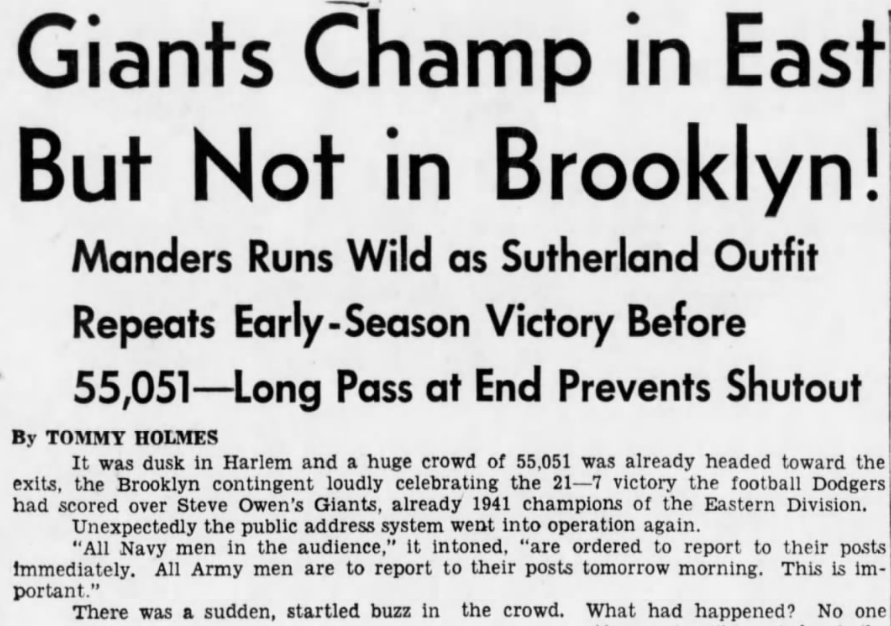
The Dodgers didn't care. They were going for a season sweep of the Giants, and they got it, winning 21-7. The Giants may have been the official Division Champions, but the Dodgers were the unofficial City Champions.
The Brooklyn Eagle, December 8, 1941

The attack started at 7:48 AM Hawaii time, which was 1:48 PM East Coast time. During the 2nd half, word got to the press box, and announcements began to come over the public address system. In those days, it was rare for someone to get paged at a sporting event. Usually, it was a doctor, who had to go and attend to a medical emergency.

This time, with the draft already in place, and enlistments already well underway as well, military officers attending the game were paged, and told to report to their various bases in and around New York City.

At Comiskey Park in Chicago, home to the Great Lakes Naval Training Center on Lake Michigan, another crosstown battle was held. The Bears beat the host Cardinals 34-24. And at Griffith Stadium in Washington, in the capital so the number of government officials and military officers present was considerably larger than in New York and Chicago, the host Redskins beat the Philadelphia Eagles 20-14.

When the game in New York ended, Dodger fans could not openly celebrate, and Giant fans didn't care, either, because it was then announced to the crowd that Pearl Harbor had been attacked.

The NFL Championship Game was played as scheduled, at Wrigley Field in Chicago on December 21, and, despite a 9-9 deadlock in the 3rd quarter, the Bears went on to beat the Giants 37-9.

This was during Major League Baseball's offseason, so none of their games were played. This was 5 years before the founding of the NBA, so none of their games were played. There were 3 National Hockey League games played on the day that Pearl Harbor was attacked:

* At the old Madison Square Garden, the host New York Rangers beat the defending Stanley Cup Champions, the Boston Bruins, 5-4. Alex Shibicky scored 2 goals.

* At the Olympia Stadium, the host Detroit Red Wings beat the Montreal Canadiens, 3-2.

* And at the Chicago Stadium, the host Chicago Blackhawks beat the Brooklyn Americans, 5-4. Only in this, what turned out to be their last season, were the former New York Americans, or "Amerks," using the Brooklyn name, even though they still played all their home games at The Garden. A plan for a new arena in Brooklyn was proposed for after The War, but it never happened, and the franchise suspended at the conclusion of the 1941-42 season, was officially folded in 1946.

* The Toronto Maple Leafs were not scheduled to play that day.

Time magazine named Roosevelt its Man of the Year for the 3rd time, due to his efforts to aid Britain, France and the Soviet Union without getting Congress to declare war on the Axis Powers, until Pearl Harbor made it unavoidable.

Thursday, December 1, 2022

December 1, 1906: "Anchors Aweigh" Is First Played

The original sheet music, with a photo of Zimmerman

December 1, 1906: The Army-Navy football game is played, at the original Franklin Field in Philadelphia. Navy win, 10-0. As their team took the field before the game, the Navy's marching band played a new song: "Anchors Aweigh."

The music was composed by Charles A. Zimmerman, who served as the bandmaster at the U.S. Naval Academy in Annapolis, Maryland from 1887 until his death in 1916. (It was from a brain hemorrhage, not due to military service.) In 1902, he had composed the music for a stage play version of The Wizard of Oz.

The lyrics were written by Alfred Hart Myles, then a Midshipman First Class (equivalent to a college senior), and it was his idea to write a fight song for the football team. He asked Zimmerman to compose the music.

"Weigh anchor" is an old English sailors' expression, an order that a ship's anchors be raised. In response to the order, the phrase "anchors aweigh" reports back that all anchors are clear of the sea bottom; therefore the ship is officially under way.

"Anchors aweigh," both in general and in writing the title of the song, is often misspelled as "Anchor's away," leading to confusing the terms, and sometimes misunderstanding the order as meaning "to drop anchor."

While "Anchors Aweigh" is the official fight song of the Naval Academy's football team, it is only through informal adoption that it is associated with the U.S. Navy as a whole. Despite proposals, it has never been made the branch's official song.

*

December 1, 1906: was a Saturday. Baseball was out of season. Basketball barely existed. Hockey was still mostly amateur. In English soccer, Woolwich Arsenal, the South-East London team that would eventually becomes Arsenal F.C., the North London team I would one day support, traveled to the North-East of England, and lost to Sunderland, 1-0 at Roker Park in Sunderland.

Saturday, November 26, 2022

November 26, 1943: The Death of Butch O'Hare

November 26, 1943: Lieutenant Commander Edward Henry "Butch" O’Hare, U.S. Navy, is shot down in his F6F Hellcat, near the Gilbert Islands, now part of the Republic of Kiribati. He was 29 years old.

He was born on March 13, 1914 in St. Louis. He moved with his father to Chicago, where his father, a lawyer, worked with Al Capone, before turning against him and helping the government convict him of tax evasion. He was appointed to the U.S. Naval Academy, and graduated in 1937.

He was the 1st U.S. Navy man in World War II to reach "flying ace" status, shooting down 5 enemy aircraft, and the first Navy man in that war to be awarded the Congressional Medal of Honor. He was also awarded the Navy Cross and 2 Distinguished Flying Crosses.

On September 19, 1949, the Chicago-area Orchard Field Airport was renamed O'Hare International Airport. (The "Orchard" name survives in its airport code, "ORD.") A model of the Grumman F4F-3 Wildcat he'd previously flown is on display in Terminal 2 of that airport. It surpassed Midway Airport as the most important in the city in the 1950s, because it could handle the new jet aircraft, and Midway couldn't. It remains the Midwest's most important airline hub.

*

November 26, 1943 was a Friday, the day after Thanksgiving. Television producer Bruce Paltrow was born. He created the TV shows The White Shadow and St. Elsewhere, and married actress Blythe Danner. Their daughter is actress Gwyneth Paltrow.

Baseball was out of season. Football was in midweek: The NFL didn't play for another 2 days, and, while there were college games the day before (Thanksgiving) and the day after. The NBA hadn't been founded yet. And the NHL had no games scheduled. So there were no scores on this historic day.


Monday, November 14, 2022

November 14, 1943: FDR Is Almost Killed By "Friendly Fire"

November 14, 1943: The U.S. Navy destroyer USS William D. Porter, DD-579, inadvertently fires an armed torpedo at the battleship USS Iowa.

"If this wasn't bad enough," author Kermit Bonner would note later, "the Iowa was carrying President Franklin D. Roosevelt, Secretary of State Cordell Hull and all of the country's World War II military brass." They were on their way to the Tehran Conference, where FDR was to meet with Prime Minister Winston Churchill of Great Britain, and, for the first time, with Premier Joseph Stalin of the Soviet Union.

The Iowa and its escort -- consisting of the destroyers Porter, USS Cogswell (DD-651) and USS Young (DD-580) -- were 50 miles east of Bermuda, and a demonstration of torpedo accuracy and range was being performed for the Commander-in-Chief. Torpedoman Lawton Dawson had failed to remove the explosive primer from torpedo tube three, a prerequisite for target practice. In other words, the torpedo was supposed to be launched, but it was also supposed to be a dud, incapable of doing serious damage to the hull of a battleship.

As soon as the torpedo was launched, it made the unique sound of an armed weapon, which was speeding directly toward the Iowa. The radioman on board the W.D. Porter was able to signal the Iowa to turn right to evade the approaching bomb in time. Miraculously, this proved unnecessary, as the Iowa’s high-speed wake detonated the torpedo at a distance that reports put at between 100 and 1,000 yards.

The entire crew of the W.D. Porter was placed under arrest, and held at Bermuda. Although Dawson would be sentenced to 14 years of hard labor, Roosevelt intervened and asked that he not be punished for the accident.

Writing in his personal logbook that evening, Roosevelt noted that "Had that torpedo hit the Iowa in the right spot with her passenger list of distinguished statesmen, military, naval, and aerial strategists and planners, it could have had untold effect on the outcome of the war and the destiny of the country."

For one thing, Vice President Henry A. Wallace would have become the 33rd President of the United States, and he was far more conciliatory toward the Soviet Union than the man who eventually did succeed FDR, Harry Truman. So even if the Allies did still manage to win the war, the postwar world would have looked very different.

Under the Presidential Succession Act of 1886 (superseded by a new one in 1947), next in the line of succession was the Secretary of State. With Hull dead, it would have moved to the Secretary of the Treasury. This means that, given that the Vice Presidency would have remained vacant until the next Inauguration Day, had something happened to Wallace before Congress could approve a new Secretary of State, the 34th President of the United States would have been Henry Morgenthau Jr. -- a Jewish President. A Jew would have commanded the greatest military force the world had ever known. Had he found that out, Adolf Hitler might have avoided all the trouble, and killed himself immediately.

Just 2 days before this incident, with Lieutenant Commander Wilfred A. Walter in charge of an especially inexperienced crew, the Porter, nicknamed the Willie Dee, committed its first mistake before the trip had really begun. As it was leaving the harbor in Norfolk, Virginia, the Fletcher-class destroyer’s anchor made contact with another ship, and inflicted significant damage. The Willie Dee emerged unscathed, though.

Shortly thereafter, an explosion shook the small fleet of which the Porter was a part. All of the ships immediately began anti-submarine maneuvering. The chaos continued until someone figured out what had happened: A depth charge had fallen off the stern of the ship. The safety on the charge had mistakenly not been set, and when it crashed into the rough sea, it detonated. Soon after that, a huge wave smashed into the Porter, stripping it of everything that wasn't tied down. A man was knocked overboard, and his body was never found.

After nearly killing its commander-in-chief with "friendly fire," the Porter was reassigned to the Aleutian Islands in Alaska. While there, someone on board accidentally shot a 5-inch artillery shell, which landed in the front yard of the base's commandant.

The ship was assigned to Okinawa, and, in the battle, it shot down several Japanese aircraft -- and 3 American planes. On June 10, 1945, the USS William D. Porter was put out of its misery, when a kamikaze plane exploded and sank it. For once, luck was with the crew: They all survived.

Lt. Commander Walter remained in command of the Porter through May 30, 1944. He later retired as a Rear Admiral, and lived until 1996. Lawton Dawson wasn't so lucky, only living until 1968, age 50. 

William D. Porter was a U.S. Navy Commodore who commanded ships in the American Civil War, before dying of heart disease in 1864. Due to its bad luck, DD-579 remains the only ship named for him.

*

November 14, 1943 was a Sunday. This was the same day that Leonard Bernstein first conducted the New York Philharmonic. I have a separate entry for that event.

These games were played in the NFL:

* The New York Giants lost to the Chicago Bears, 56-7 at the Polo Grounds. This was an outlier: Although the Bears did go on to win the NFL Championship, the Giants were not a bad team that season, going 6-3-1.

* The Brooklyn Dodgers beat the combined Philadelphia Eagles and Pittsburgh Steelers team that was known as the "Steagles," 13-7 at Ebbets Field.

* The Washington Redskins beat the Detroit Lions, 42-20 at Griffith Stadium in Washington.

* And the Green Bay Packers beat the Chicago Cardinals, 35-14 at the Dairy Bowl in the Milwaukee suburb of West Allis, Wisconsin. The Dairy Bowl was a football stadium built in the infield of a speedway, now known as the Milwaukee Mile, at the Wisconsin State Fair Park.

Baseball was out of season. The NBA hadn't been founded yet. There were 2 games played in the NHL. The New York Rangers lost to the Chicago Black Hawks, 10-5 at the Chicago Stadium. Bill Gooden scored 2 goals for the Rangers. For the Hawks, Cully Dahlstrom scored 3 goals and 2 assists. And the Montreal Canadiens beat the Detroit Red Wings, 2-0 at the Olympia Stadium in Detroit. The Boston Bruins and the Toronto Maple Leafs were not scheduled.

Sunday, November 13, 2022

November 13, 1942: The Sullivan Brothers Are Lost

Left to right: Joe, Frank, Al, Matt, and George

November 13, 1942: The cruiser USS Juneau is sunk by the Japanese destroyer Amatsukaze, while it was trying to bring troop reinforcements to Guadalcanal, in the South Pacific, east of Papua New Guinea, northeast of Australia, and north of New Zealand. Of the 697 men on board, only 10 survived.

Among those lost were 5 brothers from a single family. The U.S. Department of War later drew up a policy to never put 2 members of the same family in the same military installation. The 5 Sullivan brothers, of Waterloo, Iowa, were:

George Thomas Sullivan, 27 (born December 14, 1914), Gunner's Mate Second Class. George had been previously discharged in May 1941 as Gunner's Mate Third Class, but had re-enlisted after the attack on Pearl Harbor.

Francis Henry Sullivan, 26 (born February 18, 1916), Coxswain. "Frank" had been previously discharged in May 1941 as Seaman First Class, but had also re-enlisted.

Joseph Eugene "Joe" Sullivan, 24 (born August 28, 1918), Seaman Second Class.

Madison Abel "Matt" Sullivan, 23 (born November 8, 1919), Seaman Second Class. And:

Albert Leo "Al" Sullivan, 20 (born July 8, 1922), Seaman Second Class.

The brothers left their parents, and a sister, Genevieve, born between Frank and Joe. and their parents. Genevieve had enlisted in the WAVES (Women Accepted for Volunteer Emergency Service), to avenge her boyfriend, Bill Ball, who had been killed at Pearl Harbor. "Gen" lived on until 1975.

Al was the only one who was married, to Katherine, and the only one with a child, Jimmy, then 2 years old. He grew up to enlist in the Navy as well. Joe and Matt each left behind a fiancée.

The "Fighting Sullivan Brothers" became national heroes. President Franklin D. Roosevelt sent a letter of condolence to their parents. Pope Pius XII sent a letter of regret, a silver religious medal, and a rosary.

In 1944, Twentieth Century-Fox released the film The Fighting Sullivans, starring Thomas Mitchell as father Tom, Selena Royle as mother Alleta, Edward Ryan as Al, John Campbell as Frank, James Cardwell as George, John Alvin as Mat, George Offerman as Joe, Anne Baxter as Al's widow Katherine.

The Amatuskaze did not survive the war, either: On April 6, 1945, it was attacked by B-25s off Amoy (an island now controlled by China and named Ziamen), resulting in enough damage that it had to be scuttled.

The U.S. Navy would pay tribute to those lost with later ships:

* USS The Sullivans, a destroyer already under construction but not yet named when the brothers died, in service from 1943 to 1965, seeing action in World War II, the Korean War and the Vietnam War. Jimmy Sullivan served aboard her for a time. She is now a museum ship, part of the Buffalo and Erie County Naval & Military Park.

* USS Juneau, a cruiser active from 1946 to 1955, serving in the Korean War.

USS Juneau, an amphibious transport dock, active from 1969 to 2008. It was commissioned at the height of the Vietnam War, served as the Navy's main cleanup vessel after the Exxon Valdez disaster in 1989 (appropriate, since Juneau is the capital of Alaska, the State where that happened), and transported troops to the Persian Gulf War.

* USS The Sullivans, a destroyer, launched in 1995 and still in active service as of November 13, 2022. As with her predecessor, her motto is the brothers' motto: "We stick together."

*

November 13, 1942 was a Friday -- a Friday the 13th. Baseball was out of season. The NBA hadn't been founded yet. There were no games scheduled in the NHL. And the NFL was in midweek. But there was one score on this historic day, and it was in college football: Wake Forest beat George Washington University, 20-0 at Griffith Stadium in Washington.

Friday, November 11, 2022

November 11, 1921: The Tomb of the Unknown Soldier

November 11, 1921: The Tomb of the Unknown Soldier is dedicated at Arlington National Cemetery, in Arlington, Virginia, across the Potomac River from Washington, D.C. The Tomb faces east, overlooking the national capital.

It is 3 years to the day after the Armistice that ended World War I. An unidentified soldier from World War I is buried there on the day. Every day since, regardless of weather, a team of U.S. Army Sergeants, in dress uniform, known as "Sentinels," has walked a guard along a black mat in front of the Tomb, one at a time until relieved by another. The Sentinel does the following:

  1. Marches 21 steps south down the 21-yard-long black mat laid across the Tomb.
  2. Turns and faces east, toward the Tomb, for 21 seconds.
  3. Turns and faces north, changes weapon to the outside shoulder, and waits 21 seconds.
  4. Marches 21 steps up the mat.
  5. Turns and faces east for 21 seconds.
  6. Turns and faces south, changes weapon to the outside shoulder, and waits 21 seconds.
  7. Repeats the routine until the soldier is relieved of duty at the Changing of the Guard.

The temporary Tomb was replaced by the permanent design in 1932, with a Memorial Amphitheater around it. People are asked to view with quiet and respect. The Sentinel will remind the audience of this if there is noise.

In 1958, coffins containing unidentified remains of soldiers killed in World War II and the Korean War were added. In 1984, one from the Vietnam War was added. In 1998, a reporter looked at evidence and decided he had identified the Vietnam "Unknown" as Air Force 1st Lt. Michael Blassie. The remains were exhumed, tested, and his identity confirmed. Blassie’s coffin was taken back to his hometown of St. Louis, where he was buried with full honors.

Rather than fill the space at Arlington where Blassie had rested with another "Unknown" from the Vietnam era, the space has been left empty, as an official tribute to those who never made it home, alive or dead.

Each day, on November 11, the President of the United States, or the Vice President if the President is unavailable due to a foreign trip or illness, lays a wreath at the Tomb, with assistance from a member of the Sentinel corps not walking the guard.
President Barack Obama, November 11, 2013

And all active-duty military personnel salute the Tomb, because they don't know the men's ranks: Each of the three remaining "Unknowns" could be a buck private, or a General, although the likelihood of a General having been unaccounted for, in any war, is slim. While they are all definitely men, no one knows their ranks, their races, their religions, their places of origin, or their branches of the service. The idea is that each could be anyone, and could have been anyone -- including veterans or future servicepeople.

*

November 11, 1921 was a Friday. Baseball was out of season. Professional basketball barely existed. The start of the NHL season was over a month away. And no games were played in the NFL. But there were 8 college football games played that day:

* Virginia Tech beat North Carolina State, 7-3 on (mostly) neutral ground at League Park in Norfolk, Virginia.

* Trinity College beat Wake Forest, 17-0 at Riddick Field in Raleigh, North Carolina. Trinity was renamed Duke University in 1925.

* Birmingham-Southern beat Chattanooga, 14-7 at Rickwood Field in Birmingham, Alabama. Despite being the team that opened the city's famed Legion Field in 1929, and winning 3 Southern Conference titles in the 1930s, Birmingham-Southern College discovered that they couldn't compete with Alabama, Auburn, or even the University of Alabama at Birmingham, and so they dropped their program in 1939. They returned in 2007, playing in NCAA Division III, but folded the program again in 2023.

The University of Chattanooga was absorbed into the University of Tennessee system in 1969, and was renamed the University of Tennessee at Chattanooga. They began playing a small-college schedule in 1956, were assigned to NCAA Division II in 1973, were promoted to Division I-A in 1977, but were dropped to Division I-AA, since renamed the Football Championship Subdivision (FCS), where they remain.

* Florida beat Alabama, 9-2 at Denny Field in Tuscaloosa, Alabama.

* Texas beat Mississippi A&M, 54-7 at Clark Field in Austin, Texas. The Agricultural and Mechanical College of the State of Mississippi was renamed Mississippi State College in 1932, and Mississippi State University in 1958.

* Texas A&M and Rice played to a tie, 7-7 at Rice Field in Houston.

* Iowa State beat Kansas State, 7-0 at Ahearn Field in Manhattan, Kansas.

* And Idaho beat Wyoming, 31-3 on (mostly) neutral ground at Public School Field in Boise, Idaho.

Thursday, November 10, 2022

November 10, 1944: The USS Mount Hood Explosion

November 10, 1944: The ammunition ship USS Mount Hood (AE-11) disintegrates from the accidental detonation of 3,800 tons of cargo in the Seeadler Harbor fleet anchorage at Manus Island, Papua New Guinea.

Named for Mount Hood, the highest point in the State of Oregon, the ship had been launched on November 28, 1943, from the Norfolk Navy Yard in Virginia. Befitting her name, she was sent to the Pacific Theater of Operations in World War II.

On November 10, 1944, the ship was docked at Seeadler Harbor -- yes, I know, it looks weird, but that's how it's spelled -- in Papua New Guinea, then controlled by Australia. At 8:30 AM, a party consisting of 17 men left the ship and headed for shore, to collect the ship's mail. At 08:55, while this party was walking on the beach, the explosion occurred.

Even at a distance of 4,600 yards (about 2.6 miles) from the ship, the force of the explosion knocked the men from their feet. Scrambling back into their boat, they headed back to the ship, only to turn around again shortly thereafter as, according to one sailor's account, "There was nothing but debris all around..."

In addition to the Mount Hood, 22 small boats were destroyed, 36 nearby ships were damaged, 432 men were killed, and 371 more were injured.

Papua New Guinea was granted independence by Australia in 1949. It remains a parliamentary democracy, part of the British Commonwealth.

In 1971, a new ammunition ship was launched by the U.S. Navy, with the name USS Mount Hood, serving until 1999.

*

November 10, 1944 was a Friday. Songwriter Tim Rice was born.

Baseball season was over. The NBA hadn't been founded yet. And while the NHL season was underway, no games were scheduled for this day.

There were 2 college football games played. North Carolina State beat the University of Miami, 28-7 at Burdine Stadium, later renamed the Orange Bowl, in Miami.

And, with The War -- as my grandmother, who lived through it, always said, "Capital T, Capital W" -- was in progress, many college football teams played teams from military bases. The team from Naval Air Station Atlantic City beat Villanova University, 25-6 at Shibe Park in Philadelphia. NAS Atlantic City, in Egg Harbor Township across Brigantine Bay from the island on which Atlantic City sits, was handed over to the New Jersey Air National Guard in 1958, and was converted into Atlantic City International Airport in 1983.


Monday, October 31, 2022

October 31, 1941: The Sinking of the Reuben James

October 31, 1941: The destroyer USS Reuben James is sunk by a German U-boat off the coast of Iceland. There were 100 deaths, and only 44 survivors.

This was an act of war, as America had not yet entered World War II, but it did not move Congress to declare war on Nazi Germany, and President Franklin D. Roosevelt knew he couldn't ask them. Still.

Folksinger Woody Guthrie wrote "The Sinking of the Reuben James" about it:

Tell me: what were their names?Tell me: what were their names?Did you have a friend on the good Reuben James?
Woody's guitar reads, "This machine kills fascists."

Reuben James (1776-1838) was a boatswain's mate from Delaware, famous for his heroism in saving the life of his commanding officer, Lieutenant Stephen Decatur, during the Gunboat Battle of August 3, 1804, in the First Barbary War -- although there is dispute as to whether he was the sailor who saved Decatur.
On April 1, 1943, a new destroyer named Reuben James was christened. It was decommissioned only 4 years later, after the War ended. A 3rd ship with the name, a frigate, served from 1982 to 2013.

*

October 31, 1941 was a Friday. It was also Halloween. This was also the day that Mount Rushmore was declared "finished." I have a separate entry for that event. Actress Sally Kirkland was born on this day.

Baseball season was over. The NBA hadn't been founded yet. And the NHL season didn't start until the next day. But there were 4 college football games that night:

* Penn State beat New York University, 42-0 at the Polo Grounds.

* Clemson beat George Washington University, 19-0 at Griffith Stadium in Washington.

* South Carolina beat The Citadel, 13-6 at the County Fairgrounds in Orangeburg, South Carolina.

* And the University of Miami beat Texas Tech, 6-0 at Burdine Stadium in Miami. Burdine Stadium was renamed the Orange Bowl in 1959.

Saturday, October 29, 2022

October 29, 1991: The Tailhook Scandal Is Exposed

A demonstration after the exposure of the scandal

October 29, 1991: The Tailhook Scandal is exposed. It was one of the earliest "Me Too" stories.

tailhookarresting hook, or arrester hook, is a device attached to the rear of some military fixed-wing aircraft. The hook is used to achieve rapid deceleration during routine landings aboard aircraft carrier flight decks at sea, or during emergency landings or aborted takeoffs at properly equipped airports. The Tailhook Association is a non-profit organization supporting the interests of sea-based aviation, with emphasis on aircraft carriers.

The 35th Annual Tailhook Association Symposium was held at the Las Vegas Hilton from September 5 to 8, 1991. The Gulf War ad taken place earlier in the year, and over 11 hours of presentations and discussion concerning U.S. Navy and Marine Corps aviation operations in the conflict were to be the central focus for the 4,000 attendees.

Before the Symposium was over aviation officers were alleged to have sexually assaulted up to 83 women and 7 men, or otherwise engaged in "improper and indecent" conduct.

This scandal broke in the immediate aftermath of the Clarence Thomas hearings, and the reaction of American women was one of disgust. Something had to be done.

Not much was done: Approximately 40 naval and Marine officers received non-judicial punishment, mainly for conduct unbecoming an officer and false official statements. Three officers were taken to courts-martial, but their cases were dismissed. No officers were disciplined for the alleged sexual assaults.

The aftermath resulted in sweeping changes throughout all military services in the Department of Defense regarding attitudes and policies toward women.

The Las Vegas Hilton was originally the International Hotel, where Elvis held court from 1969 to 1977. It's now the Westgate Las Vegas.

*

October 29, 1991 was a Tuesday. The baseball season had ended 2 days earlier, when the Minnesota Twins won Game 7, and thus the World Series, over the Atlanta Braves. Football was in midweek. The NBA season began 3 days later. There were 5 games in the NHL:

* The New York Rangers beat the Minnesota North Stars, 3-2 at Madison Square Garden.

* The New York Islanders beat the San Jose Sharks, 8-4 at the Nassau Coliseum.

* The New Jersey Devils lost to the Vancouver Canucks, 4-3 at the Pacific Coliseum in Vancouver.

* The Quebec Nordiques beat the Winnipeg Jets, 7-2 at the Colisée de Québec. Owen Nolan had a hat trick.

* And the Washington Capitals beat the Pittsburgh Penguins, 8-0 at the Civic Arena in Pittsburgh.

Tuesday, October 25, 2022

October 25, 1983: The Grenada Invasion

October 25, 1983: American troops and a coalition of 6 Caribbean nations invade the island nation of Grenada.

That country had gained independence from Britain in 1974, but the New Jewel Movement, a Communist group led by Maurice Bishop, seized power in 1979. By October 1983, there was a power struggle that led to the assassination of Prime Minister Maurice Bishop, and could have led to a civil war. Not that America was predisposed to like Bishop: He was a leftist, and an ally of Cuban dictator Fidel Castro.
Bishop (left) and Castro

Bernard Coard took power, but he lasted just 5 days, from Bishop's execution on October 14 to 19, when he was deposed by General Hudson Austin, who formed a military dictatorship.
 
Hudson Austin

There were over 600 American citizens on the island, mostly medical students. President Ronald Reagan was afraid of another hostage crisis, less than 3 years after the end of the one in Iran. To make matters worse, on October 23, the U.S. Marine barracks in Beirut, Lebanon was attacked by a suicide bomber, killing 241 Americans.

His plan to invade Grenada, which he had discussed while at his ranch outside Santa Barbara, California, was deemed necessary, even if it ended up appearing that it was a distraction from the Beirut debacle.

Codenamed Operation Urgent Fury, the American portion included the Army's famed 82nd Airborne Division, its 75th Ranger Regiment, and its Delta Force; Navy SEALs, and Marine units. Vice Admiral Joseph Metcalf III was the operation's commanding officer. Among his subcommanders was Major General Norman Schwarzkopf, later to rise to 4 stars and command American ground troops during the Persian Gulf War.
Admiral Joseph Metcalf

The operation was an overwhelming success: Within 4 days, the island was secured. But not a complete success: 19 American servicemen were killed, and another 152 wounded or injured. Still, it was seen as "a win for America," which Reagan needed, as he was up for re-election in a little over a year.

The following year, democratic elections were held in both America and Grenada. Today, Grenada is a free country, home to 112,000 people, 96 percent of them black, and 96 percent of them Christian. And it celebrates October 25 as its annual Thanksgiving Day.

Coard and Austin were sentenced to death, but their sentences were commuted to life. Austin was released from prison in 2008, and died on September 24, 2022. As of that date, Bernard Coard was still alive. He had been released in 2009, and said he did not want to be involved in politics any further. Admiral Metcalf died in 2007.

*

October 25, 1983 was a Tuesday. This was also the day that Microsoft introduced Microsoft Word, which became the most popular word processing program ever. I have a separate entry for that event.

It was the middle of the week, so there were no football games. The baseball season had ended 9 days earlier, when the Baltimore Orioles beat the Philadelphia Phillies to win the World Series. The NBA season began 3 days later. The NHL season had gotten underway, and 7 games were played that day:

* The New York Islanders were the only team in the New York Tri-State Area in action, and lost to the Winnipeg Jets, 4-2 at the Nassau Coliseum.

* The Minnesota North Stars beat the Montreal Canadiens, 4-3 at the Montreal Forum.

* The Philadelphia Flyers beat the Quebec Nordiques, 4-2 at the Colisee de Quebec.

* The Washington Capitals beat the Pittsburgh Penguins, 1-0 at the Civic Arena in Pittsburgh.

* The Chicago Blackhawks beat the Boston Bruins, 5-1 at the Chicago Stadium.

* The Hartford Whalers beat the Los Angeles Kings, 8-5 at The Forum in the Los Angeles suburb of Inglewood, California.

* And the Vancouver Canucks beat the St. Louis Blues, 7-1 at the Pacific Coliseum in Vancouver.

October 25, 1944: The Last Battle Between Battleships

Admiral Jesse Oldendorf

October 25, 1944: The Battle of Surigao Strait is fought, as part of the larger battle to liberate the Philippines from the Empire of Japan. It was 1 of only 2 battleship-versus-battleship naval battles in the Pacific campaign of World War II (after one during the 1942-43 Battle of Guadalcanal), and it remains the last battleship-to-battleship action in history.

A battleship is defined as "a large, heavily armored warship with a main battery, consisting of large guns, designed to serve as a capital ship." A capital ship is defined as a navy's most important warships, generally the larger ships when compared to other warships in their respective fleet. From their advent in the late 1880s, battleships were among the largest and most formidable weapon systems ever built, until they were surpassed by aircraft carriers beginning in the 1940s. 

As the Japanese Southern Force approached the Surigao Strait, it ran into a deadly trap set by Seventh Fleet. Rear Admiral Jesse Oldendorf had a substantial force comprising 4 heavy cruisers, including his flagship, the USS Louisville; 4 light cruisers, 28 destroyers, 39 motor torpedo boats (Patrol/Torpedo or "PT" boats, like the one John F. Kennedy had commanded); and 6 battleships: The California, the Maryland, the Mississippi, the Pennsylvania, the Tennessee and the West Virginia.

All but one had been in the attack on Pearl Harbor 3 years earlier: The Mississippi had been on convoy-escort duty in Iceland at the time. The California and the West Virginia had been repaired, while new versions of the Maryland, the Pennsylvania and the Tennessee had to be built.

At 22:36 on October 24, ship time, PT-131 sighted approaching Japanese ships. At about 03:00 on October 25, 2 Japanese battleships, the Yamashiro and the Fusō were torpedoed; the former got away, but the latter was sunk, along with 4 Japanese destroyer.

Jesse Oldendorf held the rank of Real Admiral, 2 stars, at the time of the battle. On December 15, 1944, he was promoted to Vice Admiral, given a 3rd star. He was wounded in 2 separate Japanese attacks on ships he was commanding in 1945. After The War, he commanded the San Diego Naval Base, and retired in 1948, upon which he was given the rank of full Admiral, 4 stars. He lived until 1974. In 1975, the destroyer USS Oldendorf (DD-972) was named for him and commissioned. It was in service until 2003.

In World War II, the U.S. Navy had 27 battleships, all named for States. The Arizona, the Oklahoma and the Utah were sunk at Pearl Harbor. The Arizona and the Utah became part of the official memorial to the battle. The Oklahoma was raised, and sunk under tow in 1947.

The Mississippi, the Colorado, the Iowa, the New Jersey, the Wisconsin, and the Missouri also saw service in the Korean War. The Iowa, the New Jersey, the Wisconsin and the Missouri all lasted through the Vietnam War era, and even into the Persian Gulf War before being retired, the Missouri being the last American battleship, on March 31, 1992. Most likely, the reason the "Mighty Mo" was kept in service the longest was symbolic, as it was on its deck that the Japanese signed the articles of surrender on September 2, 1945.

Four were sunk as target practice: The Arkansas in 1946; and the New York, the Nevada and the Pennsylvania in 1948. Most of the battleships were ultimately scrapped: The Idaho, the New Mexico and the Wyoming in 1947; the Mississippi in 1957; the California, the Colorado, the Maryland, the Tennessee and the West Virginia in 1959; the Washington in 1960; the South Dakota in 1962; and the Indiana in 1963.

Some were saved as "museum ships." The USS Texas, BB-35, the last surviving U.S. battleship from World War I, had its longtime home adjacent to the San Jacinto Monument in the Houston Ship Channel. As of October 25, 2022, it is undergoing repairs, with the intent of moving it to a new location in Galveston, on the Gulf of Mexico.

The USS North Carolina, BB-55, is in its namesake State, across the Cape Fear River from downtown Wilmington. Wilmington, North Carolina is known as the home city of TV newscaster David Brinkley, basketball icon Michael Jordan, and TV screenwriter and producer Kevin Williamson.

The USS Massachusetts, BB-59, is in its namesake State, at Battleship Cove, a maritime museum in Fall River, on Mount Hope Bay. Battleship Cove contains the largest collection of World War II-era naval vessels, anywhere in the world.

Fall River is famous for two other things: Being the location of the murders of Andrew and Abby Borden in 1892, with Andrew's daughter Lizzie being accused, but acquitted; and being one of the founding cities of American soccer, as its large Portuguese community led to the founding of one of the earliest great U.S. teams, the Ponta Delgada Soccer Club, which sometimes got around Massachusetts' "blue laws" by playing Sunday games a few miles away, across the State Line, in Tiverton, Rhode Island.

The USS Alabama, BB-60, is in its namesake State, on Mobile Bay.

The USS Iowa, BB-61, survived a 1989 explosion that killed 47 crewmen, was retired 2 years later, after service in the Persian Gulf War, and is now a museum ship at the Port of Los Angeles, which, with the USS California having long since been scrapped, couldn't have that ship.

The USS New Jersey, BB-62, is in its namesake State, on the Delaware River in Camden, across from Center City Philadelphia, upriver from the naval shipyard where it was constructed in 1943. (UPDATE: In 2024, it returned to the Philadelphia Naval Shipyard for renovations, which lasted a few weeks.)

The USS Missouri, BB-63, is at Pearl Harbor in Honolulu, Hawaii. As with keeping it in service the longest, the ship's final resting place is symbolic: Its bow is pointed at the USS Arizona Memorial, so that the ship where America's role in The War ended can "watch over" the ship where America's role in The War effectively began. The Missouri's bell was removed, and taken to the Missouri State Museum, in the State capital of Jefferson City, where it is on display.

And the USS Wisconsin, BB-64, is at its "birthplace," the Norfolk Naval Shipyard in Virginia.

*

October 25, 1944 was a Wednesday. Jon Anderson, lead singer of British rock band Yes, and political consultant James Carville were born. This was also the day that Nazi Germany began a crackdown on the resistance group known as the Edelweiss Pirates. I have a separate entry for that event.

Baseball season had ended 16 days earlier, when the St. Louis Cardinals won the World Series by beating the St. Louis Browns in 6 games. Football was in midweek. The NBA hadn't been founded yet. And the NHL season started 3 days later. So there were no scores on this historic day.

December 31, 1999 & January 1, 2000: The Millennium

December 31, 1999:  The Millennium arrives. The people of planet Earth survived. At a terrible cost. But we hadn't destroyed ourselves. ...