Showing posts with label virginia. Show all posts

Friday, December 16, 2022

December 16, 1907: The Great White Fleet Sets Sail

USS Nebraska

December 16, 1907: The Great White Fleet sets sail. It was Theodore Roosevelt's idea.

The 26th President of the United States was fond of quoting what he called an African proverb: "Speak softly and carry a big stick. You will go far." He was also a big believer in a big navy: The 1st of the 42 books he wrote, still a record for any President, was The Naval War of 1812, published in 1882, when he was only 23 years old.

After long neglecting the Navy, Congress started generous appropriations in the late 1880s, upon the request of President Benjamin Harrison and Secretary of State James G. Blaine, who famously ran for President the 3 previous times. Beginning with just 90 small ships, over one-third of them wooden and obsolete, the Navy quickly added new steel fighting vessels. 

TR dispatched 16 U.S. Navy battleships of the Atlantic Fleet on a worldwide voyage of circumnavigation from December 16, 1907 to February 22, 1909. The hulls were painted white, the Navy's peacetime color scheme, and decorated with gilded scrollwork with a red, white, and blue banner on their bows. The superstructures were painted buff. These ships later came to be known as the Great White Fleet.

The purpose of the fleet deployment was multifaceted. Ostensibly, it served as a showpiece of American goodwill, as the fleet visited numerous countries and harbors. In this, the voyage was not unprecedented. Naval courtesy calls, many times in conjunction with the birthdays of various monarchs and other foreign celebrations, had become common in the 19th Century. Port calls showcased pomp, ceremony, and militarism during a period of rising prewar nationalism.

Additionally, the voyage of the Great White Fleet demonstrated both at home and on the world stage that the U.S. had become a major sea power in the years after its triumph in the Spanish-American War of 1898.

With the battleship USS Connecticut as flagship, under the command of Rear Admiral Robley D. Evans, the fleet sailed from Hampton Roads, Virginia for Trinidad, British West Indies; thence to Rio de Janeiro, Brazil; Punta Arenas, Chile; Callao, Peru; Magdalena Bay, Mexico; and north along the West Coast, arriving at San Francisco on May 6, 1908.

Leaving that port on July 7, the fleet visited Honolulu; Auckland, New Zealand; Sydney, Melbourne and Albany, Australia; Manila, Philippines; Yokohama, Japan; and Colombo, Ceylon (now Sri Lanka); then arriving at Suez, Egypt, on January 3, 1909. While there, word was received of an earthquake in Sicily, thus affording an opportunity for the United States to show its friendship to Italy by offering aid to its victims.

Leaving Messina on January 9, 1909, the fleet stopped at Naples, Italy; thence to Gibraltar; arriving at Hampton Roads on February 22, 1909. There, President Roosevelt, in his last 10 days in office, reviewed the fleet as it passed into the roadstead. He was very pleased with the results of the tour.

In 1984, a nuclear-powered aircraft carrier was launched, named the USS Theodore Roosevelt. Although its official call sign is "Rough Rider," it is nicknamed "The Big Stick."

*

December 16, 1907 was a Monday. This was also the day of the Yolande coal mine explosion in Alabama. I have a separate entry for that event.

Baseball was out of season. Football season had just ended. And professional basketball and hockey barely existed. So there were no scores on this historic day. 

Sunday, November 13, 2022

November 14, 1910: The 1st Aircraft Carrier

November 14, 1910: Eugene Burton Ely takes off in a Curtiss Pusher airplane, from the deck of the U.S. Navy cruiser USS Birmingham, off Norfolk Navy Base in Virginia. Thus was born the aircraft carrier.

On January 18, 1911, Ely landed his Pusher on a platform on the armored cruiser USS Pennsylvania, anchored in San Francisco Bay, proving that a ship could be safely used as a landing point as well as a takeoff point. On May 9, 1912, Commander Charles Samson of Britain's Royal Naval Air Service made the 1st takeoff from a ship already in motion, off the HMS Hibernia.
On September 6, 1914, the Imperial Japanese Navy ship Wakamiya conducted the 1st successful ship-launched air raid, against the German gunboat Jaguar and the Austrian cruiser SMS Kaiserin Elisabeth. Perhaps "successful" is too strong a word: Although the attack was launched, and the planes returned safely, they did no damage to the enemy vessels. (We hear so much about how Japan was part of Nazi Germany's "Axis" during World War II that we often forget that, in World War I, they were on the same side as Britain, France, Russia, and, eventually, America.)

On August 2, 1917, Squadron Commander Edwin H. Dunning became the 1st pilot to land on a moving ship, the HMS Furious, in his Sopwith Pup, at Scapa Flow in the Orkney Islands. Landing on the forward flight deck required the pilot to approach round the ship's superstructure, a difficult and dangerous maneuver. Just 5 days later, Dunning was later killed when his airplane was thrown overboard while attempting another landing on Furious. He was 25.

On March 20, 1922, the USS Langley was commissioned, as America’s 1st ship specifically designed as an aircraft carrier. It was named for Samuel Langley (1834-1906), astronomer and aviation pioneer. It was sunk by the Japanese during World War II. A 2nd carrier named Langley was launched in 1943, but only remained in service until 1947.

Eugene Burton Ely died in a crash in 1911. He was just short of turning 25. Charles Samson was a little luckier: Heart trouble forced him into early retirement, and he lived to be 47.

The USS Birmingham was in service from 1907 to 1923, and scrapped in 1930.

Carriers such as the original Enterprise, the Lexington, the Ranger, the Yorktown, the Hornet and the Essex were vital in winning World War II. In the post-Vietnam era, the U.S. Navy has tended to name carriers after Presidents, or people involved with the Navy in some capacity (or, in some cases, both). Carriers have been named after Presidents George Washington, Abraham Lincoln, Theodore Roosevelt, Franklin D. Roosevelt, Harry Truman, Dwight D. Eisenhower, John F. Kennedy, Gerald Ford, Ronald Reagan and George H.W. Bush. A 3rd carrier named USS Enterprise is now under construction.

*

November 14, 1910 was a Monday. Baseball was out of season. Football was in midweek. Professional basketball barely existed. And hockey season hadn't yet started. So there were no scores on this historic day.

Friday, November 11, 2022

November 11, 1921: The Tomb of the Unknown Soldier

November 11, 1921: The Tomb of the Unknown Soldier is dedicated at Arlington National Cemetery, in Arlington, Virginia, across the Potomac River from Washington, D.C. The Tomb faces east, overlooking the national capital.

It is 3 years to the day after the Armistice that ended World War I. An unidentified soldier from World War I is buried there on the day. Every day since, regardless of weather, a team of U.S. Army Sergeants, in dress uniform, known as "Sentinels," has walked a guard along a black mat in front of the Tomb, one at a time until relieved by another. The Sentinel does the following:

  1. Marches 21 steps south down the 21-yard-long black mat laid across the Tomb.
  2. Turns and faces east, toward the Tomb, for 21 seconds.
  3. Turns and faces north, changes weapon to the outside shoulder, and waits 21 seconds.
  4. Marches 21 steps up the mat.
  5. Turns and faces east for 21 seconds.
  6. Turns and faces south, changes weapon to the outside shoulder, and waits 21 seconds.
  7. Repeats the routine until the soldier is relieved of duty at the Changing of the Guard.

The temporary Tomb was replaced by the permanent design in 1932, with a Memorial Amphitheater around it. People are asked to view with quiet and respect. The Sentinel will remind the audience of this if there is noise.

In 1958, coffins containing unidentified remains of soldiers killed in World War II and the Korean War were added. In 1984, one from the Vietnam War was added. In 1998, a reporter looked at evidence and decided he had identified the Vietnam "Unknown" as Air Force 1st Lt. Michael Blassie. The remains were exhumed, tested, and his identity confirmed. Blassie’s coffin was taken back to his hometown of St. Louis, where he was buried with full honors.

Rather than fill the space at Arlington where Blassie had rested with another "Unknown" from the Vietnam era, the space has been left empty, as an official tribute to those who never made it home, alive or dead.

Each day, on November 11, the President of the United States, or the Vice President if the President is unavailable due to a foreign trip or illness, lays a wreath at the Tomb, with assistance from a member of the Sentinel corps not walking the guard.
President Barack Obama, November 11, 2013

And all active-duty military personnel salute the Tomb, because they don't know the men's ranks: Each of the three remaining "Unknowns" could be a buck private, or a General, although the likelihood of a General having been unaccounted for, in any war, is slim. While they are all definitely men, no one knows their ranks, their races, their religions, their places of origin, or their branches of the service. The idea is that each could be anyone, and could have been anyone -- including veterans or future servicepeople.

*

November 11, 1921 was a Friday. Baseball was out of season. Professional basketball barely existed. The start of the NHL season was over a month away. And no games were played in the NFL. But there were 8 college football games played that day:

* Virginia Tech beat North Carolina State, 7-3 on (mostly) neutral ground at League Park in Norfolk, Virginia.

* Trinity College beat Wake Forest, 17-0 at Riddick Field in Raleigh, North Carolina. Trinity was renamed Duke University in 1925.

* Birmingham-Southern beat Chattanooga, 14-7 at Rickwood Field in Birmingham, Alabama. Despite being the team that opened the city's famed Legion Field in 1929, and winning 3 Southern Conference titles in the 1930s, Birmingham-Southern College discovered that they couldn't compete with Alabama, Auburn, or even the University of Alabama at Birmingham, and so they dropped their program in 1939. They returned in 2007, playing in NCAA Division III, but folded the program again in 2023.

The University of Chattanooga was absorbed into the University of Tennessee system in 1969, and was renamed the University of Tennessee at Chattanooga. They began playing a small-college schedule in 1956, were assigned to NCAA Division II in 1973, were promoted to Division I-A in 1977, but were dropped to Division I-AA, since renamed the Football Championship Subdivision (FCS), where they remain.

* Florida beat Alabama, 9-2 at Denny Field in Tuscaloosa, Alabama.

* Texas beat Mississippi A&M, 54-7 at Clark Field in Austin, Texas. The Agricultural and Mechanical College of the State of Mississippi was renamed Mississippi State College in 1932, and Mississippi State University in 1958.

* Texas A&M and Rice played to a tie, 7-7 at Rice Field in Houston.

* Iowa State beat Kansas State, 7-0 at Ahearn Field in Manhattan, Kansas.

* And Idaho beat Wyoming, 31-3 on (mostly) neutral ground at Public School Field in Boise, Idaho.

Monday, November 7, 2022

November 7, 1989: New York Elects Its 1st Black Mayor

November 7, 1989: David Dinkins, President of the Borough of Manhattan, is elected the 1st black Mayor of New York City. A Democrat, he wins a close election over the Republican nominee, former U.S. Attorney Rudolph Giuliani, 50 percent to 48, a margin of 47,080 votes. Dinkins won Manhattan, The Bronx and Brooklyn, while Giuliani won Queens and Staten Island. This followed Dinkins' defeat of the 3-term incumbent, Ed Koch, in the Democratic Primary, 50 percent to 42.

Jim Florio, a Congressman representing the Philadelphia suburbs of South Jersey, is elected Governor of New Jersey. In a landslide, the Democrat gets 61 percent of the vote to defeat Jim Courter, also in the House, whose District included my hometown of East Brunswick.
It was his 3rd try. He had lost the Democratic Primary in 1977. In 1981, with Governor Brendan Byrne, a Democrat, term-limited, Florio won the Democratic nomination, but lost the general election to Tom Kean, the Speaker of the State Assembly, by 1,797 votes, the closest election in the office's history. It was so close, the State Constitution required an automatic recount. For over a week, we didn't know who the next Governor was going to be. I remember seeing the State flag flying upside-down at a McDonald's, and my mother said it was a reflection of the "upside-down election."

Kean was easily re-elected in 1985, and Florio was too smart to challenge him. After 2 terms, Kean was term-limited, and couldn't run again. Florio had collected so many "political IOUs" over the years, the nomination was easily his. Courter owed his career not just to President Ronald Reagan, who was now out of office, but to a gerrymandered, pro-Republican district (which has since been redrawn to favor a Democrat). Outside of his district, Courter didn't have name recognition, and he won only 5 out of 21 Counties, while Florio got 61 percent of the vote.

Oddly, Dinkins and Florio had grown up in each other's jurisdiction: Dinkins was born and raised in New Jersey's capital city, Trenton, and went to Trenton Central High School; while Florio was born and raised in Brooklyn, and went to Erasmus Hall High School.

The same day, Doug Wilder, Lieutenant Governor of Virginia, is elected the 1st black Governor of any State since Reconstruction. In a very close election, by 6,741 votes, he defeats Marshall Coleman, a former Attorney General of the State.
None of these 3 victorious Democrats would serve a 2nd term. Governors of Virginia are limited to 1 term, although Wilder would return to public life, being elected Mayor of Richmond, the State capital and his hometown. In 1993, both Dinkins and Florio would lose close and very nasty races for re-election, the former in a rematch with Giuliani, the latter to Somerset County Freeholder Christine Todd Whitman.

*

November 7, 1989, like all modern Election Days in America, was a Tuesday. Major league pitcher Sonny Gray was born.

Baseball season was over. Football was in midweek: There were 9 games in the NBA:

* The New Jersey Nets lost to the Miami Heat, 83-77 at the Brendan Byrne Arena at the Meadowlands.

* The Washington Bullets beat the Atlanta Hawks, 118-114 at The Omni in Atlanta.

* The Chicago Bulls beat the Detroit Pistons, 117-114 at the Chicago Stadium. Michael Jordan scored 40 points.

* The Milwaukee Bucks beat the Boston Celtics, 106-100 at the Bradley Center in Milwaukee.

* The Houston Rockets beat the Portland Trail Blazers, 109-86 at The Summit in Houston. (It's now the Central Campus of Joel Osteen's Lakewood Church.)

* The Los Angeles Lakers beat the Phoenix Suns, 111-107 at The Forum outside Los Angeles in Inglewood, California. James Worthy scored 35 points.

* The Golden State Warriors beat the Los Angeles Clippers, 118-94 at the Oakland Coliseum Arena.

* The Sacramento Kings beat the Dallas Mavericks, 96-94 at the ARCO Arena in Sacramento.

* And the Seattle SuperSonics beat the Charlotte Hornets, 128-88 at the Seattle Center Coliseum.

And there was 1 game in the NHL: The Washington Capitals beat the New York Islanders, 5-3 at the Nassau Coliseum.

Thursday, October 27, 2022

October 27, 1967: Theodore Roosevelt Island Is Dedicated

October 27, 1967: Theodore Roosevelt Island is dedicated, on what would have been the 89th birthday of its namesake, the 26th President of the United States.

The island, on the Potomac River between the District of Columbia and Virginia, had been known by previous names, most recently Mason's Island, until May 28, 1932, when it was renamed for TR. (Apparently, he didn't mind the use of his initials, but hated the nickname "Teddy.")

The Island is accessible by a footbridge from Virginia, but not D.C.; and not by car or public transit from either. The Theodore Roosevelt Bridge opened on June 23, 1964, and carries Interstate 66 and U.S. Route 50 over the Potomac, and crosses the southern tip of the Island, but does not provide access to it.
According to the National Park Service, which administers and maintains the island, "In the 1930s landscape architects transformed Mason's Island from neglected, overgrown farmland into Theodore Roosevelt Island, a memorial to America's 26th president. They conceived a 'real forest' designed to mimic the natural forest that once covered the island. Today miles of trails through wooded uplands and swampy bottomlands honor the legacy of a great outdoorsman and conservationist."

But it took until 1960 for Congress to act to put a memorial for TR on the island, to match the ones on the National Mall for George Washington, Thomas Jefferson and Abraham Lincoln. (The ones for Dwight D. Eisenhower, President in 1960, and Franklin Roosevelt, TR's cousin, have followed.) The memorial was designed by Eric Gugler, and contained 4 large stone monoliths, inscribed with familiar quotations of TR's, and a 17-foot statue of him, hand raised as if in mid-speech, sculpted by Paul Manship.
There is a Theodore Roosevelt Dam on the Salt River in Arizona, creating Theodore Roosevelt Lake. There are towns named for him in Georgia and Missouri, and Counties in Montana and New Mexico. U.S. Route 1 in Philadelphia is Roosevelt Boulevard, and Illinois Route 38 in Chicago, formerly 12th Street, is Roosevelt Road.

There are Theodore Roosevelt High Schools in The Bronx (my grandfather went there), Yonkers, Washington, the suburbs of Cleveland, Dayton, Indiana, Chicago, Des Moines, Minneapolis, St. Louis, San Antonio, Sioux Falls, Colorado, Los Angeles, Fresno, Seattle and Honolulu. There have been 3 ships named the USS Theodore Roosevelt: A troop transport in 1918 and 1919, a submarine serving from 1961 to 1982, and a nuclear-powered aircraft carrier, CVN-71, nicknamed The Big Stick, in service since 1986.

Among the actors who have played TR: Claude Akins in The Gambler Returns: The Luck of the Draw in 1991, James Gammon in The Young Indiana Jones Chronicles in 1992, Tom Berenger in Rough Riders in 1997, and Robin Williams in A Night at the Museum in 2006. (Gammon and Berenger both starred in the Major League series of baseball films.)

James R. Garfield, the son of President James A. Garfield, served as Secretary of the Interior for the last 2 years of TR's Presidency. He lived until 1950, becoming the last surviving member of the Cabinet.

TR was the 1st President born in New York City. Only one has followed him: Donald Trump. TR would have known how to handle him.

UPDATE: The Theodore Roosevelt Presidential Library opened on July 4, 2026, the 250th Anniversary of American independence, at Theodore Roosevelt National Park in Medora, North Dakota, which also includes his cattle ranch.

*

October 27, 1967 was a Friday. Scott Weiland, lead singer for the rock bands Stone Temple Pilots and Velvet Revolver, was born on this day.

Baseball season ended 16 days earlier, with the St. Louis Cardinals beating the Boston Red Sox in Game 7 of the World Series.

There were 2 college football games played that night. The University of Miami beat Auburn, 7-0 at the Orange Bowl in Miami. And the University of Texas at El Paso (UTEP) beat the University of New Mexico, 75-12 at University Stadium in Albuquerque, New Mexico. Just a year and a half earlier, on May 27, 1966, the UTEP name was adopted, replacing the former name, Texas Western University. On March 19, 1966, under the Texas Western name, the school put an all-black starting five onto the court against an all-white Kentucky team and beat them in the NCAA's Division I Men's Basketball Tournament Final.

No games were scheduled for the NHL that day. But there were 5 games played in the NBA:

* The Philadelphia 76ers, defending NBA Champions, beat the Seattle SuperSonics, an expansion team playing only their 6th regular-season game, 132-115, at The Spectrum in Philadelphia, a new arena in only its 4th NBA game. Hal Greer scored 26 points, while Wilt Chamberlain scored 15 and had 18 rebounds.

* The Boston Celtics beat the Detroit Pistons, 128-109 at Cobo Hall (now Huntington Place) in Detroit.

* The Cincinnati Royals beat the San Diego Rockets, 116-113 at the San Diego Sports Arena (now the Pechanga Arena). Jerry Lucas had 26 points and 20 rebounds for the Royals. The Rockets, like the Sonics, were an expansion team, playing only their 7th game, their 5th home game. They moved to Houston in 1971. The following year, the Royals moved, becoming the Kansas City Kings, and moved again in 1985, becoming the Sacramento Kings.

* The Los Angeles Lakers beat the Chicago Bulls, 125-117 at the Los Angeles Memorial Sports Arena. Bob Boozer scored 42 for the Bulls, but the Lakers got 39 from Archie Clark and 27 from Elgin Baylor.

* And the San Francisco Warriors beat the Baltimore Bullets, 124-111 at the Oakland Coliseum Arena. Nate Thurmond scored 25 and had 33 rebounds. When the Coliseum complex opened in 1966, the Warriors began playing some home games there. In 1967-68, they played 18 games there, almost as many as they played at the Cow Palace. In 1971, they moved to Oakland in full, until the Chase Center opened in San Francisco in 2019.

The American Basketball Association had just begun play, and played 3 games that night:

* The Pittsburgh Pipers beat the Denver Rockets, 91-77 at the Civic Arena in Pittsburgh. The Pipers went on to win the 1st ABA title. In spite of that, they did not survive to be absorbed into the NBA, while the Rockets were, as the Denver Nuggets, a name change made in 1974 in anticipation of entering a league that already had the Houston Rockets.

* The New Orleans Buccaneers beat the Dallas Chaparrals, 101-97 at the State Fair Coliseum in Dallas. The Buc reached the 1st ABA Finals, losing to the Pipers. In spite of that, they did not survive to be absorbed into the NBA, while the Chaps were, after moving in 1973, becoming the San Antonio Spurs.

* And the Indiana Pacers beat the Oakland Oaks, 119-105 at the Oakland Coliseum. This was the 1st time an arena hosted an NBA game and an ABA game on the same day. So, unless the Oakland-Alameda County Coliseum Authority was going for that particular distinction, I can't imagine why they would do both. Certainly, I find it hard to believe the NBA, never mind the Warriors organization, would want to share an arena, even for 1 day, with a team in a "rebel league." The Oaks won the ABA title in 1969, but did not survive. The Pacers won it in 1970, 1972 and 1973, and did survive.

Monday, October 24, 2022

October 24, 2002: The Beltway Snipers Are Arrested

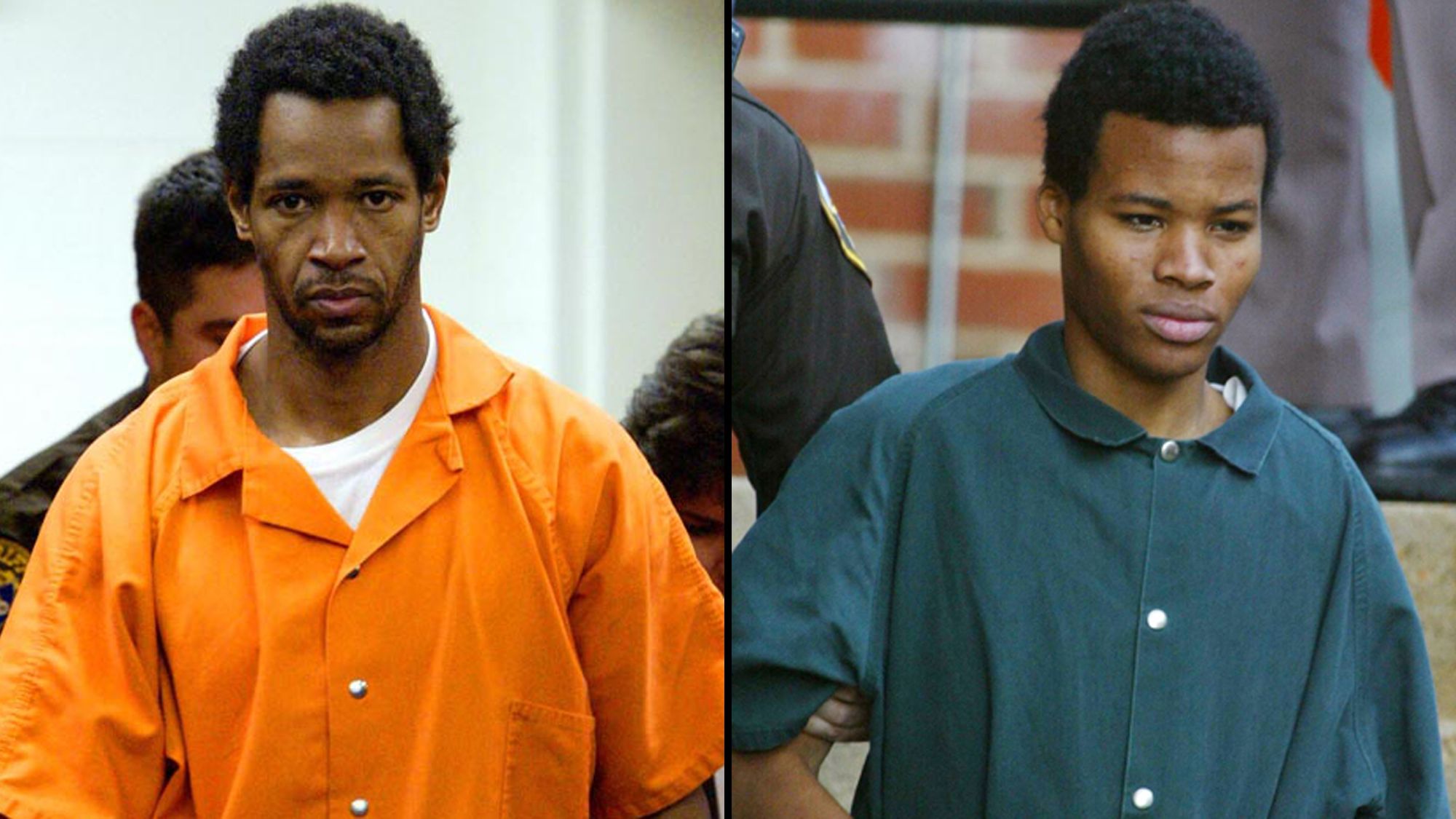
John Allen Muhammad (left) and Lee Malvo

October 24, 2002: The "Beltway Snipers," who killed 7 people in the Washington, D.C. area, are arrested.

John Allen Muhammad was 41 years old, and a native of Baton Rouge, Louisiana. He joined the Nation of Islam, dropping his birth name of John Allen Williams. In 1999, he kidnapped his children and took them to the Caribbean island nation of Antigua, apparently engaging in credit card and immigration document fraud.

It was during this time that he became close with Lee Boyd Malvo, who was living on Antigua with his mother. Then 17 and a native of Jamaica, he fell into a Svengali relationship with Muhammad, being converted to Islam and moved to Bellingham, Washington. There, he shoplifted a Bushmaster XM-15, an AR-15 style semi-automatic rifle.

At first, Muhammad was making Malvo shoot people connected with his ex-wife, Mildred Williams. On February 16, 2002, 21-year-old Keenya Nicole Cook was shot and killed by Malvo at the front door of her aunt's home in Tacoma, Washington. The aunt, Isa Nichols, had been good friends with John Allen Muhammad's ex-wife Mildred and had encouraged her to seek a divorce. This was the 1st of 9 shootings that the FBI later classified as "preliminary attacks": 3 in Maryland, 2 in Louisiana, and 1 each in Washington State, Arizona, Atlanta and Alabama.

Then came the series of shootings that became known as the Beltway Sniper attacks. A hole was cut at the rear of a blue 1990 Chevrolet Caprice driven by Muhammad and Malvo, as a firing port to be used during their attacks. This allowed them to remain hidden and escape the scene following their attacks.

On October 2, a shot was fired in Aspen Hill, Maryland, but it didn't hit anybody, and it was originally presumed to be random, before it was later compared to the other shootings. Just an hour later, in a supermarket parking lot in Wheaton, Maryland, James Martin was shot and killed.

The next morning, all within a span of 2 hours and 17 minutes, 4 people were killed in the Maryland suburbs of Washington, all in open areas where they were easy targets: A man at a car dealership in Rockville; a man at a gas station in Aspen Hill; a woman at in a shopping center parking lot in Norbeck; and a woman at a gas station in Kensington. That night, a man was killed outside a Target in the Shepherd Park neighborhood of Washington, D.C.

The next day, October 4, the pair of killers crossed the Potomac River into Virginia, and shot a woman in a mall parking lot in Spotsylvania. She survived. There were no shootings for 2 days, but on October 7, a 13-year-old boy was shot outside his school in Bowie, Maryland. He survived. On October 9, a man was shot and killed at a gas station in Manassas, Virginia. On October 11, a man was shot and killed at a gas station in Spotsylvania.

Charles Moose, Chief of the Montgomery County Department of Police, headed the investigation. Since more than one State was involved, he worked closely with the FBI even before one of their employees became a victim. On October 14, with the killers probably not realizing they were now messing with the wrong people, they shot a woman who was an FBI intelligence analyst in a shopping center parking lot in Falls Church, Virginia.

Just as a belief that the serial killer known as the Son of Sam was killing women with long blonde hair in New York in 1977, and women started tying their hair up or dying it, gas stations responded to these shootings by putting tarps up to conceal their customers, and some people crouched over while pumping their own gas.

It would take 5 more days before the shootings resumed. On October 19, a man was killed in a restaurant parking lot in Ashland, Virginia. At 90 miles, this was the furthest yet from downtown Washington. On October 22, a man was shot on his house steps in Aspen Hill.

Just after midnight on October 24, 2002, refrigerator mechanic Whitney Donahue called 911 at a rest stop off Interstate 70 near Myersville, Maryland. He said he saw a dark blue 1990 Chevrolet Caprice with New Jersey license plates, which matched the description that law enforcement had said they were looking for. At 3:19 AM, Muhammad and Malvo were found sleeping in their car, and were arrested on federal weapons charges.

The stolen Bushmaster rifle was found, and ballistics tests later conclusively linked it to 11 of the 14 shootings, including one in which no one was hurt. The Caprice was later discovered to have formerly been used as an undercover police car in Bordentown, New Jersey.

In total, Muhammad and Malvo were responsible for 27 people being shot, 17 of them fatally. There were 12 attacks in Maryland, 5 in Virginia, 2 in Louisiana, and 1 each in the District of Columbia, Washington State, Arizona, Georgia and Alabama.


In 2003, both defendants were convicted. Muhammad was sentenced to death, and was executed by lethal injection at Greensville Correctional Center in Virginia on November 10, 2009. As Malvo was legally a juvenile at the time of the shootings, he received 6 life sentences in Maryland and 3 in Virginia.

Charles Moose died in 2021. As of October 24, 2022, Mildred Muhammad, John Allen's ex-wife, is a motivational speaker and counselor, counseling people affected by crime, including the victims and the families of the perpetrators. Lee Malvo is serving multiple life sentences at Keen Mountain Correctional Center in Virginia. He is unlikely ever to be released alive. 

*

October 24, 2002 was a Thursday. This was also the day that Gary Lineker, former star soccer player for Leciester City Football Club, led a consortium to buy the team and save it from bankruptcy. the I have a separate entry for that event.

Game 5 of the World Series was played. The San Francisco Giants beat the team then known as the Anaheim Angels, 16-4. Jeff Kent hit 2 home runs. The most well-known moment in this game occurred in the bottom of the 7th inning, when Giants 1st baseman J.T. Snow scored off a Kenny Lofton triple. Three-year-old batboy Darren Baker, son of Giants manager Dusty Baker, ran to home plate to collect Lofton's bat before the play was completed, and was quickly lifted by the jacket by Snow with one hand as he crossed the plate, with David Bell close on his heels. Had Snow not acted quickly, Darren could have been seriously injured in a play at home plate.

The Giants were now 1 win away from winning the World Series for the 1st time in 1954, when they were still in New York. They would have to wait. Darren Baker was later drafted by the Washington Nationals as a 2nd baseman.

(UPDATE: In 2024, he played 9 games for the Nationals. These were his only major league games through the 2025 season.)

The NFL was in midweek. Two games were played in college football. Number 12 North Carolina State beat Clemson, 38-6 at Memorial Stadium in Clemson, South Carolina. And Colorado State beat Brigham Young University, 37-10 at Hughes Stadium in Fort Collins, Colorado.

The NBA season started 5 days later. There were 9 games in the NHL:

* The New York Islanders beat the Florida Panthers, 5-3 at the Nassau Coliseum.

* The Boston Bruins and the Ottawa Senators played to a tie, 2-2 at the FleetCenter (now the TD Garden) in Boston.

* The Philadelphia Flyers beat the Montreal Canadiens, 6-2 at the First Union Center (now the Xfinity Mobile Arena) in Philadelphia.

* The San Jose Sharks beat the Nashville Predators, 2-1 at the Gaylord Entertainment Center (now the Bridgestone Arena) in Nashville.

* The Minnesota Wild beat the Chicago Blackhawks, 3-2 at the United Center in Chicago.

* The Colorado Avalanche beat the Phoenix Coyotes, 3-2 at the American West Arena (now the Mortgage Matchup Center) in Phoenix.

* The Dallas Stars and the Calgary Flames played to a tie, 3-3 at the Saddledome in Calgary.

* The St. Louis Blues beat the Edmonton Oilers, 2-1 at the Skyreach Center (as the Northlands Coliseum was then known) in Edmonton.

* And the Vancouver Canucks and the Mighty Ducks of Anaheim played to a tie, 2-2 at General Motors Place (now the Rogers Arena) in Vancouver.) 

Monday, September 26, 2022

September 27, 1903: The Wreck of the Old 97

September 27, 1903: "The Wreck of the Old 97" takes place in Danville, Virginia. It is one of the most infamous railway disasters in American history.

"The Old 97" was The Fast Mail, a mail and baggage train with no passengers, given the right of way over all others to allow for more speed, on the Pennsylvania Railroad from Communipaw Terminal in Jersey City (after taking on mail from a ferry in Manhattan, as New York's Pennsylvania Station wouldn't open until 1910) to the Baltimore and Potomac Station in Washington. From there, the crew and the locomotive would be changed, and it would take the Southern Railway to Atlanta, Birmingham, and ending at Union Station in New Orleans.

The line was known for always being on time, much like the one Casey Jones ran in Mississippi when he saved his passengers at the cost of his own life 3 years earlier. But when Southern Railway locomotive 1102 was hooked up at Washington on September 27, 1903, it was already behind schedule. By the time it got to Monroe, Virginia, it was already an hour late.

It left Monroe with a crew of 17, including engineer Steve Broady at the controls. An 18th crewman would be picked up in Lynchburg. At Monroe, Broady was told to get the train to Spencer on time. This would require an average speed of 51 miles per hour, and the usual average speed on that 166-mile run was 39. But if the train didn't get there on time, the railroad would be penalized by the U.S. Postal Service, as per their contract.

There was a curve on the Dan River and a downgrade leading into the Stillhouse Trestle at Danville, Virginia, and Broady was unable to reduce his speed enough. The train derailed, fell into a ravine, and burst into flame. Of the 18 men on board, 11 died, including Broady, who was 33 years old. The other 7 survived because they saw what was happening, and jumped. They were all injured, but survived.

The cargo wasn't so lucky: Most of the mail was burned in the crash. One survivor was a large case filled with canaries. The birds managed to escape and fly away unharmed. Apparently, canaries are safer in a train derailment than they are in a coal mine.

That would seem to be the end of the story. But, as Danville is in the Appalachian Mountains, often called the birthplace of country music, songs were written about the wreck. In 1924, one such ballad, "The Wreck of the Old 97," was written and recorded by fiddler G.B. Grayson and guitarist Henry Whitter.

In 1929, they were the 1st act to record the folk song "Tom Dooley," based on the 1868 capture of North Carolina murder suspect Tom Dula -- by G.B.'s uncle, James Grayson. The song is usually introduced as being about "the eternal triangle," so it sounds like "Mr. Grayson" is the other man seeking the woman's affections. But in real life, Grayson was a Union Army officer turned lawman, which made him none too popular in those parts. Making him even less so: The available evidence suggests that Dula was innocent. Today, we don't even remember his name right.

In 1865, Henry Clay Work, noted for his Civil War ballads, wrote "The Ship That Never Returned." Copyright laws being what they were in the 1920s, Grayson and Whitter took the melody and wrote lyrics, the latter apparently based on the eyewitness account of Fred Jackson Lewey, whose cousin, Albion Clapp, was one of the firemen (shovelers of coal into the engine) killed in the wreck. Regardless, the lyrics put the blame on the railroad, telling Broady, "This is not 38, this is Old 97, you must put her into Spencer on time!"

In 1927, the song was recorded by Vernon Dalhart, and it became the 1st country song to selling over 1 million copies. Until Johnny Cash (who, of course, recorded all 3, and many other train songs) came out with "Folsom Prison Blues" in 1956, it rivaled "Casey Jones" and "The Wabash Cannonball" as the most famous train song ever recorded.

The melody would be used for another train song in 1948, and, like "Tom Dooley," become a hit for The Kingston Trio in the late 1950s: "M.T.A.," about a man who gets on the Boston subway and refuses to pay the newly-installed exit fare: "He's the man who never returned!"

Ironically, while the Wreck of the Old 97 is remembered, because of the song, it was not the worst railway disaster in America in the Autumn of 1903. Just 34 days later, on Halloween, a train crash in Indianapolis would kill 17 people, including 14 players on the Purdue University football team. But "the Purdue Wreck" didn't get a song written about it.

When Amtrak took over passenger rail service in America in 1971, it included a train it named the Fast Mail. The name is still in use today, although, with airmail service, carrying mail by trains is now obsolete.

*

September 27, 1903 was a Sunday. This was before the NFL, so baseball was still the only major sport playing on Sundays. Even then, not every team played, because some States still had "blue laws" against Sunday baseball. Nevertheless:

* The Brooklyn Superbas, who became the Dodgers in 1911, were the only one of New York City's 3 teams in action that day. They split a doubleheader with the Cincinnati Reds, at the Palace of the Fans in Cincinnati. That ballpark would be torn down in the 1911-12 off-season, and Crosley Field built in its place. Brooklyn won the opener, 14-7. Cincinnati won the nightcap, 7-6, in a game shortened to 5 innings due to the Sunday night curfew.

* The Chicago Cubs beat the Boston Beaneaters, 10-3 at the West Side Grounds in Chicago. After a few name changes, the Beaneaters became the Braves in 1912.

* A doubleheader was split at Robison Field in St. Louis. The Philadelphia Phillies won the 1st game, 6-3. The St. Louis Cardinals won the 2nd game, 5-3.

All taking a day off due to blue laws: The New York Highlanders (they became the Yankees in 1913) hosting the Detroit Tigers, the New York Giants at the Pittsburgh Pirates, the St. Louis Browns at the Boston Americans (they became the Red Sox in 1908), the Cleveland Naps (they became the Indians in 1915, and the Guardians in 2022) at the Philadelphia Athletics, and the Chicago White Sox at the Washington Senators.

Friday, September 16, 2022

September 17, 1908: The 1st Fatal Plane Crash

September 17, 1908: It has been less than 5 years since Orville Wright and his brother Wilbur invented the airplane. Only this year was a public demonstration made of it, so that the general public had become aware of the invention. Now, for the 1st time, someone dies as a result of a plane crash.

Orville Wright is the pilot. He is badly hurt. But he is not the fatal victim.

Thomas Selfridge was the nephew and grandson of Real Admirals in the U.S. Navy. Nevertheless, he went into the U.S. Military Academy at West Point, New York, graduating in 1903, in the class topped by eventual General of the Army Douglas MacArthur. He was stationed at the Presidio, in San Francisco, and was involved in relief efforts after the 1906 earthquake.

In 1907, he was assigned to the Aeronautical Division of the U.S. Signal Corps, the original version of what would become the U.S. Air Force. Stationed at Fort Myer, adjacent to Arlington National Cemetery on the Virginia side of the Potomac River, across from Washington, D.C.

He learned to fly dirigibles, and then a tetrahedral kite, on December 6, 1907, flying for 7 minutes of Nova Scotia, making him the 1st person to fly any heavier-than-air craft in Canada. He designed a plane called the Red Wing in 1908, but it crashed near Hammondsport, in the Finger Lakes region of New York State. The pilot, Frederick W. Baldwin, survived. On May 19, 1908, Selfridge became the 1st U.S. military officer to pilot a modern aircraft, when he flew solo in White Wing at Hammondsport.

On September 17, Orville Wright came to Fort Myer to demonstrate the Wright Model A, which he had hoped would become the Army's standard airplane. Selfridge, now with the rank of 1st Lieutenant, arranged to be his passenger, and Wright piloted the craft. On this occasion, the Flyer was carrying more weight than it had ever done before: The combined weight of the two men was about 320 pounds.
Selfridge (left) and Wright (wearing cap), before takeoff

The Model A circled Fort Myer 4½ times, at a height of 150 feet. Halfway through the 5th circuit, at 5:14 in the afternoon, the right-hand propeller broke, losing thrust. This set up a vibration, causing the split propeller to hit a guy-wire bracing the rear vertical rudder. The wire tore out of its fastening and shattered the propeller. The rudder swiveled to the horizontal and sent the Flyer into a nose dive. Wright shut off the engine and managed to glide to about 75 feet, but the craft hit the ground nose-first.
After the crash

Both men were thrown forward against the remaining wires, and Selfridge struck one of the wooden uprights of the framework, fracturing the base of his skull. He underwent neurosurgery, but died three hours later without regaining consciousness. He was 26 years old. Wright suffered severe injuries, including a broken left femur, several broken ribs, and a damaged hip, and was hospitalized for 7 weeks.

Selfridge was laid to rest at Arlington. Selfridge Air National Guard base, in the Detroit suburb of Harrison Township, Michigan, is named for him.

*

September 17, 1908 was a Thursday. These baseball games were played on that day:

* The New York Highlanders lost to the Detroit Tigers, 7-4 at Bennett Park in Detroit. Ty Cobb went 0-for-2 with 2 walks.

In the 1911-12 off-season, Bennett Park was torn down, the field realigned, and Navin Field built on the site. It was renamed Briggs Stadium in 1938, and Tiger Stadium in 1961. In 1913, the Highlanders officially changed their name to what people were already calling them: The New York Yankees.

* The New York Giants beat the St. Louis Cardinals, 10-5 at the 1890-1910 version of the Polo Grounds. That stadium burned down at the start of the 1911 season, and was quickly rebuilt.

* The Brooklyn Superbas beat the Cincinnati Reds, 6-2 at Washington Park in Brooklyn. The Superbas became the Brooklyn Dodgers in 1911.

* The Chicago Cubs beat the Boston Doves, 4-1 at the 1888-1914 version of the South End Grounds in Boston. The Doves became the Boston Braves in 1912.

* The Pittsburgh Pirates beat the Philadelphia Phillies, 1-0 at National League Park in Philadelphia. The ballpark was renamed Baker Bowl in 1914. Honus Wagner went 3-for-5 with 2 RBIs.

* The Cleveland Naps beat the Boston Red Sox, 1-0 at the 1891-1909 version of League Park in Cleveland. Addie Joss pitched a 6-hit shutout, to outpitch Cy Young. The Cleveland team was named for its manager, 2nd baseman and best hitter, Napoleon "Nap" Lajoie, who went 0-for-3 in the game. The team became the Cleveland Indians in 1915, and the Cleveland Guardians in 2022.

* The Chicago White Sox beat the Washington Senators, 5-0 at South Side Park in Chicago. Guy "Doc" White, a dentist, pitched a 5-hit shutout.

* And the Philadelphia Athletics and the St. Louis Browns were rained out at the 1898-1908 version of Sportsman's Park in St. Louis. The game was made up the next day as part of a doubleheader. The Browns swept, 2-1 and 5-4.

Saturday, September 10, 2022

September 10, 2016: American Football's Biggest Crowd

September 10, 2016: The biggest crowd in the history of American football, at any level, is recorded. And not at a place known for hosting the sport.

The University of Tennessee is in Knoxville, Tennessee. The Virginia Polytechnic Institute, a.k.a. Virginia Tech, is in Blacksburg, Virginia. Their stadiums are 237 miles apart, separated by Interstates 81 and 40. However, they are not rivals, because they are in different leagues: Tennessee are in the Southeastern Conference (the SEC), Tech in the Atlantic Coast Conference (the ACC).

Perhaps the fact that they are not rivals made this neutral-site game easier to set up. Tech's Lane Stadium seats 65,632. Tennessee's Neyland Stadium seats 101,915. But they set up a game against each other at a racetrack, the Bristol Motor Speedway, in Bristol, Tennessee, 110 miles from Neyland Stadium, 138 miles from Lane Stadium, and 7 miles from the Virginia/Tennessee State Line that Bristol straddles. (Bristol, Virginia is home to 17,000 people; Bristol, Tennessee, to 26,000.)

The Speedway opened in 1961, is a regular on the NASCAR "short track" circuit, and is known as "The World's Fastest Half Mile." Officially, it seats 153,000. But when the Tennessee Volunteers and the Virginia Tech Hokies played each other there on September 10, 2016, the attendance was a new record for a game of the sport the rest of the world calls "American football": 156,990.

The current NFL record is 112,376, for an exhibition game at Estadio Azteca in Mexico City in 1994. The Houston Oilers beat the Dallas Cowboys, 6-0. The biggest crowd for a regular-season game was 105,121 at AT&T Stadium in Arlington, Texas, on September 20, 2009. The Cowboys lost this one, too, to the New York Giants, 33-31.

Here's what the 156,990 at "The Battle at Bristol" saw. Tech scored 2 touchdowns in the 1st quarter, for a 14-0 lead. The Volunteers took over from there, scoring 31 unanswered points: 4 touchdowns and a field goal, making it 31-14. The Hokies added a field goal to close it to within 31-17 at the end of 3 quarters.

The Vols scored 2 more touchdowns in the 4th quarter. The Hokies added a touchdown, but that would be it: Tennessee 45, Virginia Tech 24. Tech football is known for 2 things: Michael Vick and good defense. On this night, they had neither.

Tennessee went 9-4, staying at home for the postseason, winning the Music City Bowl in Nashville. Virginia Tech went 10-4, winning the Coastal Division of the ACC, losing the ACC Championship Game to Clemson, and winning the Belk Bowl (now the Duke's Mayo Bowl) in Charlotte.

*

September 10, 2016 was a Saturday. These other notable college football games were played that day:

* Number 1 Alabama beat Western Kentucky, 38-10 at Bryant-Denny Stadium in Tuscaloosa, Alabama.

* Number 2 Clemson beat Troy, 30-24 at Clemson Memorial Stadium in Clemson, South Carolina.

* Number 3 Florida State beat Charleston Southern at Doak Campbell Stadium in Tallahassee, Florida.

* Number 4 Ohio State beat the University of Tulsa, 48-3 at Ohio Stadium in Columbus, Ohio.

* Number 5 Michigan beat Central Florida, 51-14 at Michigan Stadium in Ann Arbor.

* Number 6 University of Houston beat Lamar University, 42-0 at TDECU Stadium in Houston.

* Number 8 University of Washington beat Idaho, 59-14 at Husky Stadium in Seattle.

* Number 9 Georgia beat Nicholls State, 26-24 at Sanford Stadium in Athens, Georgia.

* Number 10 Wisconsin beat the University of Akron, 54-1 at Camp Randall Stadium in Madison, Wisconsin.

* Number 15 Texas Christian (TCU) were upset by Arkansas at Amon G. Carter Stadium in Fort Worth, Texas.

* Number 22 Oklahoma State were upset by Central Michigan, 30-27 at Boone Pickens Stadium in Stillwater, Oklahoma.

* In a major rivalry, the University of Pittsburgh beat Penn State, 42-39 at Heinz Field (now Acrisure Stadium) in Pittsburgh.

* Among the service academies, Army beat Rice, 31-14 at Michie Stadium in West Point, New York; Navy beat the University of Connecticut, 28-24 at Navy-Marine Corps Memorial Stadium in Annapolis, Maryland; and Air Force beat Georgia State, 48-14 at Falcon Stadium in Colorado Springs, Colorado.

* And Rutgers beat Howard University, 52-14 at High Points Solutions Stadium (now SHI Stadium) in Piscataway, New Jersey.

It was a little early for the NBA and NHL seasons to start. But these baseball games were played that day:

* The New York Yankees beat the Tampa Bay Rays, 5-1 at Yankee Stadium. Masahiro Tanaka was the winning pitcher, and home runs were hit by two men who became pariahs among Yankee Fans, Jacoby Ellsbury and Gary Sánchez.

* The New York Mets lost to the Atlanta Braves, 4-3 at Turner Field (now Center Parc Stadium) in Atlanta. Adonis Garcia singled home the winning run in the bottom of the 10th inning.

* The Washington Nationals beat the Philadelphia Phillies, 3-0 at Nationals Park in Washington. How many Nats pitchers does it take to pitch a 5-hit shutout? This time, 4: Max Scherzer, 6 2/3rds innings; Marc Rzepczynski, 1 inning; Shawn Kelley, 1/3rd of an inning, faced only one batter, but, because he was their pitcher when the Nats took the lead, on a 3-run home run by Bryce Harper in the bottom of the 8th, he was credited as the winning pitcher; and Mark Melancon, who got the save.

* The Los Angeles Dodgers beat the Miami Marlins, 5-0 at Marlins Park (now LoanDepot Park) in Miami. How many Dodger pitchers does it take to pitch a 2-hit shutout? Also 4. At least this time, the starter got the win: Rich Hill pitched 7 no-hit innings, before manager Dave Roberts replaced him with Joe Blanton, who allowed a hit in the 8th; Grant Dayton allowed a hit in the 9th, and Kenley Jansen got the last out.

* The Toronto Blue Jays beat the Boston Red Sox, 3-2 at the Rogers Centre in Toronto.

* The Cincinnati Reds beat their arch-rivals, the Pittsburgh Pirates, 8-7 at PNC Park in Pittsburgh.

* The Baltimore Orioles beat the Detroit Tigers, 11-3 at Comerica Park in Detroit.

* The Kansas City Royals beat the Chicago White Sox, 6-5 at U.S. Cellular Field (soon to be renamed Guaranteed Rate Field, and now named just Rate Field) in Chicago.

* The Minnesota Twins beat the Cleveland Indians, 2-1 at Target Field in Minneapolis. Joe Mauer singled home the winning run in the bottom of the 12th inning.

* The St. Louis Cardinals beat the Milwaukee Brewers, 5-1 at Busch Stadium in St. Louis.

* The Houston Astros beat the Chicago Cubs, 2-1 at Minute Maid Park (now Daikin Park) in Houston.

* The San Francisco Giants beat the Arizona Diamondbacks, 11-3 at Chase Field in Phoenix.

* The San Diego Padres beat the Colorado Rockies, 6-3 at Petco Park in San Diego.

* The Texas Rangers beat the Los Angeles Angels, 8-5 at Angel Stadium of Anaheim.

* And the Seattle Mariners beat the Oakland Athletics, 14-3 at the Oakland Coliseum.

And in English soccer, Arsenal beat Hampshire team Southampton, 2-1 at the Emirates Stadium in North London.

Tuesday, August 23, 2022

August 23, 2011: The Virginia Earthquake

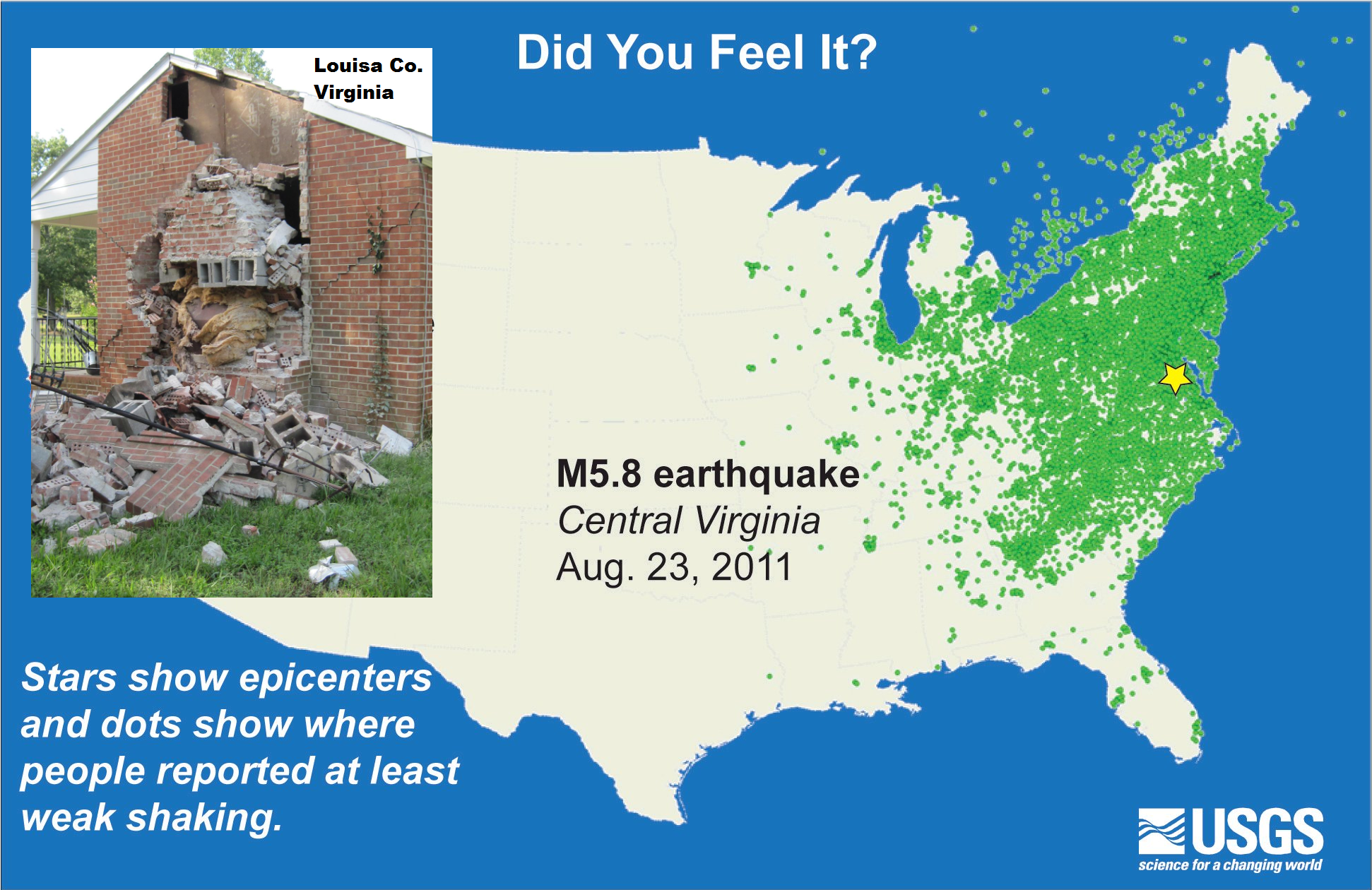
August 23, 2011: A rare East Coast earthquake occurs, measuring 5.8 on the Richter scale, with its epicenter in Cuckoo, Virginia.

You read that right: The community was named after a cuckoo clock in the Colonial-era tavern. The nearest full town is Louisa, namesake and seat of Louisa County. The epicenter was 50 miles northwest of the State capital of Richmond, and 100 miles southwest of the national capital of Washington, D.C.

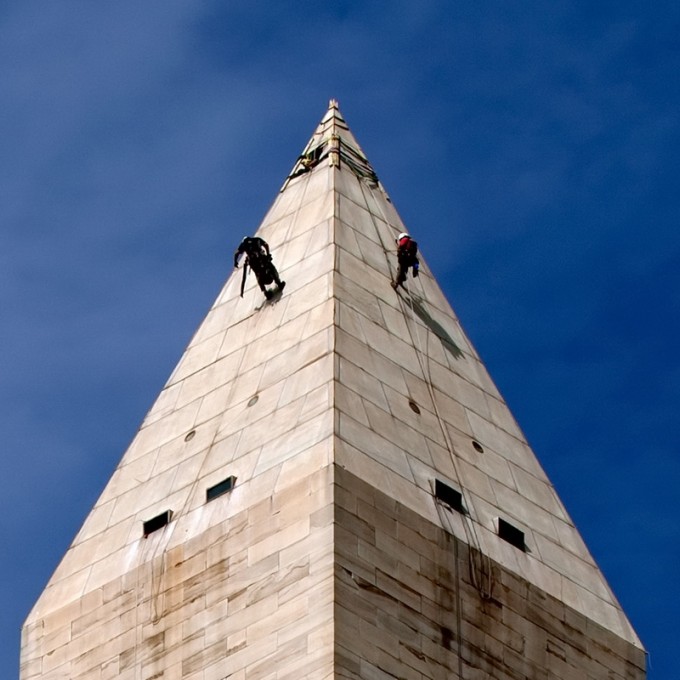
Among the damage in Washington was to the Washington Monument and the National Cathedral. The Monument was closed for repairs for 3 years; the Cathedral was closed for a few weeks, but, as of August 23, 2022, repairs were still being done.
Workmen atop the Washington Monument,
about 550 feet above the ground.

At the time, I was working in Sayreville, on the New York side of New Jersey. My office was in a typical 1960s box-type building that never looked all that stable, and, despite being a little over 300 miles from the epicenter, I thought the building was going to collapse. I thought the shaking was a combination of the bad building and the noisy Indian IT guys in the office next door.

It was only the 2nd earthquake I can remember, following the one at 3.8 that was centered in Marlboro, New Jersey that interrupted my 4th grade class in East Brunswick in 1979.

UPDATE: On April 5, 2024, a quake measuring 4.8 was centered on Lebanon, New Jersey.

*

August 23, 2011 was a Tuesday. None of the Major League Baseball games scheduled for this day were postponed due to the earthquake, and were played, with the results as follows:

* The New York Yankees lost to the Oakland Athletics, 6-5 at Yankee Stadium. Brandon McCarthy, later a Yankee, outpitched Bartolo Colón. Nick Swisher and Jorge Posada hit home runs. Derek Jeter went 3-for-3 with a walk. Alex Rodriguez did not play. Brandon Allen hit 2 home runs for the A's.

* The New York Mets lost to the Philadelphia Phillies, 9-4 at Citizens Bank Park in Philadelphia. Vance Worley outpitched Jon Niese. Shane Victorino and John Mayberry Jr. hit home runs for the Phils, while Lucas Duda hit one for the Mets.

* The Arizona Diamondbacks beat the Washington Nationals, 2-0 at Nationals Park in Washington. Ian Kennedy pitched 7 innings of 6-hit shutout ball, and David Hernandez and J.J. Putz finished the 6-hit shutout.

* The Detroit Tigers beat the Tampa Bay Rays, 2-1 at Tropicana Field in St. Petersburg, Florida.

* The Cincinnati Reds beat the Florida Marlins, 8-6 at Sun Life Stadium (now Hard Rock Stadium) in Miami Gardens, Florida.

* The Kansas City Royals beat the Toronto Blue Jays, 6-4 at the Rogers Centre in Toronto.

* The Milwaukee Brewers beat the Pittsburgh Pirates, 11-4 at PNC Park in Pittsburgh.

* The Seattle Mariners beat the Cleveland Indians, 12-7 at Progressive Field in Cleveland.

* The Atlanta Braves beat the Chicago Cubs, 5-4 at Wrigley Field in Chicago.

* The Baltimore Orioles beat the Minnesota Twins, 8-1 at Target Field in Minneapolis.

* The Los Angeles Dodgers beat the St. Louis Cardinals, 13-2 at Busch Stadium in St. Louis.

* The Boston Red Sox beat the Texas Rangers, 11-5 at Rangers Ballpark (now Choctaw Stadium) in the Dallas suburb of Arlington, Texas. Adrián González hit 2 home runs.

* The Colorado Rockies beat the Houston Astros, 8-6 at Coors Field in Denver.

* The Los Angeles Angels beat the Chicago White Sox, 5-4 at Angel Stadium of Anaheim.

* And the San Diego Padres beat the San Francisco Giants, 7-5 at AT&T Park (now Oracle Park) in San Francisco.

December 31, 1999 & January 1, 2000: The Millennium

December 31, 1999:  The Millennium arrives. The people of planet Earth survived. At a terrible cost. But we hadn't destroyed ourselves. ...