Showing posts with label game of the century. Show all posts

Saturday, December 31, 2022

December 31, 1975: Hockey's "Game of the Century"

Left to right: Peter Mahovlich,
Vladislav Tretiak, Yvan Cournoyer

December 31, 1975: A hockey game is played at the Montreal Forum. It not only ends up getting labeled "The Game of the Century," but it is often credited with "saving the sport."

Super Series '76 was scheduled, with 2 Soviet club teams taking on NHL teams. One was the reigning Soviet Champions, CSKA Moscow. Translated into English, "CSKA" (pronounced "CHESS-kah") became "Central Sports Club of the Army." It was a team sponsored by the country's Red Army, and that's what they were called in the American media: "The Red Army." The other was Krylya Sovetov, translated as "Soviet Wings." This suggests they were sponsored by the country's Air Force. Not quite: They were sponsored by the country's aircraft builders.

The Super Series began on December 28, 1975, at Madison Square Garden, and the Red Army pounded the New York Rangers, 7-3. This was understandable: Despite celebrating their 50th Season, the Broadway Blueshirts were in total disarray, having recently fired their head coach and general manager, Emile Francis; and traded away several key players, including goaltender Eddie Giacomin, defenseman Brad Park and center Jean Ratelle. On December 29, the Soviet Wings beat the Pittsburgh Penguins, 7-4. Also not a surprise: The Pens were not a good team at the time.

The next game got people's attention, though: On New Year's Eve, at the Montreal Forum, the Red Army took on the Montreal Canadiens, a team loaded with future Hall-of-Famers, and one of the favorites to win the Stanley Cup.

Les Habitantes got on the board first, as Steve Shutt scored 3:10 into the game. At 7:25, Yvon Lambert made it 2-0. Boris Mikhailov scored for the Soviets, 3:54 into the 2nd period. At 9:39, Canadien Captain Yvan Cournoyer scored, to make it 3-1. So, of the Habs' 1st 3 goals, 2 were scored by men with the French variation on the Russian name "Ivan," meaning "John."

At 16:21, Valery Kharlamov scored, to make it 3-2. At 4:04 into the 3rd period, Boris Aleksandrov scored to tie the game. It ended in a 3-3 tie, and the entire game only saw 8 penalties called. Montreal goalie Ken Dryden saved 10 of 13 shots, while the Soviets' Vladislav Tretiak saved 35 of 38. Each man was reprising a fine performance in the 1972 "Summit Series." It has been called one of the greatest games in the sport's history.

"We outshot them 38 to 13, and that was pretty indicative of the way the game went," the Canadiens' Doug Risebrough said. "Vladislav Tretiak stole the game. He was just great. But the final score didn’t matter. Whether we won, lost or tied the game, we knew we had something special."

On January 4, 1976, an NHL team finally got a win. The Buffalo Sabres, who had advanced to the previous season's Stanley Cup Finals, beat the Wings, 12-6 at the Buffalo Memorial Auditorium. But the Russians re-established their dominance: On January 7, the Wings went into the Chicago Stadium, and beat the Chicago Black Hawks, 4-2.

On January 8, the Red Army went into the Boston Garden and, playing a Boston Bruins team with Bobby Orr injured, Phil Esposito traded to the Rangers for Park and Ratelle, and Park and Ratelle not really settled in yet, dominated the Beantown Brats, 5-2. And on January 10, the Wings went out to Long Island, and beat the rising New York Islanders, 2-1.

There was one game left to play. On January 11, the Red Army went into The Spectrum in Philadelphia, to play the Philadelphia Flyers, 2-time defending Stanley Cup Champions. And the Flyers, in the process of standing up for America, undid a lot of the undoing of the damage.

They had a well-balanced team led by Captain Bobby Clarke and goaltender Bernie Parent. But they were also the most violent team hockey had ever seen, known as "The Broad Street Bullies." Philadelphia fans, enjoying their image as a city for tough people, loved it. 

In the 1st period, Ed Van Impe was sent to the penalty box for hooking. When his penalty ended, with the score still 0-0, he went right at Kharlamov, and elbowed him in the head. The referee, Lloyd Gilmour, did not call a penalty. Red Army coach Konstantin Loktev decided that his players were not going to be treated fairly, and, with the clock reading 11:21 of the 1st period (in other words, 9:39 to go), pulled his team off the ice. Bob Cole, calling the game for CBC (the Canadian Broadcasting Corporation), yelled, "They're going home! They're going home!"

With the threat of losing their share of the gate receipts, the Russians were talked back into going back onto the ice, and the Flyers beat them, 4-1. Tretiak said the Flyers won by playing "rude hockey." Loktev called them "a bunch of animals." They were both right. But the Flyers had won, and came away believing the Russians were skilled but soft. They were right, too.

The Flyers made it 3 straight trips to the Stanley Cup Finals, and printed up memorabilia reading, "HAT TRICK IN '76." But the Canadiens put a stop to that, sweeping them in 4 straight, for the 1st of 4 straight Stanley Cups. They credited the New Year's Eve tie with the Soviets for sparking them into that dynasty. Dryden, Cournoyer, Shutt, Guy Lafleur, Jacques Lemaire, Bob Gainey, Serge Savard, Guy Lapointe and Larry Robinson would all be elected to the Hockey Hall of Fame.

*

December 31, 1975 was a Wednesday. There were 4 regular-season games in the NHL that day:

* The New York Rangers lost to the Atlanta Flames, 8-1 at Madison Square Garden.

* The Pittsburgh Penguins beat the Los Angeles Kings, 5-1 at the Civic Arena in Pittsburgh.

* The Detroit Red Wings beat the Washington Capitals, 4-0 at the Olympia Stadium in Detroit.

* And the Boston Bruins beat the Minnesota North Stars, 6-1 at the Metropolitan Sports Center in the Minneapolis suburb of Bloomington, Minnesota.

There were no games in the World Hockey Association. Nor were there any in the NBA. There was 1 in the American Basketball Association: The Denver Nuggets beat the Kentucky Colonels, 141-137 at the McNichols Arena in Denver.

Baseball was out of season. There were 2 college bowl games played. Number 4 Alabama beat Number 8 Penn State, 13-8 in the Sugar Bowl in New Orleans. It was the 1st Sugar Bowl indoors, at the Superdome, after being outdoors at Tulane Stadium since New Year's Day 1935. And West Virginia beat North Carolina State, 13-10 in the Peach Bowl, at Atlanta-Fulton County Stadium.

Friday, December 16, 2022

December 16, 1905: Rugby's "Match of the Century"

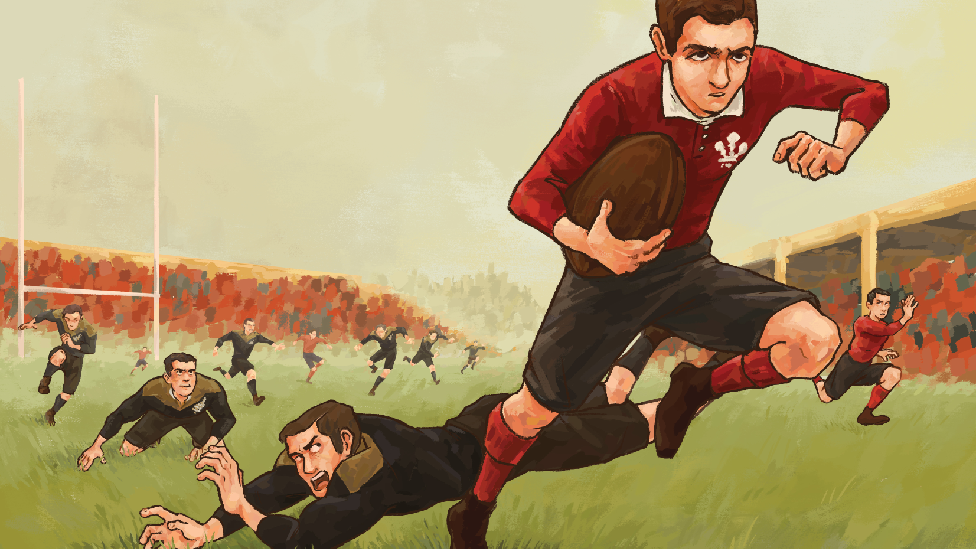
Illustration for a children's book about the match

December 16, 1905: A rugby union match is played, becoming known as the sport's "Match of the Century."

Rugby was allegedly invented at the prep school of the same name in England's Midlands in 1823. Wales began playing it in 1850, the Welsh Rugby Union was formed in 1881, and the Home Nations Championship, between Wales, England, Scotland and Ireland was first played 2 years later. (France was added in 1910, making it the Five Nations Championship. In 2000, Italy was added, making it the Six Nations Championship.)

The sport was first played in New Zealand in 1870. By 1904, New Zealand was sending its national team on tour. Because of their all-black uniforms, they became known as the All Blacks. (The soccer team eventually became known as the All Whites, and their cricket team as the Black Caps.)

The Original All Blacks, also known simply as "The Originals," were the first New Zealand team to tour outside Australasia. They toured the British Isles, France and the United States during 1905–1906. Their opening game, on September 16, 1905, was against Devon, in England's West Country, whom they defeated 55–4. They defeated every English side that they faced, including a 16–3 victory over English county champions Durham in the North-East, and a 32–0 victory over Blackheath in South-East London.

They defeated the national teams of Scotland, 12-7, easily the closest match on the tour before December 16; Ireland, 15-0; and England, also 15-0. On December 13, they beat Yorkshire in Leeds, 40-0. By the time the tour arrived in Wales, the All Blacks had not conceded a single point in their last 600 minutes of rugby. They had played 27 matches on the tour so far, scoring 801 points and conceding just 22.

The team travelled to Wales by train on 15 December, arriving at Cardiff Station in the evening. Despite the late hour, the visitors received a raucous welcome, a large crowd (contemporary estimates put it crowd at 20,000) had gathered to greet the All Blacks both inside the station and along the neighboring streets, preventing the players from getting to their hotel, and police had to force a path through the crowd for the tourists.

As early as October, the Welsh Match Committee had been observing the All Blacks tour. On October 19, the committee travelled to Gloucester, and say the tourists defeat one of the best club sides in England, 44–0. Rugby historians tend to accept that the scale and manner of this All Blacks victory encouraged the Welsh observers to develop new tactics that could match the tourists' unorthodox style.

As early as 1888, the New Zealand players had been performing a pregame routine that featured the haka, a dance of their native Māori people. They brought it with them to Britain. The Wales team debated how to counter this, and it was agreed that they would simply sing "Hen Wlad Fy Nhadau" ("Land of My Fathers"). It is believed to be the earliest performance of a National Anthem before a sporting event, and it whipped the crowd at Catdiff Arms Park into a frenzy, charging the players up.

As has become traditional for them, Wales wore all red, which would have been distinctive in person against New Zealand's literal all-black uniforms, but makes it difficult to tell the teams apart in black & white photographs.

Having studied the All Blacks' tactics, Wales concentrated on outside play. This resulted in a defensive struggle, and accounts of the match were unanimous in reporting how unusually poor New Zealand were in the 1st half, conceding an abundance of penalties in the opening 15 minutes. (Rugby union matches are 80 minutes, 2 halves of 40 minutes each.) One reporter stated that the normally free-scoring All Blacks did not get any play inside the Welsh 25 yard line until the very moment before half-time.

In the 23rd minute, a scrum was called, and Dicky Owen saw a chance to call the move he devised in training. As Wales won the ball, Owen ran it down the blindside, with the backline of Percy Bush, Gwyn Nicholls (the team Captain) and Willie Llewellyn following him in support. This initial move drew several New Zealand players. Owen then switched the play, throwing a long pass back to the openside, with Cliff Pritchard having to take the ball at his feet. The long pass gave Pritchard time to draw a covering tackle, before passing to Rhys Gabe, who similarly drew a would-be tackler. Finally, Gabe passed to Teddy Morgan, who sprinted more than 20 yards to touch down in the left corner. It was 3-0 to Wales, the first time that the All Blacks had conceded without first scoring themselves. Wales failed to kick the conversion.

The All Blacks had most of the attacking play in the 2nd half. Billy Wallace crossed the try line, but was called back, having run into touch and a forward pass from Bob Deans prevented an inevitable try for Duncan McGregor.

The closest opportunity came for the All Blacks when Deans was brought down inches from the line. By this point, there was a mist over the field, and it wasn't clear who had made the key tackle, with reports at the time saying it was a combined effort of Morgan and Gabe, but Morgan gave Gabe sole credit.

The mist led the All Blacks to believe that Deans had scored, which would have tied the game, and given them the chance to take the lead on the ensuing conversion. Even some of the Welsh players admitted that they thought he had scored, then been pulled back. But the referee, J.D. Dallas of Scotland, ruled that he never crossed the line, and was 6 to 12 inches short.

The 3-0 score held, and the crowd invaded the pitch after the final whistle, carrying some of the Wales players off on their shoulders. Dave Gallaher, the New Zealand Captain, went into the Wales locker room, congratulated their team, and admitted that the better team had won. He and Captain Nicholls exchanged shirts. Gallaher's shirt is now on display at the World Rugby Museum at Twickenham Stadium, "The Home of Rugby" in South-West London.

The All Blacks continued their tour, and managed narrow wins against 4 Welsh club teams, before opposing the France national team in its 1st-ever test match. On New Year's Day, January 1, 1906, New Zealand beat France, 38-8. They returned to New Zealand via North America, where they played 2 matches against Canadian teams. Overall, they played a total of 35 matches, which included 5 Tests. The Wales Test was their only loss.

The 1905 All Blacks tour of Britain went on to achieve legendary status within the rugby world, and New Zealand in particular. They scored 976 points and conceded only 59, and thus set the standard for future All Blacks sides. The tour also saw the first use of the All Blacks name, and established New Zealand's reputation as a world-class rugby nation. Some of these players eventually defected, to participate in the professional 1907-08 tour of Australia and Great Britain, where they played against Northern Union sides, in the variation on the sport that would eventually become known as rugby league.

Bob Deans died in 1908, only 3 years after the match, from a botched appendicitis operation. He was only 24. To the end, he insisted that he had scored.

Despite the sport's popularity around the world, there wasn't a Rugby World Cup until 1987, a joint hosting by Australia and New Zealand. It's also been hosted by each of those nations separately, England, Wales, a joint British-Irish hosting, France, South Africa and Japan. It's been won by New Zealand in 1987, 2011 and 2015; Australia in 1991 and 1999; South Africa in 1995, 2007 and 2019; and England in 2003. (UPDATE: South Africa repeated in 2023, making them the 1st 4-time winner, surpassing New Zealand with 3.)

*

December 16, 1905 was a Saturday. There were no scores in North America: Baseball was out of season, football season had just ended, and basketball and hockey were mostly all-amateur.

England's Football League played that day, among the games being a 2-2 tie between Woolwich Arsenal and Yorkshire team Middlesbrough, at the Manor Ground in Plumstead, South-East London. In 1913, the hosts moved to the Highbury section of North London, and dropped the Woolwich locality from their name, becoming simply Arsenal Football Club.

Tuesday, December 6, 2022

December 6, 1969: Texas vs. Arkansas, "The Game of the Century"

December 6, 1969: One of college football's occasional "Games of the Century" is played.

They seemed to be coming every year. 1966 saw Michigan State vs. Notre Dame, in the Big Ten region if not a Big Ten game in its own right. 1967 saw USC vs. UCLA, in the league now known as the Pac-12. Now, it was Texas vs. Arkansas, for the Championship of the Southwest Conference.

Darrell Royal had been a quarterback under Bud Wilkinson at the University of Oklahoma. He never played pro football, but went into coaching. His 1st head coaching job was with the Edmonton Eskimos of the Canadian Football League of 1953. He must have gotten tired of the cold, because he went to Mississippi State University in 1954, and the University of Washington in 1956.

In 1957, he was hired at the University of Texas, one of Oklahoma's main rivals. By 1963, he had made Texas National Champions. In 1968, he installed the wishbone offense, and made his team nearly unstoppable. They won or shared the SWC title in 1959, 1961, 1962, 1963 and 1968.
They roared through the 1969 season, hanging 69 points on Texas Christian (TCU), 56 each on Navy and Baylor, 49 each on Texas A&M and Texas Tech, and 45 on Southern Methodist (SMU). But they only played 1 ranked team all season, beating Number 8 Oklahoma, 27-17 at the Cotton Bowl in Dallas. After beating A&M away on Thanksgiving Day, they were 9-0, and ranked Number 1 in the nation. They went into the game with an 18-game winning streak, their last loss to Texas Tech early in the 1968 season.

Frank Broyles had also been a college quarterback, at Georgia Tech, but not a pro one. He got his 1st head coaching job in 1957, at the University of Missouri. After just 1 year, the University of Arkansas was impressed enough to hire him away.

At the time, the Southwest Conference had 9 teams, and Arkansas, in Fayetteville, was the only 1 of them not in the State of Texas. The others were: Texas, in Austin; Texas A&M, in College Station; Texas Tech, in Lubbock; Texas Christian University (TCU), in Fort Worth; Southern Methodist University (SMU), in Dallas; Baylor, in Waco; and 2 schools in Houston, Rice University and the University of Houston.

But Broyles' Razorbacks held their own, winning the SWC title in 1959, 1960, 1961, 1964, 1965 and 1968, and taking the National Championship in a split poll in 1964. (Alabama won the other poll.) Future Dallas Cowboys head coach Jimmy Johnson and owner Jerry Jones played on his '64 National Champions.
Arkansas also had a fabulous season in 1969. Its offense wasn't as high-powered, but they scored 55 points on the University of Tulsa, 52 on Wichita State, 39 on Oklahoma State, 35 on Texas A&M, 33 on Texas Tech, and 30 on Rice. After beating Texas Tech on Thanksgiving, they were 9-0, and ranked Number 2, behind only Texas. They went into the game with a 15-game winning streak, their last loss being to Texas the season before.

The 1969 season marked the 100th Anniversary of college football, with Rutgers having beaten Princeton in the first game in 1869. Beano Cook, then an executive with ABC Sports, suggested moving the Texas-Arkansas game, normally played in October, to the 1st weekend in December, a week after most other teams had finished playing. The teams agreed, because it meant the entire country would be focused on their game, not on another.

And moving the game turned out to be a lucky break. Because, on November 22, Ohio State, defending National Champions and ranked Number 1, were upset by their arch-rivals, Michigan, handing Michigan the Big 10 title. That moved Texas up to Number 1 and Arkansas up to Number 2, without either of them even playing. All each team had to do was win their respective game on Thanksgiving, which they did: The 'Horns beat A&M 49-12, and the Hogs beat Texas Tech 33-0.

And so, on Saturday, December 6, 47,500 people shoehorned themselves into Razorback Stadium in Fayetteville. That was about 5,000 above normal capacity at the time, and later expansions have made it now a 76,000-seat facility.
Razorback Stadium, 1969. The practice fields in the upper left corner
are where Marine One landed, depositing Nixon.

Among those 47,500 fans, his Marine One helicopter landing on an adjacent practice field a few minutes before the scheduled kickoff, was the nation's Number 1 football fan, a former offensive lineman at Whittier College outside Los Angeles, the President of the United States, Richard Nixon. He had said that week that he would give a plaque to the winning coach, declaring them the National Champions. Of course, this was before the New Year's Day bowl games could have messed that up. 

Also among the fans was the Rev. Billy Graham, who delivered a pregame prayer over the public address system. Graham had a degree from Wheaton College, in Wheaton, Illinois, hometown of football legend Red Grange, although Grange went to the University of Illinois.

Not among the fans was Bill Clinton, then 23 years old, himself a future President, and a future Governor of Arkansas. At some point during his political career, a rumor got out that he had watched the game for free from a tree. The rumor grew, until it involved him flashing Nixon, or holding up an antiwar sign in front of Nixon. But he was then a Rhodes scholar at Oxford University in England, left to listen to the game on the Armed Forces Radio Network.

One time, while he was Governor, a man asked him if it was true he had heckled Nixon that day. Clinton told the truth, and denied it. Disappointed, the man said, "That's one of the reasons I voted for you!"

At the time, both schools had racially integrated student bodies, but all-white football team rosters, all-white bands, and all-white cheerleading corps. How many black fans were in the stands is unknown, but the number probably wasn't very large. In 2002, Terry Frei, who has written many books about football, published one about this game, fittingly titled Horns, Hogs, and Nixon Coming: Texas vs. Arkansas in Dixie's Last Stand, pointing out that, the last month of the 1960s, this was the last major all-white sporting event in America.

It was only 38 degrees at kickoff, and there was still some fog after an early morning rain when the game kicked off at 12:00 noon Central Time (1:00 PM Eastern Time). The game had to be held that early, because Razorback Stadium didn't yet have lights.

Broyles offered to move the game to War Memorial Stadium in Little Rock, which was a secondary home for the Razorbacks, did have lights, was a larger stadium, was in the central part of the State and thus closer to most people in Arkansas, and was closer to Austin, thus making it an easier roadtrip for the Texas fans. But ABC rejected this idea, dismissing that stadium's lights as not bright enough.

Arkansas, in red, kicked off, and benefited from Texas, wearing white, fumbling the ball away on their 2nd play from scrimmage. The Razorbacks converted that into a touchdown run by Bill Burnett. Their 7-0 lead held through halftime.

(If you get a chance to see this game, on a nostalgia network or online, you'll miss the 1st Arkansas touchdown: ABC only managed to save the last 3 quarters of their broadcast. The full game should be available on film.)

The Hogs started the 2nd half by driving through the Longhorn defense, resulting in a 29-yard touchdown pass from Bill Montgomery to Chuck Dicus. With 9:06 left in the 3rd quarter, it was Arkansas 14, Texas 0. And the Longhorns hadn't yet looked like scoring on the afternoon. This "Game of the Century" was not yet living up to the hype.

On the 1st play of the 4th quarter, Texas quarterback James Street made a 42-yard dash for a touchdown. Now, it was 14-6 Razorbacks. Royal, remembering the 1966 "Game of the Century" between Michigan State and Notre Dame that ended in a 10-10 tie, chose to go for a 2-point conversion. Street got over the goal line, to make it 14-8.

The Hogs were not fazed. On their next drive, Montgomery took them down to the Texas 7-yard line. But on 3rd and goal, his pass was intercepted in the end zone by Danny Lester. Had it merely been incomplete, a chip-shot field goal would have made it 17-8, a 2-score game, and probably cinched it for Arkansas.

Instead, it was still 14-8, and, with 4:47 left, Royal rolled the dice again, going for it on 4th and 3 from his own 43. Street threw to Randy Peschel, who caught it and took it deep, to the Arkansas 13. Two plays later, Jim Bertelsen scored a touchdown. The extra point by James "Happy" Feller gave the Longhorns a 15-14 lead. Now, with 3:58 left, the game was living up to the hype.

Arkansas refused to fold. They got to the Texas 40, and Campbell let a pass loose, but it was intercepted by Tom Campbell on the Texas 21 with under a minute to go. The Longhorns ran out the clock, and were 15-14 victors.

In the Longhorn locker room, ABC cameras captured Nixon's presentation of his National Championship plaque to Royal. But the bowl games were still left to play. Texas still had to beat Notre Dame in the Cotton Bowl in Dallas to truly be National Champions. They did, coming back from 10-0 down to win 21-17.
Nixon gives Royal the plaque. Number 24 is tailback Ted Koy.
Number 16 is quarterback James Street.

Arkansas went to the Sugar Bowl in New Orleans, and lost again, to Mississippi, 27-22. USC, undefeated at 9-0-1, beat Michigan in the Rose Bowl in the Los Angeles suburb of Pasadena, California. Undefeated and untied Penn State rose to Number 2 after Arkansas' loss to Texas, and won the Orange Bowl in Miami, 10-3 over Missouri, the Big 8 Champions and previously undefeated and untied.

Being undefeated, but with a tie, USC did not claim to be the National Champions over Texas. Undefeated and untied Penn State did, and felt robbed when both the AP and UPI published final polls listed Texas at Number 1 and Penn State at Number 2.

Penn State have no case. They had their chance. The Cotton Bowl committee invited Penn State, hoping Michigan would upset Ohio State, and thus make the Cotton Bowl to set up a Number 1 vs. Number 2 matchup with the SWC Champion, regardless of whether it turned out to be Texas or Arkansas. But Joe Paterno figured it wouldn't be Number 1 vs. Number 2, because he figured Ohio State would beat Michigan, and would still Number 1, and turned them down.

Paterno later said, "I've wondered how President Nixon could know so little about Watergate in 1973, and so much about college football in 1969." Nixon died in 1994, before everyone found out that Joe Paterno was a lesser human being, and presided over more felonies, than Tricky Dick.

James Street was also a pitcher on the Longhorn baseball team, and pitched a perfect game. He was drafted by the Cleveland Indians, but got hurt, and never played in the major leagues, nor in professional football. He became a successful settlement planner. He died in 2013, having lived to see his son, Huston Street, become a star major league reliever.

Happy Feller kicked in the NFL for Philadelphia in 1971 and New Orleans in 1972 and '73. As of December 6, 2022, he is still alive.

In 1970, Julius Whittier became the 1st black football player at the University of Texas. In 1972, the Longhorns had 1 touchdown pass all season long. Whittier caught it, in their Thanksgiving Day win over Texas A&M. He became a lawyer, and died in 2018.

Darrell Brown had tried to be the 1st black player at Arkansas, and played for their freshman team in 1965, but broke his ankle, and was unable to play a varsity down. Like Whittier, he became a lawyer, and died in 2015.

Due to Brown's injury, Arkansas didn't integrate its football team until 1974, after every other school in both the SWC and the Southeastern Conference had already done so. Leotis Harris was a guard, and played for their 1977 team that nearly won the National Championship. He played 6 seasons for the Green Bay Packers, and is still alive.

"A lot of other coaches from other schools used to talk about that Coach Broyles wouldn't have a black player on his team," Harris said. He found otherwise: "He was a fair guy. Some people said some things about him, about the black-white thing, but he was just a great man."
This game would soon have a profound effect on not just Texas, but two other "blue blood" college football programs. (Three, if you count Penn State not getting a piece of the National Championship.) In 1970, Oklahoma unveiled its own wishbone offense in their rivalry game with Texas. Texas won the game, 41-9, and remained undefeated until losing the Cotton Bowl to Notre Dame, ending their winning streak at 30 games. But Oklahoma kept with the wishbone, and became one of the dominant college football teams of the next 20 years, continuing to run the formation into the 1990s.
And at the end of that 1970 season, Oklahoma and Alabama played to a 24-24 tie in the Bluebonnet Bowl in the Astrodome in Houston. 'Bama coach Paul "Bear" Bryant was so impressed with the wishbone, he installed it as his own offense the next season, and the Crimson Tide were also one of the top teams of the 1970s.
Broyles and Royal both retired as head coach after the 1976 season. Royal remained the Longhorns' athletic director until 1980. Broyles remained the Razorbacks' athletic director until 2007. Both men became broadcasters for ABC Sports. Royal lived until 2012; Broyles, until 2017.
And that plaque that Nixon gave Royal? Well, as it turned out, Nixon only posed with Royal and the plaque. He didn't give it to Royal. He said he would take it back to Washington, and have "TEXAS LONGHORNS" engraved above the words "NATIONAL CHAMPIONS."
After that, the plaque disappeared. No one knows where it is. The UT athletic department denies that it has possession. No player on the 1969 Longhorn team claims to have it, either. Nor does Royal's widow, Edith. Nor does the Nixon Presidential Library. Nor does the Lyndon B. Johnson Presidential Library, which was then being built across from Texas' Memorial Stadium in Austin. Nor does the White House. Nor does the National Archives. Nor does the Smithsonian Institution. Nor does the College Football Hall of Fame. Nor does the Texas Sports Hall of Fame, which is in Waco. Nor does the Texas State Capitol building, also in Austin.
Bill Little, the Texas football program's official historian, said on the game's 50th Anniversary in 2019, "No one's seen it in 50 years." Cotton Speyrer, a receiver on that Texas team, suggested, "Some Penn State fan had probably gotten the plaque and thrown it into Lake Erie." (Hayden Fox and Jack Geller, noted fictional throwers of football-related things into lakes, couldn't be reached for comment.)
In 2019, to celebrate the 50th Anniversary of the game, a replica of the plaque was made, and put on display at the Longhorn Hall of Fame, in the north end zone of what's now named Darrell K. Royal Texas Memorial Stadium.
*
December 6, 1969 was a Saturday. This was the day of the disastrous rock music festival at the Altamont Speedway in the San Francisco Bay Area. And "Na Na Hey Hey Kiss Him Goodbye," by the "studio group" Steam, hit Number 1. I have separate entries for these events.
There was 1 other college football game played that day: The Pasadena Bowl, held at the Rose Bowl stadium in Pasadena. San Diego State beat Boston University, 28-7.
There were 5 games played in the NBA:
* The New York Knicks beat the Milwaukee Bucks, 124-99 at Madison Square Garden. Rookie Lew Alcindor, later to become Kareem Abdul-Jabbar, scored 26 for the Bucks. But Willis Reed and Bill Bradley each scored 29 for the Knickerbockers.
* The Philadelphia 76ers beat the Cincinnati Royals, 120-102 at The Spectrum in Philadelphia.
* The Seattle SuperSonics beat the Baltimore Bullets, 132-129 in overtime at the Baltimore Civic Center (now the CFG Bank Arena). Bob "Golden" Rule scored 40 for the Sonics.
* The Chicago Bulls beat the Boston Celtics, 116-114 in overtime at the Chicago Stadium.
* And the Los Angeles Lakers beat the San Diego Rockets, 128-115 at the San Diego Sports Arena (now the Pechanga Arena). Elvin Hayes had 40 points and 20 rebounds in a losing effort. The Rockets moved to Houston in 1971.
There were 2 games played in the American Basketball Association. The Denver Rockets beat the Washington Capitols, 108-97 at the Washington Coliseum. (The Rockets became the Denver Nuggets in 1974.) And the New Orleans Buccaneers beat the Miami Floridians, 112-104 at the Miami Beach Convention Center.
There were 5 games played in the NHL:
* The Minnesota North Stars beat the Montreal Canadiens, 4-3 at the Montreal Forum.
* The Boston Bruins beat the Chicago Black Hawks, 6-1 at the Boston Garden.
* The Toronto Maple Leafs beat the Pittsburgh Penguins, 5-0 at Maple Leaf Gardens in Toronto.
* The Detroit Red Wings beat the St. Louis Blues, 5-1 at the St. Louis Arena.
* The Los Angeles Kings beat the Oakland Seals, 5-3 at The Forum outside Los Angeles in Inglewood, California.
* And the New York Rangers and the Philadelphia Flyers were not scheduled.
Also, Arsenal drew 2-2 with Southampton at Highbury in North London.

Wednesday, November 30, 2022

November 30, 1935: The Game That Made Texas Football

November 30, 1935: If, as they say, football is a religion in the State of Texas, then this was their moment of evangelism, when they spread their gospel throughout the land.

Dallas is the largest city in North Texas. Fort Worth is the 2nd-largest. Dallas is home to Southern Methodist University. Fort Worth is home to Texas Christian University, affiliated with a different Protestant sect, the Disciples of Christ. SMU's Ownby Stadium and TCU's Amon G. Carter Stadium are just 40 miles apart, making their schools among the closest major rivals in college football. (For comparison's sake, in the State's biggest football rivalry, Texas and Texas A&M are 104 miles apart.)

Ownby Stadium was named for its benefactor, Jordan C. Ownby. Amon G. Carter was the publisher of the city's largest newspaper, the Fort Worth Star-Telegram, a.k.a. the Startle-gram. Left his fortune, his daughter Ruth Carter Stevenson spent much of it to found Fort Worth's Amon Carter Museum Museum of American Art, the most popular museum dedicated to art about the American West.

As with any other pair of big cities that are relatively close -- such as Minneapolis and St. Paul, Tampa and St. Petersburg, San Francisco and Oakland, etc. -- Dallas and Fort Worth don't like each other, despite all that they have in common. Fort Worthers think Dallasites are stuck-up, what with their nouveau riche money in oil, banking and insurance. Dallasites point to the fact that Fort Worth is known for its stockyards, and think of Fort Worthers as their country cousins, bumpkins.

From 1916 to 1921, interrupted by serving in World War I, Leo Robert Meyer, nicknamed Dutch because he was of German descent and people tended not to be able to tell the difference between "Dutch," from the Netherlands, and "Deutsch," the Germans' name for themselves, played end for TCU.

In 1923, he was named an assistant coach for them. In 1934, he was named head coach, and would remain so until 1952. He also coached baseball there, on and off, from 1926 to 1957; and basketball from 1934 to 1937. He was also their athletic director from 1950 to 1963, and lived until 1982, age 84.

In 1981, TCU graduate Dan Jenkins, the college football expert for Sports Illustrated, wrote an article for their College Preview Issue about growing up in Fort Worth as a TCU fan. He was just about to turn 7 when this game was played, but seemed to remember it well. He also claimed to remember Dutch Meyer once telling his players, "Football is a game played by men! Not by a bunch of damn sissies and city slickers from Dallas!"

And how did the "men" play for the Horned Frogs of TCU in 1935? Pretty well: They came into the game 10-0, their defeated opponents including Texas, Texas A&M and Arkansas. They were led by a quarterback named Sammy Baugh. Slingin' Sammy was the greatest passer Texas had ever seen -- maybe the greatest anybody had ever seen to that point.

And how did the "bunch of damn sissies and city slickers from Dallas" play for the Mustangs of SMU that year? About equally well: They came into the game 10-0, their defeated opponents including Texas, Arkansas, and UCLA at the Los Angeles Memorial Coliseum. They had a game at Texas A&M yet to come. Their best player was halfback Bob Wilson.

They were coached by William Madison "Matty" Bell, who had also played end, although not at the school he was coaching now, but at Centre College in Kentucky. He had been TCU's head coach from 1923 to 1928, with Meyer on his staff. So perhaps Meyer was taking this personally.

So the rivals came into the game undefeated, with the championship of the Southwest Conference on the line. It could have even been for the National Championship, because the Rose Bowl was talking about inviting the winner. Four weeks earlier, Notre Dame had beaten Ohio State in a game that was called "The Game of the Century" by some people. But in Texas, this game was called "The Game of the Century." NBC decided to broadcast it live on radio to the entire country. A crowd of 36,000 packed into Carter Stadium to watch it in person.
Amon G. Carter Stadium. Built in 1930
and expanded a few times since, TCU still play there.

The only scoring in the 1st quarter was an SMU touchdown. The Mustangs scored again early in the 2nd quarter. But Baugh led the Frogs on a touchdown drive, and the half ended 14-7 SMU. It remained that way through the 3rd quarter, but Baugh led a touchdown drive early in the 4th quarter, and the game was tied.

With 9 minutes left to play, and a 4th down and long to go, Bob Finley faked a punt and threw to Wilson, who took the ball in for a touchdown. The extra point was missed, so SMU's lead was 20-14, giving TCU fans hope of winning, 21-20.

With the clock winding down, Baugh took the Horned Frogs down the field, and got to the SMU 35-yard line. But on the final play, he threw into the end zone, and his receiver was too well-covered, and SMU's 20-14 lead held. SMU's band played "California, Here I Come."

Grantland Rice, the nation's leading syndicated sports columnist, covered the game, called it "one of the greatest football games ever played." It is credited with elevating the Southwest Conference to the college football equivalent of "major league" status. In 2017, The Dallas Morning News ranked it the greatest game ever played between the 2 rivals. However, having taken place in the age of radio, it tends to get passed over in "Game of the Century" discussions in Texas, in favor of the nationally-televised 1969 game between Texas and Arkansas.

SMU still had to play Texas A&M, but beat them, after which they were, indeed, invited to the Rose Bowl. But they lost it to Stanford. TCU went to San Francisco to play their last scheduled regular-season game, beating Santa Clara University. They were invited to the Sugar Bowl in New Orleans, and beat Louisiana State.

TCU, in spite of their loss to SMU, were named National Champions by the Williamson System. SMU, in spite of their loss to Stanford, were named National Champions by the Dickinson System, the Houlgate System, and, retroactively, by the Berryman System and the Sagarin Ratings. The University of Minnesota were selected as National Champions by United Press (UP, forerunners of United Press International or UPI), the Billingsley Report, the Boand System, the Helms Athletic Foundation, the Litkenhous System, the Poling System, and retroactively by the College Football Researchers Association and the National Championship Foundation.

This system didn't work too well. For the 1936 season, the Associated Press (AP) began polling the sportswriters who covered college football. Usually, they got it right. UP/UPI, which polled the nation's head coaches, usually named a National Champion, and it usually matched the AP's selection. On the occasions when it didn't, their selection was usually justifiable, if not the better choice. Still, this system proved unsatisfying. The Bowl Championship Series made things better, and the current College Football National Playoff system better still, but there have been flaws in every system yet tried.

Baugh went on to a great career with the NFL's Washington Redskins, and was a charter inductee into the College and Pro Football Halls of Fame. TCU won a legitimate National Championship in 1938, with another great quarterback, Heisman Trophy winner Davey O'Brien. But for the rest of the 20th Century, they tended to struggle, before a revival in the early 21st Century.

None of SMU's players did much in the pros, but they had a better record over the next few decades than TCU. In 1982, they nearly won the National Championship with their "Pony Express" backfield of Eric Dickerson and Craig James. But their cheating on top of cheating led them to become the 1st, and still the only, college football program ever to receive the NCAA's "death penalty," in 1986. They started play again in 1989, and they've been what college basketball fans call a "mid-major" school ever since. But then, so have TCU.

Carter Stadium still stands, with significant modernization. Ownby Stadium was demolished in 1998, and Gerald J. Ford Stadium was built on the site. Again, the new stadium was named for its funder. He was not related to Gerald R. Ford, the 38th President of the United States -- although that Gerald Ford was an All-American football player in 1935, a center at the University of Michigan.

*

November 30, 1935 was a Saturday. Comedian and director Woody Allen was born on this day.

These other notable college football games were played that day:

* Army beat Navy, 28-6 at Franklin Field in Philadelphia.

* Georgia Tech beat Georgia, 19-7 at Grant Field in Atlanta.

* Mississippi beat Mississippi State, 14-6 at Hemingway Stadium (now Vaught-Hemingway Stadium) in Oxford, Mississippi.

* Louisiana State beat Tulane, 41-0 at Tulane Stadium.

* Washington University beat crosstown rivals Saint Louis University, 26-0 at Walsh Memorial Stadium.

* Columbia beat Dartmouth, 13-7 at Baker Field in Manhattan.

* And Princeton beat Yale, 38-7 at the Yale Bowl in New Haven, Connecticut.

Actually, most of the big rivalries that weekend were played 2 days earlier, on Thanksgiving Day: Fordham beat New York University 21-0 in front of 72,000 at Yankee Stadium, Pittsburgh and next-door neighbors Carnegie Tech (now Carnegie-Mellon) played to a 0-0 tie, Kentucky beat Tennessee, Missouri and Kansas played to a 0-0 tie, Oklahoma beat Oklahoma State, and Utah and Utah State played to a 14-14 tie.

And, most important from the Lone Star State's perspective, for if football is a religion there, then this is its holy war: Texas A&M beat Texas, 20-6 at Kyle Field in College Station.

Baseball was out of season. The NBA hadn't been founded yet. There were 3 NHL games played that day:

* The New York Americans beat the Boston Bruins, 2-1 at the old (but then still relatively new) Madison Square Garden.

* The Montreal Maroons beat the Detroit Red Wings, 3-2 at the Montreal Forum.

* And the Toronto Maple Leafs beat their arch-rivals, the Montreal Canadiens, 8-3 at Maple Leaf Gardens in Toronto.

And in English soccer, North London team Arsenal went to Yorkshire, and played Huddersfield Town to a draw, 0-0 at Leeds Road in Huddersfield.

November 30, 1905: Chicago vs. Michigan, College Football's 1st "Game of the Century"

Walter Eckersall

November 30, 1905: The Championship of college football's Western Conference -- forerunner of the Big Ten -- is decided at Marshall Field in Chicago, named for the department store mogul who funded its construction. It becomes the 1st of many college football games referred to as "The Game of the Century."

The University of Chicago, coached by Amos Alonzo Stagg, came into the game at 10-0. They had allowed only 5 points all season, in a 16-5 win over Indiana. They had scored 44 points against Illinois, 42 each against Iowa and Beloit College, 33 against Lawrence University, and 32 against Northwestern.

They were led by Walter Eckersall, and, while quarterback was a very different position at the time, with the forward pass not legalized until the next season, he was widely regarded as the best player in the country. Stagg, later to be known as "The Grand Old Man of Football," called Eckersall "a selfless performer, marked by complete dedication to victory."

Future Notre Dame star end and coach Knute Rockne grew up in Chicago, and saw Eckersall play in both high school and college. He said of Eckersall, "The first time I learned a football was not only something to kick, but something to think with, was when I saw a great football player in action."

Stagg had recruited Eckersall out of Hyde Park High School, on the city's South Side, not far from the UC campus. Fielding Yost had also tried to recruit him, for the University of Michigan. There, Yost had such a high-powered offense that they were known as "The Point-a-Minute Team." They came in at 12-0: 65-0 over Ohio Wesleyan, 44-0 over Kalamazoo College, 36-0 over Case University, 23-0 over Ohio Northern, 18-0 over Vanderbilt, 31-0 over Nebraska, 70-0 over Albion, 48-0 over Drake, 33-0 over Illinois, 40-0 over Ohio State, 12-0 over Wisconsin, and 75-0 over Oberlin.

Granted, this 495-0 performance wasn't exactly against a modern Football Bowl Subdivision "Power 5 Conference" schedule. And only one of those games, the win over Illinois, was played away from Regents Field in Ann Arbor, Michigan. It should be noted that Wisconsin came closer than anybody to beating each team, having come within 4-0 of Chicago.

Since the start of the 1902 season, the Chicago Maroons were 46-4-3. But the Michigan Wolverines were 54-0-1 in their last 55 games. Their last loss? November 29, 1900, 15-6 -- against Chicago at Marshall Field. The showdown was set for Thanksgiving Day, and a crowd of 27,000, believed to be the largest in college football history to that point, filed into Marshall Field. (At the time, Thanksgiving Day was the last Thursday in November. It became the 4th Thursday in November in 1941.)
Marshall Field, built 1893, renamed Stagg Field 1913

At first, the game was a punting duel between Eckersall and Michigan's John Garrels. It was scoreless early in the 3rd quarter, when a Garrels punt and a penalty pinned Chicago inside its own 10-yard line. On third down, as Eckersall attempted to punt, he encountered a fearsome rush, but evaded the Michigan tacklers, and was able to scramble to the 22-yard line and a 1st down.

After 3 more 1st downs, the drive stalled and Chicago were forced to punt again. Eckersall's booming punt carried into the end zone, where it was caught by Michigan's William Dennison "Denny" Clark, who attempted to run the ball out. He advanced the ball forward to the 1-yard line, but was hit hard by Art Badenoch, and then was brought back inside his own end zone by Mark Catlin.

Under the rules of the time, forward progress was not credited, and a ball carrier could be carried backwards or forwards until he was down. Therefore, Chicago were credited with a safety: 2 points. And that would produce the final score: Chicago 2, Michigan 0. Michigan's streak was over, and Chicago were awarded the Western Conference and National Championships.

Football observers like to say, "Defense wins championships." This is hardly ever true: You can't win if you don't score, and you can't score if you don't have the ball; and, if you have the ball, by definition, you are on offense. This time, defense really did win a Conference and a National Championship. The only other major football championship ever decided on a safety was the 1929 Rose Bowl, the Roy Riegels Game. (I have an entry for that event.)

Clark received the blame for the Michigan loss, and tried to live with it, but couldn't. In 1932, he shot and killed himself. He was 48 years old. In a suicide note to his wife, he reportedly expressed the hope that his "final play" would be of some benefit in atoning for his error at Marshall Field.
Denny Clark

Chicago would see its 14-game winning streak end on November 10, 1906, defeated by Minnesota. Since there was, as yet, no real professional football to speak of, Eckersall became a college football referee, considered the finest of his era. He also became a writer on the game for the Chicago Tribune. At the end of each season, as a counterweight to the Eastern-heavy "All-American" team selected by former Yale coach Walter Camp, Eckersall named an "All-Western" team, and it was considered prestigious in its day.

But "Eckie" was a heavy drinker, and died of cirrhosis of the liver on March 24, 1930. He was only 43 years old, and, to protect his public image, the Tribune reported the cause of death as a heart attack.

In 1949, the Chicago Public Schools constructed a sporting facility on the South Side, at 2423 East 82nd Street, named "Walter Eckersall Stadium." Eckersall, Stagg and Yost would all be charter inductees into the College Football Hall of Fame in 1951.

*

November 30, 1905 was a Thursday. Among the other notable college football games played that Thanksgiving Day: Alabama beat Tennessee, 29-0; Auburn beat Georgia, 20-0; Georgia Tech beat Clemson, 17-0; Holy Cross beat Fordham, 28-5; Indiana beat Ohio State, 11-0; Iowa beat St. Louis University, 31-0; Iowa State beat cross-State rival Drake, 17-12; Kansas beat arch-rival Missouri, 24-0 in Kansas City; Nebraska beat Illinois, 24-6; North Carolina beat Virginia, 17-0 in Norfolk, Virginia; Penn State beat the University of Pittsburgh, 6-0; the University of Pennsylvania beat Cornell, 6-5; and Utah beat Colorado State, 24-0.

Rutgers, Princeton, Harvard and Yale all completed their seasons the preceding Saturday. Army and Navy had the week off, to prepare for each other: They tied, 6-6, at Princeton's University Field.

Sunday, November 27, 2022

November 28, 1889: College Football's Game of the Century -- the 19th Century

The 1889 Princeton Tigers

November 28, 1889: Perhaps, for the 1st time, a college football game was hyped up to be considered "The Game of the Century." Except, this was the 19th Century.

The 1889 season was a bit of a step forward for a sport that still resembled the English game of rugby more than the game the world outside the United States calls "American football." A field goal was worth 5 points, making it worth more than a touchdown, which was 4 points, and a kicked point after touchdown (PAT) was 2 points. Scoring a safety, then as now, was 2 points. Not until 1909 would a field goal become the 3 points it has remained ever since, and a PAT 1 point. It would be 1912 before a touchdown became 6 points.

The field itself was different. There was no end zone until 1912, which was also when the field was shortened from 110 to 100 yards. That was also the year a team was given 4 downs to make a 1st down, instead of 3. And 1889 was also the year that a "touchdown" no longer had to be literally true: Until then, a player had to cross the goal line and touch the ball to the ground. From this year onward, just crossing the goal line would be enough.

The game was still mostly played in the Northeast, and was dominated by the schools that would later be collectively called, and would ultimately found, "The Ivy League": Harvard, Yale, Princeton, the University of Pennsylvania (or "Penn"), Columbia, Dartmouth, Brown and Cornell.

But  there were some schools playing in the Midwest. And the South was beginning to catch on, and the 1st college football game in the State of South Carolina was played on December 14: Wofford defeated Furman, 5-1 on Furman's campus in Greenville. Wofford is in Spartanburg. Both schools now play in the NCAA's Football Championship Subdivision, formerly known as Division I-AA.

On October 26, the University of Delaware played its 1st game, losing 74-0 away to the Delaware Field Club in Wilmington. On November 16, the University of Iowa played its 1st game, losing 24-0 away to Iowa College in Grinnell. On November 23, Syracuse University (which had been founded in 1870, thus making it younger than the sport) played its 1st game, losing 36-0 away to the University of Rochester. And, in the Pacific Northwest, the University of Washington played its 1st game on November 28, Thanksgiving Day. I'll get to that shortly.

One major change for the 1889 season was the legalization of low tackling. This led to a sharp decrease in open-field running, and an increase in heavy, concentrated line formations like the "Princeton V," where teams engaged in brutal momentum plays to drive the ball forward. Also known as the "flying wedge," Princeton (officially, still "The College of New Jersey" until 1896, but everybody called them "Princeton") had used it against Rutgers in the 1st 2 college football games ever played, in 1869, with each team winning a game.
Harvard players demonstrating the flying wedge, 1892

The flying wedge would prove to be dangerous, resulting in several injuries, and even some deaths. It would be eliminated as part of safety measures created by the newly-established National Collegiate Athletic Association (NCAA) in 1906. But, for now, Princeton, already known as the Tigers due to their black and orange striped socks, were able to use it with brutal effectiveness.

How brutal? Their 1st 8 games went as follows: A 16-0 win over Lehigh, at University Field on the Princeton campus in Princeton, Mercer County, New Jersey; a 16-4 win in a rematch against Lehigh in Bethlehem, Pennsylvania; a 49-0 home win over Stevens Institute of Technology; a 72-4 win over Penn at the University Athletic Grounds in Philadelphia; a 98-0 win over Wesleyan University at the Berkeley Oval in The Bronx; a 71-0 win over Columbia at the Berkeley Oval just 3 days later, meaning they played 2 games in 4 days at the same location, and won by a combined total of 169-0; a 41-15 win over Harvard at Jarvis Field in Cambridge, Massachusetts; and a 54-6 home win over the Orange Athletic Club of Orange, New Jersey, outside Newark. So Princeton played 8 games, won all 8, and outscored its opponents 417-29, or an average of 52-4.

Big deal, you say? Weak schedule, full of "weak sisters," "paper tigers," "cupcakes," "gimmes"? Going into their game with Princeton on November 15, Harvard were 9-0, and had outscored their opponents 404-6, and Princeton beat them, 41-15. After their season-opening "doubleheader" with Princeton, Lehigh played 11 games, and went 8-1-2, so, clearly, they weren't a bad team. And, while the Orange A.C. mainly played other amateur sides that were not affiliated with colleges, they went 6-3 that season.

And then there was Yale University of New Haven, Connecticut. If there was any doubt, going into November 15, that the best team in the country was not either Princeton or Harvard, it was Yale.  Walter Camp's Bulldogs were dogged, indeed: They beat Wesleyan at home, 38-0, then away, 63-5; Williams college at home, 36-0; Cornell at home, 56-6; Amherst College at home, 42-0; Trinity College away in Hartford, 64-0; Columbia away, 62-0; Penn away, 20-10; Stevens at Berkeley Oval, 30-0; the Crescent Athletic Club, one of the Orange A.C.'s other opponents, 18-0 at Washington Park in Brooklyn, then home of the baseball team that would become the Dodgers; Cornell away, 70-0; Amherst on their campus in Amherst, Massachusetts, 32-0; Williams on their campus in Williamstown, Massachusetts, 70-0 the very next day; and Wesleyan at Hampden Park in Springfield, Massachusetts, 52-0.

And then, on November 23, in what was already the biggest rivalry in college football, on Saturday afternoon, November 23, also at Hampden Park, named for the famed "football ground" in Glasgow, Scotland, in front of 15,000 paying customers, an enormous total for the time, Yale beat Harvard, 6-0.

That's 15-0, outscoring their opponents, 699-21, or an average of 47-1. And that's after outscoring their opponents 698-0 in 13 games the year before. I don't care what era you're playing in, or what your schedule is: That is mind-boggling.

So a showdown between Yale and Princeton was set up, at the Berkeley Oval, for November 28, Thanksgiving Day, which, thanks to high school football in the Northeastern U.S., was already a traditional day for big rivalry football games. A crowd of 25,000, probably a record for a college football game anywhere in the country at that point, saw the teams kick off at 2:30 PM.

Yale attempted a field goal, but it hit an upright, and bounced back onto the field. Under the rules of the time, a player from the defending team could retrieve the ball and try to advance it. A Princeton player picked up the loose ball, and punted it back upfield, getting the Tigers out of danger.

Later, Princeton missed a field goal attempt, and the ball skidding past the goal line. Still considered live, a Yale player picked it up, but before he could decide whether to run with it or kick it, he fumbled it, and it rolled into the stands. This allowed a Princeton player to go into the stands and claim a touchdown. Another Yale fumble, deep in their own territory, led to a 2nd Princeton touchdown.

Princeton erased all doubt as to who was the better team, defeating Yale, 10-0. To put that in perspective: The last time Yale was held scoreless was in the 1886 season finale, a 0-0 tie with Princeton. The last time they lost was on November 21, 1885 -- to Princeton. They were undefeated in their last 48 games: 47-0-1. They did not lose again until the next season's Harvard game.

Let me put this another way. Yale began playing football in 1872. Through the 1895 season, their combined record against Princeton and Harvard was 23-7-8. Against all other teams, their record was 163-1-3. That is not a typographical error: One hundred sixty-three wins, one loss, three ties. Yale were not the New York Yankees of college football, or the Boston Celtics, or the Montreal Canadiens: They were all three combined.

Yale were considered National Champions for 1872, 1874, 1876, 1877, 1879, 1880, 1881, 1882, 1883, 1884, 1886, 1887, 1888, 1891, 1892, 1893, 1894, 1895, 1897, 1900, 1901, 1902, 1905, 1906, 1907, 1909 and 1927 -- 27 times.

Princeton closed its season on December 7, defeating an all-star team from Washington, D.C., 57-0 at Capitol Park, the District's baseball park. They finished 10-0, outscoring their opponents 482-29, for an average of 48-3. They were the undisputed National Champions.

Princeton were considered National Champions for 1869, 1870, 1873, 1875, 1878, 1885, 1889, 1893, 1896, 1898, 1899, 1903, 1911, 1920, 1922, 1933, 1935 and 1950 -- 18 times. Harvard were considered National Champions for 1890, 1910, 1912, 1913 and 1919 -- "only" 5 times.

After the 1889 season, Caspar Whitney, a magazine editor who later served as President of the U.S. Olympic Committee, created one of American sports' earliest all-star teams, naming it the All-America Team. It became a postseason tradition. These were the initial selections:

* Ends: Amos Alonzo Stagg of Yale, Arthur Cumnock of Harvard. Between them, Stagg and Yale mentor Walter Camp did more to shape the sport of football in America than any other people.

* Tackles: Hector Cowan of Princeton, Charles Gill of Yale.

* Guards: Walter "Pudge" Heffelfinger of Yale, John Cranston of Harvard. In 1892, a Pittsburgh athletic club made Heffelfinger the 1st man to be openly paid to play American football.
Pudge Heffelfinger

* Center: William George of Princeton.

* Quarterback: Edgar Allan Poe of Princeton, also their team Captain, making him, effectively, also their head coach. He went on to be elected to the office of Attorney General of the State of Maryland, as had his father, John Prentiss Poe. The writer Edgar Allan Poe had married his first cousin, Virginia Clemm, which made him both the great uncle and the second cousin twice removed of the Princeton Edgar Allan Poe.
Edgar Allan Poe. That's a football he's holding,
not a tell-tale heart or a cask of Amontillado.

* Halfbacks: Roscoe Channing of Princeton and James P. Lee of Harvard.

* Fullback: Knowlton Ames of Princeton. It sure sounds like the name of an Ivy League football player, and like the name of a successful financier, and he was both. He also served as head football coach at Purdue University, and as the 1st head coach at Northwestern University.
Knowlton Ames

So the 1st All-American team consisted of 5 players from Princeton, 3 from Yale, and 3 from Harvard.

The Berkeley Oval was at West 179th Street and University Avenue. New York University built it there as part of its University Heights Campus. NYU built Ohio Field in 1901, and the Oval began to decline in use, and apartment buildings went up on the site in 1923.

But NYU would end up scheduling bigger games at the Polo Grounds and Yankee Stadium. In 1973, having long since scaled back their athletic program (they now play in NCAA Division III), NYU left the campus, and the City University of New York (CUNY) system -- ironically, the successor to NYU's former rivals, City College (CCNY), took over the campus, as Bronx Community College.

Although football is no longer played there, BCC maintains Ohio Field as an athletic facility. But the Berkeley Oval, 2 blocks to the south, was arguably the more important sports site, and yet there's no historical marker, or any other indication of that importance.

*

November 28, 1889 was a Thursday -- being, as I said, Thanksgiving Day. There were 6 other college football games played that day:

* Dartmouth beat the Stevens Institute of Technology, 18-5 at the St. George Cricket Grounds in Hoboken, Hudson County, New Jersey, which is where Stevens was, and still is, now playing as an NCAA Division III school. Stevens was founded by engineer Edwin Augustus Stevens, who owned the land on which the St. George Grounds were built.

Previously, the only St. George Cricket Grounds I knew of was on Staten Island, adjacent to the St. George Ferry Terminal, roughly where the Staten Island University Hospital Community Park is now, home of minor-league baseball's Staten Island FerryHawks, and formerly the Staten Island Yankees.

In 1889, the New York Giants baseball team used that St. George Cricket Grounds as a temporary home, because the City of New York decided to extend 111th Street through the original version of the Polo Grounds, between 5th and 6th Avenues, and so a new ballpark with that name was built at 155th Street and 8th Avenue in Upper Manhattan, but the Giants needed a temporary home. Despite this, they won the National League Pennant. 

* Cornell beat Lafayette, 24-0 at Syracuse, New York, making it more or less a home game for Ithaca-based Cornell.

* Wesleyan University beat the University of Pennsylvania, 10-2 at the Berkeley Oval in The Bronx, roughly halfway between the schools. Wesleyan, now a Division III school, is in Middletown, Connecticut; and Penn is in Philadelphia.

* Franklin & Marshall University beat Dickinson College, 22-0 at McGrann's Park in Lancaster, Pennsylvania. Both schools now play in NCAA Division III.

* Lehigh University beat the Naval Academy, 26-6 at the Academy's parade ground in Annapolis, Maryland.

* And, in the very first game in what would become a proud history, the University of Washington got off to a bad start, losing to a team of alumni of Eastern colleges who happened to be living in Seattle, 20-0, at the Jackson Street Baseball Park.

December 31, 1999 & January 1, 2000: The Millennium

December 31, 1999:  The Millennium arrives. The people of planet Earth survived. At a terrible cost. But we hadn't destroyed ourselves. ...