Showing posts with label memphis. Show all posts

Wednesday, November 9, 2022

November 9, 1991: Memphis: Blue Pyramid, Red Ink, White Elephant

November 9, 1991: The Great American Pyramid opens in Memphis, Tennessee. The sports arena's design was somewhat appropriate, as Memphis was named for a city in ancient Egypt. At 321 feet high, it is the tallest building ever built to house sporting events in North America. For comparison's sake, AT&T Stadium outside Dallas, so big that it's been nicknamed The Death Star, is 320 feet at its peak, not quite breaking the record.

The Mid-South Coliseum had hosted college and pro basketball games, minor-league hockey games, and concerts starting in 1964, but did not have the modern amenities that sports teams now demand, making it unlikely that the city could attract an NBA team.

But since the American Basketball Association team known as the Memphis Pros in the 1970-71 and 1971-72 seasons, the Memphis Tams in 1972-73 and 1973-74, and the Memphis Sounds in 1974-75 folded, the Blues City had been without a major league sports team -- unless you count the Memphis Showboats of the United States Football League in 1984 and 1985. The 1987 announcement of expansion teams for the 1988-89 and 1989-90 seasons included Charlotte, Miami and Orlando, all Southern teams, and Northern team Minnesota, but not Memphis.

The Pyramid was built on the bank of the Mississippi River, just north of the Hernando de Soto Bridge, which carries U.S. Route 40 over the River, to West Memphis, Arkansas. Built in 1973 and also known as the M Bridge, because its cantilevered shape makes it look like an M for Memphis, the de Soto is sometimes called "the New Bridge." "The Old Bridge" opened in 1949, is officially known as the Memphis & Arkansas Bridge, nicknamed the M&A, and carries Interstate 55. The M&A is "the Mississippi River Bridge" mentioned in Chuck Berry's song "Memphis," turned into hit covers by Lonnie Mack (instrumental) and Johnny Rivers (vocal).

The biggest team to move into the Pyramid at its opening was the men's basketball team at Memphis State University, which was renamed the University of Memphis in 1994. The NBA's 1993 announcement of expansion teams for the 1995-96 season put teams in Canada: The Toronto Raptors and the Vancouver Grizzlies. But the Grizzlies failed in Vancouver, and were moved to Memphis for the 2001-02 season.
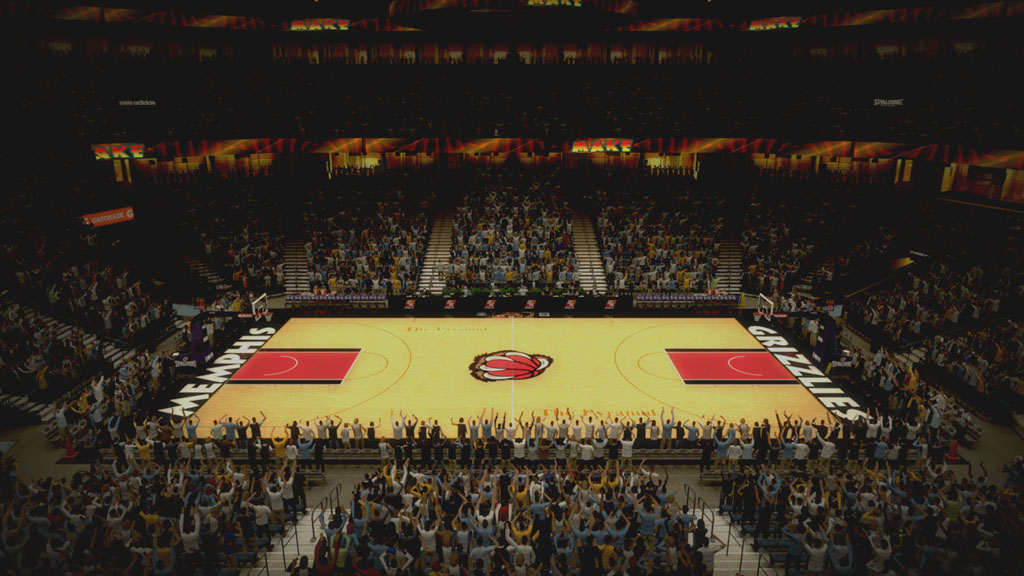
In 1993, the Pyramid hosted the men's and women's basketball tournaments for the Great Midwest Conference. It hosted the Southeastern Conference's men's tournament in 1994 and 1997, Conference USA's men's tournament in 1996 and 2000, CUSA's women's tournament in 2003, NCAA men's tournament games in 1995, 1997 and 2001; and the Memphis Pharaohs of the Arena Football League in 1995 and 1996. In 2002, Lennox Lewis knocked Mike Tyson out there.

The Grizzlies are one seriously messed-up franchise. Their failure in Vancouver can be explained by playing at the same time as a hockey team in Canada. (In contrast, soccer's Vancouver Whitecaps play the other time of the year, and are doing well.) But while the Pyramid was designed to lure an NBA team to Memphis, it was considered unsuitable for 81 games a year. So a new arena was built in 2004, the FedEx Forum. The University of Memphis also moved from the Pyramid to the Forum.

Still, despite being the only major league team in town, the Grizzlies have not done well, either at the box office or on the court. Only once have they ever made the Conference Finals, in 2013, and they got swept. But they won't move, because they're all Memphis has got at the major league level. Like Nashville, their baseball team is Class AAA. And the NFL, the NHL and MLS have chosen Nashville over Memphis. It does seem to make sense, as Nashville is the larger city, with (according to the 2020 Census) 689,000 people to Memphis' 633,000, and a metropolitan area with 2.1 million people to Memphis' 1.3 million.

The Pyramid went dark after the Grizzlies and the Tigers left. In 2005, a plan was put forward to convert it into a retail complex, headed by a Bass Pro Shops store, but it took until 2010 to get it approved and for construction to start. Until then, it was unusable, an embarrassing "white elephant" for one of America's greatest cities.
Finally, the complex opened in 2015. There's also restaurants, a bowling alley, and an aquarium. It gets 3 million visitors a year.

UPDATE: The Grizzlies don't yet have a team Hall of Fame. They have retired 3 numbers: 9, for 2010-17 guard Tony Allen; 33, for 2008-19 center Marc Gasol; and 50, for 2009-17 forward Zach Randolph. They have also honored 1995-2005 broadcaster Don Poier with a banner; and announced that they will retire 11 for 2007-19 guard Mike Conley Jr. when he retires as a player.

Carter has also played for the Grizzlies, 2014-17. Gasol's brother, forward Pau Gasol, played for them 2001-08. Guard Allen Iverson played 3 games for them in 2009. Hubie Brown was their head coach, 2002-04. And Jerry West was their general manager, 2002-07. All have been elected to the Basketball Hall of Fame. None were involved with them in Vancouver.

Thus far, Zach Randolph is the only Grizzlies figure elected to the Tennessee Sports Hall of Fame.

*

November 9, 1991 was a Friday. Actor Anthony Ramos was born.

Baseball season was over. These were among the college football games played:

* Number 1 Florida State beat South Carolina, 38-10 at Doak Campbell Stadium in Tallahassee, Florida.

* Number 2 Miami beat West Virginia, 27-3 at the Orange Bowl stadium in Miami. The next week, they played Number 1 Florida State, one of their major rivals. Oddly, I don't remember it being promoted as "The Game of the Century." Miami won, as Florida State missed a field goal on the last play of the game. The same thing happened between the teams the next year. The games became known as "Wide Right I" and "Wide Right II," respectively, and each one cost the Seminoles a shot at the National Championship. Each time, the Hurricanes kept theirs.

Not yet members of the Atlantic Coast Conference, Florida State accepted a berth in the Cotton Bowl. Miami accepted a berth in the Orange Bowl game, on their home field.

* Number 3 Washington beat USC, 14-3 at the Los Angeles Memorial Coliseum. Washington won the Pacific-10 Conference title, and received the accompanying berth in the Rose Bowl.

* Number 4 Michigan beat Northwestern, 59-14 at Michigan Stadium in Ann Arbor. Michigan won the Big Ten Conference title, and received the accompanying berth in the Rose Bowl, where they lost to Washington.

Both Washington and Miami were 12-0. The National Championship vote couldn't have been much closer: The Associated Press (AP), the poll of college football writers, gave Miami the title by 4 votes; while United Press International (UPI), the poll of college football coaches, gave Washington the title by 9 votes. This split poll was one of the pushes forward the idea of a Playoff needed.

* Number 5 Notre Dame were upset by Number 13 Tennessee, 35-34 at Notre Dame Stadium in South Bend, Indiana. Despite losing again to Penn State the next week, the Fighting Irish were invited to the Sugar Bowl, where they beat Florida.

* Number 6 Florida beat Number 23 Georgia, 45-13 at the Gator Bowl in Jacksonville, the neutral site for their rivalry, "The World's Largest Outdoor Cocktail Party." Florida went on to win the Southeastern Conference title, and accepted the accompanying bid to the Sugar Bowl, where they lost to Notre Dame.

* Number 7 University of California beat Oregon State, 27-14 at Parker Stadium (now Reser Stadium) in Corvallis, Oregon. Cal had already blown the Pac-10 title by losing to Washington, but they did go to the Florida Citrus Bowl, where they beat Clemson.

It was a typically wretched season for Oregon State, as they went 0-10, but they ended it in the best way possible, going to Eugene and upsetting arch-rival University of Oregon. They weren't much better, going in at 3-7. Cliché Alert: In this game, you can throw out the records.

* Number 8 Alabama beat Louisiana State University (LSU), 20-17 at Tiger Stadium in Baton Rouge, Louisiana. The Crimson Tide had already blown the SEC title by getting embarrassed by Florida, 35-10, but that would be their only loss. They beat Colorado in the Blockbuster Bowl.

* Number 9 Penn State beat Maryland, 47-7 at Memorial Stadium in Baltimore. Penn State went to the Fiesta Bowl, where they beat Tennessee.

* Number 10 Iowa beat Number 25 Indiana, 38-21 at Kinnick Stadium in Iowa City. The Hawkeyes had already blown the Big 10 title by getting embarrassed by Michigan, 43-24, but that would be their only loss. They were invited to the Holiday Bowl, where they played Brigham Young University (BYU) to a 13-13 tie.

* Number 11 Nebraska beat Kansas, 59-23 at Memorial Stadium in Lawrence, Kansas. Nebraska won the Big 8 Conference title, and received the accompanying berth in the Orange Bowl. But, at least for a little longer, Miami had Nebraska's number, and it was not 1.

* Number 12 Texas A&M beat Texas Christian University (TCU), 44-7 at Amon G. Carter Stadium in Fort Worth, Texas. A&M won the Southwest Conference title, and accepted the accompanying bid to the Cotton Bowl, where they lost to Florida State.

* Number 18 North Carolina State were upset by Number 24 Virginia, 42-10 at Carter-Finley Stadium in Raleigh, North Carolina.

* Number 22 UCLA were upset by Stanford, 28-10 at Stanford Stadium outside San Francisco in Palo Alto, California.

* Air Force beat Army, 25-0 at Falcon Stadium in Colorado Springs, Colorado; while Navy lost to Tulane, 34-7 at the Superdome in New Orleans.

* And New Jersey's team, Rutgers, lost to the University of Pittsburgh, 22-17 at Pitt Stadium in Pittsburgh.

There were 10 games in the NBA, none of them, of course, in Memphis:

* The New York Knicks beat the Charlotte Hornets, 118-113 at Madison Square Garden.

* The New Jersey Nets lost to the Detroit Pistons, 110-100 at the Brendan Byrne Arena at the Meadowlands.

* The Golden State Warriors beat the Washington Bullets, 127-119 at the Capital Centre in the Washington suburb of Landover, Maryland. Chris Mullin led all scorers on the day with 38 points.

* The Atlanta Hawks beat the Miami Heat, 97-93 at The Omni in Atlanta. Dominique Wilkins scored 34 points.

* The Milwaukee Bucks beat the Dallas Mavericks, 111-95 at the Bradley Center in Milwaukee.

* The Chicago Bulls beat the Orlando Magic, 107-76 at the Chicago Stadium.

* The Houston Rockets beat the Phoenix Suns, 96-95 at The Summit in Houston. (It's now the Central Campus of televangelist Joel Osteen's Lakewood Church.)

* The Utah Jazz beat the Los Angeles Clippers, 101-84 at the Salt Palace in Salt Lake City, Utah. Karl Malone scored 31 points.

* The Minnesota Timberwolves beat the Sacramento Kings, 84-80 at the Arco Arena in Sacramento.

* And the Seattle SuperSonics beat the Indiana Pacers, 118-111 at the Seattle Center Coliseum.

There were 7 games played in the NHL:

* The New York Islanders lost to the San Jose Sharks, 4-3 at the Cow Palace outside San Francisco in Daly City, California.

* The New Jersey Devils lost to the Boston Bruins, 4-0 at the Boston Garden.

* In an "Original Six" matchup, the Montreal Canadiens beat the Chicago Blackhawks, 4-2 at the Montreal Forum.

* The Calgary Flames beat the Toronto Maple Leafs, 6-1 at Maple Leaf Gardens in Toronto.

* The Pittsburgh Penguins beat the Minnesota North Stars, 3-2 at the Metropolitan Sports Center in the Minneapolis suburb of Bloomington, Minnesota.


* The Hartford Whalers beat the St. Louis Blues, 4-3 at the St. Louis Arena.

* The Edmonton Oilers and the Los Angeles Kings played to a tie, 4-4 at The Forum outside Los Angeles in Inglewood, California.

And in New Jersey high school football, my Alma Mater, East Brunswick, beat Perth Amboy, 26-6 at Jay Doyle Field in East Brunswick.

Wednesday, September 28, 2022

September 28, 1962: Booker T. & The M.G.’s Release “Green Onions”

Left to right: Donald Dunn, Booker T. Jones,
Steve Cropper & Al Jackson Jr.

September 28, 1962: Booker T. & The M.G.'s release the instrumental "Green Onions." All 4 members of the M.G.'s, short for "Memphis Group," were credited as the song's writers: Black organist Booker T. Jones, white guitarist Steve "the Colonel" Cropper, white bass guitarist Lewie Steinberg, and black drummer Al Jackson Jr., a.k.a. "the Human Timekeeper."

Why call it "Green Onions"? Somebody said in the studio that the track was "funky," and they debated what was the smelliest thing they could think of. Somebody thought of green onions. As Stan Freberg put it in his "Christmas Dragnet" novelty record a decade earlier, "Some people call them green onions, but they're really scallions."

The fact that the M.G.'s were split right down the middle, black and white, was almost unheard of in those days, especially in the South. But, along with the Memphis Horns, they played on just about every hit to come out of Memphis' Stax Records, including "Soul Man" by Sam & Dave, with Sam Moore memorably yelling over a Cropper guitar lick, "Play it, Steve!"

In 1965, Steinberg left the group, and was replaced with white bassist Donald "Duck" Dunn. Jackson was shot and killed in 1975, and the suspect gunman was subsequently killed in a shootout with the police.

In 1978, The M.G.'s, with black drummer Willie Hall replacing Jackson, and the Memphis Horns were hired as The Blues Brothers' band on NBC's Saturday Night Live, and also backed them in their 1980 film. In 1992, they were elected to the Rock and Roll Hall of Fame. That same year, they were the "house band" for the Bob Dylan tribute concert at Madison Square Garden.

Dunn died in 2012, Steinberg in 2016. As of September 28, 2022, Jones, Cropper and Hall are still alive.

UPDATE: Cropper died in 2025.

*

September 28, 1962 was a Friday. Grant Fuhr, the goaltender for the Edmonton Oilers' dynasty of the 1980s, and the 1st black player elected to the Hockey Hall of Fame, was born on this day.

One college football game was played that night: Alabama, ranked Number 1 in the nation, beat Tulane, 44-6 at Tulane Stadium in New Orleans.

And these baseball games were played:

* The New York Yankees beat the Chicago White Sox, 7-3 at Yankee Stadium. The Yankees scored 2 runs in the 7th inning and 4 in the 8th, all off ChiSox starter Early Wynn, to make a winning pitcher out of Tex Clevenger in relief of Jim Bouton. I guess Bouton didn't smoke them inside. (Ball Four reference.)

Roger Maris, Dale Long and rookie Joe Pepitone hit home runs. Mickey Mantle went 0-for-3 with a walk. Yogi Berra went 1-for-2 after pinch-hitting for Elston Howard, who also went 1-for-2.

* The New York Mets lost to the Chicago Cubs, 3-2 at Wrigley Field in Chicago. Ernie Banks went 0-for-3. Only 595 paying customers came out on a Friday afternoon to see the Cubs advance to 58-102, and the expansion Mets fall to 39-119. They would finish 59-103 and 40-120, respectively, with the Mets having 2 games they never made up. Those 120 losses were the most in the 20th Century. (UPDATE: They would remain the most losses in a Major League Baseball season between 1899 and 2024.)

* The Cincinnati Reds beat the Philadelphia Phillies, 7-3 at Crosley Field in Cincinnati. Frank Robinson went 0-for-3, but was hit by a pitch. He actually had, statistically speaking, a better season than the year before, when he was named the National League's Most Valuable Player. Willie Mays had an even better year, helping the Giants win the Pennant, as Robinson had done with the Reds the year before. But the MVP went to Maury Wills of the 2nd-place Dodgers, because of his unprecedented 104 stolen bases.

* The Detroit Tigers were leading the Kansas City Athletics, 7-3 at Tiger Stadium, after 7 innings, when the game was called due to rain. Al Kaline and Rocky Colavito hit home runs.

* The Pittsburgh Pirates beat the Milwaukee Braves, 8-2 at Milwaukee County Stadium. Hank Aaron did not play. Nor did Roberto Clemente, and rookie Willie Stargell went 0-for-5. He got better.

* The Minnesota Twins beat the Baltimore Orioles, 11-5 at Metropolitan Stadium in the Minneapolis suburb of Bloomington, Minnesota. Brooks Robinson went 1-for-3 with a walk. Harmon Killebrew went 1-for-3 with 2 walks.

* The St. Louis Cardinals beat the Los Angeles Dodgers, 3-2 at Dodger Stadium in Los Angeles. Charlie James singled Bobby Smith home with the winning run in the top of the 10th inning. Smith was pinch-running for Stan Musial, who, approaching his 42nd birthday, went 2-for-5 with an RBI. Larry Jackson went the distance for the win. Duke Snider drew a walk as a pinch-hitter.

* The Boston Red Sox and the Washington Senators were rained out at Fenway Park in Boston. The game was made up as part of a doubleheader the next day. The Senators won the opener, 3-1. The Red Sox won the nightcap, 3-1, on a walkoff home run by Don Gile. Over the 2 games, Carl Yastrzemski went 2-for-6 with a walk.

* The Houston Colt .45s and the San Francisco Giants were rained out at Candlestick Park in San Francisco. The game was made up as part of a doubleheader the next day. The Giants won the 1st game, 11-5. The Colts (who became the Astros in 1965) won the 2nd game, 4-2. Over the 2 games, Willie Mays went 0-for-7, with 2 walks.

As in 1951, on the other coast, the Giants were making a big comeback to catch the Dodgers, and would beat them in a Playoff for the Pennant, before losing to the Yankees in the World Series.

* And the Cleveland Indians and the Los Angeles Angels were rained out at Cleveland Municipal Stadium. Since the next day, Saturday, already had a rain-forced doubleheader scheduled, this game was moved to the final day, Sunday. The Indians swept, 4-3 and 6-1.

Tuesday, August 16, 2022

August 16, 1977: Elvis Presley Dies

August 16, 1977: Elvis Presley dies at his home, Graceland, on the south side of Memphis, Tennessee. He had a massive heart attack, brought on by years of a rotten diet and massive prescription drug use. The man known as the King of Rock and Roll was only 42 years old.

Graceland Farms was owned by Stephen Toof, who ran a commercial printing firm. He named it for his daughter, Grace. She inherited the property from him in 1894, and after her death, it went to her niece, Ruth Moore. Her husband, Thomas Moore, built a mansion on the site in 1939.

Elvis bought it in 1957, after seeing the house he'd bought for himself and his parents in a nice section of Memphis besieged by fans. The house on the Graceland property was well back of U.S. Route 51, providing protection from the public. The address was 3764 Bellevue Boulevard, in the Whitehaven section of Memphis, and it's actually closer to the Mississippi State Line (4 miles) than it is to downtown (7 miles). In 1972, while Elvis was still alive, the City renamed the road Elvis Presley Boulevard.

Elvis had begun taking amphetamines while serving in the U.S. Army in 1958. This led to sleeping pills to counter the effects, and later diet pills in a vain attempt to control his weight.

He concluded a tour at the Market Square Arena in Indianapolis on June 26, and was preparing to fly out of Memphis on August 16, to start a new tour the next night. As rich as he seemed, as it turned out, he needed the money. Elvis had a huge entourage, including family members such as his father; and his manager, "Colonel" Tom Parker, was taking far too much of his earnings.

Divorced from his only wife, formerly Priscilla Beaulieu, he was now dating actress Ginger Alden, who was living with him at Graceland. At the peak of his fame, at a shade over 6 feet, he weighed about 170 pounds. Now, he was more than twice that.

That afternoon, he was in the master bedroom with Ginger, and he told her, "Precious, I'm going to go into the bathroom, and read." A few minutes later, Ginger heard a sound come from the bathroom. Elvis had fallen off the toilet, his various maladies and prescriptions having combined to give him a heart attack. He was taken to Baptist Memorial Hospital, and was pronounced dead at 3:30 PM Central Time (4:30 Eastern).

Under Priscilla's leadership, Colonel Parker lost control of Elvis' estate, and it made more money in the 1st 3 years after his death than he made in the 42 years that he was alive. Graceland is not just the most-visited former private home in America: It has become a theme park, with the house and the Meditation Gardens -- final resting place of Elvis and various relatives -- and a hotel on the east side of Elvis Presley Boulevard, and various Elvis-related items on the west side, including restaurants named for his parents: Vernon's Smokehouse and Gladys' Diner. There's also an Elvis-themed Automobile Museum, and "Elvis Presley's Memphis," an exhibit about the city during his lifetime.

*

August 16, 1977 was a Tuesday. Football, basketball and hockey were out of season. There were Major League Baseball games were played on that day, including the New York Yankees playing the Chicago White Sox at Yankee Stadium.

When ESPN made its miniseries about the 1977 Yankees, The Bronx Is Burning, it included this exchange, between Mather Zickel, playing Lou Piniella, and Leonard Robinson, playing Mickey Rivers -- keeping in mind, this was 3 years before John Lennon was shot and killed in New York:

Lou: Presley's dead!
Mickey: Who?
Lou: Elvis Presley! I just heard it on the radio.
Mickey: Somebody shot him?
Lou: No, nobody shot him!
Mickey: Well, what, then? Heart attack? 'Cause, I heard, for a superstar, he had a pretty poor diet.
Lou: No, they're saying, drugs, or something.
Mickey: Well, that just goes to show you.
Lou: Goes to show you what?
Mickey: Well, hell if I know, but it must go to show you something!

And then the Yankees took the field, and played what may have been their craziest game of the year. They led 2-0 after 2 innings, saw the ChiSox tie it in the 4th, took a 4-2 lead in the 5th, saw the ChiSox tie it in the top of the 7th, took a 5-4 lead in the bottom of the 7th, extended it to 9-4 in the 8th, and then the ChiSox exploded for 6 runs in the top of the 9th to make it 10-9. Future Yankee Jim Spencer had hit 2 home runs for the Pale Hose, while Roy White had hit one for the Pinstripes.

Cliché Alert: Walks can kill you, especially the leadoff variety. Thurman Munson led off the bottom of the 9th with a walk. Piniella hadn't started the game, but manager Billy Martin put him in as a pinch-runner for Reggie Jackson, who had gone 1-for-3, and kept him in right field for Reggie. Lou bunted Thurman over. This turned out to be unnecessary, as the next batter, Chris Chambliss, hit a walkoff home run.

The day Elvis died was the day that the Baby Boomers realized that they weren't kids anymore. The day Yankee legend Mickey Mantle died, 18 years later to the week, was the day the Baby Boomers had to accept that they were now old.

As for the other games played that day:

* The New York Mets beat the St. Louis Cardinals, 5-1, at Busch Memorial Stadium in St. Louis. Of the 4 players the Mets had gotten in the Tom Seaver trade on June 15, Steve Henderson and Doug Flynn each had 3 hits, and Pat Zachry went the distance for the win, while Dan Norman did not play. For the Cards, Lou Brock went 0-for-4.

* The Philadelphia Phillies beat the Montreal Expos 7-5 at the Olympic Stadium in Montreal. The Phils scored 5 runs in the top of the 8th to win it. Mike Schmidt went 2-for-4 with an RBI.

* The Boston Red Sox beat the Kansas City Royals, 5-3 at Fenway Park in Boston. George Brett did not play. Butch Hobson hit a home run, and Carl Yastrzemski went 0-for-3 with a walk.

* The Baltimore Orioles beat the Minnesota Twins, 6-5 at Memorial Stadium in Baltimore. Lee May hit a home run for the O's, and Doug DeCinces singled home eventual Rookie of the Year Eddie Murray in the bottom of the 13th inning.

* The Houston Astros beat the Atlanta Braves 4-1 at Atlanta-Fulton County Stadium.

* The California Angels 7 beat the Toronto Blue Jays, 7-2 at Exhibition Stadium in Toronto.

* The Oakland Athletics beat the Cleveland Indians 7-3 at Cleveland Municipal Stadium.

* The Cincinnati Reds beat the San Diego Padres 5-1 at Riverfront Stadium in Cincinnati. The aforementioned Tom Seaver went the distance for the win, and the Reds got home runs from Pete Rose and Dan Driessen. Rose and Johnny Bench each went 1-for-4.

* The Seattle Mariners beat the Detroit Tigers, 3-2 at Tiger Stadium in Detroit.

* The Chicago Cubs beat the Pittsburgh Pirates, 6-5 at Wrigley Field in Chicago. Bill Robinson hit 2 home runs for the Pirates. Willie Stargell did not play. Gene Clines singled home the winning run in the bottom of the 15th inning.

* The Texas Rangers beat the Milwaukee Brewer,s 11-3 at Milwaukee County Stadium.

* And the Los Angeles Dodgers beat their arch-rivals, the San Francisco Giants, 3-2 at Dodger Stadium in Los Angeles.

Friday, July 15, 2022

July 15, 1914: W.C. Handy Records "The Saint Louis Blues"

July 15, 1914: W.C. Handy Records "The Saint Louis Blues," a landmark in recording the blues, a uniquely American art form.

William Christopher Handy was born on November 16, 1873 in Florence, Alabama, in a log cabin built by his grandfather. His father and said grandfather were both ministers in the African Methodist Episcopal Church (AME). His father believed musical instruments were the tools of the Devil, but William learned to play the guitar and the cornet. 

In his autobiography, titled after a nickname he did not give himself, Father of the Blues, he cited as inspiration the "whippoorwills, bats and hoot owls and their outlandish noises," Cypress Creek washing on the fringes of the woodland, and "the music of every songbird and all the symphonies of their unpremeditated art." But he also cited his own people: "Southern Negroes sang about everything... They accompany themselves on anything from which they can extract a musical sound or rhythmical effect."

In 1893, a quartet he formed performed at the World's Columbia Exhibition, a World's Fair in Chicago. He eventually toured in Cuba, Mexico and Canada. In 1896, he married Elizabeth Price, and they had 6 children.

He is best known for 2 songs with "blues" and a city's name in the title. In 1909, he wrote "The Memphis Blues," which became the campaign song for the election of Mayor of Edward Crump, despite Crump being a white segregationist, and on his way to running the Democratic Party of Tennessee into corruption.

Sheet music for "The Memphis Blues" was published in 1912, and was said to be the inspiration for the invention of the Foxtrot by the married dancers Vernon and Irene Castle. Along with the Castles, Handy had become a national star.

In 1914, he wrote "The Saint Louis Blues" -- with "Saint" spelled out on the sheet music, not abbreviated as "St." He wrote:

The one-step and other dances had been done to the tempo of "Memphis Blues."... When "St Louis Blues" was written the tango was in vogue. I tricked the dancers by arranging a tango introduction, breaking abruptly into a low-down blues. My eyes swept the floor anxiously, then suddenly I saw lightning strike. The dancers seemed electrified. Something within them came suddenly to life. An instinct that wanted so much to live, to fling its arms to spread joy, took them by the heels.

He also wrote and recorded "Atlanta Blues," but it was not as big of a hit as his Memphis and St. Louis songs. In 1916, he had another Memphis-themed song, "Beale Street Blues," which was a hit. "Yellow Dog Blues," from 1912, was a big hit, and was even mentioned in Bobby Darin's 1958 hit song "Queen of the Hop."

He moved to New York, and was able to live off his music royalties, so that live performing was a pleasure, not a need. In 1929, an early sound film was titled St. Louis Blues. Handy produced it, but did not appear in it. Bessie Smith did, as "The Saint Louis Blues" was the song that introduced "The Empress of the Blues" to the world. It is believed to be her only film appearance.

In 1943, Handy fell off a Subway platform, and, although he was not hit by a train, he went blind as a result of the fall. His family moved him to nearby Yonkers, New York. In spite of his impairment, in 1949, he played "The Saint Louis Blues" on Toast of the Town, the show that became The Ed Sullivan Show.

He died on March 28, 1958, of bronchial pneumonia, at the age of 84, and was buried in Woodlawn Cemetery in New York, where Vernon Castle, Bert Williams and Florence Mills had been buried. They would eventually be joined by Irene Castle, Fritz Kreisler, Duke Ellington, Milt Jackson, Irving Berlin, Miles Davis, Lionel Hampton, Max Roach, Scott La Rock, Celia Cruz, Ornette Coleman, Coleman Hawkins and Diahann Carroll -- and that's just from the world of music.

Handy did not quite live to see the premiere of a film based on his life, St. Louis Blues, which came on April 10, 1958. He was played by Nat King Cole. Ella Fitzgerald played herself. The film also starred Eartha Kitt, Cab Calloway, Mahalia Jackson, Ruby Dee, Pearl Bailey, and, as Handy as a boy, future rock and roll star Billy Preston.

New York City renamed West 52nd Street between 6th and 7th Avenues "W.C. Handy Place." West 52nd had previously been nicknamed "Swing Street" for all the music clubs along it. Billy Joel titled a 1978 album 52nd Street in tribute.

In 1967, 2 major league sports teams were established, taking their names from African-American music: The St. Louis Blues of the National Hockey League, and the New Orleans Saints, from "When the Saints Go Marching In," of the National Football League.

*

July 15, 1914 was a Wednesday. There were 3 major leagues in baseball that year. In the American League:

* The New York Yankees split a doubleheader with the Chicago White Sox at the Polo Grounds. The ChiSox won the opener, 3-2. The Yankees were leading the nightcap, 2-1 after 8 innings, when the umpires called the game due to darkness.

* The Boston Red Sox beat the Cleveland Naps, 4-0 at Fenway Park in Boston. Hubert "Dutch" Leonard pitched a 7-hit shutout. In their last year with Napoleon "Nap" Lajoie as their 2nd baseman, best hitter, manager and namesake, the team that became the Indians the next season couldn't score, even with Lajoie himself singling as a pinch-hitter. Babe Ruth, who had made his major league debut with the Red Sox 4 days earlier, did not appear in this game. Nor did "Shoeless" Joe Jackson, then with Cleveland.

* The Washington Senators and the Detroit Tigers were tied, 3-3 at American League Park (later Griffith Stadium) in Washington, when the game was called due to darkness. Neither team's signature player, Walter Johnson of the Senators or Ty Cobb of the Tigers, appeared in this game.

* And the Philadelphia Athletics and the St. Louis Browns were rained out at Shibe Park in Philadelphia. The game was made up as part of a doubleheader on August 25. The A's swept, 9-0 and 1-0. Rube Bressler pitched a 3-hit shutout in the 1st game, and Herb Pennock pitched a 6-hit shutout in the 2nd game.

In the National League: 

* The New York Giants lost to the Chicago Cubs, 5-4 at the West Side Grounds in Chicago. The Cubs scored 3 runs in the bottom of the 9th to win it.

* The Cincinnati Reds beat the Philadelphia Phillies, 6-4 at Redland Field (later renamed Crosley Field) in Cincinnati.

* The Brooklyn Robins lost to the Pittsburgh Pirates, 4-3 at Forbes Field in Pittsburgh. This was the once-and-future Dodgers' 1st year with Wilbert Robinson as their manager, and they were named the Robins for him as long as he was with them, through the 1931 season, after which they became the Dodgers again. Zack Wheat went 0-for-3 for them. Honus Wagner went 0-for-4 for the Pirates.

* And the St. Louis Cardinals beat the Boston Braves, 5-3 at Robison Field in St. Louis.

And 1914 was the 1st of 2 seasons for the Federal League:

* The only team the FL had in New York City, the Brooklyn Tip-Tops, beat the Pittsburgh Rebels, 4-2 at Exposition Park, former home of the Pirates, which stood roughly where PNC Park does now. 

* The Indianapolis Hoosiers beat the Kansas City Packers, 5-3 at Gordon & Koppel Field in Kansas City. The Hoosiers went on to win the Pennant.

* The Buffalo Blues swept a doubleheader from the Baltimore Terrapins, 7-0 and 4-0 at at the International Fair Association Grounds in Buffalo. Earl Moore pitched a 4-hit shutout in the 1st game, and Fred Anderson pitched a 3-hit shutout in the 2nd game.

* The St. Louis Terriers beat the Chicago Whales, 2-0 at Weeghman Park in Chicago, the ballpark that would be adopted by the Cubs and eventually renamed Wrigley Field. Mordecai "Three-Finger" Brown, the former Cubs ace, returned to the city of his greatest deeds, and pitched a 4-hit shutout for the Terriers.

Tuesday, July 5, 2022

July 5, 1954: Elvis Presley's 1st Recording Session

July 5, 1954: Elvis Presley makes his 1st professional recording, a cover of "That's All Right" by Arthur "Big Boy" Crudup.

At the time, Elvis was a 19-year-old kid with a high school education, driving a truck for Crown Electric Company of Memphis, Tennessee, where he and his family, previously from Tupelo, Mississippi, had lived since he was 13.

He wanted to be a singer. He admired gospel singers, both white and black. He admired rural singers, both white men singing "country and western music" and black men singing "the blues." He admired pop singers, in particular Dean Martin, one of the biggest stars in America in 1954.

Elvis wasn't especially ambitious -- not yet, anyway. He just wanted to make enough money to get himself and his parents, Vernon and Gladys, out of poverty. He had been born in what was known as a "shotgun shack," and now they were living in what we in the Northeast would charitably call "garden apartments," but, though all-white, as Tennessee was very much racially segregated, it was definitely a ghetto.

So Elvis did have an ambition, if not an especially big one. What he needed was someone to recognize his talent.

*

In 1950, Sam Phillips opened the Memphis Recording Service, at 706 Union Avenue. It was a studio, not a company producing records. In 1951, he produced "Rocket 88," credited to Jackie Brenston and His Delta Cats. This was an all-black band playing what was then being called "race music," but would soon be called "rhythm and blues," or "R&B." (In contrast, people began calling "Country and Western" music "C&W.")

In fact, the band was actually Ike Turner and His Kings of Rhythm, for whom Brenston was the lead singer. Yes, that Ike Turner, the one who later discovered, trained, renamed, married and abused Tina.

There is dispute as to what was "the first rock and roll record." "Rocket 88" is a frequently-named contender, and it was soon recorded by a white band, The Saddlemen, and became a minor hit. The leader and lead singer of The Saddlemen was Bill Haley, who named his next band The Comets, and helped move the music that Cleveland disc jockey Alan Freed had named "rock and roll" forward tremendously.

The Brenston version of "Rocket 88" made Phillips enough money to found a record label for his studio, Sun Records. Some of the biggest names in Memphis, already a great music city, black and white alike, came to him to record. Sam didn't care: The only color he cared about was green. Money.

Sam was ambitious. He said, "If I can find me a white boy who can sing like a black man, I could make a billion dollars." He really did say, "billion," with a B. To put that in perspective: With inflation factored in, $1 billion in 1954 would be worth about $10.9 billion in 2022. We're not quite talking Bill Gates money, but we are talking money that, to that point, very few Americans had reached. The Rockefellers. The Fords. The Mellons. Maybe a few other families.
And Sam was careful in his terminology. Not because he was tired of hearing grown men called "boy" because they were black (although that may also have been true), but because he thought it would be easier to sell records made by a white teenager who had the voice and feeling -- it would later be called "soul" -- of a mature black man.

So Sam had an especially big ambition. What he needed was someone to fulfill it.

*

This is not 1954. Most of you have heard of Elvis Presley. Some of you, but far fewer, have heard of Sam Phillips. That is unfortunate, given the jumpstart Sam gave to rock and roll. Even fewer of you have heard of Arthur "Big Boy" Crudup. And that is a tragedy.

Crudup was born in Mississippi in 1905. By 1939, he was barely getting by as a street singer, when he was discovered. Over the 1940s, he had a few hits with his blues songs. One, recorded in 1946, was "That’s All Right." This song became popular in the South, with both black bluesmen and white country singers. In 1954, it became the 1st song professionally recorded by Elvis. Elvis later recorded another of Crudup' songs at Sun Records, "My Baby Left Me."
By the time Elvis started recording, Crudup had stopped, because he wasn’t getting his royalties: "I realized I was making everybody rich, and here I was, poor.” He died in 1974, at 68, having won a case in court, but getting very little of what he was now legally owed. Today, when he is remembered at all, it is for writing Elvis’ first song.

*

On July 18, 1953, Elvis went to the Memphis Recording Service, because he wanted to hear how he sounded. This was the equivalent of making an audition tape. He paid $3.98, about $43.57 in today's money. About half a day's pay. This allowed him to record a two-sided record.

One side was "My Happiness." Written in 1933, it didn't become a hit until 1948, when Ella Fitzgerald recorded it. It became a hit again in 1958, for Connie Francis.

The other side was "That's When Your Heartaches Begin." Written in 1937, it became a hit in 1941, when it was recorded by the all-black vocal group The Ink Spots. After becoming famous, Elvis would record a much more professional version, which in 1957 became the B-side to "All Shook Up."

So Elvis recorded these 2 songs. Nothing happened: Sam didn't notice either recording. On January 4, 1954, Elvis went back to Sun, and recorded a 2nd acetate: Hy Heath's "I'll Never Stand in Your Way" and Fred Rose's "It Wouldn't Be the Same Without You." Still, nothing happened. At some point, Elvis made another recording, a 1918 song by Nora Bayes titled "Without You." (Not to be confused with "It Wouldn't Be the Same Without You," or with the later Harry Nilsson song titled "Without You.")

On May 26, Sam heard that record, and bought it for a quarter -- with inflation, probably the best $2.72 anybody's ever spent. But the name of the singer wasn't on it. He took it back to Sun, and played it for his assistant, Marion Keisker. She recognized the voice as "the young truck driver." They checked their records (books, not platters), and found Elvis. Marion called him, and said Sam wanted him to come down.

On the 4th of July, Sam took Elvis to the home of Winfield Scott "Scotty" Moore, a local guitarist, and, backed by Moore and standup bass fiddle player Bill Black, auditioned him. Neither Scotty nor Bill was especially impressed with Elvis, but they agreed to meet at the Sun studio the next day, to see what they could do.

The first song they tried was "I Love You Because," written in 1949 by country singer Leon Payne, and a hit for pop singer Eddie Fisher in 1952. They weren't impressed. They tried a few other country songs, but nothing worked. So they took a break.

Elvis and Bill stayed in the room, while Sam and Scotty went into another room to smoke and talk. Bored, Bill started playing around with his bass. Elvis started mimicking it on his guitar. Apparently, it reminded him of "That's All Right," because that's what he started singing. Sam heard it: Here was a white kid singing a black man's song, and it felt real, not faked. A tribute, not a mockery.

Sam had found his white boy. Scotty went back in, and a proper recording of the song was made. They also recorded "Blue Moon of Kentucky" by Bill Monroe, the fiddler (violinist) who invented bluegrass music.

Three days later, Sam took the record to Dewey Phillips (no relation), a disc jockey at WHBQ in Memphis. (It was at 560 on the AM dial. It's now an all-sports station.) Dewey played it. Within a week, Sun had 6,000 advance orders for "That's All Right." It was released on July 19.

Elvis started playing live dates with Scotty and Bill, each of them getting 25 percent of his earnings. Sun would release 5 double-sided singles for Elvis in 1954 and 1955, and his touring from Florida to Texas, especially on the live radio broadcast Louisiana Hayride out of Shreveport, made him one of the biggest draws in the South. He was billed as "The Memphis Flash." People listening to his records and his radio shows couldn't see him jiggling around onstage, but they loved his voice and his personality.

But by November 1955, Sam needed money. He wasn't making the billion dollars. So he sold Elvis' contract to RCA Victor Records for $40,000 -- about $436,000 in today's money. On January 10, 1956, in Nashville, Tennessee, Elvis, Scotty, Bill, additional guitarist Chet Atkins, drummer D.J. Fontana, and pianist Floyd Cramer recorded Elvis' 1st RCA single, "Heartbreak Hotel." It was released nationally 17 days later. When Billboard magazine released its April 21 issue, it listed "Heartbreak Hotel" as the Number 1 song in the country.

Sam no longer had Elvis, and he didn't have the billion dollars. What he did have was the $40,000, enough to record some new performers he wanted to try. These included Carl Perkins, Jerry Lee Lewis, Roy Orbison and Johnny Cash.

Sam never did make his billion dollars, but he made a few million. He actually made more money investing in a new company that had been started in Memphis: The Holiday Inn hotel chain. He was the 1st non-performer inducted into the Rock and Roll Hall of Fame in 1986, happily capitalized off his connection to Elvis, and lived until 2003. He was 80 years old.

Marion Keisker left Memphis in 1957, and enlisted in the U.S. Air Force. She became an information officer, and rose to the rank of Captain. Discharged in 1969, she joined the National Organization for Women. She died in 1989, at 72.

Elvis continued to sing "That's All Right" in his concerts up until his death in 1977. Bill Black died of cancer in 1965. Chet Atkins lived until 2001. Scotty Moore and D.J. Fontana joined Elvis for his 1968 NBC "Comeback Special." Moore lived until 2016, Fontana until 2018.

*

July 5, 1954 was a Monday. This was a big day in rock and roll for another reason. The man believed to be the coiner of the very phrase "rock and roll," disc jockey Alan Freed, had left Cleveland, and, on this night, played his 1st show in New York, on 1010 AM, WINS. From this day onward, thanks in large part to Alan Freed, Sam Phillips and Elvis Presley, the world would never be the same.
Alan Freed

It was the off-season for the NFL, the NBA and the NHL. But a lot of Major League Baseball games were played. Apparently, it wasn't enough that the day before was the 4th of July: Because it was now a common thing to give people the day off on July 5 when the 4th fell on a Saturday, the 5th also saw some doubleheaders. In fact, every matchup on this day was a twinbill:

* The New York Yankees swept the Philadelphia Athletics at Connie Mack Stadium in Philadelphia. The Yankees won the opener 7-4. Harry Byrd, ironically a former A's pitcher, was the winning pitcher. Joe Collins and Mickey Mantle hit back-to-back home runs in the top of the 8th inning.

The Yankees won the nightcap 11-2. Confusingly, the Yankees used pitchers named Tom Morgan (for 6 1/3rd innings) and Tom Gorman. Known as the Plowboy, Morgan had his best season in 1954, going 11-5 with a save. He helped the Yankees win 3 World Series. Irv Noren went 3-for-4 in this game, with 2 homers and 5 RBIs.

After the season, the Mack family sold the A's, and they were moved to Kansas City.

* The New York Giants swept the Philadelphia Phillies at the Polo Grounds. The Giants won the 1st game 10-0. Johnny Antonelli pitched a 3-hit shutout. Davey Williams and Dusty Rhodes hit home runs.

The Jints won the 2nd game 4-3. Ruben Gomez was shaky, and Leo Durocher took him out in the 2nd inning. Hoyt Wilhelm, the knuckleballer who eventually became the 1st relief pitcher elected to the Hall of Fame, ended up as the winning pitcher. Rhodes homered again, and another homer was hit by Willie Mays, who ended up as the biggest reason the Giants went on to win the World Series.

* The Brooklyn Dodgers swept the Pittsburgh Pirates at Forbes Field in Pittsburgh. The Brooks won the opener 8-6. Russ Meyer, "the Mad Monk," was a shaky starter. Ben Wade was even worse, but ended up as the winning pitcher. Vern Law, eventually to be a Cy Young Award winner for the Bucs, was knocked out of the box in the 1st inning. The game wasn't won until the top of the 9th inning, when Walt "Moose" Moryn and Edwin "Duke" Snider hit back-to-back home runs.

Dem Bums won the nightcap 7-2. Billy Loes went the distance, with 11 strikeouts against only 1 walk. Jim "Junior" Gilliam hit a home run. Jackie Robinson drove in a run with a sacrifice fly.

* There was a split at Griffith Stadium in Washington. The Boston Red Sox won the 1st game 14-0. Willard Nixon pitched a 6-hit shutout. Jackie Jensen and Ted Lepcio hit home runs. The Washington Senators won the 2nd game 7-1. Ted Williams got 2 hits in the 1st game, but none in the 2nd game.

* There was a split at Briggs Stadium in Detroit. (It was renamed Tiger Stadium in 1961.) The Cleveland Indians won the 1st game 13-6. The Detroit Tigers won the 2nd game 1-0. Cleveland's Don Mossi and Detroit's George Zuverink both went the distance, 11 innings, ending when Mossi was taken deep by Harvey Kuenn.

* The Cincinnati Reds swept the Chicago Cubs at Crosley Field in Cincinnati. The Reds won the 1st game 6-5. Randy Jackson hit 2 home runs for the Cubs, but Ted Kluszewski had 3 hits including a home run. The game went 10 innings, and an RBI single by Bobby Adams won it. Cincy won the 2nd game 8-7.

* The Chicago White Sox swept the Baltimore Orioles at Comiskey Park in Chicago. The Pale Hose won the 1st game 3-0, as Billy Pierce pitched a 4-hit shutout. The O's pitcher also went the distance. His name was Don Larsen. The ChiSox won the 2nd game 2-1.

* And the Milwaukee Braves swept the St. Louis Cardinals at the original Busch Stadium in St. Louis. (It had been named Sportsman's Park until the year before.) The Braves won the opener 8-6, and the nightcap 10-4. Eddie Mathews hit 2 home runs in the 1st game. Between the 2 games, the Braves' rookie left fielder, Hank Aaron, went 3-for-10 with 2 RBIs, but no home runs.

Tuesday, June 7, 2022

June 7, 1966: The Shooting of James Meredith

June 7, 1966: Civil rights activist James Meredith is shot during his March Against Fear. It is part of the backlash against the successes of the Civil Rights Movement.

One of those successes had been the integration of the University of Mississippi in 1962, by Meredith, with the assistance of President John F. Kennedy federalizing the Mississippi National Guard, making Meredith a civil rights icon and a national figure. He graduated, and went to New York to attend Columbia University School of Law.

On June 6, 1966, in the wake of the Voting Rights Act of 1965, Meredith planned a March Against Fear, from Memphis, Tennessee, to Jackson, the capital of Mississippi, to encourage voter registration. He said he did not want major civil rights organizations involved. He believed he would not be killed, saying, "I had always felt that I could stop a mob with the uplift of a hand, Because of my divine responsibility to advance human civilization, I could not die."

Unlike his predecessor, Ross Barnett, who did everything he could to prevent Meredith from enrolling at "Ole Miss," the current Governor of Mississippi, Paul Johnson, allowed the March, and offered State Police protection.

It didn't work. On the 2nd day, 28 miles into his walk down U.S. Route 51, outside Hernando, Mississippi, Meredith was shot by Aubrey James Norvell, a 40-year-old unemployed member of the Ku Klux Klan. (Apparently, the Klan wasn't willing to find him a job.) Meredith was hit by over 60 shotgun pellets, all over his body. He yelled, "Oh, my God, is anybody going to help me?" They did. He was quickly taken to a hospital, and survived, as his wounds turned out to be superficial.

Martin Luther King of the Southern Christian Leadership Conference, Roy Wilkins of the NAACP, Whitney Young of the Urban League, Stokely Carmichael of the Student Nonviolent Coordinating Committee and Floyd McKissick of the Congress of Racial Equality, all having some measure of differences with each other, united, and went to see Meredith in the hospital. They asked him for permission to carry on the march in his name. He assented, and 20 marchers set out to finish his 220-mile journey.

Just a day out of Jackson, the demonstrators were joined by Marlon Brando, Sammy Davis, Jr., the comedian Dick Gregory, and a recovered Meredith. On June 25, he led the column into the State Capitol.

The demonstrators registered over 4,000 black Mississippians in 18 days. Nevertheless, a 15,000-strong crowd that gathered for a rally in Jackson oh June 26 epitomized the now-overt conflict in the movement. The King faction shouted, "Freedom now!" The faction led by Carmichael and McKissick shouted "Black power!"

The FBI quickly caught Norvell, who pleaded guilty to battery and assault with intent to kill, and was sentenced to 5 years in prison. He served only a year and a half. He died in 2016. True to his belief, Meredith did not die, and, as of June 7, 2022, is still alive, at the age of 89.
King was assassinated in 1968, only 39 years old. Young drowned in 1971, just 49. Wilkins died in 1981, at 80. McKissick died of cancer in 1991, at 69. Carmichael, having adopted the name Kwame Ture and moved to Africa, also died of cancer, in 1998, at 57. Meredith outlived them all.

*

June 7, 1966 was a Tuesday. This was also the day the New York Mets selected Steve Chilcott with the 1st pick in the baseball amateur draft, with the Kansas City Athletics picking Reggie Jackson 2nd. I have a separate entry for that event.

These Major League Baseball games were played:

* The New York Yankees beat the Cleveland Indians, 7-2 at Cleveland Municipal Stadium. Fritz Peterson went the distance for the win. Bobby Richardson and Joe Pepitone hit home runs. Mickey Mantle went 2-for-4 with a walk and 2 RBIs. Roger Maris went 2-for-5 with an RBI.

* The New York Mets lost to the Atlanta Braves, 11-6 at Shea Stadium. Hank Aaron went 2-for-4 with a walk and 2 RBIs. He did not hit a home run for the Braves, but Joe Torre did. Dick Stuart, the power-hitting but horrible-fielding 1st baseman known as "Dr. Strangeglove," homered for the Mets.

* The Philadelphia Phillies beat the Cincinnati Reds, 5-1 at Connie Mack Stadium in Philadelphia. Jim Bunning went the distance, allowing 1 run on 3 hits, no walks and 14 strikeouts. He beat Milt Pappas, whom the Reds had traded Frank Robinson to get. The only Reds run came on a home run by Leo Cárdenas. Pete Rose went 0-for-3.

* The Baltimore Orioles beat the Washington Senators, 6-5 at Memorial Stadium in Baltimore. The Senators scored 2 runs in the top of the 12th inning, but in the bottom half, the O's scored 3, winning on an RBI single by Frank Robinson, who went 4-for-6. Brooks Robinson went 0-for-4 with a walk.

* The Pittsburgh Pirates beat the St. Louis Cardinals, 9-1 at Forbes Field in Pittsburgh. Don Cardwell outpitches Bob Gibson. Roberto Clemente went 3-for-5 with a home run and 3 RBIs. Willie Stargell went 2-for-5. Lou Brock went 1-for-4.

* The Detroit Tigers beat the Boston Red Sox, 2-1 at Tiger Stadium in Detroit. Mickey Lolich outpitched Bob Sadowski. The only Sox run came on a home run by Tony Conigliario. Carl Yastrzemski went 0-for-3 with a walk. Al Kaline went 0-for-3.

* The Los Angeles Dodgers beat the Chicago Cubs, 8-6 at Wrigley Field in Chicago. Fergie Jenkins relieves Bob Hendley in the 5th inning, but gives up back-to-back home runs to Jim Lefebvre and Al Ferrara leading off the top of the 10th. It was Ferrara's 2nd homer of the game. Phil Regan is the winning pitcher, in relief of rookie Don Sutton. Ernie Banks went 2-for-4 with a walk and an RBI.

* The Minnesota Twins beat the Kansas City Athletics, 6-1 at Metropolitan Stadium in the Minneapolis suburb of Bloomington, Minnesota. Harmon Killebrew went 2-for-4.

* The Houston Astros beat the San Francisco Giants, 10-9 at the Astrodome in Houston. Willie Mays doubled, then left the game with an injury. His pinch-runner was Jesús Alou, who went to right field and went 3-for-4 with an RBI, as Ollie Brown moved from right to center.

* And the California Angels beat the Chicago White Sox, 3-2 at Anaheim Stadium (now Angel Stadium of Anaheim).

Friday, April 29, 2022

April 30, 1900: The Legend of Casey Jones

April 30, 1900: Casey Jones saves the people on his train, at the cost of his own life, and becomes an American legend. That's the legend, and that's also the truth. There is more to the truth, however. He was... complicated.

John Luther Jones was born on March 14, 1863 in Cayce, Kentucky. The town's pronunciation, KAY-see, led to his nickname, "Casey." (Just as Charles Dillon Stengel was from Kansas City, and that got shortened to "K.C.," ultimately becoming "Casey.") He had a wife and 3 children, and was believed to have never touched a drop of alcohol.

He worked for the Mobile & Ohio Railroad, and became a brakeman on their route from Columbus, Kentucky to Jackson, Tennessee, outside Memphis. Jackson became his home for the rest of his life. He was promoted to fireman (shoveling coal to put in the fire to power the locomotive) on their route from Jackson to Mobile, Alabama. In 1887, a yellow fever epidemic hit the Illinois Central Railroad hard, opening opportunities, and in 1888, Casey was hired as a fireman on their freight line from Jackson to Water Valley, Mississippi, finally being promoted to engineer in 1891. He was 28, and becoming an engineer so young was unusual.

He was noted for his exceptionally punctual schedules, often saying he would "get her there on the advertised," meaning on schedule. People were known to set their watches by his arrival. But this sometimes had a degree of risk, including those of derailing, crashing into another train, or hitting a person on the track before they could get out of the way of the oncoming train. But from 1891 to 1899, there were no incidents on Casey's trains.

Well, one, a heroic incident. In 1895, he was approaching Michigan City, Mississippi. He had left the cab in charge of fellow engineer Bob Stevenson, who had reduced speed sufficiently for Casey to walk safely out on the running board to oil the relief valves. He advanced from the running board to the steam chest and then to the pilot beam to adjust the spark screen.

He had finished well before they arrived at the station, as planned, and was returning to the cab when he noticed a group of small children dart in front of the train some 60 yards ahead. All cleared the rails easily except for a little girl who suddenly froze in fear at the sight of the oncoming locomotive. Jones shouted to Stevenson to reverse the train and yelled to the girl to get off the tracks in almost the same breath. Realizing that she was still immobile, he raced to the tip of the pilot or cowcatcher and braced himself on it, reaching out as far as he could to pull the frightened but unharmed girl from the rails.

In February 1900, Casey was transferred from Jackson to Memphis, for the passenger run between there and Canton, Mississippi, the 3rd link in the 4-train Illinois Central run from Chicago to New Orleans, in the days before the City of New Orleans (leaving Chicago by morning and arriving in New Orleans at morning, and vice versa, running from 1947 to 1971) and the Panama Limited (a night train at each end, 1911 to 1971) could run the whole way (and before each could be celebrated in song: "The City of New Orleans" in 1971 and "Night Train" in 1951).

On April 29, 1900, already scheduled to make the Memphis to Canton run, he was asked to take over another service through the day, which may have deprived him of sleep. He left Memphis aboard Engine No. 382, known (like many other fast trains of the era) as "The Cannonball," at 12:50 AM on April 30, an hour and 15 minutes late.

But he drove that train hard. By the time he got to Durant, Mississippi, he was only 5 minutes behind, telling his fireman, a black man named Simeon Webb, "Sim, the old girl's got her dancing slippers on tonight!" He thought he could get to Canton "on the advertised" at 4:05 AM.

But at Vaughan -- 172 miles south of Memphis, 225 miles north of New Orleans, and just 16 miles north of his destination of Canton -- there were 3 trains in the station, and 2 were, due to their length, crossing between the passing track and the main line. An air hose broke on one, leaving 4 cars of 1 of the trains on the main line. And Jones and Webb were coming in, only 2 minutes behind schedule, on a left-hand curve that blocked Jones' view from the right side.

Webb saw the red lights ahead, meaning "Stop." He told Casey. Casey told him to jump off, which was pretty dangerous, but better than staying on. He jumped, and was knocked unconscious, but not before he heard Jones blow a long, piercing train whistle to warn anyone still on the freight train ahead.

Casey reversed the throttle and slammed the airbrakes. This could only cut his speed from 70 to 40 miles per hour, before he crashed into the freight cars ahead of him, wrecking some. There were 6 people injured, including Webb. But, between his train, the others, and the people in the station, only 1 person died, and that was Casey Jones. The impact stopped his watch at 3:52 AM -- 13 minutes before he was scheduled to arrive in Canton. Had the tracks been clear, he would have made it. He was 37 years old.

Adam Hauser, a passenger on Casey's train, told The Times-Democrat, a New Orleans newspaper, "The passengers did not suffer, and there was no panic. I was jarred a little in my bunk, but when fairly aware the train was stopped and everything was still. Engineer Jones did a wonderful as well as a heroic piece of work, at the cost of his life."

Sim Webb -- who, probably due to his race, never got the credit he deserved for seeing the stuck train and giving Casey the chance to save everyone's lives -- lived on until 1957, age 83. Casey's widow, Janie Brady Jones, died the next year, at 92, having never remarried, and having worn black nearly every day since Casey's death. She was buried next to him in Jackson (the one in Tennessee, not the State capital of Mississippi).

By 1909, there was already a song titled "The Ballad of Casey Jones." It made its way up the Illinois Central to Chicago, where it became popular in vaudeville. Poet Carl Sandburg, based in Chicago, called it "the greatest ballad ever written." Labor activist and songwriter Joe Hill challenged the traditional version and, without evidence of Casey actually having been one, wrote "Casey Jones, Union Scab." (In fact, Casey belonged to 2 unions, 1 for locomotive firemen and 1 for engineers.)

In 1969, The Grateful Dead began performing a song titled "Casey Jones," recording it for their 1970 album Workingman's Dead. It bears little resemblance to the true story, with lyricist Robert Hunter writing:

Driving that train
high on cocaine.
Casey Jones you'd better
watch your speed.
Trouble ahead
trouble behind
and you know that notion
just crossed my mind.

Hunter later said he tried rhyming "Driving that train" with something else: "I write, 'Driving that train, whipping that chain.' No. 'Lugging propane.' No. I tried any way to get away from it, and there just wasn't one. It had to go. There was no other line for that song."

*

April 30, 1900 was a Monday. The National League was down to 8 teams, after eliminating the teams then using the names of the Baltimore Orioles, the Cleveland Spiders, the Louisville Colonels and the Washington Senators. And the American League was working its way up to major league status. These NL games were played that day:

* The Philadelphia Phillies beat the New York Giants, 14-13 at the Huntington Avenue Grounds in Philadelphia, later renamed Baker Bowl.

* The Brooklyn Superbas beat the Boston Beaneaters, 5-2 at Washington Park in Brooklyn. The Brooklyn team was managed by Ned Hanlon, and that reminded someone of a popular circus troupe of the time, Hanlon's Superbas. By 1911, they were the Dodgers. By 1912, after going through several nicknames, the Boston team of the NL became the Braves, which they have remained through their Boston, Milwaukee and Atlanta tenures.

* The Chicago Orphans beat the St. Louis Cardinals, 9-6 at the West Side Grounds in Chicago. "Orphans" because, as he got older, Adrian "Cap" Anson was re-nicknamed "Pop," and, since he retired in 1897, the team "missed their Pop." They became the Cubs in 1903.

* And, seeing a weather forecast showing rain for April 30, the Pittsburgh Pirates moved their home game with the Cincinnati Reds at Exposition Park up to April 26. It did the Pirates no good, as the Reds won, 12-11.

December 31, 1999 & January 1, 2000: The Millennium

December 31, 1999:  The Millennium arrives. The people of planet Earth survived. At a terrible cost. But we hadn't destroyed ourselves. ...