Showing posts with label u.s. capitol. Show all posts

Thursday, December 1, 2022

December 2, 1913: Woodrow Wilson Delivers the State of the Union -- Live

December 2, 1913: President Woodrow Wilson delivers his State of the Union Address before a joint session of Congress, at the U.S. Capitol Building in Washington. He gives written copies to the Speaker of the House of Representatives, Champ Clark of Missouri; and to his Vice President, Thomas R. Marshall, in his role as President of the Senate.

The speech itself was unremarkable. He stated, "The country, I am thankful to say, is at peace with all the world, and many happy manifestations multiply about us of a growing cordiality and sense of community of interest among the nations, foreshadowing an age of settled peace and good will." Nor was the speech unusual for length: It was just over 3,500 words, and took 28 minutes to read. It recent years, the Address is usually twice that long, or longer; but, at the time, a major Presidential speech lasting under half an hour was no big deal.

The timing might seem odd to modern eyes: Prior to the 20th Amendment to the Constitution of the United States in 1933, with its fixed date of January 3, Congress tended to take the Summer off, and then reconvene in early December. So, until then, Presidents would send their "Annual Message to Congress" to Congress in early December. Since then, it's usually done in late January or early February, at 9:00 PM Eastern Time, and usually on a Tuesday, though sometimes on a Wednesday.

A new President, in his 1st few weeks on the job, will usually give an address before a joint session of Congress, but this 1st one is not generally called "The State of the Union Address." A few outgoing Presidents have given such addresses, but none has since Gerald Ford in 1977.

What was unusual about the message was that it was delivered in person at all. That hadn't happened in 113 years.

In the Constitution, Article II, Section 3, Clause 1, spells out this particular duty of the President: "He shall from time to time give to the Congress Information of the State of the Union, and recommend to their Consideration such Measures as he shall judge necessary and expedient."

But the Constitution doesn't say how it shall be done. On the TV show The West Wing, series creator and main writer Aaron Sorkin had his fictional President's White House Director of Communications, Toby Ziegler (played by Richard Schiff), say, "The President could simply buy Congress a subscription to The Wall Street Journal, and fulfill the Constitutional obligations."

George Washington delivered the 1st regular annual message before a joint session of Congress on January 8, 1790, at Federal Hall in New York, then the provisional U.S. capital. He did so every year thereafter, as did John Adams.

In 1801, Thomas Jefferson discontinued the practice of delivering the address in person, regarding it as too monarchical, similar to the British monarch's "Speech from the Throne" before Parliament. That was his official reason. In reality, he never felt good about public speaking: He made only 2 public speeches as President, his Inaugural Addresses. Like some other Presidents -- George H.W. Bush comes to mind -- he was much more at ease speaking to small groups than to large audiences.

Jefferson has often been regarded as the best writer among Presidents, and sent his Annual Message by mail. Every President followed him -- even Theodore Roosevelt, who loved public speaking as much as any President ever has, though he was also a renowned writer -- until Wilson. Every President since has delivered it live, except for Herbert Hoover. (Richard Nixon delivered one in writing in 1973, and Jimmy Carter in 1981, but each had otherwise done it live.)

The part that usually bugs me about the ceremony is that the House's Sergeant at Arms introduces the President, and he takes his own sweet time in shaking hands and taking on the way to the rostrum, and then soaks in the standing ovation (from his own Party, at least), and then the Speaker of the House starts the process all over again by saying, "I have the high honor and distinct privilege of presenting to you the President of the United States." And then there's another ovation. And people wonder why the speech lasts so long: It's not always the fault of the President or his writers.

In the days of the written message, the best-remembered one is from 1823, when James Monroe delivered the Monroe Doctrine, defining American foreign policy in ways that still matter today. Notable moments in the spoken version have included:

* 1941: Franklin D. Roosevelt discussing what he called the Four Freedoms.
* 1944: FDR proposing what he called the Second Bill of Rights.
* 1964: Lyndon Johnson introducing what he called the War On Poverty.
* 1975: Gerald Ford actually telling the American people the truth, saying, "The State of the Union is not good." Two years later, leaving office, he was able to say, with some truth, "The State of the Union is good."
* 1984: Ronald Reagan delivered the Address on February 6, his 73rd birthday, and Congress sang "Happy Birthday" to him.
* 1994: Bill Clinton saying, "The State of our Union is strong," but also telling Congress that if they sent him legislation on health care reform that didn't cover every American citizen, he would veto it and force them to start over. He even held up a pen as a prop. The threat failed.
* 1998: Clinton delivering the Address mere days after the exposure of his affair with former White House intern Monica Lewinsky, acting as though nothing out of the unusual was happening, and winning back some of the American people.
* 1999: Clinton delivering the Address while his Impeachment trial, connected with the affair, was ongoing in the Senate, again acting like it was just another SOTU.
* 2002: George W. Bush calling Iraq, Iran and North Korea "an axis of evil." It wasn't true.
* 2020: Donald Trump delivering it having already been impeached by the Democratic-controlled House, and acquitted by the Republican-controlled Senate.

Since 1966, the opposing party has delivered a televised response. Usually, it's either a leader of that party in either house of Congress, or someone that party would like to set up as a potential opponent for the incumbent's re-election. The latter has never, ever worked: Although Ford, George H.W. Bush and Clinton did it and later became President, none did so in the term in which they delivered the response; and the only responder to ever even be nominated in the year in question has been Bob Dole in 1996, and he lost to Clinton solidly.

*

December 2, 1913 was a Tuesday. There were no scores on this historic day: Baseball season was over, football was in midweek, professional basketball barely existed, and the seasons of the National Hockey Association and the Pacific Coast Hockey Association started a few days later.

Monday, November 7, 2022

November 7, 1983: The U.S. Senate Bombing

November 7, 1983: A bomb explodes on the Senate side of the U.S. Capitol Building in Washington. There were no injuries.

The Senate adjourned at 7:02 PM. For the next 2 hours, a well-attended reception was held near the Senate Chamber. At 10:58, there was an explosion on the 2nd floor of the Capitol's north wing. The adjacent hallways were mostly unoccupied at the time.

A few minutes before the explosion, a tape-recorded message was telephoned to The Washington Post news desk and the Capitol switchboard, claiming to represent the Armed Resistance Unit, and warning that a bomb was about to be detonated near the Senate Chamber, in retaliation for recent U.S. military involvement in Lebanon and Grenada. The "Armed Resistance Unit" also plotted to murder former Secretary of State Henry Kissinger.

The force of the explosive device, placed beneath a bench at the eastern end of the corridor outside the Chamber, blew off the door to the office of Robert Byrd of West Virginia, the Senate Minority Leader. Byrd was an active supporter of involvement in Grenada, and had recently made attempts to garner support for retaliating against recent attacks against U.S. Marines stationed in Lebanon.

The bomb blast also tore a hole in a wall partition, sending pulverized brick and plaster into the Republican cloakroom. The cloakroom's glass windows were shattered.[7] Major damage was done to arches, walls, and the glazed-tile floor near the blast.

A grandfather clock that had in been place by the Senate chamber since 1859 was destroyed, and 6 paintings were ripped, shredded or damaged, including a portrait of early 19th Century Senator and Secretary of State Daniel Webster. A conservator worked for months to restore the painting to a semblance of the original. While the explosion caused no structural damage to the Capitol Building, officials calculated damages of $1 million.

The group Resistance Conspiracy was a United States-based branch of the wider communist organization known as the May 19th Communist Order. This group existed from its first attack in 1976 until later attacks in 1985. Throughout the lifespan of the organization, 20 incidents of domestic terrorism were committed, including one murder. The organization is also known as the Armed Resistance Unit, the Red Guerilla Resistance, and the Revolutionary Fighting Group.

The group mailed a recorded communique to National Public Radio stating, "We purposely aimed our attack at the institutions of imperialist rule rather than at individual members of the ruling class and government. We did not choose to kill any of them this time. But their lives are not sacred."

After a 5-year investigation, federal agents arrested 6 members of the Armed Resistance conspiracy group on May 12, 1988, and charged them with bombing the Capitol, as well as Fort McNair and the Washington Navy Yard.

The area outside the Senate Chamber, previously open to the public, was permanently closed after the 1983 bombing. Congressional officials also set up a system requiring staff ID cards for entry and installed metal detectors at building entrances. These metal detectors were in addition to those already in place at the Chamber Gallery doors following a prior Capitol bombing in 1971.

*

November 7, 1983 was a Monday. Actor Adam DeVine, known for his roles in the Pitch Perfect films and his role as Andy Bailey on the TV show Modern Family, was born on this day. This was also the day that the NATO military exercise titled Able Archer 83 began, triggering a close call between NATO and the Warsaw Pact. Despite the lucky fact that nothing ended up happening, I have a separate entry for this event.

The baseball season was over. There were no NBA or NHL games scheduled. On ABC Monday Night Football, the Detroit Lions beat the New York Giants, 15-9 at the Silverdome in the Detroit suburb of Pontiac, Michigan.

Sunday, October 16, 2022

October 16, 1995: The Million Man March

October 16, 1995: The Million Man March is held, at the U.S. Capitol, and extending westward down the National Mall, in Washington, D.C.

How many people actually attended Louis Farrakhan's gathering is in dispute: The National Park Service said around 400,000 (which would still have been about 100,000 more than attended the 1963 March On Washington), while ABC hired a research firm that said 837,000 (not quite one million, but still one of the largest gatherings in American history).
Born on May 11, 1933, in The Bronx, with the name Louis Eugene Walcott, Farrakhan began his professional life as a calypso singer, before converting to the Nation of Islam, a.k.a. "The Black Muslims," and impressing their leader, Elijah Muhammad. After a few years using the name "Louis X," with "X" as an "unknown," standing in for his African name that had been lost, he took the name "Farrakhan," a corruption of "furqan," meaning "criterion."

He had written articles for the NOI's newspaper, Muhammad Speaks, saying that Elijah Muhammad's former protege, Malcolm X, was "worthy of death." Once the NOI's most prominent public representative, Malcolm had split upon learning of Elijah Muhammad's personal and financial improprieties. On February 21, 1965, Malcolm was assassinated. Farrakhan has been accused of involvement (he was in Newark at the time), or, at least, through his writing, inciting the act. He has always denied it.

In 1975, Elijah Muhammad died, and his son, Warith Deen Muhammad, reorganized the NOI into a more mainstream Islamic group, dropping its anti-white and anti-Semitic stances. Farrakhan revived the NOI name and platform in 1981, proclaiming himself its leader. His views and statements have been condemned by a wide range of groups, including the Anti-Defamation League of B'nai B'rith and the Southern Poverty Law Center.

In 1994, a protégé of Farrakhan's, Khalid Abdul Muhammad, made a series of incendiary remarks, and subsequently survived an assassination attempt. Attempting a public relations repair job, Farrakhan agreed to an interview by Barbara Walters on ABC News' program 20/20. Instead, he dug his hole deeper with his answers. To make matters worse, the interview aired on April 22, and was cut off when news of the death of former President Richard Nixon was announced.

Farrakhan recognized two major needs: Helping the life status and the image of black Americans, especially black menl and helping the image of himself and his organization. He decided that a "Million Man March" on the nation's capital would be an unmistakable message.

He announced it as a "National Day of Atonement" -- a poor choice of words for a man so often accused of anti-Semitism, especially since Yom Kippur, the Day of Atonement and the holiest day on the Hebrew Calendar, had been on October 3 and 4, only a few days before. October 3 had also seen the announcement of the Not Guilty verdict in the murder trial of O.J. Simpson, which had raised racial tensions.

Farrakhan certainly couldn't be faulted for outreach, as he lined up several esteemed speakers. Mayors Marion Barry of host city Washington and Kurt Schmoke of nearby Baltimore spoke. So did Donald Payne, a black Congressman from Newark, then beginning a transition from a majority-black city to a majority-Hispanic city. Noted writers Maya Angelou and Cornel West also spoke. So did Jeremiah Wright, a Chicago minister who would get in trouble with remarks he made that nearly derailed the 2008 Presidential campaign of Barack Obama.

Representing the original Civil Rights Movement were Martin Luther King III; King allies Rosa Parks, Jesse Jackson, Dorothy Height, Joseph Lowery and James Bevel; Malcolm X's widow, Betty Shabazz; and, perhaps an unwise choice, Tynnetta Muhammad, who had been a mistress of Elijah Muhammad, and the mother of 4 of his children.

Introduced by Benjamin Chavis, national coordinator of the March, and formerly the executive director of the NAACP, Farrakhan had a chance to change a lot of minds that day. Instead, he spoke for two and a half hours, leading to many people walking away, and possibly inspiring the discrepancy in the spectator count.

The length of his speech wasn't its only problem: He went off on tangents, quoting from African-American hymns (the kind of songs that used to be known as "Negro spirituals"), and launched into a focus on the number 19 and its apparent significance to Islam. It reached a point where anyone who hadn't heard him before, and wasn't used to this sort of thing, didn't have the slightest idea of what he was talking about.

In spite of a Spike Lee's film Get On the Bus, depicting a fictional trip to the March and released a year later, the March was a wasted opportunity. The idea was copied: Marches were done on the 10th and 20th Anniversaries, and a "Million Mom March" in favor of gun control was held in 2000.

But, as of October 16, 2022, Farrakhan is still alive, and still running the NOI, with no apparent successor -- Khalid Abdul Muhammad seemed like the most obvious choice, but, having survived his 1994 shooting, he died of a brain aneurysm in 2001 -- but has faded into the background. With the rise of Barack Obama, Al Sharpton, Kamala Harris, and other black leaders, and his own bigotry rendering him a pariah, Farrakhan had been all but irrelevant since 1995.

*

October 16, 1995 was a Monday. Just as the 1963 March On Washington was held on a Wednesday, Farrakhan held his march on a weekday. It didn't make any sense, in either case: Why force the potential attendees to choose between attending and risking losing their jobs?

In baseball, the National League Championship Series had already been decided, as the Atlanta Braves had swept the Cincinnati Reds in 4 straight games. It was a travel day for the American League Championship Series. The next day, in Game 6, the Cleveland Indians beat the Seattle Mariners, and clinched their 1st Pennant in 41 years. The Braves would beat the Indians in the World Series, in 6 games.

The NBA season started 18 days later. There was 1 game played in the NHL: The Hartford Whalers beat the New York Rangers, 7-5 at Madison Square Garden.

And on ABC Monday Night Football, the Denver Broncos beat the Oakland Raiders, 27-0 at Mile High Stadium in Denver.

Monday, August 29, 2022

August 29, 1957: The Longest Senate Filibuster

August 29, 1957: Strom Thurmond spends 24 hours making a racist ass of himself.

That was not his goal. He failed to achieve his goal.

Thurmond was born in 1902, was elected to the South Carolina State Senate in 1934, and a State judge in 1938. In World War II, he served with the U.S. Army's famed 82nd Airborne Division on D-Day, and rose to the rank of Lieutenant Colonel. In 1946, he was elected Governor.

In 1948, he was one of the Southern members of the Democratic Party who formed the States' Rights Party that split over the issue of civil rights, and was nominated by them for President. In an interview late in life, he said he thought the Republican nominee, Governor Thomas E. Dewey in New York, would win, because he would win the Southern States, taking them from the Democratic incumbent, President Harry S Truman. Truman won anyway, and Thurmond finished a distant 3rd.

In 1954, Thurmond became the 1st person elected to the U.S. Senate as a write-in candidate. In 1956, he co-wrote the Southern Manifesto, with Southern members of both houses of Congress promising "massive resistance" to federal laws backing up the U.S. Supreme Court's decision striking down State laws segregating public schools.

In 1957, the Administration of President Dwight D. Eisenhower introduced a civil rights bill, imposing expansion of federal supervision of integration in Southern States. It would establish the U.S. Commission on Civil Rights, and the Civil Rights Division of the U.S. Department of Justice. On June 18, the U.S. House of Representatives passed it, by a vote of 286-126. On August 7, the Senate passed an amended version, 72-18. On August 27, with the differences worked out, the House passed it again, 279-97. It became the Senate's turn to try again.

To block even a vote on the bill, Thurmond began a filibuster: A a tactic used in the Senate to delay or block a vote on a measure by preventing debate on it from ending. The Senate's rules place few restrictions on debate: In general, if no other Senator is speaking, a Senator who seeks recognition is entitled to speak for as long as they wish. Only when debate concludes, whether naturally or using a "cloture" vote, can the measure be put to a vote. One Senator can "hand off" a filibuster to another Senator, to further delay a vote, or to convince the sponsor to withdraw it.

Before 1957, the record for the longest filibuster was set on April 24, 1953, when Wayne Morse a Republican-turned-Independent (and eventually a Democrat) from Oregon spoke for 22 hours and 26 minutes, in an unsuccessful attempt to stop the Submerged Lands Act. That broke the 1908 record of 18 minutes and 23 seconds, by Robert La Follette Sr., Republican of Wisconsin, trying to stop the Aldrich-Vreeland Act, which established the National Monetary Commission.

On May 27, 1935, the Supreme Court struck down the National Industrial Recovery Act as unconstitutional. On June 12, Democrats tried to pass an amendment they believed would make it constitutional. But one Democrat, Huey Long of Louisiana, opposed it, and spoke for 15 hours and 30 minutes, filling the time by, among other things, reading recipes from a cookbook he had written: "Now, I come to pot likker... "

Thurmond shattered all records, going more than one full day: 24 hours and 18 minutes, spewing invective against the federal government and anti-racist crusaders, and reading aloud from The Case for the South, by W.D. Workman Jr., a reporter and a friend of his. 

Other Southern Senators, who had agreed as part of a compromise not to filibuster this bill, were upset with Thurmond, because they thought his defiance made them look incompetent to their constituents. Thurmond sent copies to each of his 95 Senate colleagues, and also to Vice President Richard Nixon,

Finally, the Senate invoked cloture, ending his filibuster, and approved the bill, 60-15. President Eisenhower signed the Civil Rights Act of 1957 into law on September 9. Just 15 days later, he sent the U.S. Army to enforce the integration of Central High School in Little Rock, Arkansas.

New Civil Rights Acts were passed in 1960, 1964, 1965 (the Voting Rights Act) and 1968 (the Fair Housing Act). After a multi-Senator filibuster was broken to pass the Civil Rights Act of 1964, Thurmond switched to the Republican Party, the 1st major American politician to do so.

Southern Democrats' switch to the Republicans over the issue of race would be a long process. However, by the time Thurmond finally retired from the Senate in 2002 -- at the age of 100, dying a few months later, on June 26, 2003 -- nearly every Southern State had 2 Republican Senators, including some who had previously been Democrats, and nearly every State had no white Democrats in the House, only white Republicans and black Democrats.

Republicans used the filibuster to stop 2 notable Supreme Court nominations, in the hopes that they could delay until after a Presidential election, when a Republican President would give them a Justice more to their liking: In 1968, to stop President Lyndon Johnson's intended promotion of Associate Justice Abe Fortas to Chief Justice, resulting in President Nixon's appointment of Earl Warren; and in 2016, to stop President Barack Obama's appointment of Merrick Garland, resulting in Donald Trump's appointment of Neil Gorsuch.

Alfonse D'Amato, Republican of New York, twice tried to break Thurmond's record: On October 17, 1986, against the Defense Authorization Act, getting to 23 hours and 30 minutes, within 48 minutes of the record; and on October 5, 1992, against the Revenue Act, getting to 15 hours and 14 minutes.

On September 24, 2013, Ted Cruz, Republican of Texas, tried to stop a Continuing Appropriations Act to keep the government funded, because it included funding for the Affordable Care Act, a.k.a. "Obamacare." He went 21 hours and 18 minutes, and included reading Green Eggs and Ham by Dr. Seuss aloud.

The point he wanted to make is that he didn't like "socialized medicine" here or there, he did not like it anywhere. It was pointed out to him that he had completely missed the point of this book that was so simple, a child could understand it: The point was that, if you try something new, however weird it might seem, you might like it. The move deepened Cruz's already-established reputation as a buffoon, who could not get elected outside a Southern State.

UPDATE: On March 31 and April 1, 2025, Senator Cory Booker, Democrat of New Jersey, gave a speech lasting 25 hours and 5 minutes, protesting the policies of Republican President Donald Trump. That broke Thurmond's record for the longest Senate speech. But, since it was not done to block a vote on a Senate bill, Thurmond still holds the record for the longest Senate filibuster.

*

August 29, 1957 was a Thursday. Jockey Jerry Bailey was born. There were only 3 scores on this historic day, all in baseball:

* The New York Yankees beat the Chicago White Sox, 2-1 at Comiskey Park in Chicago. Enos Slaughter, 41 years old, hit a home run in the top of the 11th inning. "Country" wasn't really known as a hitter: He retired after the 1959 season, with just 169, but also with a .300 lifetime batting average.

Whitey Ford was the winning pitcher, pitching 5 shutout innings in relief of Tom Sturdivant. Hank Bauer also hit a home run. Mickey Mantle went 2-for-5, and Yogi Berra went 1-for-3 with 2 walks.

* The Cleveland Indians beat the Baltimore Orioles, 13-4 at Cleveland Municipal Stadium. The Tribe scored 6 runs in the 1st inning and 3 in the 2nd, and never looked back. Brooks Robinson went 1-for-2 with a walk.

* And the Boston Red Sox beat the Detroit Tigers, 6-1 at Briggs Stadium in Detroit. (The ballpark was renamed Tiger Stadium in 1961.) Ted Williams went 0-for-1 -- with 4 walks. Al Kaline went 0-for-4.

Thursday, July 28, 2022

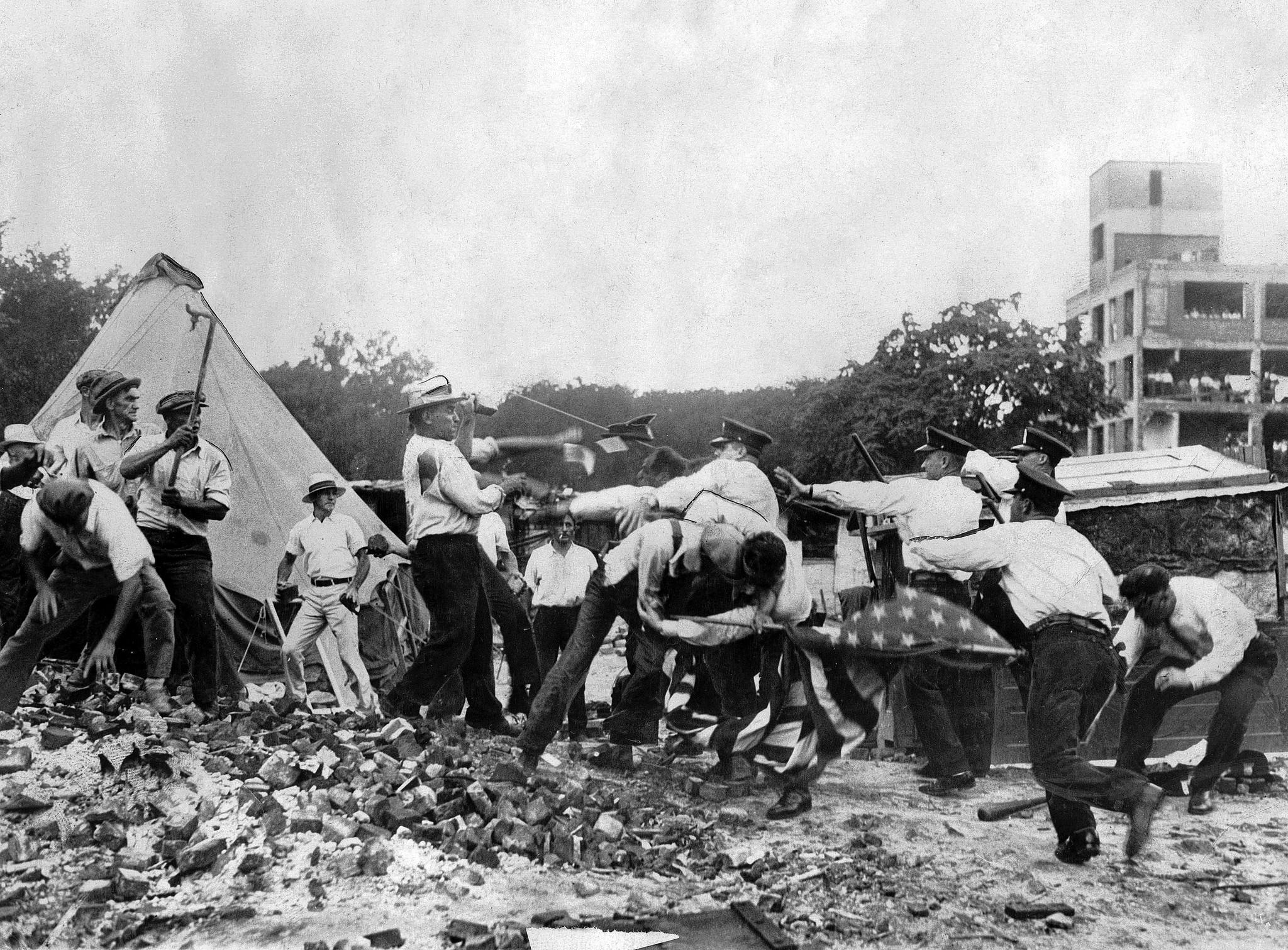
July 28, 1932: The Rout of the Bonus Army

July 28, 1932: The Bonus Army is chased off Capitol Hill by the United States Army.

Those words might not make sense to you. Let's go back, much further than 1932:

The practice of war-time military bonuses began in 1776, as payment for the difference between what a soldier earned and what he could have earned had he not enlisted. America first did this, as you might expect, in the War of the American Revolution. 

In 1783, as the war ended, hundreds of veterans from Pennsylvania marched on the nation's capital, Philadelphia, demanding an increase in their bonuses. They surrounded the State House, which was doubling as the home of the U.S. Congress, and was soon to be renamed Independence Hall. Congress evacuated, and a few weeks later, the U.S. Army arrived, and kicked them out. Nobody died.

The U.S. entered World War I on April 6, 1917, and made the difference for the Allies, gaining the Armistice on November 11, 1918. In 1924, Congress passed a bill awarding that war's veterans $1.00 per day of domestic service, up to $500; and $1.25 per day of overseas service, up to $625.

Lest you think that Republican Presidents being conservative assholes is a relatively new phenomenon, President Calvin Coolidge vetoed the bill. Congress overrode his veto, and the bill became law. But here's the kicker: This bonus would not be made available to the veterans until 1945. (Which turned out to be the year that World War II ended.) They would have to wait 21 years.

Then came the stock market crash of 1929, and the Great Depression. President Herbert Hoover did not cause these things, but in 1930 and 1931, he didn't seem to be trying very hard to turn them around. (He never publicly said the infamous sentence, "Prosperity is just around the corner," and he knew it wasn't.)

By early 1932, with 13 years to go before the bonus kicked in, one out of every four men in the workforce could not find a job. Many of these men were veterans of the war. Some men sold their medals to get money for food, bringing to mind the expression, "What price glory?" The plight of unemployed veterans worked its way into songs, including Bing Crosby's "Brother, Can You Spare a Dime?", although that song was not released until a few weeks after the Bonus Army march.

Not for the first time in human history, or even in American history, and not for the last time, men asked the question, "I was there when my country needed me, so where is my country now that I need it?" And now, Hoover had to run for re-election.

On March 11, 1932, Oregon veteran Walter W. Waters organized a group of fellow veterans and began leading them East toward Washington. Taking their name from that of American troops in France in World War I, the American Expeditionary Force, he called them the Bonus Expeditionary Force. Most news reports just called them the Bonus Army.

They arrived in Washington 43,000 strong -- 17,000 veterans and their families -- on May 28, and camped in tents to the south of the U.S. Capitol Building, on the Anacostia Flats. Like so many other encampments of the homeless across America, it was quickly labeled a "Hooverville."

They demanded that Congress pass, and Hoover sign, a bill into law mandating the paying of their 1945-due bonuses immediately. On June 15, the House of Representatives, controlled by the Democratic Party, passed such a bill, 211-176. There was hope.

That hope was crushed only 2 days later: The Senate voted it down, and it wasn't even close, 62-18. So even though the Senate was controlled by the Republican Party, many Democratic Senators also voted it down.

There seemed to be very little reason for the Bonus Army army to stay. But they did. Through the 2nd half of June. And almost all the way through July.

Finally, on July 28, Hoover had had enough. He ordered Pelham Glassford, the Superintendent of the District of Columbia Police, to get the Bonus Army out.

The Bonusers refused to leave. The police opened fire, and killed 2 of them: William Hushka, 37, an immigrant from Lithuania who became a butcher in Chicago; and Eric Carlson, 38, of Oakland, California. Both, as they were legally entitled as honorably discharged veterans, were buried across the Potomac River in Arlington National Cemetery. Still, the campers refused to leave.

Finally, Hoover ordered Secretary of War Patrick J. Hurley to use the current real Army to get those aggrieved heroes away from Washington. Hurley passed the order to the U.S. Army's Chief of Staff. This 4-star General sent in cavalry and tanks, and told his troops to do whatever it took to disperse the Bonus Army. Nobody else died, but many were brutally beaten.

Had modern television coverage been available at the time, the outrage throughout the country would have meant that this General would have been forced to resign. Instead, his career continued. His name was Douglas MacArthur.

On November 8, 1932, Hoover was defeated for re-election, losing 42 out of the 48 States then in the Union to the Democratic Party's nominee, the Governor of New York, Franklin Delano Roosevelt.

In 1933, there was a smaller march on Washington demanding the Bonus. FDR responded by offering them federal government jobs. Those who accepted were better off. Those who refused were given transit fare home.

In 1935, Canada held its own version of the Bonus Army march, the On-to-Ottawa Trek. They never got anywhere near their country's capital, ending with the Regina Riot.

In 1936, with the Depression easing but by no means over, both houses of Congress passed a bill awarding the Bonus, now just 9 years ahead of schedule. FDR vetoed it -- something his hagiographers usually don't mention. Congress overrode his veto, and the Bonus was paid.

In 1944, with the end of World War II in sight, and determined not to make the same mistake, FDR asked Congress to pass a G.I. Bill of Rights. It did, and the returning veterans got immediate benefits far beyond what those who returned from World War I got.

Walter Waters was never prosecuted for anything he may have done with the Bonus Army. He lived until 1959. MacArthur died in 1964. Later that year, so did Hoover.

*

July 28, 1932 was a Thursday. It was the off-season for the NFL and the NHL, and the NBA hadn't been founded yet. But these games were played in Major League Baseball:

* The New York Yankees beat the Cleveland Indians, 10-1 at League Park in Cleveland. Babe Ruth hit 2 home runs in support of Red Ruffing.

* The New York Giants got swept in a doubleheader at the Polo Grounds. The Pittsburgh Pirates beat them in the 1st game 10-7, and in the 2nd game 9-1.

* The Brooklyn Dodgers split a doubleheader at Ebbets Field. They beat the St. Louis Cardinals in the opener, 9-6, before dropping the nightcap, 8-6.

* The Chicago Cubs beat the Boston Braves, 4-1 at Braves Field in Boston.

* The Cincinnati Reds beat the Philadelphia Phillies, 7-4 at Baker Bowl in Philadelphia. 

* The Detroit Tigers beat the Philadelphia Athletics, 4-2 at Navin Field in Detroit. (It was renamed Briggs Stadium in 1938 and Tiger Stadium in 1961.)

* The Boston Red Sox beat the Chicago White Sox, 2-1 at Comiskey Park in Chicago.

* And the St. Louis Browns beat the Washington Senators, 6-4 at Sportsman's Park in St. Louis. 

Sunday, July 24, 2022

July 24, 1998: The U.S. Capitol Shooting

July 24, 1998: Russell Weston kills 2 U.S. Capitol Police officers: Jacob Chestnut, 58; and John Gibson, 42. Both men lay in state in the Capitol Rotunda, making Chestnut the 1st black person so honored.

Weston, then 41, was from Valmeyer, Illinois, outside St. Louis. He had been diagnosed with paranoid schizophrenia. He told a court-appointed psychiatrist that he stormed the Capitol to prevent the United States from being annihilated by disease and legions of cannibals.

He would have fit in perfectly with the insurrectionists of January 6, 2021, the next time a Capitol Policeman died in the line of duty. He remains in the federal prison at Butner, North Carolina.

July 24, 1998 was a Friday. These Major League Baseball games were played:

* The New York Yankees beat the Chicago White Sox, 5-4 at Yankee Stadium. Andy Pettitte was the winning pitcher, supported by 2 home runs from Darryl Strawberry and another by Paul O'Neill. Derek Jeter went 0-for-3, but did draw a walk.

* The New York Mets swept a doubleheader from the Chicago Cubs, 5-0 and 7-3 at Wrigley Field in Chicago. In the opening, Armando Reynoso threw 8 innings of 5-hit shutout ball. Dennis Cook pitched a hitless 9th. Sammy Sosa went 1-for-4 in each game, but didn't hit a home run in either game.

* The Toronto Blue Jays beat the Boston Red Sox, 10-6 at Fenway Park in Boston.

* The Philadelphia Phillies swept a doubleheader from the Florida Marlins, 6-4 and 7-6 at Veterans Stadium in Philadelphia. Both games went 12 innings. Scott Rolen won the 1st game with a home run. In the 2nd game, the Marlins took a 6-5 lead in the top of the 12th. But Ruben Amaro Jr. homered to lead off the bottom of the 12th, Doug Glanville singled, Desi Relaford bunted him over to 2nd, Scott Rolen was walked intentionally, and Rico Brogna singled Amaro home.

* The Baltimore Orioles beat the Seattle Mariners, 7-4 at Camden Yards in Baltimore. Rafael Palmeiro cheated his way to 2 home runs. Cal Ripken Jr. went 1-for-3 with a walk. Ken Griffey Jr. went 1-for-4.

* The Tampa Bay Devil Rays beat the Oakland Athletics, 6-0 at Tropicana Field in St. Petersburg, Florida. Tony Saunders pitched 6 2/3rds innings of 5-hit shutout ball. Jim Mecir pitched 2 1/3 no-hit innings to complete the shutout. Rickey Henderson went 0-for-2 with 3 walks and 2 stolen bases.

* The Atlanta Braves beat the Pittsburgh Pirates, 3-0 at Three Rivers Stadium in Pittsburgh. John Smoltz pitched a 3-hit shutout, striking out 10 and walking none.

* The Cleveland Indians beat the Detroit Tigers, 2-1 at Jacobs Field (now Progressive Field) in Cleveland. Travis Fryman won it with a home run in the bottom of the 11th inning.

* A doubleheader was split at Milwaukee County Stadium. The Milwaukee Brewers won the 1st game, 10-7. The Montreal Expos won the 2nd game, 11-2.

* The Minnesota Twins beat the Texas Rangers, 5-3 at the Metrodome in Minneapolis.

* The Kansas City Royals beat the Anaheim Angels, 4-3 at Kauffman Stadium in Kansas City.

* The Colorado Rockies beat the St. Louis Cardinals, 12-3 at Coors Field in Denver. Mark McGwire went 0-for-4.

* The Houston Astros beat the San Diego Padres, 2-1 at Qualcomm Stadium in San Diego. Tony Gwynn went 2-for-4.

* The Los Angeles Dodgers beat the Arizona Diamondbacks, 3-1 at Dodger Stadium in Los Angeles.

* And the San Francisco Giants beat the Cincinnati Reds, 12-2 at Candlestick Park (then named 3Com Park at Candlestick Point) in San Francisco. Jeff Kent hit 2 home runs, with 7 RBIs. Barry Bonds went 2-for-3 with a walk, but did not hit a home run.

Wednesday, July 6, 2022

July 6, 1915: Eric Muenter Goes Out With a Bang

July 6, 1915: Eric Muenter dies, still in the process of becoming one of the most successful terrorists ever to strike at America. How could that be?

He was born on March 25, 1871 in Uelzen, Lower Saxony, Germany. In 1906, he was a professor of German at Harvard University, when his pregnant wife, the former Leona Krembs, died of arsenic poisoning. He was accused of murder, and was almost certainly guilty.

He went on the run, reappeared under the name Frank Holt, remarried, and got a job teaching German at another Ivy League school, Cornell University in Ithaca, New York. By 1915, while not yet fighting in World War I, the American government was aiding Britain and France against Germany. He joined Abteilung III b (Department Three-B), which planted time-bombs on ships carrying arms for the Allies from American ports.

On July 2, about 2 months after a German U-boat sank the RMS Lusitania, increasing the calls for America to enter the war, he entered the U.S. Capitol Building in Washington. Unable to gain access to the locked Senate chamber, he hid a time-bomb in the Senate reception room. There was no one to be injured by the explosion, and he wrote a letter to The Washington Star under a pseudonym, saying he hoped to "Make enough noise to be heard above the voices that clamor for war."

This was not the first attempt to attack the Capitol: In 1814, during the War of 1812, the British Army had burned it, along with the White House. And it would not be the last: There was a shooting in the House of Representatives chamber that wounded 5 Congressmen in 1954, the Weather Underground planted a bomb that hurt no one in 1971, a pro-Communist group set off a bomb that hurt no one in 1983, 2 Capitol police offers were shot and killed in 1998, some Senators received anthrax-tainted mail in 2001, and, of course, there was the Trump Insurrection of January 6, 2021, in which 5 people died.

Muenter was just getting warmed up. On July 3, the day the letter appeared, he was already in New York, where he boarded the SS Minnehaha, which was loaded with munitions meant for Britain. He then took the Long Island Rail Road to Glen Cove, and invaded the mansion of J.P. Morgan Jr. His father, the financier/robber baron John Pierpont Morgan, had died in 1913, but Morgan Jr. had continued his activities, and was financing some of the aid to Britain.

Muenter found Morgan, and aimed his gun. Morgan lunged at him, and actually managed to tackle him before he could get off a shot. In the struggle, Muenter fired 2 shots, but Morgan was not hurt enough to give up the struggle. Finally, Morgan's butler hit Muenter, knocking him out. Morgan was treated, and returned to work within weeks.

The would-be assassin was identified as Frank Holt. But another man saw a resemblance to Eric Muenter, whom the witness knew was wanted for the killing of his wife. A Harvard official was brought to New York, and he confirmed that Muenter and Holt were one and the same.

On July 5, in his jail cell in Mineola, on Long Island, Muenter slashed his wrist, but this attempt at suicide failed. The next day, a guard failed to lock his cell, and Muenter got out, went up to the roof, and jumped to his death. He was 44 years old.

But while his life was over, his reign of terror was not. His new wife received a letter from him, warning that a ship heading for England would sink on July 7. It was quickly narrowed down to the Minnehaha, and the ship was contacted by radio. The crew searched for the bomb, but couldn't find it before it exploded. Fortunately, Muenter had goofed: He put it too far from the munitions on board to do anything more than minor damage, and the ship arrived safely.

American anger at Germany rose, but, still, America didn't get into the war. Finally, on April 2, 1917, faced with additional German attacks on American ships, President Woodrow Wilson, who had recently won re-election on the slogan, "He kept us out of war," could keep out of it no longer, and asked Congress for a Declaration of War. He got it, and the war was won on November 11, 1918.

The 2 years after that would see several other terrorist incidents on American soil -- but most of them would not be committed by Germans seeking revenge.

*

July 6, 1915 was a Wednesday. This was during the Federal League's attempt to be a 3rd major league in baseball. In the American League that day:

* The New York Yankees lost to the Philadelphia Athletics, 7-6 at the Polo Grounds, where they groundshared with the Giants until the 1st Yankee Stadium was built in 1923. Jack Lapp hit a home run, Nap Lajoie went 1-for-5 with 2 RBIs, and Wally Schang went 3-for-5 with an RBI. Schang would later be the catcher on the Yankees' 1st 3 Pennant winners and their 1st World Series winners in 1923.

* The Boston Red Sox swept a doubleheader from the Washington Senators at Fenway Park in Boston. Tris Speaker, in his last season before being traded to Cleveland, went 3-for-8 with an RBI. In the nightcap, Vean Gregg outpitched Walter Johnson. Babe Ruth, in his 1st full season, did not appear in either game.

* The Detroit Tigers beat the Cleveland Indians, 7-6 at League Park in Cleveland. For the Tigers, Ty Cobb went 1-for-3 with 2 walks and 2 RBIs. For the Indians, Shoeless Joe Jackson went 1-for-4.

* And the Chicago White Sox beat the St. Louis Browns, 12-2 at Sportsman's Park in St. Louis.

In the National League:

* The New York Giants beat the Philadelphia Phillies, 5-1 at Baker Bowl in Philadelphia. In spite of this loss, the Phillies won their 1st Pennant, before losing the World Series to the Red Sox.

* The Brooklyn Dodgers -- or the Brooklyn Robins, as they were known under the managing of Wilbert Robinson from 1914 to 1931 -- swept a doubleheader from the Boston Braves at Ebbets Field, 3-2 and 4-3.

* The St. Louis Cardinals beat the Pittsburgh Pirates, 2-1 at Forbes Field in Pittsburgh. Honus Wagner went 1-for-4.

* And there was a doubleheader at the West Side Grounds in Chicago. In the opener, the Chicago Cubs beat the Cincinnati Reds, 5-4. Pete Knisely drove in the winning run with a triple in the bottom of the 14th inning. The nightcap was tied 2-2 after 7 innings, when the umpires called it due to darkness.

The next season, with the collapse of the FL, Chicago Whales owner Charlie Weeghman was allowed to buy the Cubs, and moved them into the Whales' home, Weeghman Park, which later became Wrigley Field.

And in the Federal League:

* The Newark Peppers beat the Baltimore Terrapins, 7-1 at Terrapin Park in Baltimore. After the FL's collapse, the International League's Baltimore Orioles moved into Terrapin Park, renamed it Oriole Park, became the dominant minor-league team of the 1920s, and stayed until a fire burned the park down on July 4, 1944. Their move to Baltimore Municipal Stadium led to its conversion into Memorial Stadium, and to Baltimore's return to the major leagues.

* The Brooklyn Tip-Tops beat the Buffalo Blues, 5-1 at Washington Park in Brooklyn, where the Dodgers had played before Ebbets Field.

* The Kansas City Packers beat the St. Louis Terriers, 1-0 at Gordon and Koppel Field in Kansas City. Nick Cullop had to leave the game after 3 innings, but he and Gene Packard combined for a 7-hit shutout.

* And the Chicago Whales and the Pittsburgh Rebels were rained out at Weeghman Park, the future Wrigley Field, in Chicago. The Whales won the Pennant, and the game was never made up.

Sunday, May 1, 2022

May 1, 1894: Coxey's Army, the 1st March On Washington

May 1, 1894: The worst economic depression America had yet seen leads to the first march on Washington, the nation's capital.

The Panic of 1893, a stock market crash, sent the economy, already shaky since the passage of the Sherman Silver Purchase Act of 1890, down the drain. The economy had allowed Grover Cleveland to become the 1st (and still the only) former President ever to regain the office in 1892. But the Panic came just 3 months into his term, and he never had a chance.

By the Spring of 1894, people were desperate. Unemployment was way up. Bank runs paralyzed local financial systems. Credit dried up. Deflation sent wages tumbling.

Enter Jacob S. Coxey. A Pennsylvania native who ran an iron mill in Massillon, Ohio, Coxey had run for the State Senate in 1885, and lost. He had been a member of the Greenback Party and the People's Party, both of which had challenged America's two-party system from the left.

How did those challenges go? Greenback candidate Benjamin Franklin Butler, a Civil War General and former Governor of Massachusetts, won 1.3 percent of the popular vote for President in 1884. In 1892, Populist candidate James B. Weaver, a former Congressman from Iowa, won 8.5 percent, and carried the States of Colorado, Idaho, Kansas, Nevada and North Dakota for 22 Electoral Votes.

Coxey believed that a program of public works, especially road improvement, would save the economy. It would not only provide something the country really needed, but it would put people back to work, put money back in people's pockets, and remove the need for so much credit.

On March 30, 1894, Coxey left Massillon with 100 men, and set out on a 350-mile march to Washington. "Coxey's Army," as it became known in the newspapers, grew to 6,000 people by the time it camped out on the Shreve farm at Colmar Manor, Maryland on April 30. The month in between included Coxey's 40th birthday.

The next day, May 1, May Day, already known as International Workers' Day, Coxey and the leaders of his Army walked onto the grounds of the U.S. Capitol Building. Unfortunately for them, specifically, they walked onto its grass. They were arrested for this. Fortunately, the arrests were handled peacefully, and nobody got hurt.

With this, one of the great anti-climaxes of American history, the movement quickly fell apart. Coxey went down in the American imagination, at least in the short term, as a crank.

Jacob Coxey wasn't wrong. He was just significantly premature. In 1901, following the assassination of President William McKinley, Theodore Roosevelt became President, and began to put together what he called "the Square Deal," launching America's "Progressive Era." In 1912, Woodrow Wilson was elected President, and his "New Freedom" expanded on TR's work. (This in spite of the two men personally despising each other.)

In 1926, President Calvin Coolidge (in college at the time of Coxey's Army) signed the federal highway program into law. This included U.S. Route 30, over the path of Coxey's march from Massillon to Pittsburgh.

In 1932, Franklin D. Roosevelt (only 12 years old in 1894) was elected President, saying, evoking memories of his cousin's Square Deal, "I pledge myself to a New Deal for the American people. This is more than a political campaign, it is a call to arms." In 1935, he created the Works Project Administration, which built so many things that created jobs, from post offices to dams to stadiums (including the original Rutgers Stadium in 1938).

In 1956, President Dwight D. Eisenhower (3 years old in 1894) signed the Interstate Highway Act into law. Coxey's route from Pittsburgh to Breezewood, Pennsylvania is now part of Interstate 76 and the Pennsylvania Turnpike. His route from Breezewood to Frederick, Maryland is now part of Interstate 70. And his route from Frederick to Washington is now part of Interstate 270.

Coxey lived to see much of this, despite being a perennial candidate. The People's Party nominated him for the U.S. House of Representatives in 1894, and for Governor in 1895 and 1897. The Socialist Party nominated him for the U.S. Senate in 1916 and 1928; and for the House in 1922, 1924, 1926, 1928, 1930, 1932 and 1934. The Union Party nominated him for the Senate in 1936, and for the House in 1938 and 1942. He lost all of these races. He won one election in his life, for Mayor of Massillon in 1931, but lost in his 1st bid for re-election.
Jacob Coxey, May 1, 1944.
The "crank" was a prophet, all along.

On May 1, 1944, 50 years to the day after he made the 1st march on Washington, Coxey was invited to read his original petition from the Capitol Steps. He did. It was terribly delayed, but it was vindication, something rarely obtained in Washington, especially in one's own lifetime, and rarer still to one's own face. He died in 1951, at the age of 97.

*

May 1, 1894 was a Tuesday. Baseball was the only sport in America that dared to be openly professional. These games were played in the National League that day:

* The New York Giants beat the Baltimore Orioles, 7-4 at the Polo Grounds. This version of the Polo Grounds would burn down in 1911, and be replaced by the most familiar version. This version of the Orioles would go out of business after the 1899 season.

* The Boston Beaneaters beat the Philadelphia Phillies, 7-3 at the Huntingdon Avenue Grounds. Later in the year, this ballpark would burn down, and be replaced on the site by Baker Bowl. The Beaneaters eventually became the Braves.

* The Washington Senators beat the Brooklyn Bridegrooms, 2-1 at Boundary Field in Washington. Coxey's Army had no effect on this game. These Senators also went out of business after 1899. They should not be confused with the American League's version of the Senators, who became the Minnesota Twins. So named because of multiple marriages for players on their roster in 1887, the Bridegrooms eventually became the Dodgers.

* The Pittsburgh Pirates beat the Cincinnati Reds, 7-6 at League Park in Cincinnati. Crosley Field would be built on the site in 1912.

* The Cleveland Spiders beat the St. Louis Browns, 7-0 at Sportsman's Park in St. Louis. The Spiders also went out of business after 1899, while the Browns became the Cardinals. They should not be confused with the American League's version of the Browns, who became the Baltimore Orioles. And this version of Sportsman's Park would be replaced on the same site in 1909.

* And the Chicago Colts, forerunners of the Cubs, and the Louisville Colonels, another team that went out of business after the 1899 season, appear not to have been scheduled to play on May 1, 1894. 

Thursday, April 7, 2022

April 7, 1995: The Republicans' Contract With America

April 7, 1995: Not quite 100 days -- 94, to be exact -- into Republican control of Congress, the Speaker of the House of Representatives, Newt Gingrich, Republican of Georgia, asks the major TV networks for time to discuss his Party's newly-implemented "Contract With America" -- as if he were the President, addressing the nation from the Oval Office of the White House.

They gave him the time. The photo above shows Gingrich at the Speaker's Chair in the House of Representatives chamber, in front of an American Flag. His actual speech was in the Speaker's office in the U.S. Capitol Building, although he did have gold curtains flanking an open window, as the Oval Office often has.

During the midterm election campaign in the preceding Summer and Autumn, Gingrich had promised to bring 10 bills to the House floor for a vote -- not that they would become law, not even that they would pass the House, just that they would come to a vote. He called it "The Contract With America." It worked: The Republicans gained control of both houses of Congress, and nearly every member, newly-elected or re-elected, who was no better than a toss-up to win when calendar year 1994 began now owed Gingrich his job, and, therefore, his loyalty.

So, all 10 bills did pass the House. Some turned out to be inconsequential, mere feel-good items, meaning more to the Republican Congressmen than to the American people. A couple were signed into law by President Bill Clinton. Clinton also vetoed a couple. Some were stopped in the Senate, or amended to the point where they no longer resembled the sweeping legislation that Gingrich conceived of them as being.

Most notable was an Amendment to the Constitution of the United States, requiring a balanced federal budget. And, since Gingrich insisted on tax cuts for the wealthiest 1 percent of Americans, and refused to cut spending on the U.S. Department of Defense, a balanced budget would have required deep cuts in spending on Social Security, Medicare, Medicaid, education and environmental protection -- things that angered many middle-of-the-road Americans.
The proposed Amendment got the necessary 2/3rds supermajority in the House (290 votes, instead of the usual majority of 218), but failed by 1 vote in the Senate (getting 66 out of 67, rather than the usual majority of 51). Had it gotten the 67th vote, it then would have gone to the States: A majority vote for it in three-quarters of their legislatures, 38 out of 50, would have made it a part of the Constitution of the United States.

That 1 Senate vote to stop it came from Mark Hatfield, Republican of Oregon. A former Governor, he knew how hard it is to balance a budget, even when you don't have to protect things like Social Security. The conservative movement vowed to run a candidate much to his right in the next Primary. Instead, he retired, and the seat has been held by Democrat Ron Wyden ever since.

The most significant part of what Clinton called "the Contract On America" was a budget with deep cuts to Medicare and Medicaid. He vowed to veto it, and he did, leading to an epic showdown in the Autumn of 1995. Between that, and the Balanced Budget Amendment, the Contract has to be viewed, then as now, as a disappointment at best, and a failure at most.

By airing print and TV ads making it look as though the Republican nominee for President, outgoing Senate Majority Leader Bob Dole of Kansas, had made Gingrich, rather than former Congressman and football player Jack Kemp, his running mate, Clinton was easily re-elected in 1996. But it was a personal victory, without enough "coattails" to win back a majority in either house of Congress.

In 1997, Clinton, Gingrich, and the new Senate Majority Leader, Trent Lott of Mississippi, negotiated a balanced budget, one based on the economic growth brought about by Clinton's 1993 tax increase and a streamlining of the Department of Defense, and so the social-spending cuts weren't necessary.

By the end of the 2000s, thanks to the Republicans controlling the Presidency and the Congress for most of the decade, the budget deficit was high enough to make Gingrich -- and Ronald Reagan -- look like actual fiscal conservatives. It has begun to come down again because a liberal Democratic President named Barack Obama got things under control.

And Gingrich? After resigning not just as Speaker, but from Congress completely, in disgrace in 1998, he returned to the public eye by running for President in 2012, and made a big fool of himself all over again. He has often claimed to be a historian, but instead of becoming what he called "a transitional figure in history," he'd probably be better off if history just plain forgot him. Don't bet on it.

*

April 7, 1995 was a Friday. Baseball was in Spring Training, delayed due to the resolution of the Strike of '94. Football was out of season. There were 9 games in the NBA:

* The New Jersey Nets lost to the Milwaukee Bucks, 107-92 at the Bradley Center in Milwaukee.

* The Boston Celtics beat their arch-rivals, the Philadelphia 76ers, 91-81 at the Boston Garden.

* The Charlotte Hornets beat the Washington Bullets, 98-93 at the USAir Arena (formerly the Capital Centre) in the Washington suburb of Landover, Maryland.

* The Atlanta Hawks beat the Indiana Pacers, 102-90 at The Omni in Atlanta.

* The Detroit Pistons beat the Orlando Magic, 104-94 at The Palace in the Detroit suburb of Auburn Hills, Michigan.

* The Chicago Bulls beat the Cleveland Cavaliers, 97-88 at the United Center in Chicago.

* The Dallas Mavericks beat the Minnesota Timberwolves, 111-94 at the Reunion Arena in Dallas.

* The Los Angeles Lakers beat the Utah Jazz, 113-90 at The Forum outside Los Angeles in Inglewood, California. Cedric Ceballos led all scorers on the night with 36 points.

* And the Portland Trail Blazers beat the Houston Rockets, 127-109 at the Veterans Memorial Coliseum in Portland, Oregon.

And there were 6 games in the NHL:

* The New York Islanders beat their arch-rivals, the New York Rangers, 4-3 at Madison Square Garden.

* In an "Original Six" matchup, the Detroit Red Wigs beat the Toronto Maple Leafs, 4-2 at Maple Leaf Gardens in Toronto.

* The Winnipeg Jets beat the Vancouver Canucks, 7-4 at the Winnipeg Arena.

* The Calgary Flames beat the Los Angeles Kings at the Saddledome in Calgary.

* The Dallas Stars beat the Mighty Ducks of Anaheim, 2-0 at the Arrowhead Pond of Anaheim (now the Honda Center).

* And the San Jose Sharks beat the Edmonton Oilers, 5-0 at the San Jose Arena (now the SAP Center).

Saturday, March 26, 2022

March 26, 1964: Martin Luther King & Malcolm X Meet

Martin was 5-foot-7. Malcolm was 6-foot-4.

March 26, 1964: Martin Luther King Jr. and Malcolm X, the opposing poles of the Civil Rights Movement, meet face-to-face for the first time. It will turn out to be the only time.

They both had the goal of making life better for black Americans. They disagreed as to the means. Martin preferred nonviolent resistance. Malcolm wanted a tougher stance. He called Martin "a 20th Century Uncle Tom." Martin said of Malcolm's ideas, "Fiery, demagogic oratory in the Black ghettos, urging Negroes to arm themselves and prepare to engage in violence, as he has done, can reap nothing but grief."

Nevertheless, in July 1963, Malcolm invited Martin to join a rally in Harlem. He called for a period of racial unity to fight white oppression, writing, "If capitalistic Kennedy and communistic Khrushchev can find something in common on which to form a United Front despite their tremendous ideological differences, it is a disgrace for Negro leaders not to be able to submerge our 'minor' differences in order to seek a common solution to a common problem posed by a Common Enemy." But Martin never responded to the invitation, and didn't show up.

On one occasion, Malcolm called Martin a "chump," and called other civil rights leaders "stooges of the white establishment." He called the August 28, 1963 March On Washington, ending at the Lincoln Memorial, Dr. King's finest moment, "the farce on Washington," and "a demonstration run by whites in front of a statue of a President who has been dead for a hundred years, and who didn't like us when he was alive."

On March 26, 1964, both men were on Capitol Hill in Washington, watching a U.S. Senate hearing regarding legislation aimed at ending segregation in public places and racial discrimination in employment. The bill had been proposed by President John F. Kennedy following intense lobbying by King and others, and, following JFK's assassination, was being shepherded through Congress by President Lyndon B. Johnson, despite harsh opposition by many Southern elected officials.

As Martin was wrapping up a press conference, he was approached by Malcolm, and the two shook hands and exchanged greetings. As cameras clicked away, Malcolm expressed his desire to become more active, saying, "I'm throwing myself into the heart of the civil rights struggle." Then, just as quickly as it began, the brief meeting between the two legends was over.

The Kennedy civil rights bill passed Congress, and Johnson signed it into law as the Civil Rights Act of 1964 on July 2. Johnson invited King to the signing ceremony, and gave him one of the signing pens. He did not invite Malcolm X, and it's unlikely that Malcolm would have accepted, anyway. There is no record of him ever having visited the White House, or of him ever having met a President.

By that point, Malcolm had returned from an extensive visit to North Africa and the Middle East, including a pilgrimage to the Muslim holy city of Mecca, Saudi Arabia. Having seen Muslims of every race and color, from all over the world, the trip fundamentally shifted his thinking on the issue of race in America. While not entirely denouncing his earlier positions, he adopted a more conciliatory approach, writing, "I was no less angry than I had been, but, at the same time, the true brotherhood I had seen had influenced me to recognize that anger can blind human vision."

Malcolm X was assassinated in New York on February 21, 1965. Martin Luther King Jr. was assassinated in Memphis on April 4, 1968. Each man was 39 years old at the time of his death. In the years to come, their widows, and then their children, would build strong friendships that uplifted the cause of civil rights.

*

March 26, 1964 was a Thursday. This was also the day the musical Funny Girl premiered on Broadway. I have a separate entry for that event.

Baseball was in Spring Training. Football was out of season. No games were scheduled in the NBA. There were 2 games in the Stanley Cup Playoffs. The Montreal Canadiens beat the Toronto Maple Leafs, 2-0 at the Montreal Forum. And the Chicago Black Hawks beat the Detroit Red Wings, 4-1 at the Chicago Stadium. However, the the Leafs and the Wings would both bounce back, and would face each other in the Finals, where the Leafs would win.

December 31, 1999 & January 1, 2000: The Millennium

December 31, 1999:  The Millennium arrives. The people of planet Earth survived. At a terrible cost. But we hadn't destroyed ourselves. ...