Showing posts with label norway. Show all posts

Tuesday, December 13, 2022

December 14, 1911: Roald Amundsen Reaches the South Pole

December 14, 1911: Roald Amundsen becomes the 1st person to reach the South Pole. 

It made sense for a Norwegian to attempt to become the 1st person to reach the North Pole, 90 degrees North latitude: The only countries whose mainlands have points further north than Norway's northernmost point are Canada and Russia. This does not count Denmark, which owns Greenland, which has a more northerly point of land than any country: Kaffeklubben Island, at 83.63 degrees North.

It made sense for Amundsen to be the Norwegian to attempt it. In 1906, aboard the sloop Gjøa, he became the leader of the first expedition to sail the long-sought Northwest Passage. He did make an attempt to reach the North Pole, but in 1909, American expeditioner Robert Peary claimed to have gotten there first. Maybe Peary should have kept trying: It is now believed that he did not, in fact, beat Amundsen and everyone else to it.

It did not make much sense for a Norwegian to be the first person to attempt to reach the South Pole, 90 degrees South latitude. The country with the southernmost land is Chile, Hornos Island, at 55.97 degrees South latitude; followed by Argentina and Australia. (Villa Las Estrellas, on King George Island, is the northernmost point on Antarctica, at 62.11 degrees South.) Since Australia was part of the British Empire, a Royal Navy officer, Captain Robert F. Scott, made the first serious attempt at it.

But since Amundsen did have experience in a polar expedition, he thought he could reach the South Pole first. On June 3, 1910, he sailed his ship Fram out of his national capital of Oslo. Upon reaching the Portuguese colony of Madeira, he sportingly sent Scott a telegram stating his intentions. On January 14, 1911, he reached the continent of Antarctica, on the Ross Ice Shelf, and established base camp there.

An attempt set out on September 8, but had to turn back. A 2nd attempt was made on October 19, with 4 sleds, each pulled by 13 dogs. On December 8, they reached 88 degrees, 23 minutes south, the furthest point anyone had yet reached, in 1909 by Ernest Shackleton. They were 97 miles away. They went on.

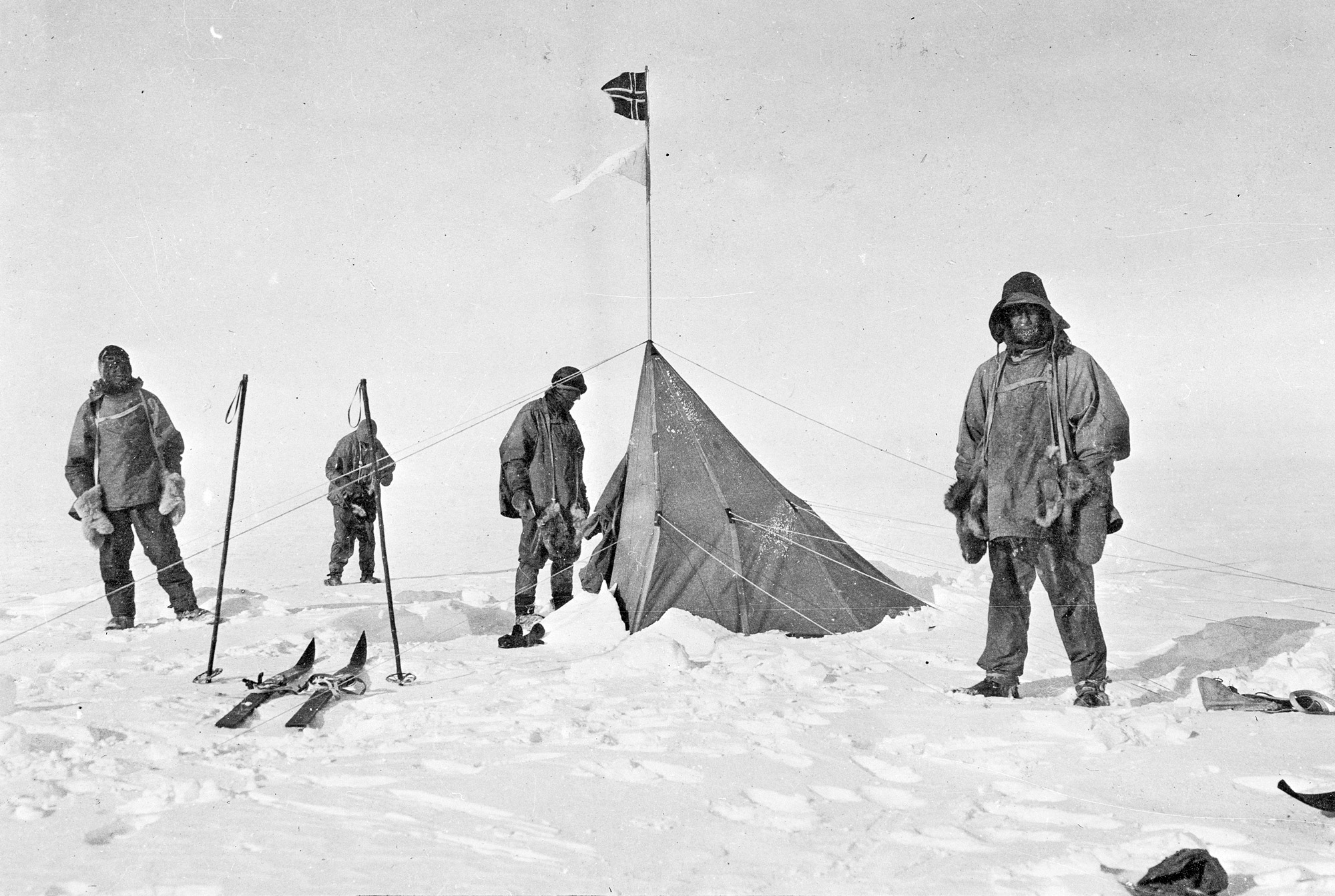
On December 14, 1911, Amundsen stopped, took some measurements, and told his crew, "Gentlemen, I am certain we are at the South Pole." He asked crewmates to take their own measurements, and a central point within them was decided as the Pole. They pitched a tent, topped with a Norwegian flag. Amundsen wrote a message for Scott, in case he made it, and left it inside the tent.
On March 7, 1912, the Fram reached Hobart, Tasmania, Australia. Amundsen made his claim, and learned that no word had yet been reached from Scott. Scott had reached the Pole on January 17, but found Amundsen's tent and note. Scott never made it back alive: Snowstorms prevented him from getting back to his base camp. A search party found him on November 12, with a last entry in his diary dated March 29. He was 43 years old.
Robert F. Scott

Scott was hailed as a hero in death. Amundsen lived on, and on May 12, 1926, led a team on the airship Norge to become the 1st people to fly over the North Pole. On June 18, 1928, he led a team searching the Arctic for the lost airship Italia. His plane, a Latham 47 "flying boat," also disappeared, and has never been found. He was 56.

*

December 14, 1911 was a Thursday. American novelty musician Lindley "Spike" Jones was born on this day. Baseball was out of season. Football season was over. There was no NBA yet. And the professional hockey season was about to start. So there were no scores on this historic day.

Monday, October 24, 2022

October 24, 1945: The Execution of Vidkun Quisling

October 24, 1945: Vidkun Quisling is executed by firing squad in the Norwegian capital of Oslo. He was 58 years old. The only man ever to be leader of the National Union Party, in 1931 he was named Norway's Minister of Defense, serving until 1933. On February 1, 1942, after the Nazis conquered Norway, he was appointed Minister President.

He held the office until May 9, 1945, a day after V-E Day, when, knowing the game was up, he turned himself in. On V-E Day, he had written:

I know that the Norwegian people have sentenced me to death, and that the easiest course for me would be to take my own life. But I want to let history reach its own verdict. Believe me, in ten years' time I will have become another Saint Olav. 

Olaf II was King of Norway from 1015 to 1028, and was known as Olaf the Holy. He is his country's patron saint, and deserves to be remembered as more than just the namesake of the fictional hometown of the Golden Girls character Rose Nylund.

Quisling was wrong. Even while still in power, "quisling" became a word synonymous with "traitor." He is remembered as a traitor, and a willing sender of Norwegian Jews to die in the Holocaust.

*

October 24, 1945 was a Wednesday. Also on this day, the Charter of the United Nations was ratified by the original 5 permanent members of the United Nations Security Council: America, Britain, France, China and the Soviet Union, and by a majority of the other signatories. I have a separate entry for this event. And Gene Monahan, trainer for the New York Yankees from 1973 to 2011, was born.

The baseball season had ended 14 days before, when the Detroit Tigers beat the Chicago Cubs in Game 7 of the World Series. Football was in midweek. The NBA wasn't founded until the next year.  

The National Hockey League played its 1st peacetime game since April 16, 1939, with World War II beginning for Canada, as part of the British Empire, the following September 3. Although it had continued to operate for the duration, Canada's membership in the Empire had led to a serious manpower drain in the League.

Some teams were affected more than others. The New York Americans had to suspend operations after the 1941-42 season, and never started up again. The New York Rangers had won the Stanley Cup in 1940 and finished 1st overall in 1942, but went into a tailspin, and only reached the Stanley Cup Finals once in the next 30 years.

The Boston Bruins' entire "Kraut Line" -- Milt Schmidt centering Bobby Bauer and Woody Dumart -- all Canadians of German descent, helped them win the Cup in 1939 and 1941, and losing the Finals in 1943, dropped off after that, not winning another Cup until 1970, going 0-5 in Finals from 1941 to 1970.

The Bruins were the hosts in this peacetime puck-dropper, but lost to the Chicago Black Hawks, 5-4 at the Boston Garden. The Bruins would make the Finals in 1945-46, but lose to the Montreal Canadiens. 

October 24, 1945: The Charter of the United Nations

October 24, 1945: The Charter of the United Nations is ratified by the original 5 permanent members of the United Nations Security Council: America, Britain, France, China and the Soviet Union, and by a majority of the other signatories. 

The Charter established the purposes, governing structure and overall framework of the UN system, including its 6 principal organs: The Secretariat, the General Assembly, the Security Council, the Economic and Social Council, the International Court of Justice, and the Trusteeship Council.

In commemoration of the event, the General Assembly celebrates United Nations Day every October 24, and schedules its annual gathering for the days leading up to the date.

*

October 24, 1945 was a Wednesday.  Also on this day, Vidkun Quisling is executed by firing squad in the Norwegian capital of Oslo. The fascist leader of Norway during World War II, allied with the Nazis, was 58 years old. I have a separate entry for this event. And Gene Monahan, trainer for the New York Yankees from 1973 to 2011, was born.

The baseball season had ended 14 days before, when the Detroit Tigers beat the Chicago Cubs in Game 7 of the World Series. Football was in midweek. The NBA wasn't founded until the next year.  

The National Hockey League played its 1st peacetime game since April 16, 1939, with World War II beginning for Canada, as part of the British Empire, the following September 3. Although it had continued to operate for the duration, Canada's membership in the Empire had led to a serious manpower drain in the League.

Some teams were affected more than others. The New York Americans had to suspend operations after the 1941-42 season, and never started up again. The New York Rangers had won the Stanley Cup in 1940 and finished 1st overall in 1942, but went into a tailspin, and only reached the Stanley Cup Finals once in the next 30 years.

The Boston Bruins' entire "Kraut Line" -- Milt Schmidt centering Bobby Bauer and Woody Dumart -- all Canadians of German descent, helped them win the Cup in 1939 and 1941, and losing the Finals in 1943, dropped off after that, not winning another Cup until 1970, going 0-5 in Finals from 1941 to 1970.

The Bruins were the hosts in this peacetime puck-dropper, but lost to the Chicago Black Hawks, 5-4 at the Boston Garden. The Bruins would make the Finals in 1945-46, but lose to the Montreal Canadiens.

Sunday, August 7, 2022

August 7, 1947: The Kon-Tiki Expedition

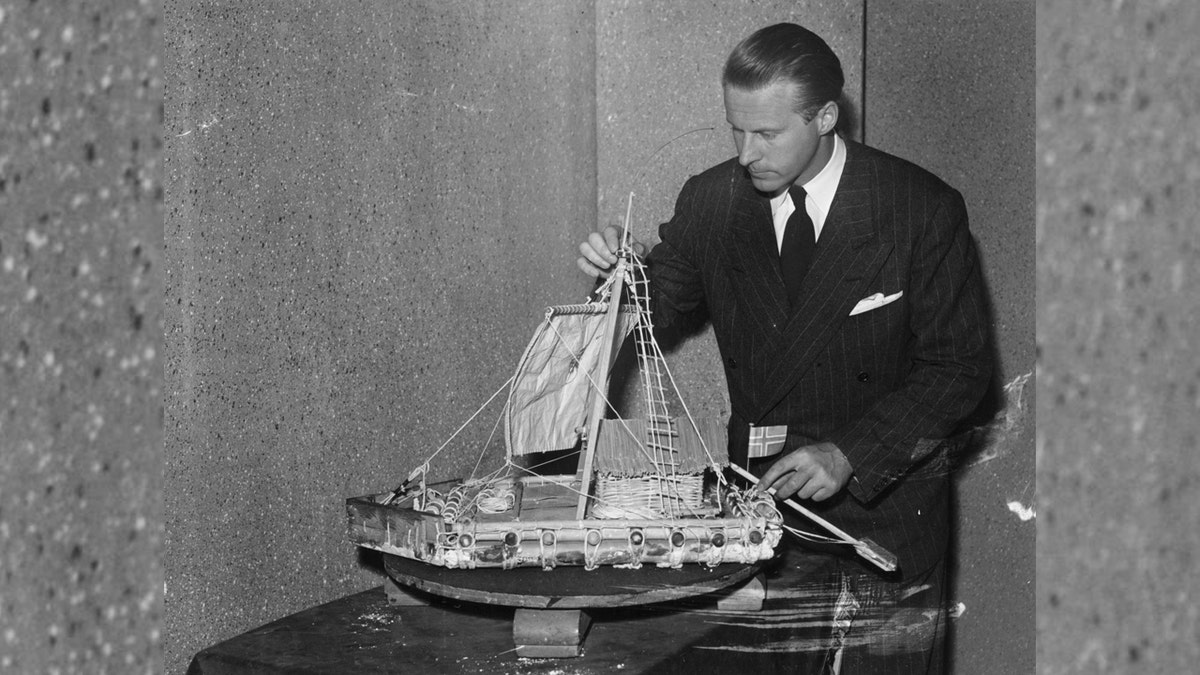
Heyerdahl with a model of the Kon-Tiki

August 7, 1947: The raft Kon-Tiki arrives on a reef in the Tuamotus, in French-controlled Polynesia. This backs up the theory of its captain that ancient peoples from there and South America could reach each other's lands without modern technology, and meet and interact with each other.

Thor Heyerdahl was born on October 6, 1914 in Larvik, Norway. With his backgrounds in biology, zoology, botany and geography, he could have been one of the inspirations for the character of Indiana Jones.

He had the raft Kon-Tiki, named for a god of the Incas in what is now Peru, built to prove a theory that, using only the materials and technologies available to them at the time, people from South America could have reached Polynesia during pre-Columbian times. (In other words, before Christopher Columbus crossed the Atlantic Ocean in 1492.) There had been suggestion of this, based on the genetics of the respective peoples.

There were 5 others with Heyerdahl on the raft: Erik Hesselberg, navigator; Bengt Danielsson, steward, in charge of supplies and daily rations; Knut Haugland, radio operator; Torstein Raaby, also a radio operator, because there had to be at least one awake and available to operate at all times; and Herman Watzinger, engineer and meteorologist, the latter skill making him a key figure on the voyage.

The team built the raft out of balsa logs and other native materials, in a dockyard in Peru, on South America's Pacific Coast. They headed out on April 28, 1947, covering 4,300 miles in 101 days, before arriving at the reef at Raroia in the Tuamotus. That island remains under French control. (Presumably, Heyerdahl met with the French authorities, and let them know of his plans beforehand, and got permission to travel to those islands.)

Heyerdahl narrated a 1950 documentary film about the expedition, and it won the Academy Award for Best Documentary Feature, despite requiring translation: For all his skills, Heyerdahl did not speak English.

Heyerdahl died in 2002. The last survivor of the voyage was Haugland, who lived until 2009. The original Kon-Tiki raft is on display at the Kon-Tiki Museum in the Norwegian capital of Oslo.

*

August 7, 1947 was a Thursday. These baseball games were played that day:

* The New York Giants beat the Philadelphia Phillies, 5-2 at the Polo Grounds.

* The Brooklyn Dodgers lost to the Boston Braves, 3-1 at Braves Field in Boston. Jackie Robinson went 0-for-4.

* The Boston Red Sox beat the Washington Senators, 12-2 at Griffith Stadium in Washington. Ted Williams went 2-for-4 with a home run.

* The St. Louis Cardinals beat the Cincinnati Reds, 9-2 at Crosley Field in Cincinnati.

* The Pittsburgh Pirates beat the Chicago Cubs, 3-0 at Wrigley Field in Chicago. Krby Higbe pitched a 7-hit shutout for the Pirates. Hank Greenberg went 0-3 with a walk. Ralph Kiner 1/for-3.

* The Chicago White Sox beat the St. Louis Browns, 8-4 at Sportsman's Park in St. Louis.

* The Cleveland Indians and the Detroit Tigers were rained out at Briggs Stadium (later renamed Tiger Stadium) in Detroit. The game was made up as part of a doubleheader on September 20. The Tigers won the opener, 3-2. Eddie Mayo singled Jimmy Outlaw home with the winning run in the bottom of the 10th inning. Fred Hutchinson of Detroit and Bob Feller of Cleveland both went the distance. The 2nd game went 10 innings, and was tied 5-5, when rain came again, and the game was called.

* And the New York Yankees and the Philadelphia Athletics were not scheduled.

Friday, July 22, 2022

July 22, 2011: The Utøya Massacre

July 22, 2011: Anders Breivik kills 8 people, and injures over 200 others, with a bomb targeting government buildings in Oslo, the capital of his homeland of Norway. The bomb was placed inside a van next to the tower block housing the office of the Prime Minister, then Jens Stoltenberg, leader of the country's center-left Labour Party. He was not present, so was not among those injured.

Breivik, 32 years old, then put on a homemade police uniform, complete with false identification, went to a Workers' Youth League camp on the island of Utøya, 24 miles to the west, and shot and killed 69 people, 33 of them under age 18. Stoltenberg was scheduled to speak there the next day, suggesting that Breivik got his scheduled mixed up.

Breivik was a right-wing extremist, who emailed a manifesto on the day of his attacks, titled "2083: A European Declaration of Independence." He blamed Islam and feminism for what he called a "European cultural suicide." He called for the deportation of all Muslims from Europe, and cited a quotation attributed to Napoleon Bonaparte: "He who saves his country, violates no law."

He was diagnosed with narcissistic personality disorder, and convicted of 77 counts of murder. As of July 22, 2022, he remains in Ringerike Prison in Tyristrand, Norway, and will for the rest of his life. While there, he wrote of his support for Vladimir Putin and Donald Trump.

*

July 22, 2011 was a Friday. These Major League Baseball games were played:

* The New York Yankees beat the Oakland Athletics, 17-7 at Yankee Stadium. Yes, that's a baseball game, not football. The Yankees scored 5 runs in the 2nd inning and 9 in the 3rd, but Phil Hughes still couldn't finish the 5th inning, so Héctor Noesi ended up as the winning pitcher.

Surprisingly, the Yankees only got 2 home runs, from Mark Teixeira, who had 4 RBIs, and Nick Swisher, who had 5. Derek Jeter went 2-for-3 with a walk and 3 RBIs.

* The New York Mets beat the Florida Marlins, 7-6 at Sun Life Stadium (now Hard Rock Stadium) in Miami Gardens, Florida.

* The Boston Red Sox beat the Seattle Mariners, 7-4 at Fenway Park in Boston. David Ortiz went 1-for-3 with a walk and an RBI. Jacoby Ellsbury hit a home run. Ichiro Suzuki went 2-for-5 with 2 stolen bases.

* The Philadelphia Phillies beat the San Diego Padres, 3-1 at Citizens Bank Park in Philadelphia. Cole Hamels was the winning pitcher.

* The Los Angeles Angels beat the Baltimore Orioles, 6-1 at Camden Yards in Baltimore.

* The St. Louis Cardinals beat the Pittsburgh Pirates, 6-4 at PNC Park in Pittsburgh.

* The Chicago White Sox beat the Cleveland Indians, 3-0 at Progressive Field in Cleveland. Gavin Floyd pitched 7 2/3rds innings of 4-hit shutout ball, and 2 relievers completed the 5-hit shutout.

* The Atlanta Braves beat the Cincinnati Reds, 6-4 at Great American Ball Park in Cincinnati.

* The Chicago Cubs beat the Houston Astros, 4-2 at Wrigley Field in Chicago.

* The Detroit Tigers beat the Minnesota Twins, 8-2 at Target Field in Minneapolis.

* The Kansas City Royals beat the Tampa Bay Rays, 10-4 at Kauffman Stadium Kansas City.

* The Texas Rangers beat the Toronto Blue Jays, 12-2 at Rangers Ballpark (now Choctaw Stadium) in the Dallas suburb of Arlington, Texas.

* The Colorado Rockies beat the Arizona Diamondbacks, 8-4 at Chase Field in Phoenix.

* The Washington Nationals beat the Los Angeles Dodgers, 7-2 at Dodger Stadium in Los Angeles.

* And the Milwaukee Brewers beat the San Francisco Giants, 4-2 at AT&T Park (now Oracle Park) in San Francisco.

Sunday, June 5, 2022

June 7, 1905: The Norway-Sweden Dissolution

King Haakon VII of Norway

June 7, 1905: The Union between Norway and Sweden is dissolved. They have been 2 separate countries ever since.

From the establishment of the Kalmar Union in 1397 until the end of the Thirty Years War in 1648, Sweden was a legitimate world power, with the descendants of the Vikings giving them what was, at the time, the world's greatest navy.

The Kalmar Union was dissolved in 1524, leaving Norway as part of Denmark. Briefly following the 1814 fall of Napoleon Bonaparte, with whom Denmark was allied, Norway was independent. But the Convention of Moss formed the United Kingdoms of Sweden and Norway.

Under this format, Norway was again under the rule of a neighbor, in a "personal union": Norway was a country within the Kingdom of Sweden. They had their own parliament, judiciary, legal system, armed forces, flag and currency.

But King Charles XIII of Sweden was also the King of Norway, and thus their head of state, with some power over Norway, including control of their foreign policy. He was followed in 1818 by King Charles XIV John, in 1844 by King Oscar I, in 1859 by King Charles XV, and in 1872 by King Oscar II. (Oscar II is the man for whom the King Oscar brand of sardines was named.)

There largely existed feelings of goodwill between the two peoples, and the two Charleses and the two Oscars generally tried to act in the interest of both Kingdoms. But, in time, differences became more pronounced. We now tend to think of Sweden, and Scandinavia as a whole, as being politically liberal. At the time, Norway was. But Sweden was considerably more conservative. And Oscar II was occasionally vetoing laws passed by the Storting, Norway's parliament. As Felix Unger of The Odd Couple might have said, "Oh, Oscar, Oscar, Oscar!"
King Oscar II of Sweden

Norwegians also came to believe that their foreign policy interests were inadequately served by Sweden's ministry of foreign affairs. The Norwegian economy was more dependent on foreign trade, and thus more sensitive to Sweden's protectionism. Due to distance, Norway's trade and other links were stronger with Britain, and Sweden's were with Germany. And while Sweden's business dealings were mainly within Europe, Norway's were worldwide.

In early 1905, Norwegian Prime Minister Christian Michelsen formed a coalition government consisting of liberals and conservatives, whose only stated objective was to establish a separate Norwegian corps of consuls. The law was passed by the Norwegian parliament.
Christian Michelsen

As expected, and probably as planned, King Oscar vetoed the laws, and the Michelsen government tendered its resignation. The King refused to accept the resignations, so Michelsen and his ministers refused to countersign his decision. They returned to the capital of Christiania on June 7, 1905, triggering a constitutional crisis. (Christiania was renamed Oslo in 1925.)

Later that day, the Storting voted unanimously to dissolve the union with Sweden, taking the line that Oscar had effectively abandoned his role as King of Norway by refusing to appoint a replacement government. It also empowered the Michelsen cabinet to act as a caretaker government until further notice, vesting it with the executive authority normally vested in the crown.

The Swedish government could have overreacted to this by declaring war on Norway. But they hadn't had a war since the Napoleonic Wars in 1814. (And they still haven't: They stayed neutral through both World Wars, and Germany, already a major trading partner, pretty much left them alone both times.) Instead, it asked for a Norwegian plebiscite. The Norwegian government had anticipated this, and had already scheduled one for August 13, thus avoiding the appearance that it had been called in response to demands from Sweden. The Yes vote was 368,208. The No vote was 184. The Yes side won with 99.95 percent of the vote.

Within Sweden, there was much more support for letting Norway go than keeping it, and the Social Democratic Party led demonstrations against the possibility of war. Polar explorer Fridtjof Nansen lobbied for British support for Norwegian independence, and got it. France, Germany, Russia and Italy soon followed. Swedish conservatives wanted a war, but King Oscar decided it wasn't worth it.

On September 23, negotiators at Karlstad, Sweden completed an agreement for the dissolution. Norway's parliament approved it on October 9. Sweden's followed on October 13. On October 26, King Oscar II renounced all claims of himself and his descendants to the Norwegian throne.

On November 13, there was a 2nd plebiscite, and the voters of Norway chose a monarchy instead of a republic. On November 18, the crown was offered to Prince Carl of Denmark. He was the grandson of that country's King Christian IX, and thus had family ties to the royal houses of Denmark and Sweden. His wife, Princess Maud, was the daughter of King Edward VII of Britain. And he already had a son, Prince Alexander, to continue the line of succession.

After gaining the consent of his royal grandfather, Prince Carl accepted the crown, and, seeking a traditional Norwegian regnal name, became King Haakon VII. (Haakon VI died in 1380.) He reigned until his death in 1957, and Prince Alexander took the name King Olav V. He reigned until his death in 1991, and his son became King Harald V. Since the divide, Norway has had only those 3 monarchs.

King Oscar II of Sweden died in 1907. His son became King Gustav V. He reigned until 1950, and his son became King Gustav VI Adolf. Prince Gustaf Adolf, Duke of Västerbotten, son of Gustav VI, predeceased both his father and his grandfather, dying in a plane crash in 1947. But he already had a son, and when Gustav VI died in 1973, the Duke's son became King Carl XVI Gustaf.

As of June 7, 2022, Norway and Sweden have peacefully coexisted for 107 years, and Harald V of Norway and Carl XVI Gustaf are still on their respective thrones. Harald is 85 years old, and since 2003 has battled illnesses that have seen his son, Crown Prince Haakon, act as regent. He would, presumably, become King Haakon VIII.

The 1974 Instrument of Government, passed by the Swedish parliament, stripped Carl XVI of most of the power that Swedish monarchs previously had, so, like Harald and most of his other European counterparts, he is limited to ceremonial roles. He is 76. A 1980 law abolishing absolute primogeniture means that his daughter, Crown Princess Victoria, became Duchess of Västerbotten, and stands to become Sweden's 1st Queen regnant since Ulrika Eleonora died in 1741.

Harald V, Queen Margrethe II of Denmark, King Philippe of the Belgians, and Henri, Grand Duke of Luxembourg are all direct descendants of Oscar II.

Christian Michelsen served as the 1st Prime Minister of a fully independent Norway until October 23, 1907, resigning because the government had already descended into petty squabbles. He lived until 1925.

Here are the places generally considered part of Scandinavia, and their historic affiliations:

* Norway: Original unification, 872-1397; Kalmar Union, 1397-1524; Denmark-Norway, 1524-1814; Kingdom of Norway, February 25 to November 4, 1814; the United Kingdoms of Sweden and Norway, 1814-1905; Kingdom of Norway, 1905-present. Norway was occupied by Nazi Germany from April 9, 1940 to May 8, 1945, V-E Day.

* Sweden: Original unification, 970-1397; Kalmar Union, 1397-1523; Kingdom of Sweden, 1523-1814; the United Kingdoms of Sweden and Norway, 1814-1905; Kingdom of Sweden, 1905-present. As I said, Sweden stayed neutral, but trade-friendly to Germany, so the Nazis never invaded.

* Finland: Under Swedish rule, 1150-1809; Grand Duchy of Finland, within the Russian Empire, 1809-1917; Republic of Finland, 1917-present. Since the Finns hated the Russians, they sided with the Nazis during World War II, although they never had concentration camps or other anti-Jewish measures. Since independence, Finland had never had a monarchy, despite appearing to have one in the film King Ralph.

* Denmark: Original unification, around AD 500; Kalmar Union, 1397-1524; Denmark-Norway, 1524-1814; Kingdom of Denmark, 1814-present. The Nazis also began occupying Denmark on April 9, 1940, and gave it up on May 5, 1945, 3 days before D-Day.

* Greenland: Under Danish control since around 900.

* Faroe Islands: Under Danish control since around 1000.

* Iceland: Under Danish control, 874-1918; Kingdom of Iceland, with King Christian X of Denmark also reigning over Iceland, 1918-1944; Republic of Iceland, 1944-present.

*

June 7, 1905 was a Wednesday. James J. Braddock, the "Cinderella Man" who was Heavyweight Champion of the World from 1935 to 1937, was born. And these baseball games were played:

* The New York Giants beat the Pittsburgh Pirates, 5-3 at Exposition Park in Pittsburgh. Christy Mathewson was the winning pitcher. Honus Wagner went 1-for-4.

* The Brooklyn Superbas, who became the Dodgers in 1911, lost to the Cincinnati Reds, 5-4 at The Palace of the Fans in Cincinnati.

* The Boston Americans, who became the Red Sox in 1908, beat the St. Louis Browns, 2-1 at the Huntington Avenue Grounds in Boston.

* The Chicago White Sox beat the Philadelphia Athletics, 8-0 at Columbia Park in Philadelphia. Nick Altrock pitched a 7-hit shutout.

* The Chicago Cubs beat the Boston Braves, 10-2 at the West Side Grounds in Chicago.

* And the Philadelphia Phillies beat the St. Louis Cardinals, 7-4 at Robison Field in St. Louis.

* The Detroit Tigers and the Washington Senators were rained out at American League Park in Washington. The game was made up as part of a doubleheader on September 23. The Senators swept, 8-5 and 3-1.

* And the New York Highlanders, who became the Yankees in 1913, and the Cleveland Naps, who became the Indians in 1915 and the Guardians in 2022, were rained out at Hilltop Park in Upper Manhattan. The game was made up as part of a doubleheader on September 28. New York won the opener, 9-4; while Cleveland won the nightcap, 3-1 in 10 innings.

Sunday, May 8, 2022

May 8, 1945: V-E Day

May 8, 1945: Nazi Germany surrenders to the Allies. President Harry S Truman makes the announcement: It is Victory in Europe Day, or V-E Day.

Nazi Germany's surrender was authorized by Adolf Hitler's appointed successor as head of state, Reichspräsident Karl Dönitz, an Admiral in the German navy, the Kriegsmarine. His administration was known as the Flensburg Government.

The act of military surrender was first signed at 2:41 AM on May 7 in SHAEF (Supreme Headquarters Allied Expeditionary Force) headquarters in Reims, France. A slightly modified document, considered the definitive German Instrument of Surrender, was signed on May 8 in Karlshorst, Berlin, at 10:43 PM local time. It read as follows:

The German High Command will at once issue orders to all German military, naval and air authorities and to all forces under German control to cease active operations at 23.01 hours Central European time on 8 May 1945. 

Russia and some countries formerly in the Soviet Union celebrate V-E Day on May 9, as Germany's unconditional surrender entered into force at 11:01 PM on May 8, Central European Summer Time (10:01 PM, Greenwich Mean Time in Britain; 6:01 PM, U.S. Eastern Time), and this corresponded with 12:01 AM on May 9, Moscow Time.

In Britain, it was still daylight on May 8 when the announcement was made. Though Winston Churchill ran the government as Prime Minister, crowds in London rushed to Buckingham Palace, chanting "We want the King!" Hearing it, King George VI, exhausted and aged by the war well beyond his 49 years, said, "The King wants his dinner."

But he soon appeared on the balcony, in his Royal Navy uniform, with his wife Queen Elizabeth, and their daughters, Princesses Elizabeth and Margaret. Churchill soon appeared with them, with Minister of Labour Ernest Bevin leading the crowd in a singing of "For He's a Jolly Good Fellow."

(In Britain, the refrain to that chant is, "And so say all of us!" In America, it's "Which nobody can deny!")

In the United States, the event coincided with Truman's 61st birthday. He dedicated the victory to the memory of his predecessor, Franklin D. Roosevelt, who had died 26 days earlier. American flags remained at half-staff for the remainder of the 30-day mourning period. Great celebrations took place in many American cities, especially in New York's Times Square.

V-E Day also marked the liberation of Norway and Denmark. The Netherlands had been liberated on May 5.

World War II would continue for another 98 days -- 14 weeks -- until the Empire of Japan surrendered on August 14, which became known as V-J Day.

*

May 8, 1945, V-E Day, was a Tuesday. It was also the day that one of the Allies, France, carried out the Sétif and Guelma massacre, leading to the Algerian War of Independence. I have a separate entry for that event.

The NFL was in its off-season. The NHL had recently completed its season. The NBA had not yet been founded. Major League Baseball had only 2 games scheduled for that day, and neither was postponed:

* The Cleveland Indians beat the Chicago White Sox, 7-1 at Comiskey Park in Chicago.

* The St. Louis Browns beat the Washington Senators, 7-1 at Sportsman's Park in St. Louis. 

Tuesday, April 5, 2022

April 6, 1909: Robert Peary Reaches the North Pole (Or So He Said)

April 6, 1909: Robert Peary becomes the 1st person to reach the North Pole -- or so he would claim.

A native of Portland, Maine, civil engineer for the U.S. Navy, in 1892 he led the first team to cross Greenland by dogsled, conclusively proving that it is an island. In 1902, he reached the northernmost point in Greenland, Capra Morris Jesup, at 83 degrees, 38 minutes north latitude. The dream of reaching the North Pole, 90 degrees north, now seemed within reach.

He had competition. Roald Amundsen, from Norway, accomplished in 1906 what explorers had been trying to do for 400 years: He successfully sailed the Northwest Passage. But his attempts to reach the North Pole had fallen short.

Frederick Cook, from the Catskill Mountains of New York, claimed to have reached the Pole on April 22, 1908. All the evidence he gathered was examined, and a commission at the University of Copenhagen, in the capital of Denmark, the country with jurisdiction over Greenland, concluded that he hadn't made it. Cook lived until 1940, still insisting that he had.

On a 1906 expedition, Peary got as far as 86 degrees, 30 minutes. In 1908, at age 52, he set out again. On April 6, 1909, according to his own readings, he woke up at his camp at 89 degrees, 57 minutes north, about 3 miles away.

He sent his chief scout, Matthew Henson, a 42-year-old black navigator from Southern Maryland, ahead to see if he could find a safe path. He returned, saying, "I think I'm the first man to sit on top of the world," Peary was unhappy at being denied the ultimate credit, but he was satisfied that Henson knew what he was talking about, and ordered the expedition to go to the location Henson found. Peary knew that, as commanding officer, he would get most of the credit, had pictures of the group taken at the alleged Pole, and ordered their return.
Matthew Henson

Based on the evidence Peary had with him, he officially got the credit. Cook was still sure he was first. Amundsen still believed that neither of them had gotten there, and that he could still be the first. But he put that goal on hold, and switched to trying to be the first to reach the South Pole. Two years later, he did that.
Roald Amundsen

Convinced to the end that they had made it, Peary died in 1920; Henson, in 1955.

On May 9, 1926, Richard E. Byrd attempted to fly over the North Pole in an airplane. He was widely credited with achieving this, but his claim subsequently became subject to doubt.

Three days later, on May 12, 1926, the airship Norge carried Amundsen and 15 other men over the North Pole, en route from Spitsbergen, Norway to Alaska, the first achievement of the Pole about which there is no controversy.

The first person definitely to set foot on the Pole was the Russian Aleksandr Kuznetsov, who landed an aircraft there on April 23, 1948. Byrd lived until 1957; Kuznetsov, until 1966.
Aleksandr Kutznetsov

On August 3, 1958, a U.S. Navy submarine, the USS Nautiluswas the first to sail under the ice pack to reach the North Pole. On March 17, 1959, the USS Skate became the first submarine to surface at the North Pole.

The team of Ralph Plaisted, Walt Pederson, Gerry Pitzl and Jean-Luc Bombardier is regarded by most polar authorities to be the first to succeed in a surface traverse by snowmobile across the ice to the North Pole, on April 20, 1968, making the first confirmed surface conquest of the Pole before being airlifted out.

On April 6, 1969, 60 years to the day after Peary's claimed reach, British explorer Sir Wally Herbert became the first person to indubitably reach the Pole on foot, having sledged from Alaska. His expedition was supported by air drops.
In 1989, based on the available evidence, including his own experience, Herbert determined that Peary hadn't made it, though he had set what was then a record, coming within 60 miles. Unlike Cook, however, Herbert determined that circumstances had messed with Peary's measures, and that his claim, unlike Cook's, was more flawed than fraud.

One more thing must be said: It's almost as if, as soon as it became generally accepted that Henson, not Peary, was the first man at the North Pole, that's when people began saying that Peary never actually got to the Pole.

Almost as if they still don't want Henson, the black man, to get the credit.

*

April 6, 1909 was a Tuesday. Baseball season hadn't started yet. Football was out of season. Professional basketball barely even existed. And the hockey season ended on March 13, with the Ottawa Senators winning the Stanley Cup. So there were no scores on this historic day.

Friday, March 25, 2022

March 25, 1944: The Real "Great Escape"

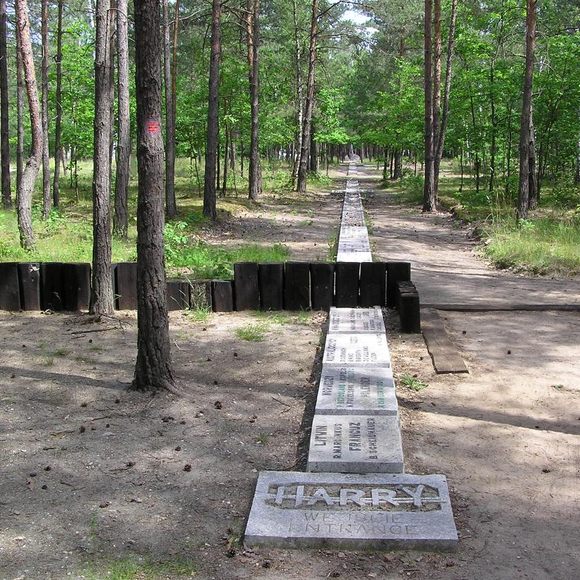
The route of the Harry tunnel from above

March 25, 1944: What becomes known as "The Great Escape" takes place. For 3 men, it was a success. For 73 others, it was a failure.

Stalag Luft III was a prisoner-of-war camp set up by Nazi Germany in Sagan, Lower Silesia, within German borders. Due to the changing borders after the war, the town is now in Poland, and named Żagań. The name "Luft," meaning "Air," indicates that all the prisoners were survivors of Allied planes that had been shot down.

Having dug 3 tunnels, codenamed TomDick and Harry, 76 Allied prisoners escaped. All but 3 were quickly recaptured: Bram van der Stok of the Netherlands, and Norwegians Per Bergsland and Jens Müller. van der Stok, due to his language skills and contacts with the French resistance, found safety with the British consulate in neutral Spain. The 2 Norwegians made it to neutral Sweden by train and boat, with the help of friendly sailors. But of the 73 men captured, the Nazis executed 50. Bergsland lived until 1992, van der Stock until 1993, Müller until 1999.

In 1950, Paul Brickell published the book The Great Escape, based on the story. In 1963, the book was adapted into a film. Only 3 of the 76 real escapees were Americans. But, given the nature of Hollywood, Americans were given starring roles in the film, some as foreigners.

*

March 25, 1944 was a Saturday. Baseball was in Spring Training. Football was out of season. The NBA hadn't been founded yet. One game was played in the Stanley Cup Playoffs: The Montreal Canadiens beat the Toronto Maple Leafs, 2-1 at Maple Leaf Gardens in Toronto.

England's Football League had suspended play for the duration of World War II, but there was another competition set up, known as the London Combination. In this, Reading FC, of Berkshire, beat Arsenal, 5-1 at White Hart Lane in Middlesex. (In 1963, the boundaries of London were redrawn so that White Hart Lane, home of Tottenham Hotspur, was now in North London. Arsenal's usual North London home, Highbury, had been appropriated by the government for the duration.)

Saturday, February 19, 2022

February 19, 1928: The Magic of Sonja Henie

February 19, 1928: Sonia Henie wins the Gold Medal in Ladies' Figure Skating at the Winter Olympics in St. Moritz, in the Swiss Alps.

"Ladies" may have been a bit of a stretch: She was only 15 years old.

Sonia Henie -- apparently, her entire birth name -- was born on April 8, 1912, in Kristiana, the capital of Norway. The name of the city was changed to Oslo in 1925. Figure skating is an expensive sport to pursue, but her father, Wilhelm Henie was a wealthy furrier.

Just as importantly, he was an athlete, a world cycling champion in 1894, and he encouraged his children, Sonja and her older brother Leif, to take up sports. Sonia did well in tennis, swimming and equestrian events. But skating was where he true talent lay, and after seeing the great Russian ballerina Anna Pavlova perform in London, she tried to pattern her skating style after her. At the 1st Winter Olympics, in Chamonix, France in 1924, she finished 8th -- and she was only 11 years old.

More than any other region, the Alps have hosted the Winter Olympics: France, Chamonix in 1924, Grenoble in 1968, and Albertville in 1992; Switzerland, St. Moritz in 1928 and 1948; Germany, Garmisch-Partenkirchen in 1936; Italy, Cortina d'Ampezzo in 1956 and Turin in 2006; and Austria, Innsbruck in 1964 and 1976. Indeed, except for Lake Placid, New York, in the U.S. in 1932, the Winter Games wouldn't be held outside the Alps until 1952, when they were held in Henie's hometown of Oslo.

For the 1928 Winter Games, the Opening Ceremony, on February 11, was hit by a blizzard. Then the opposite happened: The weather quickly warmed up, causing lots of problems, as most events were still outdoors.

Out of a possible 14 events, the U.S. won 2 Gold Medals: In the now-defunct event of the 5-man bobsled, and in the later-discontinued, since-restored event of skeleton, won by Jennison Heaton. In each case, Americans also won the Silver Medal. Switzerland won just 1 medal, a Bronze, which remains the worst performance ever by a host nation at an Olympic Games, Summer or Winter. Norway led the way with 15 Medals, 6 of them Gold, including Henie's.

Henie would also win in 1932, in Lake Placid; and in 1936, in Garmisch-Partenkirchen. Later in 1936, she starred in the film One In a Million, and made a living in professional skating shows and, for all intents and purposes, playing herself in movies, for which she was paid as much as anybody in Hollywood. The surviving footage shows that her moves would now be considered rather basic; but, at the time, nobody had ever seen anything like it.
j
As a European celebrity of the 1930s, she made the acquaintance of the various national leaders of the time, including the Chancellor of Nazi Germany, Adolf Hitler, who was rather taken with her, and once gave her a photograph with an autograph and a long inscription. In spite of this, and in spite of her match for the Nordic physical ideal, there is no evidence that she ever accepted the Nazi philosophy.

She married 3 times, but had no children. Her 1st husband was Dan Topping, but she divorced him shortly after he became a part-owner of baseball's New York Yankees. Her 3rd husband was a Norwegian shipping magnate, Niels Onstad, and, together, they built a substantial art collection. She died of leukemia on October 12, 1969, only 57 years old.

*

February 19, 1928 was a Sunday. Baseball and football were out of season. Professional basketball barely existed. There were 2 games in the NHL. The Boston Bruins beat the New York Rangers, 2-0 at the new building that would eventually be known as "the old Madison Square Garden." And the Chicago Black Hawks beat the Detroit Cougars, the team that would become known as the Detroit Red Wings, 2-1 at the Olympia Stadium in Detroit.

Friday, February 18, 2022

February 18, 1994: The Redemption of Dan Jansen

February 18, 1994: Dan Jansen, the American speed skater who fell in 2 different races in the 1988 Winter Olympics in Calgary, and staying on his feet but winning no medal in 1992 in Albertville, France, writes a happy ending, winning the Gold Medal in the 1,000 meters in Lillehammer, Norway.

He was inspired to try speed skating by his sister, Jane. In 1984, in the Winter Olympics in Sarajevo, Yugoslavia (now in Bosnia), he finished 4th in the 500 meters. He won a Gold Medal at the World Sprint Championships in 1988, leading up to the Olympics in Calgary. He looked ready.

But Jane had leukemia. On the morning of February 14, 1988, the day of the 500 meters, he was told she was dying. He spoke to her over the phone for the last time. She died a few hours later, and he found out shortly before the race. He fell in the first turn. Four days later, in the 1,000-meter race, he began with record-breaking speed, but fell again, just past the 800-meter mark. He left the 1988 Olympics with no medals but became the recipient of the U.S. Olympic Spirit Award for his valiant efforts.

In 1992, he tried again. He stayed on his feet, but could do no better than 4th, in the 500 meters. IN 1993, at the World Championships, he won the 500 meters in world record time. In 1994, he won his second World Sprint Championship title. He arrived in Lillehammer looking like a medal challenger.

In the 500-meter event, he finished 8th. He had 1 last chance, in the 1,000 meters, not his best event. But he defied expectations and finished 1st, setting a new world record. He not only got his one and only Olympic Medal, it was Gold. He was chosen by his fellow Olympians to bear the U.S. flag at the Closing Ceremony. At the end of the year, he was given the James E. Sullivan Award, as the year's outstanding U.S. amateur athlete.

*

February 18, 1994 was a Friday. Baseball and football were out of season. There were 9 games played in the NBA:

* The New Jersey Nets beat the Washington Bullets, 113-110 at the USA Arena (formerly the Capital Centre) in the Washington suburb of Landover, Maryland. Kenny Anderson scored 42 points for the Nets.

* The Milwaukee Bucks beat the Charlotte Hornets, 106-99 at the Charlotte Coliseum.

* The Orlando Magic beat the Seattle SuperSonics, 124-93 at the Orlando Arena. Shaquille O'Neal scored 38 points and grabbed 20 rebounds.

* The Denver Nuggets beat the Chicago Bulls, 109-84 at the Chicago Stadium.

* The Cleveland Cavaliers beat the Minnesota Timberwolves, 85-78 at the Target Center in Minneapolis.

* The Phoenix Suns beat the Los Angeles Lakers, 113-96 at the America West Arena (now the Mortgage Matchup Center) in Phoenix.

* The Atlanta Hawks beat the Los Angeles Clippers, 97-91 at the Los Angeles Memorial Sports Arena.

* The Sacramento Kings beat the Utah Jazz, 90-81 at the ARCO Arena in Sacramento.

* And the Portland Trail Blazers, 109-93 at the Portland Memorial Coliseum.

There were 9 games played in the NHL:

* The New York Rangers beat the Ottawa Senators, 3-0 at Madison Square Garden

* The New York Islanders lost to the Washington Capitals, 3-1 at the USAir Arena (formerly the Capital Centre) in the Washington suburb of Landover, Maryland.

* The Buffalo Sabres beat the Florida Panthers, 4-1 at the Buffalo Memorial Auditorium.

* The Detroit Red Wings beat the Edmonton Oilers, 5-1 at the Joe Louis Arena in Detroit.

* The St. Louis Blues beat the Boston Bruins, 3-1 at the St. Louis Arena.

* The Chicago Blackhawks beat the Winnipeg Jets, 7-2 at the Winnipeg Arena.

* The Dallas Stars beat the Calgary Flames, 4-2 at the Reunion Arena in Dallas.

* The Quebec Nordiques beat the Mighty Ducks of Anaheim, 1-0 at the Arrowhead Pond of Anaheim (now the Honda Center).

* And the Philadelphia Flyers beat the Los Angeles Kings, 4-3 at The Forum outside Los Angeles in Inglewood, California.

Friday, January 21, 2022

January 22, 1892: The Origin of Edvard Munch's "The Scream"

January 22, 1892: Norwegian painted Edvard Munch, in Nice on the French Riviera, writes this in his diary:
One evening I was walking along a path, the city was on one side and the fjord below. I felt tired and ill. I stopped and looked out over the fjord – the sun was setting, and the clouds turning blood red. I sensed a scream passing through nature; it seemed to me that I heard the scream. I painted this picture, painted the clouds as actual blood. The color shrieked. This became The Scream.
He later described his inspiration for the image:
I was walking along the road with two friends – the sun was setting – suddenly the sky turned blood red – I paused, feeling exhausted, and leaned on the fence – there was blood and tongues of fire above the blue-black fjord and the city – my friends walked on, and I stood there trembling with anxiety – and I sensed an infinite scream passing through nature.
Munch (pronounced like "moonk") was born on December 12, 1863 in Ådalsbruk, Norway, a country which was then under Swedish control; and grew up in Kristiana, which became the national capital under the name Oslo upon breaking from Sweden in 1905. By that point, his place in art history was assured.

Tuberculosis killed his mother when he was 3 years old, and his sister when he was 13. His father, a doctor, was so deeply religious that Edvard thought him mentally ill, writing, "From him I inherited the seeds of madness. The angels of fear, sorrow, and death stood by my side since the day I was born." 

Although he did well in college, he dropped out to attend an art school, against his father's protest that art was "an unholy trade." He was first inspired by the Impressionists, but when he saw the work of Paul Gaugin (and the as-yet-largely-unknown Vincent van Gogh), he became, like them, a Post-Impressionist. The Scream definitely shows a use of color that van Gogh, had he lived beyond 1890, would have understood as being influenced by his own.

Munch's 1886 painting The Sick Child was a tribute to his dead sister Johanne Sophie. In 1889, he painted his surviving sister in Inger on the Beach. Later that year, his father died, and, rather than feeling relief that his harshest critic was gone, he fell into a depression: "I live with the dead -- my mother, my sister, my grandfather, my father… Kill yourself and then it's over. Why live?"

In 1891, his painting Melancholy was displayed at the Autumn Exhibition in Oslo. The following year, having already been inspired to paint The Scream, he was invited to be the first artist to have a one-man exhibition at the Union of Berlin Artists. It stirred up such emotion, some positive, some negative, that it closed after one week: "Never have I had such an amusing time. It's incredible that something as innocent as painting should have created such a stir."
In 1889, at the Universal Exposition in Paris, the World's Fair that introduced the Eiffel Tower, a mummy from Peru was on display. Its hands raised to its head, and its open jaw, may have been seen by Munch, and served as the inspiration for the pose of the figure in The Scream.

As for the intensity of the red: Since Munch wrote, "One evening... " without specifying a year, the evening could have been in 1883 or 1884, after the world's skies had been darkened by the eruption of the volcano Kraktoa, in the Dutch East Indies, now Indonesia. Enough ash was thrown into the air to create a "volcanic winter." Temperatures all over the world dropped in 1883 and 1884. It also created more rainfall than the world was used to: The California cities of Los Angeles and San Diego received the most rain in their respective histories.

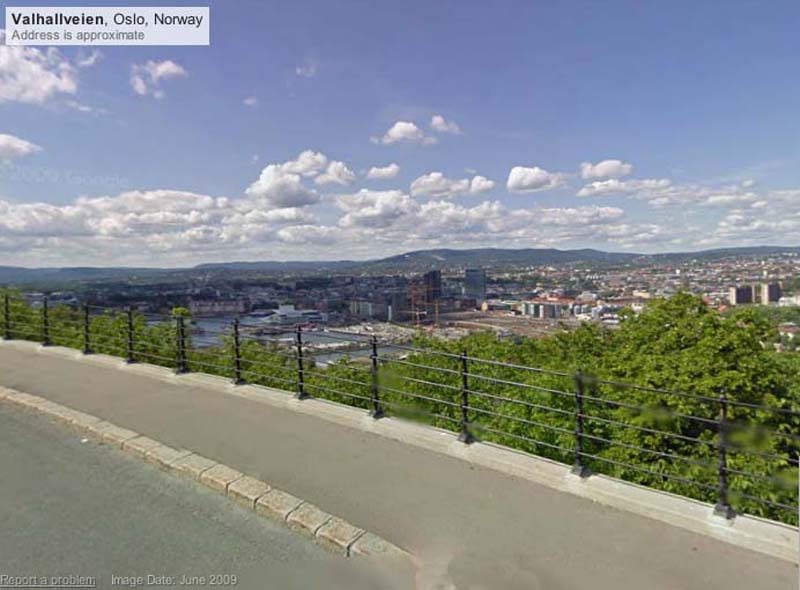
The location is believed to be an overlook on the side of a road called "Valhallveien," on a hill above Oslo. The hill is known as Ekeberg Hill, about 2 miles southeast of downtown. The winding road up to the park on the top of Ekeberg Hill was a popular place for citizens of Oslo to view the city. The hill and park were also popular places for Oslo artists to paint.
A recent photo

The painting has been called a symbolization of the anxieties of humanity in the 19th Century: It had seen the Napoleonic Wars; frequent revolutions; wars of colonialism in which the European powers had conquered "backward" natives of Africa and Asia, but still took the occasional shocking defeat from them, as Britain did at Meerut in India in 1857, Isandlwana in South Africa in 1879, and Khartoum in the Sudan in 1885; the unifications of Italy in 1860 and Germany in 1871, which upset many social orders; a worldwide "Long Depression" caused by the American stock market's Panic of 1873, and lasted until 1879; the aforementioned eruption of Krakatoa, and the environmental issues it caused; and the Industrial Revolution, which was making some men rich (or richer), but making the lives of poor people miserable, through brutally hard jobs or eliminating altogether the jobs they already had.

The painting was indicative of Munch's work from then on, including his series Frieze of Life -- A Poem about Life, Love and Death, which he began in 1893, after The Scream was first exhibited. He wrote, "No longer should interiors be painted, people reading and women knitting: there would be living people, breathing and feeling, suffering and loving."

In 1897, he returned to Oslo, where he was celebrated. He had a mental breakdown in 1908, and this caused him to give up drinking, and to paint more optimistic images. He survived both World War I (writing, "All my friends are German but it is France I love") and a bout with the Spanish Flu epidemic at its end, but not the Nazi takeover of Norway in 1940: He died at his house in Ekely, near Oslo, on January 23, 1944, at age 80.

Journalist Arthur Lubow called The Scream "A Mona Lisa for our time." Like Leonardo da Vinci's 1506 Mona Lisa, it has been endlessly parodied and homaged. Pop psychologist Arthur Janov put it on the cover of his 1970 book The Primal Scream. Macaulay Culkin's screaming pose in the 1990 film Home Alone has been compared to it. The Ghostface mask from the Scream movies that began in 1996 is a direct homage. So is the Internet's "scream emoji": 😱 

Munch painted 4 versions of The ScreamToday, the original version is in Norway's National Gallery. Another is in the Munch Museum. Both are in Oslo.

*

January 22, 1892 was a Friday. Baseball and football were out of season. Hockey was still all-amateur. And the sport of basketball had been invented only 1 month earlier. So there were no scores on this historic day.

December 31, 1999 & January 1, 2000: The Millennium

December 31, 1999:  The Millennium arrives. The people of planet Earth survived. At a terrible cost. But we hadn't destroyed ourselves. ...