
January 22, 1892: Norwegian painted Edvard Munch, in Nice on the French Riviera, writes this in his diary:
He later described his inspiration for the image:
Munch (pronounced like "moonk") was born on December 12, 1863 in Ådalsbruk, Norway, a country which was then under Swedish control; and grew up in Kristiana, which became the national capital under the name Oslo upon breaking from Sweden in 1905. By that point, his place in art history was assured.
Tuberculosis killed his mother when he was 3 years old, and his sister when he was 13. His father, a doctor, was so deeply religious that Edvard thought him mentally ill, writing, "From him I inherited the seeds of madness. The angels of fear, sorrow, and death stood by my side since the day I was born."
Although he did well in college, he dropped out to attend an art school, against his father's protest that art was "an unholy trade." He was first inspired by the Impressionists, but when he saw the work of Paul Gaugin (and the as-yet-largely-unknown Vincent van Gogh), he became, like them, a Post-Impressionist. The Scream definitely shows a use of color that van Gogh, had he lived beyond 1890, would have understood as being influenced by his own.
Munch's 1886 painting The Sick Child was a tribute to his dead sister Johanne Sophie. In 1889, he painted his surviving sister in Inger on the Beach. Later that year, his father died, and, rather than feeling relief that his harshest critic was gone, he fell into a depression: "I live with the dead -- my mother, my sister, my grandfather, my father… Kill yourself and then it's over. Why live?"
In 1891, his painting Melancholy was displayed at the Autumn Exhibition in Oslo. The following year, having already been inspired to paint The Scream, he was invited to be the first artist to have a one-man exhibition at the Union of Berlin Artists. It stirred up such emotion, some positive, some negative, that it closed after one week: "Never have I had such an amusing time. It's incredible that something as innocent as painting should have created such a stir."

In 1889, at the Universal Exposition in Paris, the World's Fair that introduced the Eiffel Tower, a mummy from Peru was on display. Its hands raised to its head, and its open jaw, may have been seen by Munch, and served as the inspiration for the pose of the figure in The Scream.
As for the intensity of the red: Since Munch wrote, "One evening... " without specifying a year, the evening could have been in 1883 or 1884, after the world's skies had been darkened by the eruption of the volcano Kraktoa, in the Dutch East Indies, now Indonesia. Enough ash was thrown into the air to create a "volcanic winter." Temperatures all over the world dropped in 1883 and 1884. It also created more rainfall than the world was used to: The California cities of Los Angeles and San Diego received the most rain in their respective histories.
The location is believed to be an overlook on the side of a road called "Valhallveien," on a hill above Oslo. The hill is known as Ekeberg Hill, about 2 miles southeast of downtown. The winding road up to the park on the top of Ekeberg Hill was a popular place for citizens of Oslo to view the city. The hill and park were also popular places for Oslo artists to paint.
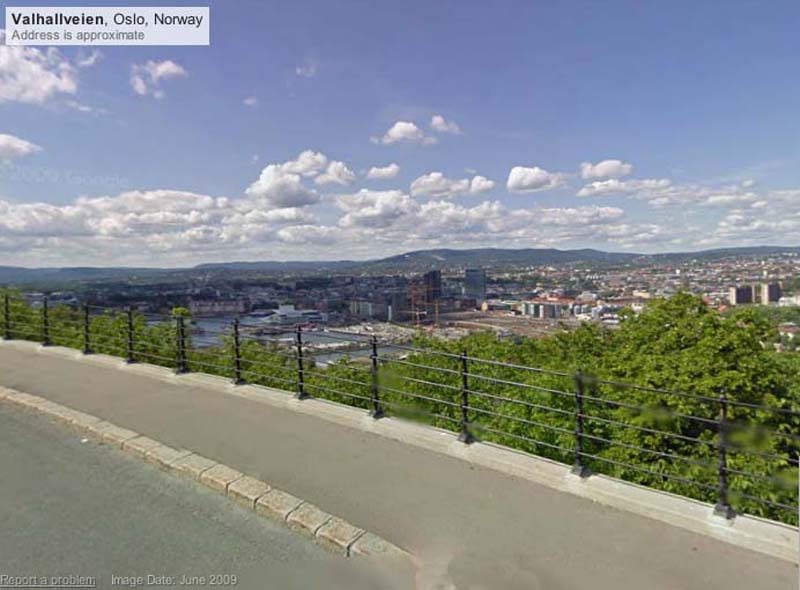
A recent photo
The painting has been called a symbolization of the anxieties of humanity in the 19th Century: It had seen the Napoleonic Wars; frequent revolutions; wars of colonialism in which the European powers had conquered "backward" natives of Africa and Asia, but still took the occasional shocking defeat from them, as Britain did at Meerut in India in 1857, Isandlwana in South Africa in 1879, and Khartoum in the Sudan in 1885; the unifications of Italy in 1860 and Germany in 1871, which upset many social orders; a worldwide "Long Depression" caused by the American stock market's Panic of 1873, and lasted until 1879; the aforementioned eruption of Krakatoa, and the environmental issues it caused; and the Industrial Revolution, which was making some men rich (or richer), but making the lives of poor people miserable, through brutally hard jobs or eliminating altogether the jobs they already had.
The painting was indicative of Munch's work from then on, including his series Frieze of Life -- A Poem about Life, Love and Death, which he began in 1893, after The Scream was first exhibited. He wrote, "No longer should interiors be painted, people reading and women knitting: there would be living people, breathing and feeling, suffering and loving."
In 1897, he returned to Oslo, where he was celebrated. He had a mental breakdown in 1908, and this caused him to give up drinking, and to paint more optimistic images. He survived both World War I (writing, "All my friends are German but it is France I love") and a bout with the Spanish Flu epidemic at its end, but not the Nazi takeover of Norway in 1940: He died at his house in Ekely, near Oslo, on January 23, 1944, at age 80.
Journalist Arthur Lubow called The Scream "A Mona Lisa for our time." Like Leonardo da Vinci's 1506 Mona Lisa, it has been endlessly parodied and homaged. Pop psychologist Arthur Janov put it on the cover of his 1970 book The Primal Scream. Macaulay Culkin's screaming pose in the 1990 film Home Alone has been compared to it. The Ghostface mask from the Scream movies that began in 1996 is a direct homage. So is the Internet's "scream emoji": 😱
Munch painted 4 versions of The Scream. Today, the original version is in Norway's National Gallery. Another is in the Munch Museum. Both are in Oslo.
*
January 22, 1892 was a Friday. Baseball and football were out of season. Hockey was still all-amateur. And the sport of basketball had been invented only 1 month earlier. So there were no scores on this historic day.


No comments:
Post a Comment