Showing posts with label highbury. Show all posts

Monday, November 14, 2022

November 14, 1934: The Battle of Highbury

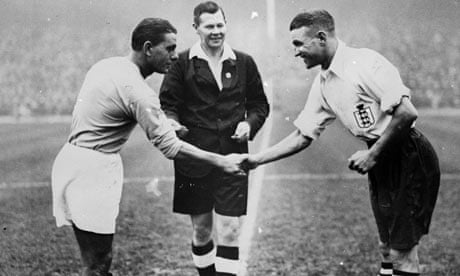
Left to right: Italy Captain Attilio Ferraris,
referee Otto Olsson, England Captain Eddie Hapgood

November 14, 1934: The most-hyped soccer game ever to that point is played. And, while the competition lived up to the hype, everything else was horrible.

In 1928, a dispute with the governing body of world soccer, the Fédération internationale de Football Association (FIFA), England left their jurisdiction. The other "home nations" of the United Kingdom of Great Britain and Northern Ireland -- Wales, Scotland and Northern Ireland -- followed suit. (To this day, I don't know why they compete as a single united kingdom in the Olympics Games, but, for every other event, the home nations each have their own separate teams.)

This made the home nations ineligible to play in FIFA's signature tournament, the World Cup, which began in 1930, with Uruguay winning on home soil. The 1934 tournament would be the 1st held in Europe, in Italy, then ruled by fascist dictator Benito Mussolini. With a team dominated by players from Juventus FC of Turin and FC Internazionale Milano of Milan, Italy won it.

But England, which "invented football" (at the least, it did so in an organized way), still thought it had the best team in the world. So they challenged Italy in a game to decide "the real world championship." Italy accepted. The game would be in England, so Mussolini couldn't use his authority to cheat. But he did offer an incentive: If they won, each player would receive a new Alfa Romeo car and a cash prize which, converted into 2022 U.S. money, was about $7,000, a pretty good figure during the Great Depression..

Italy manager Vittorio Pozzo sent out this lineup (with neither side wearing uniform numbers):

* Goalkeeper: Carlo Ceresoli of Inter. This was a change from the World Cup, where his keeper, and his Captain, was Gianpiero Combi of Juventus.
* Right Back: Eraldo Monzeglio of Bologna FC.
* Left Back: Luigi Allemandi of Inter.
* Right Half: Attilio Ferraris of SS Lazio of Rome, Italy's Captain for this game.
* Center Half: Luis Monti of Juventus.
* Left Half: Luigi Bertolini of Juventus.
* Outside Right: Enrique Guaita of AS Roma of Rome.
* Inside Right: Pietro Serantoni of Juventus.
* Center Forward: Giuseppe Meazza of Inter. He had been the inside right in the World Cup, but was moved to center forward for this game, replacing Angelo Schiavio of Bologna. The Milan stadium used by both Inter and AC Milan, known worldwide as the San Siro for its neighborhood, is officially named for Meazza, as he was the greatest Italian player of his generation.
* Inside Left: Giovanni Ferrari of Juventus.
* Outside Left: Raimundo Orsi of Juventus.

At the time, England did not have a "manager" as we now understand that term. Essentially, the team Captain was the head coach. Rather, a board of directors selected the starting eleven:

* Goalkeeper: Frank Moss of Arsenal FC. Arsenal, of North London, were the dominant team in England in the 1930s, winning 5 Football League titles and 2 FA Cups.
* Right Back: George Male of Arsenal.
* Left Back: Eddie Hapgood of Arsenal. So respected by his peers was Hapgood that he was named Captain of his country before he was named Captain of his club: Arsenal's Captain at the time was the great Scottish forward Alex James.
* Right Half: Cliff Britton of Everton FC, based in Liverpool.
* Center Half: Jack Barker of Derby County FC, in the East Midlands.
* Left Half: Wilf Copping of Arsenal. A purely defensive player, he never scored a goal for Arsenal. But he was the most feared player in the league. Not that he was dirty: Not once was he ever booked for a foul. (This was before Mike Riley, a known Arsenal hater, was in charge of English referees.)
* Outside Right: Stanley Matthews of Stoke City FC. At 19, he was the youngest player on the team. He would eventually become the grand old man of English football, playing for Stoke in Division One at age 50. In between tenures at Stoke, he would play for Lancashire side Blackpool FC. Playing his career for struggling teams, "The Wizard of Dribble" only won 1 trophy in his career, the 1953 FA Cup. In that game, his teammate Stan Mortensen became the 1st, and remains the only, player to score 3 goals in an FA Cup Final. And yet, the game is still called "The Matthews Final," such was his dominance of the game.
* Inside Right: Ray Bowden of Arsenal.
* Center Forward: Ted Drake of Arsenal. Recently acquired from Hampshire team Southampton FC, he became the top scorer in the country. The following year, he would tie the League record by scoring 7 goals against Birmingham team Aston Villa.
* Inside Left: Cliff Bastin of Arsenal. Normally an outside left, he would score 178 goals for "The Gunners," a team record that would last until surpassed by Ian Wright in 1997. He finished with 185, which was surpassed by Thierry Henry with 228.
* Outside Left: Eric Brook of Manchester City FC.

Seven players from Arsenal. It remains the only time 1 team has had 7 players in the England starting XI. So the match was set for Arsenal's home, Arsenal Stadium, known for its neighborhood as "Highbury." Although having little experience at the international level, these players were battle-tested in the toughest league in the world.

The referee was Otto Olsson, of Sweden. The crowd was given as 56,044 people. England wore white shirts and navy blue shorts, while Italy wore sky blue shirts and white shorts.

But when the game began at 3:00 on that Wednesday afternoon -- 10:00 in the morning, U.S. Eastern Time -- it was pouring rain, and the rain continued throughout the game. And the Italians were dirty from the outset. In only the 1st minute of the game, Drake had a one-on-one with Ceresoli, who crashed into him. Olsson awarded a penalty, but it was taken by Brook, who missed it.

Just a minute later, Monti tackled Drake, and broke his own foot in the process. A minute later, Brook headed in a cross from Matthews, and it was one-nil to England. Shortly thereafter, Hapgood took an elbow to the face, breaking his nose. In the 10th minute, Brook fired a free kick that Matthews said was "like a thunderbolt." It was 2-0 England. Just 2 minutes later, Drake made it 3-0. It looked like a wipeout.

By the 15-minute mark, both Monti and Hapgood had to leave the pitch. Both sides were down to 10 men. Pozzo changed tactics, and the Italian defense got tighter. And dirtier: Drake was punched, Brook's arm was broken, and Bowden got his ankle hurt. Olsson booked none of these offenses.

The Italians kept their tactics up in the 2nd half, and the tide of the game turned. Meazza scored twice within 4 minutes on either side of the hour mark. He fought hard for an equalizer, denied by saves from Moss and once hitting the post. When Olsson blew his whistle for full-time, it was still England 3, Italy 2.

England claimed to be the true world champions, their "gentlemen" having defeated the World Cup winners at their dirtiest, in a match that Matthews, whose length and greatness of career can be compared to American baseball pitcher Nolan Ryan and Canadian hockey player Gordie Howe, called it the most violent match in which he had ever played.

But Italy received its players as heroes. Recognizing that they had played under completely unfavorable conditions, they were hailed as "The Lions of Highbury." Mussolini, not bound by his promise because of the defeat, followed through anyway, giving the players the cash prizes and the cars.

Ceresoli lived until 1995, making him the last surviving Italian player from this game. Matthews was the game's last survivor, living until February 23, 2000.

Italy would repeat as World Cup winners in 1938. World War II canceled the World Cup of 1942, and the inability to set up qualifying matches because the European phase of the war didn't come until 1945 forced the cancellation of the 1946 edition. FIFA and the British home nations settled their differences, and England entered the 1950 World Cup, but failed until hosting the tournament in 1966. That remains the only international tournament that England have ever won. Italy have won the World Cup again in 1982 and 2006; and the UEFA European Championships of 1968 and 2020.

*

November 14, 1934 was a Wednesday. Baseball season was over. Football was in midweek. The NBA hadn't been founded yet. And no games were scheduled for the NHL. So there were no other scores on this historic day.

Tuesday, November 1, 2022

November 1, 1939: "The Arsenal Stadium Mystery" Premieres

George Allison delivering his pregame team talk

November 1, 1939: The Arsenal Stadium Mystery premieres. It is the 1st feature film set around a major professional sports team in the British Isles. Thorold Dickinson directed. He had become known for directing musicals, and would go on to direct John Gielgud as Benjamin Disraeli in The Prime Minister.

From 1930 to 1938, 9 seasons, Arsenal Football Club, based at the Arsenal Stadium, a.k.a. Highbury for its neighborhood in North London, had won 5 Football League Division One titles (1931, '33, '34, '35 and '38, and just missing in '32 and '37) and 2 FA Cups (1930 and '36, losing the Final in '32). Herbert Chapman was the manager who built this team. Upon his death in 1934, George Allison was appointed manager, and kept it going.

The story involves Arsenal FC playing an exhibition game, or a "friendly" as it's known in soccer, against the Trojans, a fictional amateur team that appears to have a decent-sized following. Arsenal's last League game of the 1938-39 season, a 2-0 win over West London team Brentford, was filmed for this movie.

Before the game, Allison is shown addressing the players in the dressing room, but none of the players has a speaking part in the film. While right back George Male, as usual during that season, served as Captain, he also served as the head coach, as Allison usually watched the game from the press box. In this film, he is shown sitting next to a radio announcer, played by E.V.H. (Edward Victor Henry) Emmett, in real life a commentator for a film newsreel, Gaumont British News.

Alf Kirchen scored in the 1st half, and Ted Drake added a goal in the 2nd half. Both goals were shown in the finished film. At halftime, Allison tells Emmett, "One-nil to The Arsenal. That's just the way we like it." The phrase "One-nil to The Arsenal" stuck in fans' minds, and, in the 1993-94 season, when it seemed like, if Arsenal won at all, it was by a 1-0 score, including in the European Cup Winners' Cup Final, they starting singing "One-nil, to The Arsenal!" to the tune of "Go West," a Village People song that had recently been covered by British pop duo Pet Shop Boys.

But, within the story of the film, halftime saw one of the Trojans players drop dead. The Arsenal team doctor determines that he has been poisoned, and suspicion falls on various people, including his teammates, and his former mistress -- who, before the film ends, also ends up poisoned. Detective Inspector Slade, played by Leslie Banks, must solve the crime. The culprit does turn out to be one of the other Trojans players.

Allison remained Arsenal manager until 1947, and lived until 1957. Emmett lived until 1971. Banks only made it until 1952.

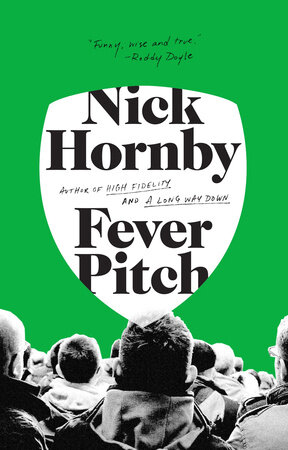
Arsenal would again be the subject of a feature film in 1997, Fever Pitch, based on the memoir of teacher turned author Nick Hornby. That film goes back and forth between his childhood (first 1968, then 1972) and the 1988-89 season, when Arsenal struggled to stay on top of the League, finally winning it in a dramatic finale against Liverpool FC.

In 2006, Arsenal moved into the Emirates Stadium, about half a mile west of Highbury. The stadium's historic North Bank and southern Clock End were demolished, and its East and West stands were converted into apartments.

*

November 1, 1939 was a Wednesday. Actress Barbara Bosson was born.

England had already suspended Football League play for the duration of World War II, and wouldn't have been playing on a Wednesday, anyway, barring a backup of postponements. In North America, baseball season was over. Football was in midweek. The NBA hadn't been founded yet. And the NHL season didn't start until the next day. So there were no scores on this historic day.

Wednesday, October 26, 2022

October 26, 1938: England vs. The Rest of Europe & Hockey Comes to TV

Tommy Lawton

October 26, 1938: The Arsenal Stadium, a.k.a. Highbury after its North London neighborhood, hosts a match between the England national team and a team representing "The Rest of Europe." The game commemorates, on the actual anniversary day, the 75th Anniversary of the founding of the Football Association. A crowd of 40,185, including King George VI, sees England win 3-0. It was the 2nd full England match to be shown live on British television.

The England team consisted of Arsenal's left back Eddie Hapgood (Captain) and left half Wilf Copping, Chelsea's goalkeeper Vic Woodley, Tottenham's right back Bert Sproston and inside right Willie Hall, Huddersfield's right half Ken Willingham, Wolverhampton Wanderers' centre half (and future title-winning manager) Stan Cullis, Stoke City's outside right Stanley Matthews, Everton's centre forward Tommy Lawton and outside left Walter Boyes, and West Ham United's inside left Len Goulden. Hall, Lawton and Goulden scored.

The Rest of Europe team included 5 players from recent World Cup winners Italy, 2 Germans, a Frenchman, a Belgian, a Hungarian, and a Norwegian. Only 1 of the 5 Italians was on the forward line, so even then, Italy was a defense-first footballing nation. It was Silvio Piola, considered too young for their 1934 World Cup winners, but starred on the 1938 version while playing his club soccer for Lazio in Rome. The Belgian, Ray Braine, was his country's 1st professional footballer, when he signed for Sparta Prague -- not in his own country, which had yet to allow professionalism, but in Czechoslovakia -- in 1930.
Ray Braine

The last survivor of each team was Cullis, who lived until 2001; and Pietro Rava of Italy and Juventus, who lived until 2006.

Also on this day, for the 1st time, an ice hockey match is televised. Oddly, this does not occur in Canada, or in America, or in any of the European nations that we now associate with the game, such as Russia or Sweden. It is in England, on the BBC, between Harringay Racers of North London and Streatham Redskins of South London. The broadcaster, at least, was a Canadian: Winnipeg-born Stuart MacPherson.

I don't have a record of the result, although Harringay finished ahead of Streatham in the English National League in the 1938-39 season. Harringay won it the preceding season, 1937-38, and Streatham had won it in 1934-35. Harringay folded in 1957, and have since been replaced by a new team using the name. Streatham are still in business.

In 1940, New York station W2XBS (forerunner of WNBC-Channel 4) would become the 1st TV station to broadcast an NHL game, a 6-2 New York Rangers win over the Montreal Canadiens at the old Madison Square Garden. Just 3 days after that, they would broadcast the 1st televised basketball game, also at the old Garden. That station had already done, all in New York City in 1939, the 1st TV broadcasts of baseball, at Ebbets Field; college football, at Columbia University's Baker Field; and the NFL, at the Polo Grounds.

In 1952, CBC would bring Hockey Night In Canada from radio to TV, and it quickly became, and remains, Canada's favourite (that's how it's "spelt" up there) TV show. But the U.S. -- ABC/ESPN, NBC and Fox have all tried -- has never really gotten hockey broadcasts right. "Glow puck," anyone?

*

October 26, 1938 was a Wednesday. Baseball season was over. Football was in midweek. The NBA hadn't been founded yet. And the NHL season wouldn't start for another 8 days. So there were no other scores on this historic day.

Friday, September 16, 2022

September 16, 1937: The 1st Soccer Game on TV

September 16, 1937: For the 1st time, a soccer game is shown on TV. It is the Arsenal first team for the Arsenal Reserves, at the Arsenal Stadium, a.k.a. Highbury, in North London.

Arsenal had won the Football League title in 1931, 1933, 1934 and 1935, won the FA Cup Final in 1930 and 1936, and lost it in 1932. But by 1937, they were in something of a transition. Manager George Allison saw his Captain, Alex James, retire. And Ray Bowden had been sold.

Allison still had legends like George Male, Eddie Hapgood, Jack Crayston, Herbie Roberts, Wilf Copping, Joe Hulme, Ted Drake and Cliff Bastin. And new players were brought up from the youth ranks, including the brothers Leslie and Denis Compton. Both had represented England at the senior level in cricket as well as in football (soccer), Les being better at football, Denis being better at cricket. Other new additions included Jack Crayston, Bernard Joy, and Alf Kirchen, who notably scored the goal in the 1938-39 League finale that was filmed for the movie The Arsenal Stadium Mystery.

But after winning their 1st 3 games easily, Arsenal went on a tailspin, winning only 2 of their next 12. And that 1937-38 season was hit hard by a rough Winter. In the 3rd Round of the FA Cup alone, snow caused 261 postponements, and that Round took 66 days to complete.

Arsenal got their act together: From January 29 to April 9, they won 7 games, drew 4, and lost only 2. But 1 of those losses was in the 5th Round of the Cup, to Lancashire team Preston North End, featuring Bill Shankly, who would lift Liverpool FC to glory in the 1960s and '70s.

Preston went on to defeat Huddersfield Town in the Final, the 1st Cup Final ever televised. The 93,000-strong Wembley crowd outnumbered British TV owners 10 to 1, but that didn't stop the Daily Herald from running the headline: "The day is not far off when you may be able to watch your favourite football team from your fireside."

Just 7 days later, the League had its final slate of games for the season. Birmingham-area team Wolverhampton Wanderers led Arsenal by 1 point, but lost away to defending Champions Sunderland, 1-0. Arsenal beat Manchester-area team Bolton Wanderers, 5-0, and had finished 1 point ahead of Wolves. Arsenal were Champions for the 5th time in 8 seasons, their 6th major trophy in 9. "Lucky Arsenal," the newspapers called them. Even then, the English media seemed to be aligned against the Gunners.

Arsenal finished 5th in 1938-39, and World War II began early in the 1939-40 season, causing the Football Association to suspend League and Cup play for the duration. By the time League play began for 1946-47, the older players from before were too old to contribute; and even the younger players brought up in 1937-38 seemed to have lost their touch during The War.

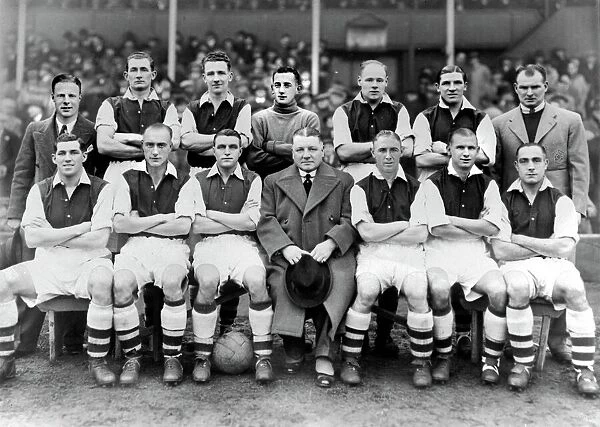
But a new manager, former Arsenal player and team physiotherapist Tom Whittaker, rebuilt quickly, and a new group won the League in 1948, won the Cup in 1950, finished 2nd in both in 1952, and won the League in 1953. (In the 1937-38 team photo above, Whittaker is in the suit in the upper right, while Allison is seated in the middle.)

However, football on English TV would not become common until the Premier League was started in 1992. Big games, like the FA Cup Final, would be shown live, but regular-season games would only be shown on tape delay, either hours later on the BBC's Match of the Day or the next day on ITV's The Big Match.

*

September 16, 1937 was a Thursday. Vince Naimoli, the 1st owner of baseball's Tampa Bay Rays (Devil Rays) was born. And these baseball games were played:

* The New York Yankees beat the Cleveland Indians, 8-0 at Yankee Stadium. Lefty Gomez pitched a 3-hit shutout. Lou Gehrig went 0-for-3 with a walk, and had an RBI on a sacrifice fly. Joe DiMaggio went 1-for-4 with a walk and an RBI.

* The New York Giants beat the Pittsburgh Pirates, 3-0 at Forbes Field in Pittsburgh. Cliff Melton pitched a 6-hit shutout. Mel Ott went 0-for-3 with a walk. For the Pirates, Paul Waner went 0-for-4, and Lloyd Waner went 1-for-4.

* A doubleheader was split at Crosley Field in Cincinnati. The Brooklyn Dodgers won the opener, 8-5. The Cincinnati Reds won the nightcap, 5-1.

* The Philadelphia Athletics beat the St. Louis Browns, 4-3 at Shibe Park in Philadelphia.

* The Washington Senators beat the Detroit Tigers, 7-6 at Griffith Stadium in Washington. Hank Greenberg went 1-for-4 with a walk.

* The Boston Bees (as the Braves were known from 1936 to 1940) beat the Chicago Cubs, 7-0 at Wrigley Field in Chicago. Rookie Jim Turner pitched a 7-hit shutout. Known as "The Milkman," because he delivered (like later basketball star Karl "The Mailman" Malone), Turner went on to win 20 games and lead the National League in ERA. Had there been a Rookie of the Year award at the time, he would have won it easily. In 1941, the Reds converted him to a reliever, and he helped the Yankees win Pennants in 1942 and 1943. He later became a renowned pitching coach.

* The St. Louis Cardinals swept a doubleheader from the Philadelphia Phillies, 6-2 and 8-1 at Sportsman's Park in St. Louis.

* And the Boston Red Sox and the Chicago White Sox were rained out at Fenway Park in Boston. Given the lateness of the season, travel issues, and the fact that the Yankees were running away with the American League Pennant, the game was never made up.

Monday, September 12, 2022

September 12, 1992: "Fever Pitch" Is Published

September 12, 1992: Fever Pitch: A Fan's Life is published, a memoir by Nick Hornby, less of his life in general to that point than a story of the evolution of his fandom for a sports team. It might be the best book ever written about being a fan of a particular team.

Hornby, then an English teacher in London, is a fan of Arsenal Football Club, a soccer team in North London. He told of following the team from the start of the 1968-69 season until just before publication, including the 1971 "Double" season (meaning that they won the Football League Division One and the Football Association Cup in the same season) and the next League title, which wasn't until 1989 -- 18 years.

The book made Hornby a best-selling author, and raised Arsenal's profile to the point where, already one of the most popular teams in England, they became one of the most popular teams in the world. But it also sparked a backlash against them, and they became one of the country's most hated teams as well.
Nick Hornby, posing outside Highbury
before the last match, May 9, 2006

Fever Pitch was made into a film in the United Kingdom, premiering on April 4, 1997, starring Colin Firth and Ruth Gemmell. The tagline was, "Life gets complicated when you love one woman and worship eleven men." This version, with Hornby writing the screenplay, followed a fictionalized version of Hornby during the epic 1988-89 season, with flashbacks to his youth in 1968 and 1972.

In the film, returning from Arsenal's 1-0 win over Newcastle United on April 15, 1989, Firth's Paul Ashworth and Gemmell's Sarah Hughes are watching the news reports of the Hillsborough Disaster, when a crowd crush in Sheffield led to the deaths of Liverpool fans -- 74 at the time of the report, rising to 95 at the time of the book's publication. A 96th victim was still in a coma at that time, and died the next year. In 2021, fan who had been injured in the crush died, and his death was ruled to have been caused by his 1989 injuries, thus making him the 97th victim.

Sarah says that football matches aren't safe, and she has a point. Paul says people will go back -- which they did, and stadiums were made significantly safer in response to the disaster. But she says he and the other fans she met had an unhealthy obsession with the sport, and she leaves him. She returns to him afterward, seeing the joy and the others he felt at winning the title, seeing that sport can heal.

But, for the moment, Paul was left to ruminate on what the sport was doing to his life. Hornby wrote, and Firth spoke:

Football has meant too much to me, and has come to represent too many things. See, after a while, it all gets mixed up in your head. You can't remember whether life's shit because Arsenal's shit, or if it's the other way around.

I've been to watch far too many games, and spent far too much money, fretted about Arsenal when I should have been fretting about something else. I've asked too much of the people I love.

Okay, I accept all that. Perhaps it's something you can't understand, unless you belong...

The great thing is, it comes again and again. There's always another season. You lose the Cup Final in May? Well, there's the 3rd Round to look forward to in January. And what's wrong with that? It's actually pretty comforting, if you think about it.

The United States version was adapted by Providence, Rhode Island-based filmmakers Peter & Bobby Farrelly, fans of New England's sports teams, including baseball's Boston Red Sox. They cast Jimmy Fallon, then a former star of NBC's Saturday Night Live, and not yet the host of a late-night talk show, now hosting The Tonight Show. Ironically, in real life, Fallon is a fan of the New York Yankees, the Red Sox' arch-rivals -- so this film proves that he really can act.

This version of the film follows the Red Sox in their own epic season, of 2004. To avoid confusion, this film was renamed The Perfect Catch for the British Isles market. The French-language version of the British film is titled Carton Juane -- "Yellow Card," which is what a referee shows a player as a warning. A red card is for a foul so bad, it requires the player to be immediately sent off, and getting a second yellow card in a single game is followed by a red card.

*

September 12, 1992 was a Saturday. Although Hornby's memoir celebrated Arsenal, the club did not hold up their end of the bargain, losing to Lancashire team Blackburn Rovers, 1-0 at Highbury in North London.

In American football, the day's slate of college games included these did not include a game by the team then ranked Number 1, the University of Miami, in Florida. They had the week off. But the slate included these games:

* Number 2 Washington beat Wisconsin, 27-10 at Husky Stadium in Seattle.

* Number 3 Notre Dame and Number 6 Michigan played to a 17-17 tie at Notre Dame Stadium in South Bend, Indiana.

* Number 4 Florida beat Kentucky, 35-19 at Ben Hill Griffin Stadium in Gainesville, Florida.

* Number 5 Florida State beat Number 15 Clemson, 24-20 at Memorial Stadium in Clemson, South Carolina.

* Number 7 Texas A&M beat the University of Tulsa, 19-9 at Kyle Field in College Station, Texas.

* Number 8 Alabama beat Southern Mississippi, 17-10 at Legion Field in Birmingham, Alabama.

* Number 9 Syracuse beat Texas, 31-21 at the Carrier Dome (now the JMA Wireless Dome) in Syracuse, New York.

* Number 10 Penn State beat Temple University, 49-8 at Beaver Stadium in State College, Pennsylvania.

* Number 14 Georgia were beaten by Number 20 Tennessee, 34-31 at Sanford Stadium in Athens, Georgia.

* Number 17 University of California were beaten by Purdue, 41-14 at Ross-Ade Stadium in West Lafayette, Indiana.

* Number 18 Mississippi State were beaten by Louisiana State (LSU), 24-3 at Tiger Stadium in Baton Rouge, Louisiana.

* Among the service academies, Army beat Holy Cross, 17-7 at Michie Stadium in West Point, New York; Navy lost to Number 23 Virginia, 53-0 at Navy-Marine Corps Memorial Stadium in Annapolis, Maryland; and Air Force lost to Hawaii, 6-3 at Aloha Stadium in Honolulu.

* And in New Jersey, Rutgers beat Colgate, 41-0 at Rutgers Stadium in Piscataway.

And these Major League Baseball games were played that day:

* The New York Yankees beat the Kansas City Royals, 11-9 at Yankee Stadium. Randy Velarde hit a home run. Don Mattingly went 4-for-4 with 3 RBIs. Bernie Williams went 4-for-5 with 2 RBIs.

* The New York Mets lost to the Montreal Expos, 4-1 at the Olympic Stadium in Montreal.

* The Detroit Tigers beat the Boston Red Sox, 9-5 at Fenway Park in Boston. Wade Boggs went 4-for-5 with an RBI.

* The Pittsburgh Pirates beat the Philadelphia Phillies, 9-7 at Veterans Stadium in Philadelphia. Barry Bonds went 1-for-4.

* The Milwaukee Brewers beat the Baltimore Orioles, 5-0 at Camden Yards in Baltimore. Jaime Navarro pitched a 5-hit shutout. Robin Yount went 1-for-4. Paul Molitor went 2-for-5. Cal Ripken went 0-for-4.

* The Cleveland Indians beat the Chicago White Sox, 5-3 at the new Comiskey Park (now Rate Field) in Chicago.

* The Minnesota Twins beat the California Angels, 7-2 at the Metrodome in Minneapolis.

* The St. Louis Cardinals beat their arch-rivals, the Chicago Cubs, 11-3 at Busch Memlorial Stadium in St. Louis.

* The Toronto Blue Jays beat the Texas Rangers, 4-2 at Arlington Stadium in the Dallas suburb of Arlington, Texas.

* The Atlanta Braves beat the Houston Astros, 9-3 at the Astrodome in Houston.

* The Cincinnati Reds beat the San Diego Padres, 7-4 at Jack Murphy Stadium in San Diego. Tony Gwynn did not play.

* The Los Angeles Dodgers beat their arch-rivals, the San Francisco Giants, 7-0 at Dodger Stadium. Pedro Astacio pitched a 6-hit shutout.

* And the Oakland Athletics beat the Seattle Mariners, 5-4 at the Oakland Coliseum. Neither Rickey Henderson nor Mark McGwire played for the A's in this game. Ken Griffey Jr. went 3-for-5 with an RBI.

Tuesday, September 6, 2022

September 6, 1913: The Arsenal Stadium Opens In Highbury

The stadium's final configuration, 1993-2006.
Note the words "ARSENAL STADIUM" on the East Stand,
even though most people called it "Highbury."

September 6, 1913: The Arsenal Stadium opens, in the Highbury section of North London. In time, the stadium itself will come to be called "Highbury." Woolwich Arsenal, who had played in South-East London since their founding in 1886, had come to North London because it would be easier for fans, and for other teams, to get to. Woolwich Arsenal defeat Leicester Fosse, 2-1, on a penalty kick by Archie Devine, following a late Leicester handball in the box.
Highbury, in its 1913-1932 configuration

At the conclusion of this 1913-14 season, the team's owner, Henry Norris, dropped the locality from the name, and the club officially became "Arsenal Football Club" -- to this day, unofficially called "The Arsenal," capital T, capital A, by many.

Along with Port Vale in Staffordshire, Arsenal are 1 of only 2 clubs in the Football League to not have a locality as part of their name. (Well, technically, "Arsenal" could be, but the club had long since outgrown their "works side" status.) Leicester Fosse would later become Leicester City, and are still in business.

Tottenham Hotspur, or "Spurs," based 4.7 miles away at White Hart Lane, which was then in Middlesex but would be in North London once city boundaries were redrawn, objected to the move, as they did when Chelsea Football Club were established in 1905, all the way across the city in West London. 

, yet again, flip out about a club invading "their territory," even though the new stadium, to be named Arsenal Stadium, but nicknamed "Highbury" after the neighborhood, is 4 1/2 miles away -- roughly as far away from White Hart Lane as Clapton Orient already were.

It should be noted that neither Clapton Orient (also about 4 1/2 miles away from White Hart Lane), nor West Ham United (in East London), nor Chelsea, nor any other London or quasi-London club objected to the Arsenal move. Just Spurs, whose fans, even today, claim, "North London is ours."

It isn't. It took Arsenal until 1930 to win a trophy, but, starting then, in a span of 9 seasons, they won 5 Football League titles -- compared to 2 for Spurs in their entire history -- and 2 FA Cups. This success allowed Arsenal to build a West Stand and an East Stand in that decade, in the Art Deco style.
View from the Clock End, of the 1936-1988 configuration,
with the singled-decked, roofed, all-standing North Bank

They won the League and the Cup in 1971, for their 1st "Double." They did that again in 1998 and 2002. In 1989, which would end up as another title-winning season, they put luxury boxes over their south side, the Clock End. In 1993, to comply with the Taylor Report's demand for all-seater stadiums, they opened a new, double-decked North Bank stand. In 2004, they completed an unbeaten Premier League season.

By that point, realizing that they could not expand Highbury beyond its all-seater capacity of 38,000, they had to build a new stadium. The Emirates Stadium opened half a mile away, and Highbury was closed on May 7, 2006, with a 5-2 win over Birmingham-area team West Bromwich Albion. The North Bank and the Clock End were demolished, but the East and West Stands were converted into an apartment complex called Highbury Square. Some former Arsenal players bought apartments there.

*

September 6, 1913 was a Saturday. In American football, the college season was 2 weeks away. But these baseball games were played:

* The New York Yankees lost to the Washington Senators, 9-1 at American League Park (later Griffith Stadium) in Washington. The Yankees only got 1 hit, by 1st baseman John Knight, off 3 Senator pitchers, none of whom was Walter Johnson.

* The Brooklyn Dodgers beat their arch-rivals, the New York Giants, 2-0 at the Polo Grounds. Ed Reulbach, a veteran of the Chicago Cubs' rivalry with the Giants, pitched a 3-hit shutout.

* The Boston Braves swept a doubleheader from the Philadelphia Phillies, 4-1 and 7-2 at the South End Grounds in Boston.

* The Philadelphia Athletics beat the Boston Red Sox, 9-2 at Shibe Park in Philadelphia. Eddie Collins went 2-for-4.. Tris Speaker went 3-for-4.

* The Pittsburgh Pirates beat the St. Louis Cardinals, 4-2 at Forbes Field in Pittsburgh. Honus Wagner went 2-for-4 with an RBI.

* The Cleveland Naps beat the Detroit Tigers, 3-1 at Navin Field in Detroit. Napoleon "Nap" Lajoie, the Cleveland team's 2nd baseman, best hitter, manager and namesake, went 0-for-3 with a walk. "Shoeless" Joe Jackson went 1-for-4. Ty Cobb went 0-for-3, but had an RBI on a groundout. The Naps were renamed the Indians in 1915 and the Guardians in 2022. Navin Field was renamed Briggs Stadium in 1938 and Tiger Stadium in 1961.

* The Chicago Cubs beat the Cincinnati Reds, 5-3 at the West Side Grounds in Chicago.

* And the St. Louis Browns beat the Chicago White Sox, 4-0 at Sportsman's Park in St. Louis. Roy Mitchell pitched a 5-hit shutout, to outpitch Christy Mathewson.

Sunday, July 3, 2022

July 3, 2001: Arsenal sign Sol Campbell

Sol Campbell with the FA Cup (in his right hand)
and the Premier League trophy (in his left)

July 3, 2001: Arsenal Football Club sign Sol Campbell. The centreback had been Captain of their North London arch-rivals, Tottenham Hotspur F.C., and had led "Spurs" to the 1999 League Cup. But, his contract having run out, he was not given any assurances by team management that they would bring in new talent to improve the team.

In contrast, Arsenal offered the 26-year-old East Londoner the chance to stay in London, and play Champions League games. After he had rejected all overtures by Spurs, and from European giants FC Barcelona, Internazionale Milano and Bayern Munich, Campbell signed with Arsenal. Spurs' Captain was now the rock of Arsenal's defense, ready to replace the aging team Captain, Tony Adams.

Tottenham fans were livid, turning as red as their rivals' shirts. Not with embarrassment, as they should have, but with rage.

Result? In his 1st season with Arsenal, they won the Premier League and the FA Cup -- the Double. 2nd season? The FA Cup again. 3rd season? An unbeaten League season, clinching the title at, of all places, Spurs' White Hart Lane. 4th season? Another FA Cup. 5th season? Arsenal reached the Champions League Final, and Sol scored in the game, although Arsenal lost.

He then left Arsenal, signing with Hampshire team Portsmouth FC. In 2008, Portsmouth made an unlikely run to win the FA Cup, with Campbell as Captain.

To this day, Spurs fans sing about Sol being "Judas," and that's one of the more printable things they say. But he says he has no regrets.

Since he made the North London switch, Spurs have won just 1 major trophy, and that's if you consider the League Cup to be a "major trophy," doing so in 2008, meaning that Campbell still outdid them that season by leading Portsmouth to the FA Cup.

*

July 3, 2001 was a Tuesday. These Major League Baseball games were played that day:

* The New York Yankees beat the Baltimore Orioles, 10-6 at Camden Yards in Baltimore. Derek Jeter, Tino Martinez and Scott Brosius hit home runs. Randy Keisler started, but only went 4 innings, so Ramiro Mendoza became the winning pitcher. Cal Ripken, in his final season, went 1-for-3 with an RBI.

* The New York Mets lost to the Chicago Cubs, 3-0 at Shea Stadium. Kerry Wood had a 5-hit shutout going through 6 1/3rd innings, but had thrown 110 pitches and already had a history of injury. Kyle Farnsworth and Tom Gordon went the rest of the way, without allowing another hit. Sammy Sosa and Ron Coomer hit home runs for the Cubs.

* The Florida Marlins beat the Montreal Expos, 7-0 at the Olympic Stadium in Montreal. Ryan Dempster pitched a 4-hit shutout.

* The Atlanta Braves beat the Philadelphia Phillies, 14-7 at Turner Field (now Center Parc Stadium) in Atlanta. Tom Glavine started for the Braves, but didn't get past the 3rd inning. Still, the Phils blew a 5-1 lead. Chipper Jones hit 2 home runs, and the Braves scored 8 runs in the 7th inning. Bobby Abreu homered for the Phillies.

* The Tampa Bay Devil Rays beat the Toronto Blue Jays, 7-2 at Tropicana Field in St. Petersburg, Florida.

* The Cleveland Indians beat the Boston Red Sox, 9-1 at Jacobs Field (now Progressive Field) in Cleveland.

* The Pittsburgh Pirates beat the Cincinnati Reds, 3-2 at Cinergy Field (formerly Riverfront Stadium) in Cincinnati.

* The Detroit Tigers beat the Kansas City Royals, 8-4 at Comerica Park in Detroit.

* The Minnesota Twins beat the Chicago White Sox, 5-3 at the new Comiskey Park (now Rate Field) in Chicago.

* The Milwaukee Brewers beat the St. Louis Cardinals, 2-0 at Miller Park (now American Family Field) in Milwaukee. Jamey Wright pitched 8 innings of 3-hit shutout ball. For some reason, Brewer manager Davey Lopes decided he needed 3 pitchers to finish the 9th inning, and Wright wasn't one of them. Mark McGwire went 0-for-3 with a walk for the Cardinals.

* The Seattle Mariners beat the Texas Rangers, 8-4 at The Ballpark (now Choctaw Stadium) in the Dallas suburb of Arlington, Texas. "Rookie" sensation Ichiro Suzuki went 3-for-5 with an RBI and a stolen base.

* The Houston Astros beat the Arizona Diamondbacks, 6-5 at Enron Field (soon to be renamed Minute Maid Park, now Daikin Park) in Houston.

* The San Diego Padres beat the Colorado Rockies, 6-5 at Qualcomm Stadium (formerly San Diego Stadium and Jack Murphy Stadium). Rickey Henderson went 1-for-4 with a walk. In his final season, Tony Gwynn appeared as a pinch-hitter, and did not reach base.

* The Los Angeles Dodgers beat their arch-rivals, the San Francisco Giants, 4-3 at Dodger Stadium in Los Angeles. Barry Bonds went 0-for-3 with 2 walks, 1 of them intentional.

* And the Oakland Athletics beat the Anaheim Angels, 5-2 at the Oakland Coliseum (then named the Network Associates Coliseum).

Sunday, May 15, 2022

May 15, 2004: Arsenal Finish the Premier League Season Unbeaten

The usual starting lineup. Top row, left to right:
Patrick Vieira, Dennis Bergkamp, Edu Gaspar,
Jens Lehmann, Lauren Mayer, Sol Campbell, Kolo Touré.
Bottom row, left to right: A mascot, Ashley Cole,
Freddie Ljungberg, Thierry Henry, Robert Pires.

May 15, 2004: Arsenal defeat Leicester City, 2-1 at Highbury, and complete an undefeated Premier League season.

Only once before had an English team gone through an entire top-flight season without a League loss: Preston North End, in the 1st Football League season, 1888-89. And that was a season of 22 games. Arsenal in 2003-04? As the announcer on that day's broadcast, Jon Champion, said at the final whistle, "Played 38, won 26, drawn 12, lost exactly none!"

Arsène Wenger, from Strasbourg, France, had been named manager of Arsenal in September 1996, having won a League title as a player for RC Strasbourg, and as a manager for AS Monaco, and national cups for Monaco in France's Football Federation (even though Monaco, however small, is a separate country) and for Nagoya Grampus Eight in Japan. In 1998, he led Arsenal to win the Premier League and the FA Cup, "The Double." He led them to another Double in 2002.
Arsène Wenger, 2002

In 2002-03, Wenger was mocked for saying he dreamed of going an entire League season unbeaten. When it didn't happen, oh, how the English media and fans of other teams laughed at the Frenchman. But a year later, in 2003-04, he did it. No other manager has. Like those Preston pioneers, the 2003-04 Gunners became known as "The Invincibles."

Arsenal had won the FA Cup in 2002-03, but a loss to Blackburn Rovers on March 15 and another to Leeds United on May 4, with 2 League games to go, cost them the title, throwing it to Manchester United. Between them, Arsenal and United had won 12 of the last 15 titles in the English top flight. (The Football League Division One became the Premier League in 1992.)

Arsenal beat Southampton and Sunderland in their last 2 games of 2002-03. At the time, few people cared. But those 2 games would become part of the most remarkable streak in English soccer history.

The main lineup: Goalkeeper, Jens Lehmann of Germany; right back, Lauren Etame Mayer (usually just "Lauren") of Cameroon; left back, Ashley Cole of England; centerbacks, Sol Campbell of England and Kolo Touré of the Ivory Coast; midfielders, Freddie Ljungberg of Sweden, Captain Patrick Vieira of France, Gilberto Silva (usually just "Gilberto") of Brazil, and Robert Pires of France; and forwards, Dennis Bergkamp of the Netherlands and Thierry Henry of France.

The season began with the FA Community Shield, formerly named the Charity Shield, the annual season opener, not counting in League standings, between the previous year's League and Cup winners. (If a team won both, "The Double," then the 2nd-place team is invited.) The game was scoreless, and United won on penalties. There seemed little foreshadowing in it, and, compared to what came, it was soon forgotten.

The 1st 4 games of the 2003-04 Premier League season weren't very notable: Arsenal beat Everton at home, Middlesbrough away, Aston Villa at home, and Manchester City away. After the previous season, their greatest goalkeeper ever, David Seaman, saw his contract run out. He signed with Man City, as Arsenal signed Lehmann. As the game against Man City proved, he had aged a lot overnight, and by the time the teams played again later in the season, he had retired.

Then came 2 threats to the Gunners' ambitions. The 2nd was expected. The 1st was not. Portsmouth, of Hampshire on England's South Coast, came in to Highbury on September 13. The English media treated their manager, Harry Redknapp, once a pedestrian player for West Ham United, as a jolly good bloke. In truth, he was one of the dirtiest managers in League history.

Teddy Sheringham, who drove Arsenal crazy with local rival Tottenham Hotspur, and then with competitive rival Manchester United, scored for Portsmouth in the 26th minute. In the 39th, Pires was tripped in the box by Steve Stone. To this day, Arsenal-haters insist that this was a "dive" by Pires. They are idiots. Henry converted the penalty, and Arsenal had a draw.

Then they went to Old Trafford to face Manchester United. The game was scoreless after 90 minutes, when United's Diego Forlán made a pathetic, obvious dive. Since it was Old Trafford, and since the opponent was Arsenal, the penalty was awarded.

Dutch striker Ruud van Nistelrooy, also a notorious diver, took it, but it clanged off the crossbar, and the game ended 0-0. Veteran English centerback Martin Keown, who had seen so much United chicanery, got in van Nistelrooy's horselike face, and the teams had to be separated. It is one of a few games that is known as the Battle of Old Trafford.
"Count Keown" vs. "Ruud Van Horseface"

Surviving such a close call seemed to spark Arsenal. They beat Newcastle United at home, beat Liverpool away on a stunning goal by Pires, beat Chelsea at home, survived a close call to draw with Charlton Athletic in South London, and crushed Leeds United away.

Then came the 1st North London Derby of the season. It had been 10 years since Tottenham Hotspur, or "Spurs," had beaten Arsenal at Highbury. They took a 1-0 lead, but Pires equalized, and in the 79th, a Ljungberg shot was deflected high into the air, but came down in the net. This is my favorite Bergkamp moment, and he didn't even touch the ball: The deflection just begins to come down, and he raises his fists, as he realizes before anybody else in the stadium that it's going in.

This was followed by a win away to Birmingham City, draws at home to Fulham and away to Leicester City, a win over Blackburn Rovers, a draw away to Bolton Wanderers, a 3-0 home demolition of Wolverhampton Wanderers on Boxing Day, and they closed the calendar year winning away to Southampton. They were now halfway through the League schedule: Played 19, won 13, drawn 6, lost none.

The new year began with Everton holding them to a draw in Liverpool, but this was followed by 9 straight wins: Home to Middlesbrough, away to Aston Villa, home to Manchester City, away to Wolverhampton, home to Southampton, over Chelsea in West London, home to Charlton, away to Blackburn, and home to Bolton. That was 29 straight unbeaten to start the League season, through March 20. This tied the record set by Leeds United in 1973-74. They ended up losing 4 games.

Writing in The Times on February 9, Rick Broadbent wrote, "Some people refuse to appreciate new Arsenal. They still believe this is the side that Nick Hornby said stood for boring and lucky and dirty and petulant and rich and mean. The truth is, it is a privilege to watch new Arsenal. They are Prozac for those used to the prosaic."

Arsenal weren't totally unbeatable. They rarely take the League Cup seriously, and were knocked out of it by Middlesbrough in the Semifinal on February 3. In the Group Stage of the UEFA Champions League, they lost 2 and drew 1, before winning 3 straight to top their group, including a 5-1 defeat of Internazionale Milano, making them the 1st English team ever to beat "Inter" at the San Siro. (In a 2008 CL match, they became the 1st English team to beat AC Milan there.)

They got past the CL's Round of 16, eliminating Celta Vigo, including their 1st win ever in Spain. But the Quarterfinals began on March 24, and this began the most difficult part of the season. It was an All-London matchup, against Chelsea. Arsenal managed a 1-1 draw at Stamford Bridge, which seemed to be a good sign. Then, on March 28, came the home game against Man United, and Henry gave them a 1-0 lead, but Louis Saha scored in the 86th to earn United a draw. That was 30 straight to start, a new record, and, despite back-to-back draws, there seemed little reason to worry.

But the next game, on April 3, was also against United, in the FA Cup Semifinal, on neutral ground at Villa Park in Birmingham. Arsenal had been cruising through the Cup to this point. They won 4-1 away to Leeds United in the 3rd Round, won 4-1 home to Middlesbrough in the 4th round, and beat Chelsea 2-1 at home in the 5th Round. Unlike the 2 League games against Portsmouth, the Quarterfinal away to them was easy, a 5-1 win.

But in the Semifinal, Paul Scholes scored in the 32nd minute, and that was it: Arsenal, still thinking about a "European Treble" of Premier League, FA Cup and Champions League, were out of the Cup.

On April 6, the home leg of the CL Quarterfinal was played. Chelsea had recently been bought by Russian energy baron Roman Abramovich. Whether he was spending his wealth on bribing officials to look the other way on his players' misdeeds is still, for all the evidence, speculation. Whether he was spending it on bringing in great players from around the world was obvious. But it was the rather pedestrian left back Wayne Bridge who scored in the 87th minute to help Chelsea advance.

Given that Chelsea then lost in the Semifinal to AS Monaco, who then lost in the Final to Portuguese team FC Porto, managed by Jose Mourinho, the 2003-04 Champions League is considered by many to be the great missed opportunity in Arsenal history. The next season, Chelsea hired Mourinho away, and what was essentially a 2-team League became a 3-team League.

Four straight big games that Arsenal had failed to win. Knocked out of 2 competitions in 3 days. Only the League, and the chance at an unbeaten season, remained. But in the next game, Arsenal trailed Liverpool 2-1 at the half, at home. It looked like it was all falling apart. But Pires equalized, and then Henry completed a hat trick with 2 candidates for the goal of the season, and Arsenal had won, 4-2. This was followed with a draw away to Newcastle United, and a 5-0 home walloping of soon-to-be relegated Leeds United, with Henry scoring 4 goals, for 33 down, 5 to go.
Thierry Henry, 2002

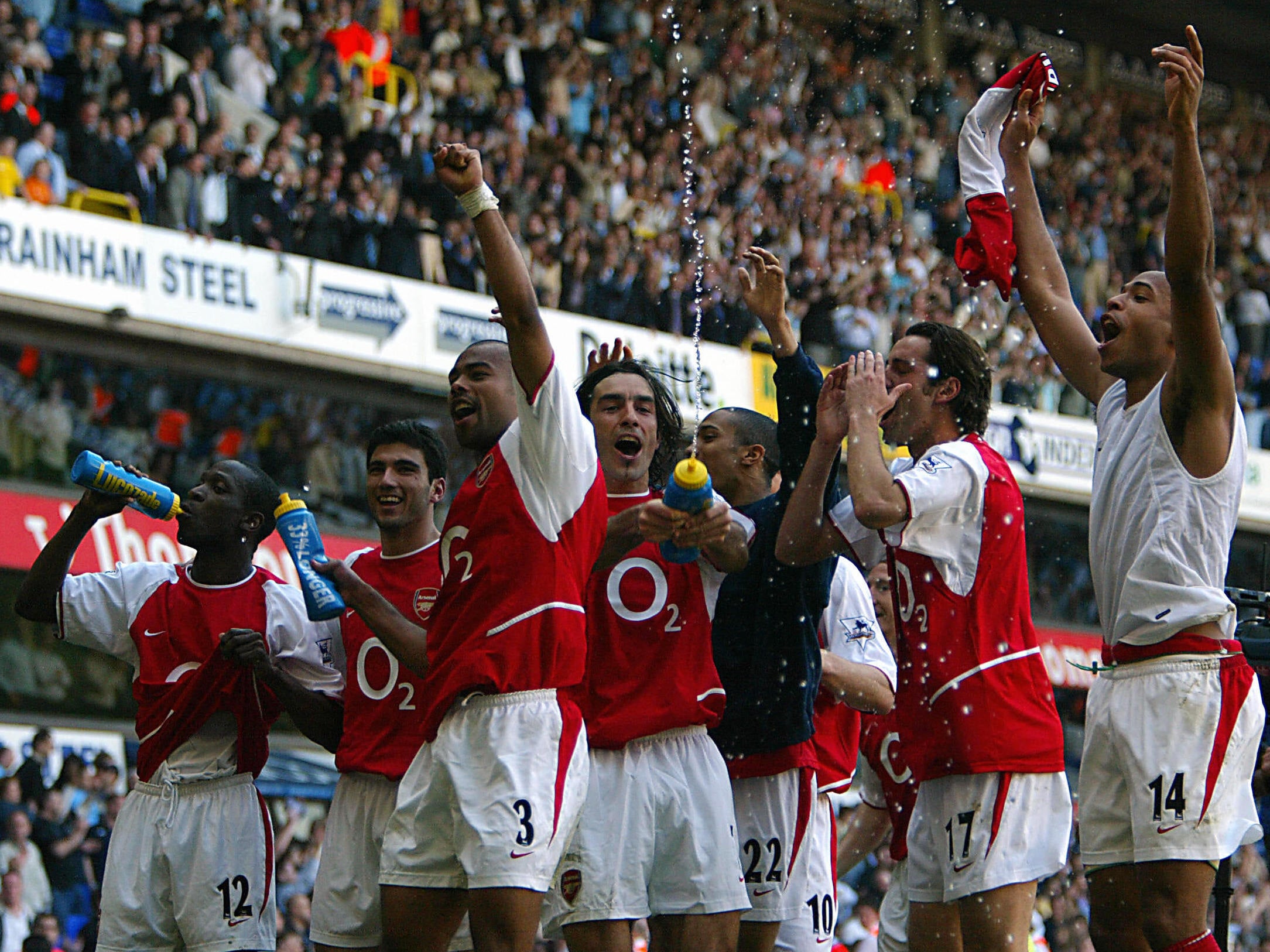
On Sunday, April 25, 2004, Arsenal were scheduled to play Spurs, 4.7 miles up the road at White Hart Lane. Newcastle had beaten Chelsea in the day's early game, meaning that Arsenal could clinch the League title with only a draw. They jumped at the chance, with superb goals by Vieira in only the 3rd minute of the game, and Pires, who always seemed to score against Spurs, in the 35th.

But in the 58th, Jamie Redknapp, son of Harry, hit a screamer of his own. In stoppage time, referee Mark Halsey ruled that Lehmann had pushed Robbie Keane during a corner kick, and awarded a penalty. Keane took it, and it was 2-2.

Before the game, Wenger had told his players that, if they get the point they need, they should not celebrate on the pitch, but rather wait until they were in the dressing room. But, as Henry later said, after the equalizer, the Spurs fans "celebrated like they won the World Cup Final." (As a part of the France team that did just that in 1998, he would know, as would Vieira and Pires, and 2002 Brazil winner Gilberto.)

Play resumed, and when Halsey almost immediately blew his whistle, the Gunners basically said, "To hell with it, we're the Champions," and partied along with the Arsenal fans who'd made the trip up the Seven Sisters Road to celebrate. The song, dating back to the 1971 title clincher in the old Football League Division One, went up:

We won the League (We won the League)
at White Hart Lane! (at White Hart Lane!)
We won the League at White Hart Lane!
We won the League at the Shithole!
We won the League at White Hart Lane!
The title was especially sweet for Sol Campbell. He had been Tottenham's Captain, but his contract ran out in 2001, and they made no effort to re-sign him. So he went to Arsenal. He had now won a Double in 2002, another FA Cup in 2003, and had won the League at White Hart Lane -- playing against Tottenham.
Sol Campbell, 2002

The title was won. The unbeaten season was still to play for. Fans of teams who have achieved much, but not an unbeaten season, accuse Arsenal of having "played for draws" the rest of the way. Which is stupid. They were held to a 0-0 draw at home by Birmingham City on May 1, and a 1-1 draw away to Portsmouth on May 4. But they beat Fulham 1-0 at Loftus Road for the 37th straight. (Fulham were renovating their usual home, Craven Cottage, and playing home games at the home of their West London neighbors and arch-rivals, Queens Park Rangers.)

May 15. One to go. Home to Leicester City, already relegated. It shouldn't have been too hard. But Paul Dickov, who had started his career with Arsenal, scored in the 26th minute. As Sky Sports announcer Alan Parry said, "That wasn't in the script now, was it?"

But they had come too far to blow it in the last game, at home, against a relegated opponent. A Bergkamp pass came to Cole in the box, but Cole was practically given an American-style football tackle by Frank Sinclair. Referee Paul Durkin correctly awarded the penalty. (It was the last game for the retiring Durkin, who had also officiated in major Arsenal wins in the 1998 FA Cup Final and the title-clincher against Manchester United in 2002.) Henry took it, becoming the 1st Arsenal player to score 30 goals in a League season since Ronnie Rooke in the title season of 1948. In the 66th minute, Captain Vieira, appropriately, closed it out: Arsenal 2-1 Leicester.
Patrick Vieira, 2004

At the final whistle, Parry said, "Make a note of the date: May the 15th, 2004. History has been made. One of the greatest achievements since English football began: Arsenal have gone through an entire League campaign without losing. The first time it's happened for over 100 years. Played 38, won 26, drawn 12, lost exactly none!"

The streak was actually 40 straight, counting the last 2 games of the season before. They broke the old record of 42, set by Nottingham Forest in 1977-78. They ran their streak of unbeaten matches in the League to an all-time record 49, before a Wayne Rooney dive would give Man United a dubious penalty and a dubious win at Old Trafford the following October 24.

Arsenal have not won the Premier League since. They've won the FA Cup in 2005, 2014, 2015 and 2017. They've reached the Final of the League Cup in 2007 and 2018, and of the UEFA Champions League in 2006. They've seriously challenged for the League title -- contrary to what a bunch of fools will tell you -- in 2008, 2009, 2010, 2011, 2014 and 2016. (UPDATE: And 2023, and 2024.) But they haven't won it.

Manchester United have won the "European Treble": The Premier League, the FA Cup, and the Champions League, in 1999. Manchester City have won the "Domestic Treble": The Premier League, the FA Cup, and the League Cup, in 2019. But nobody else has been "The Invincibles." Only The Arsenal have done it.

One more note about United: Having knocked Arsenal out in the Semifinal, they won the FA Cup a week later, defeating South London team Millwall, 3-0 at the Millennium Stadium (now the Principality Stadium) in Cardiff, the Final's temporary home while the new Wembley Stadium was being built in West London.

United Captain Roy Keane accepted the Cup, not from a representative of the royal family as is usually the case, but from the manager of the England national team at the time, Sven-Göran Eriksson. So the championship of England was played in Wales, won by a manager from Scotland, with the trophy accepted by a Captain from Ireland, from a presenter from Sweden.

*

May 15, 2004 was a Sunday. Football was out of season. There were 2 games played in the NBA Playoffs. The Indiana Pacers beat the Miami Heat, 94-83 at the Conseco Fieldhouse (now the Gainbridge Fieldhouse) in Indianapolis. And the Los Angeles Lakers beat the San Antonio Spurs, 88-76 at the Staples Center (now the Crypto.com Arena) in Los Angeles.

There was 1 game played in the Stanley Cup Playoffs. Game 4 was played in the Eastern Conference Finals. The Philadelphia Flyers beat the Tampa Bay Lightning, 3-2 at the Wachovia Center (now the Xfinity Mobile Arena) in Philadelphia. But the Lightning would win the series in 7 games, and beat the Calgary Flames in the Stanley Cup Finals.

And these Major League Baseball games were played:

* The New York Yankees lost to the Seattle Mariners, 13-7 at Yankee Stadium. Donovan Osborne started for the Yankees, and didn't have much. The Yankees got 2 home runs from Alex Rodriguez, and 1 each from Gary Sheffield, Hideki Matsui and Bernie Williams. Derek Jeter went 1-for-7.

Here's what Yankee pitcher Gabe White allowed in the top of the 13th inning: Double, intentional walk, sacrifice bunt, a 2nd intentional walk, a 2-RBI double, a 3rd intentional walk, hit a batter to force a run home, and a 3-RBI double, before finally getting 2 more outs.

* The New York Mets lost to the Houston Astros, 7-4 at Minute Maid Park (now Daikin Park) in Houston. Once-and-future Yankee Andy Pettitte started and won for the Astros.

* The Anaheim Angels beat the Baltimore Orioles, 7-4 at Camden Yards in Baltimore.

* The Boston Red Sox beat the Toronto Blue Jays, 4-0 at the SkyDome (now the Rogers Centre) in Toronto. Bronson Arroyo allowed 3 hits over 8 innings, and Keith Foulke completed the 4-hit shutout.

* The Cleveland Indians beat the Tampa Bay Devil Rays, 9-7 at Jacobs Field (now Progressive Field) in Cleveland.

* The Texas Rangers beat the Detroit Tigers, 6-1 at Comerica Park in Detroit.

* The Minnesota Twins beat the Chicago White Sox, 4-1 at U.S. Cellular Field (now Rate Field) in Chicago.

* The Atlanta Braves beat the Milwaukee Brewers, 11-6 at Miller Park (now American Family Field) in Milwaukee.

* The St. Louis Cardinals beat the Florida Marlins, 4-0 at Busch Memorial Stadium in St. Louis. Chris Carpenter allowed 4 hits over 7 1/3rd innings, and and 2 Cardinal relievers completed the 5-hit shutout.

* The Oakland Athletics beat the Kansas City Royals, 3-1 at Kauffman Stadium in Kansas City.

* The Philadelphia Phillies beat the Colorado Rockies, 16-5 at Coors Field in Denver.

* The Montreal Expos beat the Arizona Diamondbacks, 5-0 at Bank One Ballpark (now Chase Field) in Phoenix. Claudio Vargas allowed 6 hits over the 1st 7 innings, and Luis Ayala finished the 7-hit shutout.

* The Chicago Cubs beat the San Diego Padres, 7-5 at Petco Park in San Diego.

* The Cincinnati Reds beat the Los Angeles Dodgers, 4-0 at Dodger Stadium in Los Angeles. Todd Van Poppel allowed 5 hits over 6 innings, and 3 Reds relievers completed the 6-hit shutout.

* And the Pittsburgh Pirates beat the San Francisco Giants, 6-4 at SBC Park (now Oracle Park) in San Francisco. Barry Bonds did not play in this game against his former team.
December 31, 1999 & January 1, 2000: The Millennium

December 31, 1999:  The Millennium arrives. The people of planet Earth survived. At a terrible cost. But we hadn't destroyed ourselves. ...