Showing posts with label jess willard. Show all posts

Monday, July 4, 2022

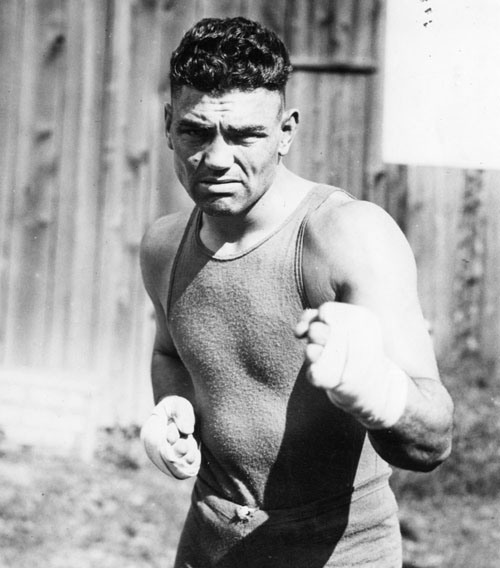
July 4, 1919: Jack Dempsey Says Hello

July 4, 1919: The Heavyweight Championship of the World changes hands in the most devastating fashion in its history.

The Champion was Jess Willard, from Kansas. At 6 feet, 6½ inches at 245 pounds, he was known as the "Pottawatamie Giant." He had won the title 4 years earlier, knocking out Jack Johnson, the 1st black Heavyweight Champion. He successfully defended his title against Frank Moran in 1916, before World War I prevented him from making another defense.

The war over, he was set to defend it at Bayfront Park in Toledo, Ohio, on the 4th of July. He took a 21-3-1 record into the fight. But he was 37 years old, and it was going to be hot. And his opponent...

William Harrison Dempsey was 24, stood 6-foot-1 and weighed 187, and was 56-4-9. That's right: 13 years younger, and had won more than twice as many fights as Willard had fought.

He was called Jack because of an earlier fighter, former Middleweight Champion Jack "Nonpareil" Dempsey (real name John Edward Kelly, held the title from 1884 to 1891). He was from Mansassa, Colorado, and was known as the Manassa Mauler. And, because this was the 1910s, and he was a white man who nonetheless had a very dark complexion, he was called "Kid Blackie."

His last 6 fights before his title shot all ended in knockouts, all of them in the 1st round. Or, as boxing historian Bert Sugar put it, "In his last two fights before the Willard fight, Dempsey knocked his opponents out in 19 and 27 seconds. Not rounds."

But he had learned to box in hobo camps and saloons, places barely removed from the "Wild West." He hadn't fought serious contenders. Surely, a seasoned professional and a gigantic man, like Willard, would be able to handle him easily. But Lightweight Champion Benny Leonard wrote a newspaper column predicting that Dempsey would win, because, despite being smaller, he was stronger.

Leonard was right: The fight was a massacre. Dempsey knocked Willard down 7 times in the 1st round. At the time, the rules allowed the standing fighter to remain standing over the one knocked down, to wait for him to get up, and then go after him again. Dempsey took advantage of this rule.

Had current rules been in place, Willard still wouldn't have lasted much longer: Dempsey would have had to go to a neutral corner (a new rule that he forgot about in 1927, in what became known as the Long Count Fight), Willard would have been given a standing 8-count, and with the 3rd knockdown of the round, the fight would have been declared over.

Somehow, Willard got up for the 2nd and 3rd rounds, but not the 4th. Dempsey was the new Heavyweight Champion of the World, and became one of the sports icons of the 1920s. For a while, he was both loved and hated in equal measure: Loved, even more than Babe Ruth for a time, for his success and his personality; hated, because some accused him of not properly serving his country in World War I, calling him a "slacker." Out of the ring, Dempsey was a considerably more mild-mannered man, but the "slacker" tag bothered him.
Go ahead. Call him a slacker. I dare you.

Reports on Willard's injuries were conflicted. The New York Times reported "severe swelling" on one side of his face, but mentioned no broken bones. Other reports suggested broken facial bones, several broken teeth, a broken jaw, and broken ribs.

Willard would accuse Dempsey of cheating. Many others agreed: How could Dempsey have injured Willard's face so badly, without injuring his own hands?

Eventually, Dempsey would have a falling-out with his manager, Jack Kearns. In 1964, with both fighters also still alive, Kearns gave an interview to Sports Illustrated, claiming he applied plaster of Paris to the wrappings on Dempsey's hands.

Also still alive at that point was Nat Fleischer, founder and editor of The Ring magazine, known as "the Bible of Boxing." He said he was present when Dempsey's hands were wrapped:

Jack Dempsey had no loaded gloves, and no plaster of Paris over his bandages. I watched the proceedings and the only person who had anything to do with the taping of Jack's hands was Deforest. Kearns had nothing to do with it, so his plaster of Paris story is simply not true.

And boxing historian J.J. Johnston said, "the films show Willard upon entering the ring walking over to Dempsey and examining his hands." That, along with an experiment conducted by a boxing magazine designed to re-enact the fight, have been noted as proof that Kearns' story was a lie.

Willard fought only twice more. In the 1st prizefight ever held at the original Yankee Stadium, on May 12, 1923, he knocked Floyd Johnson out in the 11th round. Two months later, at Boyle's Thirty Acres in Jersey City, New Jersey, he got knocked out in the 8th round by Luis Angel Firpo. That was it for Willard, who died in 1968.

Willard's last fight was Firpo's warmup for a fight with Dempsey at the Polo Grounds, one of the greatest fights in Heavyweight Title history. It was to be Dempsey's last title defense, as he then didn't fight for 3 years, losing the title to Gene Tunney in 1926. He lived until 1983, one of the last surviving sports stars of "The Roaring Twenties," a.k.a. "The Golden Age of Sports."

*

July 4, 1919 was a Friday. Football, basketball and hockey were out of season. But baseball was in midseason, and the 4th of July was often a day for doubleheaders:

* The New York Yankees swept the Washington Senators at the Polo Grounds, 8-2 and 6-5. Bob Shawkey was supported in the opener by 2 home runs from former Athletics slugger Frank "Home Run" Baker. Former Red Sox star Duffy Lewis won the nightcap with a double in the bottom of the 9th.

* The New York Giants swept the Philadelphia Phillies at Baker Bowl, 3-1 and 8-3.

* A doubleheader was split at Ebbets Field in Brooklyn. The Brooklyn Robins (as the Dodgers were known from 1914 to 1931) won the 1st game, 7-3. The Boston Braves won the 2nd game, 5-2.

* The Boston Red Sox swept the Philadelphia Athletics at Fenway Park in Boston, 9-2 and 9-6. In the 2 games, Babe Ruth went 3-for-4 with an RBI double.

* The Chicago Cubs swept the Pittsburgh Pirates at Forbes Field in Pittsburgh, 7-3 and 4-1.

* The Cleveland Indians swept the St. Louis Browns at League Park in Cleveland, 9-4 and 11-1. Tris Speaker went 3-for-8, while George Sisler went 3-for-5.

* The Cincinnati Reds swept the St. Louis Cardinals at Redland Field in Cincinnati (it was renamed Crosley Field in 1934), 4-3 in 12 innings, and 4-2.

* And the Chicago White Sox swept the Detroit Tigers at Comiskey Park in Chicago, 8-1 and 2-1. Ty Cobb only appeared as a pinch-hitter in the 1st game, unsuccessfully, before going 1-for-4 in the 2nd game. Shoeless Joe Jackson went 3-for-7 with an RBI.

Monday, April 4, 2022

April 5, 1915: The Fall of Jack Johnson

April 5, 1915: America's white racists get what they had been looking for for the last 6 years: The fall of Jack Johnson.

A native of Galveston, Texas, Johnson had become the 1st black Heavyweight Champion of the World on December 26, 1908, at Sydney Stadium in Sydney, Australia, when he knocked out Canadian fighter Tommy Burns. This "conquest of the white man," and his flamboyant lifestyle, made Johnson the most hated man in America. Even many black people hated him, for making them look bad. He didn't care: He was still going to be Jack Johnson.

So America's white establishment looked for a "Great White Hope" who could beat Johnson. Four times in 1909, a fighter was put up against Johnson:

* Philadelphia Jack O'Brien, the Light Heavyweight Champion, fought him in his hometown of Miami. I mean, Philadelphia. (Just wanted to see if you were paying attention.) It was a draw, but O'Brien didn't want a rematch.

* Tony Ross fought him in Pittsburgh, and Johnson beat him.

* Al Kaufman fought him in San Francisco, and Johnson beat him.

* Stanley Ketchel, the Middleweight Champion, a vicious fighter known as the Michigan Assassin, made a deal with Johnson, the same deal that O'Brien had made with him: They would fight to a draw, and thus split the proceeds from the film rights. It was a good plan. Except Ketchel got greedy, for the title and the money, and knocked Johnson down. All that did was make Johnson mad, and he not only knocked Ketchel out, he knocked out a bunch of his teeth. The film of the fight is clear enough to see Johnson brushing Ketchel's teeth out of his glove.

Now, the search for a Great White Hope became truly intense. Novelist Jack London, tapping into the racism of the time, had a nationally syndicated newspaper column, and used it to address Jim Jeffries, who had been Heavyweight Champion from 1899 to 1904, and retired undefeated to an alfalfa farm outside Los Angeles. London wrote, "Jeff, it's up to you."

Boxing promoter George "Tex" Rickard promised him $75,000 -- about $2.2 million in 2022 money -- regardless of the result. It took Rickard a while to find a location willing to host the fight, and Reno, Nevada set it up for the 4th of July, 1910. A ring was built in an open field, and a temporary stadium was built around it.

Johnson was willing to fight Jeffries. Having waited so long for his shot at the title, he knew he had no right to duck anybody. And he was sure he would win -- if the fight was on the level. So he told Rickard that the referee had to be someone that both fighters could trust. After making some inquiries about who was ready, willing and able, Rickard decided to officiate himself. Both fighters accepted him.

The fight was a mismatch. It was scheduled for a maximum of 45 rounds, which sounds brutal for the modern era, where the norm became 15, and eventually 12 by the 1980s. Jeffries hung on for 12 rounds, but in the 13th, Johnson knocked Jeffries down. Jeffries got up. He shouldn't have, because Johnson knocked him out in the 15th. Later that day, Jeffries admitted that, on his best day, he never could have beaten Johnson -- and this was far from his best day.

Without the Internet, television, or even radio, it was the telegraph that spread word of the fight around the nation. Black people launched great celebrations. White people, humiliated and angry, accepting Jeffries' defeat as their own loss, launched attacks on black people, and there were riots in New York, Philadelphia, Johnson's adopted hometown of Chicago, and many other cities. At least 20 deaths are attributable to these riots.

In 1912, Johnson was arrested for violating the Mann Act, which forbade "transporting women across State lines for immoral purposes." The woman in question was Lucille Cameron. Contrary to what is often reported, Cameron was not already Johnson's wife, which would have made the charge impossible to prove in court -- not that an all-white jury would have cared. But she refused to cooperate, and soon married Johnson.

In 1913, Johnson was arrested on the Mann Act again. This time, in a Chicago courtroom presided over by Judge Kenesaw Mountain Landis, later to become the 1st Commissioner of Baseball and the perpetuator of the sport's "color line," Johnson was convicted by an all-white jury, and sentenced to a year and a day in prison.

He skipped bail, and escaped first to Canada, then to France. Having only defended his title once since the Jeffries fight, he could now only do so abroad. On December 19, 1913, in Paris, in the 1st-ever Heavyweight Championship fight between 2 black men, he may have recognized the significance, and held back a little, as he fought Battling Jim Johnson (no relation) to a rather lackluster draw. In 1914, he defeated Frank Moran in Paris. In early 1915, he knocked Jack Murray out in Buenos Aires, Argentina.

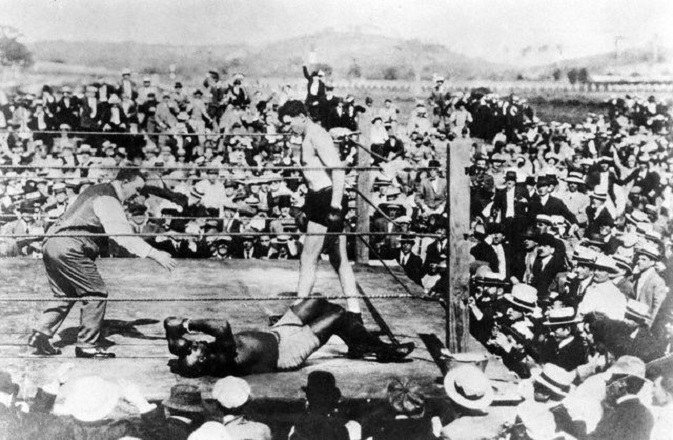
Finally, it all caught up with him. Jess Willard, a 6-foot-6 Kansan, became the latest "Great White Hope." On April 5, 1915, at Oriental Park, a horse racing track in Havana, Cuba, in a fight scheduled for 45 rounds, and held in heat even worse than in Reno 4 years earlier, perhaps he finally got tired of being Jack Johnson, and threw the fight. Or maybe, at 37, the oldest Heavyweight Champion ever (and he would remain so until Jersey Joe Walcott in 1951), he just wasn't in shape anymore. Willard knocked him out in the 26th round.

Jack and Lucille Johnson continued to live abroad. Finally, on July 20, 1920, Jack crossed the border from Mexico to America, and surrendered to federal agents. He was taken to the federal penitentiary at Leavenworth, Kansas (with some irony, in Willard's home State), and began serving his sentence. He was released early, on July 9, 1921.

Lucille was the 3rd of what turned out to be 4 wives for Jack Johnson. Only the 1st was black. On June 10, 1946, he was driving on U.S. Route 1 near Franklinton, North Carolina, when he crashed into a telegraph pole, and died. He was 68 years old.

His last wife, Irene Pineau, said of him, "I loved him because of his courage. He faced the world unafraid. There wasn't anybody or anything he feared."

Jeffries went back to his farm, never fought again, and lived until 1953. Burns lasted until 1955. Willard successfully defended his title once, defeating Frank Moran at Madison Square Garden -- the 2nd one, overlooking Madison Square, and torn down in 1926 to make way for the New York Life Building. With World War I on, there was little desire to see a title fight in 1917 or 1918. He was destroyed by Jack Dempsey in his 2nd defense. He died in 1968.

That same year, Howard Sackler's play The Great White Hope made its Broadway premiere. James Earl Jones became a star playing Jack Jefferson, a barely-disguised version of Johnson, right down to the shaved head. Jane Alexander played the character's white wife, both enjoying her husband's fame and struggling with its downside.

They reprised their roles in the 1970 film version, which seems to suggest that Johnson lost the title simply because his fight with the U.S. government had taken his fighting spirit away from him -- if not coming right out and saying he threw the Willard fight.

Oriental Park was demolished in 1967.

*

April 5, 1915 was a Monday. Baseball was in Spring Training. Football was out of season. There barely was any professional basketball. And the Stanley Cup had already been decided on March 26, with the Pacific Coast Hockey Association Champion Vancouver Millionaires beating the National Hockey Association Champion Ottawa Senators. So there were no scores on this historic day.

December 31, 1999 & January 1, 2000: The Millennium

December 31, 1999:  The Millennium arrives. The people of planet Earth survived. At a terrible cost. But we hadn't destroyed ourselves. ...