Showing posts with label hermann goering. Show all posts

Saturday, December 31, 2022

December 31, 1940: The Nazi Plot to Hijack the Election

William Rhodes Davis

December 31, 1940: A Nazi plot to hijack the recent Presidential election is revealed. It had failed, of course.

As the calendar year began, it was believed by most people that President Franklin D. Roosevelt would respect the 2-term limit on the Presidency -- which, until the ratification of the 22nd Amendment to the Constitution, in 1951, was unofficial. The Nazis concluded that if Roosevelt could be replaced by someone not willing to intervene in the Nazis' takeover of Europe, the prospects of U.S. involvement in the European phase of World War II would be greatly reduced, and possibly eliminated.

So they found a sympathetic, well-connected American. William Rhodes Davis was an oilman with a sketchy business past who, in the late 1930s, made a fortune by selling cut-rate Mexican oil to the German government. Davis had cultivated connections inside the Democratic Party, making a big donation to its 1936 election efforts.

But when The War began, the British imposed a blockade on German ports, interfering with Davis' ability to make money from dealing with Germany. He believed that the only way to save his business was by personally making peace in Europe, by negotiating a deal between the warring parties himself. Davis approached the White House with his plan for peace. FDR turned him down.

Davis then traveled to Germany, met with leaders of the Third Reich, including Hermann Göring, President of the Reichstag -- in effect, Germany's equivalent of the Speaker of the U.S. House of Representatives -- and returned with the vague outlines of a deal that would have given Germany territorial gains in exchange for Roosevelt mediating a peace treaty. Roosevelt refused to even meet with Davis upon his return, worried that he might be compromised and acting as a Nazi agent.

As it turned out, FDR was absolutely right about that. Davis had talked to Göring about the possibility of a non-interventionist winning the 1940 election. He even had, he thought, the perfect candidate in mind: John L. Lewis, the head of the Congress of Industrial Organizations (CIO), and the President of the United Mine Workers. Widely popular among America's working people, he was nonetheless opposed to many of FDR's New Deal reforms, and was a non-interventionist. Of course, being the leader of a labor union, and aside from his New Deal opposition a leftist, he would have been considered unacceptable to German Chancellor Adolf Hitler himself, as anything other than a temporary tool to achieve Hitler's aims.

Göring gathered $5 million -- about $104 million in 2022 money, which would have bought quite a bit of newspaper and magazine advertising space, and radio airtime -- to support the plan, and had it stashed at the German embassy in Washington D.C. for Davis' use.

But both major parties put a stop to the plan. FDR ran for a 3rd term anyway, and was easily renominated. And the Republicans nominated an interventionist, Wendell Willkie. The Nazi money did Lewis no good: He paid for a national radio address by Lewis on Labor Day, September 2, denouncing Roosevelt. The President was re-elected on November 5, anyway, with an electoral landslide, although the popular vote was the closest of what turned out to be his 4 runs.

In December 1940, Verne Marshall, head of the No Foreign War Committee, claimed that Davis, upon returning from a trip to Germany in 1939, presented the State Department with a peace plan representing Göring's views, and called for President Roosevelt to serve as mediator between the warring nations. Marshall criticized FDR for failing to take advantage of the opportunity, but most viewed the plan as an attempt to impose a "German peace." The German government, of course, denied any knowledge of such a plan.

On December 31, 1940, in reaction to Davis's role in forming and financing the No Foreign Wars Committee, U.S. Senator Joshua B. Lee, Democrat of Oklahoma, said, "The record of this man Davis shows conclusively the great financial stake he has in a complete Nazi victory in the European war. Much of the gasoline sending showers of fiery death into the defenseless heart of London was sold to the German government by this man Davis."

On January 7, 1941, Davis was subpoenaed to testify before a grand jury in Washington, D.C., investigating campaign expenditures for violations of the Hatch Act and the Corrupt Practices Act during the 1940 Presidential campaign. The same day, Senator Burton K. Wheeler, Democrat of Montana, a non-interventionist, scheduled Davis to testify before the Senate Interstate Commerce Subcommittee about the "peace place" described by Marshall.

Davis died of a heart attack in Houston on August 1, 1941. The traitor was 52 years old. In 1946, O. John Rogge, an official in the U.S. Department of Justice, issued a report on Davis' activities, proving his guilt beyond a reasonable doubt. The report ended up being buried until 1961.

Davis' grandson, Joseph Graham Davis Jr., a.k.a. Gray Davis, served as Governor of California from 1999 to 2003 -- as a Democrat. His loyalty to America has never been seriously questioned.

*

December 31, 1940 was a Tuesday. Baseball was out of season. The NBA hadn't been founded yet. There were 2 games played in the NHL. The New York Rangers and the Boston Bruins played to a 2-2 tie at the Boston Garden. And the New York Americans beat the Montreal Canadiens, 4-2 at the old Madison Square Garden.

The next day, New Year's Day 1941, Stanford beat Nebraska in the Rose Bowl, Boston College beat Tennessee in the Sugar Bowl, Texas A&M beat Fordham in the Cotton Bowl, Mississippi State beat Georgetown in the Orange Bowl, and Western Reserve beat Arizona State in the Sun Bowl. 

Sunday, October 16, 2022

October 16, 1946: The Nuremberg Executions

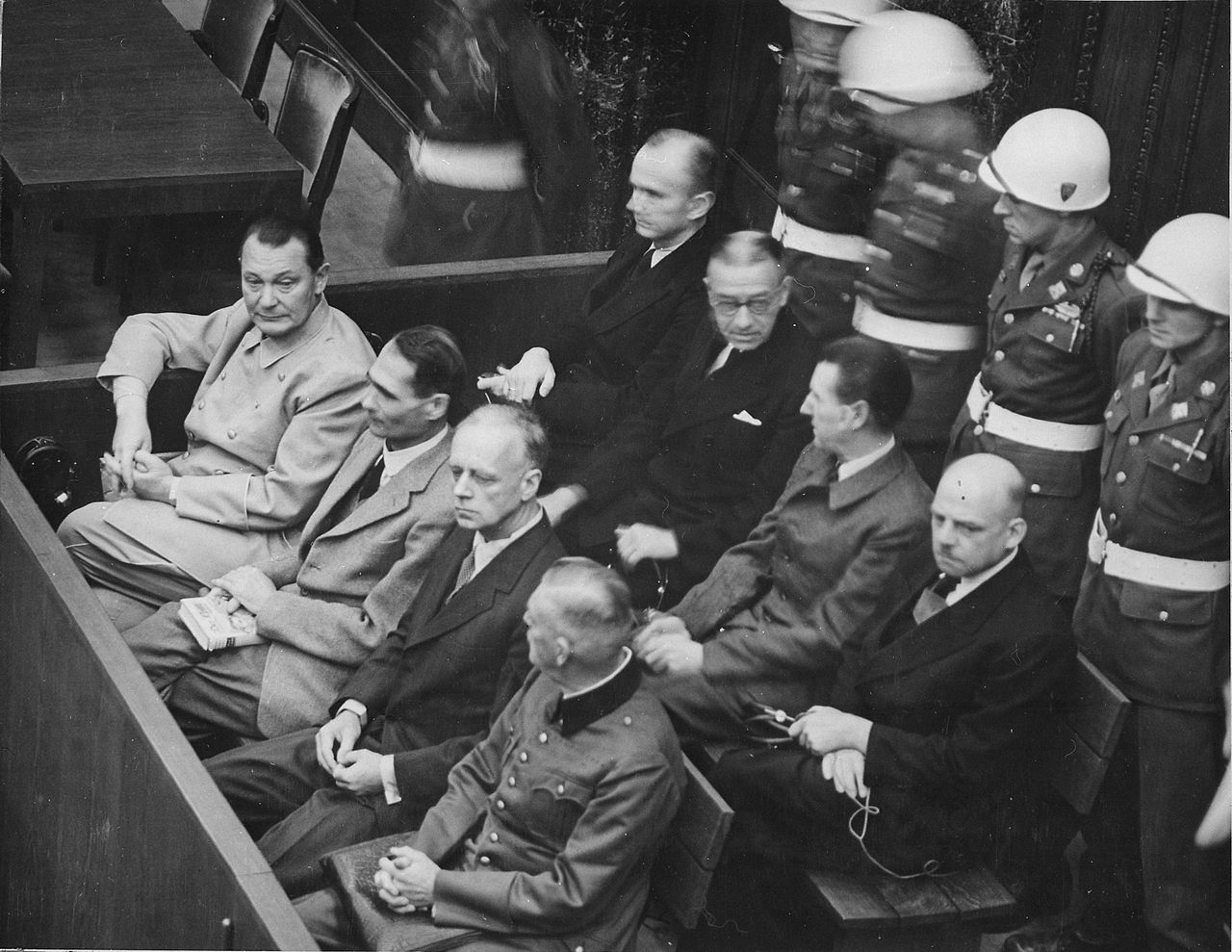
Göring, at the far left (or so to speak)

In the year 1947, America was able to do fun things again. In that year, we desegregated baseball, established network television, began watching Howdy Doody Time on said television, invented the microwave oven and the transistor, and began looking for UFOs.

But first, in 1946, we had serious work to tend to: Punishing Nazis.

October 16, 1946: Ten Nazi war criminals, convicted of crimes against humanity, are executed by hanging at the Palace of Justice in Nuremberg, Germany. They included:

* Joachim von Ribbentrop, age 53, Adolf Hitler's Foreign Minister.
* Julius Streicher, 61, Nazi Germany's top propaganda publisher.
* General Alfred Jodl, 56, Chief of the Armed Forces, who had signed the surrender papers on V-E Day.
* Field Marshal Wilhelm Keitel, 64.
* Hans Frank, 46, Governor-General of occupied Poland.

You may have seen the "Hitler Rants Parodies," based on a scene from the 2004 film Downfall, starring Bruno Ganz as Hitler. Christian Redl played Jodl in that scene, and Dieter Mann played Keitel.

As for the other 2 Generals that Hitler had asked to remain in the room: Hans Krebs, played by Rolf Kanies, and Wilhelm Burgdorf ("Mein Führer, this is an outrage!"), played by Justus von Dohnányi, both committed suicide in the Bunker on May 2, 1945. Krebs was 47, and Burgdorf was 50.

Minister of Propaganda Joseph Goebbels, not named, also remained in the room. He committed suicide in the Bunker the day before. He was 47, and was played by Ulrich Matthes. Also not named, but remaining in the room, was Martin Bormann, head of the Nazi Party Chancellery. He escaped on May 2, but saw the Soviets closing in, and committed suicide. He was 44, and was played by Thomas Thieme. SS leader Heinrich Himmler committed suicide in British custody on May 23. He was also 44. He did not appear in the scene, but did appear in the film, and was played by Ulrich Noethen.

Not among the condemned, but scheduled to be so, was Reichsmarschall Hermann Göring, the highest-ranking Nazi official to have survived V-E Day. He had made an appeal, asking to be shot as a soldier instead of hanged as a common criminal, but the court refused. So he committed suicide with a potassium cyanide capsule the night before he was to be hanged. He was 53. He also was not in the scene, but was in the film, played by Mathias Gnädinger.

*

October 16, 1946 was a Wednesday. Actress Suzanne Somers was born.

With the World Series having ended the day before, with the St. Louis Cardinals beating the Boston Red Sox in Game 7, there was only one sporting event on this day. And it is the NHL debut of Gordie Howe. The 18-year-old native of Floral, Saskatchewan wore Number 15, instead of the familiar 9 that he will start wearing the next season. The right wing scores against Turk Broda, and the Detroit Red Wings play the Toronto Maple Leafs to a 3-3 tie at the Olympia Stadium in Detroit.

The goal will be the 1st of 786 that the man who becomes known as Mr. Hockey will score for the Wings, going on to win 4 Stanley Cups and becoming the greatest player the game has ever known, and I don't want to hear about no Number 99: Gordie was better. We lost him in 2016, at the age of 88.

Thursday, June 30, 2022

June 30, 1934: The Night of the Long Knives

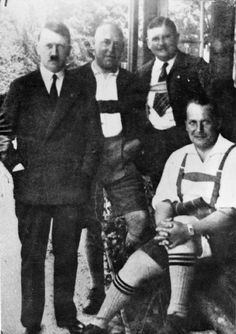
Left to right: Adolf Hitler, Gregor Strasser,
Ernst Röhm and Hermann Göring, 1932.

June 30, 1934: Adolf Hitler, Chancellor of Germany and Führer (Leader) of the Nazi Party, as paranoid as ever, consolidates his power with a "purge" that becomes known as "The Night of the Long Knives."

Ernst Röhm was the co-founder and leader of the Sturmabteilung (SA, meaning "Storm Division," or "Storm Troopers," also known as the "Brownshirts"), the Nazi Party's original paramilitary wing, which played a significant role in Hitler's rise to power. He and Hitler were close friends.

But Hitler began to see the independence of the SA, and the penchant of its members for street violence ,as a direct threat to his newly gained political power. He also wanted to appease leaders of the Reichswehrthe German military, who feared and despised the SA as a potential rival, in particular because of Röhm's ambition to merge the army and the SA under his own leadership.

Additionally, Hitler was uncomfortable with Röhm's outspoken support for a "second revolution" to redistribute wealth. In Röhm's view, President Paul von Hindenburg's appointment of Hitler as chancellor on January 30, 1933 had brought the Nazi Party to power, but had left unfulfilled the party's larger goals.

So, urged on by Hermann Göring, the President of the Reichstag (the national legislature), and Heinrich Himmler, the Reichsführer of the Schutzstaffel (SS, "Protection Squadron"), Hitler ordered a series of political extrajudicial executions.

The primary instruments of Hitler's action, which carried out most of the killings, were the  SS and its Sicherheitsdienst (SD, "Security Service"); and the Geheime Staatspolizei (shortened to "Gestapo," meaning "Secret State Police"), under the command of Reinhard Heydrich.

Leading members of the Strasserist faction of the Nazi Party, including its leader, Gregor Strasser, were also killed. So were establishment conservatives and anti-Nazis, such as former Chancellor Kurt von Schleicher and Bavarian politician Gustav Ritter von Kahr, who had helped suppress Hitler's Beer Hall Putsch in Munich in 1923. In Godfather terms, Hitler was settling all business.

Röhm was arrested in Munich, but not killed right away. On the afternoon of July 1, in his cell, he was approached by SS-Brigadeführer Theodor Eicke and SS-Obersturmbannführer Michael Lippert. They handed him a Browning pistol with one cartridge, and said that he had 10 minutes to use it on himself, or they would do it for him. He refused, saying, "If I am to be killed, let Adolf do it himself." Eicke and Lippert then carried out their threat. Röhm was 46 years old.

There are 85 documented cases of people killed in the Night of the Long Knives. The actual death toll is usually considered by historians to be over 200, and may be as high as 1,000. But it did what Hitler wanted it to do: It strengthened and consolidated his support within the military, and provided a legal grounding for the Nazis, as the German courts and cabinet quickly swept aside centuries of legal prohibition against extrajudicial killings to demonstrate their loyalty to the regime. Now, without question, Hitler was, in the words he used before a July 13 speech to the Reichstag, "the supreme administrator of justice of the German people."

Hitler's sense of justice wasn't the only perverted thing about his government.

*

June 30, 1934 was a Saturday. Magician Harry Blackstone Jr. was born. And these baseball games were played:

* The Brooklyn Dodgers beat their arch-rivals, the New York Giants, 8-4 at the Polo Grounds. Ray Benge outpitched Carl Hubbell. Jimmy Jordan went 4-for-5 with an RBI. Giants player-manager Bill Terry and Mel Ott each went 1-for-4 with an RBI.

* The Boston Braves beat the Philadelphia Phillies, 6-2 at Braves Field in Boston.

* The Philadelphia Athletics beat the Boston Red Sox, 7-6 at Shibe Park in Philadelphia. Bob Johnson saved the A's with a home run in the bottom of the 9th inning, and then Frankie Hayes singled Bing Miller home with the winning run in the bottom of the 10th. Jimmie Foxx went 0-for-4 with a walk for the A's.

* The Chicago Cubs beat the Pittsburgh Pirates, 6-4 at Forbes Field in Pittsburgh. Paul Waner went 1-for-5, and Lloyd Waner went 1-for-4 with a walk.

* The Cincinnati Reds beat the St. Louis Cardinals, 11-4 at Crosley Field in Cincinnati. The Reds scored 9 runs in the bottom of the 8th inning.

* The Chicago White Sox beat the Cleveland Indians, 2-1 at Comiskey Park in Chicago.

* The St. Louis Browns beat the Detroit Tigers, 4-3 at Sportsman's Park in St. Louis. Harlong Clift singled Rollie Hemsley home with the winning run in the bottom of the 10th inning. Tigers player-manager Mickey Cochrane went 2-for-3 with 2 walks and 2 RBIs. Hank Greenberg went 1-for-5.

* And, in what is, as far as I know, a unique example in MLB history, the New York Yankees were supposed to play the Washington Senators at Griffith Stadium, but, according to Baseball-Reference.com, the game was postponed -- due to wind. Not rain, not snow, not cold, but wind.

It was postponed until August 7, as part of a doubleheader. The Yankees won the opener, 4-3. The Senators won the nightcap, 6-3. Over the 2 games, Babe Ruth, in his last season as a Yankee, went 0-for-6 (only pinch-hitting in the nightcap); Lou Gehrig went 1-for-9 with a walk and an RBI; and Senators shortstop-manager Joe Cronin went 2-for-8.

Wednesday, January 19, 2022

January 19, 1940: The 1st U.S. Movie to Mock the Nazis

January 19, 1940: For the 1st time, an American film makes fun of the Nazi Party, rulers of Germany since 1933, under Chancellor Adolf Hitler. It is titled You Nazty Spy! A combination of "Nazi" and "nasty," which was certainly appropriate. This was 8 months after the release of the 1st major movie to attack the Nazis, Confessions of a Nazi Spy, which was by no means a comedy.

It is a short film, only 18 minutes long. "Shorts" were less scrutinized by the Hays Code, so there was less oversight over its political overtones.

The stars are Moe Howard, Larry Fine, and Moe's brother, Jerry Howard, a.k.a. Curly. Together, they were known as The Three Stooges. All three of whom were Jewish in real life: Moe was born Moses Harry Horwitz, Curly was Jerome Lester Horwitz, other brother Shemp was Samuel Horwitz, and Larry was Louis Feinberg.

The story: Three munitions manufacturers, discontent with reduced profits due to King Herman the 6 7/8ths' pacifist policies, conspire to overthrow him and institute a dictatorship. The trio selects the unwitting Stooges, acting as wallpaper hangers, as figureheads for their regime. Moe assumes the role of the leader, directly spoofing Hitler; Curly, bald and chubby, is a composite of Italian dictator Benito Mussolini and Nazi official Hermann Göring; and Larry spoofs Nazi propaganda minister Joseph Goebbels.

Moe's imitation of Hitler preceded Charlie Chaplin's performance in The Great Dictator by 9 months.

*

January 19, 1940 was a Friday. Baseball and football were out of season. The NBA hadn't been founded yet. And no games were scheduled for the NHL. So there were no scores on this historic day.

December 31, 1999 & January 1, 2000: The Millennium

December 31, 1999:  The Millennium arrives. The people of planet Earth survived. At a terrible cost. But we hadn't destroyed ourselves. ...