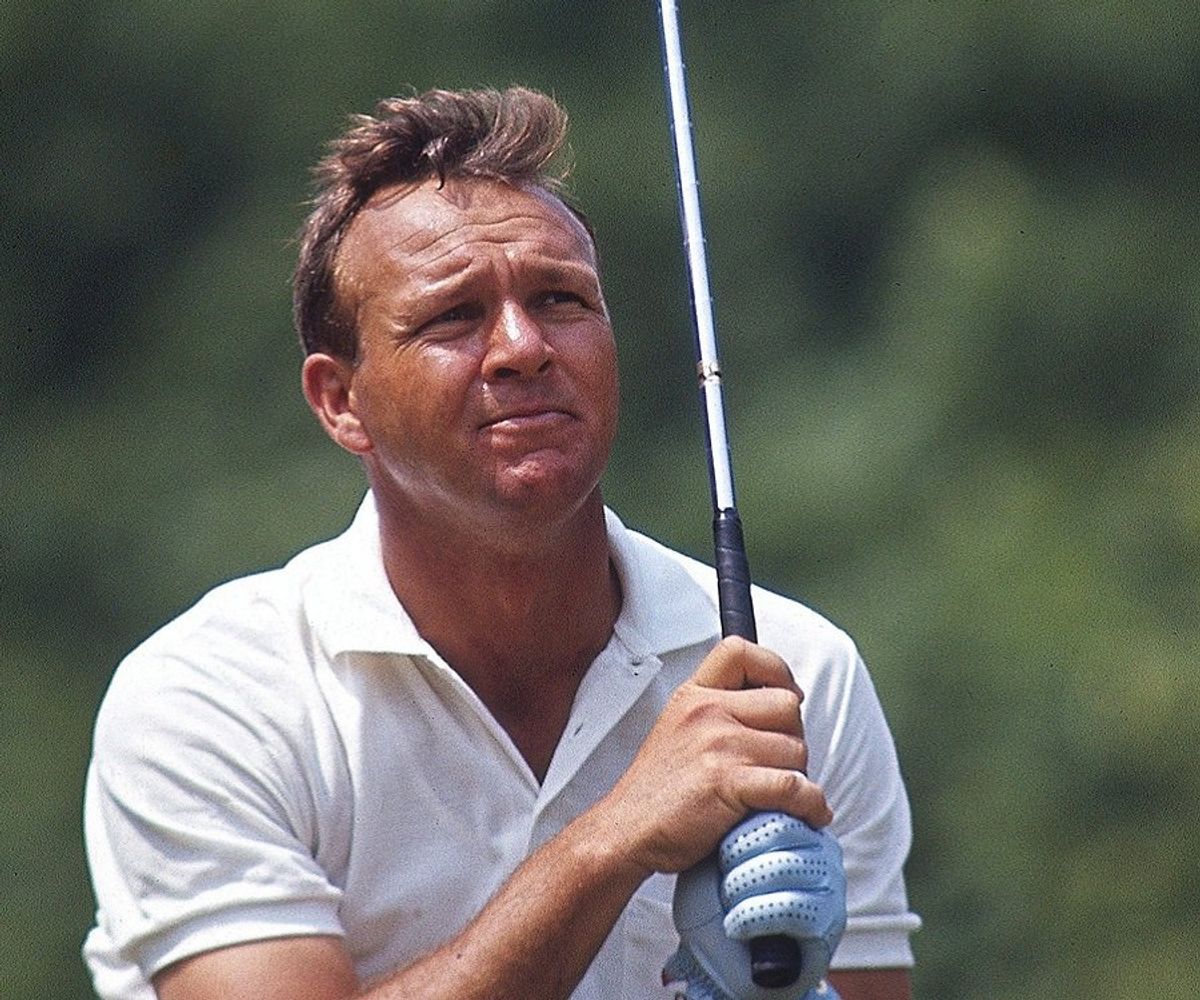
Young Arnie
June 18, 1960: The U.S. Open golf tournament is held at Cherry Hills Country Club in Cherry Hills Village, Colorado, a suburb of Denver. It is often regarded as the greatest golf tournament ever held on U.S. soil.
NOTE: For a long time, with this project, I resisted putting in references to golf, because of the kind of people who tend to play it. I finally caved in, although I haven't included as many references as I would if it were a real sport, which it is not.
Essentially, it was golf's past, present and future coming together. The past was represented by Ben Hogan, 47 years old at the time of this tournament. He had won the PGA Championship in 1946, and won that and the U.S. Open in 1948.
In 1949, he was badly hurt in a car crash, but, despite already being 36 years old, recovered enough to win more "major" tournaments after it. In 1950, he won the U.S. Open. In 1951, he won the U.S. Open and the Masters.
In 1953, he won the Masters, the U.S. Open and, for the only time in his career, the British Open. Because, that year, it overlapped with the British Open, he didn't enter the PGA Championship, which, if he won, would have given him the Grand Slam, something no golfer has ever done.
Having achieved that, he started the Ben Hogan Golf Equipment Company, which became a success, because his record was his own best sales pitch. A private man, he was not well known by the public, but he was as admired as any golfer who ever lived, including Bobby Jones. But by 1960, he was widely thought to be done as far as championship golf was concerned.

One of several books Hogan wrote
The present was represented by Arnold Palmer. The 1st great golfer of the television era, he did more than any other person to make golf popular among non-rich Americans. (And that includes Dwight D. Eisenhower, America's foremost golfing President -- until Donald Trump -- who was in his last year in office.) A 30-year-old native of Western Pennsylvania, he graduated from Latrobe High School a year after children's TV host Fred "Mr." Rogers, and they remained friends for life.
He had won the Masters in 1958 and 1960, but not yet any of the others. Still, being seen on TV gave him a devoted following of fans, known as Arnie's Army. And he was one of the earliest sports figures -- if, that is, you consider golf to be a "sport" -- to advertise products in TV commercials. He was best known for advertising a home-State product, Pennzoil motor oil. Later, he would team with football star -- turned murder defendant -- O.J. Simpson in ads for Hertz rental cars.
The future was represented by Jack Nicklaus. At this point, the native of Columbus, Ohio was only 20 years old, still an amateur, and still a student at Ohio State University. However, he had already won a tournament that was once considered a major, the 1959 U.S. Amateur.

"The Golden Bear" as a cub
He was already married with a son named Jack Nicklaus II. Years later, someone asked him if he wasn't putting pressure on the boy by giving his son the name "Jack Nicklaus." He had the perfect answer: "At the time, I didn't know I was going to be Jack Nicklaus."
The leader after each of the 1st 2 rounds was Mike Souchak, a 33-year-old native of Eastern Pennsylvania, who had played football at Duke University, but had not yet won a major -- and, as it turned out, never would. South African golf star Gary Player was 6 strokes off the lead. So was "Slammin' Sammy" Snead, probably Palmer's predecessor as the most-loved American golfer -- like I said, Hogan was admired, but not really known, so not really loved. Nicklaus was 7 strokes off. Palmer was 8 off. Hogan was not as close as that.
After the 3rd round, Souchak still led. But a sea change had happened. Hogan and Nicklaus both came on strong, and were just 3 strokes behind him. Player was 5 back, Palmer 7.
But on Sunday, Palmer went on one of the greatest runs in golf history. He birdied the 1st, 2nd, 3rd, 4th, 6th and 7th holes, nearly eagling the 3rd. He finished the round at 65, for a total of 280, 4 under par, and the lead. Souchak finished 3 strokes behind him.
Nicklaus looked like he might make a similar run. He eagled the 5th, and birdied the 9th, and briefly took the lead. But his putting failed him on the back 9, and he finished 2 strokes behind Palmer.
Hogan had one great run left in him, and this was it. He managed to tie Palmer for the lead on the 16th. But he hit water hazards on the 17th and 18th, and finished 4 strokes back. If he had avoided the water, who knows?
But Palmer, the fan favorite, was the winner. He was now halfway to the Grand Slam. But he went to St. Andrews for the British Open, and lost it by 1 stroke. He missed the PGA title by 5 strokes, 2 weeks after that. Sports Illustrated named him its Sportsman of the Year for 1960.
He did win the British Open in 1961 and 1962, but he never won the PGA, finishing 2nd 3 times, thus missing the "Career Grand Slam."
Old Arnie
Nicklaus, however, was just getting started. In 1962, he won his 1st major, the U.S. Open. In 1963, he took the Masters and the PGA. In 1965, he won the Masters a 2nd time. In 1966, a 4th Masters and his 1st British Open, for the Career Grand Slam. In 1967, the U.S.
Then came a drought before winning the PGA in 1971. In 1972, he won the Masters and the U.S., putting him halfway to the Slam, but he couldn't win the other 2. In 1973, he won the PGA. In 1975, he won the Masters and the PGA. In 1978, he won the British Open for the 3rd and last time. Sports Illustrated named him Sportsman of the Year, even though he'd had better years.
And he would again. In 1980, he won the U.S. Open and the PGA, 2 majors at age 40. It was his 4th U.S. title, and his 5th PGA. In 1986, at 46, he won a record 6th Masters. That game him 18 majors, which remains a record. Tiger Woods has 15.
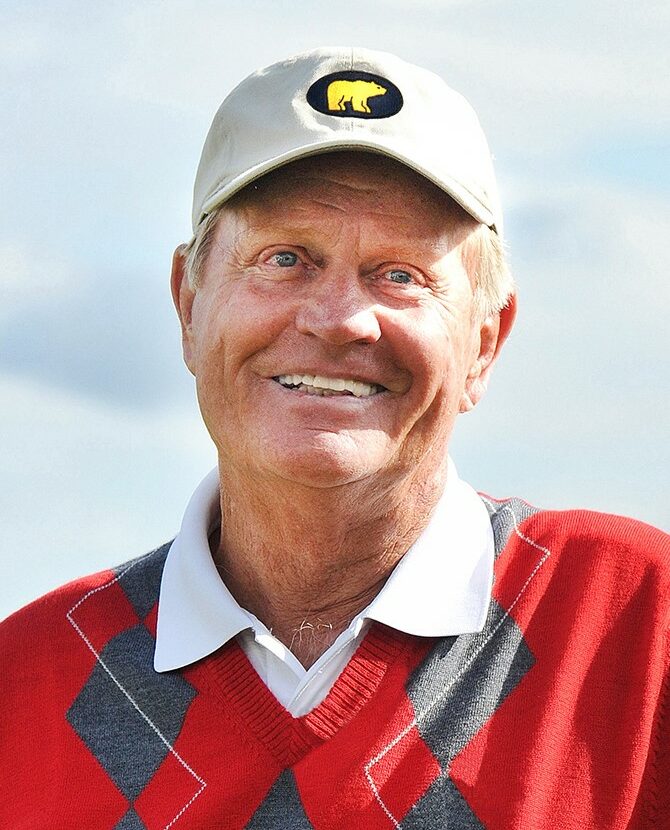
"The Golden Bear" in his golden years
Ben Hogan died in 1997, Mike Souchak in 2008, Arnold Palmer in 2016. As of June 18, 2022, Jack Nicklaus is still alive.
*
June 18, 1960 was a Sunday. These baseball games were played:
* The New York Yankees beat the Chicago White Sox, 12-5 at Comiskey Park in Chicago. Following their American League Pennant the year before, their 1st in 40 years, White Sox owner Bill Veeck installed the "exploding scoreboard," shooting off fireworks when a Pale Hose player hit a home run, or after a game the team won. In this game, Jim Rivera and Roy Sievers homered, in support of Early Wynn.
The Yankees thought it was "bush league," so, when one of their players hit one -- and, in this game, they got homers from Mickey Mantle, Roger Maris, and Moose Skowron, in support of Bob Turley -- they lit sparklers, and danced around the dugouts like idiots, to make the point that the White Sox looked like idiots first.
* The Cleveland Indians beat the Boston Red Sox, 2-1 at Cleveland Municipal Stadium. Ted Williams, in his final season as a player, did not play for the Red Sox in this game. But 1951 New York Giants hero Bobby Thomson did, drawing a walk as a pinch-hitter.
* The Cincinnati Reds beat the Chicago Cubs, 7-1 at Crosley Field in Cincinnati. Ernie Banks went 2-for-3 with a walk. Frank Robinson went 0-for-3 with 2 walks.
* The Detroit Tigers beat the Baltimore Orioles, 5-3 at Briggs Stadium in Detroit. The ballpark was renamed Tiger Stadium the next year. Brooks Robinson went 0-for-4. Al Kaline did not play for the Tigers, but Charlie Maxwell hit 2 home runs.
* The Milwaukee Braves beat the St. Louis Cardinals, 5-0 at Milwaukee County Stadium. Lew Burdette pitched a 7-hit shutout. Hank Aaron went 2-for-4. Stan Musial did not play.
* The Washington Senators beat the Kansas City Athletics, 7-2 at Kansas City Municipal Stadium. Harmon Killebrew did not play for the Senators, who became the Minnesota Twins the next season. But Jim Lemon hit 2 home runs, and Dan Dobbek added one.
* The Pittsburgh Pirates beat the Los Angeles Dodgers, 4-3 at the Los Angeles Memorial Coliseum. Hal Smith hit a home run, and then won the game in the top of the 10th inning by singling Roberto Clemente home. Clemente went 1-for-4 with a walk. Duke Snider went 1-for-5 with an RBI.
* And the San Francisco Giants beat the Philadelphia Phillies, 7-4 at Candlestick Park in San Francisco. Willie Mays went 2-for-4 with a walk and an RBI.


