Showing posts with label christianity. Show all posts

Friday, November 18, 2022

November 18, 1959: "Ben-Hur" Premieres

Stephen Boyd (left) and Charlton Heston

November 18, 1959: Ben-Hur premieres, directed by William Wyler, based on the 1880 novel by Lew Wallace. It had previously been filmed in 1925, starring Mexican actor Ramon Navarro in the title role, and Francis X. Bushman as the villain.

That was in black & white, and silent. This was in Technicolor, in full sound, and filmed in Italy with the largest budget ($15.175 million -- about $152 million in 2022 money), and the largest sets built, of any film produced at the time.

The story takes place in Jerusalem, in the early 1st Century AD, in the years immediately before, during, and after the ministry of Jesus of Nazareth. Judah Ben-Hur, played by Charlton Heston, already the preeminent performer of "historical epics," is a wealthy Jewish prince and merchant.

A childhood friend, Messala, played by Stephen Boyd, becomes commander of the nearby Roman fortress. While Judah has remained Jewish, Messala has totally bought into the Roman Empire's way of doing things. One thing leads to another, and Messala throws Judah into slavery, leading to the famous rowing scene.

After 3 years as a galley slave, Judah is assigned to Roman Consul Quintus Arrius' flagship. Arrius (Jack Hawkins) notices Judah's determination and self-discipline, and, after Judah saves his life in a battle with Macedonian pirates, Arrius petitions Emperor Tiberius to free him.

In Rome, Judah becomes a champion charioteer, driving the horses of Sheik Ilderrim (Hugh Griffith), and reunites with former girlfriend Esther (Israeli actress Haya Harareet). He enters a chariot race against Messala, in front of the new Governor of Judea, Pontius Pilate (Frank Thring), resulting in one of the most spectacular scenes ever filmed. Messala attempts to cheat, but, in response, a move by Judah results in Messala's method resulting in his own wreck and death. With his dying breath, Messala tells his friendy-turned-enemy that his mother, Miriam (Martha Scott), and his sister, Tirzah (Cathy O'Donnell), are alive, and where to find them.

Judah hears about a prophet he seeks who preaches love and forgiveness and urges Judah to cast off his consuming hate and vengeance. Judah and Esther attend the Sermon on the Mount. Soon afterward, Judah meets Pilate, who warns him against using his victory to lead a rebellion against Roman rule. Judah renounces his Roman citizenship. He finds out Tirzah is dying, and seeks Jesus to heal her.

But he is too late, and is a witness to the walk down the Via Dolorosa. History repeats itself: He recognizes Jesus (Claude Heater, uncredited) as a man who once tried to give him water as a galley slave, and tries to return the favor; but, as in the earlier incident, the gift is prevented by a Roman soldier (not the same one). After witnessing the Crucifixion, Judah walks through a storm to the cave where Miriam Tirzah and Esther are hiding. As the storm ends, he sees his mother and sister cured of their maladies, and accepts the miracle and forgives his enemies.

Metro-Goldwyn-Mayer spent $14.7 million, almost as much as it cost to make the film in the first place, to market it. It worked: Ben-Hur became the highest-grossing film premiering in 1959, and the 2nd-highest grossing film in history to that point, behind Gone with the Wind (also an MGM film). It became the 1st film to win 11 Academy Awards, including Best Picture, Best Director for Wyler, Best Actor for Heston, and Best Supporting Actor for Griffith.

Cathy O'Donnell (Tirzah) married Robert Wyler, brother of Ben-Hur director William Wyler. She died of cancer in 1970. Haya Harareet (Esther) died in 2021, and was the last surviving credited member of the film's cast.

Also premiering on this date was A Summer Place, based on the previous year's novel by Sloan Wilson. It starred Richard Egan and Dorothy McGuire as lovers reunited after 20 years, with Sandra Dee as the former's daughter and Troy Donahue as the latter's son, who begin their own affair.

The film was pretty steamy by the standards of the time. But now, it’s best known for its theme song, conducted by Percy Faith, which held the Number 1 spot on Billboard magazine's Hot 100 chart for 9 weeks in the Winter and Spring of 1960.

*

November 18, 1959 was a Wednesday. Baseball was out of season. Football was in midweek. No games were scheduled in the NHL. There were 3 games scheduled for the NBA:

* The New York Knicks beat the Minneapolis Lakers, 106-105 at the Minneapolis Armory.

* The Syracuse Nationals beat the Boston Celtics, 138-103 at the Onondaga County War Memorial (now the Upstate Medical University Arena) in Syracuse, New York.

* And the Detroit Pistons beat the Cincinnati Royals, 110-93 at the Cincinnati Gardens.

Saturday, August 6, 2022

August 6, 1966: The Beatles "Get Canceled" by America's Religious Right

The Beatles -- left to right: Ringo, Paul, John and George --
on their 1966 World Tour,
looking uneasy, maybe even shellshocked.
Which would have been understandable.

August 6, 1966: What would later be called "cancel culture" hits the biggest act in world entertainment at the time: The Beatles.

On March 4, 1966, The Evening Standard, a London-based newspaper but, like many, serving Great Britain nationally, published an article titled "How Does a Beatle Live?" written by Maureen Cleave. She had interviewed all 4 group members regularly, and accompanied them on their 1st visit to America in February 1964. She is widely believed to have had an affair with John, and to have been the subject of his song "Norwegian Wood (This Bird Has Flown)."
In her latest interview with John Lennon, she portrayed him as restless and searching for meaning in his life. The year before, he had written the song "Help!" While most American teenagers thought it was just a great rock and roll song, it was more than that: John was physically and mentally exhausted from 2 years of nonstop Beatlemania, and all the money he'd made hadn't reduced his stress. So he really was looking for help and meaning.

He and bandmate George Harrison had been reading about religion. Unlike George, who found a connection with Eastern, especially Indian, faiths, John found no comfort in it, or in any other religion. Cleave quoted him as saying:

Christianity will go. It will vanish and shrink. I needn't argue about that; I'm right and I'll be proved right. We're more popular than Jesus now; I don't know which will go first – rock 'n' roll or Christianity. Jesus was all right but his disciples were thick and ordinary. It's them twisting it that ruins it for me.

People in Britain barely noticed: The article provoked no controversy there. Church attendance there was in decline, and Christian churches were attempting to transform their image, to make themselves more "relevant to modern times."

At first, that was also the case in America. Later in March, Newsweek printed the quote. In May, Detroit magazine printed the interview. On July 3, The New York Times Magazine printed it. Still, there was no reaction worth mentioning.

On July 29, Datebook magazine published the interview, and also Cleave's most recent interview with Paul McCartney, in its September 1966 "Shout-Out" issue, which was dedicated to controversial youth-orientated themes, including recreational drugs, sex, long hair, and the Vietnam War.

Although only Paul was shown on the cover, Art Unger, the magazine's editor, put a quote from Lennon's interview on the cover: "I don't know which will go first – rock 'n' roll or Christianity!" In author Robert Rodriguez's description, the editor had chosen what he thought would be Lennon's "most damning comment" for maximum effect.

Except, while it probably should have been, that wasn't the quote that upset people: It was the line, "We're more popular than Jesus now."

And he was right. Granted, 2,000 years from now, if human civilization survives, there will likely be more Bibles sold than Beatle albums. But, at the time, kids were more interested in 4 young men from current Liverpool than in 1 young man from ancient Israel and his 12 disciples.

The people that freaked out over John's remarks shouldn't have asked, "How dare he say that?" They should have asked, "What can we do to make Jesus, once again, more popular than The Beatles?" (Disclaimer: I don't have an answer now, and I probably wouldn't have had an answer had I been around then.)

In Birmingham, Alabama, WAQY disc jockey Tommy Charles said, on the air, "That does it for me. I am not going to play The Beatles anymore." He destroyed their records on the air. Local UPI reporter Al Benn filed a news report in New York City, culminating in a major story in The New York Times on August 5. Radio stations all over the country, including in supposedly liberal cities like New York and Boston, announced that they would no longer play Beatle songs.
On August 6 came the kind of event that one would have expected in Nazi Germany: In Reno, Nevada, station KCBN announced a public bonfire for that night, where the band's albums would be burned.
Many stations in Southern cities followed. Paul compared it to what the Nazis did with books they didn't like, and called it "hysterical low-grade American thinking."
Brian Epstein, the group's manager, who was Jewish, shrugged it off at first. saying, "If they burn Beatles records, they've got to buy them first." But then the press office at the Vatican -- though not Pope Paul VI himself -- weighed in, issuing this statement: "Some subjects must not be dealt with profanely, not even in the world of beatniks." Now, it wasn't just a bunch of ignorant, bigoted, archconservative Southern Baptists that were angry at the Fab Four: It was, officially, the Roman Catholic Church.
What's more, there were death threats. Now, John was scared: He had put his bandmates, and even their loved ones -- by this point, all but Paul were married, John and Ringo Starr each had one son, and George had a sister and her children living in St. Louis -- at physical risk.
And so, for what turned out to be the only time in his public life, John Lennon ate crow, and apologized for something he'd said or done.
On August 11, the Beatles flew from London to Chicago, where the North American leg of their World Tour was to begin. That night, at the Astor Tower Hotel, at a press conference in front of TV cameras, John said, "I suppose if I had said television was more popular than Jesus, I would have got away with it. I'm sorry I opened my mouth. I'm not anti-God, anti-Christ, or anti-religion. I was not knocking it. I was not saying we are greater or better."
He stressed that he had been remarking on how other people viewed and popularized the band. He described his own view of God by quoting the Bishop of Woolwich, "not as an old man in the sky. I believe that what people call God is something in all of us."
He was adamant that he was not comparing himself with Christ, but attempting to explain the decline of Christianity in the UK. He closed with what could be considered a halfhearted apology: "If you want me to apologize, if that will make you happy, then, okay, I'm sorry." (Shades of more recent "I'm sorry if I offended anyone" statements.)
Most American journalists accepted this. A New York Times editorial said that the matter was over. Even the Vatican's newspaper, L'Osservatore Romano (The Roman Observer), decided that the apology was sufficient.
But it wasn't over. On August 13, in South Carolina, the Ku Klux Klan "crucified" a Beatles record on a large wooden cross, which they burned. On the same night, radio station KLUE in Longview, Texas held a Beatles bonfire. The next day, a lightning bolt struck its transmission tower, briefly knocking it off the air. Maybe this was God confirming that He had accepted John's apology as well.
It still wasn't over. On August 15, The Beatles played District of Columbia Stadium (later renamed Robert F. Kennedy Stadium), in Washington, which was still considered a semi-Southern city at that point, and the KKK picketed the concert. On August 19, The Beatles played their only scheduled concert in the South, at the Mid-South Coliseum in Memphis. The Klan picketed this show, too. During the concert, a spectator threw a firecracker onstage, and all 4 members later said that they thought someone had fired a gun.
(Memphis was, of course, the hometown of Elvis Presley. If anyone asked Elvis for his thoughts on the matter, they've never been made public.) 
To make matters worse, John couldn't keep his mouth shut. On August 17, before their concert at Maple Leaf Gardens in Toronto, he gave his approval to Americans fleeing to Canada to avoid the military draft. At a press conference in New York before their concert at Shea Stadium on August 22, John said the Vietnam War was "wrong." The year before, they had filled all 55,000 available seats at the Flushing Meadow stadium. This time, "only" 40,000 showed up, with pickets both for and against them facing off against each other. (There was no fight between these factions.)
It was their most stressful tour ever, and George said he'd rather leave the band than ever go on another tour. They decided they wouldn't, and would be only a recording band from that point onward, although they did not publicly announce it yet. George agreed to stay -- for now.
The last concert on the tour was at Candlestick Park in San Francisco on August 29. They were supported by The Ronettes, The Cyrkle, Bobby Hebb, and The Remains. (The Cyrkle were also managed by Epstein's company.) Attendance: 25,000, meaning about 17,000 empty seats. (In 1971, the NFL's San Francisco 49ers joined baseball's San Francisco Giants there, leading to an expansion to 69,000 seats.)
As usual, they roared through their set, playing 11 songs in 33 minutes, unable to hear themselves over all the screaming, partly due to the fact that, in spite of having a year pass since their first round of stadium concerts, no one had yet figured out how to stage a rock concert in a ballpark. (By the 1970s, that problem would be solved.) The last song they played was a cover of Little Richard's "Long Tall Sally," sung by Paul.
While they'd decided not to tour again, even the four of them did not know that this would be their last paying concert together, ever. There would be the concert on the roof of the building where Apple Records was based, on January 30, 1969. And each of them would have notable solo gigs, with Paul and Ringo living and continuing to tour into the 2020s. But The Beatles would never have another official concert.
In 1970, for his solo album John Lennon/Plastic Ono Band, John recorded a song titled "God," in which he rattled off things and people he didn't believe in: Magic, the I-Ching, the Bible, tarot cards, Adolf Hitler, Jesus, John F. Kennedy, Buddha, mantras, Gita, yoga, kings, Elvis, Zimmerman (meaning Bob Dylan), and, finally, The Beatles. He said, "I just believe in me. Yoko and me. And that's reality." In 1971, for his album Imagine, he recorded a song of the same title, asking people to imagine there's no Heaven or Hell, "and no religion, too."
In contrast, in 1970, for his solo album All Things Must Pass, George recorded "My Sweet Lord," in which he seemed to want to get to know God better -- but the background singers, after chanting, "Hallelujah," began chanting, "Hare Krishna," and moved on to chanting the names of the Hindu gods Brahma, Vishnu and Shiva.
Maureen Cleave, who wrote the original article, died in 2021, at the age of 87.
*

August 6, 1966 was a Saturday. Back in Britain, a preseason exhibition game, or "friendly," was played between two of the most popular soccer teams in the country. Arsenal Football Club of North London traveled to Ibrox Stadium in Glasgow, Scotland, home of Rangers Football Club.

Arsenal were in a transition, having just survived relegation the season before, and had hired a new manager, Bertie Mee. He would build them into England's greatest team once again. But that would take 5 seasons. In contrast, Rangers were, as usual, one of the better teams in Scotland, and had won the Scottish Cup the last season. Rangers won this match, 2-0.

And these baseball games were played:

* The New York Yankees beat the Cleveland Indians, 5-4 at Cleveland Municipal Stadium. Jim Bouton and Sam McDowell started, but, in relief, it was Whitey Ford who was the winning pitcher, and Luis Tiant the losing pitcher. Clete Boyer and Horace Clarke hit home runs. Neither Mickey Mantle nor Roger Maris played.

* The New York Mets lost to the St. Louis Cardinals, 10-8 at Shea Stadium. The Cardinals led 5-0 after 3 innings, then the Mets led 8-4 after 4, but the Cards won. Lou Brock went 2-for-4 with a walk, a stolen base and an RBI. Ken Boyer hit a home run for the Mets over the team he had captained to a World Championship, and won a Most Valuable Player award for, just 2 years earlier.

* The Philadelphia Phillies beat the Atlanta Braves, 6-5 at Connie Mack Stadium in Philadelphia. Hank Aaron went 1-for-3 with 2 walks. Joe Torre went 2-for-5.

* The Baltimore Orioles beat the Washington Senators, 4-0 at Memorial Stadium in Baltimore. Dave McNally pitched a 7-hit shutout. Frank Robinson went 3-for-4 with an RBI. Brooks Robinson went 1-for-3 with an RBI.

* The Pittsburgh Pirates beat the Cincinnati Reds, 9-3 at Forbes Field in Pittsburgh. Roberto Clemente went 0-for-4, but had an RBI on a bases-loaded walk. Willie Stargell did not play. Pete Rose went 2-for-4 with 2 RBIs.

* The Boston Red Sox beat the Detroit Tigers, 8-2 at Tiger Stadium in Detroit. Carl Yastrzemski went 0-for-2 with 2 walks. Tony Conigliaro went 1-for-5. Al Kaline went 1-for-4.

* The Chicago Cubs beat the San Francisco Giants, 5-2 at Wrigley Field in Chicago. Ernie Banks went 2-for-4 with a home run and 2 RBIs. Robin Roberts started for the Cubs, but only pitched 3 innings, and made just 5 more major league appearances before retiring. Willie Mays went 2-for-4.

* The Minnesota Twins beat the Kansas City Athletics, 5-0 at Kansas City Municipal Stadium. Jim "Mudcat" Grant pitched a 4-hit shutout. Harmon Killebrew went 1-for-3 with a walk.

* The Los Angeles Dodgers beat the Houston Astros, 4-3 at the Astrodome in Houston. Don Drysdale outpitched Mike Cuellar.

* And the Chicago White Sox beat the California Angels, 7-1 at Anaheim Stadium (now Angel Stadium of Anaheim).

Friday, April 8, 2022

April 8, 1966: Time Magazine's "Is God Dead?" Cover

April 8, 1966: Time magazine prints its most famous cover, asking a big question: "Is God Dead?"

Why did the question come up? The question was already steeped in German philosophy in the 19th Century. In 1797, German writer Jean Paul wrote Siebenkäs (Sevencheese), in which a character says, "'The Dead Christ Proclaims That There Is No God." Philipp Mainländer and George Hegel had also written on the subject. In 1862, French writer Victor Hugo had his character Gerard de Nerval say, "God is dead, perhaps" in Les Misérables.

In his 1882 book The Gay Science (sometimes translated as "The Joyful Science," it has nothing to do with homosexuality), Friedrich Nietzsche came right out and said it: "Gott ist tot." He said, "The belief in the Christian God has become unbelievable," adding that everything that was "built upon this faith, propped up by it, grown into it," including "the whole of European morality," is bound to "collapse." He repeated the line "God is dead" in his next and most-known book, Thus Spoke Zarathustra.

The World Wars of the 20th Century, in which both Germany as aggressor and the nations defending themselves used God as justification, would likely have convinced him that he was right, at least about the collapse part.

What's more, Nietzsche believed it was a good thing: He often wrote of an "overman" who was "beyond good and evil," superseding established concepts of what was moral and what was not. And that was part of the problem: After his death in 1900, this belief in an Übermensch was twisted into the official beliefs of the aggressors of the World Wars, Kaiser Wilhelm II and Chancellor Adolf Hitler.

It was an American of German descent, Otto Fuerbringer, who, as editor of Time, released that cover, the magazine's first without a photograph in its 43 years of publishing to that point. But the issue did not attempt to answer the question. In more recent terms, the cover was "clickbait."

The article accompanying the magazine cover, titled "Toward a Hidden God" and written by the magazine's religion editor, John T. Elson, mentioned the so-called "God Is Dead" movement only briefly in its introduction. In a footnote, it identified the leaders of the movement, and explained how those theologians had been trying to construct a theology without God.
Otto Fuerbringer

The article pointed out that, while this movement had roots in the philosophy of Nietzsche, it also drew on a broader range of thinkers, who had expressed concerns about the role of God in an increasingly secularized world. The immediate reality did not indicate a death of God, or a death of religion, and the article pointed out that the recent Second Vatican Council had done much to revitalize Christianity, and the Roman Catholic Church in particular.

The article cited a poll in which 97 percent of Americans declared a belief in God, but only 27 percent called themselves "deeply religious."

Time received around 3,500 letters to the editor, still the largest number of responses to any one story in the history of the magazine. In its issue of December 26, 1969, Time ran a follow-up cover story asking, "Is God Coming Back to Life"?

A month before the controversial cover, John Lennon of The Beatles gave an interview in which he said, "Christianity will go. It will vanish and shrink. I needn't argue about that; I'm right and I'll be proved right. We're more popular than Jesus now." When it was published in the American magazine Datebook on July 29, evangelical Americans lost their minds, and convinced radio stations to ban the Beatles, and even held record burnings, as if it was Nazi Germany. Lennon had to apologize.

On November 29, 1993, Time did a cover story on psychology, discussing how people were moving away from the teachings of Sigmund Freud. Freud had died in 1939, and was famously atheist: He wouldn't have said God was dead, he would have said God never existed in the first place. But the 1993 cover showed a painting of Freud, with his head coming apart like pieces of a puzzle, asking, "Is Freud Dead?"

And on April 3, 2017, with Donald Trump having become President, despite so many of his statements having been proven to be lies, Time printed this cover.
Trump was defeated in 2020, so the answer was, "No, but it sure was sick for a while." (UPDATE: Trump was returned to the Presidency in 2024, indicating that truth remains seriously ill.)

Otto Fuerbringer died in 2008; John T. Elson, the following year.

*

April 8, 1966 was a Friday -- indeed, it was Good Friday, the traditional date of the Crucifixion of Jesus, with Easter to follow on Sunday. Actresses Cynthia Nixon and Robin Wright were born on this day.

The baseball season started 3 days later. Football was out of season. The NBA Playoffs were in the Divisional Finals, but both were between games. The Boston Celtics beat the Philadelphia 76ers in 5 games, while the Los Angeles Lakers needed 7 games to beat the St. Louis Hawks. The Celtics then beat the Lakers in the Finals.

And the Stanley Cup Playoffs were underway, but both Semifinal series were between games. The Montreal Canadiens would sweep the Toronto Maple Leafs in 4 straight, while the Detroit Red Wings would need 6 games to finish off the Chicago Black Hawks, and then the Canadiens would beat the Wings for the Cup. So there were no scores on this historic day.

Friday, February 25, 2022

February 25, 2004: “The Passion of the Christ” Premieres

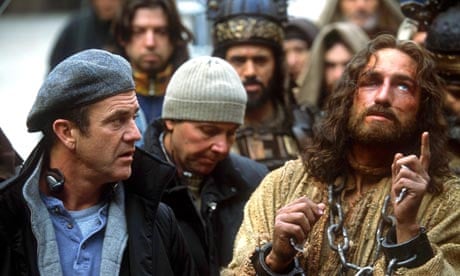
Mel Gibson (left) and Jim Caviezel (right).
I cannot identify the man in the middle.

February 25, 2004: The Passion of the Christ, directed by Mel Gibson, premieres. The film stars not Gibson but Jim Caviezel as Jesus. Even Gibson didn't have the ego to cast himself.

Gibson intended to show the last day in the earthly life of Jesus, whose suffering became known as "the Passion" long before the term "passion" came to mean anything romantic or sexual. "Passion Plays," depicting the last days of Jesus, were common in Europe as early as the Middle Ages.

Gibson concluded with the empty tomb, rather than the reappearing after the Resurrection. In other words, in his effort to show the sufferings of the Crucifixion, he totally missed the point: Not that Jesus lost, but that he won. And that is an offense even worse than Gibson injecting blatant anti-Semitism into the film. It's like ending the Star Wars saga with Luke and Vader both getting blown up on the Death Star, or 300 without mentioning that, enabled and inspired by the Spartan sacrifice, the Greeks went on to kick the Persians out.

Also, what would Jesus say about Caviezel wearing that cap,
advertising the movie? Does that count as making a graven image?

Gibson's director of photography was Caleb Deschanel, one of the best in the business. He is also the husband of actress Mary Jo Deschanel, and they are the parents of actresses Emily Deschanel and Zooey Deschanel, neither of whom was in the movie.

Most of the actors in the movie, shot in Italy, were Italian. As a result, few were known to American audiences, although Gibson cast the fabulous Monica Bellucci, definitely known to U.S. moviegoers, as Mary Magdalene. Jesus' mother Mary was played by Romanian actress Maia Morgenstern, the Apostle Peter by Francesco De Vito, the disloyal Judas Iscariot by Luca Lionello, and Governor Pontius Pilate by Bulgarian actor Hristo Shopov.

Another thing holding the movie back was Gibson's insistence on the actors speaking the languages that their characters would have spoken at the time: Aramaic, Hebrew and Latin. To make matters worse, he didn't want subtitles, but Newmarket Films, not willing to go bankrupt, insisted on them.

On a budget of $30 million, the film made over $600 million, especially appealing to American evangelicals. As Billy Crystal, Jewish, joked while hosting the Oscars a few weeks later, "It opened on Ash Wednesday. It had a Good Friday."

Other notable films about Jesus include King of Kings, made with H.B. Warner in 1927 and again with Jeffrey Hunter in 1961; The Greatest Story Ever Told, with Max von Sydow, 1965; Jesus of Nazareth, with Robert Powell, a TV miniseries first broadcast on Italy's RAI, Britain's ITV, and America's NBC in 1977; The Last Temptation of Christ, with Willem Dafoe, 1988; Jesus, with Jeremy Sisto, 1999; and Mary, Mother of Jesus, with future Batman Christian Bale, also in 1999. As with Gibson's film, the Powell and Sisto versions were produced and filmed in Italy.

In 1973, country singer Johnny Cash produced and narrated Gospel Road, filming it on location in Israel and Jordan were the events are said to have happened. He had the guts to cast his wife, country singer June Carter Cash, as the not-really-a-prostitute Mary Magdalene. Robert Elfstrom played Jesus, and his son Robert Jr. played him as a boy.

Dafoe later made a Mercedes-Benz commercial where he played the Devil. This made him, as far as I know, the only actor ever to play both Jesus and the Devil. George Burns played God in the 3 Oh, God! films, and also played the Devil in the last of them, Oh, God! You Devil in 1984.

*

February 25, 2004 was, as stated a Wednesday. Baseball and football were out of season. There were 10 games played in the NBA:

* The New York Knicks lost to the Phoenis Suns, 113-95 at the America West Arena (now the Footprint Center) in Phoenix.

* The New Jersey Nets lost to the Minnoesta Timberwolves, 81-68 at the Target Center in Minneapolis.

* The Milwaukee Bucks beat the Boston Celtics, 106-104 at the FleetCenter (now the TD Garden) in Boston.

* The Washington Wizards beat the Toronto Raptors, 76-74 at the Air Canada Centre (now the Scotiabank Arena) in Toronto.

* The Golden state Warriors beat the Memphis Grizzlies, 99-92 at the Memphis Pyramid.

* The New Orleans Hornets beat the Los Angeles Clippers, 99-93 at the New Orleans Arena (now the Smoothie King Center).

* The Detroit Pistons beat their arch-rivals, the Chicago Bulls, 107-88 at the United Center in Chicago.

* The Houston Rockets beat the Cleveland Cavaliers, 90-84 at the Toyota Center in Houston.

* The Los Angeles Lakers beat the Denver Nuggets, 112-111 at the Pepsi Center (now the Ball Arena) in Denver. Kobe Bryant and Carmelo Anthony each scored 35 points.

* And the Utah Jazz beat the Seattle SuperSonics, 93-92 in overtime at the Key Arena in Seattle. Ray Allen led all scorers on the night with 40 points.

And there were 8 games in the NHL:

* The New Jersey Devils beat the Buffalo Sabres, 8-2 at the Continental Airlines Arena at the Meadowlands. Patrik Eliáš had 2 goals and 3 assists.

* The Carolina Hurricanes beat the Washington Capitals, 2-1 at the MCI Center (now the Capital One Arena) in Washington.

* The Tampa Bay Lightning beat the Atlanta Thrashers, 4-2 at the Philips Arena (now the State Farm Arena) in Atlanta.

* The Florida Panthers beat the Toronto Maple Leafs, 4-0 at the Office Depot Center (now the Amerant Bank Arena) in the Miami suburb of Sunrise, Florida.

* The Dallas Stars and the Los Angeles Kings played to a tie, 1-1 at the American Airlines Center in Dallas.

* The Chicago Blackhawks beat the Columbus Blue Jackets, 4-3 at the Nationwide Arena in Columbus.

* The Pittsburgh Penguins beat the Phoenix Coyotes, 4-3 at the Glendale Arena (now the Desert Diamond Arena) in the Phoenix suburb of Glendale, Arizona. Ric Jackman scored the winning goal with 3:12 left in overtime.

* And the Mighty Ducks of Anaheim beat the Edmonton Oilers, 4-2 at the Arrowhead Pond of Anaheim (now the Honda Center).

December 31, 1999 & January 1, 2000: The Millennium

December 31, 1999:  The Millennium arrives. The people of planet Earth survived. At a terrible cost. But we hadn't destroyed ourselves. ...