Showing posts with label conservative party. Show all posts

Sunday, November 27, 2022

November 27, 1975: The Assassination of Ross McWhirter

The McWhirter Twins, 1974: Norris (left) & Ross

November 27, 1975: Ross McWhirter, with his twin brother Norris a sportswriter, co-founder of The Guinness Book of World Records, and a Conservative Party activist, is assassinated outside his home in Enfield, North London. He was 50 years old.

The twin brothers were born on August 12, 1925 in North London, and both served in the Royal Navy in World War II, on a minesweeper. They became sports journalists. In 1951, they published Get to Your Marks, and earlier that year they had founded an agency to provide facts and figures to Fleet Street, the catch-all name for British newspapers, even if they were no longer based on the London street of that name.

In 1954, Norris served as the public address announcer for the track meet at Oxford University in which Roger Bannister became the 1st man to run a mile race in under 4 minutes. Also competing that day was Christopher Chataway, who worked for the Guinness brewery, and introduced them to his boss, Sir Hugh Beaver.

The following year, the 1st Guinness Book of World Records was published, billed as the ultimate settler of bar bets. It quickly became the biggest-selling book in Britain, setting a world record itself, and eventually became more famous than the stout itself. In 1965, the twins were guests on the American panel game show I've Got a Secretwhere they exhibited their memorization of their book.

Both brothers became Conservative Party activists. Both ran for seats in Parliament in the 1964 general election, but were unsuccessful. Norris tried again in 1966, and lost again. In 1972, Prime Minister Edward Heath, Leader of the Conservative Party, brought Britain into the European Common Market. Norris called it "treason." In a 2017 article in The Guardian, Stuart Jeffries called him "the original Brexiter":

Imagine, if you dare, that Katie Hopkins is also the status guru on Test Match Special. Or that Nigel Farage is renowned not just as the beef-faced broker who got us out of the EU but for his astute postgame analysis on Match of the Day.

Neither of these comparisons really does justice to Norris McWhirter. He was something else. He was alt-right before the term was invented. 

(For readers not familiar with British politics: Hopkins is a newspaper columnist, known for her anti-immigrant views; Farage was the longtime leader of the far-right UK Independence Party, and claims to be the person most responsible for Britain finally leaving the European Union, the process known as "Brexit"; Test Match Special is a TV show about cricket; Match of the Day, about soccer. And, yes, there is another show on British TV, called Soccer Saturday, so they don't always call that sport "football.")

Ross advocated and lobbied for various restrictions on the freedom of the Irish community in Britain, such as compulsory registration with the local police, and a requirement for signed photographs when renting flats or booking hotel rooms. If that sounds like something that Donald Trump would like, that's not my fault.

In 1975, Ross McWhirter offered a £50,000 reward -- in 2022 money, about £342,000; with the current exchange rate, about $415,000 -- for information leading to a conviction for several recent high-profile bombings in England that were publicly claimed by the Provisional Irish Republican Army (IRA).

On November 27, at 6:45 PM, he was shot by 2 members of the Balcombe Street Gang. The killers were Harry Duggan and Hugh Doherty. Duggan said later, "McWhirter thought he lived in Texas. He put a bounty on our heads. He asked to be killed."

No, he didn't. Being a right-wing jerk is not an invitation to murder. And killing him didn't accomplish anything.

Duggan and Doherty were captured 9 days later, and charged with his murder and 10 others. They were sentenced to life imprisonment, but freed in 1999 under the terms of the Good Friday Agreement. As of November 27, 2022, both men are still alive.

Norris McWhirter lived on, without his brother, as a union-bashing libertarian. With the election of the Conservatives, and of the twins' longtime friend Margaret Thatcher as Prime Minister, in 1979, his beliefs became, for the most part, official government policy.

He had medals cast and given to athletes boycotting the Olympics in Moscow in 1980, and publicly defended athletes who dared to resist the ban on playing sporting events in then-apartheid South Africa. Defenders of that state, in both Britain and America, defended by saying they weren't personally racist, themselves, but supported a regime that was openly anti-Communist. Of course, the implication was that the country's black activists were Communists.

Norris sold his interest in the Guinness Book in 1996, and died on April 19, 2004, at the age of 78.

*

November 27, 1975 was a Thursday. In America, it was Thanksgiving Day. Since 1934, that had meant that the Detroit Lions played at home. This would be their 1st T-Day game in the suburbs, and they lost, 20-0 to the Los Angeles Rams, at the Silverdome in Pontiac, Michigan.

Since 1966, Thanksgiving had meant that the Dallas Cowboys played at home. But this year, and again in 1977 (but not in 1976), the NFL deviated from Dallas, giving the home game to the football version of the St. Louis Cardinals. The Cards lost to the Buffalo Bills, 32-14 at Busch Memorial Stadium. The NFL might have been motivated to give St. Louis the game not because of the Cardinals, but because of their opponents: The Bills featured the most popular player in the League, running back O.J. Simpson.

One game was played in college football, the rivalry known as "Clean Old-Fashioned Hate": Georgia, then ranked Number 15, beat Georgia Tech, 42-26 at Grant Field in Atlanta.

Baseball was out of season. There were 3 games played in the NBA:

* The New York Knicks beat the Washington Bullets, 96-90 at the Capital Centre in the Washington suburb of Landover, Maryland.

* The Kansas City Kings beat the Cleveland Cavaliers, 95-91 at The Coliseum in the Cleveland suburb of Richfield, Ohio.

* And the Golden State Warriors beat the Milwaukee Bucks, 106-105 at the Milwaukee Exposition & Convention Center Arena, a.k.a. The MECCA. (It's now the UW-Milwaukee Panther Arena.)

And there was 1 game in the American Basketball Association: The Utah Stars beat the Kentucky Colonels, 128-126 in overtime at the Salt Palace in Salt Lake City, Utah. Despite the defeat, William "Bird" Averitt of the Colonels led all scorers on the night with 43 points. Ron Boone led the Stars with 34.

There were 2 games in the NHL. The Montreal Canadiens beat the New York Islanders, 2-1 at the Nassau Coliseum. And the League's Missouri teams played each other: The Kansas City Scouts beat the St. Louis Blues, 3-2 at the Kemper Arena (now the Hy-Vee Arena) in Kansas City. This may have been the Scouts' high point: A year later, they moved to Denver, becoming the Colorado Rockies. In 1982, they moved again, becoming the New Jersey Devils.

And there were 4 games in the World Hockey Association:

* The Indianapolis Racers beat the Winnipeg Jets, 3-1 at the Market Square Arena in Indianapolis.

* The Minnesota Fighting Saints beat the Cincinnati Stingers, 5-3 at the St. Paul Civic Center in St. Paul, Minnesota.

* The Calgary Cowboys beat the Phoenix Roadrunners, 5-1 at the Arizona Veterans Memorial Coliseum in Phoenix.

* And the San Diego Mariners beat the Quebec Nordiques, 5-1 at the San Diego Sports Arena (now the Pechanga Arena).

Friday, November 4, 2022

November 4, 1969: John Lindsay's Upset Win

November 4, 1969: John Lindsay, denied renomination by the Republican Party, and running as the nominee of the Liberal Party, is re-elected Mayor of New York City.
The opposition to him had fragmented: The Democratic nominee was Mario Procaccino, a conservative serving as City Comptroller, and widely viewed as a racist; while the nominee of the Republican and Conservative Parties was John Marchi, a State Senator from Staten Island, who was so conservative, he made Barry Goldwater look like Bobby Kennedy.
When Lindsay was denied renomination, he looked finished. The fact that he had presided over race riots and municipal strikes while calling New York "Fun City" didn't help. He may have been the 1st major politician to run having used the expression "Mistakes were made" -- used many times by many people since, without specifically saying, "I have made mistakes" -- and used an expression that would later be used by some of his successors, calling the job of Mayor of New York "the second-toughest job in America."
On this day, Lindsay got 42.4 percent of the vote -- not a majority, but a plurality, and over the 40 percent threshold for a runoff -- while Procaccino got 34.8 percent and Marchi got 22.7 percent. The Borough tallies were as follows:
* Manhattan: Lindsay 67 percent, Procaccino 20, March 12.
* Bronx: Procaccino 41, Lindsay 40, Marchi 19.
* Brooklyn: Procaccino 42, Lindsay 36, Marchi 25.
* Queens: Lindsay 36.3, Procaccino 35.8, March 28.
* Staten Island: March 62, Procaccino 20, Lindsay 17.
What saved Lindsay? It wasn't just liberals and minorities, afraid of what Procaccino or Marchi would do. It was the New York Mets. Their run to a World Series win allowed him to identify with them, and he was in the locker room when they won the Series at Shea Stadium on October 16, 19 days before the election. He then gave them a ticker-tape parade and a big ceremony at City Hall. (He gave the Super Bowl-winning Jets a ceremony, too, but not a parade.)
Lindsay in the Mets' locker room, October 16, 1969
Lindsay's 1st term was hard. His 2nd term was a bit more peaceful in terms of civil strife, but harder in terms of holding the City's government and economy together. He might have wished he had lost. He did not run for a 3rd term in 1973 -- he wouldn't have had a chance -- and he died in 2000.
Procaccino never won another election, and died in 1995. Marchi won the Republican and Conservative nominations for Mayor in 1973, but lost to Abe Beame, the Comptroller that Lindsay had beaten for Mayor in 1965. Marchi set a record that has never been surpassed in any State: 50 years in the State Legislature, January 1, 1957 to December 31, 2006. He died in 2009.
Also on this day, William T. Cahill, a Republican Congressman representing Camden County, is elected Governor of New Jersey. After 16 years of Democratic Governors, under Robert Meyner and, since a Governor of New Jersey can't serve 3 consecutive terms, Richard J. Hughes, people wanted something different, and when Meyner was nominated to regain the office, he couldn't get any traction.
Cahill got the State legislature to pass the bill creating the New Jersey Sports and Exposition Authority, which built the Meadowlands Sports Complex. But he raised taxes, and 3 major Republican officials were convicted of crimes. He was denied renomination by his own Party in 1973. He went on to teach at Princeton University, and died in 1996. Meyner died in 1990.
Also on this day, The Allman Brothers Band release their self-titled debut album. It includes the song "Whipping Post."
Also on this day, Matthew McConaughey (no middle name) is born in Uvalde, Texas. Admit it: After playing a stoner in Dazed and Confused, a lawyer in A Time to Kill, winning an Oscar as an AIDS patient in Dallas Buyers Club, and apparently playing another stoner in some Cadillac commercials, you forgot he was in a baseball movie, playing left fielder Ben Williams in the 1994 remake of Angels In the Outfield.
Also on this day, Sean John Combs is born in Manhattan, and grows up in nearby Mount Vernon, Westchester County, New York. The rapper, music producer, and fashion designer is known by many names: Sean John, Puff Daddy, Puffy, P. Diddy, or just Diddy. Personally, I will always think of him as The Guy Who Got Jennifer Lopez Arrested.
*
November 4, 1969, like all modern American Election Days, was a Tuesday. Actor Matthew McConaughey and hip-hip mogul Sean Combs (Puff Daddy, P. Diddy, Diddy) were born on this day.
The baseball season was over. Football was in midweek. There were 4 games played in the NBA:
* The New York Knicks beat the Phoenix Suns, 116-99 at the Arizona Veterans Memorial Coliseum. Despite the Suns' defeat, Connie Hawkins led all scorers on the night with 39 points.
* The Baltimore Bullets beat the San Francisco Warriors, 124-105 at the Baltimore Civic Center (now the CFG Bank Arena). This was actually part of a doubleheader that also included this game:
* The Philadelphia 76ers beat the Chicago Bulls, 113-109.
* And the Seattle SuperSonics beat the Detroit Pistons, 116-102 at Cobo Hall (now the Huntington Center) in Detroit.
There was 1 game in the American Basketball Association: The Washington Capitols beat the Carolina Cougars, 117-107 at the Washington Coliseum.
Only 1 game was played in the NHL: The Toronto Maple Leafs beat the Oakland Seals, 5-2 at the Oakland Coliseum Arena.

Tuesday, October 25, 2022

October 25, 1993: Canada's Tories Are Nearly Wiped Out

October 25, 1993: Canada holds a federal election. Brian Mulroney had resigned as Prime Minister and Leader of the Progressive Conservative Party 4 months earlier, because he knew that the PCs, or "Tories," were going to get clobbered. So he asked the Party to approve his Minister of Justice, Kim Campbell as Leader, thus making her the 1st female head of government in North America. She was also the 1st Prime Minister from the Province of British Columbia.
If Mulroney thought this might gain the Tories some female voters, he was very, very wrong. The Liberal Party gained 96 votes to achieve 177 seats and a majority, and make their Leader, Jean Chrétien, the new Prime Minister. The Tories went from 156 seats to only 2 -- and Campbell's, for Vancouver Centre, was not one of them. Nor was Mulroney's, in Charlevoix, Quebec. They fell from 43 percent of the popular vote to 16 percent.
Campbell's 133-day tenure as Prime Minister was one of the shortest in the nation's history, and it was not her fault at all that it ended so soon. After 9 years of Mulroney, the countries was sick of the Tories. They went from the most seats in the House of Commons to 5th place.
The Bloc Québécois, essentially representing the interests of people who didn't even want to be in Canada anymore, were now in 2nd place, and thus the official Opposition, with 54. The Reform Party was now the leading right-of-center party, going from just 1 seat to 52. And the New Democratic Party, the largest openly socialist party in North America, actually lost seats, retaining 35. Left parties now outnumbered right parties 266-54, getting 75 percent of the popular vote.
Chrétien remained in office for 10 years, his party for nearly 13. The PCs and the Reform Party would merge to form a new Conservative Party, and it would regain power under Stephen Harper in 2006.

*

October 25, 1993 was a Monday. The baseball season had ended 2 days earlier, with the Toronto Blue Jays, Canada's own, repeating as World Champions, defeating the Philadelphia Phillies, 8-6 in Game 6 of the World Series at the SkyDome (now the Rogers Centre) in Toronto. On ABC Monday Night Football, the Minnesota Vikings beat the Chicago Bears, 19-12 at Soldier Field in Chicago.

The NBA season wouldn't start for another 11 days. There were 3 games played in the NHL that day:

* The Ottawa Senators beat the Mighty Ducks of Anaheim, 4-1 at the Ottawa Civic Center (now the TD Place Arena) in Ottawa.

* The Dallas Stars beat the Detroit Red Wings, 5-3 at the Joe Louis Arena in Detroit.

* And the Calgary Flames beat the Washington Capitals, 3-2 at the Saddledome in Calgary. Ted Drury scored the winning goal with 2:03 left in overtime.

Wednesday, October 12, 2022

October 12, 1984: The Brighton Hotel Bombing

October 12, 1984: At 2:54 AM, a bomb planted by the Provisional Irish Republican Army explodes in Room 629 of the Grand Hotel in Brighton, Sussex, on England's South Coast. There was a Conservative Party meeting there, and 5 people were killed. But the main target, Prime Minister Margaret Thatcher, escaped serious injury.

The victims were Anthony Berry, a Member of Parliament; Donald Maclean, the President of the Scottish Conservative and Unionist Party; his wife, Muriel; Lady Jeanne Shattock, the wife of the Western Area chairman of the Conservative Party, Sir Gordon Shattock, who was injured but survived; and Roberta Wakeham, wife of John Wakeham, then the Government Chief Whip in the House of Commons, who has since been created a Baron.

(Both Shattock and Wakeham would remarry. In the latter's case, he married his secretary, Alison Ward -- who had previously served as Thatcher's secretary.)

The explosion caused several floors a wing of the hotel to collapse. Norman Tebbit, then Secretary of State for Trade and Industry, recalled:

The ceiling came crashing down on us and then, in a hail of debris, the floor collapsed, catapulting us down under an avalanche of bricks, timber and plaster. The force of the impact was indescribable, blow after blow as the debris smashed on to my left side. Something tore into my abdomen with a terrible blow, and I heard my very guts sloshing inside me. There was a colossal impact tearing a great hole in my side, then I stopped falling, with no idea where, nor even which way up I was, as the debris cascaded down.

But he survived. His wife, Margaret, fell through 4 floors, and was wheelchair-bound for the rest of her life. Thatcher's room was below the Tebbits'. Her bathroom was badly damaged but she, her husband Denis, and Robin Butler, her personal private secretary, were all uninjured.

According to Rory Carroll, then 12 years old and living in Dublin, but later the Ireland correspondent for English newspaper The Guardian and the author of a book on the bombing, the bomb "did not even scratch her. But it came very, very close." He theorized that if she had still been in the bathroom, "she would have been cut to ribbons, perhaps fatally."

The Provisional IRA released this statement: "Mrs. Thatcher will now realise that Britain cannot occupy our country and torture our prisoners and shoot our people in their own streets and get away with it. Today we were unlucky, but remember we only have to be lucky once. You will have to be lucky always. Give Ireland peace and there will be no more war."

Thatcher responded with her usual bluntness: "That is the scale of the outrage in which we have all shared, and the fact that we are gathered here now -- shocked, but composed and determined -- is a sign not only that this attack has failed, but that all attempts to destroy democracy by terrorism will fail."

The man who planted the bomb was Patrick Magee, then a 33-year-old Provisional IRA member who had previously served 2 years in prison. He was sentenced to 8 life terms, but was released in 1999 as part of the Good Friday Accord. As of October 12, 2022, he is still alive, and has written a book about his experiences.

If the Provisional IRA thought this bombing would rally people to their cause, they were wrong. Support for Thatcher only grew, as she achieved the rare distinction of being both strong leader and victim at the same time.

Thatcher had led the Conservative Party to victory in the national elections of 1979 and 1983, and would do so again in 1987. But an intraparty squabble forced her out in 1990. Tebbit was among those considering running to support her, but, still needing to look after his wife, he retired from the Commons instead, and John Major became Prime Minister. Like Wakeham, Tebbit was later created a Baron, and sat in the House of Lords.

Thatcher was loved by conservatives for her toughness and her belligerence, but hated by the poor, labor unions, and especially the Irish, for being bigoted and openly harmful to them. She was renowned for her alliance with Ronald Reagan, whose entire Presidency was during her Premiership. When Reagan died, the half of America that hated him held its tongue out of respect; when Thatcher died, the half of Britain that hated her rejoiced.

*

October 12, 1984 was a Friday. Game 3 of the World Series was played at Tiger Stadium in Detroit. The Detroit Tigers beat the San Diego Padres, 5-3. Milt Wilcox outpitched Tim Lollar. Marty Castillo hit a home run for the Tigers, who would win the Series in 5 games.

Football was in midweek. The NBA season hadn't started yet, but there were 2 games played in the NHL. The New Jersey Devils beat the New York Islanders, 7-2 at the Brendan Byrne Arena at the Meadowlands. And the Edmonton Oilers beat the St. Louis Blues, 5-1 at the Northlands Coliseum in Edmonton.  

Wednesday, September 14, 2022

September 14, 1926: The King-Byng Affair

William Lyon Mackenzie King

September 14, 1926: Canada holds a general election. It is won by the Liberal Party, which means that its Leader, former Prime Minister William Lyon Mackenzie King, will be returned to the job. And that means that the people of Canada were sending a message to their "mother country," Great Britain: We may still be a part of your Empire, but we will decide our own fate.

Since "Confederation" gave Canada a partial independence in 1867, the nation's head of state had been the British monarch, represented in-country by a Governor-General; and the head of government had been the Prime Minister, the Leader of the party with the most seats in the House of Commons.

In 1921, Julian Byng, 1st Baron Byng of Vimy, was named Governor-General of Canada by King George V. Lord Byng had been the commanding officer of the Canadian Corps at the Battle of Vimy Ridge in Vimy, France during World War I. As a result, he was called Canada's greatest military hero, and he replaced the Duke of Devonshire as Governor-General.
Julian Byng

The titles of the outgoing and incoming Governors-General was not unusual: From 1867 to 1952, the Governors-General included 2 Dukes, 6 Earls, 2 Lords who went on to become Earls after their fathers died, 3 Marquesses, 2 Viscounts, and 2 Barons.

Among them were the donors of the trophies for the championships of ice hockey and Canadian football, respectively: Frederick Stanley, who had to resign as Governor-General because his father had died, and passed to him the title of Earl of Derby; and Albert Grey, the 4th Earl Grey, grandson of Charles Grey, for whom Earl Grey tea was named.

In 1920, Robert Borden, who had been Prime Minister through World War I, retired, and handed the office off to Arthur Meighen. But in the next election, in 1921, his Conservative Party lost to the Liberal Party, and Mackenzie King -- usually referred to by his 3rd and 4th names, not by all 4 -- became the new Prime Minister. On October 29, 1925, Meighen returned to power with a coalition government, as he took the Tories to a lead in the Commons, but not a majority.
Arthur Meighen

King, however, thought he could retake the government by peeling off some members of the coalition. He combined the Liberal and Progressive caucuses to gain a plurality, and hung on to power. But the following year, due to a scandal that didn't involve King himself, the coalition fell apart.

King turned to Lord Byng, and asked him to exercise his power and dissolve Parliament, so that a new election could be called. Byng refused, citing the will of the people that had given Meighen the lead in the most recent election, and the right to form his coalition. On June 29, 1926, Byng asked Meighen to form a government, and he did.

Because of the possibility of losing a vote in the Commons, Meighen advised Byng to appoint the ministers of the Crown in an "acting" capacity only, to avoid triggering the automatic by-elections Ministers faced when accepting their appointments at the time. King used the technique to mock the government, and to further his accusation that Meighen had acted irresponsibly by accepting Byng's appointment, attracting Progressive support to take down the fledgling government. The government lost a motion regarding the "acting" Ministers by one vote, only 3 days after Meighen's appointment. With no other parliamentary leader to call upon, Byng called a new election for September 14.

King effectively campaigned against Byng, instead of against Meighen, and won the most seats in the House of Commons, although his party won a smaller proportion of the popular vote than the Conservatives. However, this was largely because the Liberals did not run candidates in all ridings, and had an informal electoral pact with the Progressives and Liberal-Progressives. In particular, the election results in the Province of Manitoba had the Conservatives capture almost 40 percent of the vote, twice the vote share of any other party, but not finishing 1st in a single riding, so they won no seats. Thus, King's Liberals were able to govern.

It became known as "The King-Byng Affair," and Byng returned to Britain at the end of the year. He was raised to the rank of Viscount. Meighen resigned as Conservative Leader. He ended up being knighted for his service to the British Empire. He was the last Prime Minister of Canada who saw himself as being a member of the British Empire, and so he was the last Prime Minister of Canada to be knighted as a result. He became Sir Arthur Meighen, despite the fact that his 1st government lasted 527 days, and his 2nd government lasted 89 days.

The incoming Prime Minister had not only defeated his predecessor: He had, for all intents and purposes, forced the Governor-General to resign, showing the Crown that Canada was its own nation, with its own government, speaking for its own people. Since 1926, no Governor-General of Canada, and no monarch of Great Britain, has tried to impose his or her will on the Prime Minister. All of which makes it weirder that the Prime Minister would be named "King."

With the Great Depression having started, Mackenzie King would lose the 1930 election, to a Conservative Party now led by Richard B. Bennett. But Bennett could not get Canada out of the Depression, and held off calling a new election for as long as he constitutionally could, finally standing for one in 1935. King and the Liberals won it.

Canada entered World War II along with Britain in 1939. Despite this, an election was held on time in 1940, and the Liberals slightly increased their majority. Another was held on time in 1945 -- between V-E Day and V-J Day, as it turned out, just as Britain's was -- and the Liberals lost seats, but hung on to enough seats to keep their majority. King retired in 1948, as Canada's longest-serving Prime Minister.

Julian Byng died in 1935, Mackenzie King in 1950, Arthur Meighen in 1960. Today, when Lord Byng is remembered, it is mainly as the husband of Evelyn Byng. During her time in Canada, she became a fan of the sport of ice hockey, and the Byngs attended Ottawa Senators games together in the nation's capital.
Evelyn Byng

In 1925, Evelyn donated the Lady Byng Trophy, to be awarded to "the player adjudged to have exhibited the best type of sportsmanship and gentlemanly conduct combined with a high standard of playing ability." After her death in 1949, the NHL changed the trophy's name to the Lady Byng Memorial Trophy.
The process of Canada becoming self-governing was further affirmed in 1982, when Prime Minister Pierre Trudeau and Queen Elizabeth II signed the Constitution Act, "repatriating" Canada's Constitution, meaning that Canada can amend the document as it sees fit, without getting the permission of Britain's Parliament. The British monarch remains Canada's head of state, but has little say over Canada's governance.

In 1952, right after becoming Queen of the United Kingdom, and thus also the Queen of Canada, Elizabeth II had to appoint a new Governor-General of Canada. She chose Vincent Massey. He had the diplomatic credentials, but he was not of noble birth, the 1st Governor-General for whom this was true. Indeed, from Massey onward, no Governor-General of Canada has even received a knighthood.

In 1959, upon Massey's retirement, Queen Elizabeth appointed Georges Vanier, the 1st Francophone Governor-General. The Vanier Cup, the championship of Canadian college football, is named for him. In 1984, the Queen appointed Jeanne Sauvé, who became not only the 1st female Governor-General, but also the 1st lifelong civilian.

In 1999, the Queen appointed Adrienne Clarkson, who is of Chinese descent, making her the 1st nonwhite Governor-General. Given the strong Asian presence in Canada, especially in the West, it is not surprising that the country had an Asian head of state before it had a black one. It is also not surprising that the 1st black head of state was a Francophone: In 2005, following Clarkson's retirement, the Queen appointed Michaëlle Jean, who was born in Haiti.

As of September 14, 2022, 4 of the last 5 Governors-General have been women, including the incumbent, Mary Simon, the last of the 13 appointed by Queen Elizabeth. All previous British monarchs had appointed 17.

*

September 14, 1926 was a Tuesday. Dick Dale, the lefthanded guitarist whose instrumentals helped launch "surf rock," was born on this day.

Only 3 baseball games were played that day:

* The New York Giants lost to the Pittsburgh Pirates, 5-0 at the Polo Grounds. Ray Kremer pitched a 4-hit shutout, backed by a home run from Paul Waner.

* The Brooklyn Robins (as the Dodgers were known from 1914 to 1931, when Wilbert Robinson managed them) lost to the Cincinnati Reds, 5-1 at Ebbets Field.

* And the Philadelphia Phillies beat the Chicago Cubs, 5-4 at Baker Bowl in Philadelphia.

Tuesday, July 5, 2022

July 5, 1945: The Order of the Boot

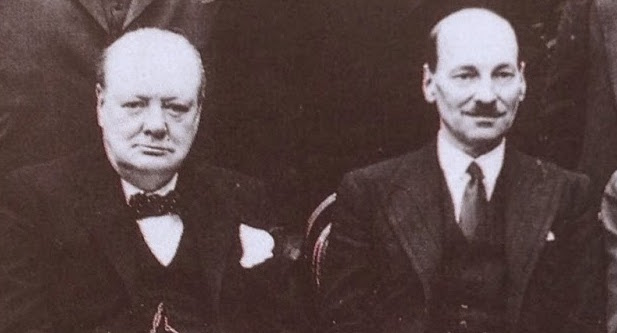
Winston Churchill (left) and Clement Attlee

July 5, 1945: The United Kingdom of Great Britain and Northern Ireland holds its 1st general election since the start of World War II. And their message to the incumbent head of government was, "Thank you for saving our arses, now, cheerio."

The war wasn't over yet -- V-J Day was still 40 days away -- but the Nazis had been defeated, and Britain's part in that, as Prime Minister Winston Churchill predicted it would be, was "their finest hour." In spite of his policy that had led to the deaths of 3 million people in British India, Churchill was arguably the most popular person on Earth. After all, the other contenders for that title were Franklin Roosevelt, who was already dead; and Joseph Stalin, who was probably the most hated living person, following the death of Adolf Hitler.

But the people of Britain had long memories. They knew that Churchill, while a great war leader, hadn't previously been good for them in peacetime. And so, they handed his Conservative Party a tremendous defeat, and elected to the Labour Party, led by Clement Attlee. Before the election, the Conservatives, or "Tories," had 386 seats in the House of Commons, while Labour had 154. Afterward, Labour had 393, the Tories 197.

Not that it mattered, any more than it matters over the Electoral College in elections for President of the United States, but, in this election, Labour won 47.7 percent of the popular vote, the Tories 36.2, the Liberal Party 9.0 (12 seats), the National Liberal Party 2.9 (11 seats), and all other parties 4.0 (29 seats).

Attlee thus became only the 2nd Prime Minister from the Labour Party, after James Ramsay MacDonald, who had last held the office 10 years earlier. His postwar program for rebuilding Britain included the National Health Service and educational reforms, which made Britain a less class-stratified country. The Conservatives called it "socialism." The British people decided they liked it.

Despite having been "booted from office," Churchill remained personally popular. After King George VI offered him the Order of the Garter, he accepted, saying, "I had just gotten the Order of the Boot." When his wife, Clementine, told him the defeat was "a blessing in disguise," he told her, "It was very well disguised."

Turnabout is fair play: By the early 1950s, the people of Britain decided that Labour wasn't doing enough, and in the 1950 election, the Tories gained a lot of seats, although not enough to take control. Attlee hung on for another year and a half, but miscalculated, calling for a snap election for October 25, 1951. The Tories won, 321-295, and Churchill served 3 more years as Prime Minister. Attlee never regained the job. Both men resigned as their parties' respective leaders in 1955, Churchill after 15 years, Attlee after 20.

*

July 5, 1945 was a Thursday. Michael Blake, author of Dances With Wolves, was born. This was also the day that Prime Minister John Curtin of Australia died in office. I have a separate entry for that event.

These baseball games were played that day:

* The New York Yankees lost to the Cleveland Indians, 3-2 at League Park in Cleveland. Jeff Heath hit a home run leading off the bottom of the 11th inning to win it. Ed Klieman went the distance for the Indians, Ernie "Tiny" Bonham for the Yankees.

* The New York Giants lost to the St. Louis Cardinals, 7-5 at the Polo Grounds.

* The Brooklyn Dodgers lost to the Cincinnati Reds, 8-4 at Ebbets Field.

* The Chicago Cubs beat the Boston Braves, 5-4 at Braves Field in Boston.

* The Detroit Tigers beat the Boston Red Sox, 9-8 at Briggs Stadium (later renamed Tiger Stadium) in Detroit.

* The Washington Senators beat the Chicago White Sox, 5-2 at Comiskey Park in Chicago.

* The St. Louis Browns beat the Philadelphia Athletics, 4-3 at Sportsman's Park in St. Louis. The A's tied the game in the top of the 9th inning, but the Browns won it in the bottom of the 11th, on a bases-loaded walk drawn by Frank Mancuso.

* And the Philadelphia Phillies and the Pittsburgh Pirates were rained out at Shibe Park in Philadelphia. It was made up as part of a doubleheader on August 8. The Pirates won the opener, 4-0. Elwin "Preacher" Roe, later to star with the Brooklyn Dodgers, allowed 8 hits, but kept the shutout. The Phillies won the nightcap, 5-0. Dick Mauney also pitched an 8-hit shutout.

Tuesday, June 21, 2022

June 21, 1957: Dief the Chief

June 21, 1957: John Diefenbaker takes office as Prime Minister of Canada. He was the only conservative (with a "small C") Prime Minister between 1935 and 1979, and the only one to serve at least one full year between 1935 and 1984.

John George Diefenbaker was born on September 18, 1895 in Neustadt, 107 miles northwest of Toronto. It was one of several places in the Province of Ontario with a German name where German immigrants, like his grandparents, had moved. These included a city outside Hamilton named Berlin, for Germany's capital. When World War I came, and prejudice against Germans hit the Allied nations, including the U.S. and Canada, the city of Berlin changed its name to Kitchener, after a fallen British hero of that war.

In 1910, the family moved west to Saskatoon, Saskatchewan, where Diefenbaker remembered being 15 years old and taking his first political action, selling a newspaper to the visiting Prime Minister, Wilfred Laurier. He became disgusted at the treatment of French and Indigenous Canadians, later telling an interviewer:

From my earliest days, I knew the meaning of discrimination. Many Canadians were virtually second-hand citizens because of their names and racial origin. Indeed, it seemed until the end of World War II that the only first-class Canadians were either of English or French descent. As a youth, l determined to devote myself to assuring that all Canadians, whatever their racial origin, were equal and declared myself to be a sworn enemy of discrimination. 

By the time he was 21, he had both a Bachelor of Arts and a Master of Arts degree from the University of Saskatchewan. He later became the 1st student ever to receive 3 degrees from that school, earning a law degree in 1919. In between, he served in the Canadian Army during World War I, being sent to Britain, but never into combat on the European Continent.

At the time, Saskatchewan was heavily tilted toward the Liberal Party, but he was a member of the Conservative Party. After success as a lawyer, he first ran for the House of Commons in 1925, but lost. The next year, due to a quirk in the national election laws and a dispute between Prime Minister William Lyon Mackenzie King and Governor-General Julian Byng, another election was held the next year, and Mackenzie King ran for the seat Diefenbaker had run for. An established political icon ran against a future one, and Mackenzie King won.

Diefenbaker ran for the Province's Legislative Assembly in 1929, Mayor of the city of Prince Albert in 1933, and the House of Commons again in 1938, having refused to run on 2 other occasions. Finally, in 1940, on his 6th try for public office and his 3rd try for Parliament, Diefenbaker won, despite his party having its worst election ever.

Canada's Conservative Party had become the Progressive Conservative Party in 1942, but hadn't had a Prime Minister since Richard Bennett lost to William Lyon Mackenzie King in 1935, and hadn't won a general election since Bennett beat Mackenzie King in 1930. Diefenbaker first ran for the PC Leadership in 1948, and won it in 1955. He stood as Party Leader in the general election of June 10, 1957, saying of his Party's program:

It is a program... for a united Canada, for one Canada, for Canada first, in every aspect of our political and public life, for the welfare of the average man and woman. That is my approach to public affairs, and has been throughout my life... A Canada, united from Coast to Coast, wherein there will be freedom for the individual, freedom of enterprise, and where there will be a Government which, in all its actions, will remain the servant and not the master of the people.

For the 1st time in 22 years, Canada had, and, for the 1st time in 27 years, elected, a conservative government: The Tories gained 61 seats, giving Diefenbaker a minority government, and forcing out the Liberal Party's Leader, Louis St. Laurent. "Dief the Chief" was the 1st Prime Minister from a riding (what America's House of Representatives would call a "District") from the Province of Saskatchewan -- indeed, the 1st from anywhere west of Ontario.

He called another election for March 31, 1958, and gained 96 seats to win the biggest majority any party has ever had in the country: 208 seats to the Liberals' 48. Canadian historian Conrad Black wrote, "He was very formidable; a deadly campaigner, an idiosyncratic but often galvanizing public speaker, a brilliant parliamentarian, and a man of many fine qualities. He was absolutely honest financially, a passionate supporter of the average and the underprivileged and disadvantaged person, a fierce opponent of any racial or religious or socioeconomic discrimination."

But Diefenbaker overplayed his hand. His aggressive conservatism made him more Canada's Barry Goldwater than its Dwight D. Eisenhower. He and "Ike" barely got along, and starting in 1961, he and John F. Kennedy couldn't stand each other. Nor could he and Harold Macmillan, whose tenure as Prime Minister of Britain coincided with his (January 10, 1957 to October 18, 1963), despite each of them leading his respective country's Conservative Party.

Canadian historian Robert Bothwell wrote, "By the time Diefenbaker left office, his conduct of foreign policy was reviled by an important and growing number of Canadians, while his relations with both the Americans and the British were disastrous."

Eventually, he alienated his own people, losing 89 seats and his majority in the 1962 election, 21 seats and the government entirely to Lester Pearson on April 22, 1963, and the Party leadership to Robert Stanfield in 1967.

Diefenbaker remained in Parliament until his death on August 16, 1979, from a heart attack at the age of 83, having lived to see Joe Clark become the 1st Prime Minister from the Progressive Conservative Party since himself. He is still revered by Canada's right wing, but only they seem to consider him to have been a positive force.

In 2003, the PCs merged with other, smaller right-of-center parties to become the new Conservative Party.

*

June 21, 1957 was a Friday. Berkley Breathed, the cartoonist who created and wrote Bloom County, was born.

These baseball games were played:

* The New York Yankees beat the Chicago White Sox, 4-2 at Yankee Stadium. Johnny Kucks was the winning pitcher. Mickey Mantle went 2-for-4 with an RBI. Yogi Berra went 1-for-4.

* The New York Giants beat the Chicago Cubs, 12-10 at Wrigley Field in Chicago. Bobby Thomson and Danny O'Connell hit home runs for the Giants in the top of the 10th inning. Willie Mays went 2-for-6. Ernie Banks went 1-for-5 with an RBI.

* The Brooklyn Dodgers lost to the St. Louis Cardinals, 2-0 at the 1st Busch Stadium (which was the last Sportsman's Park) in St. Louis. Von McDaniel pitched a 2-hit shutout. Stan Musial went 0-for-2 with a walk. Duke Snider went 1-for-4.

* The Boston Red Sox beat the Kansas City Athletics, 4-3 at Fenway Park in Boston. Ted Williams went 0-for-2 with 2 walks.

* The Baltimore Orioles beat the Detroit Tigers, 6-5 at Memorial Stadium in Baltimore. Brooks Robinson did not play for the O's. Al Kaline did play for the Tigers, and went 0-for-3 with a walk.

* The Washington Senators beat the Cleveland Indians, 6-3 at Griffith Stadium in Washington. Rooke Roger Maris went 1-for-3 with a walk for Cleveland.

* The Pittsburgh Pirates beat the Cincinnati Reds, 3-2 at Crosley Field in Cincinnati. Hank Foiles singled Bill Mazeroski home with the winning run in the top of the 11th. Roberto Clemente went 0-for-5. Frank Robinson went 5-for-5, but had no RBIs.

* And the Philadelphia Phillies beat the Milwaukee Braves, 6-1 at Milwaukee County Stadium. Curt Simmons outpitched Lew Burdette. Hank Aaron went 1-for-4.

Thursday, June 9, 2022

June 9, 1983: "The Longest Suicide Note In History"

June 9, 1983: Britain's Conservative Party wins a 2nd consecutive term, gaining 58 seats in the House of Commons, and increasing the majority of its Leader, the country's 1st female, and most conservative, Prime Minister ever, Margaret Thatcher.

The Labour Party, led by Michael Foot, lost 60 seats. The defeat, the largest for a left-of-center party in Britain since 1924, is attributed to their warmup publication: The New Hope for Britain: Labour's Manifesto 1983. One of their own Members of Parliament -- Gerald Kaufman, once Prime Minister Harold Wilson's press officer -- called the manifesto "the longest suicide note in history."

Born in 1913 in Plymouth, Devon, Foot was first elected to Britain's House of Commons in the postwar election of 1945. In 1980, he was elected Leader of the Labour Party, and thus Leader of the Opposition. He maintained Labour's status as a party further left than America's Democrats and Canada's Liberals, and was beloved by the trade unions. He became the face of socialism for the Western world.
But when he went into the election of 1983, he approved the party's manifesto, which advocated unilateral nuclear disarmament, higher personal taxation, a return to a more interventionist industrial policy, the abolition of the House of Lords, the nationalization of the banks, and – oddly, given Labour's more recent stance – immediate withdrawal from what was then called the European Economic Community.

The Conservatives gained a net 59 seats, and Foot had to resign as Leader. He was a principled leader, but a poor campaigner. In American terms, he was a George McGovern, rather than a Bernie Sanders.

When he died in 2010, at the age of 96, he was admired (if not liked) by pretty much everyone. When Thatcher died, 3 years later, half the country deeply mourned, and the other half said, "Good riddance!"

Contrary to legend, The Times of London never actually ran a headline about his leadership of a nuclear disarmament committee reading "Foot Heads Arms Body." Someone came forward to admit that he had written the headline, but it was not approved for the paper.

*

June 9, 1983 was a Thursday. These Major League Baseball games were played:

* The New York Mets beat the Chicago Cubs, 6-4 at Wrigley Field in Chicago. Bob Bailor doubled 2 runs home in the top of the 11th inning.

* The Pittsburgh Pirates beat the Montreal Expos, 6-3 at the Olympic Stadium in Montreal.

* The Detroit Tigers beat the Boston Red Sox, 8-2 at Fenway Park in Boston. Carl Yastrzemski, in his final season as a player, went 1-for-4 with 2 RBIs.

* The Philadelphia Phillies beat the St. Louis Cardinals, 6-5 at Veterans Stadium in Philadelphia. Bob Dernier singled Pete Rose home in the bottom of the 11th inning to win it. Rose had entered the game as a pinch-hitter, and went 2-for-3. Mike Schmidt went 1-for-4 with a walk. Joe Morgan hit 2 home runs.

* The Baltimore Orioles beat the Milwaukee Brewers, 10-7 at Memorial Stadium in Baltimore. Eddie Murray went 1-for-4 with a walk and an RBI. Cal Ripken went 2-for-4 with a walk. Robin Yount went 1-for-5 with an RBI. Paul Molitor went 0-for-5.

* The Los Angeles Dodgers beat the Atlanta Braves, 4-2 at Atlanta-Fulton County Stadium.

* The Cincinnati Reds beat the San Diego Padres, 8-1 at Riverfront Stadium in Cincinnati. Each team had the greatest player in their history available for this game, but neither entered: 35-year-old Johnny Bench for the Reds, in his final season as a player, and 23-year-old Tony Gwynn for the Padres, in his 2nd full season.

* The Kansas City Royals beat the Minnesota Twins, 6-5 at Royals Stadium (now Kauffman Stadium) in Kansas City. George Brett did not play.

* The California Angels beat the Chicago White Sox, 3-2 at Anaheim Stadium (now Angel Stadium of Anaheim). Tommy John went the distance for the win. Neither Reggie Jackson nor Rod Carew entered the game for the Angels.

* The Houston Astros beat the San Francisco Giants, 3-0 at the Astrodome in Houston. Bob Knepper pitched a 2-hit shutout, and got 2 hits himself, including an RBI triple.

* The Oakland Athletics beat the Toronto Blue Jays, 3-1 at the Oakland Coliseum. Rickey Henderson went 0-for-2 before leaving the game due to an injury.

* The Seattle Mariners beat the Texas Rangers, 3-2 at the Kingdome in Seattle. Todd Cruz singled Dave Henderson home in the bottom of the 11th to win it.

* And the New York Yankees and the Cleveland Indians were not scheduled.

Sunday, June 5, 2022

June 5, 1963: The Profumo Affair

June 5, 1963: John Profumo resigns as Britain's Secretary of State for War. The equivalent position in America would be the Secretary of Defense.

The issue wasn't that he had been exposed as having an affair with model Christine Keeler. It wasn't even that she was also having an affair with Captain Yevgeny Ivanov, a naval attaché at the Soviet Embassy in London, who had been exposed as a Soviet spy. Powerful men in the British government had been getting away with naughty behavior since the Romans invaded 2,000 years earlier.

No, the issue was that Profumo had stood before the House of Commons, and had lied about it. That was the true unforgivable sin in British politics.

Keeler was just 17 when she met Stephen Ward, an osteopath with several prominent clients, including Profumo, who served in the Cabinet of Prime Minister Harold Macmillan. Keeler and Ward lived together, but she later said there was no sex involved. She had already had a baby that did not survive, with a U.S. Air Force officer stationed in London. Keeler and Ward had been introduced by Mandy Rice-Davies, an ex-girlfriend of a friend of Ward's -- and she was only 15 at the time.

She was 19 when Ward introduced her to Profumo, who was 46, on July 8, 1961, at a pool party at a Buckinghamshire mansion. Ward also introduced her to Ivanov, who was 35. She soon began affairs with both men, neither of which lasted long -- but lasted long enough to ruin the lives of everyone involved.
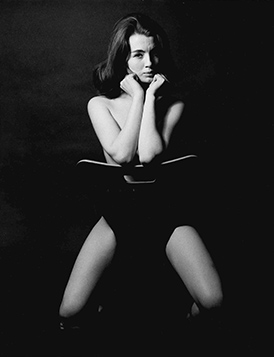
The infamous photo of Keeler, taken by Lewis Morley.
She later said she wasn't totally nude, and was wearing underwear.

In 1962, she had simultaneous affairs with jazz singer Lucky Gordon and promoter Johnny Edgecombe. The jealousy between the men boiled over, and Edgecombe slashed Gordon's face with a knife. A few weeks later, she broke up with Edgecombe, and, following her to Ward's house, he fired gunshots into it, hitting no one. He was arrested, and, as the investigation grew, one revelation led to another, until, finally, Profumo could deny it no longer, and had to resign.

Ward went on trial -- not for espionage, but for "living on the earnings of prostitution." One thing led to another, and it was revealed that Rice-Davies had also had an affair with William Waldorf Astor, the 3rd Viscount Astor. He denied this, and when Rice-Davies was asked about it, she told the media, "Well, he would, wouldn't he?" This phrase became famous, and would be abbreviated to "MRDA," for "Mandy Rice-Davies Applies."

Ward was convicted, but committed suicide via pills before sentence could be pronounced. Ivanov was recalled by his country, and resumed his naval career. Keeler was convicted of perjury, was sentenced to 9 months in prison, and served 6. She later married twice, with a child from each marriage. Having lost her money in legal fees, she got by over the years with paid TV appearances, talking about the scandal. Rice-Davies was never prosecuted, and became a singer and a novelist.

The government appointed Tom Denning, Baron Denning, the Master of the Rolls, to investigate the various rumors that had emanated from and around the Profumo affair. His report, published on September 26, 1963, concluded that there had been no security leaks, nor evidence to link members of the government with associated scandals. In other words, there was no evidence that any state secrets were leaked to the Soviet Union as a result of the affair(s). Denning laid most of the blame for the affair on Ward, an "utterly immoral" man whose diplomatic activities were "misconceived and misdirected."

Nevertheless, Macmillan resigned as Prime Minister on October 18, 1963, citing his health, replaced by Foreign Minister Alec Douglas-Home. While the Conservative Party government might have been doomed in the 1964 election anyway, the Profumo affair didn't help, as Labour won 317 seats to the Tories' 304, and Harold Wilson became Prime Minister.

Profumo's wife, actress Valerie Hobson, forgave him, and they retreated into charity work, rebuilding his reputation. By the time he died, he had long been back in British society's good graces.

In 1989, the story gained back some traction for 2 reasons: The film Scandal retold the story, with Ian McKellen as Profumo, Deborah Grant as Hobson, Joanne Whalley as Keeler, Bridget Fonda as Rice-Davies, John Hurt as Ward, Leslie Phillips as Astor, Dutch actor Jeroen Krabbé as Ivanov, Leon Herbert as Gordon, Fine Young Cannibals lead singer Roland Gift as Edgecombe. And it was mentioned in Billy Joel's rapid-fire history song "We Didn't Start the Fire," leading a generation not old enough to remember 1963 what the line "British politician sex" was about.

Astor died in 1966, Macmillan in 1986, Ivanov in 1994, Hobson in 1998, Denning in 1999, Profumo in 2006, Edgecombe in 2010, Rice-Davies in 2014, Keeler and Gordon in 2017.

*

June 5, 1963 was a Wednesday. These baseball games were played that day:

* The New York Yankees beat the Baltimore Orioles, 4-3 in Baltimore, but it was costly for them. At the time, Memorial Stadium had a chain-link fence in the outfield, making for easier removal for football games. After already going 2-for-2, Mickey Mantle went deep into center field to try to catch a ball hit by Brooks Robinson. It was no use, as it went over that fence for a home run. But it making the attempt, Mantle got his foot caught in the fence, and broke it. He was out for 2 months, the longest of his many in-season injuries. At any rate, Whitey Ford outpitched Milt Pappas, and Roger Maris hit a home run.

* The New York Mets lost to the Milwaukee Braves, 11-9 at the Polo Grounds. The Mets scored 7 runs in the 6th inning, and forced extra innings. But Bubba Morton singled home 2 runs in the top of the 10th inning to win it for the Braves. Hank Aaron and Eddie Mathews each went 3-for-5, and Mathews added 2 RBIs.

* The Philadelphia Phillies beat the St. Louis Cardinals, 6-0 at Connie Mack Stadium in Philadelphia. Ray Culp pitched a 3-hit shutout. Stan Musial, in his last season, when 0-for-4.

* The Pittsburgh Pirates swept a doubleheader from the Cincinnati Reds, 5-4 and 4-3 at Forbes Field in Pittsburgh. Over the 2 games, Roberto Clemente went 2-for-8, Bill Mazeroski went 5-for-8 with a home run and 4 RBIs; Frank Robinson went 4-for-7 with 2 home runs and 4 RBIs, and rookie Pete Rose went 0-for-5 with a walk.

* The Detroit Tigers beat the Cleveland Indians, 5-4 at Cleveland Municipal Stadium. Jim Bunning outpitched Jim "Mudcat" Grant. Al Kaline went 1-for-3 with 2 walks and an RBI.

* The Chicago Cubs swept a doubleheader from the San Francisco Giants, 9-5 and 5-4 at Wrigley Field in Chicago. Willie Mays went 1-for-2 with a home run, a walk and 2 RBIs in the 1st game, and appeared as a pinch-hitter without reaching base in the 2nd game. Over the 2 games, Ernie Banks went 4-for-7 with 2 home runs, a walk, and 3 RBIs.

* The Minnesota Twins beat the Kansas City Athletics, 4-0 at Kansas City Municipal Stadium. Jim Roland (7 innings) and Bill Dailey combined on a 5-hit shutout. Harmon Killebrew went 1-for-3 with a walk.

* The Los Angeles Dodgers beat the Houston Colt .45s, 5-1 at Colt Stadium in Houston. Sandy Koufax went the distance for the win. The Colts became the Houston Astros in 1965.

* A doubleheader was split at Dodger Stadium in Los Angeles, where the Los Angeles Angels groundshared with the Dodgers until their stadium in Anaheim was built. The Chicago White Sox won the opener, 3-0. John Buzhardt allowed 9 hits, but kept the shutout. The Angels won the nightcap, 8-2.

And the Boston Red Sox and the Washington Senators were rained out at District of Columbia Stadium in Washington. (And yet, just 42 miles away, Baltimore got its entire game in.) The game was rescheduled as part of a doubleheader on August 2. The Red Sox won the 1st game, 5-0. Earl Wilson pitched a 6-hit shutout, and helped his own cause with a home run. The Senators won the 2nd game, 4-3. Over the 2 games, Carl Yastrzemski went 3-for-8 with a walk and an RBI.

December 31, 1999 & January 1, 2000: The Millennium

December 31, 1999:  The Millennium arrives. The people of planet Earth survived. At a terrible cost. But we hadn't destroyed ourselves. ...