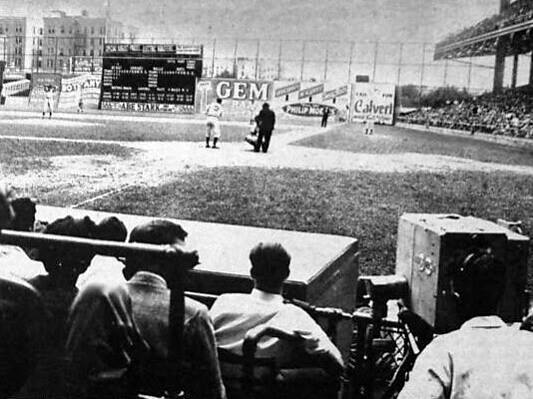
The Dodgers had opened the season with a lot of hope. They hadn't won a National League Pennant since 1920, and hadn't been in a Pennant race since 1924. But they had been rebuilt, under the auspices of team president Larry MacPhail. He had renovated Ebbets Field, hired Walter "Red" Barber as radio broadcaster, traded for shortstop Leo Durocher, made Durocher the manager, and made other key transactions, including trading for Durocher's replacement as shortstop, Harold "Pee Wee" Reese.
After going 62-91 in the last pre-MacPhail season, 1937, the Dodgers improved to 69-80 in 1938. In 1939, they improved to 84-69, 3rd place, but still 12 1/2 games behind the Pennant-winning Cincinnati Reds. In 1940, they were 88-65, 2nd place, but still 12 games behind the Pennant-winning Reds.
Still, hopes were high for 1941. From April 18 to 30, the Dodgers went 13-1. They ended the month in 1st place by 1 game. From May 6 to 14, they rattled off a 7-game winning streak. From May 23 through June 1, they won 9 straight. They were tied for 1st with the St. Louis Cardinals, with the next-closest team, the Giants, being 8 games behind. From June 19 to July 11, they won 15 out of 19 decisions (plus a game that was called due to rain while tied) through July 11.
They went 9-1 from July 31 through August 11. But the Cards stayed hot, too, so, by that date, the teams were tied for 1st. As late as September 3, the teams were tied for 1st. The Dodgers got hot one more time, going 13-6 from September 6 to 24. This run included a 10-inning win at home to the Giants on the 7th, an 11-inning win away to the Cards on the 11th, and 4 runs in the top of the 17th to beat the defending World Champion Reds.
On September 25, the Dodgers clinched the Pennant when Whitlow Wyatt pitched a shutout for his 22nd win of the season, and was backed by a home run by Pete Reiser. The Dodgers won, 6-0.
The Dodgers and their fans were feeling particularly potent. They were convinced that they would beat the New York Yankees in the World Series and take over New York.
*
October 1, 1941, a Wednesday: Game 1 of the World Series was played at Yankee Stadium. Durocher surprised everyone by choosing Curt Davis as his starting pitcher. He later admitted he messed up the Dodgers' rotation for the Series, one of the few times Leo the Lip admitteda mistake, rather than blaming someone else.
In hindsight, while the rotation was all out of whack, Davis pitched fairly well. But a home run by Joe Gordon and the pitching of Charles "Red" Ruffing gave the Yankees a 3-2 win.
October 2, 1941, a Thursday: Game 2 at Yankee Stadium. The Yankees took a 2-0 lead in the 3rd, but the Dodgers tied the game in the 5th, and Dolph Camilli's single in the 6th won it, 3-2.
October 3, 1941, a Friday: The Maltese Falcon premieres, starring Humphrey Bogart as San Francisco private investigator Sam Spade. If "Bogie" wasn't already a legend, he certainly became one with this film. It was the 3rd film version of Dashiell Hammett's mystery novel, following the 1931 film of the same title (with Ricardo Cortez as Spade) and the 1936 film Satan Met a Lady (Warren William).
Ernest Evans was born. He would become known as Chubby Checker, the man who popularized (though did not create, nor write the song about) the dance craze The Twist.
Given the proximity of the teams, a travel day wasn't necessary for the World Series, but it got one, anyway.
October 4, 1941, a Saturday: This was the birthdate of journalist Roy Blount Jr., horror novelist Anne Rice, and Elizabeth Eckford of the Little Rock Nine, and Anne Rice.

Game 3 of the World Series is played at Ebbets Field. The game is scoreless in the 7th inning, with Fred Fitzsimmons throwing goose eggs for the Brooklyn team, and Marius Russo doing so for the Bronx outfit. Russo comes to bat, and launches a line drive off Fat Freddie's kneecap. The ball caroms to shortstop Reese, who throws Russo out to the end inning.
On the official World Series highlight film, it's not clear how bad the injury is. Fitzsimmons is shown limping off the field under his own power -- probably a good thing, since he would have been pretty hard to carry off with all that weight. But the film is misleading: It turns out that the kneecap is broken.
Once an All-Star for the Giants, Fitzsimmons seemed to specialize in beating the Dodgers. But in 1937, a slow start led the Giants to trade him to the Dodgers, a big mistake. He was welcomed by the Flatbush Faithful, and they wouldn't have won the Pennant without him. Durocher said, "I wish we had 9 guys like Fitz. We'd never lose."
But now, he was permanently injured. At age 41, he would pitch just 1 game in 1942, and 9 more in 1943, before accepting his injury and retiring to the coaching ranks. He also ran a popular bowling alley in Brooklyn for many years.
Durocher was forced to bring Hugh Casey in to pitch the top of the 8th. The 1st relief pitcher to be called "The Fireman," because he "put out fires," he got the 1st out, but allowed 4 straight singles, scoring 2 runs. Russo allowed a double to Fred "Dixie" Walker and a single to Reese, but hung on to for a complete-game 2-1 win. The Yankees now led, 2 games to 1.
October 5, 1941, a Sunday. This was also the day of the Berdychiv Massacre, when Nazi Germany's Gestapo killed 38,000 Jews in Ukraine. I have a separate entry for that event.
Arnold Malcolm Owen -- sometimes incorrectly listed as "Mickey Owens," but there was never an S on the end -- was a 4-time National League All-Star as catcher for the Dodgers, was elected a County Sheriff, and ran the Mickey Owen Baseball School. For the last 64 years of his life, he was decent enough to field questions about the one part of his life that everyone seems to remember.
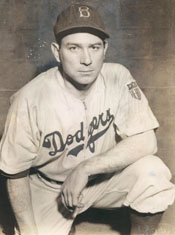
In Game 4 of the World Series at Ebbets Field, Charlie Keller of the Yankees singled home a run off Kirby Higbe of the Dodgers in the 1st inning. In the top of the 4th, Johnny Sturm singled home 2 runs to make it 3-0 Yankees.
But in the bottom of the 4th, the Dodgers closed to within 3-2 when Jimmy Wasdell doubled home 2 men that Atley Donald had walked. In the 5th, Reiser hit a home run to give the Dodgers a 4-3 lead.
Reiser was the NL's batting champion that season. The Cardinals had been scouting him since he was 12 years old. He was so talented that Durocher, later to manage the Giants and thus manager Willie Mays, said that Reiser might have been better. But he ended up crashing into outfield walls to make catches, much like Lenny Dykstra in the 1980s and '90s. And when Reiser did it, those walls were not padded. Injuries caught up with him, and he was never able to live up to his Hall of Fame-level talent.
The 4-3 Dodger lead held up until the top of the 9th. Casey got the 1st 2 outs. Tommy Henrich came to the plate as the Yankees' last hope. Casey got 2 strikes on him. Then he threw…
Casey told the press it was a curveball. Owen also said it was a curve, which was what he had signaled for. Henrich called it "the sharpest-breaking curveball that Hugh Casey ever threw." But many observers, including DiMaggio, and the Yankees' rookie shortstop, Phil Rizzuto, said that they thought it was a spitball.
Henrich swung and missed. Strike 3. Ballgame over. Dodgers win, and the World Series is tied at 2 games apiece.
Except… Owen didn't catch the 3rd strike! The ball tailed away from him, as spitballs have been known to do, and he couldn't hold onto it. It rolled all the way to the screen. Henrich saw this, and ran to 1st, and Owen didn't even have time to get off a throw.
He later recalled: "It wasn't a strike. It was a low inside curve that I should have had. But I guess the ball struck my glove, and by the time I got hold of it, I couldn't have thrown anybody out at first. It was an error."
It is the most famous passed ball in baseball history, but if it was a spitball, which was and remains an illegal pitch anyway, then it should, instead, have been credited as a wild pitch, and be the most famous one of those, and Casey, rather than Owen, should be faulted.
No matter. Casey only needed to get 1 more out. Even if Henrich represented the tying run and the next batter represented the winning run. Just 1 more out.
The batter was DiMaggio. Uh-oh, you don't give the Yankee Clipper a written invitation to keep a game alive. Especially not in 1941, when he had become the most celebrated athlete in America, ahead of Ted Williams; ahead of football stars Sammy Baugh, Sid Luckman and Don Hutson; ahead of even the Heavyweight Champion of the World, Joe Louis.
DiMaggio singled to left. Now the tying run was on 2nd, the potential winning run on 1st. But there were still 2 outs. If Casey could get the next batter, the game would still end, however precariously, with a Dodger victory.
The batter was Keller. At this point in his career, before a back injury curtailed it, he looked like he was headed to the Hall of Fame. And he did nothing to dispel that in this at-bat: He rocketed a Casey delivery off the right-field wall, and Henrich and DiMaggio scored.
Keller would later say, "When I got to 2nd base, you could have heard a pin drop in Ebbets Field." The noisiest, most raucous ballpark of his time had been stunned into silence.
The Yankees scored 2 more runs in the inning, and won 7-4. They now led 3 games to 1.
It's not fair to Owen. He was widely respected prior to the '41 Series, and most Dodger fans didn't go on to hate him. Certainly, he escaped the scorn that was heaped on Ralph Branca after 1951. And neither one of them got the kind of treatment that Bill Buckner got from Boston fans after 1986.
It is the most famous passed ball in baseball history, but if it was a spitball, which was and remains an illegal pitch anyway, then it should, instead, have been credited as a wild pitch, and be the most famous one of those, and Casey, rather than Owen, should be faulted.
No matter. Casey only needed to get 1 more out. Even if Henrich represented the tying run and the next batter represented the winning run. Just 1 more out.
The batter was DiMaggio. Uh-oh, you don't give the Yankee Clipper a written invitation to keep a game alive. Especially not in 1941, when he had become the most celebrated athlete in America, ahead of Ted Williams; ahead of football stars Sammy Baugh, Sid Luckman and Don Hutson; ahead of even the Heavyweight Champion of the World, Joe Louis.
DiMaggio singled to left. Now the tying run was on 2nd, the potential winning run on 1st. But there were still 2 outs. If Casey could get the next batter, the game would still end, however precariously, with a Dodger victory.
The batter was Keller. At this point in his career, before a back injury curtailed it, he looked like he was headed to the Hall of Fame. And he did nothing to dispel that in this at-bat: He rocketed a Casey delivery off the right-field wall, and Henrich and DiMaggio scored.
Keller would later say, "When I got to 2nd base, you could have heard a pin drop in Ebbets Field." The noisiest, most raucous ballpark of his time had been stunned into silence.
The Yankees scored 2 more runs in the inning, and won 7-4. They now led 3 games to 1.
*
As I said, October 5, 1941 was a Sunday. There were NFL "Scores On This Historic Day":
* The football version of the New York Giants beat the Pittsburgh Steelers, 37-10 at Forbes Field in Pittsburgh.
* The football version of the Brooklyn Dodgers lost to the Washington Redskins, 3-0 at Griffith Stadium in Washington.
* The Chicago Bears beat the Cleveland Rams, 48-21 at Cleveland Municipal Stadium. (The Rams moved to Los Angeles in 1946.)
* The Green Bay Packers beat the Chicago Cardinals, 14-13 at the Dairy Bowl in the Milwaukee suburb of West Allis, Wisconsin. The Dairy Bowl was a football stadium built in the infield of a speedway, now known as the Milwaukee Mile, at the Wisconsin State Fair Park.
* And the Philadelphia Eagles and the Detroit Lions had the week off.
October 6, 1941, a Monday. Were the Dodgers rattled by their 9th inning collapse of the day before? Maybe. In the top of the 2nd, Wyatt walked Keller, gave up a single to Bill Dickey that got Keller to 3rd, uncorked a wild pitch that scored Keller and got Dickey to 3rd, and gave up a single to Joe Gordon that scored Dickey.
Dem Bums did have their chances to bounce back. In the bottom of the 3rd, Wyatt helped his own cause with a double down the left-field line off his opposite number, Ernie "Tiny" Bonham. After getting Walker to fly out, Bonham gave up a hit to Lew Riggs, and Reiser hit a sacrifice fly to get Wyatt home. The next batter was Dolph Camilli, who would be named the NL's Most Valuable Player. But Bonham struck him out to end the threat. It was still 2-1 Yankees.
Henrich, who would be nicknamed "Old Reliable" by Yankee broadcaster Mel Allen, hit a home run in the top of the 5th, and that would be all the scoring in the ballgame. Bonham went the distance for the Bronx Bombers, getting the last out when Wasdell flied out to DiMaggio in center field. Yankees 3, Dodgers 1. The Yankees had won their 9th World Series, already more than any other team. It was the 1st time, though, that they had faced the Dodgers in a World Series. There would be more.
The Brooklyn Eagle newspaper printed a big headline, reading, "WAIT TILL NEXT YEAR." The next year, the Dodgers won 104 games, but the Cardinals won 106. The Dodgers would lose the World Series to the Yankees again in 1947, 1949, 1952 and 1953, before finally winning it in 1955. The Eagle had closed earlier that year, so it was up to the New York Daily News to print the obvious headline on October 5, 1955, the day after the great triumph: "THIS IS NEXT YEAR!"
Despite America's entry into World War II, Owen never went into the service. I wonder if some Dodger fans said, "Mickey Owen is such a bum, even the Army don't want him!"
The Dodgers didn't win the Pennant again until 1947, the rookie year of Jackie Robinson. It was a last gasp for the holdovers from 1941, including Dixie Walker, who led the Southerner faction of the team that had initially opposed Robinson's signing. After the clincher, he said that Robinson had more to do with the team winning than anyone, "with the exception of Bruce Edwards." Edwards had succeeded Owen as the Dodgers' starting catcher. He wasn't a great player, but he was reliable, never committing the kind of passed ball that Owen did.
Edwards was succeeded the next year by Negro League star Roy Campanella, who became a Hall-of-Famer and a 3-time Most Valuable Player. And yet, I wonder if a lot of the accolades that would later come his way were due to what became known as "Mickey Owen's Muff." That Campy might have been cheered not just for what he was, a fantastic player and a good guy, but for what he wasn't: Owen.
It's not fair to Owen. He was widely respected prior to the '41 Series, and most Dodger fans didn't go on to hate him. Certainly, he escaped the scorn that was heaped on Ralph Branca after 1951. And neither one of them got the kind of treatment that Bill Buckner got from Boston fans after 1986.
Which is a good thing. Nobody deserves that. Well, maybe not nobody… But certainly not Buckner, nor Branca, nor Owen.
If Owen had hung onto the ball, and the Dodgers had won, tying the Series, what kind of difference would it have made? Probably not much: The Yankees won Game 5 anyway, and would've needed to win Game 6 or Game 7 at Yankee Stadium. They still would have won. Pretty much the only things that would have changed would have been the reputations of Owen and Casey, for the better.
Owen died on July 13, 2005, in his home town of Mount Vernon, Missouri. He was 89. It's a little ironic that he and Branca both came from towns named Mount Vernon, in Branca's case the one in Westchester County, New York.
Henrich died on December 1, 2009, as the last survivor of this game. He was also the last surviving person who had been a teammate of Lou Gehrig. Herman Franks, who later helped steal a Pennant from the Dodgers as a 1951 New York Giant, had died earlier in 2009 as the last surviving '41 Dodger.
Today, the Sandlot Baseball Camp, formerly the Mickey Owen Baseball School, is still open on State Highway 96 in Miller, Missouri, in the southwestern part of the State, in the Ozark Mountains, about halfway between Joplin and Springfield -- 238 miles southwest of St. Louis, 171 miles southeast of Kansas City, 64 miles northwest of Branson (the "Redneck Vegas"), and 80 miles northeast of Mickey Mantle's hometown of Commerce, Oklahoma.