Showing posts with label betty white. Show all posts

Sunday, October 2, 2022

October 2, 1961: "Password" and "Ben Casey" Premiere

The Odd Couple/Password crossover. Left to right:
Betty White, Allen Ludden, Jack Klugman and Tony Randall

October 2, 1961: The TV game show Password premieres. In runs on CBS until 1967, then on ABC until 1975. Allen Ludden hosts.
The main part of the game features five words, shown to the audience, whispered by an announcer. Two teams, made up of a celebrity panelist and an ordinary citizen contestant, take turns giving and receiving the clues. The contestants were usually one man and one woman, with a celebrity of the same gender assisting. On occasion, the female celebrity panelist would be Ludden's wife, comic actress Betty White.
The person giving must say a word that is a clue to the "password." If the first team gets it, that's 10 points. If they don't, the other team gets to try, for 9 points; then 8, and so on. The five passwords are a clue to a larger password, which is worth bonus points.
Password figured in the December 1, 1972 episode of The Odd Couple, also on ABC. Allen (playing himself) invited sportswriter Oscar Madison (Jack Klugman) to appear as one of the celebrity guests, and he brings his roommate, commercial photographer Felix Unger (Tony Randall), as a contestant. Even Allen and Betty agree that the results are "ridiculous."
The show would be revived on NBC as Password Plus from 1979 to 1982, but Ludden died of cancer in 1981, and was replaced briefly by Bill Cullen, and then by Tom Kennedy. NBC brought it back as Super Password from 1984 to 1989, hosted by Bert Convy. Unfortunately, Convy also developed cancer, and it was decided to close the show. He died in 1991. In the 2008-09 season, CBS brought it back as Million Dollar Password. In 2022, NBC brought it back, with actress Keke Palmer as host.
(UPDATE: Shortly after she began hosting, Palmer announced that she was pregnant. Given the nature of TV "seasons" in recent years, it was easy to schedule new tapings around her maternity leave. She is probably the 1st pregnant game show host on U.S. network television. Vanna White had been pregnant as the letter-turner on Wheel of Fortune, but that doesn't count as hosting.)
*
Also on October 2, 1961, Ben Casey premieres on ABC. Vince Edwards played Casey, a talented young neurosurgeon. Sam Jaffe played Dr. David Zorba, the chief of neurosurgery at the hospital where Casey worked. Every episode began with a hand drawing the symbols "" on a chalkboard, as Jaffe delivered the meaning behind the symbols: "Man, woman, birth, death, infinity." The series ran for 5 seasons.
Vince Edwards

Jaffe died in 1984, Edwards in 1996. 

Speaking of men named Casey, in this case a real one: Also on this day, coming out of retirement, former Yankee skipper Casey Stengel agrees to manage the Mets, New York's National League expansion team.

At his introductory press conference, he goofed, and said, "I'm very pleased to be managing the New York Knickerbockers." I guess nobody told him the real name of the team -- which, since it hadn't played a game yet, was partly understandable.

That would not be the most embarrassing thing that happened to the franchise during Stengel's involvement. During in their 1st season, 1962, he was quoted as saying, "Come and see my amazing Mets! I been in this game a hundred years, but they've shown me ways to lose that I never knew existed before!" On another occasion, he was quoted as saying, "Can't anybody here play this game?"

*

October 2, 1961 was a Monday. Baseball was between the end of the regular season and the World Series. Football was in midweek: The debut of Monday Night Football was 9 years away. And it was too soon for either the NBA or the NHL season for 1961-62 to begin. So there were no scores on this historic day.

Monday, September 19, 2022

September 19, 1970: "The Mary Tyler Moore Show" Premieres

September 19, 1970: The Mary Tyler Moore Show premieres on CBS. By the standards of the time, it was considered to be a groundbreaking situation comedy.

Mary Tyler Moore had previously played Laura Petrie on The Dick Van Dyke Show. This time, having formed MTM Enterprises with her then-husband, then-CBS executive Grant Tinker, she worked with co-creators James L. Brooks and Allen Burns to create a new show with her name on it. Brooks had written for Marlo Thomas' sitcom That Girl, and he and Burns would later create the sitcom Taxi.

Moore, 33 years old at the time of the premiere, played Mary Richards, 30, never yet married, no children, and recently having broken her engagement to a man she realized didn't really want to get married. So she leaves her (fictional) hometown of Roseburg, Minnesota, and heads for the nearest big city, Minneapolis.

Originally, the idea was that Mary Richards was going to be divorced, not single. But even in 1970, this was a touchy subject. As it turned out, Catholics and evangelical Protestants were shocked to find out that the character, to put it politely, was no innocent young thing. If she'd come into the show divorced, that might have tanked the ratings right there.

CBS executives, who had made a lot of money on the lack of intelligence of many TV viewers, had a 2nd reason to veto the divorce angle: They were worried that, given Moore's claim to fame as Laura Petrie, audiences would think she had divorced Dick Van Dyke. That's how dumb they thought TV viewers were -- and a lot of them were.

(Don't look at me like that: I was a kid in the 1970s, and it always surprised me when someone, be they an actor or a newscaster, switched networks. I didn't realize that was allowed.)

The Season 1 opening montage shows her driving to Minneapolis, interspersed with a scene of a going-away party thrown by her friends. The theme song, "Love Is All Around," was written and sung by Sonny Curtis, formerly of Buddy Holly's Crickets and author of Bobby Fuller's "I Fought the Law." The song asks the question, "How will you make it on your own? This world is awful big. Girl, this time, you're all alone."

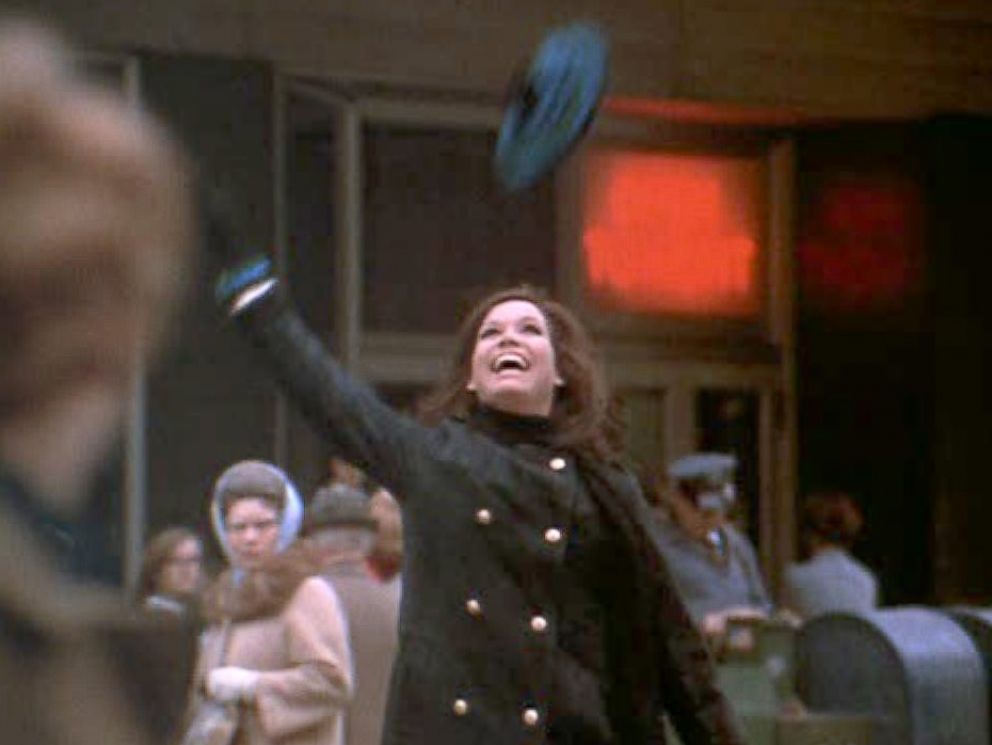
The song rebounds from this gloomy start, picks up, and concludes with the words, "You just might make it after all!" and with Mary tossing her hat in the air, while standing in front of the Donaldson's department store, at South 7th Street and Nicollet Mall in downtown Minneapolis.

Unusual for opening credits, the name of the show is not mentioned, only the lead actor's name: "MARY TYLER MOORE." And none of the other members of the main cast are mentioned, until the closing credits start.

To reflect Moore's initials, the closing shot is of the logo of MTM Enterprises, a parody of Metro-Goldwyn-Mayer, or MGM, and their roaring lion: A mewing kitten named Mimsie. There would be variations over the years, depending on the MTM-produced show: A Christmas episode would have the round frame as a wreath, and the kitten wearing a Santa Claus hat; The White Shadow showed a cat dribbling a cartoon basketball; Hill Street Blues had the kitten wearing a policeman's cap; Remington Steele had the kitten wearing a deerstalker cap like Sherlock Holmes, and dropping a Holmesian pipe out of its mouth as it mewed; and Newhart had Bob Newhart saying a sardonic, deadpan "Meow."

St. Elsewhere had the kitten wearing a surgical gown and cap. In one of the most tasteless moments in TV history, the last episode of St. Elsewhere had the kitten lying down, hooked up to machines, and flatlining, suggesting that the kitten was dead. I can't believe Moore approved that. Certainly, Betty White, "Animal lover that I am," would have objected! (In real life, the original Mimsie had recently died, living to a decent age for a cat.)

In the pilot, Mary gets an apartment in a house owned by Phyllis Lindstrom (Cloris Leachman), a character that beat Beatrice Arthur's Maude Findlay to the title of sitcoms' 1st brassy feminist by 2 years. The house's address was listed as 119 North Weatherly Street, which does not really exist. The exterior shots were of a real house in Minneapolis, at 2104 Kenwood Parkway.

Phyllis often refers to her husband, a dermatologist named Lars, but the character is never seen onscreen. They have a daughter, Bess (Lisa Gerritsen), a teenager who follows her mother's example, perhaps a little too much.

Mary meets her upstairs neighbor, Rhoda Morgenstern (Valerie Harper), a wisecracking window dresser from New York. Also single, her lovelife is more active than Mary's, though without better results. In the pilot, Rhoda doesn't like Mary, but this soon changes, and they become best friends. Bess also gets along well with both Mary and, to Phyllis' dismay, Rhoda, often calling her "Aunt Rhoda," to which Phyllis says, "She's not your aunt!"

Mary applies for a job as an associate producer for the evening news at WJM, Channel 12. The producer, Lou Grant (Edward Asner), is old-school even by the standards of the time. Asner was 40 when the show began, but the later Lou Grant series established that Grant was actually 44, and with his bald head and paunch, he could have passed for being in his 50s.

Lou doesn't like women holding what traditionally were men's jobs, especially since they could get married and quit, or could already be married and get pregnant and quit, leaving him in the lurch. But he hires her anyway, reluctantly, saying, "You know what? You've got spunk. I hate spunk!" (At the time, "spunk" meant "nerve" or "gumption," and was not widely known to refer to anything sexual.)

Mary soon sees that everybody who works for Lou calls him, "Lou," even though she can never bring herself to call him anything but "Mr. Grant." Often, a tearful, "Ohhhh, Mr. Gra-a-ant!" Lou starts the show married to Edie (Priscilla Morrill), but the marriage falls apart, and they divorce. They had 3 daughters and 4 grandchildren.

Murray Slaughter (Gavin MacLeod) is the news department's head writer, and quickly becomes friends with Mary. He is an expert verbal jouster, but also perceptive enough to know how far he can go with it from one person to another. He is married to Marie (Joyce Bulifant), and they have children, but how many was never specified.

Ted Baxter (Ted Knight) is the anchorman. He is dumb. And cheap. How dumb, and how cheap, is he? Ask Lou: "Ordinarily, Ted can't add 6 and 4. But, put a dollar sign in front of it, and he becomes Einstein." Shortly after Lou says this, knowing that his 6:00 broadcast lasts half an hour, he offers to take Mary out to dinner, and says, "Meet me at, um... " and tries to do the math in his head. He can't, until Lou says, "Put a dollar sign in front of it, Ted!" And Ted immediately says, "6:45."

But in spite of being dumb, and cheap, and vain, he has the look of an anchorman (Knight was only 46 when the show debuted, but his hair was already white, though he still had a full head of it for the rest of his life), and he had the deep, sonorous voice of an anchorman. And so, he was popular with the Twin Cities public. And, for the most part, he was a nice guy.
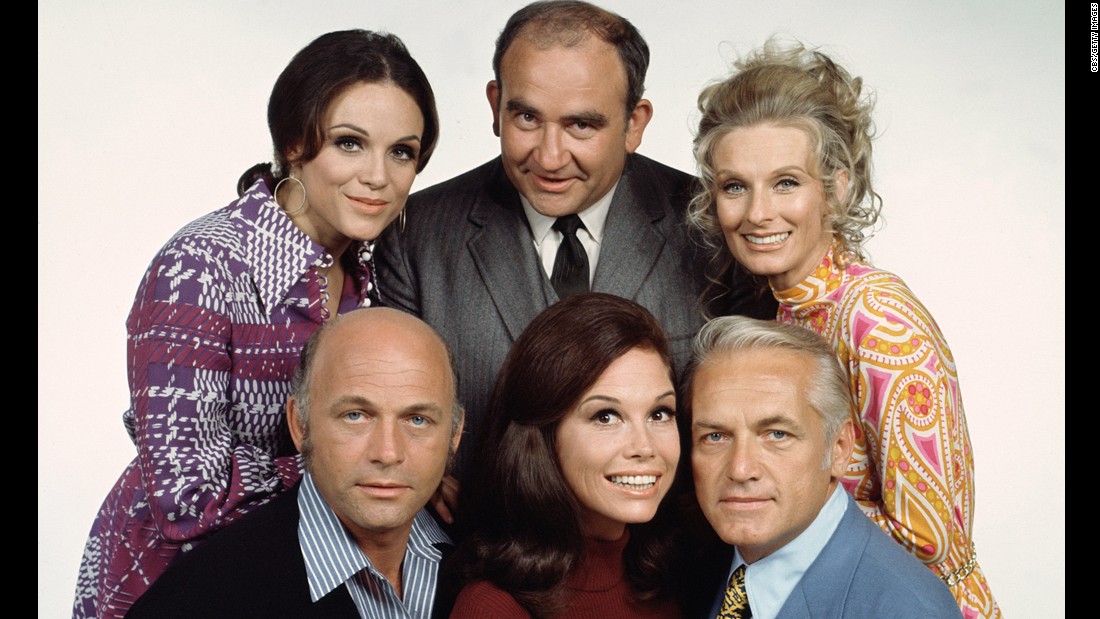
The original cast. Top, left to right:
Valerie Harper, Ed Asner, Cloris Leachman. Bottom, left to right:
Gavin MacLeod, Mary Tyler Moore, Ted Knight.

In Season 2, Ted met Georgette Franklin (Georgia Engel), a co-worker of Rhoda's. They eventually got married, in a ceremony held in Mary's apartment, by a minister played by John Ritter, who had just come from a tennis match and was still dressed for that. Ted and Georgette went on to have a son and a daughter.

In Season 4, a new character was introduced: Sue Ann Nivens (Betty White), who hosted The Happy Homemaker on WJM. More like a happy homewrecker: She slept around, including a disastrous one-night stand with Lou after his divorce. The character was supposed to be a one-time-only, but was such a hit, White became a regular. Sue Ann softened up a bit as the show went along.

For Season 2, to reflect the fact that Mary was beginning to make it -- in spite of the craziness at the office, and her penchant for hosting parties that went wrong -- a new version of the theme song was recorded, with Curtis re-writing the lyrics, including the immortal opening line, "Who can turn the world on with her smile?" And the song closes with a more definitive, "You're gonna make it after all!"

Mary and Rhoda both dated, but love proved fleeting for both. And they didn't just date. One time, when Mary's parents visited, Mary's mother reminded her husband, "Take your pill!" And both father and daughter said, "I will!" The implication was that Mary was taking birth control pills, and thus that Mary was having sex -- or, at least, was looking to do so. For the Nixon years, this was a big step for a single female sitcom character. It's generally accepted that MTM was the 1st U.S. sitcom to mention "The Pill."

Before starring on Good Times, John Amos made 13 appearances as Gordy Howard, WJM's weatherman. His race was never mentioned. This was also revolutionary: He wasn't "the black weatherman," he was "the weatherman." "I thought that was a very healthy attitude for the writers and the producers to take," Amos said.

Sports wasn't mentioned often on the show, but in later opening sequences, Mary is shown washing her Ford Mustang while wearing a Minnesota Vikings jersey, with the Number 10 of Hall of Fame quarterback Fran Tarkenton, then still active. During the course of the show, the Vikings went to 3 Super Bowls, but lost them all.

In the last episode, airing on March 19, 1977, the station was bought, and everybody was fired except Ted, the dummy. The last scene, of the remaining characters walking out the door while hugging, is one of the most fondly remembered in TV history. In the last shot for the last episode, instead of mewing, the MTM kitten is Moore's voice saying, "Bye!"
The closing cast. Top, left to right:
Gavin MacLeod, Ed Asner, Ted Knight. Bottom, left to right:
Betty White, Mary Tyler Moore, Georgia Engel.

The MTM Show won 29 Primetime Emmy Awards, a record that stood until Frasier won its 30th in 2002 -- and, let's face it, considering Frasier a better show than MTM is a joke. These Emmys included 3 as Outstanding Comedy Series; 3 for Moore as Outstanding Lead Actress in a Comedy Series; 3 for Asner and 2 for Knight as Outstanding Performance by an Actor in a Supporting Role in Comedy; and 3 for Harper, 2 for Leachman and 2 for White as Outstanding Performance by an Actress in a Supporting Role in Comedy. In other words: In all 7 seasons, someone on the show won Best Supporting Actress, while someone won Best Supporting Actor in 5 of the 7.

The show inspired 3 spinoffs. Harper left after 4 seasons when Rhoda got married, and starred for 4 seasons on Rhoda, with the character and her husband moving to her hometown of New York. Leachman and Gerritsen left after 1 more season, and starred on Phyllis, with the premise that Lars had died, and Phyllis and Bess moved back to Phyllis' hometown of San Francisco. And when The MTM Show came to an end, Asner starred on Lou Grant -- not a half-hour sitcom, but an hourlong drama, in which he moved to Los Angeles and ran a newspaper. It was another innovation: A spinoff of a sitcom being a drama had never been done before, nor has since. All of these shows were, like The MTM Show, on CBS, and produced by MTM Productions.

Pretty much everybody on the show went on to star on other shows. In addition to the preceding, White starred as dim but lovable Rose Nylund on The Golden Girls, MacLeod as Captain Merrill Stubing on The Love Boat, and Knight as cartoonist and family man Henry Rush on Too Close for Comfort. Knight was also the narrator of the Super Friends cartoon: "Later, at the Hall of Justice... "

White was joined on The Golden Girls by Beatrice Arthur as Dorothy Zbornack, and Rue McClanahan as Blanche Devereaux. Bea and Rue had been together on Maude, as Maude Findlay and Vivian Harmon. Rue was cast first, and knew that Bea was the only woman who could play Dorothy. Knowing that most sitcoms had a "dummy," Bea told Rue that she didn't want to be on the show if Rue was going to play it again. Rue said, "No, this time, Betty is playing Vivian, and I'm playing Sue Ann!" Getting the reference, Bea said, "Interesting!" and took the role.

Bulifant became part of the cast of the Alice spinoff Flo, and Engel later became a recurring character on another Minnesota-based show, ABC's football-themed sitcom Coach, set at Minnesota State University -- then a fictional school, but a real school has since adopted the name. Despite that show's success, The Mary Tyler Moore Show remains the most popular show ever set in Minnesota, and one of the most popular sitcoms of all time.

In addition to all that, White and Bulifant became semi-regular panelists on the CBS game show Match Game. White had plenty of game-show experience, often appearing as a panelist on Password, hosted by her husband, Allen Ludden. White's activism for animals was already well-known, and any time there was a possibility of an answer of an animal getting hurt or killed on Match Game, if Betty was there, a panelist might mention avoiding the possibility because of it. If she wasn't there, such an answer might be given, and host Gene Rayburn would say, "It's a good thing Betty White isn't here!"

When Bulifant was on Match Game, she became the queen of what Rayburn called "rotten answers," and was often called a weirdo by him. Asner also made occasional appearances. Later on, White, who had taken George Burns' former place as America's favorite old person, starred on the sitcom Hot In Cleveland, and Moore, Harper, Leachman and Engel all guest-starred on a 2013 episode of that show.

In 2000, ABC aired the 2-hour TV movie Mary and Rhoda, a sequel to the original series. It revealed that Mary had eventually gotten married, to Steve Cronin, a Congressman, but that he had recently been killed in a rock-climbing accident. Rhoda had gotten divorced from her 1st husband, gotten married again, and gotten divorced again.

After not seeing each other for several years -- Mary had continued in TV news production in New York, and Rhoda had lived as a photographer in Paris with her French 2nd husband -- they were basically starting over again at ages 60 and 58, respectively.

They each had a daughter attending college in New York: Rose Cronin (played by Bethany Joy-Lenz) was an English major at New York University (NYU), and Meredith Gerard (Marisa Ryan) was a pre-med student at Barnard College. (If you're an original fan of the original show, and you don't already feel old, this means that both Mary's daughter and Rhoda's daughter are now in their early 40s, and could legitimately be grandmothers.) Joan Jett sang a punked-up version of the old theme song.

Donaldson's went out of business in 1988. But, even before that, the store behind Mary's hat-toss burned as part of a fire on Thanksgiving Day, November 25, 1982. Gaviidae Common, a shopping mall, was built on the site of the former Donaldson's flagship store in 1989.

On May 8, 2002, a statue of Mary tossing her hat, sponsored by the nostalgia TV network TV Land, was unveiled, roughly on the same spot, by Moore herself. It was the 1st in a series of TV Land statues of famous TV characters that also includes Jackie Gleason as Ralph Kramden on The Honeymooners in New York; Henry Winkler, a.k.a. "The Bronze Fonz," in Happy Days' site of Milwaukee; and Andy Griffith and Ron Howard as Andy and Opie Taylor on The Andy Griffith Show in Griffith's hometown of Mount Airy, North Carolina.
Ted Knight died of cancer in 1986, while still starring on Too Close for Comfort. And Priscilla Morrill, not a major star of the show, died in 1994. Other than that, the cast proved to be surprisingly long-lived: Mary Tyler Moore died in 2017, after years of battling diabetes and its effects; Valerie Harper in 2019, after years of battling cancer; Georgia Engel also in 2019; and Allan Burns, Cloris Leachman, Gavin MacLeod and Betty White, all in 2021. Betty died on New Year's Eve, just 17 days short of what would have been her 100th birthday.

As of September 19, 2022, James L. Brooks, Sonny Curtis, Joyce Bulifant, Lisa Gerritsen and John Amos are still alive.

UPDATE: John Amos died in 2024.

*

September 19, 1970 was a Saturday. This was also the day the 1st Glastonbury Festival began. I have a separate entry for that event.

These games were played in Major League Baseball:

* The New York Yankees beat the Detroit Tigers, 7-6 at Tiger Stadium in Detroit. The Yankees scored 5 runs in the top of the 9th to win it, although they didn't hit a home run. Horace Clark and John Ellis each had 2 hits and 2 RBIs. Al Kaline went 0-for-4.

* The New York Mets lost to the Pittsburgh Pirates, 2-1 at Shea Stadium. Luke Walker (not Luke Skywalker) outpitched Gary Gentry. Roberto Clemente and Willie Stargell each went 1-for-4 with an RBI.

* The Chicago Cubs beat the Montreal Expos, 8-4 at Jarry Park in Montreal. Ernie Banks did not play.

* The Boston Red Sox swept a doubleheader with the Washington Senators at Fenway Park in Boston, 7-3 and 11-3. Carl Yastrzemski only got 1 hit over the 2 games, but he got an RBI from it.

* The Cleveland Indians beat the Baltimore Orioles, 4-2 at Memorial Stadium in Baltimore. Brooks Robinson only appeared as a pinch-hitter, and did not reach base. Frank Robinson also appeared only as a pinch-hitter, and drew a walk.

* The Cincinnati Reds beat the Atlanta Braves, 7-4 at Atlanta Stadium (later Atlanta-Fulton County Stadium). Pete Rose went 0-for-2 with 3 walks. Johnny Bench went 3-for-4 with an RBI. Jim McGlothlin was the winning pitcher, and helped his own cause with a home run. Hank Aaron did not play.

* The Minnesota Twins, which would have been Mary's team, were on the road, and beat the Chicago White Sox, 5-3 at Comiskey Park in Chicago. Would you believe me if I said that Luis Aparicio hit a home run and Harmon Killebrew didn't? That's what happened in this game, although Killebrew did have an RBI on a sacrifice fly. Rod Carew did not play.

* The Kansas City Royals beat the Milwaukee Brewers, 4-1 at Milwaukee County Stadium.

* The Philadelphia Phillies beat the St. Louis Cardinals, 10-6 at Busch Memorial Stadium. Lou Brock went 0-for-3, but had an RBI on a sacrifice fly.

* The San Francisco Giants beat the San Diego Padres, 3-0 at San Diego Stadium (later Jack Murphy Stadium and Qualcomm Stadium). Willie Mays went 0-for-3 with a walk. Gaylord Perry pitched a 3-hit shutout.

* The Los Angeles Dodgers beat the Houston Astros, 6-5 at Dodger Stadium in Los Angeles.

* And the Oakland Athletics beat the California Angels, 2-1 at the Oakland Coliseum. Reggie Jackson went 0-for-2, but drew 2 walks.

There was also college football that day. Not for preseason Number 1 Ohio State, who didn't open their season until the following week. But these games were among those played:

* Number 2 Texas beat the University of California (a.k.a. Cal), 56-15 at Memorial Stadium in Austin, Texas.

* Number 3 Southern California (a.k.a. USC), fresh off beating then-Number 3 Alabama in what became known as "The Sam Cunningham Game," were themselves sort-of upset, held to a 21-21 tie by Number 9 Nebraska at the Los Angeles Memorial Coliseum.

* Number 4 Stanford beat San Jose State, 34-3 at the old Stanford Stadium in the San Francisco suburb of Palo Alto, California. Even though these schools' respective stadiums are just 15 miles apart, this is not a rivalry. Certainly not like Stanford vs. Cal, 40 miles apart, the regular-season finale known as "The Big Game."

* Number 5 Mississippi (a.k.a. Ole Miss) beat Memphis State (now the University of Memphis), 47-13 at the Liberty Bowl (now Simmons Bank Liberty Stadium) in Memphis.

* Number 6 Notre Dame beat Northwestern, 35-14 at Dyche Stadium (now Ryan Field) in the Chicago suburb of Evanston, Illinois.

* Number 7 Penn State beat Navy, 55-7 at Beaver Stadium in State College, Pennsylvania.

* Number 8 Michigan beat Arizona, 20-9 at Michigan Stadium in Ann Arbor, Michigan.

* Number 10 Missouri beat Minnesota, 34-12 at Faurot Field in Columbia, Missouri. It was never mentioned if Mary Richards went to college, although the University of Minnesota is a strong possibility.

* Number 12 Louisiana State (a.k.a. LSU) were upset by Texas A&M, 20-18 at Tiger Stadium in Baton Rouge, Louisiana.

* Number 13 Kansas State were upset by Kentucky, 16-3 at McLean Stadium in Lexington, Kentucky.

* Number 19 Georgia were upset by Tulane, 17-14 at Tulane Stadium in New Orleans.

* Alabama were now unranked, and took their frustrations out on Virginia Tech, 51-18 at Legion Field in Birmingham.

* North Carolina beat North Carolina State, 19-0 at Kenan Memorial Stadium in Chapel Hill, North Carolina.

* Baylor beat Army, 10-7 at Michie Stadium in West Point, New York.

* And Rutgers beat Lafayette, 41-16 at Rutgers Stadium in Piscataway, New Jersey. Princeton did not start their season until the following week, and beat arch-rival Rutgers, 41-14 at Palmer Stadium in Princeton, New Jersey.

Also, in English soccer, Arsenal beat Birmingham-area team West Bromwich Albion, 6-2 at the Arsenal Stadium, a.k.a. Highbury, in North London.

Wednesday, September 14, 2022

September 14, 1985: "The Golden Girls" Premieres

Left to right: Estelle Getty, Beatrice Arthur,
Rue McClanahan and Betty White

September 14, 1985: The Golden Girls premieres on NBC. The Miami-set sitcom lasts 7 seasons, and becomes an all-time favorite.

Beatrice Arthur was already a legend for playing the title character, an outspoken feminist, on the 1972-78 CBS sitcom Maude. One of her co-stars was Rue McClanahan, who played Maude's best friend, the nice but dumb Vivian Harmon. Betty White was already a long-standing TV star, including appearing on another iconic CBS sitcom, The Mary Tyler Moore Show, as the smart-mouthed, maneating Sue Ann Nivens.

TV producer Tony Thomas, son of comedian Danny and brother of actress Marlo, wanted to produce a sitcom about older women in Miami, a city known for having a lot of older people, showing that they could have just as much fun as younger people. He created the series with Paul Junger Witt and his then-wife, Susan Harris, with whom Thomas had previously created the sitcoms Soap and its spinoff Benson.

Thomas wanted Bea Arthur, thinking the show needed a Maude type. So he went back-channel, first getting McClanahan and White -- but reversing their former roles. So when Rue approached Bea with the idea, Bea said she didn't want Rue playing "another Vivian." "Oh, but you don't understand," Rue said. "This time, Betty's playing Vivian, and I'm playing Sue Ann!" Bea immediately got the reference, and said, "Interesting!"

So Bea played Dorothy Zbornack, a tough teacher who moved from New York to Miami after splitting with her no-good cheating husband Stan, a recurring character played by Herb Edelman. Betty played Rose Nylund, a nice but dumb lady from St. Olaf, a small town in Minnesota. Her hometown's eccentricities featured in her stories that the other "girls" could never believe. (This may have been a nod to James Noble's Governor Gene Gatling, the good-natured, odd-story-telling, not dumb but in-over-his-head Governor on Benson.) Rose moved to Miami after the death of her husband, Charley, who was never shown.

And Rue played Blanche Devereaux, a Southern belle who had already moved to Miami with her husband, George, but had advertised for roommates after his death in a car crash. How she stayed faithful to him for years wasn't explained, but, both before and after her marriage, she slept around. And around, and around, and around.

In the pilot episode, Dorothy's 82-year-old mother, Sophia Petrillo (Estelle Getty), moved in with them, after her nursing home, Shady Pines, mysteriously burned down. Dorothy frequently threatened to send her back to the rebuilt Shady Pines, but never carried the threat out.

Oddly, Getty was younger than the actress playing her daughter: At the time the show began, Arthur was 63 years old, Getty was 62, McClanahan was 51, and White was also 63.

Being the youngest, McClanahan's character also was, and Blanche's age became a point of contention. In the 2nd season premiere, she feared she might be pregnant, and mentioned her age as being 48. To make matters worse for Blanche was that she didn't know who the prospective father was: According to her "little black book," there were 5 potential candidates! (And there's no way to know if 5 different men in a week is Blanche's "personal best"!)

(Coincidentally, 48 was also the age Maude was when she was pregnant, and got TV's 1st abortion, in 1972, when it was still illegal in most of the country, but legal in the State of New York, where her show was set.)

As it turned out, instead of being pregnant, Blanche was going through menopause, and was afraid this would make her less desirable to men. This also turned out not to be true, and she kept up her wild lifestyle, all the while denying that she was in her 50s. As Dorothy put it: "Blanche, have you heard the latest ad campaigns? 'Join the Navy, see the world, sleep with Blanche Devereaux.' 'Join the Army, be all you can be, and sleep with Blanche Devereaux.' 'The Marines are looking for a few good men who haven't slept with Blanche Devereaux!'"

All 4 women had very sharp wits, and the above just scratches the surface of the digs they got in against each other. Given enough provocation, even Rose could briefly get smart enough to slip in a great insult. In the end, however, they would always reconcile, and split a late-night cheesecake in the kitchen. In other words, Friends was not the white Living SingleLiving Single was the young black Golden Girls. And Sex and the City was the young white Golden Girls.

Cindy Fee sang the theme song, "Thank You For Being a Friend," which had been written by Andrew Gold, and was a minor hit for him in 1978.

The Golden Girls was surprisingly progressive by the standards of the Reagan and Daddy Bush years. Blanche had a gay brother, Clayton Hollingsworth (Monte Markham). In his 1st appearance, she had trouble with him coming out to her, but accepted it; in his 2nd, he got married, though it wouldn't be legal in Florida for another 25 years.

The term "a friend of Dorothy" has long been used as a euphemism for a gay person, especially a woman. In a 1986 episode, Jean (Lois Nettleton), a friend of Dorothy's, moved to Miami after the death of her partner, and Dorothy was afraid to tell the others that Jean was a lesbian, until Jean admitted she was falling for Rose. Things were settled tastefully. And Dorothy's brother, Phil Petrillo (never portrayed onscreen), was a cross-dresser, which was difficult for Sophia to handle, until he died, and they had to deal with it.

The show ran 7 seasons, and inspired a spinoff, Empty Nest, starring former Soap star Richard Mulligan as a widowed pediatrician with 3 unmarried daughters. That show spun off another sitcom, Nurses. The shows occasionally crossed over with each other.

In the series finale, Dorothy married Blanche's other brother, Lucas Hollingsworth, played by Leslie Nielsen. Bea Arthur was done with the show, and apparently the jokes about her appearance bothered her more than the jokes about the others and their peculiarities bothered them. After all, Betty wasn't really dumb, Rue wasn't really easy, and Estelle wasn't really mean.

So, just as the 3 actors who wanted M*A*S*H to keep going starred in AfterMASH, which failed, White, McClanahan and Getty starred in The Golden Palace, where Rose, Blanche and Sophia ran a hotel, with help from comedian Cheech Marin as the hotel's chef, and an as-yet-unknown Don Cheadle as its manager. Despite some notable guest stars, including Arthur in a two-parter, the show tanked, and was canceled after 1 season. The conclusion of Empty Nest in 1995, after 7 seasons, ended the franchise.

Herb Edelman died in 1996, Estelle Getty in 2008, Bea Arthur in 2009, Rue McClanahan and Leslie Nielsen in 2010, Andrew Gold in 2011, and Paul Junger Witt in 2018. Betty White became America's favorite old person. She died on New Year's Eve, December 31, 2021, 17 days short of her 100th birthday. This was very upsetting to a lot of people, more so to Golden Girls fans than to fans of her other shows. Many people went online and issued profane remarks about how 2021 wouldn't let us take Betty into the New Year for her Centennial. As of September 14, 2022, Tony Thomas, Susan Harris and Cindy Fee are still alive.

UPDATE: In 2023, as a nod to the show's popularity among gay men, an all-drag version, 4 men playing the characters, began starring in Golden Girls: The Laughs Continue, which depicts the characters in the present day. The play has toured continuously.

In 2024, a rumor got around that there would be a reboot, starring former Saturday Night Live castmembers Tina Fey, Amy Poehler and Maya Rudolph, and former Friends star Lisa Kudrow -- the oldest of them, and, presumably, the one who would have played Sophia. But both Fey and Rudolph publicly denied the rumor. Susan Harris, in particular, has resisted efforts to reboot the show.

*

September 14, 1985 was a Saturday. These Major League Baseball games were played that day:

* The New York Yankees lost to the Toronto Blue Jays, 7-4 at Yankee Stadium. The Jays scored 5 runs in the 6th inning, and that made the difference, as Jimmy Key went the distance for the win. Jesse Barfield hit a home run for them. Rickey Henderson homered for the Yankees, while Don Mattingly went 1-for-4, and Dave Winfield went 0-for-4 with an RBI on a sacrifice fly.

After winning the 1st game of this 4-game series on Thursday night, the Yankees lost the last 3, and that turned out to be the key series of the season, as the Jays ended up winning the American League Eastern Division title by 2 games.

* The New York Mets lost to the Montreal Expos, 5-1 at the Olympic Stadium in Montreal.

* The San Francisco Giants beat the Atlanta Braves, 3-1 at Atlanta-Fulton County Stadium.

* The Pittsburgh Pirates beat the Philadelphia Phillies, 6-3 at Three Rivers Stadium in Pittsburgh. Lee Tunnell outpitched Steve Carlton. Mike Schmidt went 1-for-4 with an RBI.

* A doubleheader was split at Cleveland Municipal Stadium. The Cleveland Indians won the opener, 11-9. The Minnesota Twins won the nightcap, 5-3.

* The Los Angeles Dodgers beat the Cincinnati Reds, 7-0 at Riverfront Stadium in Cincinnati. Bob Welch pitched a 6-hit shutout. Reds player-manager Pete Rose, who had officially broken Ty Cobb's career hits record 3 days earlier, went 1-for-4.

* A doubleheader was split at Tiger Stadium in Detroit. The Detroit Tigers won the 1st game, 10-3. The Baltimore Orioles won the 2nd game, 5-4. Over the 2 games, Eddie Murray went 2-for-7 with 2 walks, and Cal Ripken Jr. went 3-for-9.

* The St. Louis Cardinals beat their arch-rivals, the Chicago Cubs, 5-4 at Wrigley Field in Chicago.

* The Boston Red Sox beat the Milwaukee Brewers, 10-8 at Milwaukee County Stadium. Dwight Evans won the game with a home run in the top of the 11th inning. Wade Boggs went 3-for-6 with an RBI. Paul Molitor went 1-for-5. Robin Yount did not play.

* The Houston Astros beat the San Diego Padres, 4-3 at the Astrodome in Houston. Tony Gwynn went 2-for-4.

* The Texas Rangers beat the California Angels, 8-5 at Anaheim Stadium (now Angel Stadium of Anaheim). The Rangers scored 3 in the 8th and 2 in the 9th to win it. Reggie Jackson went 1-for-3 with a walk and an RBI. Rod Carew, in his last month as an active player, went 1-for-4.

* The Kansas City Royals beat the Oakland Athletics, 2-1 at the Oakland Coliseum. George Brett went 0-for-4.

* And the Seattle Mariners beat the Chicago White Sox, 6-5 at the Kingdome in Seattle.

Among the college football games played that day were these:

* Number 1 Auburn beat Southern Mississippi, 29-18 at Jordan-Hare Stadium in Auburn, Alabama. Auburn running back Vincent "Bo" Jackson would win the Heisman Trophy.

* Number 2 Southern Methodist University (SMU), Number 4 University of Southern California (USC), Number 6 Florida State University (FSU) and Number 7 Louisiana State University (LSU) were idle.

* Number 3 Florida were held to a tie, 28-28, at home at Florida Field, by Rutgers. For the Scarlet Knights, it was a "Harvard Beats Yale, 29-29" situation, even though there was no rivalry between the schools.

Or, to put it another way: If the old saying, which originated in college football, of "A tie is like kissing your sister" is true, then, for Rutgers, this tie was like kissing their sister's really nice-looking best friend. While, for the Gators, this tie was like kissing their sister's other best friend. You know, the one with the "great personality."

* Number 5 Iowa beat Drake, 58-0 at Kinnick Stadium in Iowa City. Drake University is in Des Moines, and, since the 1950s, pretty much the only thing the Bulldogs' football program has had in common with the Hawkeyes' is that they're both in Iowa.

* Number 8 Oklahoma State beat North Texas, 10-9 at Lewis Field (now T. Boone Pickens Stadium) in Stillwater, Oklahoma.

* Number 9 Ohio State beat the University of Pittsburgh, 10-7 at Ohio Stadium in Columbus.

* Number 10 UCLA were held to a tie by Tennessee, 26-26 at Neyland Stadium in Knoxville, Tennessee.

* Number 11 Penn State barely beat Temple, 27-25 at Beaver Stadium in State College, Pennsylvania. Had Temple, from Philadelphia, beaten Penn State, it would have been a bigger deal than the aforementioned Rutgers beating any Top 10 team.

* Number 13 Notre Dame were upset by Michigan, 20-12 at Michigan Stadium in Ann Arbor.

* And, among the service academies, Army beat Western Michigan, 48-6 at Michie Stadium in West Point, New York; Navy lost to Delaware, 16-13 at Delaware Stadium in Newark, Delaware; and Air Force beat Wyoming, 49-7 at War Memorial Stadium in Laramie, Wyoming.

And in English soccer, Arsenal beat Sheffield Wednesday, 1-0 at the Arsenal Stadium, a.k.a. Highbury, in North London.

Saturday, July 2, 2022

July 2, 1973: "Match Game" Premieres

Gene Rayburn with the panel on February 15, 1974,
after one of the show's most famous moments.
Top, left to right: Steve Allen, Brett Somers, Charles Nelson Reilly.
Bottom, left to right: Fannie Flagg, Richard Dawson, Kaye Ballard.

July 2, 1973: Match Game '73 premieres on CBS. The addition of the year was necessary, because a previous version of the show had aired on NBC from 1962 to 1969. As each year changed, it became Match Game '74, Match Game '75, Match Game '76, Match Game '77, Match Game '78 and Match Game '79.

The 1960s version, filmed at NBC's studios at Rockefeller Center in New York, was hosted by Gene Rayburn, who had starred in the original Broadway production of Bye, Bye, Birdie, along with 2 other men who would become TV game show mainstays, Paul Lynde and Charles Nelson Reilly. Although Gene was happily married, he later developed an onscreen persona of a womanizer. Despite these facts, he remained friends with Lynde and Reilly, both of whom were gay (but never a couple), and hid this on TV to varying degrees.

The format of the original version of Match Game was similar to that of Password, in which there were two contestants and two "celebrity panelists." As host, Gene would read a card with a statement or phrase on it, with a blank space, which he pronounced with the word "blank," and the contestant had to try to match the word (or words) that the panelist had written down.

In 1973, CBS revived the series, videotaping it at Studio 33 at CBS Television City in the Los Angeles suburb of Burbank, California. By this time, Rayburn, a son of Croatian immigrants who grew up in Chicago, was living on Massachusetts' Cape Cod. So it went like this: He would drive to Boston on a Friday night, take the "redeye" out of Logan International Airport to Los Angeles, and tape 5 shows, an entire week's worth, on a Saturday; do this again on Sunday; and then fly back to Boston on Sunday night, arriving back home on Cape Cod on Monday morning.

This new version was broadcast in color, with a garish orange set. Gene would sometimes wear suits, supplied by Rubin Brothers International, that matched the set; other times, his suits would purposely clash. (Reilly liked to say that whenever Gene wore his green suit, the panelists were in trouble.) On occasion, he wore a tie that seemed to have bullseyes on it, which I initially mistook for CBS' familiar "Eye" logo. In 1978, a redesign of the set added a considerable amount of blue.

The panelists were arranged in two "tiers." From the TV viewer's perspective, the upper tier would be a male panelist, a female panelist, and another male; the lower tier would be female, male, female. The panelists on the 1st week of shows, from July 2 to 6, 1973 were as follows: Michael Landon, Vicki Lawrence, Jack Klugman, Jo Ann Pflug, Richard Dawson and Anita Gillette.

Landon had just wrapped up 14 years of playing "Little Joe" Cartwright on Bonanza, and would soon begin playing Charles Ingalls on Little House on the Prairie, enabling him to finally be called what he called Lorne Greene's Ben, "Pa."

Lawrence was a member of the cast of The Carol Burnett Show, which taped from the exact same studio. Klugman was then playing Oscar Madison on The Odd Couple. Pflug was then a part of the cast of Candid Camera. Dawson was an English actor who had been part of the casts of Hogan's Heroes and Rowan & Martin's Laugh-In. Gillette was an actress who was a regular panelist on game shows.

Most of the time, the contestants would be 1 man and 1 woman. Sometimes, it was 2 women, but never 2 men. The 1st contestants were 2 women: Joan Roselle, and Stanley Viltz, a black woman from Los Angeles, who explained that her mother had seen Bette Davis play a woman named Stanley in the 1942 film This Is Our Life, and liked it, and named her daughter that.

The 1st question was this: "The sexiest thing a woman can wear is (blank)." So, right off the bat, there was a hint that this was a game show for the post-Hays Code era. Joan said, "a negligee." Landon said, "Herself." Lawrence said, "Nothing." Klugman said, "With the exclusion of my wife: Nothing." Pflug said, "A long dress." Dawson said, "Perfume" -- referencing a question Marilyn Monroe was once asked about what she wore to bed, suggesting no clothes. Gillette said, "Nothing." So Joan got no matches. At the end of 2 rounds, Stanley was the winner, getting one match to Joan's none.

Speaking of his wife: Klugman was then married to actress and playwright Brett Somers, who played Oscar's ex-wife Blanche on The Odd Couple. Life was imitating art -- or was it the other way around? Although they raised 2 sons together, Jack and Brett were always fighting, though they respected each other's work. So when Brett said that Match Game looked like fun, Jack suggested to Gene, who suggested to co-creators and co-producers Mark Goodson and Bill Todman, that Brett be a panelist, too.

For one week, they were seated side-by-side on the stage's upper tier. And they went at it, zinger for zinger. Finally, it would be just Brett, and she and Jack split up in 1974. Brett developed a stage persona where she was mean to the other panelists, especially Charles Nelson Reilly, who began appearing regularly late in 1973, as she did. Each frequently accused the other of copying their answers.

Brett would also pretend to have antagonistic relationships with other panelists, including comedy writer Fannie Flagg (Brett often referenced Fannie's Southern roots and accent, and her large chest) and Mary Tyler Moore show actress Betty White (referencing her animal activism and her marriage to Password host Allen Ludden). Yet she was usually kind to the contestants, often apologizing for not matching when it looked like the contestant might lose.

Brett also developed a persona as a "dirty old lady," or a "cougar" as we would say now. Already 49 years old, and wearing wigs to hide her gray hair, when the show began, she would flirt with contestants, and sometimes with the male panelist to her right, saying, "I'm crazy about him," while insulting Charles, to her left. By July 1974, she and Gene had a running gag where, after a show, they would go to a cheap motel in the Los Angeles suburb of Encino.

Gene didn't help matters, hitting on contestants and panelists alike. By August 1975, he was placing rookie female panelists in the Number 4 seat, and saying, "We got a new kid on the block," and giving them the "proper welcome": He would spritz breath spray into his mouth, and kiss them on the lips. 

None ever objected, although Broadway star Elaine Joyce, a semi-regular in that seat, would often complain about Gene hitting on her. Vicki once sat in that seat, and as Gene was kissing her on the neck, said, "Boy, are you gonna get it!" He stopped. As Brett did with the other female panelists, he knew how far he could go, and went no further.

So a regular panel would be: A popular actor, Brett, Charles, a popular actress, Richard, and a female comedy star. That Number 6 seat, though, tended to produce, as Gene put it, "weirdo answers": Fannie, Betty, her fellow Mary Tyler Moore show castmember Joyce Bulifant, Bob Newhart Show castmember Marcia Wallace, and former Laugh-In writer and star Patti Deutsch would come up with answers that were, at times, barely comprehensible.

In her first appearance, on October 29, 1973, Fannie used the word "pee," and it was edited out. Goodson told her that the verb to use in such a situation was "tinkle," and that if she ever used the other one again, she would be banned from the show. She never used it again, and remained a regular to the end.

On that same show, a question began, "Bertha was so fat... " and panelist Bert Convy, himself an esteemed game-show host, asked, "How fat was she, Gene?" "How hot was it?" and "How dumb is he?" jokes became a running gag on the show, although they may have been started earlier by Johnny Carson on The Tonight Show.

The name "Dumb Dora" had been around since the 1920s, and Brett objected to the use of the name. Rather than get rid of good jokes on the basis of feminism, they gave Dumb Dora a masculine equivalent: Dumb Donald. There was also Weird Willie and Weird Wanda, Horrible Hank and Horrible Hannah, and Fat Fred and Fat Freida. Without gender counterparts were Skinny Minnie, Mean Marvin, Rodney Rich, Cheap Charlie, Absent-Minded Andy, and Muggsy, whose neighborhood was so tough!

Just as "tinkle" became the euphemism for urination, when the answer should have been "prostitute," Brett often said, "A rugmaker, or hooker." When the answer was "rear end," Richard Dawson would use the French "derrière," and, on at least 2 occasions, Betty wrote, "Dairy Air."

But you couldn't make reference to sex organs on Match Game. On September 13, 1973, just 2 months after the show began, this clue came up: "The Jolly Green Giant has a giant green (blank)!" Gene cracked up, dropped the card with the clue on it, and told everyone, "You're on your own!" Both Richard and comedian Stu Gilliam figured out that, having a garden, the JGG, mascot of Green Giant frozen foods, had a "green thumb."

And when the answer had to be "breasts," they got around it by saying, "bosoms" -- sometimes pronouncing it "ba-zooms." But on February 15, 1974, this clue came up: "The Big Bad Wolf said, 'I just came from this house, where this old lady had the biggest (blank)s I ever saw!'" And the contestant, Valerie Wood -- a woman, mind you -- said, "Boobs!"

The studio audience lost their minds. And every panelist except Richard walked off the stage, apparently afraid that the show was going to be canceled, and they wanted to show they weren't to blame. Gene brought them back, but Fannie walked over and politely slapped Valerie's hand. Brett reminded Fannie that she shouldn't object, "because you got the biggest ones in the room!" Fannie screamed, but what could she do? It was true: Never mind Raquel Welch, Fannie could give Dolly Parton a run for her money. (Ironically, given her stage name, she had no butt at all. She couldn't use her real name, Patricia Neal, because there was already an Oscar-winning actress with that name.)

Steve Allen did not match. Brett did. So did Charles, except he used the more genteel answer "Busts." Gene moved over to Fannie, and said, "Speaking of bazooms, Fannie, show us yours." And she shrieked again, and her answer was "Berries." Richard matched, and singer-actress Kaye Ballard said, "Feets." (It was, after all, "blanks" instead of "blank.") In spite of everything, CBS aired the episode, unedited, on March 4.

Gene called Steve's answer "pillows" a "rotten answer." He began using that term regularly, so that became the "hinge episode" of the show: From that point onward, almost anything went.

And Joyce Bulifant became the queen of rotten answers. On one 1975 episode, the question was, "The lady said to the bald man, 'I don't care if you are Allen Funt: Get your Candid Camera out of my (blank)!'" "Bedroom" and "bathroom" would both have been good answers, and the panelists were split between them -- except Joyce, who said, "Get your Candid Camera out of my pie." (Funt hosted Candid Camera. Fannie was a writer for that show, and, like Pflug, a frequent onscreen participant.)

Depending on the character in the questions -- "(Whoever it was) said... " -- Gene would sometimes do accents that bordered on what we now call "casual racism." His Godfather impression was bad, his French accent (when doing Jacques Cousteau) was worse, and his Chinese ("brank" instead of "blank") and Indian accents were atrocious.

And whatever impression he could do, Richard Dawson could it better, especially W.C. Fields, Bela Lugosi as Dracula, and Boris Karloff as Dr. Frankenstein or the Frankenstein Monster. (Richard also did Groucho Marx, and Stan Laurel of Laurel & Hardy, neither of which Gene did.)

In addition to the preceding, among the semi-regular panelists were Bob Newhart Show castmembers Bill Daily and Marcia Wallace. Marcia was, aside from Brett, the only female panelist who regularly returned Gene's flirting. It would bother her when she matched Bill. It would also bother her when she matched Brett, whom she sometimes called "the Somers Woman." And, once, in 1978, acknowledging a painful truth, she said that, when a panelist was stuck for an answer, you had a 50-50 shot at getting a match if you said, "Boobs," or, "Howard Cosell." 

Patti Deutsch also once called Brett "the Somers Woman." And, like many panelists, she despised Richard Nixon, who resigned as President shortly after the show's 1st anniversary. She called him "Private Citizen Nixon" and "the San Clemente Recluse."

But she wouldn't say, "Boobs." She would say, "Upper Frontals," or "Chestal Area." If the answer was, "Wife," she would say, "The Little Woman." And if the answer was some kind of food, she would add, "...To Go."

Star Trek star William Shatner was a panelist 3 times. Two former Miss Americas were semi-regular panelists: Lee Meriwether, 1955; and Mary Ann Mobley, 1959. Three Academy Award winners were panelists: Patty Duke (using her then-married name, Patty Duke Astin), George Kennedy and Rita Moreno. On occasion when Patty wasn't there, Brett would launch into some act, and Charles, an acting teacher and a director as well as an actor himself, would say, "It's a good thing Patty Duke isn't here to see such lousy acting!" One time, Brett tempted fate while Charles, Patty and George were all there, but only Charles called her out.

Three professional athletes were panelists: Baseball pitcher Don Sutton (available because he was then pitching for the Los Angeles Dodgers), and former football defensive linemen Rosey Grier and Alex Karras (both available because they had become actors by that point). Despite Richard's background, and some other natives of the British Commonwealth, only one panelist would ever be knighted by Queen Elizabeth II: Dame Joan Collins appeared for a week in 1975.

The oldest panelist ever was Arlene Francis, the former What's My Line? standby, who was 70 when she made her last appearance. The youngest panelist was Valerie Bertinelli, of the CBS sitcom One Day at a Time, who was 18 when she made her first appearance. (Her co-stars Bonnie Franklin and Pat Harrington also appeared.)

Actresses Brianne Leary and Kirstie Alley, talk-show host Jenny Jones, football coach Brian Billick, and advertising executive turned TV show host Donnie Deutsch were contestants before becoming famous. Leary, Alley and Deutsch each won 1 game, but Jones and Billick didn't. Deutsch survived blowing his 1st question, which was, as fate would have it, a Dumb Donald question. Just 3 years after her appearance, Leary was part of the cast of CHiPs, and became the only former Match Game contestant to become a panelist.

In 1976, Goodson and Todman created another game show, Family Feud, and named Richard the host. He became a bigger star than ever, but began to feel that he wasn't getting enough respect on Match Game. He left the show in August 1978, a few weeks after the set-design change.

The show never really recovered from his departure, and CBS canceled it early the next year. It returned in syndication, known as simply Match Game, without the year as a suffix, running until June 15, 1982. There was also a nighttime version, known as Match Game PM, that ran from 1975 to 1981, where there was a little more leeway with how explicit the answers could be.

It returned as the 1st half of The Match Game/Hollywood Squares Hour in 1983, with Jon Bauman, a.k.a. Bowzer of the music group Sha Na Na. They did Match Game first, with Bauman as a panelist, then he and Gene switched, and Jon would host Hollywood Squares while Gene was a panelist. But that only lasted 9 months. Another version, without Rayburn, lasted a little over a year, in 1990-91. Rayburn died in 1999, a few weeks after another revival ended after a year.

Among regular and semi-regular panelists, and others involved with the show: Producer Bill Todman died in 1979, Bert Convy in 1991, producer Mark Goodson in 1992, Mary Wickes in 1995, McLean Stevenson in 1996, David Doyle in 1997, Avery Schreiber in 2002, Debralee Scott and Nipsey Russell in 2005, Charles Nelson Reilly and Brett Somers within a few weeks of each other in 2007, Dick Martin in 2008, producer and judge (often infuriating people with deciding certain answers weren't matched) Ira Skutch in 2010, Richard Dawson in 2012, Marcia Wallace in 2013, Mary Ann Mobley in 2014, Patty Duke in 2016, Patti Deutsch in 2017, Bill Daily in 2018, Orson Bean in 2020, Betty White in 2021, and Scoey Mitchell in 2022.

As of July 3, 2022, semi-regular panelists still alive include Jo Anne Worley, Ann Elder, Lee Meriwether, Joyce Bulifant and Gary Burghoff.

Alec Baldwin hosted a new version on ABC, starting in 2016. This version lasted 5 years, and was considerably looser with the standards, and you could say almost anything. Valerie Bertinelli was the only panelist on the original show who became a panelist on this version, although former contestant Kirstie Alley became one as well.

UPDATE: In 2025, ABC brought it back, with Martin Short as host.

*

July 2, 1973 was a Monday. Betty Grable, the 1940s "pinup girl" with "the Million Dollar Legs," died on that day, of lung cancer, only 56 years old. A few weeks later, Charles Nelson Reilly paid a nice tribute to her on Match Game.

And these Major League Baseball games were played:

* The New York Yankees lost to the Boston Red Sox, 1-0 at Yankee Stadium. John Curtis pitched an 8-hit shutout. Fritz Peterson allowed only 2 hits, but 1 was a home run to Dwight Evans in the 5th inning.

* The New York Mets lost to the Montreal Expos, 2-1 at Jarry Park in Montreal. Charles "Boots" Day hit a home run in the bottom of the 10th inning. Buzz Capra gave up the homer, in relief of George Stone. Steve Renko pitched all 10 innings for the win. Despite being on the Mets' roster, Willie Mays, in his final season, did not play in the game.

* The Milwaukee Brewers beat the Baltimore Orioles, 5-3 at Memorial Stadium in Baltimore. Brooks Robinson went 0-for-3, but did draw a walk.

* The San Francisco Giants beat the Atlanta Braves, 9-5 at Atlanta Stadium (later Atlanta-Fulton County Stadium). Gary Mathews, Bobby Bonds and Chris Speier hit home runs for the Giants. Davey Johnson and Hank Aaron hit them for the Braves. For Aaron, it was the 694th of his career. Only 20 more to go. But he was beginning to get the hate mail.

* The Detroit Tigers beat the Cleveland Indians, 4-3 at Cleveland Municipal Stadium. Al Kaline did not play.

* The Cincinnati Reds beat the Los Angeles Dodgers, 4-2 at Riverfront Stadium in Cincinnati. Pete Rose and Johnny Bench each went 1-for-4.

* The St. Louis Cardinals beat the Philadelphia Phillies, 7-4 at Busch Memorial Stadium in St. Louis. Lou Brock went 1-for-4 with a walk and an RBI. Rookie Mike Schmidt went 0-for-3.

* The Minnesota Twins beat the Kansas City Royals, 5-2 at Royals Stadium (now Kauffman Stadium) in Kansas City. Harmon Killebrew did not play. Rod Carew went 4-for-5.

* The Chicago White Sox beat the Texas Rangers, 5-4 at Arlington Stadium in the Dallas suburb of Arlington, Texas.

* The San Diego Padres beat the Houston Astros, 8-5 at the Astrodome in Houston.

* The California Angels beat the Oakland Athletics, 4-2 at the Oakland Coliseum. Clyde Wright outpitched Vida Blue. Reggie Jackson went 1-for-3 with a walk and an RBI.

* And the Chicago Cubs and the Pittsburgh Pirates were not scheduled.

Thursday, June 16, 2022

June 16, 2010: “Hot In Cleveland” Premieres

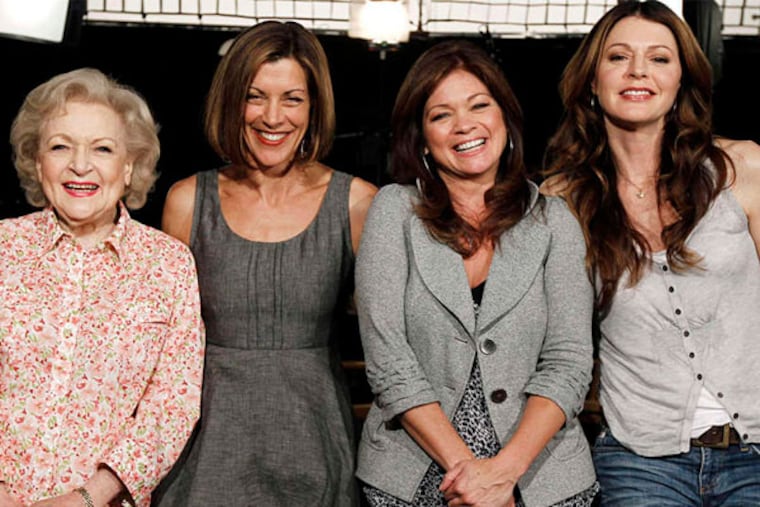
Left to right: Betty White, Wendie Malick,
Valerie Bertinelli and Jane Leeves

June 16, 2010: Hot In Cleveland premieres on the cable network TV Land, which specializes in reruns of classic sitcoms.

Like CBS, TV Land is owned by Paramount Pictures, and so the show was taped at CBS Television City in the Los Angeles suburb of Burbank, California. Betty White knew the complex well, from The Mary Tyler Moore Show and Match Game. Valerie Bertinelli knew it well, from One Day at a Time and the briefly-airing Sydney. Jane Leeves knew it well, from Murphy Brown. Only Wendie Malick, whose previous sitcom work had been on NBC, didn't know the studio like the back of her hand.

In fact, all 4 had been on NBC sitcoms: White had been on The Golden Girls, Bertinelli had been on the short-lived Café Americain, Leeves was best known for her role on Frasier, and Malick was known for her role on Just Shoot Me! Before that, she was on HBO's Dream On.

The 3 younger actresses had each been the subject of many a young man's fantasy, but now, Malick was 59, Bertinelli was 50, and Leeves was 49. (In contrast, Malick was 39 when Dream On premiered, Leeves was 32 at the start of Frasier, and Bertinelli was just 15 at the start of One Day at a Time.) The idea was that, when their plane, heading for Paris, made an emergency landing in Cleveland, they found that men were more attracted to them there than in their hometown of Los Angeles.

So, unlike basketball star LeBron James, who had just "decided to take my talents to South Beach," Melanie Moretti (Bertinelli), Rejoyla "Joy" Scroggs (Leeves) and Victoria Chase (Malick) decide to stay in Cleveland, and lease a house owned by Elka Ostrovsky (White).

Melanie is a recently-divorced writer with a college-age son an daughter. Joy is a beautician from England, never married, but had a son at age 15, and gave him up for adoption. His return becomes part of the storyline. Victoria is the longtime star of a soap opera, for which she's won Emmy Awards, but it's just been canceled. She and Susan Lucci, who occasionally appears as herself, are arch-rivals within the show's world. She's been married and divorced 5 times, making her sound like a soap opera character, with 3 kids: Emmy, Oscar and Tony. (Oscar is a girl.) And Elka, despite being old, has a fresh mouth, a checkered past, and seems to have more boyfriends than Victoria.

Hot In Cleveland lasted 6 seasons, and was favorably compared to The Golden Girls. Michael Musto of The Village Voice wrote: "Wendie Malick is basically the modern-day Bea Arthur. Sweet-faced Valerie Bertinelli is the new Betty White. Been-around Jane Leeves is the nouveau Rue McClanahan. And witheringly sarcastic Golden Girl Betty White has turned into Estelle Getty."

*

June 16, 2010 was a Wednesday. Football was out of season. The Stanley Cup Finals had ended a week earlier, with the Chicago Blackhawks beating the Philadelphia Flyers in 6 games. The NBA Finals were between Games 6 and 7. The next night, the Los Angeles Lakers beat the Boston Celtics for the title.

The World Cup was in progress in South Africa. The host nation lost to Uruguay, 3-0 at Loftus Versfeld Stadium in Pretoria. Chile beat Honduras, 1-0 at Mbombela Stadium in Nelspruit. And Switzerland upset Spain, 1-0 at Moses Mabhida Stadium in Durban. But Spain went on to win the tournament.

And these games were played in Major League Baseball:

* The New York Yankees lost to the Philadelphia Phillies, 6-3 at Yankee Stadium II. Jamie Moyer was 47 years old and the winning pitcher, while AJ Burnett was 33 and didn't get out of the 4th inning. Ryan Howard and Jayson Werth hit home runs for the Phils, while Shane Victorino hit a bases-loaded triple. For the Yanks, Jorge Posada and Robinson Canó homered, Derek Jeter went 0-for-4, and Alex Rodriguez went 1-for-3 with a walk and an RBI.

* The New York Mets beat the Cleveland Indians, 8-4 at Progressive Field in Cleveland. Jon Niese, who was born on the day the Mets won their last World Series in 1986, was the winning pitcher. Ángel Pagán went 3-for-5 with 3 RBIs.

* The Boston Red Sox beat the Arizona Diamondbacks, 6-2 at Fenway Park in Boston. Jon Lester was the winning pitcher. The Sox got home runs from Dustin Pedroia and Kevin Youkilis. David Ortiz went 1-for-2 with 2 walks.

* The Atlanta Braves beat the Tampa Bay Rays, 6-2 at Turner Field (now Center Parc Stadium) in Atlanta.

* The Texas Rangers beat the Florida Marlins, 6-3 at Sun Life Stadium (now Hard Rock Stadium) in Miami Gardens, Florida.

* The Chicago White Sox beat the Pittsburgh Pirates, 7-1 at PNC Park in Pittsburgh.

* The Los Angeles Dodgers beat the Cincinnati Reds, 6-2 at Great American Ball Park in Cincinnati.

* The Detroit Tigers beat the Washington Nationals, 8-3 at Comerica Park in Detroit.

* The Chicago Cubs beat the Oakland Athletics, 6-2 at Wrigley Field in Chicago.

* The Minnesota Twins beat the Colorado Rockies, 2-1 at the new Target Field in Minneapolis.

* The Seattle Mariners beat the St. Louis Cardinals, 2-1 at Busch Stadium in St. Louis. Ichiro Suzuki went 2-for-4 with a stolen base. Albert Pujols went 1-for-4.

* The Houston Astros beat the Kansas City Royals, 4-2 at Kauffman Stadium in Kansas City.

* The Toronto Blue Jays beat the San Diego Padres, 7-1 at Petco Park in San Diego.

* The Los Angeles Angels beat the Milwaukee Brewers, 5-1 at Angel Stadium of Anaheim.

* And the San Francisco Giants beat the Baltimore Orioles, 6-3 at AT&T Park (now Oracle Park) in San Francisco. These teams both wear black and orange, and both had moved from previous cities in the 1950s. Their cities have a lot more in common: They're port cities, with large immigrant and labor union presences, and Nancy Pelosi, at this time Speaker of the U.S. House of Representatives. was the daughter and brother of Mayors of Baltimore, before moving to San Francisco and moving up through their political system.

December 31, 1999 & January 1, 2000: The Millennium

December 31, 1999:  The Millennium arrives. The people of planet Earth survived. At a terrible cost. But we hadn't destroyed ourselves. ...