September 19, 1970: The Mary Tyler Moore Show premieres on CBS. By the standards of the time, it was considered to be a groundbreaking situation comedy.
Mary Tyler Moore had previously played Laura Petrie on The Dick Van Dyke Show. This time, having formed MTM Enterprises with her then-husband, then-CBS executive Grant Tinker, she worked with co-creators James L. Brooks and Allen Burns to create a new show with her name on it. Brooks had written for Marlo Thomas' sitcom That Girl, and he and Burns would later create the sitcom Taxi.
Moore, 33 years old at the time of the premiere, played Mary Richards, 30, never yet married, no children, and recently having broken her engagement to a man she realized didn't really want to get married. So she leaves her (fictional) hometown of Roseburg, Minnesota, and heads for the nearest big city, Minneapolis.
Originally, the idea was that Mary Richards was going to be divorced, not single. But even in 1970, this was a touchy subject. As it turned out, Catholics and evangelical Protestants were shocked to find out that the character, to put it politely, was no innocent young thing. If she'd come into the show divorced, that might have tanked the ratings right there.
CBS executives, who had made a lot of money on the lack of intelligence of many TV viewers, had a 2nd reason to veto the divorce angle: They were worried that, given Moore's claim to fame as Laura Petrie, audiences would think she had divorced Dick Van Dyke. That's how dumb they thought TV viewers were -- and a lot of them were.
(Don't look at me like that: I was a kid in the 1970s, and it always surprised me when someone, be they an actor or a newscaster, switched networks. I didn't realize that was allowed.)
The Season 1 opening montage shows her driving to Minneapolis, interspersed with a scene of a going-away party thrown by her friends. The theme song, "Love Is All Around," was written and sung by Sonny Curtis, formerly of Buddy Holly's Crickets and author of Bobby Fuller's "I Fought the Law." The song asks the question, "How will you make it on your own? This world is awful big. Girl, this time, you're all alone."
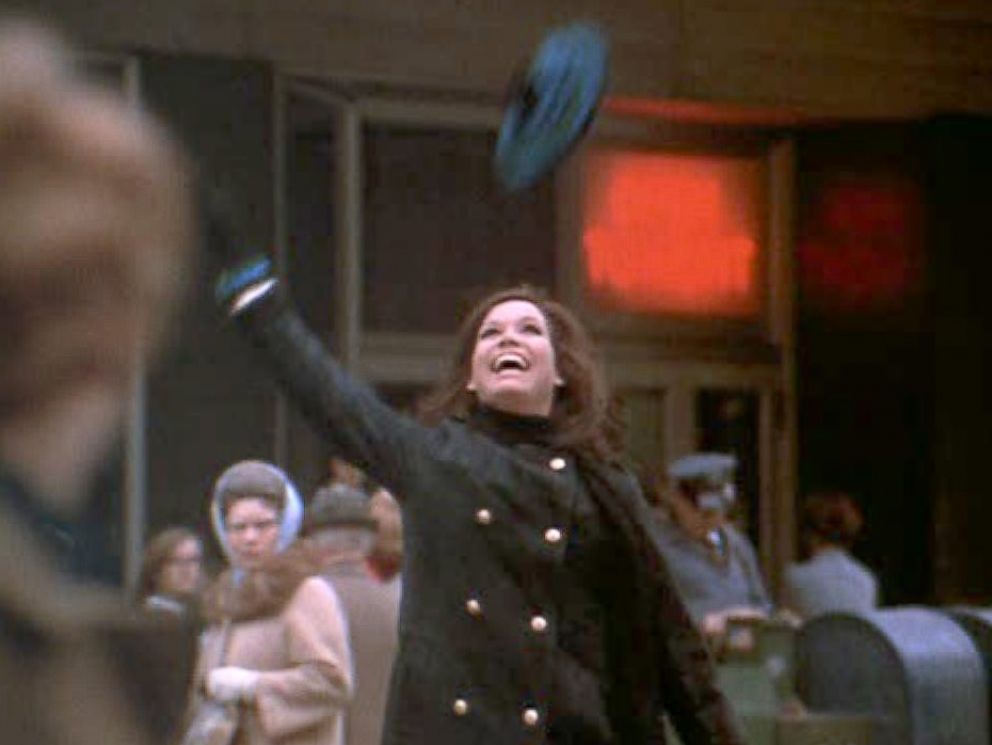
The song rebounds from this gloomy start, picks up, and concludes with the words, "You just might make it after all!" and with Mary tossing her hat in the air, while standing in front of the Donaldson's department store, at South 7th Street and Nicollet Mall in downtown Minneapolis.
Unusual for opening credits, the name of the show is not mentioned, only the lead actor's name: "MARY TYLER MOORE." And none of the other members of the main cast are mentioned, until the closing credits start.
To reflect Moore's initials, the closing shot is of the logo of MTM Enterprises, a parody of Metro-Goldwyn-Mayer, or MGM, and their roaring lion: A mewing kitten named Mimsie. There would be variations over the years, depending on the MTM-produced show: A Christmas episode would have the round frame as a wreath, and the kitten wearing a Santa Claus hat; The White Shadow showed a cat dribbling a cartoon basketball; Hill Street Blues had the kitten wearing a policeman's cap; Remington Steele had the kitten wearing a deerstalker cap like Sherlock Holmes, and dropping a Holmesian pipe out of its mouth as it mewed; and Newhart had Bob Newhart saying a sardonic, deadpan "Meow."
St. Elsewhere had the kitten wearing a surgical gown and cap. In one of the most tasteless moments in TV history, the last episode of St. Elsewhere had the kitten lying down, hooked up to machines, and flatlining, suggesting that the kitten was dead. I can't believe Moore approved that. Certainly, Betty White, "Animal lover that I am," would have objected! (In real life, the original Mimsie had recently died, living to a decent age for a cat.)
In the pilot, Mary gets an apartment in a house owned by Phyllis Lindstrom (Cloris Leachman), a character that beat Beatrice Arthur's Maude Findlay to the title of sitcoms' 1st brassy feminist by 2 years. The house's address was listed as 119 North Weatherly Street, which does not really exist. The exterior shots were of a real house in Minneapolis, at 2104 Kenwood Parkway.
Phyllis often refers to her husband, a dermatologist named Lars, but the character is never seen onscreen. They have a daughter, Bess (Lisa Gerritsen), a teenager who follows her mother's example, perhaps a little too much.
Mary meets her upstairs neighbor, Rhoda Morgenstern (Valerie Harper), a wisecracking window dresser from New York. Also single, her lovelife is more active than Mary's, though without better results. In the pilot, Rhoda doesn't like Mary, but this soon changes, and they become best friends. Bess also gets along well with both Mary and, to Phyllis' dismay, Rhoda, often calling her "Aunt Rhoda," to which Phyllis says, "She's not your aunt!"
Mary applies for a job as an associate producer for the evening news at WJM, Channel 12. The producer, Lou Grant (Edward Asner), is old-school even by the standards of the time. Asner was 40 when the show began, but the later Lou Grant series established that Grant was actually 44, and with his bald head and paunch, he could have passed for being in his 50s.
Lou doesn't like women holding what traditionally were men's jobs, especially since they could get married and quit, or could already be married and get pregnant and quit, leaving him in the lurch. But he hires her anyway, reluctantly, saying, "You know what? You've got spunk. I hate spunk!" (At the time, "spunk" meant "nerve" or "gumption," and was not widely known to refer to anything sexual.)
Mary soon sees that everybody who works for Lou calls him, "Lou," even though she can never bring herself to call him anything but "Mr. Grant." Often, a tearful, "Ohhhh, Mr. Gra-a-ant!" Lou starts the show married to Edie (Priscilla Morrill), but the marriage falls apart, and they divorce. They had 3 daughters and 4 grandchildren.
Murray Slaughter (Gavin MacLeod) is the news department's head writer, and quickly becomes friends with Mary. He is an expert verbal jouster, but also perceptive enough to know how far he can go with it from one person to another. He is married to Marie (Joyce Bulifant), and they have children, but how many was never specified.
Ted Baxter (Ted Knight) is the anchorman. He is dumb. And cheap. How dumb, and how cheap, is he? Ask Lou: "Ordinarily, Ted can't add 6 and 4. But, put a dollar sign in front of it, and he becomes Einstein." Shortly after Lou says this, knowing that his 6:00 broadcast lasts half an hour, he offers to take Mary out to dinner, and says, "Meet me at, um... " and tries to do the math in his head. He can't, until Lou says, "Put a dollar sign in front of it, Ted!" And Ted immediately says, "6:45."
But in spite of being dumb, and cheap, and vain, he has the look of an anchorman (Knight was only 46 when the show debuted, but his hair was already white, though he still had a full head of it for the rest of his life), and he had the deep, sonorous voice of an anchorman. And so, he was popular with the Twin Cities public. And, for the most part, he was a nice guy.
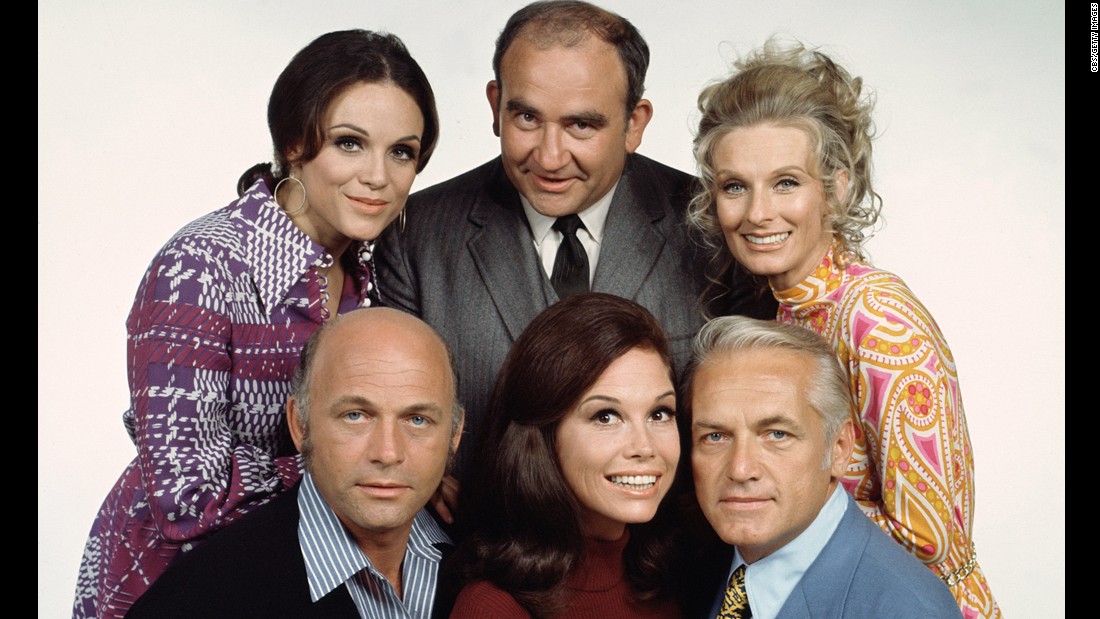
The original cast. Top, left to right:
Valerie Harper, Ed Asner, Cloris Leachman. Bottom, left to right:
Gavin MacLeod, Mary Tyler Moore, Ted Knight.
In Season 2, Ted met Georgette Franklin (Georgia Engel), a co-worker of Rhoda's. They eventually got married, in a ceremony held in Mary's apartment, by a minister played by John Ritter, who had just come from a tennis match and was still dressed for that. Ted and Georgette went on to have a son and a daughter.
In Season 4, a new character was introduced: Sue Ann Nivens (Betty White), who hosted The Happy Homemaker on WJM. More like a happy homewrecker: She slept around, including a disastrous one-night stand with Lou after his divorce. The character was supposed to be a one-time-only, but was such a hit, White became a regular. Sue Ann softened up a bit as the show went along.
For Season 2, to reflect the fact that Mary was beginning to make it -- in spite of the craziness at the office, and her penchant for hosting parties that went wrong -- a new version of the theme song was recorded, with Curtis re-writing the lyrics, including the immortal opening line, "Who can turn the world on with her smile?" And the song closes with a more definitive, "You're gonna make it after all!"
Mary and Rhoda both dated, but love proved fleeting for both. And they didn't just date. One time, when Mary's parents visited, Mary's mother reminded her husband, "Take your pill!" And both father and daughter said, "I will!" The implication was that Mary was taking birth control pills, and thus that Mary was having sex -- or, at least, was looking to do so. For the Nixon years, this was a big step for a single female sitcom character. It's generally accepted that MTM was the 1st U.S. sitcom to mention "The Pill."
Before starring on Good Times, John Amos made 13 appearances as Gordy Howard, WJM's weatherman. His race was never mentioned. This was also revolutionary: He wasn't "the black weatherman," he was "the weatherman." "I thought that was a very healthy attitude for the writers and the producers to take," Amos said.
Sports wasn't mentioned often on the show, but in later opening sequences, Mary is shown washing her Ford Mustang while wearing a Minnesota Vikings jersey, with the Number 10 of Hall of Fame quarterback Fran Tarkenton, then still active. During the course of the show, the Vikings went to 3 Super Bowls, but lost them all.
In the last episode, airing on March 19, 1977, the station was bought, and everybody was fired except Ted, the dummy. The last scene, of the remaining characters walking out the door while hugging, is one of the most fondly remembered in TV history. In the last shot for the last episode, instead of mewing, the MTM kitten is Moore's voice saying, "Bye!"

The closing cast. Top, left to right:
Gavin MacLeod, Ed Asner, Ted Knight. Bottom, left to right:
Betty White, Mary Tyler Moore, Georgia Engel.
The MTM Show won 29 Primetime Emmy Awards, a record that stood until Frasier won its 30th in 2002 -- and, let's face it, considering Frasier a better show than MTM is a joke. These Emmys included 3 as Outstanding Comedy Series; 3 for Moore as Outstanding Lead Actress in a Comedy Series; 3 for Asner and 2 for Knight as Outstanding Performance by an Actor in a Supporting Role in Comedy; and 3 for Harper, 2 for Leachman and 2 for White as Outstanding Performance by an Actress in a Supporting Role in Comedy. In other words: In all 7 seasons, someone on the show won Best Supporting Actress, while someone won Best Supporting Actor in 5 of the 7.
The show inspired 3 spinoffs. Harper left after 4 seasons when Rhoda got married, and starred for 4 seasons on Rhoda, with the character and her husband moving to her hometown of New York. Leachman and Gerritsen left after 1 more season, and starred on Phyllis, with the premise that Lars had died, and Phyllis and Bess moved back to Phyllis' hometown of San Francisco. And when The MTM Show came to an end, Asner starred on Lou Grant -- not a half-hour sitcom, but an hourlong drama, in which he moved to Los Angeles and ran a newspaper. It was another innovation: A spinoff of a sitcom being a drama had never been done before, nor has since. All of these shows were, like The MTM Show, on CBS, and produced by MTM Productions.
Pretty much everybody on the show went on to star on other shows. In addition to the preceding, White starred as dim but lovable Rose Nylund on The Golden Girls, MacLeod as Captain Merrill Stubing on The Love Boat, and Knight as cartoonist and family man Henry Rush on Too Close for Comfort. Knight was also the narrator of the Super Friends cartoon: "Later, at the Hall of Justice... "
White was joined on The Golden Girls by Beatrice Arthur as Dorothy Zbornack, and Rue McClanahan as Blanche Devereaux. Bea and Rue had been together on Maude, as Maude Findlay and Vivian Harmon. Rue was cast first, and knew that Bea was the only woman who could play Dorothy. Knowing that most sitcoms had a "dummy," Bea told Rue that she didn't want to be on the show if Rue was going to play it again. Rue said, "No, this time, Betty is playing Vivian, and I'm playing Sue Ann!" Getting the reference, Bea said, "Interesting!" and took the role.
Bulifant became part of the cast of the Alice spinoff Flo, and Engel later became a recurring character on another Minnesota-based show, ABC's football-themed sitcom Coach, set at Minnesota State University -- then a fictional school, but a real school has since adopted the name. Despite that show's success, The Mary Tyler Moore Show remains the most popular show ever set in Minnesota, and one of the most popular sitcoms of all time.
In addition to all that, White and Bulifant became semi-regular panelists on the CBS game show Match Game. White had plenty of game-show experience, often appearing as a panelist on Password, hosted by her husband, Allen Ludden. White's activism for animals was already well-known, and any time there was a possibility of an answer of an animal getting hurt or killed on Match Game, if Betty was there, a panelist might mention avoiding the possibility because of it. If she wasn't there, such an answer might be given, and host Gene Rayburn would say, "It's a good thing Betty White isn't here!"
When Bulifant was on Match Game, she became the queen of what Rayburn called "rotten answers," and was often called a weirdo by him. Asner also made occasional appearances. Later on, White, who had taken George Burns' former place as America's favorite old person, starred on the sitcom Hot In Cleveland, and Moore, Harper, Leachman and Engel all guest-starred on a 2013 episode of that show.
In 2000, ABC aired the 2-hour TV movie Mary and Rhoda, a sequel to the original series. It revealed that Mary had eventually gotten married, to Steve Cronin, a Congressman, but that he had recently been killed in a rock-climbing accident. Rhoda had gotten divorced from her 1st husband, gotten married again, and gotten divorced again.
After not seeing each other for several years -- Mary had continued in TV news production in New York, and Rhoda had lived as a photographer in Paris with her French 2nd husband -- they were basically starting over again at ages 60 and 58, respectively.
They each had a daughter attending college in New York: Rose Cronin (played by Bethany Joy-Lenz) was an English major at New York University (NYU), and Meredith Gerard (Marisa Ryan) was a pre-med student at Barnard College. (If you're an original fan of the original show, and you don't already feel old, this means that both Mary's daughter and Rhoda's daughter are now in their early 40s, and could legitimately be grandmothers.) Joan Jett sang a punked-up version of the old theme song.
Donaldson's went out of business in 1988. But, even before that, the store behind Mary's hat-toss burned as part of a fire on Thanksgiving Day, November 25, 1982. Gaviidae Common, a shopping mall, was built on the site of the former Donaldson's flagship store in 1989.
On May 8, 2002, a statue of Mary tossing her hat, sponsored by the nostalgia TV network TV Land, was unveiled, roughly on the same spot, by Moore herself. It was the 1st in a series of TV Land statues of famous TV characters that also includes Jackie Gleason as Ralph Kramden on The Honeymooners in New York; Henry Winkler, a.k.a. "The Bronze Fonz," in Happy Days' site of Milwaukee; and Andy Griffith and Ron Howard as Andy and Opie Taylor on The Andy Griffith Show in Griffith's hometown of Mount Airy, North Carolina.

Ted Knight died of cancer in 1986, while still starring on Too Close for Comfort. And Priscilla Morrill, not a major star of the show, died in 1994. Other than that, the cast proved to be surprisingly long-lived: Mary Tyler Moore died in 2017, after years of battling diabetes and its effects; Valerie Harper in 2019, after years of battling cancer; Georgia Engel also in 2019; and Allan Burns, Cloris Leachman, Gavin MacLeod and Betty White, all in 2021. Betty died on New Year's Eve, just 17 days short of what would have been her 100th birthday.
As of September 19, 2022, James L. Brooks, Sonny Curtis, Joyce Bulifant, Lisa Gerritsen and John Amos are still alive.
UPDATE: John Amos died in 2024.
*
September 19, 1970 was a Saturday. This was also the day the 1st Glastonbury Festival began. I have a separate entry for that event.
These games were played in Major League Baseball:
* The New York Yankees beat the Detroit Tigers, 7-6 at Tiger Stadium in Detroit. The Yankees scored 5 runs in the top of the 9th to win it, although they didn't hit a home run. Horace Clark and John Ellis each had 2 hits and 2 RBIs. Al Kaline went 0-for-4.
* The New York Mets lost to the Pittsburgh Pirates, 2-1 at Shea Stadium. Luke Walker (not Luke Skywalker) outpitched Gary Gentry. Roberto Clemente and Willie Stargell each went 1-for-4 with an RBI.
* The Chicago Cubs beat the Montreal Expos, 8-4 at Jarry Park in Montreal. Ernie Banks did not play.
* The Boston Red Sox swept a doubleheader with the Washington Senators at Fenway Park in Boston, 7-3 and 11-3. Carl Yastrzemski only got 1 hit over the 2 games, but he got an RBI from it.
* The Cleveland Indians beat the Baltimore Orioles, 4-2 at Memorial Stadium in Baltimore. Brooks Robinson only appeared as a pinch-hitter, and did not reach base. Frank Robinson also appeared only as a pinch-hitter, and drew a walk.
* The Cincinnati Reds beat the Atlanta Braves, 7-4 at Atlanta Stadium (later Atlanta-Fulton County Stadium). Pete Rose went 0-for-2 with 3 walks. Johnny Bench went 3-for-4 with an RBI. Jim McGlothlin was the winning pitcher, and helped his own cause with a home run. Hank Aaron did not play.
* The Minnesota Twins, which would have been Mary's team, were on the road, and beat the Chicago White Sox, 5-3 at Comiskey Park in Chicago. Would you believe me if I said that Luis Aparicio hit a home run and Harmon Killebrew didn't? That's what happened in this game, although Killebrew did have an RBI on a sacrifice fly. Rod Carew did not play.
* The Kansas City Royals beat the Milwaukee Brewers, 4-1 at Milwaukee County Stadium.
* The Philadelphia Phillies beat the St. Louis Cardinals, 10-6 at Busch Memorial Stadium. Lou Brock went 0-for-3, but had an RBI on a sacrifice fly.
* The San Francisco Giants beat the San Diego Padres, 3-0 at San Diego Stadium (later Jack Murphy Stadium and Qualcomm Stadium). Willie Mays went 0-for-3 with a walk. Gaylord Perry pitched a 3-hit shutout.
* The Los Angeles Dodgers beat the Houston Astros, 6-5 at Dodger Stadium in Los Angeles.
* And the Oakland Athletics beat the California Angels, 2-1 at the Oakland Coliseum. Reggie Jackson went 0-for-2, but drew 2 walks.
There was also college football that day. Not for preseason Number 1 Ohio State, who didn't open their season until the following week. But these games were among those played:
* Number 2 Texas beat the University of California (a.k.a. Cal), 56-15 at Memorial Stadium in Austin, Texas.
* Number 3 Southern California (a.k.a. USC), fresh off beating then-Number 3 Alabama in what became known as "The Sam Cunningham Game," were themselves sort-of upset, held to a 21-21 tie by Number 9 Nebraska at the Los Angeles Memorial Coliseum.
* Number 4 Stanford beat San Jose State, 34-3 at the old Stanford Stadium in the San Francisco suburb of Palo Alto, California. Even though these schools' respective stadiums are just 15 miles apart, this is not a rivalry. Certainly not like Stanford vs. Cal, 40 miles apart, the regular-season finale known as "The Big Game."
* Number 5 Mississippi (a.k.a. Ole Miss) beat Memphis State (now the University of Memphis), 47-13 at the Liberty Bowl (now Simmons Bank Liberty Stadium) in Memphis.
* Number 6 Notre Dame beat Northwestern, 35-14 at Dyche Stadium (now Ryan Field) in the Chicago suburb of Evanston, Illinois.
* Number 7 Penn State beat Navy, 55-7 at Beaver Stadium in State College, Pennsylvania.
* Number 8 Michigan beat Arizona, 20-9 at Michigan Stadium in Ann Arbor, Michigan.
* Number 10 Missouri beat Minnesota, 34-12 at Faurot Field in Columbia, Missouri. It was never mentioned if Mary Richards went to college, although the University of Minnesota is a strong possibility.
* Number 12 Louisiana State (a.k.a. LSU) were upset by Texas A&M, 20-18 at Tiger Stadium in Baton Rouge, Louisiana.
* Number 13 Kansas State were upset by Kentucky, 16-3 at McLean Stadium in Lexington, Kentucky.
* Number 19 Georgia were upset by Tulane, 17-14 at Tulane Stadium in New Orleans.
* Alabama were now unranked, and took their frustrations out on Virginia Tech, 51-18 at Legion Field in Birmingham.
* North Carolina beat North Carolina State, 19-0 at Kenan Memorial Stadium in Chapel Hill, North Carolina.
* Baylor beat Army, 10-7 at Michie Stadium in West Point, New York.
* And Rutgers beat Lafayette, 41-16 at Rutgers Stadium in Piscataway, New Jersey. Princeton did not start their season until the following week, and beat arch-rival Rutgers, 41-14 at Palmer Stadium in Princeton, New Jersey.
Also, in English soccer, Arsenal beat Birmingham-area team West Bromwich Albion, 6-2 at the Arsenal Stadium, a.k.a. Highbury, in North London.


No comments:
Post a Comment